I had only just eased the Bentley back onto the Long Island Expressway after leaving Bradley and Monica at JFK when Rosa sent the message that turned my hands to ice. The sky over Queens was the color of old dishwater, low and mean and heavy enough to make the city look as if it were crouching under something. Traffic moved in bursts and snarls, that familiar New York rhythm of impatience pretending to be order. I had the heater on low because the damp had settled into my bones again, and I was still carrying the aftertaste of the airport goodbye: my son’s distracted hug, Monica’s glossy smile, the way both of them had accepted the envelope of cash I slipped Bradley as if generosity were my natural state and gratitude optional. Then my phone lit, and there was Rosa’s name. She almost never texted me. In ten years of working in my house she had called only when the pipes burst, the alarm tripped by accident, or something needed my decision and could not wait. Her first message contained only four words: Don’t go home. Before I could decide whether that was a joke, a mistake, or the beginning of a heart attack, the second message appeared. Check the cameras.
I pulled onto the shoulder so hard the tires spat gravel. A truck screamed past and rocked the car. I flicked on the hazards and sat there in the shuddering yellow light, staring at my phone with the unwillingness of a man who knows that whatever waits on the other side of a screen is going to divide his life into before and after. My fingers were shaking. That, more than Rosa’s message, told me something fundamental had already shifted. I had spent four decades in rooms full of very expensive men who would smile, compliment your tie, and then spend the next hour trying to remove your liver through a merger agreement. I had lived through market collapses, raids, litigations, betrayals of every corporate species. I did not shake. I hadn’t shaken when Elizabeth was diagnosed. I hadn’t shaken at her funeral when everyone in black talked too softly and touched my elbow as though grief were contagious. Yet there I was on the shoulder of the LIE with my hands trembling so badly I nearly dropped the phone twice before I managed to open the private security feed.
The camera in my study had been my own indulgence in old paranoia, installed years ago after a kidnapping threat during a particularly ugly takeover fight. I had never mentioned it to anyone. Not to staff, not to Bradley, not even to Elizabeth when she was alive. It looked into the room from behind a vent grate above the bookcase, and because the angle was imperfect I had always thought of it less as a security measure than as a relic of the man I used to be. Now the feed resolved itself in a wash of cold digital light, and in an instant every remaining soft thought I had about my family was stripped away.
Bradley and Monica were standing in my study.
They were supposed to be somewhere between security and an overnight flight to the Maldives, on the honeymoon they had postponed twice and then turned into a carefully staged display of marital inconvenience until I finally paid for the whole thing. Less than an hour earlier I had watched them wave at me beyond the rope line at Terminal 4. Monica had blown a kiss. Bradley had lifted two fingers in that lazy salute he used when he wanted to seem affectionate without appearing childish. I had stood there like an old fool feeling some small hopeful thing in my chest, imagining that maybe distance and sun and my money might soften whatever permanent dissatisfaction had settled over my son in recent years. Yet there they were, as real and casual as furniture, in the room I kept for work and private grief, behaving with the relaxed cruelty of people who had never considered the possibility of being seen.
Monica had taken down the 1982 Pétrus I had been saving for my seventieth birthday. Elizabeth had bought it with me in Bordeaux on our twenty-fifth anniversary, and the plan had been absurdly sentimental from the beginning: we would open it when I turned seventy, sit on the terrace in the Hamptons, and pretend time had done us a kindness. Elizabeth died six years before I reached the age the wine was meant to honor. I had never found another reason to open it. Monica uncorked it with the impatience of someone taking apart a toy she did not value. She wasn’t drinking it in any meaningful sense. She was spilling it over the rim of her glass, laughing, and then tipping the rest directly onto the Persian rug beneath my desk. The stain spread through the pale pattern like blood through snow. Bradley was in my chair, my father’s old leather wingback, feet on the desk, tapping the brass stand of the antique globe with the tip of his shoe as if he were keeping time to music only he could hear.
I turned up the sound.
“Are you sure he’s gone?” Bradley asked.
Monica gave the kind of shrug women give when they are being admired for competence. “He dropped us off himself,” she said. “He thinks we’re in the air.”
Bradley laughed. “He loves the performance.”
“He loves being needed,” Monica corrected. Then she lifted her glass toward the room itself. “To tea.”
I did not understand immediately. I wish I could say some protective stupidity saved me for a few seconds longer, but the truth is far uglier: I understood at once, and my mind still tried to find another meaning because the obvious one was too obscene. Monica walked over to the desk, leaned down, and kissed my son full on the mouth in the room where I kept my late wife’s photograph. “I doubled it this morning,” she said. “With his heart? Three more nights at most. It’ll look natural.”
Bradley tipped his head back and laughed as if she had made some small, tasteful joke at a dinner party. “Then I want the Ferrari before the funeral,” he said.
I remember every detail of the next minute with the sharpness of trauma: the hiss of tires on wet pavement beyond my windshield, the tiny clicking sound the phone case made under my tightening grip, the pulse in my neck, the strange calm in Monica’s face. There was no frenzy in either of them, no visible malice in the theatrical sense. That was what made it horrifying. Hatred, I might have understood. Passion, rage, some wild inheritance of my own flaws turned back on me—I might have understood that too. But what I saw was administration. They were planning my death the way one plans renovations or a move or a destination wedding. They were discussing dosage and timing and paperwork. Murder as project management. And Bradley, my son, the boy whose hair I had once washed in a sink because he was too small to like the shower, the teenager I had sat with after Elizabeth died when he screamed himself hoarse into a pillow because he did not know how to live in a house without her—Bradley looked pleased.
There are moments when fury arrives so fast it almost feels like silence. The world thins. Sound goes underwater. I sat there on the shoulder with traffic whipping past and felt grief and rage strike at once, not as separate emotions but as two blades crossing in the same wound. It would be convenient to say I cried. I didn’t. Tears belong to helplessness, and though I was sick and betrayed and suddenly old in a way I had never allowed myself to be, something else had already awakened beneath the shock. I had raised Bradley alone after Elizabeth died. I had paid his debts when he turned every college semester into a scandal. I had cleaned up after cocaine, gambling, bad investments, worse women, and every performative apology in between. I had called it support because it was easier to think of myself as a loving father than to admit I was financing the development of a man who had learned the world would hand him softness after every offense. On that roadside, watching him laugh about selling my house over my not-yet-buried body, I understood that what I had spent years excusing as weakness was not weakness at all. It was decay.
I did not call him. I did not turn the car around and speed home like some injured patriarch demanding to be reassured by liars. I took the SIM card out of my phone with a thumbnail that tore in the process, snapped it in half, lowered the window, and dropped the pieces into the slick gravel of the shoulder. It was a small action, almost childish, but I felt something exact and irreversible in it. The man who had driven to JFK hoping for better family photographs at Christmas died there beside the expressway. The man who merged back into traffic afterward had once been known on Wall Street for turning other people’s certainty into leverage. He was older now. Sicker. He carried scar tissue in the places that no imaging machine can light. But he still knew one thing perfectly well: when people mistake mercy for helplessness, their confidence is the weapon you use against them.
As I drove, the last six months reorganized themselves inside my mind with horrible clarity. The dizziness that came and went without pattern. The sour metallic taste I woke with some mornings. The nausea that Monica had dismissed as old-man digestion while insisting I cut back on salt and red meat and let her prepare my evening tea because she had “read something wonderful” about herbs. The tremor in my hand that began so gradually I almost believed Dr. Thorne when he called it stress. The episodes of heart fluttering, the headaches, the fog that seemed to settle over simple words. I had taken it as humiliating evidence of age. Thorne, who had been my physician for nearly twenty years and Bradley’s golf companion for at least ten, had waved away every complaint with a tone of warm professional patience that I now recognized as part of the machinery. He said men my age became fixated on decline. He prescribed a sedative. He suggested Bradley start “helping” with some of the financial oversight in case I became overwhelmed. At the time I heard practicality. Now I heard choreography.
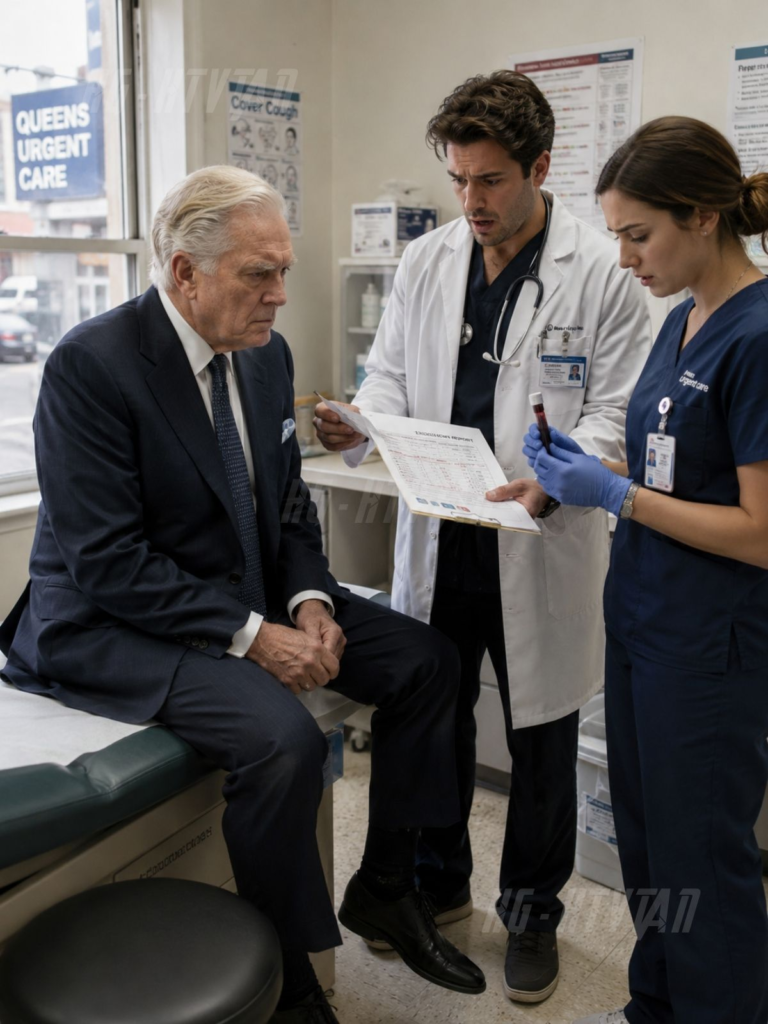
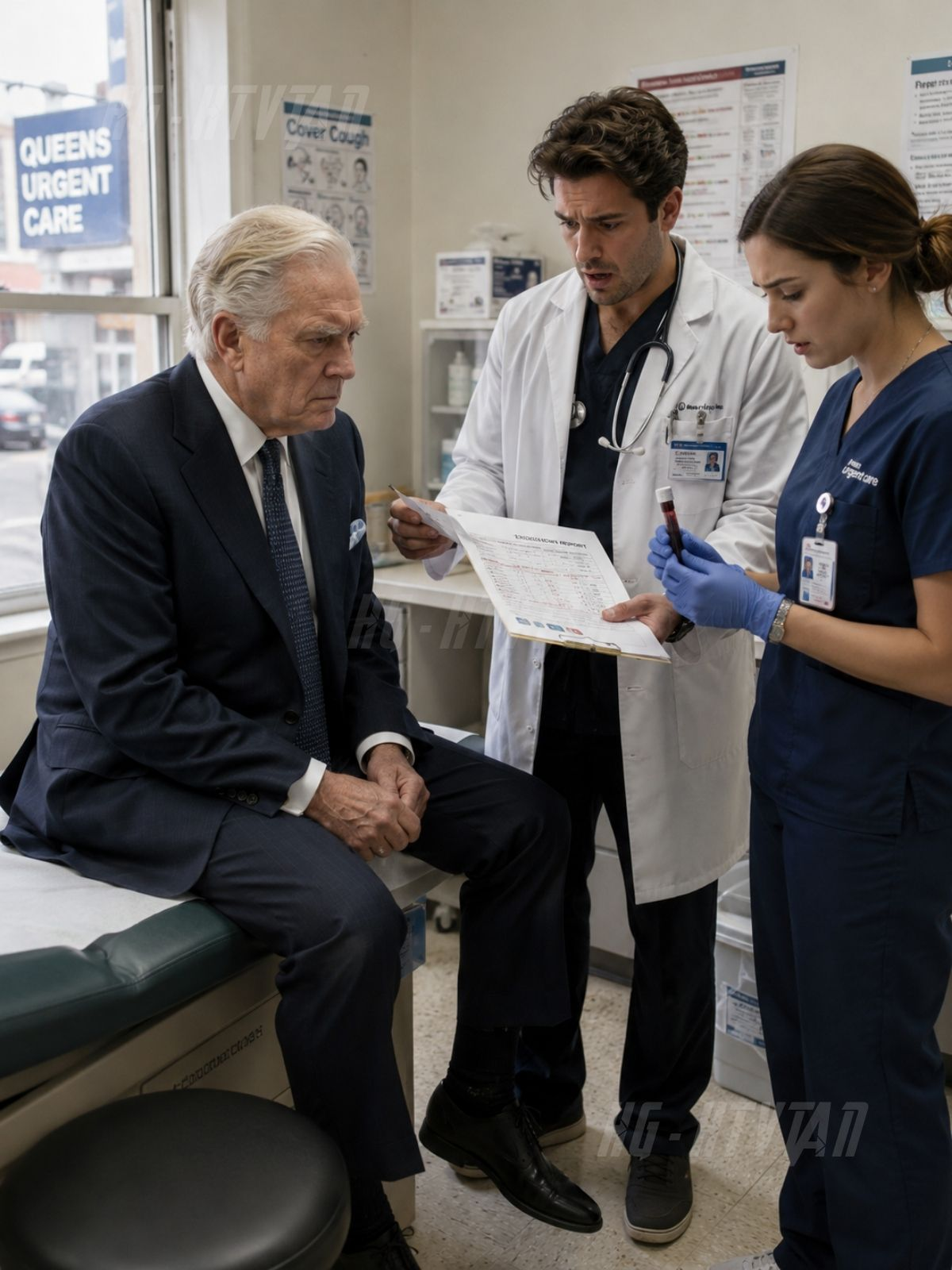
I was not foolish enough to go to any hospital whose gala I had funded or whose director might call my son out of social reflex. By the time I reached Queens, I had settled on a shabby urgent care clinic wedged between a nail salon and a discount pharmacy, the kind of place no one with my last name would normally enter. I parked in a lot full of dented sedans and delivery scooters, went inside, paid cash, and gave the receptionist a false name so quickly it felt like muscle memory from another century. The waiting room smelled of disinfectant and exhausted people. The television in the corner was tuned to a cooking show nobody watched. I was wearing a suit that cost more than the clinic’s chairs, and the absurdity of the contrast might have amused me in another life. Now I sat under buzzing fluorescent lights and demanded a full toxicology panel from a physician’s assistant who blinked twice at my tone and then stopped asking questions when she saw my face.
While they drew blood, I stepped outside, crossed to a convenience store, bought a burner phone, a charger, a spiral notebook, and two cheap pens. The man behind the counter offered me a lottery ticket with my change. I almost laughed. Back in the exam room I turned on the new phone and sent one message to Rosa. I’m safe. Do not let them know you warned me. Act normal. She answered a minute later with a single thumbs-up, which was precisely the sort of response that explained why I trusted her. Rosa was not theatrical. She was not sentimental. She did not confuse care with chatter. In ten years she had built herself into the hidden spine of my household: meals arriving when I had forgotten to eat, bills placed where they needed to be signed, flowers changed before they wilted, staff rotated, nonsense removed. Bradley had always treated her as part of the scenery, the way certain kinds of wealthy people treat anyone whose loyalty is purchased by wages rather than blood. That blindness had probably saved me.
The clinic doctor came back fifteen minutes later looking younger than his white coat and suddenly much less bored. He shut the door before speaking. “Mr.—” he began, then stopped, glancing at the false name on the chart. “You have elevated arsenic levels,” he said. “And there’s something else in your blood that shouldn’t be there. A cardiac glycoside. Are you taking heart medication?”
“No.”
His expression tightened. “Then you need a hospital. Immediately. These levels aren’t something you monitor from home.”
“Could it kill me?” I asked.
He hesitated in the way doctors do when they want not to answer and know they must. “It could.”
There are moments when certainty is almost a relief, even when it comes wrapped around your own possible death. The dizziness, the nausea, the fog, the weak spells after tea—none of it was random. None of it was age. I was being poisoned in my own home by the woman sleeping with my son while planning my obituary. “Start whatever you can start here,” I told him. “Hydration. Anything that helps until I get where I’m going.”
He stared at me, suspicious now in a way that made him suddenly useful. “If someone is doing this to you, I’m required—”
He looked at the money, then at me, and whatever moral argument had begun in him collided with the city’s older religion. When he spoke again, it was with the clipped tone of a man deciding to narrow his involvement for self-protection. He started fluids, gave me something to settle the nausea, and printed the results without further lecture. By the time I walked back to the Bentley, the rain had begun in a thin, needling mist. I sat with the engine idling and the papers in my hand, and for the first time in six years I thought not of Elizabeth’s death but of her judgment. She had always seen Bradley more clearly than I did. “He has your stubbornness without your fear,” she told me once when he was sixteen and had totaled a borrowed car. “That’s a dangerous inheritance.” I had laughed then and called him young. I did not laugh now.
There was one man I trusted to tell me the truth without social contamination. Elias Aris had once been one of the best trauma surgeons in Manhattan, a savage talent with a scalpel and no patience for committees. We met in the eighties after a car accident involving a senator, a snowstorm, and an evening I still cannot describe without implicating men whose names remained useful long after their consciences had gone stale. Elias saved someone important, refused the gratitude ceremony, and later stitched a deep cut on my arm himself when I arrived at his office because the hospital’s politics annoyed him more than my blood. Over the years we became, if not friends in the sentimental sense, then men who respected the same qualities in one another: discretion, competence, and a deep allergy to fools. A decade ago he walked away from hospitals altogether, bought a farmhouse in Connecticut, and turned an outbuilding into a private practice for people who valued absence as much as treatment. He was exactly the sort of physician you could trust when every famous one was compromised by visibility.
By the time I reached his gravel drive the rain had strengthened into a steady cold percussion on the roof of the car. The farmhouse windows glowed amber through the trees. Elias opened the clinic door before I knocked, took one look at me, and skipped every pleasantry ever invented. “Inside,” he said.
His examining room smelled faintly of cedar and alcohol. He set down a lamp, looked at my face, my hands, the way I moved, then asked only one question: “How long?”
“Months,” I said.
He did not curse, but the silence that followed contained one. He took blood, clipped a lock of hair, examined the pale bands across my nails, listened to my heart, pressed his fingers against the side of my neck, and frowned in concentration so complete it was almost a form of respect. “What have you been eating? Drinking?”
“Tea,” I said. “Every night. My daughter-in-law insists on making it.”
He gave me a look that, in another room, would have been accusation. Here it was merely data sorting itself. “Sit.”
While he ran tests I sat alone on a narrow cot and listened to rain strike the tin roof above the old barn with a rhythm that reminded me of financial tickers, that ceaseless measurable rattle of movement translating into consequence. I told myself there was still room for error, contamination, some impossible medical coincidence. I told myself many stupid things men tell themselves when the alternative requires them to admit that blood has become a threat. After nearly an hour Elias came back carrying printouts, removed his glasses, and looked older than he had when he left.
“Your arsenic levels are extremely high,” he said. “Not incidental. Not environmental. This is repeated exposure over time. And the glycoside—digitalis, or something close to it—is enough to finish what the arsenic starts. Another dose or two at the level you’re carrying, especially with your heart under strain…” He stopped.
“Would I have died quietly?” I asked.
“Yes.”
He reached for the phone on the desk. I put my hand over it.
“Don’t.”
His eyes sharpened. “This isn’t a negotiation.”
“No,” I said. “It’s a strategy.”
He sat back slowly, the phone still in his reach. I told him about the cameras, the wine on the rug, Monica’s toast, Bradley’s laughter, the fake honeymoon, Dr. Thorne’s diagnoses, the voicemail from my own body that had been building for months without my understanding its grammar. Elias listened with the stillness of a man trained to absorb horror without theatrics. When I finished he said, “If we call the police now, they may arrest someone.”
“Maybe,” I said. “Or maybe they collect statements, Bradley hires the best counsel his allowance can buy, Thorne produces medical notes about age-related confusion and early decline, Monica cries on television about caring for a paranoid old man, and everybody finds a way to be patient until the mess becomes expensive enough to fade. I don’t want maybe. I want certainty.”
“You are talking like a litigator.”
“I’m talking like prey that still has teeth.”
He looked at me for a long time, then exhaled through his nose and turned from the phone. “Fine. Then we keep you alive long enough to become a problem.” He started me on chelation treatment that left a bitter chemical taste in my mouth and warned me it would feel like illness stacked on illness. He prepared sealed copies of every result. Before I left, I made him one promise and one request. The promise was that if my condition deteriorated suddenly I would come back at once. The request was that if I turned up dead before speaking to him again, he was to take every page he had straight to federal authorities and not wait for any local explanation. He nodded once. “Try not to die in the middle of a clever plan,” he said. “It creates paperwork.”
The drive back felt longer because my body had begun to understand what my mind had only recently learned: it was under attack. My joints ached. My stomach clenched in waves. Sometimes the headlights of oncoming cars seemed too bright, as if every beam were trying to open my skull from the outside. But the fog—the worst part, the humiliation of not trusting my own thoughts—had already begun to thin at the edges. I could feel clarity returning in hard, bright threads. I was not disintegrating from age. I had been made to appear as though I were. There is a savage relief in recognizing the difference. Frailty asks for pity. Sabotage demands response.
Most men in my position would have vanished into a secure hotel and operated from a distance. That would have been prudent. I have never been purely prudent. I drove toward the Hamptons because there was one more asset on that property no one but I remembered clearly enough to use. In the early nineties, during the ugliest years of my career, after a kidnapping threat tied to a hostile acquisition, I had installed a concealed corridor running from a decorative stone folly near the far edge of the estate to a reinforced panic room hidden behind the library wall. Elizabeth called it my “Cold War vanity project.” After the danger passed she wanted it sealed. I kept it, partly out of pride and partly because men who survive certain kinds of success never entirely stop preparing for collapse. The property was dark when I arrived. I parked beyond the line of security cameras near the hedges, crossed the wet grass in Italian shoes that were not built for mud, and found the iron latch beneath the stone bench inside the folly. The door opened with a reluctant mechanical sigh, breathing out stale earth and old metal.
I moved through the tunnel with a penlight and one hand against the wall, feeling suddenly every year of my age in my knees and lower back. At the inner end I entered the panic room by pressing Elizabeth’s birthday into the keypad. The air inside was cool and dry and faintly dusty, like a sealed memory. I turned on the bank of monitors, and my house came to life in blue-lit fragments around me: the front hall, the kitchen, the terrace, the driveway, and, most importantly, the library and study just beyond the false wall. Bradley was at my desk again. Monica stood by the fireplace with a folder in her hand. I zoomed the image until the edges blurred.
Bradley had a legal pad in front of him. On it, written over and over like a schoolboy’s punishment lines, was my signature. He had pages of it. Some attempts were too bold, some too cramped, some too steady. He compared them to a letter I recognized immediately as the note I had sent the conservation board two months earlier about a grant. Each time he failed, he swore softly and tried again. Monica, meanwhile, opened a binder I knew contained the original life-insurance documentation from decades earlier, back when I still believed in clean systems. She tore out the beneficiary pages naming a children’s hospital and fed them one by one to the fire.
“Burn the medical notes too,” Bradley said without looking up.
“I did,” Monica answered. “Anything old enough to show he wasn’t declining is gone.”
He glanced up at that. “Thorne’s covered?”
She smiled. “Thorne documented tremors, confusion, anxiety, memory lapses, possible early cognitive impairment. He even wrote that you’d been expressing concern about Dad forgetting passwords and misplacing financial records. It’s perfect. Old man gets confused, fiddles with medication, heart gives out. We grieve. You step in.”
My stomach turned so violently I had to brace a hand against the concrete wall. They had not only been poisoning me. They had been building a narrative around the symptoms, curating my decay so that by the time my body failed there would already be a file explaining why. Every complaint I had voiced in confusion had become material. Every false reassurance from Dr. Thorne had been a brick in the structure they meant to stand behind once I was dead. Monica checked the clock on the mantel and said, “Maybe tonight. Maybe tomorrow. But definitely before the weekend. Have the transfer forms ready.”
I took out the cheap spiral notebook from Queens and began recording everything with the precision of a man once famous for annotating disaster. Time, date, room, objects destroyed, exact words. It was not enough to know what I had seen. Knowledge becomes evidence only when it survives later attempts to call memory unreliable. I wrote until the pen dented the paper. When I had enough, I backed out through the tunnel, sealed the entrance, and returned to the car with wet cuffs and a heart beating too hard for a man advised against excitement.
Halfway to Manhattan, Bradley called.
The new burner phone was on the seat beside me. The old phone, stripped of its SIM but still useful on Wi-Fi and certain retained functions, sat in the cup holder. Bradley was calling that number, which meant he still believed he had access to it through whatever spyware he had planted months earlier under the pretense of helping me with some weather application I never asked for. I answered on speaker and said his name in the tired, slightly slurred voice I had heard in myself over the previous weeks.
“Dad,” he said brightly, and behind his voice I could hear a faint loop of tropical ambience too regular to be real. Waves, gulls, some resort fantasy purchased in an app store. “We landed. The water’s insane. Monica says it looks fake.”
“Glad to hear it,” I said.
“You sound tired.”
“Long drive.”
“Did you have your tea?”
The question came too quickly, too casually rehearsed to hide its purpose. He was checking the dose the way a contractor checks whether a foundation has set. I let a silence pass long enough to suggest frailty, then gave him what he wanted. “Yes,” I said. “I finished it before I left.”
I could practically hear relief bloom across his face. “Good. Good. Drink the whole pot tonight, okay? Monica swears by that blend. Good for your heart.”
My hands tightened on the wheel until the leather creaked. “I will.”
He chatted for another minute about sunshine, snorkeling, how long they might stay, the sort of shallow decorative talk people use when they believe the essential outcome is secured. I thanked him for calling. I let him feel dutiful. When I ended the call, I had to pull into a parking garage in Midtown and sit for several minutes before trusting myself to move again. Fury is a usefully hot emotion only if you give it structure. Otherwise it burns the wrong house first.
I checked into the Pierre under the name of a dormant holding company I had not used in years and called Leonard Catz.
If there was ever a human being built entirely of edges, it was Leonard. He had once been the attorney general of private vengeance for three generations of American wealth, a man who could read balance sheets the way theologians read prophecy. In the eighties we had spent several nights in war rooms together during takeover fights so ugly the newspapers never got the full version. Leonard loved documents the way soldiers love maps. He believed every human weakness, however theatrical it looked on the surface, eventually left a paper trail, and if you found that trail early enough you could make the dramatic part irrelevant. We had grown older in parallel, seeing each other less often but never losing the instinctive fluency forged by mutually profitable crisis. He arrived close to midnight wearing a coat worth resenting and the expression of a man already irritated by inconvenience. Then I handed him the toxicology report and played the study footage.
His annoyance vanished without fanfare. Leonard never performed shock. He simply became more exact. He watched Monica toast my tea, Bradley laugh about the Ferrari, the wine spill across the rug, and when the clip ended he said, “How dead are you supposed to be by now?”
“Soon enough for them to be impatient.”
He nodded once. “Good. Impatient people make mistakes.”
I told him I did not want a simple complaint. No dramatic police call, no premature confrontation. I wanted certainty broad enough to survive money, tears, and the enormous public appetite for misunderstanding rich family crimes as misunderstandings. Leonard listened, fingers steepled, then asked, “Do you still have that federal settlement structure from the old tax dispute?”
It took me a second to know which one he meant. Thirty years earlier, after a maze of offshore holdings drawn up in an era when aggressive accounting was mistaken for sophistication, I had entered a settlement that left one particular offshore mechanism intact under strict supervision. It was useful, legal only under very specific conditions, and watched like a prisoner on work release. Any unauthorized movement around it would trigger alarms in places no ordinary thief imagines. I had not thought about it in years because there had been no reason to touch it. Leonard, naturally, had thought about it the moment he saw greed in motion.
“They don’t know the difference between a treasure chest and a tripwire,” he said. “Which is fortunate.”
All night we reconstructed my life. Legitimate liquid assets moved into an irrevocable charitable trust that Bradley could neither contest nor understand at first glance. Property titles shifted through entities whose names sounded tedious enough to discourage curiosity. Beneficiaries changed. Digital access points Bradley believed were tied to real control were mirrored, meaning he would see exactly what he expected to see if he went looking, while the actual authority sat elsewhere behind legal fire doors. We rewrote instructions, froze some things, accelerated others. Leonard dictated language to associates who worked from wherever sleepless excellence lives. By three in the morning I was, on paper, a much poorer man and, in every way that mattered, safer than I had been when the night began.
Then we built the bait.
The old offshore holding mechanism became the center of it. Leonard’s team refreshed interfaces, restored an access portal, and seeded enough historical truth into the visible structure to make it irresistible. Eighty million dollars’ worth of obligations and controlled assets sat there like a dragon’s hoard to anyone too ignorant or greedy to notice the federal leash clipped to it. To a competent fiduciary, it was paperwork. To Bradley and Monica, if introduced at the right angle, it would look like a hidden empire I had concealed from them. Leonard called it “the gold-painted bear trap.” I called it elegant.
Before dawn I drafted an email on my iPad to a fictitious Swiss contact. I wrote it as if I were frightened, short of breath, and suddenly aware of my mortality. I said my health was worsening, that Bradley could not be trusted with the Cayman structure, that eighty million needed to be moved quietly before anyone in the family knew. I laced it with the kind of sloppy urgency people expect from old men once they’ve decided old men are failing. Then, critically, I did not send it. I saved it to drafts and left the iPad where Monica had already shown a talent for snooping: on the library side table near the bay window, charger plugged in, screen dark, temptation alive.
The beauty of greed is how predictable it makes timing. I returned to the study feed midmorning from the hotel suite and watched the day unspool. Rosa moved through the house with her usual economy, dusting, carrying linens, saying yes when spoken to and nothing more. Monica entered late, wrapped in one of Elizabeth’s old silk robes, which I noted with the coldness of a coroner. She carried coffee, checked the inbox on the iPad, found nothing, and almost gave up. Then her finger hovered. Drafts. She tapped. The change in her posture was immediate and vulgar. Hunger has its own body language. She read the message twice, pressed a hand to her mouth not in shock but in delight, then sprinted out of frame calling Bradley’s name.
He arrived half-dressed, hair wild, still all appetite. Monica shoved the iPad at him. He read, blinked, read again, and said the number aloud as if incantation might make it land faster: “Eighty million.”
That was enough to erase the last remaining caution in both of them. They tore through the study first, overturning drawers with the frantic confidence of people convinced they are on the verge of deserved access. Then Bradley went to the painting over the wet bar, lifted it, and opened the wall safe he had known about since he was fifteen and once stole cigars from. Inside, just as planned, sat a red ledger and a flash drive. The ledger contained a mixture of authentic old codes, meaningless notations, and enough recent entries to imply ongoing management of secret funds. The flash drive held portal instructions. It was one of the oldest tricks in my professional life: give a thief just enough truth to cure him of suspicion.
Watching them find it was strangely anticlimactic. There is only so much drama the human body can sustain before procedure takes over. Monica flipped pages, whispering account balances as though reading scripture. Bradley logged into the offshore portal from my study computer and found exactly what he had been led to expect: an elegant dashboard, a Cayman structure, multiple subaccounts, and a headline number large enough to melt what little character he had left. Then the system requested the final password.
His excitement faltered. Monica swore. Bradley paced. I had anticipated that too.
Months earlier he had installed spyware on my phone under the pretense of helping me monitor storm alerts more easily when I was in the Hamptons alone. I discovered it after a software audit and left it in place, partly to see how far his curiosity went, partly because men of his temperament always show you more when they believe themselves invisible. From the hotel, using the burner phone, I called my own voicemail and left a message in the halting, frightened voice of a man trying not to sound frightened. I addressed it to Leonard as if it had been recorded by mistake. I said I felt weak. I said if anything happened overnight, the Cayman password was the date Elizabeth died and Leonard must move the funds before Bradley found out. Then I hung up.
Within minutes Bradley’s face on the study feed changed. Spyware had done its work. He replayed the voicemail twice. Monica leaned in so far their heads nearly touched. When Bradley said my dead wife’s date aloud, I waited for some flicker of shame, some hesitation at turning his mother into a code for theft. Nothing. He typed the date in with steady hands. The portal opened.
“Do it now,” Monica said.
“Wait,” he answered. “If this triggers taxes or reporting—”
She looked at him with open contempt. “He’s dying. We’ll say he moved it and forgot. Don’t be pathetic.”
He typed transfer instructions into a shell account they had already created. That, too, told me much. They had not only planned my death. They had prepared storage for the proceeds. When he hit confirm, the system displayed a clean success message designed by lawyers and programmers who understood that the best traps do not announce themselves. Bradley laughed, then did something I had once mistaken for the natural expression of joy in him: he looked around as if expecting the room itself to applaud. Monica kissed him hard enough to leave lipstick on his cheek.
On our side of the board, every click, every device signature, every geolocation stamp, every route through the controlled structure began feeding into a federal evidence log. Leonard texted me a minute later. They’re in. Warrants can be drafted. I stared at the screen and typed back the only answer that felt equal to what I wanted. Not yet.
A quiet dawn arrest would have been sensible. It also would have been too clean. Clean endings are luxuries reserved for families that do not poison one another in borrowed silk robes. I wanted witnesses. I wanted the young parasites and old opportunists who orbited my son to see him stripped of charm in real time. I wanted the people who had nodded indulgently at Bradley for years, treating every failure as a charming excess of privilege, to understand exactly what kind of man indulgence had helped build. Revenge, in its most effective form, is not always pain. Sometimes it is revelation.
The next three days became an exercise in patience, and patience is hardest when the threat wears your child’s face. Rosa remained inside the house, reporting only when absolutely necessary through terse messages sent from a prepaid phone Leonard arranged to get into her hands. She told me Monica had become almost giddy, drifting through the rooms with a proprietary ease that had not been there before. She wore Elizabeth’s scarves, tried on jewelry, called florists, and spent long hours on speakerphone discussing “the event” while never once saying my name. Bradley moved differently too. He had always had a boyish looseness to him, an expensive carelessness that some people mistook for confidence. Now he carried himself like a man already measuring a house for permanent occupation. He walked into rooms without knocking. He drank at noon. He told the grounds crew to start exploring bids for a new pool design because “things are changing soon.”
There was one risk we had not fully measured: Rosa herself. By warning me, she had placed a target on her back if either of them became suspicious. I arranged to see her once, briefly, in a church parking lot two towns over where she claimed she was attending a niece’s confirmation class. It was raining lightly when she got into the back seat of the car Leonard sent. She sat very straight, hands folded over a worn handbag, as though trying to occupy as little space as possible.
“Why did you warn me?” I asked her.
She looked offended by the question, which told me more than sentiment would have. “Because they were going to kill you,” she said. “And because your wife would haunt me if I let them.”
Despite everything, I laughed.
Rosa had known Elizabeth well enough to say such a thing without pretending intimacy. She had entered our household in the last years of Elizabeth’s illness, when nurses and specialists and well-meaning relatives had turned the house into a rotating station of usefulness. Rosa stayed after the funeral because she was good and because I could not bear one more departure arranged around pity. Over a decade she became part steward, part witness, part quiet corrective to the chaos Bradley brought in his wake. She had seen things. Monica talking too intimately with Bradley in the kitchen long before the wedding. Dr. Thorne visiting at odd hours, no bag in hand. Monica replacing my tea herself even when Rosa had already prepared it. The first time Rosa noticed powder dissolving in the teapot, she assumed it was some supplement. The second time she recognized the look Monica wore: concentration mixed with secrecy. The morning she warned me, she had gone into the study to leave invoices and overheard enough of their celebration to understand that waiting any longer would be the same as assisting.
“You must leave,” I told her.
She shook her head. “If I leave now, they’ll know. Let me finish this.”
There are people who speak courageously because they enjoy the sound of themselves. Rosa was not one of them. She was frightened; I could see it in the tightness around her mouth. But she was also resolved in the way only practical people get when morality becomes logistical. I promised her that whatever happened, she and her family would be protected. She nodded once, as if we were discussing grocery delivery. Before she stepped out, she said something Elizabeth would have appreciated. “Sir, do not speak to him alone when it happens. Men like that become children and animals at the same time.”
The “event” Bradley and Monica were planning, I learned, was supposedly a retirement celebration in my honor. Publicly, that was how it was framed. Private emails Leonard intercepted through proper warrants told a different story: a transfer-of-power gala, a soft launch for Bradley’s accession to my social throne. They hired lighting designers, a DJ, florists, extra security, luxury caterers, and an event photographer known mostly for turning other people’s money into glossy evidence of shallow happiness. Monica chose the menu herself and, in a detail I still admire for its pettiness, replaced several of Elizabeth’s preferred dishes with things she considered more “modern,” as if menu design were an exorcism. The invitations went out under my name, which was technically legal because at that point almost everything in that house still belonged to me. Nearly everyone accepted.
As plans accelerated, my body fought its own separate war. The chelation regimen Elias put me on did what it was supposed to do, but the process was punishing. Some mornings it felt as if my bones had been stuffed with wet sand. My joints burned. My stomach revolted. My heartbeat, though steadier than it had been, still reminded me at inopportune moments that the machinery beneath revenge remained compromised. I began sleeping in fractured blocks, waking at four with my jaw clenched and Monica’s voice in my ears proposing a toast to tea. Once, in the hotel bathroom, I looked at myself under unforgiving light and barely recognized the man in the mirror. My skin had gone gray at the edges. My cheeks had hollowed. The softness I associated with illness had been replaced by something harsher, almost predatory. Survival had sharpened me in strange ways. I did not know whether to be relieved or ashamed.
Leonard, naturally, preferred action to introspection. He brought in Special Agent Valerie Miller from a federal task force tied to financial crimes and public corruption, a woman with the compact stillness of a person who does not need to raise her voice to alter outcomes. Miller had already reviewed the transfer records, the footage, the medical evidence, the Thorne connection, the forged documents. She did not pretend this was ordinary. “You have attempted murder layered onto federal financial exposure,” she told me in the hotel suite while rain streaked the windows behind her. “That’s unusual even by our standards.” Her team began embedding quietly around the gala under the cover of private security, catering staff, and vendor access. I admired her lack of melodrama. She asked practical questions about exits, house layout, possible weapons, my son’s history of violence, Monica’s likely behavior under pressure. I answered all of it with the calm of a man discussing somebody else’s family, which perhaps is what they had already become.
The day of the gala arrived clear and cool, with one of those washed-blue Hamptons evenings that make wealthy people talk about the sky as if they own weather too. From the surveillance van parked discreetly down the road, I watched cars pour through my gates in polished succession: black SUVs, classic convertibles, a Bentley that was not mine, a vintage Porsche driven by a boy whose grandfather built half of Greenwich and whose only achievement to date was having cheekbones expensive enough for magazines. The house glowed. My house. Elizabeth’s roses along the central path had been trampled beneath cabling and light stands. The lawn where Bradley had once chased fireflies in oversized pajamas now held a champagne tower taller than some of the guests’ moral imagination. I watched women in sequins and men in dinner jackets drift toward my front door with the special buoyant emptiness reserved for parties thrown in other people’s grief.
Inside, according to the feeds, it was worse. Monica had transformed the ballroom into a white-and-gold monument to her own idea of triumph. Her taste had always run toward the aggressively costly, that style I privately call expensive desperation. Candles, orchids, mirrored surfaces, too much everything. She moved through the crowd with the bright controlled smile of a woman determined to be mistaken for inevitable. Then she turned toward one of the cameras, and I saw what she was wearing at her throat.
Elizabeth’s pearls.
They had been my fifteenth anniversary gift to my wife, chosen in Paris after a week of arguments, reconciliation, and rain. Elizabeth wore them rarely because she said pearls required sincerity, and most rooms we inhabited professionally were too crowded with performance. After she died I locked them away. They were not merely jewelry. They were one of the few objects in my possession that still seemed to contain her temperature. To see Monica in them, laughing, head thrown back, fingers brushing the clasp as though testing the legitimacy of her own reflection, came closer than anything else to making me abandon the plan and storm the house like an armed fool. Leonard, seated beside me, put a hand on my sleeve. “Use it,” he said. He was right. Rage is cleanest when aimed.
We waited until the party reached that familiar stage where alcohol loosens restraint but not balance, where conversations rise from gossip to indiscretion and every guest begins to believe the evening is happening for them in some important way. Through the feed I watched Bradley circulate with a tumbler of my scotch in hand, clapping shoulders, accepting congratulations never fully explained. He had dressed like a man auditioning for his own obituary: midnight tuxedo, open confidence, hair cut too sharply, grief absent. The room loved him in the shallow way rooms love people who have always been cushioned from consequence. Around ten-thirty he mounted a chair near the projection screen and lifted his glass for attention. Monica took position at his side, pearls bright against her skin like stolen moonlight.
“Friends,” Bradley said, and the room hushed because young wealth always assumes microphones even when none are present. “Thank you all for coming to celebrate a transition.” He smiled, savoring the word. “My father has decided it’s time to step back and let the next generation take the reins. So tonight isn’t just retirement. It’s a coronation.”
Laughter. Applause. Somebody whistled. I felt something inside me go very still.
He continued. “Monica and I are grateful for everything he’s built. Truly. But it’s our turn now. The old man finally signed things over, and”—here he raised his glass higher—“let’s just say Monday to now has been very, very profitable.”
The crowd cheered harder. They did not know what he meant, but they knew it involved money, and money functions as a universal applause line among the spiritually vacant. That was the moment I chose. I stepped out of the van, straightened the lapels of my tuxedo, and walked up my own drive under the lights I had paid to install.
The bouncer at the door moved toward me automatically, then froze when he recognized my face. Fear and employment wrestled visibly in him. “Mr. Ford—”
“Stand aside,” I said.
Authority, unlike youth, improves with practice. He stepped aside.
Inside, the music was loud enough to make the chandeliers tremble. Monica was dancing on the edge of laughter, Bradley glowing under his own borrowed mythology, the guests spilling across rooms they had no right to feel comfortable in. I crossed the ballroom without hurrying. Several people saw me and went pale, which had the useful effect of creating a small corridor through the crowd. At the DJ booth I reached down and pulled the power cable from the board.
Silence slammed into the room.
It is astonishing how naked people become when music disappears unexpectedly. Every small noise rose up to replace it: a glass set down too fast, a shoe scuffing wood, someone’s involuntary little gasp. Bradley turned first in irritation, then in confusion, and finally in something much more honest. He stared at me as if the category of father had temporarily been replaced by ghost. The glass slipped from his fingers and shattered at his feet.
“Good evening,” I said.
No one answered. Monica’s hand flew to the pearls at her throat. Instinct, not sentiment. She knew at once what she was wearing and what it meant that I had seen it.
Bradley recovered first, or tried to. “Dad?”
There is no measure for the number of meanings a child can stuff into that single syllable when cornered. Surprise. Appeal. Ownership. Fear. Habit.
“Take those off,” I said to Monica.
Her chin lifted. “Excuse me?”
“The pearls,” I said. “Take them off.”
A murmur moved through the room. People love material clarity in the middle of moral confusion.
Monica forced a laugh that broke halfway through. “They were given to me.”
“No,” I said. “They were bought for a woman who understood loyalty. You don’t qualify to touch the clasp.”
Her hands went to her throat. Whether from panic or defiance I never knew, but her fingers fumbled. The strand snapped. Pearls scattered across the parquet in every direction, rolling under chairs, striking shoes, vanishing into shadows. For one exquisite second the room watched her drop to her knees among them in white silk, gathering at nothing, and understood more from that image than any speech I could have made.
Bradley found his voice. “He’s sick,” he said to the room at large. “He shouldn’t be here. He’s confused.”
Confused. They always reached for the file they had built. I took the toxicology report from my inner pocket and held it up between two fingers. “This,” I said, “is confusion cured by chemistry.”
His face changed again. Monica stopped chasing pearls.
I did not raise my voice. Wealthy rooms are accustomed to amplification; a quiet tone makes them lean in against their will. “My son and his wife were meant to be on a plane to the Maldives this evening. Instead, several nights ago, they were in my study discussing how much poison she had put in my tea and how long until I was dead enough to look natural.” I let the words settle. You could feel denial in the room searching for a foothold and not finding one. “They forged my signature. They stole from a federally monitored structure. They coordinated with my physician to document a medical decline that was being manufactured in my body. And then they decided to celebrate early.”
“Stop,” Bradley said, but it came out thin.
“Oh, I think not.”
At my signal, the main lights cut. Several guests cried out. The enormous projection screen Bradley had rented for a slideshow of his own face flickered to life instead. The first image was grainy black-and-white security footage from my study, timestamped. Monica, on screen, lifting a glass and proposing a toast to tea. Bradley asking how much longer. Monica saying she had doubled the dose. The room watched itself watch. Some people covered their mouths. Others did what cowards do when confronted by reality: they looked not at the evidence but at one another, measuring how to react socially before they permitted themselves to react morally.
The next clip showed Bradley practicing my signature, page after page. Then Monica feeding documents into the fireplace. Then the two of them at my desk accessing the Cayman portal, the moment of greed plain even with the sound low. Finally we let the video run with full audio as Monica pushed Bradley to transfer the money at once. “He’s dying,” she told him. “Don’t be pathetic.” The line landed like a shot.
When the screen went dark again, there was no mistaking the quality of the silence. Earlier it had been surprise. Now it was recoil. I stepped forward while the projector fan wound down behind me. Bradley’s face had gone the color of skim milk. Monica looked not ashamed but disbelieving, as if the existence of proof itself offended her.
“This party is over,” I said. “You are no longer guests. You are witnesses.”
The front doors opened.
Special Agent Miller entered first, jacket visible now, followed by agents who had previously been pouring champagne and pretending to adjust floral arrangements. There are few sounds more satisfying than the collective intake of breath from a room discovering that the help has become law enforcement. Miller announced herself and began reading charges with the calm of a woman listing weather conditions. Conspiracy to commit murder. Attempted murder. Wire fraud. Identity theft. Money laundering. Related federal violations attached to the unauthorized transfer from a monitored settlement structure. Each count seemed to remove another layer of Bradley’s belief in his own exception.
He did what frightened men often do when years of indulgence meet the first immovable wall: he ran. Not far, of course. Toward the kitchen, the nearest private space, as if stainless steel and caterers might save him. Two agents caught him before he cleared the archway and turned him into the wall with enough force to erase any lingering romance from the scene. Monica began shouting immediately, a high furious sound that contained more entitlement than fear. “He set us up! He tricked us! You can’t arrest someone for taking what’s already theirs!”
Miller looked at her as one looks at a spill. “You can absolutely arrest them for this,” she said.
I spoke before Monica could continue. “The account you raided,” I told them both, though by then I was speaking to the room too, “was never some secret family treasure. It was part of a federally supervised settlement structure monitored more closely than either of you has ever monitored your own conscience. You did not discover hidden wealth. You stepped onto a tripwire.” I took a folded document from Leonard, who had materialized near the bar looking delighted in the pinched way lawyers sometimes do when events confirm their bleakest expectations. “And since we’re discussing inheritances, let me spare you the suspense. Earlier today I finalized the sale of this estate.”
That got the room.
Some gasped. Some laughed in pure reflexive disbelief. Bradley, pinned against the wall, stopped struggling just long enough to stare. “What?”
“The house is sold,” I said. “The trust you imagined inheriting has been dismantled. The land will be transferred into a public-use project tied to youth services and open space. Which means the kingdom you are celebrating in tonight no longer belongs to you, to me, or to the version of the Ford family you hoped to loot. It ceased to exist before you ever raised a glass.”
Monica’s composure finally cracked. “You can’t do that.”
I looked at her broken pearls scattered across the floor. “It’s already done.”
One of Bradley’s friends—a financier’s son with a chin like inherited property—tried to edge toward the exit. An agent stopped him with a hand to the chest. The room understood then that leaving was not a matter of preference. Statements would be taken. Phones would be checked. Timelines established. They had come for champagne and proximity. They were staying for subpoenas.
Bradley twisted hard enough that the agent tightened his grip. “Dad!” he shouted. “Dad, stop this!”
I walked toward him until I could smell the scotch on his breath. Up close he looked younger and older at once, the way failed sons often do in crisis. Panic stripped the polish from him. For one stray, weak second I saw the twelve-year-old who used to wait up for me by the stairs, pretending he had not fallen asleep there because he wanted to say goodnight. Then the image passed, because nostalgia is a liar that rarely survives direct evidence.
“Stop what?” I asked quietly. “The consequences? Your arrest? Or the part where I kept breathing long enough to inconvenience you?”
His face crumpled. “I’m your son.”
There it was: not remorse, not innocence, not even a well-shaped lie. Claim. Blood as coupon. The old entitlement compressed into four words.
“I had a son,” I said, “who loved baseball, hated peas, and cried into my coat when his mother died because he thought grief might drown him if he slept alone. The man standing here is not that boy. He is a thief who sat in my chair and calculated the price of my funeral before I was dead.”
His mouth opened. Nothing came out.
Monica tried a different strategy. She straightened, smoothed her dress with cuffed hands, and summoned the cold tone she had once used on caterers she considered beneath her. “This will never hold,” she said. “He’s ill. He’s vindictive. Dr. Thorne can testify to his instability.”
Leonard, bless him, actually smiled. “Dr. Thorne has already been interviewed,” he said. “His medical notes, club memberships, financial transfers, and private communications are now of interest to several offices. He may be busy.”
That was the first moment real fear showed in Monica. Not theatrical fury. Not social outrage. Fear. Systems had turned. Her reflection no longer obeyed her.
The agents began moving them toward the front door. Guests flattened themselves against walls to make room, which seemed appropriate. No one wanted to touch what they had just seen. Bradley started begging then—not with eloquence, merely with the raw repetitive desperation of a man who has never had to stand inside a closed mechanism. “Dad, please. Dad, please. I made a mistake. Please.” Monica kept demanding a lawyer, a phone call, a clarification of whose house this technically was if it had been sold that morning, which in retrospect remains one of my favorite details. As they reached the threshold, Bradley dug his heels in and looked back over the wreck of the ballroom, the broken glass, the pearls, the faces that were already disengaging from him in self-defense.
“Where am I supposed to go?” he said.
The question might once have broken me because it was, in some buried sense, a child’s question. That was always the problem with Bradley. No matter how old he became, some part of him remained convinced that material shelter was a paternal law of nature, not a gift repeatedly renewed at considerable emotional cost. But by then the answer was simple. “For once in your life,” I told him, “someone else will decide that.”
When the doors closed behind them, the house exhaled.
It did not become peaceful. That would have been too generous a word for the atmosphere that remained. The guests shifted uneasily, half-embarrassed, half-electrified, all of them suddenly aware that they were standing in the center of a story they would later tell in lowered voices with details adjusted to flatter their own role in it. I looked around at the wreckage of the evening and felt not triumph but exhaustion so pure it bordered on absence. Leonard came to stand beside me. “You should sit,” he said.
“I should burn this rug,” I answered.
Miller approached to tell me they had everything they needed on-site and would take formal statements over the next several hours. I thanked her. There was nothing else to say. Competence deserves concise gratitude. Rosa appeared in the doorway of the service hall, eyes scanning my face first, the room second. When she saw I was upright, something in her shoulders loosened. She did not come farther in. We understood one another without ceremony.
Eventually the room began to empty in controlled shame. People departed singly or in pairs, careful not to meet my eyes for too long, already rehearsing how to distance themselves from Bradley in future conversation. One woman whose charity board I had funded for years touched my arm and said, “I had no idea.” I believed her. Most people who orbit money have no idea what rot finances are concealing until the smell becomes public. Another man began to say something about family being complicated. I turned away before he could finish. Certain banalities should be punished with coldness.
Near midnight the house was finally mostly mine again, though it no longer felt like home. The caterers had vanished with admirable speed. Agents remained in discreet clusters, documenting, bagging, photographing. Broken pearls still glimmered in the corners. A smear of red wine darkened the Persian rug in the study like a wound that had dried badly. I went to the kitchen, found the unfinished bottle of Pétrus they had opened while discussing my death, and carried it to the terrace with a clean glass. The night air was cold enough to sharpen the lingering chemical taste in my mouth. Out on the lawn, the crushed roses looked almost black.
I poured a measure and sat alone.
If you have never survived the active intention of someone you love, it is difficult to explain what does not happen afterward. There is no swell of cinematic victory. No healing speech forms itself out of moonlight. The body does not say, Ah yes, justice, now I may rest. What happens instead is narrower and stranger. Your pulse slowly remembers a less urgent rhythm. Objects regain ordinary scale. A chair becomes a chair again, not a potential weapon or witness. A glass feels like glass. The wine in my hand smelled of cedar and soil and patience. I raised it toward the dark lawn, not as a toast to revenge but as an acknowledgment of continuation. They had meant me to become a framed photograph with nice flowers around it. I was still there to taste the bottle. That was enough for the moment.
The months that followed were untidy in precisely the ways clean public stories never are. Dr. Thorne resigned his hospital privileges before the licensing board could suspend them, which was the kind of tactical retreat men mistake for dignity. It did not save him. Financial records tied him to gifts and transfers from entities Bradley had access to, and his notes—so carefully slanted toward my supposed decline—became evidence of coordination instead of cover. His wife left him quietly. The country club swallowed him whole and pretended it had never known him. Monica, denied bail after a series of remarkably poor decisions during initial processing, developed the shrill piety of the trapped. Bradley alternated between rage and helpless appeals. I attended none of the preliminary hearings. My energy belonged elsewhere.
Healing is a bureaucratic form of suffering. Elias had warned me the chelation regimen would be grueling, but warning does little against repetition. Twice a week at first, then weekly, then less often, I sat in his converted barn while fluids ran and time passed in chemical increments. Some sessions left me shaking. Some left me hollow with fatigue so complete that speech felt ornamental. But slowly the fog lifted. The tremor diminished. The metallic taste faded. My bloodwork improved in small humiliatingly gradual steps. I began sleeping for more than two consecutive hours. Appetite returned in flickers. On certain mornings I could read a full page without feeling as though language were slipping through grease. Recovery did not feel heroic. It felt clerical. Sign here, swallow this, come back Thursday, rest, walk if you can, do not romanticize the fact that you are alive.
The sale of the estate, which I had pushed through with indecent speed, became both scandal and liberation. Reporters called it spite. Conservation groups called it a miracle. Eventually the truth settled somewhere in between. The land would become a public-serving project built around youth programs, open grounds, and a community arts initiative Elizabeth once said the East End needed far more than another private tennis court. Her name, not mine, ended up attached to the core foundation. That pleased me. Legacy had spent too many years in my life meaning control. It began to mean usefulness.
The first time I gave a formal statement to prosecutors, I did so from Leonard’s office overlooking Park Avenue, where the windows made the city look obedient. Assistant U.S. attorneys, federal investigators, and one stenographer sat across from me while I described my own poisoning in measured chronological detail. There is a particular indignity in saying aloud, under oath, that your daughter-in-law put arsenic in your evening tea and your son checked the dose while pretending to call from overseas. It sounds melodramatic even when true. Yet the evidence was overwhelming, and the professionals in the room were not moved by narrative shape. They wanted dates, quantities, chain of custody, financial motive, who knew what when. I gave them everything. Years in business had trained me to distinguish between pain and information. For the first time, that training felt almost moral.
Rosa received threats, mostly indirect, mostly stupid. Anonymous letters. Calls with silence on the line. One socialite Monica once flattered made a point of telling mutual acquaintances that staff members “often misunderstand family intimacy.” I moved Rosa and her grandson Matteo into an apartment arranged through Leonard’s network until the trial posture stabilized. She objected at first because she hated feeling hidden. Then she saw the building’s security and stopped objecting. Matteo, ten years old and grave in the way some children become after seeing adults fail too close-up, adapted faster than any of us. He liked the elevator. He liked the view. He liked that there was a deli downstairs where the owner taught him to play chess on milk crates during slow hours.
I met him properly during that period. Before then he had existed at the edges of my knowledge: a polite child Rosa occasionally mentioned when asking for a day off for school events or pediatric appointments. His parents were unreliable in the ordinary tragic ways—too young, too broke, too disorganized to convert love into steadiness. Rosa had effectively become the central parent. Matteo carried that reality lightly but not unconsciously. He was careful with objects, careful with words, and had the unnerving habit of looking directly at people while they lied. The first time he beat me at chess, it was because I underestimated how long he was willing to wait for an opening. I respected him immediately.
The trial itself took nearly a year to arrive. Delay, motion practice, psychiatric suggestions, media cycles, strategy. Bradley’s lawyers tried everything that privilege trains people to attempt: diminished intent, undue influence by Monica, victim unreliability due to age and medical condition, contamination of evidence, improper inducement by my “financial staging.” They could not get around the cameras, the toxicology, the account records, the forged signatures, the emails, Thorne’s communications, or the simple brute fact that Monica had discussed dosage on tape. Monica’s counsel tried to cast her as a woman manipulated by a troubled son desperate for paternal approval, which might have been darkly comic if her own messages had not demonstrated equal initiative. In the end, truth did what it sometimes still does when supported by enough paperwork: it outlived performance.
I attended only part of the trial, more out of responsibility than appetite. The first day I saw Bradley at the defense table, he looked bewilderingly ordinary. No cuffs, no dramatic collapse, just a man in a navy suit aging faster than fashion expected. Monica looked angrier, which in some ways made her more recognizable. During opening statements I realized with a kind of detached horror that hearing my life summarized by strangers produced less pain than hearing Bradley’s schoolboy voice in my memory saying Dad, I’m home. Trauma arranges priorities oddly.
When Rosa testified, the courtroom changed. Jurors listen differently when someone without visible power speaks calmly about what the powerful assumed she could be ignored while hearing. She described the household routines, Monica’s control over the tea, the overheard conversation in the study, her decision to text me despite fear. The defense tried to paint her as resentful staff with financial motives. Rosa answered each insinuation with such contained contempt that the attorney finally began hurting his own side simply by continuing. “I cleaned your client’s wineglasses,” she said at one point. “If I wanted money I could have sold gossip a long time ago. I warned Mr. Ford because I did not want to clean up after his funeral.” Even the judge had to hide a reaction.
I was called later. Taking the oath, I became briefly aware of how absurdly many rooms I had mastered in my life compared with the one that mattered then. Boardrooms, negotiation suites, gala podiums, hostile lunches, regulatory hearings—I had moved through all of them armored by expertise or power or both. The witness box offered neither. It offered only narrative under pressure. I told the story cleanly. I described the airport, the text, the shoulder of the road, the camera feed, the clinic, Elias, the tunnel, the draft email, the gala. The prosecutor guided me through it. The defense tried to suggest I had orchestrated an elaborate revenge fantasy against a flawed but innocent son. I looked at Bradley, then back at the lawyer, and said, “If I wanted revenge without evidence, counselor, I would have used methods less expensive than a federal case.” Some laughter rippled through the courtroom before the judge silenced it. Bradley stared at the table.
The verdict came after less than two days of deliberation. Guilty on the central counts for both of them. Additional findings tied to the financial crimes. Thorne had already pleaded out to lesser charges in exchange for cooperation so narrow it amused Leonard. Monica cried when the first count was read and did not stop. Bradley remained very still until the last word, then covered his face with both hands like a man shielding himself from weather that had long been forecast.
Sentencing was held three months later. By then winter had moved over the city in gray slabs, and the courthouse windows reflected little but cold. Victim impact statements are strange documents. They invite pain into a legal register and ask it to behave. I wrote and rewrote mine for days, discarding every sentence that sounded too much like revenge and every sentence that sounded like forgiveness I did not feel. When the time came, I stood and read from a single page.
I said that attempted murder within a family is not only an assault on the body. It is an assault on memory. It forces a person to revisit every kindness, every rescue, every holiday, every illness, every shared meal, and ask whether affection was present or merely useful. It pollutes the past by making one doubt the sincerity of joy. I said that my son had not simply tried to inherit wealth early; he had tried to edit me out of my own life while using my supposed decline as camouflage. I said that the greatest damage was not the poison itself but the discovery that he believed my continued existence to be an administrative inconvenience. Then I looked directly at Bradley and told him something I should have told him twenty years earlier: love without boundaries does not become virtue. It becomes permission.
He cried. I note that only because it is true, not because it moved me in the way outsiders later imagined. Tears are evidence of feeling, not of transformation. Monica stared forward with the expression of a woman still trying to understand how a stage refused to remain hers.
The judge imposed sentences that commentators later called severe. I did not. Severe would have been burial. Prison is merely structure applied too late. Bradley turned as marshals led him away and looked at me with the old appeal in his face, the one that had worked on me through school suspensions, collapsed ventures, and middle-of-the-night calls from police stations and casinos. I gave him nothing I did not mean. “You had years,” I said. He nodded once, as if some small part of him finally understood that chronology itself had become the verdict.
By the time the legal machinery settled into appeals and routine, New York had lost whatever emotional authority it once held over me. The city still excited the younger versions of people I knew. To me it had become a museum of old reflexes: phone calls, leverage, rooms, faces, memories too quick to harden into wisdom. Miami happened almost by accident. Leonard had an apartment there he wanted to unload. Elias recommended warmth and light. Rosa said Matteo would like the water. I visited for a week and discovered, to my surprise, that I no longer wanted to wake up under the weight of northeastern seasons. I bought a place overlooking Biscayne Bay with vast windows and honest sun. No tunnels. No panic room. No inherited portraits glaring from walls.
I kept very little from the old house. Elizabeth’s photograph, taken on a windy day in Nantucket when she was laughing at something I had said off camera. Two paintings she actually loved rather than merely tolerated. A silver tea strainer my grandmother used that had nothing to do with Monica’s poison. The toxicology report, folded in a drawer, because clarity deserves an archive even when pain is no longer its primary use. Everything else I either sold, donated, or let dissolve into logistics. You can spend a life mistaking possessions for continuity. Then one day you learn that survival pares taste down to essentials.
Rosa came with me, though I no longer referred to her, even privately, as staff. In Miami she had her own rooms, her own schedule, and more authority over the domestic rhythm than I did. Matteo enrolled in a school where uniforms made him look both older and impossibly small. I established a trust for his education that Leonard drafted so tightly no future foolishness could eat it. There would be support for study, housing, health, opportunity—not the soft narcotic of unlimited rescue. I had learned enough to know that inheritance without structure is just appetite paid forward.
Our life there became quiet in a way I had not realized I craved. Morning light on the bay. Rosa arguing with fishmongers who had no chance. Matteo at the dining table doing homework with the concentration of an accountant and the occasional despair of a child. My own body, slowly, stubbornly improving. Some damage remained. Age and poison together leave marks you do not bargain away. My stamina never returned fully. Certain foods still sat badly. Some nights my heart reminded me of its history with a skipped beat sharp enough to stop conversation in my head. But I walked. I read. I learned the odd pleasure of doctors who examined me without social deference and told me the truth because they had nothing to gain by softening it.
Letters from prison began arriving after a few months. The first were from Bradley. Leonard screened them, then asked whether I wanted to see. I said yes once, out of a discipline I mistook for courage. The letter was angry in the way entitled men become angry when reality refuses to behave like narrative. He said Monica had manipulated him, that he had been under pressure, that I had always loved control more than family, that I had engineered his destruction to prove a point. Halfway through the second page he asked for money for legal research materials and better commissary. I laughed so hard I had to put the letter down. After that I read only summaries. Monica’s correspondence, when it appeared through lawyers in related proceedings, was of a different flavor: self-exonerating, theatrical, eager to recast every event as mutual toxicity between damaged wealthy people into which she had unfortunately married. Leonard developed a one-word summary for all such incoming material. “Garbage,” he would say, and I would trust him.
Occasionally, because the world cannot resist spectacle, journalists tried to reopen the story. Wealthy patriarch poisoned by son and daughter-in-law. Hidden cameras. Federal money trap. Socialites at the gala. It was irresistible to people who have never understood that the most lurid facts in a case are rarely its deepest truths. I declined all interviews. Let the newspapers keep the pearls and the projector and the handcuffs. The real story was smaller and more dangerous: a man spent too long mistaking indulgence for love, and the correction nearly killed him.
On afternoons when the heat drove us indoors, Matteo and I played chess by the windows while storm clouds stacked themselves over the bay in blue-gray layers. He approached the board the way certain gifted children approach everything: with total seriousness until victory arrived, then with astonishment that the world had obeyed his logic. I taught him openings. He taught me patience in new forms. One day he found a line I had intentionally left a little loose—not a gift, exactly, but an opening—and sacrificed a bishop to trap my queen. He checkmated me four moves later, then looked up so startled by his own success that for a second he was not the careful old-souled boy Rosa had raised but simply a child thrilled by possibility. I laughed harder than I had in years. The sound startled all three of us.
It struck me afterward that this, more than the courtroom or the gala or the sealed files, was what justice had made room for. Not punishment alone. Continuation with choice. A boy with no claim on my bloodline leaning over a chessboard and learning that attention matters. Rosa in the kitchen humming to herself because the day had passed without threat. Me by the window, old but not erased, watching weather come in over water that owed no loyalty to anyone and finding that strangely consoling.
The project on the old estate progressed in fits and starts, as public-serving things often do. Permits, boards, committees, design arguments, fundraising. I attended one planning meeting by video when they needed final approval on a memorial garden. The architect suggested naming it after the Ford family. I said no. Name the literacy wing after Elizabeth. Name the scholarship fund after Rosa if she’ll permit it. Name the rest after the town if it helps. Surnames, I had finally learned, are overrated as moral categories. Usefulness is better.
People sometimes ask, in the cautious tone reserved for survivors of private damage, whether betrayal made me harder. The question misunderstands the transformation. Hardness implies closure. I did not become closed. If anything, I became less sentimental and more exact. Betrayal burned fog off certain words. Family. Loyalty. Care. I no longer heard them as automatic virtues. Blood does not ennoble appetite. Shared DNA does not convert harm into obligation. Sometimes the person who saves your life is not the son you raised but the woman who has changed your sheets, noted your habits, and decided your survival mattered more than her own job security. Sometimes the child worthy of investment is not the one who inherited your name but the one who studies a chessboard as if effort were still a respectable path through the world.
The hardest part of my seventieth year was not nearly dying. Bodies are simpler than myths. The hardest part was understanding how willingly I had participated in my own blindness. There were warning signs with Bradley that went back decades. Not the loud ones—the drugs, the debts, the girls whose tears I paid off, the casual thefts of attention and time. Those were obvious. It was the subtler pattern that should have frightened me: every time consequence approached, I called it immaturity rather than character. Every time he used pain as a lever, especially pain tied to Elizabeth, I softened. Every time he confused support with entitlement, I told myself grief had made him fragile. Perhaps grief did. But fragility is not a permanent exemption from accountability. Because I never forced that distinction early, he grew into a man for whom my existence had value only as long as I remained a source.
If there is wisdom in any of this—and I distrust the word, because wisdom is often just injury with better public relations—it may be this: protection is not the same as surrender. Love is not proved by how much damage you absorb in silence. Loyalty without discernment becomes self-harm with noble branding. When someone hands you poison in a teacup, you do not owe them one more sip to demonstrate your capacity for forgiveness. You are allowed to put the cup down. You are allowed to survive with clarity instead of apology.
On certain evenings, when the air over the bay turns soft and the last light settles on the water like metal cooling, I think of Elizabeth. Not always with grief now. Time, if you let it, teaches memory to loosen its fist. I think of her intelligence, her impatience with pretension, the way she could identify a liar before the appetizer course and decide whether exposing him would be more amusing than ignoring him. I think of the promise I made beside her hospital bed that I would protect Bradley. I failed at that in the way many parents fail: by treating rescue as love until rescue itself became the instrument of corruption. But in the end I protected what remained. I protected my life. I protected the truth. I protected the possibility that loyalty might still be chosen rather than inherited. I suspect Elizabeth, if she can see any of this, would call that less failure than overdue correction.
Once, months after moving to Miami, I found Matteo on the terrace after school looking out over the water with an expression too old for his age. I asked what he was thinking. He said, “Sometimes I worry if people are nice because they love you or because they want something.” He said it casually, not fishing, not wounded in that moment, simply articulating a problem he had noticed in the architecture of the world. Children who grow up around instability become philosophers before they become safe. I stood beside him a while before answering.
“Sometimes it’s both,” I said. “Sometimes they don’t even know the difference themselves. That’s why you watch what people do when there is no reward for kindness.”
He considered that. “Rosa says you trusted the wrong people.”
“She’s right.”
“Will you trust again?”
I looked at the water, at the city beyond it, at the gull cutting low over the sea wall. “I already do,” I said.
He seemed satisfied by that, though I was not sure he fully understood. Perhaps I didn’t either. Trust, after all, is not a single gate you either open or close forever. It is an ongoing act of measurement. I trust Rosa to tell the truth when it is inconvenient. I trust Leonard to smell weakness in a contract at fifty yards. I trust Elias to choose brutal honesty over bedside manner. I trust Matteo, increasingly, to become the sort of man who notices the difference between a gift and a debt. These are not small trusts. They are simply earned.
One spring, a little more than a year after the gala, we flew north for the opening of the first completed portion of the community project on the old estate. I had not planned to attend. Public ceremonies weary me. But the literacy center bore Elizabeth’s name, and Rosa had agreed, after considerable argument, to let a scholarship program carry hers. We arrived on a bright windblown afternoon. The lawns looked different already—less manicured for display, more open, more alive with actual use. Children ran where hedge funds had once compared watches. Local families wandered paths that used to require coded gates and guest lists. In the refurbished conservatory, shelves of books replaced imported orchids. For the first time in decades, the property felt honest.
A woman from the town council asked whether I wished to say a few words. I nearly declined. Then I saw Matteo standing near Rosa, tie crooked, hair refusing discipline, looking at me with that grave expectant face. So I stepped to the small podium and said what seemed truest. I said places inherit the character of what we do in them. For too long this land had been used to separate people, impress them, or shield the vanity of those who believed ownership was virtue. Now it would be used to teach children, shelter imagination, and open gates that had stayed closed too long. I said that if there was any dignity left in the Ford name, it would not come from preserving wealth inside bloodlines but from making sure what remained helped strangers build futures not organized around greed. Then I stopped, because anything beyond that would have smelled like redemption, and I have little use for that perfume.
Afterward, a boy no older than ten asked me if the chess tables on the south lawn were real or decorative. Matteo answered before I could. “Real,” he said, with a seriousness that made the other boy grin. They went off together with a box of pieces between them. Rosa squeezed my arm once and said nothing. We watched them set up the board beneath a tree Elizabeth had planted years ago. The wind moved through the leaves with a sound like paper turning.
By then the prison letters had almost stopped. Appeals continued in the background, as such things do, but they had the muffled irrelevance of distant construction noise. One afternoon Leonard called to tell me Bradley had requested a family visit if I was willing. I stood by the kitchen counter with an orange in my hand and thought about it for a full minute. The old version of me would have said yes out of guilt, out of curiosity, out of the persistent paternal superstition that one final conversation might uncover the lost child inside the criminal shell. I peeled the orange in silence, letting the strips fall one by one.
“No,” I said at last.
Leonard did not press. He understood that refusal can be less about anger than about proportion. Some doors, once closed by reality, need not be reopened by nostalgia pretending to be courage.
Years have their own editing function. Certain details remain carved in unnatural brightness: the wet shoulder of the expressway, Monica’s hand tipping the Pétrus onto the rug, Bradley asking whether I had finished my tea, pearls skittering across the ballroom floor like little planets leaving orbit. Other things blur usefully. I no longer remember the exact wording of many headlines. I do not remember what song was playing before I pulled the plug on the DJ booth. I cannot recall whether the weather at sentencing was sleet or mere ugly rain. This is mercy of a practical kind. The body keeps what it believes it may need for survival and lets the rest lose its edges.
What has remained sharpest, oddly enough, is not the cruelty but the clarity that followed it. I had spent so many years building systems to manage risk in business while refusing to acknowledge the larger, more intimate risk of loving badly. After the poisoning, after the trial, after Miami, after chess and sunlight and bureaucratic healing and the slow replacement of one household with another, I understood that survival is not only the continuation of heartbeat. It is the reorganization of loyalty. It is the refusal to keep funding narratives that end with your erasure. It is choosing, sometimes very late, who gets access to your table, your trust, your money, your quiet, your remaining years.
My heart, against all prediction and considerable discouragement, still keeps serviceable time. Some mornings when I wake before dawn, I lie still and feel it moving—steadier now, less theatrical, like an old engine that has finally had the right parts replaced. Outside, the bay is dark glass until the first light finds it. In those moments I sometimes think back to the shoulder of the Long Island Expressway, to the man staring at a phone while trucks roared past and his old life cracked open in his hands. If I could speak to him across time, I would not tell him to be braver. He was brave enough. I would tell him to waste less grief on the collapse of illusions. I would tell him that exposure is not the worst thing that can happen to a family lie. The worst thing is allowing it to continue because confrontation seems impolite.
I was not saved by blood. I was saved by attention, by evidence, by a woman everyone else underestimated, by a doctor outside the circle, by a lawyer who knew how greed thinks, by my own finally reawakened refusal to die for someone else’s convenience. Later, I was sustained by quieter things: medication taken on schedule, sunlight, law where law still functioned, a boy studying a chessboard, the simple dignity of a home in which tea means only tea.
And if there is a final truth worth keeping from all this, it is not that revenge is sweet. Revenge, when it arrives properly, tastes mostly of paperwork and aftermath. No, the truth worth keeping is simpler. Freedom sometimes enters your life not as a grand opening but as a warning message from the person everyone else forgot to notice. Don’t go home. Check the cameras. Four ordinary words. Yet because I believed them, because I looked, because I accepted what I saw and let it destroy the lie instead of myself, I remained long enough to watch the ocean move outside my own windows and know that the life still in me belonged to me again. That, at seventy and then seventy-one and then beyond, proved to be more than enough. It was everything.