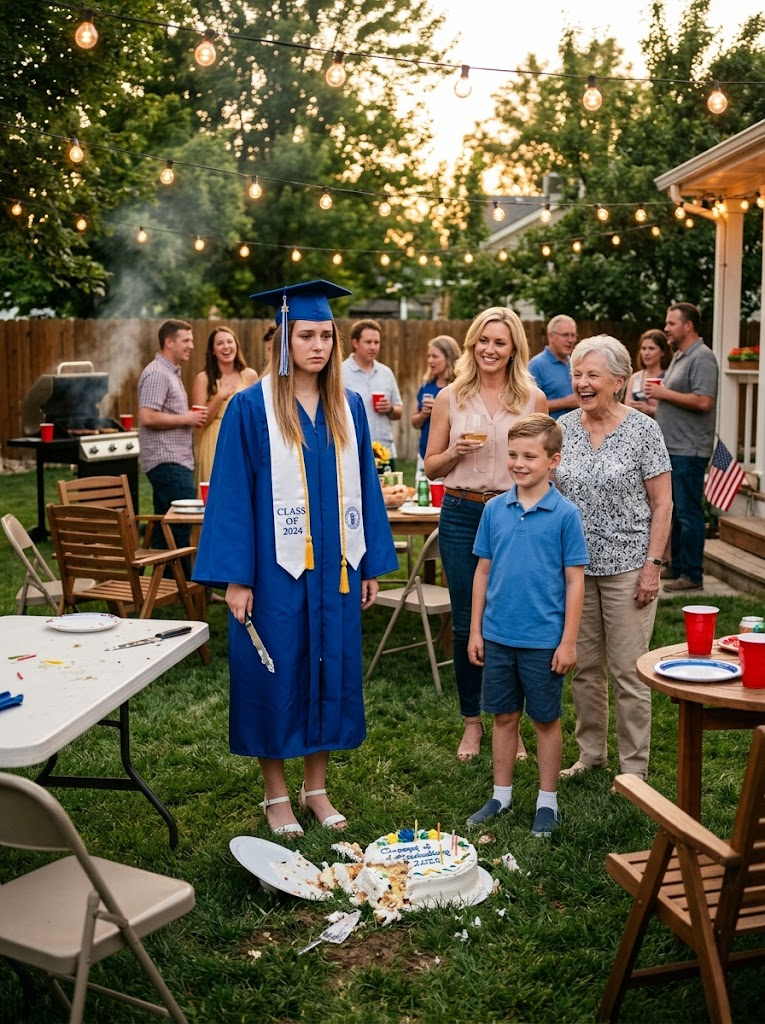
The cake hit the patio with a soft, ugly sound, the kind of sound that should have stopped every conversation in the yard.
For half a second, it did. White frosting burst across the wooden deck. Blue sugar letters smeared into a bright, broken blur. Candles rolled beneath chair legs, one of them spinning in a tiny circle before it fell through the gap between two boards. The porcelain cake plate shattered near my shoes, and a piece of it slid against the toe of the flats I had bought on clearance because I had wanted, foolishly, to look nice for my own graduation party.
Then my ten-year-old nephew grinned at me with frosting on his fingers and said, “Eat it off the ground, Aunt Daisy.”
The table erupted.
Not everyone laughed loudly at first. Some people gasped and then laughed because other people were laughing. Some covered their mouths in that way adults do when they know a child has crossed a line but are too entertained to correct him. My sister Amanda leaned back in her chair and pretended to be shocked, though her eyes were shining. My father looked down at his phone as if an urgent message had arrived from somewhere more important than the woman standing barefoot in frosting in front of him. And my mother, Linda Wilson, laughed the loudest.
“Oh, come on, Daisy,” she said, waving one hand as if I had already complained. “Don’t be so sensitive. He’s just a kid.”
I stood there holding the cake knife.
That was the strangest detail, the one I remembered later with the clearest pain. The knife was still in my hand, silver blade angled toward the deck, frosting clinging to the edge. I had been the one cutting my own cake because no one else had moved to do it. I had driven seven hours from Seattle to my mother’s backyard in Idaho for the graduation party she claimed she wanted to throw for me, and by the time the cake appeared, I had already understood that the party was not really for me. It was a stage for Amanda, for Mom’s hostess smile, for Liam’s loud little performances, for everyone to pretend we were the kind of family that celebrated each other.
But still, when I had seen my name in blue icing, I had felt something small and hopeful flutter in my chest.
Congrats, Daisy.
Two words. Not elegant, not expensive, not even centered properly. The cake had been pushed to the far end of the table between a stack of paper plates and half-empty soda cans, but my name was on it. My degree was real. I had finished what I started. I had worked full-time, studied nights, paid my own tuition in painful installments, and earned a master’s degree in data systems while half my family still acted as if I was just “doing computer things” in Seattle. I had told myself not to expect much. I had told myself the trip was only a courtesy. I had told myself I was too old to need my mother’s pride.
Then Liam shoved the cake off the table, and my mother laughed.
I set the knife down very carefully.
There are moments when anger saves you from humiliation. Mine did not come as fire. It came as a strange, clean stillness that moved through my arms, my throat, my ribs. I looked at the frosting on my shoes, at the ruined cake, at the family gathered beneath string lights in the warm Idaho evening, and I understood that if I said one word, I would give them another thing to mock. If I cried, they would call me dramatic. If I scolded Liam, Amanda would accuse me of hating her child. If I demanded an apology, Mom would turn the whole party into a trial of my personality.
So I did not say anything.
I untied the apron I had put on because Mom said she needed help serving food. I folded it once, placed it on the table beside the ruined cake, and walked toward the house.
“Daisy,” Mom called after me, still amused. “Don’t be like that.”
I kept walking.
Amanda laughed softly and said something I could not hear. Liam shouted, “Bye, Aunt Daisy!” in the same mocking tone he used when he won a board game by cheating. Someone else chuckled. Behind me, the party resumed before I even reached the sliding door. Plates clinked. Bottles opened. A country song drifted from the speaker near the fence. The string lights swayed in the evening breeze, golden and harmless, making the yard look beautiful from a distance.
That was how my family had always worked. From a distance, everything looked lovely.
Inside, the kitchen smelled like barbecue sauce, lemon cleaner, and warm bread. Trays of food sat half-covered on the counter because Mom always made too much and then complained no one helped her clean. I stood for a second in the blue light of the microwave clock, listening to the laughter outside. My hands were steady. That seemed important. I had spent so many years afraid of my own trembling that steadiness felt like a private miracle.
I picked up my purse from the laundry room, found my keys beneath a pile of folded dish towels, and left through the front door.
No one followed me.
That should have hurt more than it did. Maybe some part of me had stopped expecting to be followed years earlier.
The Idaho sky was bruised purple over the driveway, the last streaks of sunset fading behind the rooftops. I got into my car, shut the door, and sat there with both hands on the steering wheel. Through the side yard, I could still hear them. My mother’s voice rose above the others, bright and confident. Amanda laughed again. Liam shrieked at something, delighted with himself.
I had graduated that morning.
Not that anyone had asked about the ceremony. Mom had not come. She said the drive was too much, though she had driven farther for Liam’s soccer tournament the month before. Amanda said she wished she could, but the kids had activities. Dad forgot the date entirely until Mom reminded him in the family group chat with a message that read, “Daisy’s thing is today.” My Seattle friends had come instead. Elena cried when my name was called. Marcus took a video and yelled too loudly. My coworker Lydia, our CEO, sent flowers to my apartment because she said finishing a graduate program while leading product analytics at Green Pulse Tech was “unreasonably impressive.”
At the party, no one asked to see photos.
No one asked about my thesis.
No one asked what came next.
Amanda talked about her trip to Florida. Mom talked about how much Liam had grown. Dad talked to a neighbor about interest rates. I stood near the patio table with a paper plate in my hand and smiled at the right moments until my face felt like it belonged to someone else.
Then Liam ran up, eyes glittering with mischief, and said, “Aunt Daisy, Mom says you only got your degree so you can brag.”
The adults heard him. That was the part people later tried to deny. They heard. Conversation dipped. Amanda lifted her wineglass to her mouth, hiding a smile so poorly it was almost insulting. My mother gave a tiny laugh. No one corrected him.
I had swallowed that too.
The cake was simply the moment my body refused to keep swallowing.
I started the car and backed out of the driveway without looking toward the yard. I did not know where I was going at first. The logical thing would have been to drive to the motel I had booked outside Boise, sleep, and return to Seattle in the morning. Instead, I turned toward the highway.
I drove for hours.
At first, anger did not come. Neither did tears. The road stretched dark and empty ahead of me, headlights cutting through the Idaho night. Gas stations appeared and vanished. Semi trucks thundered past. My phone buzzed in the cupholder, but I ignored it. I had the strange sensation that if I looked at it, if I let their words back into the car, the silence inside me would break and I would collapse.
So I drove.
The laughter replayed anyway.
Eat it off the ground.
Don’t be so sensitive.
He’s just a kid.
But underneath those fresh sounds, older ones began rising. My mother telling me I was “the responsible one” when she needed me to co-sign the mortgage after Dad’s second layoff. Amanda crying in my apartment because her credit was ruined and she needed a reliable SUV for Liam and her younger daughter, Sophie. Dad saying, “You know how your mother worries,” whenever Mom wanted me to agree before she technically asked. The family phrase that had wrapped around my neck for years: Just help us get through this.
That was always the promise. Temporary. Just until things improved. Just until Amanda’s business picked up. Just until Dad found steady work again. Just until the refinance. Just until next month.
Next month never came.
I reached Seattle after midnight, exhausted in a way that felt beyond sleep. Rain streaked the windshield as the city opened around me, familiar and gray and mercifully indifferent. My apartment building stood in a quiet neighborhood near Lake Union, not fancy but clean, with a lobby that smelled faintly of coffee from the café downstairs. I parked, carried my purse upstairs, and let myself into the small one-bedroom apartment I had built into a life.
The silence met me like a hand on my shoulder.
I dropped my keys into the ceramic bowl by the door. My shoes were still sticky with frosting, so I took them off and placed them on an old towel. For a moment I simply stood there, barefoot on the hardwood floor, looking at the things that were mine: the blue couch Elena had helped me choose, the cactus Marcus said looked “emotionally unavailable,” the books stacked under the window, the framed print of a stormy Oregon coast I had bought after my first real promotion.
Then my phone buzzed.
Mom.
I stared at the screen.
For one impossible second, I let hope enter. Not large hope. Not the foolish, childlike kind that believes everything can be repaired with one sentence. Just a thin, tired hope that maybe she had realized what happened. Maybe she would say Liam had gone too far. Maybe she would say Amanda should have corrected him. Maybe she would say, “I’m sorry your graduation party ended that way.”
I opened the message.
“We’ve chosen to sever all contact. Stay away forever.”
I read it once.
Then again.
A small red heart appeared beneath it.
Amanda had liked the message.
Something inside me went very quiet.
I sat down at my kitchen table, phone in one hand, rain ticking softly against the window. The words on the screen did not feel real at first. We’ve chosen. As if they had held a family council. As if I had committed some unforgivable offense by leaving a party where my cake had been shoved onto the floor. Sever all contact. Stay away forever. The language was so dramatic it might have been funny if it had not revealed exactly how quickly I became disposable when I stopped absorbing humiliation politely.
I waited for the pain to tear through me.
It did not.
Maybe I had used up my pain in installments over the years. Maybe every automatic payment, every unanswered call, every birthday where Amanda’s children received expensive gifts I bought because Mom “couldn’t this month,” had taken a little from the account. Maybe by the time my mother finally disowned me by text, there was not enough left for a dramatic collapse.
I set the phone on the table, opened my laptop, and woke the screen.
The budget spreadsheet appeared because it was always open. I tracked everything. Rent. Utilities. Groceries. Student loans. Emergency savings. Retirement. Family obligations. The last category had once been labeled “Helping Home.” A year ago, after a late-night therapy-adjacent conversation with Elena over takeout, I had renamed it “Family Payments” because she said, “Daisy, call things what they are.”
Two rows stared back at me.
Parents’ mortgage — $1,400 monthly.
Amanda’s SUV — $640 monthly.
Both had my name attached. Both had started as emergencies. Both had become normal.
The mortgage was worse. Three years earlier, my parents were on the edge of losing the house after Dad’s contract work dried up and Mom’s hours at the dental office were cut. They could refinance only if someone with stable income and excellent credit co-signed. I was twenty-nine, terrified of disappointing them, and still carrying the old childhood belief that being useful might one day become being cherished.
Mom had cried on the phone. “You’re the only one responsible enough, honey.”
Dad had said, “It’s just paperwork. We’ll make every payment.”
Amanda had texted, “You’d really let Mom and Dad lose the house?”
So I signed.
Six months later, Amanda needed an SUV. Her sedan broke down, her credit was a disaster, and Liam had school, soccer, doctor’s appointments, birthday parties, all the machinery of a child-centered life that apparently mattered more than financial sense. She came to Seattle and sat on my couch sobbing while Mom called every hour to remind me that “family steps up.”
I co-signed that too.
The payments were supposed to come from their accounts. Then came the first missed mortgage withdrawal, then the second. Then Mom said their bank had made a mistake and asked if I could cover it “just this once.” Amanda said her client payments were late. Dad said he had an interview. I moved money. I fixed the problem. Everyone thanked me so warmly I mistook relief for love.
By the end of the first year, both payments were coming from my account automatically because “it was easier,” and they paid me back when they could.
They almost never could.
I looked at my mother’s message again.
Stay away forever.
The rain outside grew heavier, the drops striking the glass in uneven rhythms. I scrolled through old texts, not because I needed evidence yet, but because my mind wanted confirmation that the story I remembered was real.
Mom: The house is ours, you just helped sign. Don’t be dramatic.
Amanda: I know the car’s in your name too technically, but I’m the one using it. Stop acting weird.
Dad: We’ll make it right when things settle.
Mom: You don’t have kids. You don’t understand how much Amanda has on her plate.
Amanda: Liam misses you. Also can you cover the car this month? I’ll send it Friday.
Friday had come and gone fifty-two times.
I opened a new message to the family group chat. My hands did not shake.
“Removing my name from every loan tomorrow.”
I considered adding more. I considered explaining. I considered listing every payment, every broken promise, every small humiliation that had led us here. Then I remembered the cake, frosting on my shoes, laughter under string lights.
They did not deserve a lecture. They deserved reality.
I hit send.
The message delivered.
Nothing happened for almost thirty seconds.
Then the typing bubbles appeared.
Mom. Amanda. Dad. Mom again.
I turned the phone face down before the messages arrived.
That was the first boundary I ever set without asking permission.
I did not sleep that night. I made tea and forgot to drink it. I showered, scrubbing frosting from my feet until the skin turned pink. I threw the ruined shoes in the trash, then took them out, then threw them away again because keeping them felt like preserving evidence for a courtroom that would never exist. I changed into sweatpants and an old University of Washington hoodie, though my degree was from a different school and the hoodie had belonged to Marcus before I stole it during a rainy camping trip.
At dawn, Seattle looked washed clean. Gray light filled the apartment. The city moved beneath low clouds. I brewed coffee and sat by the window with the mug warming my hands, watching commuters hurry down the sidewalk under umbrellas.
My phone, when I finally turned it over, had become a battlefield.
Mom: What is wrong with you?
Amanda: You can’t do that.
Dad: Daisy, call me now.
Mom: After everything we sacrificed for you?
Amanda: My car payment is due next week, you psycho.
Mom: We raised you.
Dad: Don’t make emotional decisions.
Amanda: Liam cried after you left and you don’t even care.
Mom: You’ve gone too far.
Dad: We need to discuss this like adults.
Not one message said, “I’m sorry.”
That told me everything.
At nine, I called Green First Bank and asked for Mr. Diaz.
I had met Alejandro Diaz two years earlier when I moved most of my accounts to the downtown branch after a frustrating experience with a national bank. He was in his fifties, with wire-rimmed glasses, kind eyes, and the calm patience of a man who had seen enough family financial disasters to know that paperwork was often just grief in a different outfit. When I asked for an appointment, his assistant offered me one at eleven.
I dressed carefully. Gray sweater. Black slacks. Hair pulled back. No makeup except lip balm. The outfit of a woman who did not intend to cry in public.
Still, I carried a folder thick enough to make my shoulder ache.
Inside were three years of bank statements showing my payments, copies of the mortgage documents, the SUV loan, emails, text screenshots, proof that I had never lived in my parents’ house, proof that I had never driven or possessed Amanda’s SUV, proof that I had been paying liabilities for property in which I had no ownership benefit beyond the technical burden of my signature. I also had printouts of my mother’s text severing contact and Amanda’s heart reaction, though I was not sure those mattered legally. They mattered to me.
Green First Bank sat on a rainy corner downtown, glass front shining under the gray sky. Inside, everything was quiet and too clean, with pale blue walls, small offices, and a single fern near the waiting area that looked healthier than any plant I owned. Mr. Diaz greeted me at the door of his office and shook my hand with both of his.
“Miss Wilson,” he said. “I reviewed the notes you sent. Come in.”
His office had a view of the street and shelves lined with framed certificates. A family photo sat on one corner of his desk. He did not rush me. That nearly broke me.
“I co-signed two loans,” I said after I sat down. “One for my parents’ house, one for my sister’s SUV. I’ve been making the payments for years. I’m not on the deed for the house. I don’t use the vehicle. They cut contact with me last night, and I want to remove myself from every obligation I can. I understand I can’t just wave a wand and make a co-signed loan disappear.”
He nodded, and I appreciated that he did not insult me with false reassurance.
“You’re correct. Co-signer release depends on the lender, payment history, borrower qualifications, and in some cases refinance or assumption. But based on what you’ve described, there are immediate protective steps we can take.”
I let out a breath I had not realized I was holding.
“We can revoke all automatic payments from your accounts today. We can freeze any joint credit access connected to these obligations. We can submit a formal liability release request and require the primary borrowers to provide updated financial documentation. If there is evidence of misrepresentation or coercion, legal review may accelerate certain protections. For the vehicle loan, because your sister is the primary user and you have no possession, we can initiate a demand for assumption, refinance, or surrender. For the mortgage, the bank will notify the primary borrowers that continued payment responsibility rests with them unless they qualify for release.”
“So they’ll know immediately?”
“Yes,” he said. “And they will likely be upset.”
I gave a short, humorless laugh. “They already are.”
He reviewed my folder page by page. He read the messages silently, expression controlled. When he reached Mom’s text—We’ve chosen to sever all contact. Stay away forever—he paused for a fraction longer than usual.
Then he looked up.
“You’re not the first person to be taken advantage of under the word family.”
I pressed my lips together.
“I thought helping meant I mattered,” I said before I could stop myself.
His face softened. “Sometimes people confuse access with love. Especially when someone responsible keeps saving them from consequences.”
The words landed gently, but they landed deep.
We worked for nearly two hours. He called legal. He printed forms. I signed revocations of automatic payments, notices of dispute, documentation statements, and release requests. Each signature felt less like paperwork and more like cutting an invisible thread tied around my wrist.
When the final stamp came down, the sound echoed through the office.
Mr. Diaz slid copies into a folder and handed them to me.
“This is not instant freedom from every legal obligation,” he said carefully. “I don’t want to mislead you. But as of now, no further payments will be withdrawn from your accounts. No additional credit exposure will be extended through your name. Formal notices are going out today. Your family will have to respond directly.”
“What happens if they can’t?”
“Then the loans move into review. They may need to refinance, sell, surrender the vehicle, or face collections. But the important thing is this: you are no longer silently carrying the burden while they pretend nothing is happening.”
I held the folder against my chest.
Outside, the wind bit cold against my face, but I felt lighter than I had in years. Not happy exactly. Freedom at first did not feel like joy. It felt like stepping out of a room where the air had been poisoned and realizing only then how long you had been holding your breath.
I stopped at a café on the corner. The barista, a woman with silver rings and pink hair, handed me a cappuccino with a leaf drawn in the foam.
“Have a good day,” she said.
I met her eyes and surprised myself by answering honestly.
“I will.”
By evening, the family group chat had become unrecognizable.
Mom: How dare you ruin our credit.
Dad: The bank called. What did you tell them?
Amanda: My loan is frozen? Are you kidding me?
Mom: You are punishing us because you couldn’t take a joke.
Amanda: Liam is a child. You’re acting insane.
Dad: We need to resolve this privately.
Mom: You’ll regret humiliating your family.
I stood in my small kitchen stirring pasta sauce, reading the messages while water boiled. The old version of me would have responded to each accusation carefully, trying to be fair, trying to be understood. The old version of me would have explained that the bank had not been lied to, that I had only provided records, that Liam being a child did not make Amanda innocent, that laughter had consequences, that people who disown someone should not expect her to keep paying their bills.
Instead, I typed one calm line.
“I just stopped paying for people who laughed when my cake hit the floor.”
I pressed send.
The chat went silent.
Three days later, they came to my apartment.
I was making dinner when the knock began. Not a normal knock. A hard, punishing series of blows that made the thin walls vibrate. The pasta water hissed behind me as I froze, wooden spoon in hand. My body knew before my mind did. I set the spoon down, wiped my hands on a towel, and opened the video intercom app.
Mom and Amanda stood in the hallway outside the building door.
My mother wore a beige coat belted tightly at the waist, her hair arranged in the polished bob she maintained like armor. Amanda stood beside her in leggings, a puffer jacket, and expensive boots I was fairly sure I had indirectly paid for. Her eyes were bloodshot, her face pale with fury or panic or both.
“Daisy,” Mom snapped through the intercom. “Open this door right now. We need to talk. What did you do with the bank?”
I did not press the unlock button.
Amanda leaned toward the camera. “You ruined everything. The bank froze the loan review. Mom’s credit is tanking. My car could be repossessed. Do you think this is funny?”
Funny.
The word hit something old in me. That was what they always made me. The joke. The overreactor. The serious one. The one who could be poked and prodded and mocked because her feelings were inconvenient unless they served someone else’s need.
I picked up my phone and started recording.
Then I called the non-emergency line first, but when Amanda began pounding on the glass entry door hard enough that a neighbor stepped into the lobby, I opened the emergency app and requested police assistance.
The dispatcher’s voice was calm. “Are you in immediate danger?”
“They’re outside my building yelling and refusing to leave,” I said. “They’re trying to get in. They’re family, but they do not have permission to be here.”
“Do they have weapons?”
“I don’t see any.”
“Stay inside. Do not engage. Officers are on the way.”
Mom’s voice rose through the intercom. “We are your family. You do not hide from your mother.”
I almost laughed at that. Hide. As if I had not spent my life exposed to them in every way that mattered. My bank account open. My schedule flexible. My emotions available for dismissal.
Amanda’s palm slapped the glass. “You’re destroying this family. You think cutting us off makes you strong? You’re selfish. You’re heartless. Liam cried because of you.”
My hand tightened around the phone.
“No,” I whispered, though they could not hear me. “Liam cried because adults taught him cruelty has no cost.”
Ten minutes later, red and blue lights flashed against the rain-slick street. Two Seattle police officers entered the lobby—a man and a woman, both calm, both professional. I watched through the camera as Mom rushed toward them, pointing at the intercom.
“She’s my daughter,” Mom said. “She destroyed our finances and now she won’t even speak to us.”
Amanda wiped her face dramatically. “She almost cost me my car. My fiancé is threatening to leave because of the credit mess she caused. She did all this over a cake.”
The female officer looked toward the camera, then back at them. “Has the resident asked you to leave?”
“She won’t open the door,” Mom said, as if that answered a different question.
The male officer spoke evenly. “Ma’am, this is private property. If she does not want contact, you need to leave.”
“I’m her mother.”
“That does not give you the right to enter her residence or harass her at home.”
Mom’s expression changed. For the first time, she looked less angry than offended. My mother had spent decades believing motherhood gave her permanent jurisdiction over me. Hearing a stranger say otherwise seemed to shake the floor beneath her.
“She’s our daughter,” she repeated. “We have rights.”
The officer’s voice stayed calm. “You have the same rights as anyone else. You can call her. You can send lawful communication. You cannot pound on her door after being refused entry. If you continue, you may be trespassed from the property.”
Amanda folded her arms. “So she gets to ruin our lives and hide?”
The female officer looked at her. “Financial disputes are civil matters. This is a trespassing complaint.”
Through the speaker, I finally spoke.
“I want them to leave. I do not consent to contact at my home.”
All three of them turned toward the camera.
Mom’s face twisted, not with sadness, but betrayal. “Daisy, you’ll regret this. Blood doesn’t disappear just because you say so.”
“No,” I said quietly, though I was not sure if the microphone caught it. “But access does.”
The officers escorted them out.
I watched their figures move through the lobby doors into the wet evening. Mom looked back once, her expression burning. Amanda was crying now, or pretending to. I could no longer tell the difference, and the realization that I no longer needed to tell felt like another small freedom.
When they were gone, I sank down to the floor with my back against the wall. My hands trembled so violently I had to set the phone beside me. The recording was still running, capturing my breath, the hum of the refrigerator, the distant hiss of rain.
I saved the file and named it: Boundaries — April 17.
Then I sat there until the pasta water boiled away and the smoke alarm began to chirp.
The next morning, my mother went public.
I found out because Elena called me before seven.
“Daisy,” she said, and her voice had the careful tone people use when they are carrying bad news wrapped in bubble wrap. “Do not panic.”
“That’s a horrible way to start a phone call.”
“I know. I’m sorry. Your mom posted something on Facebook.”
Of course she had.
I opened the app with the dread of a person approaching a car accident and knowing the wreck belongs to her. Mom’s post sat at the top of my feed because mutual relatives had already begun commenting.
Sometimes the child you trust most betrays you the worst. Daisy stole from her parents and ruined our credit. After everything we did for her, she chose revenge over family. Some people never learn gratitude.
Below it, comments multiplied.
Poor Linda. You don’t deserve this.
What happened to respecting your parents?
I always thought Daisy seemed cold.
Someone replied, I heard she used her parents’ money to buy that apartment in Seattle.
My stomach turned.
The old Daisy would have panicked. She would have typed a public correction with dates and numbers, attached screenshots, explained every payment, begged distant cousins and church acquaintances and women from Mom’s dental office to understand. The old Daisy would have been terrified of being misrepresented.
But I had learned something in the bank office, something Mr. Diaz did not say directly but every stamped document taught me: truth does not become stronger because you scream it at people determined not to hear.
I closed Facebook and opened my work email.
Subject: Personal matter — privacy request.
Hi team,
You may see or hear rumors about me online involving a private family financial matter. Please disregard them. I’m safe, I’m handling it through the proper channels, and I appreciate your professionalism and privacy.
Daisy
I sent it to Lydia and HR, then closed the laptop.
Ten minutes later, Lydia replied.
We trust you. Take the day if you need it.
No questions. No doubt. Just trust.
I cried then, finally. Not because of Mom’s post. Because someone outside my family believed me without demanding a full trial.
By noon, the post had spread enough that my phone lit up with texts from relatives I had not seen in years. Some accused me. Some pretended concern. Aunt Carol wrote, “Your mother is devastated,” which I deleted. A cousin asked, “Did you really steal from Grandma and Grandpa?” despite the fact that my grandparents had been dead for a decade and therefore had nothing to do with anything. People love a scandal, especially when they can join without understanding the math.
Elena came over that evening with Thai food, flowers, and a bottle of wine.
“We are not doom-scrolling,” she announced, taking my phone from my hand. “We are eating noodles and discussing legal options.”
“I don’t have a lawyer.”
“You might need one.”
“I have documents.”
“Documents are great. Lawyers love documents.”
She stayed until midnight. Marcus arrived around nine with cookies and a printout titled “Defamation Basics in Washington State,” because Marcus coped with emotional emergencies by researching aggressively. Together, they sat at my kitchen table and built a folder of screenshots, dates, recordings, bank letters, and messages. They were gentle but practical. No one told me I was too sensitive. No one asked what I had done to provoke my mother. No one laughed when I said the cake hitting the floor had felt like the end of something.
“That’s because it was,” Elena said. “It was the end of your availability.”
Three days later, an envelope arrived at my office from Green First Bank.
Inside was a formal confirmation letter from Mr. Diaz. The language was precise, legal, and almost beautiful in its neutrality. It stated that all automatic payments from my accounts had been revoked, that no additional credit access could be drawn through my name, that formal co-signer release and liability review had been initiated, and that primary borrowers had been notified of responsibility for future payments pending refinance, assumption, surrender, or legal review. It also confirmed that I held no ownership interest in either the mortgaged property or the vehicle.
It was not the fairy-tale version of freedom. My name was not magically erased from every document overnight. But it was enough. It was a wall where there had once been a hole.
I held the paper under the office light and traced the bank seal with my thumb.
It was not revenge.
It was evidence.
By evening, Mom’s Facebook post had disappeared.
Maybe someone had warned her. Maybe a relative had asked for proof. Maybe Dad, who had been silent since the police visit, finally understood that public lies had legal edges. I did not ask. I did not care the way I would have cared before.
Still, that night, a text came from an unknown number.
You’ll pay for this, Daisy. You think you’ve won?
I stared at it for a long time, then blocked the number.
Winning was not the point.
Freedom was.
The weeks that followed were quieter than I expected. Not peaceful at first. Quiet. There is a difference. Peace is soft. Quiet can be waiting with a knife behind its back. I kept expecting another knock, another public post, another family ambush disguised as concern. I changed my building access code. I informed the front desk not to admit my relatives. I saved every message. I met with a lawyer Marcus found through a friend, who reviewed my documents and said I was “annoyingly prepared,” which I took as a compliment.
The lawyer, a woman named Nora Patel, sent a cease-and-desist letter to my mother regarding public defamatory claims. She also advised me not to engage emotionally in writing, which was both wise and nearly impossible.
“Your mother is trying to pull you into the mud,” Nora said. “Do not step in to prove you’re clean.”
That became my mantra.
Do not step into the mud.
Amanda tried a different tactic. She sent photos of Liam and Sophie, then a voice memo of Liam saying, “Aunt Daisy, I’m sorry about your cake,” in the flat tone of a child repeating words under supervision. I deleted it. Not because Liam did not matter, but because Amanda had turned his apology into another tool. A real apology would have come with accountability from the adults who taught him he could humiliate me and be rewarded with laughter.
Mom sent nothing after the lawyer’s letter.
Dad called once. I let it go to voicemail. His message was short.
“Daisy, this has gotten out of hand. Your mother is upset. Amanda is struggling. I know things were said. We should talk.”
Things were said.
That was how men like my father tried to shrink harm. Things were said. Mistakes were made. Emotions ran high. As if words walked into the room by themselves and threw cake on the floor.
I did not call back.
Life, strangely, continued.
Work became the place where I remembered I was competent. At Green Pulse Tech, we were preparing a product analytics launch that had kept my team busy for months. I threw myself into it with the focus of someone rebuilding internal walls. Data did not care who my mother said I was. Systems either worked or they did not. Dashboards either told the truth or they needed fixing. There was relief in that.
During a leadership meeting, Lydia paused after my presentation and said, “Daisy, you lead with steadiness. People trust that.”
The sentence settled over me like warm light.
Steadiness. Not usefulness. Not sacrifice. Not compliance. Steadiness.
After the meeting, I went to the restroom and cried quietly in a stall for three minutes because praise without demand still felt unfamiliar.
At home, I began making rituals out of ordinary things. Yoga at sunrise, even though I was bad at it. Soup on Sundays. Clean sheets every Friday. Coffee by the window without checking my phone first. Elena came over once a week. Marcus teased me about the cactus on my windowsill, saying, “It looks like me—calm, but don’t touch,” and I laughed so hard I spilled tea.
Slowly, my apartment stopped feeling like a refuge from attack and started feeling like a home.
Mr. Diaz called a month after the bank meeting. The mortgage lender had required my parents to submit updated financials. They could not qualify to keep the same loan structure without my income attached. Their options were refinance with a smaller lender, sell, or bring in another qualified co-signer. The SUV lender had given Amanda thirty days to refinance or surrender the vehicle.
“I’m telling you only what directly affects your exposure,” Mr. Diaz said. “You are not responsible for managing their choices.”
I wrote that sentence on a sticky note and put it on my monitor.
You are not responsible for managing their choices.
Amanda surrendered the SUV in June.
I found out because Hazel texted me.
Hazel was not actually part of this story at the beginning, not the way Amanda and Mom were, but she drifted in through the side door like people sometimes do when a family system changes and everyone has to choose where to stand. Hazel was my younger cousin, though Mom always called her “basically your sister” because she had lived with us for two years in high school after her parents divorced. She had been at the graduation party, quiet near the fence, laughing less than the others but not defending me either.
Her text read: Amanda turned in the SUV today. She’s telling people you stole it from her.
I wrote back: Did you believe her?
Hazel replied: No.
One word. Small. Important.
Then: I’m sorry I didn’t say anything at the party.
I stared at that message longer than I expected.
Thank you, I wrote.
Not “it’s okay.” Because it was not okay.
In July, my parents listed their house.
The Zillow link appeared in a family thread someone forgot I was still in. Four bedrooms, three baths, mature landscaping, recently updated kitchen. The photos made the house look brighter than I remembered. My childhood bedroom was now staged as a home office with a fake plant and a white desk. The backyard where my cake had hit the deck looked spotless under professional lighting. No frosting. No laughter. No evidence that anything had ever broken there.
I closed the listing and sat quietly for a while.
I expected satisfaction. Instead, grief arrived. Not for the house exactly, but for the story I had tried to build around it. The belief that if I gave enough, helped enough, signed enough, paid enough, one day I would be welcomed fully inside. A house can be sold. A fantasy has to be mourned.
That night, I dreamed of the cake.
In the dream, it did not fall. It sat perfectly in the center of the table, candles lit, blue letters bright. Everyone gathered around me. Mom smiled warmly. Amanda held Liam’s shoulder. Dad put away his phone. They sang, badly and loudly. When I looked down, the frosting did not say Congrats, Daisy.
It said: You can stop now.
I woke up crying.
A year passed before Amanda apologized.
By then, the shape of my life had changed enough that her name on my phone did not immediately send adrenaline through my body. I had been promoted to director of analytics operations. The student loans were smaller. My emergency fund was larger. My apartment had two new bookshelves and a rug that made the living room feel intentional. I had taken a solo trip to the Oregon coast and spent four days walking in rain, eating clam chowder, and learning that solitude could be nourishing when it was chosen instead of imposed.
I had not spoken to Mom in eleven months.
Dad sent birthday flowers with no note except his name. I left them in the lobby for someone else.
On an April evening, exactly one year after the police visit, my phone buzzed while I was cooking soup.
Amanda.
I almost ignored it. Then I opened the message.
I’m sorry for everything.
Six words.
No excuses. No explanation. No mention of Liam, Mom, the bank, the SUV, the party, the post, the police. Just six quiet words sitting on the screen.
I read them several times.
The old Daisy would have answered immediately. She would have said thank you, asked if Amanda was okay, opened the door wide enough for all the old patterns to rush back in. The angry Daisy, the one who had carried me through the first months of freedom, might have typed something sharp enough to draw blood.
The Daisy I had become set the phone down and kept stirring the soup.
Not because the apology meant nothing. It meant something. Maybe Amanda had finally understood. Maybe she had run out of people to blame. Maybe Liam, now eleven, had repeated the wrong cruelty to someone outside the family and Amanda had heard it differently. Maybe losing the SUV, moving into a rental, and watching Mom’s social world shrink had taught her that consequences did not always mean victimhood.
But forgiveness did not require immediate access.
I let the message sit unanswered for three days.
Then I wrote back:
“I hear you. I’m not ready for a relationship. I hope you and the kids are well.”
She did not respond.
That was better than arguing.
One month later, a letter arrived from Dad. Not a text. Not a voicemail. A letter, written in his uneven handwriting on lined paper torn from a legal pad.
Daisy,
I have started this several times. Your mother says writing makes things worse, but I think not writing already did enough damage.
I should have stopped Liam. I should have stopped Amanda. I should have stopped your mother. I did not. I sat there and looked at my phone because I did not want the trouble of choosing a side. That was choosing a side.
I also knew you were carrying more of our finances than you should have. I told myself it was temporary. I told myself you were doing well and could handle it. I let your mother make you the responsible one because it was easier than admitting I had failed.
I am sorry. I do not expect you to forgive me. I just wanted to say it plainly.
Dad
I sat with that letter for a long time.
It was the first apology from him that did not contain the phrase “but you have to understand.” It did not ask me to call. It did not ask me to comfort him. It did not rewrite the past into something softer.
I folded it and placed it in the drawer with the bank letter.
Some papers are proof of freedom. Others are proof that someone, however late, has finally told the truth.
I did not reconcile with my family in the way people expect stories to end. There was no tearful reunion in the old backyard, no Christmas miracle, no dramatic embrace where all wounds dissolved under music and snow. My mother remained proud in the way proud people sometimes do when regret threatens the structure of their identity. She sent one message through Hazel that said, “Tell Daisy she knows where to find me.” I told Hazel not to pass along messages anymore.
Amanda and I eventually spoke by phone. It lasted seventeen minutes. She apologized more specifically that time.
“I laughed because Mom laughed,” she said. “And Liam was repeating things he’d heard me say. I’m ashamed of that.”
“You should be,” I said.
“I am.”
We did not discuss rebuilding. We discussed Liam writing me a real apology when he was old enough to understand that sorry is not a script. We discussed boundaries around contact. We discussed the fact that I would not send money, co-sign anything, or be used as a financial reference ever again.
“Okay,” she said quietly.
The most surprising part was that she meant it.
At least that day.
I learned to stop predicting forever from one conversation.
Two years after the cake, Green Pulse Tech held a company retreat in Bend, Oregon. At the closing dinner, Lydia announced the new executive leadership track. My name was on the list. People clapped. Elena, who had come as my guest, screamed like I had won a reality show. Marcus sent a text that said, “Our cactus is growing.”
After dinner, I walked outside alone.
The night air smelled like pine and cold river water. Stars spread overhead in impossible numbers, brighter than they ever looked in Seattle. I stood on a wooden deck not unlike the one in my mother’s backyard, listening to laughter behind me.
For a moment, memory folded over reality. The cake. The frosting. Liam’s grin. Mom’s laughter. My own silence.
Then Elena stepped out beside me and handed me a glass of sparkling water.
“You disappeared,” she said.
“Just thinking.”
“Good thinking or bad thinking?”
“Old thinking.”
She leaned against the railing. “Do you want company?”
I looked at her, at the warm light spilling from the lodge windows, at the colleagues inside who knew me as steady, capable, sometimes funny, never as the woman who had once stood over a ruined cake wondering how love could sound so cruel.
“Yes,” I said. “I do.”
She stayed beside me without asking more.
That was love too. The kind that did not demand a confession before offering presence.
On the anniversary of my graduation party, I bought myself a cake.
Not a big one. A small white cake from a bakery near my apartment with lemon filling and buttercream roses. I asked them to write only two words on top.
Welcome home.
When I brought it back, I placed it in the center of my kitchen table. Not in the corner. Not beside trash or half-empty cans or careless elbows. Right in the center. I lit one candle, not because it was my birthday but because ceremonies matter when you are rebuilding yourself.
I took a photo and sent it to Elena and Marcus.
Then I cut one perfect slice, put it on a plate, and ate it slowly by the window while Lake Union shimmered under the evening light.
My phone sat nearby, quiet.
For once, silence did not feel like abandonment.
It felt like peace.
Later that night, I opened the drawer where I kept the documents: the bank confirmation, the police report number, the cease-and-desist letter, Dad’s apology, Amanda’s message printed out not because I needed it but because I wanted proof that one day, even she had found six honest words. I did not look at them often anymore. I no longer needed to remind myself daily that the past had happened.
But that night, I touched the folder once, then closed the drawer.
Some people think cutting ties means you stop loving. That is not always true. Sometimes cutting ties means you finally stop letting love be used as a weapon against you. Sometimes distance is not punishment. It is oxygen. Sometimes the most loving thing you can do for yourself is stop standing in rooms where people laugh when you are hurt.
I still love parts of them. That is the complicated truth. I love the mother who packed my school lunches with notes in the napkin when I was eight. I love the father who taught me how to check tire pressure before long drives. I love the sister who once climbed into my bed during a thunderstorm and whispered that twins were never really alone. I love the nephew who might still grow into someone kinder than the adults who failed him.
But I no longer confuse love with access.
I no longer confuse sacrifice with belonging.
I no longer pay for a place at a table where my cake is pushed to the edge.
My name is Daisy Wilson. I earned my degree. I built my life. I signed myself out of debts that were never truly mine. I closed the door when family became trespass. I let people call me ungrateful and learned that gratitude should never require self-erasure. I survived the silence after the laughter stopped.
And if you are waiting for the part where I say everything was worth it because they finally understood, I cannot give you that ending.
The truth is better.
Everything was worth it because I finally understood.
I understood that the girl standing in frosting with a knife in her hand did not need to beg for decency. She needed to walk away. I understood that the woman driving through the Idaho night was not running from family. She was returning to herself. I understood that the text telling me to stay away forever was not a death sentence. It was an opening. A cruel one, yes. A painful one. But an opening all the same.
Outside my window, Seattle breathed in rain and light. The city moved on, as cities do. Somewhere below, people ordered coffee, hailed rides, kissed goodbye, started over without ceremony. I stood there with the taste of lemon cake on my tongue and whispered into the quiet apartment, “Welcome home, Daisy.”