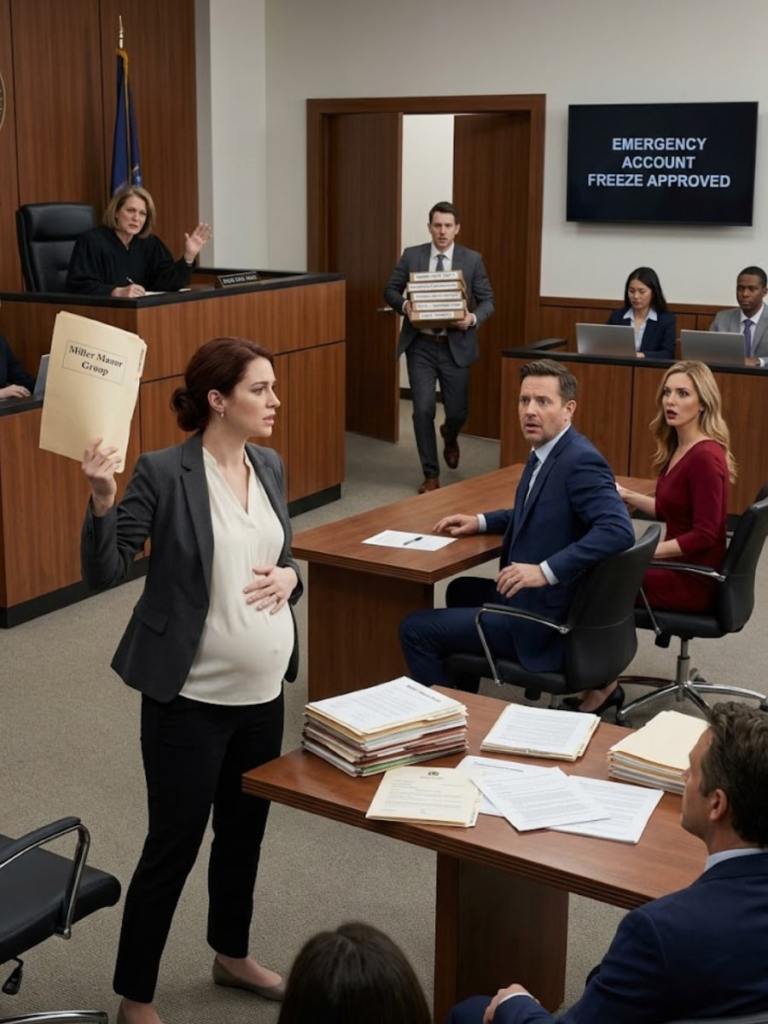
One step.
Then another.
The courthouse doors opened ahead of me with the heavy sigh of old wood and polished brass. Inside, the marble floors shone coldly beneath the morning light. My reflection moved beneath me, distorted by the gloss, a pale woman in a loose black dress and worn flats, her face fuller from pregnancy, her eyes bruised by sleeplessness. I looked like someone’s cautionary tale.
Maybe I was.
People imagine divorce as shouting. As plates breaking against walls. As lawyers barking across long tables and husbands storming out of rooms. They imagine rage because rage is easier to understand than erosion.
My divorce had been quiet.
It had sounded like me counting coins at a pharmacy counter while pretending not to cry because my prenatal vitamins were no longer covered by the insurance card that suddenly “wasn’t active.” It had looked like unpaid hospital bills spread across Megan’s coffee table at midnight while she slept in the bedroom and I tried to calculate how long I could keep living on her couch without becoming a burden. It had felt like waking at three in the morning because my baby kicked, then remembering I had nowhere certain to bring her home.
I had not come to court wanting revenge.
That mattered to me then. It matters to me even now.
I was not trying to destroy Harrison. I was not trying to humiliate him, though God knows he had never hesitated to humiliate me. I was not trying to take his company, ruin his name, or punish him for loving someone else.
I had come asking for what the law said was fair.
Child support.
Medical coverage.
Temporary use of the house we both legally owned until the baby was born.
Access to money that had not always been his, no matter how many times he told me it was.
Stability. That was all. Not luxury. Not vengeance. Just a roof, a doctor, and enough peace to give birth without wondering whether I would leave the hospital with my daughter and have nowhere to put her crib.
My daughter rolled beneath my hand, a slow, firm movement that made me pause in the courthouse lobby. She had been restless all morning, as if she knew we were walking into something dangerous.
“I know,” I whispered. “I know, sweetheart.”
A security guard glanced at me but said nothing.
The elevator was out of service. Of course it was. I stood before the small paper sign taped over the doors and almost laughed. Instead, I climbed the stairs one slow step at a time, stopping on each landing, pretending to read the directory while my breath came short and my lower back pulsed with pain.
By the time I reached the second floor, my ankles throbbed so badly I had to lean against the wall.
A woman in a navy suit looked at my belly, then at my face. “Do you need help?”
The kindness startled me. For months, help had always come with conditions or consequences. Harrison had trained me to distrust even gentleness.
“No,” I said too quickly. Then, softer, “Thank you.”
She nodded and moved on.
I stood there another moment, holding my folder against my chest. It was cheap cardboard, bent at the corners, the elastic stretched from being opened and closed too many times. Inside were the pieces of my life Harrison had not managed to take or rewrite: ultrasound reports, copies of bills, text messages I had printed at Megan’s kitchen table, bank statements that made me feel sick when I looked at them, and a photograph of my mother standing in front of Miller Manor the year she bought the building.
I had put that photograph in the folder without knowing why.
Maybe because I needed proof that I came from someone before Harrison.
Maybe because I was afraid I had forgotten.
The courtroom was at the end of a long hallway lined with wooden benches and people who looked as if they were waiting for sentences before any judge spoke them. A man in work boots sat with his elbows on his knees, turning a baseball cap in his hands. A young couple whispered fiercely beside a stroller. An older woman held a manila envelope in her lap like a shield. Everyone seemed tired. Everyone seemed afraid.
No one looked as afraid as I felt.
I checked my phone again.
No message from Simon.
Simon Fletcher, my lawyer, was supposed to meet me outside courtroom 2B at eight-thirty. It was now eight-forty-two. Simon was not the type to be late. He was not flashy, not smooth, not the sort of attorney Harrison hired, but he was careful. He wore old suits, carried too many pens, and spoke to me like I was a person rather than a problem. He had taken my case after three other lawyers gave me polite refusals once they heard Harrison Prescott’s name.
“Harrison’s team will try to bury us in paper,” Simon had told me at our first meeting. “They will try to exhaust you. They will try to make you feel unreasonable for wanting basic protection. Our job is to stay precise.”
Precise.
I had clung to that word.
Now his seat was going to be empty.
I called him. It went straight to voicemail.
“Simon, it’s Sarah,” I whispered, turning slightly toward the wall. “I’m here. They said we might be called soon. Please call me back.”
I hung up and stared at the screen as if I could will it to light.
Nothing.
A clerk emerged from the courtroom and called several names. Mine was not among them. I sat heavily on the bench outside the door, my knees angled awkwardly, one hand braced beneath my belly. Across the hall, a clock ticked in a way that seemed designed to punish the desperate.
Harrison used to buy clocks.
That was not something people knew about him. They knew the public version: Harrison J. Prescott, founder and CEO of Prescott Systems, visionary in predictive analytics, philanthropist, keynote speaker, donor to hospitals and children’s literacy programs. They saw him on stage in dark suits, sleeves rolled just enough to seem approachable, talking about innovation with one hand over his heart. He gave interviews about ethical technology and human-centered leadership. He remembered people’s names. He tipped waiters too much when others were watching. He knew how to make generosity look effortless.
But he collected clocks.
Antique clocks. Modern clocks. Wall clocks from Europe. Sleek, silent desk clocks. Enormous grandfather clocks that ticked through our house like mechanical lungs. He said he liked precision. He said time was the only honest currency.
At first, I thought it was charming.
That was before I learned that in Harrison’s world, time belonged to him. Money belonged to him. Rooms belonged to him. Silence belonged to him. Even my name, eventually, belonged to him.
When I met him, I was twenty-six and still signing emails as Sarah Jane Miller. My mother had been dead less than a year. I was working part-time for the foundation attached to Miller Manor Group, sorting tenant assistance applications and trying to understand the paperwork she had left behind. Harrison came to a charity luncheon in a gray suit and asked thoughtful questions about housing insecurity. He did not seem bored. He did not glance over my shoulder for someone more important.
“You speak about your mother like she built a city,” he said afterward, walking beside me through the lobby.
“She built homes,” I said. “That mattered more to her.”
He smiled. “Then she built something rarer.”
I remember feeling seen.
That was the first trap.
Abusers do not always begin with cruelty. Sometimes they begin with recognition. They find the part of you that aches to be understood and place their hand there gently. Later, when they press, you mistake the pain for intimacy.
Harrison was brilliant at gentleness when gentleness served him. He brought coffee to my office. He sent flowers on the anniversary of my mother’s death. He listened to stories about her as if memorizing the shape of my grief. He told me I carried too much alone. He said I deserved someone capable of protecting me.
I did not know then that some men say protection when they mean possession.
We married fourteen months later.
By then, I had signed more documents than I could remember.
Estate documents. Tax documents. Partnership documents. Transitional management agreements related to Miller Manor Group. Harrison explained them patiently, sitting beside me at our dining table with his reading glasses on, one hand resting near mine.
“Your mother’s holdings are complicated,” he said. “You shouldn’t have to carry all this while grieving.”
“I should understand what I’m signing.”
“Of course. That’s why I’m explaining.”
He always sounded reasonable. That was his gift. He could make resistance feel rude.
My mother’s attorney had retired. The new advisor Harrison recommended spoke quickly and addressed most of his answers to Harrison. I asked whether I was giving anything away. Harrison squeezed my hand under the table.
“No,” he said softly. “We’re just protecting you from liability.”
Protecting.
That word again.
Years later, in a courtroom, I would learn that protection had been a shell corporation. Liability had been ownership. Complication had been theft.
But that morning, outside courtroom 2B, all I knew was that Harrison had convinced me my mother’s company was practically gone, that it had been absorbed into structures too complex for me to manage, that my inheritance was sentimental more than financial.
“Miller Manor was your mother’s dream,” he used to say when I asked questions. “But dreams don’t always survive taxes, Sarah.”
He said Sarah, never Sarah Jane. He disliked double names. Too rural, he said once, smiling as if it were a joke. After we married, he introduced me as Sarah Prescott so consistently that even I began to feel the Miller slipping from my skin.
The clerk opened the courtroom door again. “Prescott matter?”
I struggled to stand.
“Yes,” I said.
“Your attorney here?”
I looked down the hall. Empty. “Not yet.”
The clerk’s mouth tightened with the weary sympathy of someone who had seen too many people arrive without help. “The judge is aware there was a late filing from opposing counsel last night. Come inside. We’ll sort it out.”
A late filing.
Of course.
My stomach dropped as I followed her in.
Courtroom 2B was smaller than I expected. Dark wood. High windows. Fluorescent lights that made everyone look ill. The seal of the state hung behind the bench. Counsel tables faced the judge’s seat like two islands separated by a sea no one survived crossing unchanged.
I sat at the left table alone.
The chair beside me remained empty.
Across the aisle, Harrison’s legal team was already arranged with military elegance. Three attorneys. Two associates. Stacks of binders. Laptops open. Bottled water aligned. Harrison’s lead attorney, Vivian Cross, had the polished stillness of a woman who could remove your lungs with procedural language and call it efficiency.
Harrison was not there yet.
That almost made it worse. His absence had presence. It filled the room with anticipation, the way the air shifts before thunder.
I placed my folder on the table and opened it with hands that would not stop shaking.
The baby kicked once.
“I’m trying,” I whispered.
A man seated behind me coughed. I straightened.
I had survived harder things than an empty chair. That was what I told myself. I had survived the day Harrison canceled my credit card while I was buying groceries. I had survived the night he stood in the nursery doorway and said, “You are not bringing my daughter into this house if you keep acting unstable.” I had survived packing two bags while he was at a board dinner, one for me and one filled with tiny folded clothes, then driving to Megan’s apartment because I could no longer tell whether staying was safer than leaving.
Megan lived on the third floor of a building with no elevator. Her couch sagged in the middle, and her cat hated me. She gave me her bed the first night. I refused it after that because I could not bear taking one more thing from someone kind.
“You are pregnant and scared,” she said, standing in her kitchen at midnight in a faded college sweatshirt. “You are allowed to need a bed.”
“I can sleep on the couch.”
“Sarah.”
“Megan, please. Let me keep one piece of dignity.”
She looked at me for a long time. Then she brought every pillow she owned to the couch and said, “Fine. But if you go into labor on that thing, I’m suing the manufacturer.”
I laughed then. Truly laughed. It had startled us both.
The courtroom door opened.
Harrison walked in.
Every conversation died.
He wore a charcoal suit I recognized from a magazine profile. Custom Italian tailoring. Subtle. Impeccable. Expensive enough to pay Megan’s rent for half a year. His hair was silvering at the temples in a way people called distinguished. His face was calm, almost bored, as if this hearing were an inconvenience inserted between investor calls.
Beside him stood Tiffany Rhodes.
His assistant.
His closest ally.
His mistress.
She wore cream.
Not white exactly, but close enough. A soft cream dress beneath a black coat, pearls at her ears, hair swept into a glossy knot. She looked less like a woman attending a divorce hearing and more like someone arriving at a luncheon where she expected to be photographed. She stood so close to Harrison that her sleeve brushed his. Neither of them stepped away.
That hurt more than I expected.
The affair itself no longer shocked me. I had processed that pain in long, lonely installments. The lipstick on his collar he told me was from a donor who hugged too enthusiastically. The late meetings. Tiffany’s messages appearing on his phone at midnight. The way staff at company events stopped speaking when I approached. The way Tiffany looked at me when I was five months pregnant, as though I were an obstacle temporarily swollen into visibility.
But this—her standing beside him in open court, confident and unapologetic—was another cruelty altogether.
He was not hiding her because he no longer believed I deserved even the courtesy of shame.
Harrison’s eyes moved over me. Belly. Folder. Empty chair. No Simon.
His mouth curved slightly.
There it was. Confirmation.
He had planned this.
He walked to his table. Tiffany sat behind him, crossing her legs. Her heel swung once, lazily.
Vivian Cross rose. “Your Honor, if we may address the matter of representation—”
Judge Randall Thompson entered before she could finish.
“All rise.”
I pushed myself up awkwardly, one hand gripping the table. Pain flared through my lower back. The room stood around me in a wave of dark fabric.
Judge Thompson was older than I expected. Late sixties, perhaps. Broad-shouldered, with deep lines around his mouth and silver hair cut close. He moved slowly but not weakly. When he sat, the room sat with him.
He began by scanning the file. “We are here on Prescott v. Prescott. Emergency temporary orders, support, use of marital home, insurance coverage, and related financial matters.”
His eyes lifted to the empty chair beside me.
“Mrs. Prescott, where is your counsel?”
“I don’t know, Your Honor,” I said. My voice sounded thin. “Mr. Fletcher was supposed to be here. I haven’t been able to reach him.”
Vivian Cross stood again. “Your Honor, opposing counsel was served electronically last night with our supplemental motion. If he failed to appear, that is unfortunate, but my client should not be prejudiced by their lack of preparedness.”
I turned toward her. “Last night?”
She did not look at me.
Judge Thompson frowned. “What time last night?”
“Eleven forty-seven p.m., Your Honor.”
He looked over his glasses. “That is an interesting definition of timely.”
Vivian Cross smiled without warmth. “The matter involved urgent corrections to financial misstatements.”
Harrison leaned back in his chair.
I felt suddenly lightheaded.
“Your Honor,” I said, “I did not receive—”
Harrison leaned toward me, voice low enough that he must have thought the judge would not hear. “You should just sign the settlement and walk away while you still have some dignity.”
My face burned.
He had said almost the same thing the night I left.
I was standing in our bedroom, trying to zip a small bag with one hand while my belly made bending impossible. He had stood in the doorway, holding a glass of water, watching me with clinical disappointment.
“You are embarrassing yourself,” he said. “Where will you go? Megan’s couch? A shelter? Do you understand what happens if I tell people you’re unstable?”
“I’m not unstable.”
“You’re eight months pregnant, unemployed, emotional, and refusing reasonable support.”
“You cut off my cards.”
“I paused unnecessary spending.”
“Groceries are not unnecessary.”
“They are when you’re using my accounts to perform victimhood.”
I remember the smell of his cologne. Cedar and something cold. I remember the nursery light glowing down the hall, the mobile casting tiny shadows on the wall.
“You should be grateful,” he said. “Most men would have done far worse.”
Now, in the courtroom, he whispered dignity as if he had not spent months stripping it from me piece by piece.
I kept my eyes forward.
“I’m not asking for anything unreasonable,” I said quietly.
Tiffany laughed.
It was sharp, bright, and cruel enough to turn heads.
“Fairness?” she said. “That’s a strange word for someone who trapped a successful man with a pregnancy.”
The courtroom went still.
Vivian Cross closed her eyes for a fraction of a second.
My baby moved inside me, a slow stretch beneath my ribs.
Something in my chest tightened. Fear, yes. But something else too. A small living line I would not let Tiffany cross.
“Don’t speak about my child,” I said.
My voice shook. But it held.
Tiffany’s smile disappeared.
Before I could register that she had stood, before I could understand the flash of cream fabric and perfume, her hand cracked across my face.
The sound echoed through the courtroom.
For a second, there was no pain. Only shock. My head turned with the force of it. My folder slid off the table, papers spilling across the floor. Then my cheek ignited. Heat bloomed beneath my skin. My mouth filled with the metallic taste of blood where my teeth had cut the inside of my lip.
My hands went to my stomach before thought returned.
Protect the baby.
That was all.
Protect the baby.
Silence fell so completely that I heard one of the associates across from me inhale.
No one moved.
Harrison did not rise.
Tiffany did not apologize.
Even the bailiff stood frozen, as if the impossibility of what had happened in open court had stunned his training out of him.
Then Harrison laughed softly.
Not loudly. Not theatrically. Just enough for me to hear.
“This is exactly the instability I’ve been dealing with,” he muttered.
Something changed inside me then.
It was not courage, not yet. Courage feels too noble for what happened. It was a kind of vanishing. The last belief that if I behaved calmly enough, reasonably enough, politely enough, someone would see what he was doing.
A pregnant woman had just been struck in open court, and my husband was turning it into evidence against me.
I looked down at my shaking hands. One was still spread over my belly. The other clutched the edge of the table. My ultrasound photo lay on the floor near Harrison’s shoe.
He did not pick it up.
Then I noticed the judge.
Judge Thompson was no longer looking at the documents.
He was staring directly at me.
No, not only at me.
At the papers that had spilled across the floor. At the photograph of my mother. At the top page from my folder, where my full legal name appeared in faded print from an old estate form.
Sarah Jane Miller Prescott.
His expression shifted.
Focused.
Serious.
Almost shocked.
“Bailiff,” he said.
The room jumped at the firmness of his voice.
“Seal the courtroom.”
The bailiff moved at once. The heavy doors closed. The sound traveled through me like thunder.
Harrison sat straighter.
Tiffany stepped back, color rising and draining from her face in uneven patches.
Judge Thompson’s gaze moved slowly across the room. “No one leaves.”
Vivian Cross rose. “Your Honor, my client—”
“Sit down.”
She sat.
The judge turned to the court reporter. “The assault that just occurred in my courtroom will be reflected in the record. Bailiff, identify the woman who struck Mrs. Prescott.”
The bailiff swallowed. “Tiffany Rhodes, Your Honor.”
“Ms. Rhodes will sit in the front row, away from Mr. Prescott. Now.”
Tiffany looked at Harrison.
He gave the slightest shake of his head, as if warning her not to make things worse for him.
For him.
Not for her.
She moved to the front row and sat stiffly, her cream dress suddenly garish beneath the fluorescent lights.
Judge Thompson looked back at me. His tone softened, but only slightly. “Mrs. Prescott, are you injured?”
My cheek throbbed. My lip stung. My daughter shifted, agitated, inside me.
“I don’t know,” I said.
“Do you need medical attention immediately?”
The honest answer was yes. The trained answer was don’t be trouble. The fear answer was if I leave, Harrison wins.
“I can continue,” I said.
The judge studied me for a long moment, and I had the sudden, unsettling feeling that he understood every reason behind those three words.
“We will proceed carefully,” he said. “And if at any point I determine medical attention is necessary, this hearing will pause.”
Harrison’s face tightened.
Then the judge picked up a document from the file before him. “Mrs. Prescott, I need to ask you a question. Did you submit an emergency evidentiary packet to this court by private courier at seven-ten this morning?”
I blinked. “No, Your Honor. I mean—I don’t think so. My lawyer was supposed to handle evidence, but I haven’t spoken to him this morning.”
Harrison let out a derisive breath.
Judge Thompson’s eyes snapped toward him. “Mr. Prescott.”
Harrison arranged his face into concern. “Your Honor, my wife has been emotionally unstable for months. I don’t think she understands—”
“I did not ask for your opinion.”
The words cracked across the courtroom more cleanly than Tiffany’s slap had.
Harrison went silent.
For the first time since he entered, I saw fear in his eyes.
Not panic. Harrison was too controlled for panic.
But fear, yes. A thin bright line of it.
Judge Thompson turned a page. “The filing includes an affidavit from Attorney Simon Fletcher, executed at six-forty this morning and notarized remotely under emergency circumstances. It references obstruction, interference with counsel, financial coercion, unauthorized access to medical records, and potential fraudulent transfer of marital and inherited assets.”
Vivian Cross stood again, slower this time. “Your Honor, we have not been served with any such packet.”
“I am aware.”
“Then we object to—”
“You may object after I finish determining whether this court is currently presiding over a routine divorce matter or an active pattern of intimidation.”
The room went so quiet I could hear my own pulse in my injured cheek.
The judge turned to me. “Mrs. Prescott, your full legal name is Sarah Jane Miller Prescott?”
Something about hearing Miller in his voice made my throat close.
“Yes.”
“Harrison J. Prescott is your husband?”
“Yes.”
“You are eight months pregnant?”
“Yes.”
“You are currently residing with a friend rather than in the marital residence?”
I swallowed. “Yes.”
“Why?”
Vivian Cross said, “Objection, relevance—”
“Overruled.”
Harrison leaned toward his attorney, whispering.
Judge Thompson watched him. “Mr. Prescott, you will not coach counsel while the court is addressing immediate safety concerns.”
Harrison sat back.
I tried to speak. My mouth hurt. “I left because I didn’t feel safe.”
“In what way?”
My hands trembled. I looked at my folder on the floor, papers scattered like the wreckage of every private humiliation I had hoped not to share aloud.
“He cut off my credit cards,” I said. “He canceled or paused my insurance. I found out at the pharmacy. He said I was spending irresponsibly, but it was groceries and prescriptions and prenatal things. He said if I kept acting unstable, he would lock me out while I was at a doctor’s appointment.”
Harrison’s voice broke in. “That is not—”
“One more interruption,” Judge Thompson said, “and you will be held in contempt.”
Harrison’s jaw shut.
The judge looked back at me. “Continue.”
The words were simple, but they felt like a hand under my elbow.
“He controlled the accounts. I didn’t have access to most of them anymore. My name was on the house, but he changed the alarm code twice. He said if I tried to bring anyone there, he’d have security remove them. He said no judge would give temporary residence to someone mentally unstable.”
My voice cracked on the last two words.
Tiffany looked down at her lap.
Vivian Cross stared at the table.
Judge Thompson’s expression did not change, but something in the room did. The story Harrison had built around me—fragile, irrational, greedy, pregnant woman trying to punish a successful husband—began to tilt.
“The evidence supports her statement,” Judge Thompson said.
Harrison’s eyes flashed.
The judge lifted another document. “We have bank statements showing several accounts previously used for household expenses were restricted. We have correspondence from a benefits administrator indicating Mrs. Prescott’s dependent coverage was suspended pending ‘internal review’ initiated by Mr. Prescott’s office. We have text messages referencing threats of lockout. We also have security system logs showing access code changes.”
I stared at him.
I had some of those documents in my folder. Not all.
Simon.
He had not abandoned me.
A strange, painful hope rose so fast it made me dizzy.
Judge Thompson continued. “There is more. A substantial portion of the emergency filing concerns Miller Manor Group.”
At the sound of my mother’s company name, the room seemed to drop away.
I was no longer in Courtroom 2B. I was eight years old, sitting beneath my mother’s desk while she argued with a contractor who tried to overcharge her for repairs on an apartment building. I could still see her shoes: brown leather flats scuffed at the toes. Eleanor Miller never wore shoes she could not run in if someone needed help.
Miller Manor had not begun as a company. It began as one building my mother bought with money she saved from twenty years of teaching and bookkeeping. A red-brick building on Maple Avenue with broken radiators, cracked plaster, and tenants everyone else had ignored because they were elderly, disabled, undocumented, single mothers, or simply poor. My mother repaired the heat first. Then the locks. Then the roof. Then she bought another building and did the same.
By the time she died, Miller Manor Group owned twelve properties and had a reputation for being both impossible to cheat and impossible to shame into cruelty. My mother refused evictions during hospital stays. She created payment plans by hand. She once drove a tenant’s child to school for two weeks because the bus route changed and the child’s grandmother was recovering from surgery.
“Buildings are bones,” she used to say. “People are the living part.”
After she died, I had tried to understand what she left me. I had been grieving, overwhelmed, and young enough to believe love made people honest. Harrison stepped in with his lawyers and his careful voice.
Now Judge Thompson was saying Miller Manor Group as if it had never disappeared.
“I remember signing papers after my mother passed,” I said slowly. “Harrison said they were liability protections and management transitions. I was never told I was giving anything away.”
Judge Thompson looked directly at Harrison.
“Mr. Prescott, did you present documents transferring Mrs. Prescott’s inherited interest in Miller Manor Group assets into a shell corporation under your sole operational control?”
Harrison rose halfway. “Your Honor, that is a gross mischaracterization of a sophisticated estate restructuring.”
“Sit down.”
He sat, but his face had gone hard.
Vivian Cross stood. “Your Honor, my client’s business entities are complex. Mrs. Prescott voluntarily executed documents with counsel present.”
“Which counsel?” the judge asked.
“Estate counsel retained at the time.”
“Retained by whom?”
A pause.
Vivian Cross said, “My understanding is that the firm was recommended by Mr. Prescott.”
The judge turned a page. “The affidavit alleges that Mrs. Prescott’s independent counsel was not present, that documents were summarized inaccurately, and that her signature was obtained while she was grieving her mother’s death. It also alleges subsequent diversion of rental income and asset leverage through Prescott-controlled entities.”
My mind struggled to keep up.
Rental income.
Asset leverage.
Diversion.
Words that sounded technical until I understood what they meant: Harrison had not merely controlled our marriage. He had taken the last thing my mother left me and told me it was gone.
I turned toward him.
For years, I had looked at Harrison and seen intelligence, cruelty, charm, anger, calculation. But right then, I saw something simpler.
Theft.
“You told me it was insolvent,” I said.
He did not look at me.
“You told me the taxes ate it. You told me the properties were liabilities.”
Harrison’s eyes stayed on the judge.
“You told me my mother didn’t understand modern finance.”
That made him look.
Only for a second.
Long enough.
The judge’s voice grew colder. “The filing includes preliminary corporate documents suggesting that Miller Manor rental proceeds have been routed through Hartwell Asset Services, Northglass Holdings, and an entity called MMR Preservation LLC. Are these entities controlled by you, Mr. Prescott?”
Vivian Cross said, “We cannot answer without review.”
“I am asking whether your client knows.”
Harrison stood fully now. “Your Honor, with respect, this is absurd. My wife is using a divorce proceeding to launch a fishing expedition into business matters she never understood.”
The old shame rose in me automatically. The shame of not understanding. Of needing explanations. Of believing him because he always sounded so certain.
But then my baby kicked.
Hard.
My hand went to my belly.
No.
He would not pass that inheritance of silence to my daughter.
“I asked questions,” I said.
Everyone turned to me.
My voice was still quiet, but it no longer shook the same way. “I asked questions for years. Every time I asked, he said I was too emotional, too naive, too stressed, too pregnant, too tired, too incapable of understanding. He didn’t explain. He dismissed me.”
Harrison’s lips thinned.
Judge Thompson looked at me for a long moment. “That distinction is noted.”
Tiffany shifted in the front row.
The judge turned another page. “The emergency packet also contains evidence related to unauthorized attempts to access Mrs. Prescott’s medical records.”
Tiffany went still.
“Hartford Women’s Health received three calls from an individual identifying herself as an authorized employee from Prescott Systems’ benefits division. The caller requested prenatal records, psychiatric screening notes, and appointment schedules. The phone number traces to an extension assigned to Tiffany Rhodes.”
Tiffany stood abruptly. “That’s not true.”
“Sit down, Ms. Rhodes,” the judge said.
“I was handling benefits verification.”
“You are not a party to this matter, and after striking a pregnant litigant in this courtroom, you should be grateful you are currently seated instead of detained in the hallway.”
Her mouth opened, then closed.
Harrison’s face was expressionless now in the way that meant anger had gone underground.
Judge Thompson read silently for several seconds. The seconds stretched until my skin prickled.
Then he said, “There are messages.”
I knew which ones.
Not all. But enough.
Messages I had hidden. Messages I had printed. Messages I had nearly deleted a dozen times because seeing them made me feel sick.
Harrison: Do not embarrass me at the clinic again.
Harrison: If you tell that doctor nonsense about anxiety, I will make sure they document your instability.
Harrison: You have no income, Sarah. Think carefully before threatening me.
Harrison: The house is not a shelter for disobedience.
Harrison: Tiffany will coordinate your appointments going forward.
Harrison: You are carrying my child. Act accordingly.
Tiffany: You should be careful how you speak to Harrison. Stress is bad for the baby.
Tiffany: Some women would be grateful.
Tiffany: If you make this ugly, people will know you’re unstable.
Tiffany: Harrison has been very generous. Don’t force him to protect himself.
The judge did not read them aloud. He did not need to. His mouth tightened as he skimmed.
Vivian Cross’s confidence had drained into professional alarm. She leaned toward Harrison and whispered urgently. This time the judge let her. Perhaps because even he understood that a ship taking on water requires frantic sailors.
The courtroom doors rattled.
Everyone turned.
The bailiff looked to the judge. Judge Thompson nodded.
The doors opened.
Simon Fletcher walked in.
For a second, I did not recognize him.
His tie was loose. His gray suit jacket was torn at one shoulder. His hair, usually combed flat, stuck up at the back. A bruise darkened the left side of his jaw, purple already blooming beneath his skin. He carried no briefcase. One lens of his glasses was cracked.
But he was there.
“Your Honor,” Simon said, breathing hard, “my apologies to the court.”
I covered my mouth. “Simon.”
He glanced at me, and relief crossed his face so quickly it looked like pain. Then he saw my cheek.
His expression changed.
“Who hit you?”
“Tiffany Rhodes struck Mrs. Prescott in open court,” Judge Thompson said. “It is on the record.”
Simon slowly turned toward Tiffany.
She looked away.
Judge Thompson leaned back. “Mr. Fletcher, you appear to have had a difficult morning.”
“Yes, Your Honor.”
“Explain.”
Simon approached the table beside me but did not sit yet. “At approximately seven-fifteen this morning, while en route to court, my car was blocked in the parking garage by a black SUV. Two men approached. One struck me. My phone and primary case bag were taken. I had already sent the emergency packet by courier and uploaded duplicate files to a secure server before leaving my office.”
The courtroom absorbed this in silence.
Harrison laughed once. “This is becoming theater.”
Judge Thompson’s eyes moved to him. “You are very close to contempt, Mr. Prescott.”
Harrison spread his hands. “Your Honor, surely we are not entertaining the suggestion that I arranged some parking garage scuffle.”
Simon reached into his jacket and removed a folded paper. “Security footage from the garage has already been requested. I also have a partial plate from a witness, which I provided to Detective Alvarez before arriving. The vehicle is registered to a private security contractor previously retained by Prescott Systems for executive protection.”
Vivian Cross closed her eyes again.
This time, she kept them closed longer.
Judge Thompson said, “Mr. Fletcher, are you able to proceed?”
Simon looked at me. “If Mrs. Prescott wishes.”
I wanted to cry from relief. Instead, I nodded.
“Yes,” I said. “Please.”
He sat beside me. The empty chair was empty no longer.
That mattered more than I could explain.
Simon opened a thin folder he had tucked inside his jacket. “Your Honor, due to the assault just witnessed, the interference with counsel, and the evidence already submitted, we ask the court to grant emergency protective orders immediately. We also request exclusive temporary use of the marital residence for Mrs. Prescott, restoration of medical insurance, temporary support, a freeze on marital and disputed inherited assets, and referral to the state attorney’s office for investigation of fraudulent transfers and intimidation.”
Vivian Cross stood. “Your Honor, this is outrageous overreach. My client is a respected executive with no history of violence. Mrs. Prescott has made allegations—”
“Your client’s companion struck his pregnant wife in my courtroom,” Judge Thompson said.
“Tiffany Rhodes is not my client.”
“No. But she arrived with him, sat with his party, accessed Mrs. Prescott’s medical information through his company systems, and appears in multiple messages submitted to this court. Choose your next argument carefully.”
Vivian Cross sat.
Harrison leaned forward, fury now visible. “Your Honor, Sarah left voluntarily. She abandoned the marital home. She has refused generous settlement terms. She is attempting to weaponize pregnancy to extract—”
“Stop,” the judge said.
Harrison stopped.
“I want to be very clear,” Judge Thompson continued. “This court will not characterize a pregnant woman leaving after documented financial restriction, threats of lockout, insurance interruption, and intimidation as abandonment without a full evidentiary hearing. Nor will this court ignore an assault committed in its presence.”
Tiffany began to cry softly.
I looked at her, and for the first time, I did not see power. I saw a woman who had mistaken proximity to a cruel man for safety. She had believed Harrison’s protection extended to her because it had been aimed through her at me. Now that the room was turning, she was learning what I had learned slowly: Harrison protected only himself.
The judge turned to the bailiff. “Ms. Rhodes is to be detained pending documentation of the assault and removal from this courtroom. Whether charges are filed today will be addressed by the appropriate authority.”
Tiffany stood. “Harrison?”
He did not look at her.
Her face crumpled.
The bailiff escorted her out.
The cream dress disappeared through the doors.
I thought I would feel satisfaction. I felt only tired.
Judge Thompson returned to the file. “Mr. Fletcher, address Miller Manor Group.”
Simon’s bruised jaw flexed. “Your Honor, Mrs. Prescott inherited majority beneficial interest in Miller Manor Group assets following the death of her mother, Eleanor Jane Miller. Within six months of Mrs. Miller’s death, a sequence of documents transferred operational authority, revenue flow, and ultimately beneficial control into entities created or controlled by Mr. Prescott. Mrs. Prescott was told these were liability shields. She was not informed that income was being redirected or that voting and disposition rights were being stripped.”
Harrison spoke through clenched teeth. “That is false.”
Simon continued. “We have emails from Mr. Prescott to counsel stating, quote, ‘Sarah signs what I put in front of her if it’s framed as protecting her mother’s legacy.’ We have draft notes referring to her as ‘emotionally pliable’ after bereavement. We have internal financial records indicating rental proceeds from Miller Manor properties were used to secure lines of credit for Prescott Systems subsidiaries.”
The words landed one by one.
Emotionally pliable.
I had been grieving my mother. I had been unable to sleep in the house without hearing her voice in every room. I had trusted my husband because trusting him seemed easier than drowning alone in legal language.
Emotionally pliable.
That was what he called my grief.
My baby moved again, and I pressed my palm to her.
“I’m sorry,” I whispered, not sure whether I meant to my daughter, my mother, or myself.
Harrison turned toward me, his voice low. “Sarah, do not do this.”
Judge Thompson heard him. “Mr. Prescott, you will address the court, not the protected party.”
Protected party.
The phrase startled me.
I had been called unstable, emotional, ungrateful, dramatic, dependent, irrational, fragile.
Protected was new.
Simon placed both hands on the table. “Your Honor, we are also asking for immediate restoration of health coverage or, alternatively, an order requiring Mr. Prescott to pay out-of-pocket for all prenatal and delivery-related medical costs pending further proceedings. Mrs. Prescott is in the final weeks of pregnancy. The insurance interruption appears retaliatory.”
Vivian Cross objected. “The coverage issue was administrative.”
Judge Thompson asked, “Who initiated the administrative review?”
She hesitated.
Simon answered. “Tiffany Rhodes, using authority from Harrison Prescott’s executive office.”
The judge’s expression hardened further.
For the next forty minutes, the life Harrison had built on control was dismantled in public language.
Bank account by bank account.
Property by property.
Threat by threat.
It was not dramatic in the way movies are dramatic. No one shouted except Harrison, and each time he did, it weakened him. The power was in paper. In dates. In transfers. In the calm voice of a judge reading aloud the architecture of coercion and naming it what it was.
Financial abuse.
Intimidation.
Isolation.
Potential fraud.
Retaliatory conduct.
Unauthorized medical access.
Interference with counsel.
I sat beside Simon, one hand on my stomach, the other holding a tissue to my split lip. My cheek had begun to swell. Every time I shifted, my back ached. But underneath the pain, something else was happening.
I was becoming visible.
Not beautiful. Not vindicated. Not healed.
Visible.
The judge saw me. The record saw me. The law, imperfect and slow and often indifferent, had turned its face toward me for one rare morning and said: You are not imagining this.
Harrison realized it too.
The moment came when Judge Thompson asked whether I felt safe returning to the marital home if Harrison were permitted access.
I shook my head before Simon could speak.
“No, Your Honor.”
Harrison stood. “This is outrageous. It is my house.”
“Our house,” I said.
He turned toward me with a look so vicious that the bailiff stepped closer.
“Our house,” I repeated, louder.
The judge looked at Harrison. “The deed lists both parties.”
“She paid nothing toward it,” Harrison snapped.
Simon slid a document forward. “Down payment included proceeds from a Miller Manor refinance executed under disputed authority.”
The judge took the page.
Harrison’s face changed.
It was subtle, but I had been married to him long enough to read it. Rage mixed with alarm. He had not expected Simon to trace that far. He had not expected anyone to connect the house to my mother’s stolen assets.
Judge Thompson said, “Pending further proceedings, Mrs. Prescott is granted exclusive temporary use of the marital residence. Mr. Prescott is ordered to vacate and remain away except by court-authorized retrieval of personal items supervised by law enforcement.”
Harrison slammed his hand on the table. “You can’t remove me from my own home.”
The gavel struck once.
The sound silenced everything.
“Mr. Prescott,” Judge Thompson said, each word measured, “you will control yourself.”
Harrison breathed hard.
The judge continued. “Temporary protective order granted. No contact except through counsel. No threats, direct or indirect. No use of third parties, employees, contractors, or associates to contact, monitor, intimidate, or surveil Mrs. Prescott. Any violation will be treated seriously.”
Simon exhaled beside me.
“Health insurance is to be restored within twenty-four hours,” the judge said. “If administrative restoration is delayed, Mr. Prescott will be responsible for all medical costs incurred by Mrs. Prescott related to prenatal care, delivery, and any treatment arising from today’s assault.”
Vivian Cross’s pen moved rapidly.
“Marital accounts and all entities identified in the emergency filing as holding disputed Miller Manor assets are temporarily frozen except for ordinary business expenses approved by court order. A forensic accounting review will begin immediately. Mr. Fletcher, submit proposed examiners by close of business. Ms. Cross, you may respond by noon tomorrow.”
Harrison looked as if the floor had shifted beneath him.
Prescott Systems ran on the appearance of momentum. Frozen accounts, forensic review, disputed inherited assets—these were not merely legal problems. They were investor problems. Board problems. Reputation problems.
He leaned toward me then, so softly I might have missed it if fear had not trained my hearing.
“You will regret this,” he whispered.
Judge Thompson’s gaze sharpened. “What did you say?”
Harrison straightened. “Nothing, Your Honor.”
The judge looked at me. “Mrs. Prescott?”
My mouth went dry.
For years, I had been taught that repeating Harrison’s threats made me responsible for what followed. If I told, he punished. If I stayed silent, he rewarded me with temporary calm. My body still knew that old law.
But I was in a courtroom.
The doors were sealed.
Simon was beside me.
My daughter was beneath my heart.
“He said I would regret this,” I said.
Harrison’s face flushed. “That’s not a threat.”
Judge Thompson’s voice turned cold. “You just threatened a protected individual in my courtroom after her counsel alleged a pattern of intimidation and after she was physically assaulted by a woman connected to you. Do not test the limits of this court’s patience.”
Harrison opened his mouth.
The judge leaned forward.
“She is not just your wife,” he said. “She is a citizen under the protection of this court.”
The sentence struck me so hard I almost sobbed.
Not his wife.
A citizen.
A person.
Under protection.
Harrison sat down.
He looked smaller then. Not weak. I would never make the mistake of thinking him harmless. But smaller, yes. The great machine of his certainty had met something it could not buy before lunch.
The hearing ended with orders read into the record, copies to be prepared, law enforcement notified, medical evaluation recommended immediately. Tiffany’s assault would be documented. Simon’s attack would be referred to police. Harrison’s communications would be restricted. My access to funds would be restored under temporary order. I would go home—with officers.
Home.
The word hurt.
When the judge rose, everyone stood. I tried to push myself up, but pain shot across my abdomen—not sharp, not labor, but enough to make me gasp.
Simon caught my arm. “Sarah?”
“I’m okay.”
“No,” he said gently. “We’re done pretending that.”
The judge had not yet fully exited. He turned back. “Bailiff, call medical assistance.”
“I don’t need an ambulance,” I said quickly.
Judge Thompson looked at me over the bench. “Mrs. Prescott, you were struck in court, you are eight months pregnant, and you are under extreme stress. You will be evaluated.”
It was not unkind. It was not negotiable either.
For the first time in years, an order directed at me felt like care rather than control.
“I can drive her,” Simon said.
“You look like you need evaluation yourself, Mr. Fletcher.”
Simon touched his bruised jaw. “Fair.”
In the end, a court officer escorted us through a side corridor to avoid reporters who had already gathered outside. I sat in a wheelchair I insisted I did not need and then secretly appreciated. Simon walked beside me, limping slightly. Megan was called. She arrived at the hospital before we did, hair unbrushed, wearing mismatched shoes.
“I will kill him,” she said when she saw my face.
“Megan.”
“I will injure him moderately,” she revised. “Legally ambiguous.”
I laughed, then winced because my lip hurt.
She burst into tears and hugged me carefully around the belly.
At the hospital, everything became white light, monitors, elastic bands around my stomach, nurses asking questions, a doctor shining a light in my eyes, someone cleaning the cut inside my lip. My daughter’s heartbeat filled the room in rapid, watery gallops.
Strong.
Steady.
Alive.
I cried then.
Not loud. Not dramatically. Just tears sliding into my hair while the monitor beat out proof that she was still with me.
Megan held one hand. Simon sat in the corner with an ice pack against his jaw, arguing softly with someone from his office about uploading backup files. A police officer stood outside the door because the protective order had been issued but paperwork had not yet caught up with reality.
The nurse adjusted the monitor and smiled. “Baby looks good.”
Baby looks good.
Three words. A whole universe.
I closed my eyes.
For the first time in months, my body stopped bracing for impact.
Later, when the doctor stepped out and Megan went to find coffee, Simon moved his chair closer.
“I’m sorry,” he said.
I opened my eyes. “For what?”
“For not being there when it started.”
“You were assaulted.”
“I still should have anticipated—”
“Simon.”
He stopped.
“You got the evidence there.”
His bruised face softened. “Barely.”
“But you did.”
He nodded.
“How?” I asked. “The courier. The filing. All of it.”
He leaned back carefully. “Your mother.”
I stared at him.
He smiled faintly. “Not directly. Obviously. But in a way.”
I waited.
“After you brought me the Miller Manor documents last week, something bothered me. The name. I knew I had heard it before, but not as a corporate matter. I called an older colleague. He remembered your mother. Everyone in certain housing circles did.”
That sounded like her. My mother had never cared for society pages, but building inspectors, tenant advocates, legal aid attorneys, and church volunteers all seemed to know her.
Simon continued. “Years ago, before Judge Thompson was appointed to the bench, he represented a tenant in one of your mother’s buildings. A woman with cancer. She had fallen behind on rent during treatment. The property manager at the time began eviction proceedings automatically.”
“My mother stopped it,” I said.
Simon nodded. “More than stopped it. She appeared at the hearing herself, apologized to the tenant for the notice, set up a hardship fund, and hired Thompson’s client part-time after recovery. Thompson never forgot. When he saw Miller Manor in the emergency filing, he recognized the name.”
I turned toward the window.
The afternoon sky was pale and wide. Somewhere beyond the glass, cars moved, people bought coffee, elevators opened, lives continued in ordinary ignorance. My mother had been gone for years, and still, a kindness she once offered a frightened tenant had reached across time into a courtroom where her daughter sat bleeding.
“She always said decency compounds,” I whispered.
Simon smiled. “Apparently she was right.”
“Did that affect the ruling?”
“No,” he said carefully. “The evidence did. The judge was strict because the record demanded it. But recognizing your mother’s name may have made him look twice at a packet Harrison expected everyone to ignore.”
I pressed one hand over my eyes.
For years, Harrison had told me my mother was impractical. Sentimental. Financially unsophisticated. He said she built a business on exceptions and emotional decisions, and that was why people like him had to step in afterward.
But her so-called sentiment had created loyalty. Her exceptions had created witnesses. Her kindness had outlived her.
Harrison’s sophistication had created shell companies and fear.
I knew which legacy I wanted my daughter to inherit.
The next morning, I went home with police.
Megan drove behind the cruiser like an anxious parade marshal. Simon met us there with another attorney from his office, a practical woman named Dana who carried three copies of every order and looked ready to staple someone if necessary. My hospital bracelet was still on my wrist. My cheek had darkened into a bruise, tender and humiliating, but I no longer wanted to hide it.
The house stood behind clipped hedges on a quiet street where everyone hired landscapers and pretended not to watch one another. It was large, white, and symmetrical, with black shutters and a front door Harrison had imported from Italy because the original “lacked weight.” I had once thought it beautiful. Then, for a long time, I thought of it as a museum where I was allowed to touch nothing without permission.
Now I stood at the foot of the front steps with two officers beside me and understood that a house could be both evidence and shelter.
The locks had already been changed back under court order. Harrison’s access codes had been disabled. He had been notified through counsel to stay away. Still, my hands shook when the officer opened the door.
Inside, the air smelled wrong.
Not stale. Not empty.
Occupied.
Tiffany’s perfume lingered in the foyer.
Megan muttered something obscene behind me.
The officers swept the house first. Harrison was not there. Neither was Tiffany. But traces of them remained everywhere. A lipstick-stained glass in the kitchen sink. A cream scarf draped over the back of a chair in the breakfast room. A pair of heels by the mudroom door. On the counter, Harrison’s wedding ring lay beside the espresso machine, placed deliberately where I would see it.
I did not touch it.
Not yet.
I walked upstairs.
The nursery door was closed.
For a moment, I could not open it.
When I left, the room had been soft green and white. Not overly perfect, because I had wanted it to feel human. The crib had been assembled near the window. My mother’s old rocking chair sat in the corner, reupholstered in pale yellow fabric. There were shelves with books Megan gave me, a mobile of felt clouds and moons, a small framed photograph of my mother holding me as a baby.
I had imagined sitting in that chair at three in the morning, exhausted and milk-stained, whispering stories to my daughter about the grandmother she would never meet. I had imagined telling her that Eleanor Miller could fix a boiler, read a balance sheet, scare a dishonest contractor, and make pancakes shaped like stars. I had imagined bringing my daughter home to a room that still contained me.
I opened the door.
For a second, I did not understand what I was seeing.
The walls were no longer green. They had been painted a cold blush pink, too glossy, too perfect. The crib was different—sleek white lacquer, expensive and unfamiliar. The shelves had been cleared. My books were gone. The framed photograph of my mother was gone. The felt mobile was gone, replaced by crystal droplets that caught the light like tiny chandeliers. A monogram had been hung above the crib.
P.P.
Prescott.
My chest tightened so suddenly I could not breathe.
Megan stepped into the doorway behind me. “Oh, Sarah.”
I walked to the corner where the rocking chair had been.
Empty.
“No,” I said.
The word came out small.
I turned toward the officer. “There was a chair. An old rocking chair. It was my mother’s.”
The officer’s expression softened. “We’ll look.”
We found it in the garage.
It had been pushed behind boxes of Harrison’s old sports equipment and a broken patio umbrella. Dust coated the yellow fabric. One wooden arm had a scratch. The photograph of my mother was tucked between the seat cushion and back as if someone had shoved it there in annoyance and forgotten.
I pulled it out with trembling hands.
My mother looked up at me from the frame, younger than I remembered her, hair windblown, laughing at something outside the picture. She held me on her hip. I was maybe two years old, one fist tangled in her necklace.
Megan began crying.
I did not cry.
Not then.
“Bring it back,” I said.
The officer helped carry the rocking chair upstairs. Megan wiped it down with a cloth from the linen closet, muttering threats against Tiffany with each stroke. Dana photographed the nursery, the removed items, the monogram, the scarf, the heels, the ring on the counter. Evidence, she said. Everything is evidence.
But to me, the nursery was not evidence.
It was an answer.
Harrison had not only wanted the baby.
He had wanted to erase the mother she came through.
By noon, the officers left. Dana remained long enough to review safety instructions. Megan refused to leave at all.
“I’m sleeping here,” she announced.
“You have work.”
“I’m suddenly ill.”
“Megan.”
“I have a severe condition called best friendship. Very serious. No known cure.”
I was too tired to argue.
That afternoon, while Megan made soup and cursed at the smoke detector, I sat in my mother’s rocking chair in the nursery. Sunlight filled the room in long gold stripes. The cold pink walls still surrounded me, but the chair creaked beneath my weight in the same familiar rhythm I remembered from childhood.
My mother had rocked me in that chair when I had fevers.
I would rock my daughter in it.
Tiffany could replace paint, crib, curtains, shelves. Harrison could reroute accounts, bury documents, threaten doctors, buy lawyers, and tell the world I was unstable.
But some things remained.
The chair.
The photograph.
My mother’s name.
Mine.
I rested both hands on my belly.
“My name is Sarah Jane Miller,” I said aloud.
The words felt strange at first, like shoes pulled from the back of a closet.
So I said them again.
“My name is Sarah Jane Miller.”
My daughter shifted gently, as if answering.
For the first time, silence did not feel heavy.
It felt safe.
The weeks that followed were not magically easy. Court orders did not erase fear overnight. Protective orders did not stop me from waking at every sound. Asset freezes did not immediately put money in my account. Insurance restoration required three phone calls, two letters, and Dana threatening sanctions before the card worked again. Harrison found ways to make everything difficult without technically violating the order.
He sent messages through attorneys that sounded reasonable and contained poison.
He requested access to “his personal effects” and included items from the nursery.
Denied.
He asked for medical updates “as concerned father.”
Granted only through counsel and limited to essential information.
He claimed the house contained confidential company documents and tried to schedule a retrieval while I was at an appointment.
Denied, supervised, delayed.
He filed a statement insisting I had always been “emotionally volatile.” Simon filed the emergency room photographs of my bruised face, the texts, the financial restrictions, and the record of Tiffany’s assault.
The public story changed too.
At first, Harrison’s team released a statement about a “private family matter” being exploited. Then, when news of the courtroom assault leaked, they called Tiffany a “former employee acting independently during an emotional moment.” Tiffany, through her own lawyer, objected to being thrown overboard. Screenshots began appearing online. Anonymous sources at Prescott Systems talked to reporters. The board announced an internal review. Investors asked questions.
Harrison had spent years building his image as a man of humane technology and principled leadership.
It turned out that principled leadership does not survive well beside unauthorized medical access and shell companies tied to a pregnant wife’s inheritance.
One evening, Megan found me sitting on the kitchen floor because I had opened a cabinet and seen a row of Harrison’s protein powders arranged exactly as he left them. I could not explain why that undid me. Not the court. Not the assault. Protein powder.
She sat beside me without asking.
“I hate that I still feel scared in my own kitchen,” I said.
“That makes sense.”
“I hate that.”
“That also makes sense.”
“I thought leaving would feel stronger.”
Megan leaned her head against the cabinet. “Maybe leaving feels terrible before it feels strong.”
I looked at her. “Is that wisdom from your therapist?”
“No. That’s wisdom from watching you try to sleep on my couch while insisting you were fine.”
I laughed weakly.
She nudged my shoulder. “You don’t have to be fine here.”
That became another kind of freedom.
Not legal freedom. Not financial freedom.
The freedom to be unwell without someone weaponizing it.
I cried when I needed to. I slept with lights on. I asked Megan to check the locks three times a night until eventually I checked them twice, then once. I called Simon with panicked questions and apologized every time until he said, “Sarah, stop apologizing for wanting to understand your own case.” I began reading every document myself. Slowly. With a legal dictionary open on my laptop. Some nights I understood only half. But half was more than Harrison ever wanted me to understand.
The forensic accountant found what Simon suspected.
Miller Manor had never been insolvent. It had been profitable, though not extravagantly. Harrison had redirected management fees, leveraged properties, and folded cash flow into entities that supported parts of Prescott Systems during a difficult expansion year. He had used my mother’s buildings—the homes she bought to protect vulnerable tenants—as collateral for his ambition.
When Simon explained it, I had to sit down.
“He used her,” I said.
“Yes.”
“He used me to use her.”
Simon’s face was grim. “Yes.”
I thought anger would come. Instead, grief did.
For my mother, who had worked all her life to build something ethical.
For myself, who had signed because I thought being loved meant being guided.
For the tenants whose rent checks had gone into a system that did not honor the woman they trusted.
That night, I took out my mother’s old notebooks. I had packed them away after her death because reading her handwriting felt unbearable. Now I opened them at the kitchen table. Page after page of tenant names, repair notes, payment plans, reminders.
Mrs. Alvarez—heat fixed 11/2. Send grocery card.
D. Martin—lost job, no late fee this month.
Roof Maple Ave—contractor overbilling? Check line items.
Sarah likes blue curtains in office. Ask if she wants desk someday.
I stopped there.
Ask if she wants desk someday.
I was thirty-one years old, pregnant, bruised, divorcing a man who had stolen from me, and my mother’s handwriting reached across the years to ask if I wanted a desk.
I put my head down on the notebook and wept.
The baby came two weeks early.
Not dramatically. Not in a courtroom or during a confrontation. She came on a rainy Tuesday morning while Megan was making toast and I was arguing with Simon over whether “temporary” in a court order meant business days or calendar days.
My water broke in the kitchen.
Megan looked at the floor. Then at me. Then at the toast.
“I’m going to be calm,” she said, visibly not calm.
“I think you should drive.”
“I can drive. I have driven many times. Mostly successfully.”
“Megan.”
“Right. Hospital.”
Simon, still on speaker, said, “I’ll notify counsel and the court regarding hospital security.”
I looked at the phone. “You don’t have to—”
“Yes,” he said. “I do.”
At the hospital, I gave them the protective order before I gave them my insurance card. The nurse read it carefully, then placed a privacy restriction on my chart. No visitors except those I approved. No information released by phone. No Tiffany. No Harrison. No one from Prescott Systems. The relief of that nearly buckled me.
Labor was both endless and sudden. Pain rearranged time. Megan held my hand through contractions until I thought I might break her fingers. Ruth arrived after three frantic calls, because she had become part of my circle since the hearing, bringing a bag of snacks, socks, and enough righteous anger to power the maternity ward.
At one point, between contractions, I panicked.
“What if he comes?”
Megan leaned close. “Then he meets the entire nursing staff, hospital security, a protective order, and me with a metal water bottle.”
The nurse, adjusting a monitor, said, “And me.”
I believed them.
That mattered.
My daughter was born at 4:37 p.m., red-faced, furious, and alive.
They placed her on my chest, and the world narrowed to warmth and weight. She cried once, then rooted blindly against my skin. Her hair was dark, damp, and impossibly soft. Her fingers curled with astonishing strength around nothing, as if she had arrived ready to hold on.
“Hi,” I whispered, sobbing. “Hi, my love.”
For months, Harrison had called her my child only when accusing me, his child only when asserting control. But in that room, she was simply herself. New. Loud. Real. Mine to love, not possess.
“What’s her name?” the nurse asked.
I had known for weeks but had been afraid to say it aloud, as if Harrison could steal even that.
“Eleanor Grace Miller,” I said.
Megan cried. Ruth cried. The nurse smiled.
Eleanor Grace Miller opened her eyes for half a second, dark and unfocused, and made a tiny disgruntled sound as if objecting to the lighting.
I laughed through tears.
“She has opinions,” Megan said.
“She comes by it honestly,” Ruth replied.
Harrison was notified through counsel after the birth, as the court required. He petitioned for immediate visitation. Simon opposed based on the protective order, the pending investigations, and the need for a supervised structure. The court agreed. Harrison did not meet Eleanor in the hospital.
For two days, the room was peaceful.
Not perfect. I was sore, exhausted, bleeding, overwhelmed, and terrified in the way new mothers are terrified when handed a life smaller than a loaf of bread. Eleanor screamed whenever anyone changed her diaper. Breastfeeding hurt. I slept in fragments. Megan snored in the visitor chair. Ruth rearranged flowers and interrogated nurses about soup.
But no one mocked me.
No one called me unstable.
No one said I was lucky to be tolerated.
When Eleanor slept against my chest, I watched rain move down the window and thought of my mother.
“She would have loved you,” I whispered to my daughter.
Eleanor yawned.
I took that as agreement.
Leaving the hospital was frightening. Every hallway seemed too open. Every man in a charcoal suit made my body tense. But Megan carried the bags, Ruth carried flowers, and I carried Eleanor. Hospital security escorted us to the car. At home, the nursery was still partly wrong—pink walls, unfamiliar crib—but the rocking chair waited in the corner, clean now, my mother’s photograph on the shelf beside it.
I sat down carefully, wincing, and rocked my daughter for the first time.
The chair creaked.
Eleanor sighed.
I cried silently over her hair.
Days became weeks.
The legal case widened. Harrison stepped down temporarily from Prescott Systems under board pressure. Then permanently, though the press release called it a “strategic transition.” Tiffany was charged with assault and later pled to a lesser offense, but the record remained. More importantly, she became a witness in parts of the unauthorized access investigation once Harrison’s lawyers attempted to blame her entirely.
Like Celeste in another woman’s story, Tiffany discovered too late that a man who uses you as a weapon will drop you the moment the blade points back.
She sent me one email through counsel months later. It was not an apology. Not really. It was a statement of regret “for any role I may have played in misunderstanding boundaries during a difficult marital transition.”
Megan read it and said, “May her foundation never match her neck.”
I laughed for a full minute.
The divorce did not end quickly, but the balance had shifted. Harrison no longer controlled the room simply by entering it. Simon built the case patiently. Dana handled the corporate maze. The forensic accountant produced reports that made even Harrison’s attorneys stop using the phrase misunderstanding. Miller Manor’s assets were separated from Prescott-controlled entities under court supervision. Some damage could not be undone without litigation that would take years, but control returned where it belonged.
To me.
At the first Miller Manor board meeting I attended after restoration, I wore a blue dress and carried Eleanor in a sling because childcare fell through and Megan had the flu. The conference room was in the old Maple Avenue building, the first one my mother bought. The walls still had exposed brick. The radiator clanked like an elderly man clearing his throat.
Three property managers, an accountant, Simon, Dana, and two tenant representatives sat around the table. They all stood when I entered.
I almost turned around.
Then Eleanor sneezed.
Everyone laughed softly.
I sat at the head of the table because Dana pulled out the chair and gave me a look that said do not argue.
For the first fifteen minutes, I understood almost nothing. Deferred maintenance schedules. Escrow reserves. Vendor contracts. Insurance renewals. My cheeks grew hot. Harrison’s voice rose in my memory: You never had the mind for this.
I looked down at Eleanor. Her tiny mouth moved in sleep.
Then I opened my mother’s notebook.
Roof Maple Ave—contractor overbilling? Check line items.
I cleared my throat. “On the roof estimate, why is labor listed twice under separate categories?”
The property manager blinked. Looked down. Frowned.
The accountant leaned over.
By the end of the meeting, we had caught an overbilling error.
Small. Ordinary. Nothing dramatic.
But when I walked out, I felt taller.
That night, I sat in the rocking chair with Eleanor and told her about the meeting as if she understood.
“Your grandmother would have caught it faster,” I said. “But I caught it.”
Eleanor stared at the ceiling fan.
“Fair. The fan is more interesting.”
The final divorce hearing happened almost a year after the day Tiffany slapped me.
By then, Eleanor had two teeth, a suspicious relationship with peas, and a laugh that made strangers in grocery stores smile despite themselves. My hair was shorter because postpartum shedding and legal stress had humbled my vanity. My body was different. Softer in places, stronger in others. The bruise on my cheek was long gone, but sometimes I still touched the spot without thinking.
I walked into Hartford District Court again, but not alone.
Simon was on one side. Dana on the other. Megan carried a diaper bag even though Eleanor was at home with Ruth. I wore my mother’s small gold watch, the one Harrison once called “quaint.” Its tick was uneven. I loved it anyway.
Harrison was already inside.
He looked thinner. Still expensive. Still composed. But the shine had dulled. Without unquestioned power, his charm seemed like an outdated device no one had charged. He glanced at me when I entered, then looked away first.
That was new.
The final settlement gave me primary custody, structured supervised visitation that could expand only under strict conditions, restored assets, child support, and a division of marital property that reflected what Harrison had tried to hide. Investigations into the corporate transfers continued separately. Prescott Systems survived, as companies often do, by shedding the person who thought he was irreplaceable.
When it was over, Harrison approached me in the hallway despite the no-contact boundaries having shifted for legal proceedings. Simon moved instantly, but I lifted one hand.
Harrison stopped a few feet away.
For a moment, I saw the man I had married. Not because he softened, but because memory is cruel. I saw him bringing coffee. Asking about my mother. Standing in the rain outside my office with an umbrella. I saw every beginning that had made the ending harder to accept.
“Sarah,” he said.
I waited.
He looked at Simon, then back at me. “I hope someday you understand that I was trying to protect what we built.”
There it was. Still. Protection. His favorite lie.
“No,” I said. “You were protecting what you stole.”
His face tightened.
“And my name,” I added, “is Sarah Jane Miller.”
He gave a humorless smile. “You’ll always be Prescott legally through Eleanor.”
I stepped closer, not enough to threaten, enough to be heard.
“Eleanor is a Miller because I chose that name for her. She may know yours one day. She may ask questions. I won’t lie to her. But she will never inherit your version of love.”
For the first time, Harrison had no answer.
I walked away.
Outside, the same marble steps waited. The same courthouse doors. The same morning light, though now it was autumn, not spring. Leaves skittered along the sidewalk in little bursts of gold and brown. Megan looped her arm through mine.
“You did it,” she said.
“No,” I said. “We’re doing it.”
She leaned her head briefly against my shoulder. “Fine. Grammatically acceptable.”
At home, Ruth had Eleanor in the kitchen, both of them dusted with flour. Some experiment involving teething biscuits had become architectural. Eleanor shrieked when she saw me, reaching with both hands, and I lifted her against me, breathing in the warm milk-and-baby smell of her hair.
“Hi, Grace,” I whispered.
I called her Eleanor when I wanted to honor my mother. Grace when I wanted to remind myself we had survived more gently than expected.
That evening, after everyone left, I carried her upstairs to the nursery. The walls were no longer cold pink. Megan and I had painted them blue-green over a weekend while Ruth watched Eleanor and complained that we were choosing “complicated pond.” The crystal mobile was gone. The felt clouds and moons had been rehung. The shelves were full of books, some new, some mine, some my mother had saved from my childhood. The Prescott monogram had been removed and replaced by a framed print Megan gave me that read: People are the living part.
My mother’s rocking chair sat in the corner.
I lowered myself into it with Eleanor in my arms. She was sleepy, cheek pressed to my shoulder, one hand gripping the collar of my shirt. The house was quiet around us. Not the old quiet, the one full of surveillance and waiting. A new quiet. Dishes in the sink. Laundry unfolded. Legal boxes stacked in the office. A baby monitor humming softly. Life, imperfect and mine.
On the small table beside the chair sat three things.
Harrison’s wedding ring, sealed in an evidence bag Dana had forgotten to take and later told me to keep until the property exchange concluded.
The restored Miller Manor documents, now properly reviewed, tabbed, and understood.
The photograph of my mother holding me.
I looked at the ring first.
Once, it had symbolized safety. Then captivity. Now it was only metal.
I did not touch it.
I picked up the Miller Manor documents instead.
Eleanor stirred.
“This is yours too,” I told her softly. “Not the buildings, necessarily. Not the money. The responsibility. The idea that homes should protect people. That names matter. That no one gets to explain you out of your own life.”
She made a sleepy sound.
I smiled.
“For years,” I whispered, “I thought the hardest part would be leaving. Then I thought it was court. Then birth. Then rebuilding. But maybe the hardest part was believing I was allowed to exist without his permission.”
The chair creaked beneath us.
Outside, evening settled over the street. Somewhere downstairs, my mother’s old watch ticked unevenly on the kitchen counter. Not precise. Not expensive. Honest anyway.
I looked at my daughter’s face, soft with sleep, and saw no trace of Harrison’s control there. Only possibility. Only breath.
“My name is Sarah Jane Miller,” I said into the quiet.
This time, the words did not feel borrowed.
They did not feel fragile.
They felt like a key turning in a lock.
“My name is Sarah Jane Miller,” I said again, “and you are Eleanor Grace Miller.”
My daughter slept on, safe and warm against my heart.
The silence held us gently.
And for the first time in years, I believed the future when it came near.