People whispered that Elena never smiled because life had already taken everything from her.
One rainy evening, during a charity gala for wealthy businessmen and celebrities, the hotel lobby suddenly became quiet.
A woman in a black dress rushed through the marble hallway, tears running down her face.
“Please… Elena… please listen to me…”
It was Margaret Sinclair — the wife of billionaire hotel owner Richard Sinclair.
The same woman who, twenty years earlier, had destroyed Elena’s life.
Back then, Elena was only a poor kitchen assistant. She worked endless nights to support her sick mother. Margaret had accused her of stealing expensive jewelry from the hotel. Without proof, Elena was fired publicly in front of everyone.
Humiliated and heartbroken, Elena left the city with nothing.
Her mother died only weeks later.
From that day on, Elena promised herself one thing:
“One day, they will regret choosing power over truth.”
Years passed.
Elena studied under world-class chefs in Europe, sleeping in tiny apartments, working without rest, surviving on almost nothing. Her talent eventually shocked the culinary world.
Now, she had returned — not as a servant, but as the head chef of the very hotel that once threw her away.
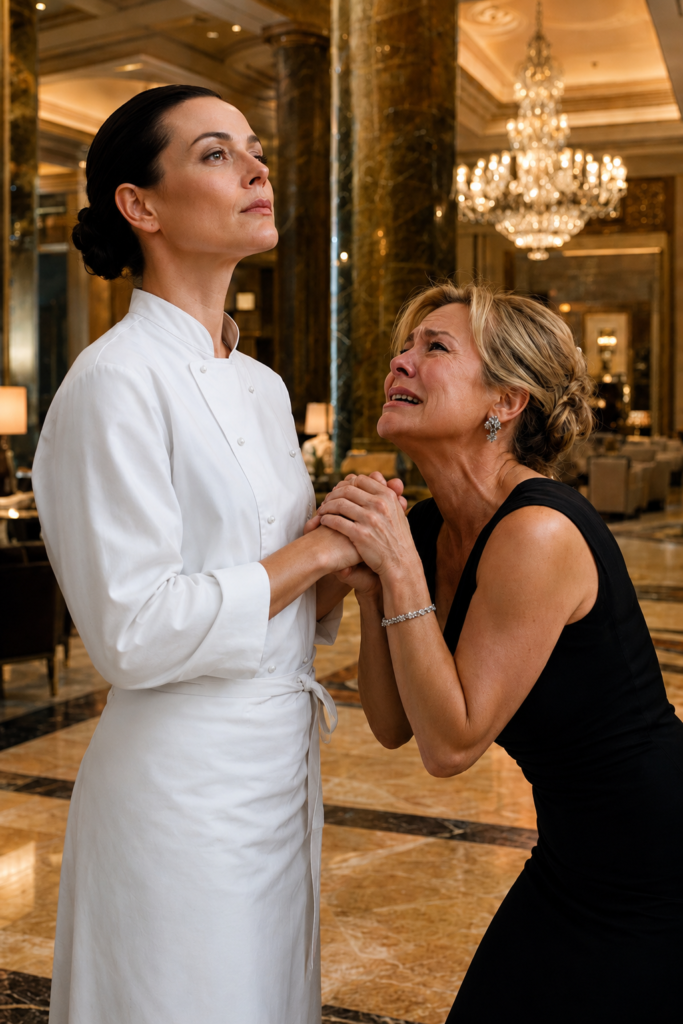
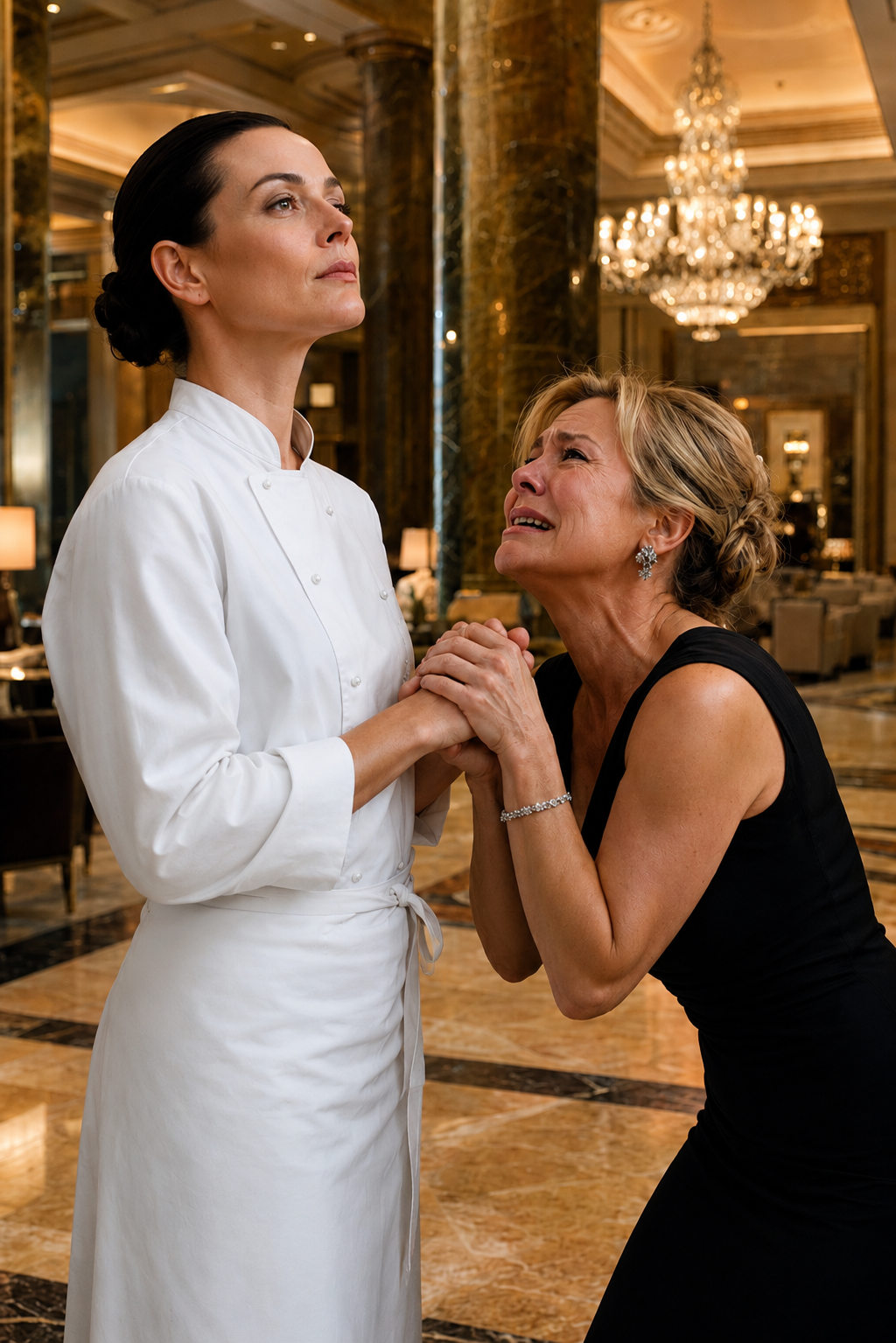
And tonight, Margaret was kneeling before her.
The powerful woman who once looked down on Elena was now shaking with fear.
“Richard is ruined,” Margaret cried. “The investors left us. The hotel is collapsing. They only trust you now. If you leave… everything is over.”
The crowd watched in silence.
Some employees secretly smiled, waiting for Elena to finally take revenge.
Margaret gripped Elena’s hands tighter.
“I know what I did to you was unforgivable… but please… save my family.”
Elena looked down at the woman trembling before her.
For a long moment, she said nothing.
The chandeliers glittered above them while cameras from the gala quietly recorded the humiliating scene.
Then Elena finally spoke.
“When I begged for mercy years ago,” she said calmly, “you never looked at me.”
Margaret broke into louder sobs.
“But I learned something from pain,” Elena continued. “Power shows who you are. Forgiveness shows who I am.”
Everyone froze.
Elena gently removed Margaret’s hands from hers.
“I will save the hotel,” she said. “Not for you. For the workers who will lose their jobs if this place dies.”
Margaret collapsed crying onto the marble floor.
For the first time in twenty years, Elena finally smiled — not because she had won, but because revenge no longer controlled her heart.
And that night, throughout America, the story of the chef who chose dignity over revenge became more famous than any meal she had ever created.As the gala guests stood frozen in silence, Elena turned and walked toward the ballroom kitchen without another word.
Margaret remained on the marble floor, crying quietly while whispers spread across the lobby.
“She forgave her…”
“I would’ve destroyed them…”
“She’s stronger than all of them.”
But Elena’s battle was far from over.
Inside the kitchen, tension exploded like fire.
The hotel’s financial collapse had already reached the staff. Suppliers refused deliveries. Half the workers feared they would lose their jobs by morning.
One young cook slammed a tray onto the counter.
“Why help them?” he shouted. “They ruined your life!”
Others nodded.
Elena slowly removed her chef gloves.
“Because innocent people work here,” she answered calmly. “Dishwashers. Waiters. Single mothers. Young cooks with dreams. Revenge against one family should not destroy hundreds of lives.”
The kitchen fell silent.
That night, Elena created a new menu for the gala using whatever ingredients remained in storage. No luxury imports. No expensive seafood. Just simple food transformed by genius.
Roasted herbs.
Handmade sauces.
Fresh bread.
Old family recipes she learned from her mother long ago.
Guests expected disaster.
Instead, the ballroom erupted in applause.
Food critics attending the gala immediately posted videos online:
“The greatest dining experience in America tonight came from a collapsing hotel.”
By midnight, clips of Elena spread across social media.
Not because of her cooking alone.
But because cameras had secretly captured Margaret kneeling before her.
America became obsessed with the story.
News stations called Elena:
“The Chef Who Rose From Ruin.”
The next morning, investors flooded the hotel with offers.
But Elena had one condition.
Every worker would keep their job.
Kitchen salaries would increase.
And the hotel would create scholarship programs for poor culinary students.
Richard Sinclair, once arrogant and untouchable, sat silently in his office while signing every agreement.
For the first time in his life, power no longer belonged to money.
It belonged to the woman he once ignored.
Days later, Margaret visited the kitchen again.
This time, she did not wear diamonds or expensive dresses.
Only a simple gray coat.
“I came to thank you,” she whispered.
Elena continued slicing vegetables without looking up.
Margaret hesitated before speaking again.
“There’s something you never knew.”
Elena stopped.
Margaret’s hands trembled.
“The necklace… the one you were accused of stealing…” she said softly. “My son took it. He was only sixteen. Richard forced the hotel to blame someone else to avoid scandal.”
The knife in Elena’s hand froze.
For twenty years… her suffering had come from a lie.
Margaret burst into tears again.
“I wanted to tell the truth many times,” she cried. “But I was weak.”
Elena slowly turned toward her.
Pain filled her eyes — not anger, not hatred… just exhaustion from carrying old wounds for too long.
Then she quietly asked:
“Did your son ever feel guilty?”
Margaret nodded.
“He died three years ago in a car accident,” she whispered. “Before he died… he confessed everything.”
Silence covered the kitchen.
Even the cooks nearby stopped moving.
Elena looked out the window at the snowy streets beyond the hotel glass.
All those years of anger.
All those sleepless nights.
All the dreams buried by humiliation.
And the person responsible was already gone.
At that moment, Elena finally understood something terrifying:
Sometimes revenge arrives too late to heal anything.
A single tear rolled down her face.
Then she picked up her knife again and returned to cooking.
Because life, no matter how painful, always continues forward.Weeks passed, but the story refused to disappear.
Everywhere Elena went, people stared.
Some admired her strength.
Others only wanted entertainment from a woman’s suffering.
Television hosts invited her onto famous shows. Publishers offered million-dollar book deals. Streaming companies wanted to turn her life into a drama series.
But Elena rejected them all.
She stayed in the kitchen.
Because cooking was the only place where her heart felt quiet.
One winter evening, after the restaurant closed, Elena found a small envelope resting beside her office door.
No name.
No stamp.
Inside was an old photograph.
A younger Elena stood beside her mother in a tiny apartment kitchen, both smiling while holding a burned birthday cake.
Her hands started shaking.
No one should have had that picture.
At the bottom was a handwritten message:
“Your mother would be proud of you.”
Elena immediately walked outside into the snowy street, searching everywhere.
But whoever left it was already gone.
That night, she could not sleep.
For years, she remembered her mother’s final days as filled with sadness and disappointment. Elena always believed she had failed her.
The next morning, Elena visited the storage room in the basement — a place untouched for decades.
Hidden among old hotel records, she discovered something shocking.
A box.
Inside were letters.
Dozens of them.
All addressed to her.
From her mother.
But they had never been delivered.
Elena opened the first letter carefully, her eyes filling with tears.
“My dear Elena,
If you are reading this, then life has already hurt you again.
I know this world can be cruel to good people. But promise me something:
Never let pain turn your heart cold.
The moment hatred controls you, the people who hurt you win forever.”
Elena covered her mouth as tears streamed down her face.
Letter after letter revealed the truth.
Her mother had known Elena was innocent.
She had believed in her until her final breath.
And hidden in the last envelope was one more secret.
A bank receipt.
Years before her death, Elena’s mother had secretly saved every dollar she could — cleaning houses, sewing clothes, skipping meals — to help Elena someday open her own restaurant.
The amount was tiny.
Not enough to build anything grand.
But to Elena, it felt more valuable than all the hotel’s wealth combined.
For the first time in years, she cried without anger.
Only grief.
And love.
Months later, Elena resigned from the luxury hotel.
The media exploded again.
People thought she was leaving for a richer company.
But instead, on a quiet street far from downtown Chicago, a small restaurant opened with a simple sign:
“Mama Rose.”
No chandeliers.
No marble floors.
No celebrities.
Just warm soup, homemade bread, and recipes passed down from a mother who never stopped believing in her daughter.
At first, only a few customers came.
Then word spread.
Not about luxury.
Not about fame.
But about how people felt when they entered.
Safe.
Seen.
Human.
One evening, an exhausted single father entered with his little daughter. He quietly admitted he could only afford one meal.
Elena personally brought them two full plates.
When he tried to apologize, she smiled gently.
“My mother used to say hungry people should never feel ashamed.”
The little girl hugged Elena before leaving.
And in that small moment, Elena realized something greater than revenge, success, or fame:
The broken parts of her life had not destroyed her.
They had taught her how to heal others.