He said, “Dad, we need your house,” and only after the words had landed between us like a dropped hammer did he add, almost as if he had remembered the proper order too late, “Patricia’s pregnant.”
My fork stopped halfway to my plate.
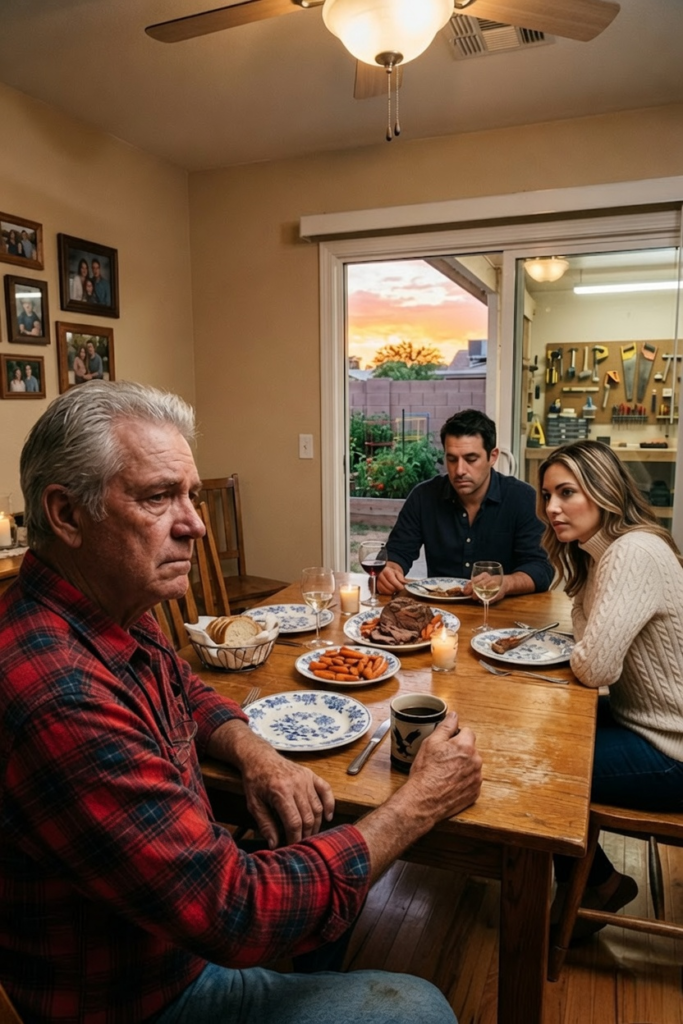
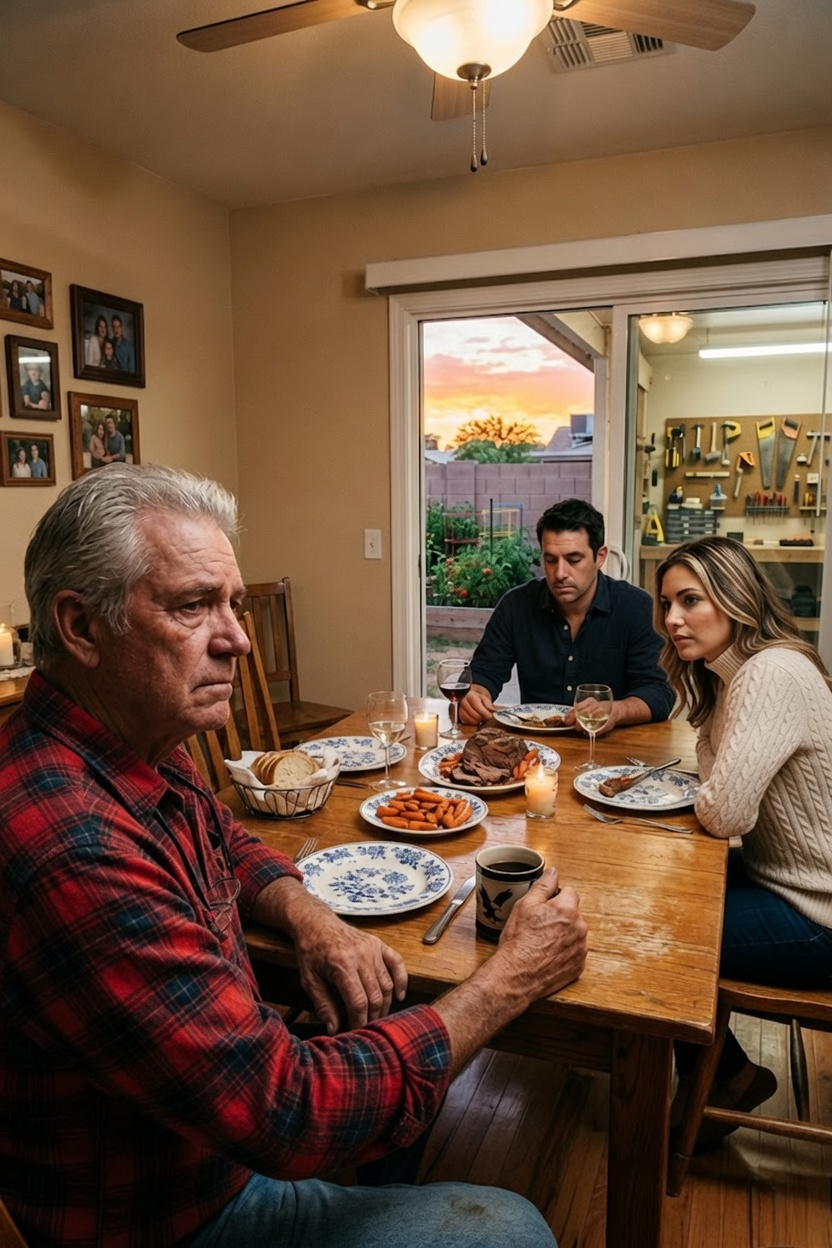
The pot roast I had cooked that afternoon sat in the center of the table, still steaming under the old glass light fixture my wife had picked out in 1996. The dining room smelled of rosemary, black pepper, roasted carrots, and the faint lemon oil I still used on the mahogany table every few weeks because old wood deserves care even when the woman who loved it is no longer there to run her palm across it and tell me I’d missed a spot.
Across from me sat my son Trevor, thirty-four years old, shoulders hunched in a button-down shirt that looked like it had been bought to impress somebody else. Beside him sat Patricia, his wife, one hand resting on the table, manicured nails shining pale pink against the wood I had built myself from salvaged oak fifteen years earlier. Her other hand was not on her stomach. I noticed that later. In the moment, I noticed only her eyes.
She was watching me.
Not glowing. Not emotional. Not waiting for a grandfather’s joy.
Watching.
Calculating.
The late Phoenix sun poured through the dining room windows, turning the dust in the air gold. Outside, beyond the sliding glass door, my backyard sat in the heavy stillness of early evening: tomato cages, pepper plants, the low block wall I had rebuilt by hand after a summer storm knocked part of it loose, and beyond that, my detached garage with its workshop door half open. I could see the pegboard inside from my chair, every tool hanging in its place. Hammers. Clamps. Chisels. Squares. Levels. A framing nailer. The old handsaw my father gave me when I was seventeen and too proud to admit I didn’t know how to cut straight.
Everything in that house had a story.
Every shelf, every hinge, every patch of tile, every cabinet door that closed right because I had made it close right. I had lived in that place for thirty years. Raised my son there. Buried my wife from there. Retired there. Learned how to be alone there without letting loneliness rot into bitterness.
And now my son was sitting at my table telling me he needed it.
Not asking.
Telling.
I set my fork down slowly.
My fingers tightened around my coffee mug, the ceramic still warm beneath my callused hand. I had poured coffee after dinner the way I always did, though Patricia once told me coffee with pot roast was “such an old-man thing.” Maybe it was. I was sixty-five. I had earned old-man things.
I looked at Trevor first.
His eyes were lowered, fixed on the edge of his plate. He had barely touched his food. He used to eat pot roast like he was storing energy for winter, back when he was twelve and always growing out of shoes. Now he sat there pushing carrots around with his fork, letting Patricia do the looking for both of them.
Then I looked at Patricia.
She gave me a small smile.
Not a daughter-in-law smile. Not family.
A saleswoman smile.
I knew that kind of smile. I had worked construction for forty-two years in Arizona, and I had seen contractors, developers, permit men, investors, and homeowners smile like that when they had already decided what your labor was worth before you opened your mouth.
I made myself breathe once.
Then I said, “Congratulations.”
My voice was even.
That surprised them.
Patricia’s fingers tightened slightly around Trevor’s sleeve, as if she had expected something louder. Trevor glanced up, but only for a second.
“Thanks,” he said.
No joy.
No nervous laugh.
No “Can you believe it, Dad?”
No “You’re going to be a grandfather.”
Just thanks.
The silence stretched until even the air conditioning seemed to lower itself out of respect for what was really happening.
Patricia leaned forward first. “We wanted to tell you in person.”
“I appreciate that.”
Trevor cleared his throat. “Our place isn’t big enough.”
“There it is,” I said.
He flinched.
Patricia’s smile vanished and reassembled itself quickly. “Harold, we’re just trying to plan ahead.”
Harold.
She never called me Dad, which was fine. I wasn’t her father. But the way she said my name always sounded like she had underlined it in a complaint.
“For the baby,” she added. “For stability.”
I looked at the table, at the grain of the wood beneath her polished fingers. I had sanded that surface for three evenings after work, back when my knees were better and my wife, Elena, kept coming into the garage with iced tea and telling me I was making more dust than progress.
“Stability,” I repeated.
Trevor looked pained. “Dad, please don’t make this harder than it has to be.”
That sentence did something to me.
Not anger, not yet.
Recognition.
I had heard versions of it before. From clients who wanted extra work without paying. From site supervisors trying to rush concrete before the inspection. From Trevor when he was seventeen and dented my truck after sneaking out to see a girl in Mesa. Don’t make this harder than it has to be usually meant: Please pretend the problem is your reaction, not my decision.
I leaned back just enough to see both of them clearly.
“What exactly are you asking?”
Patricia glanced at Trevor.
Trevor did not answer.
That told me more than words could have.
She took over, folding her hands on the table. “Your house has space.”
“My house does have space.”
“More than you really use.”
The words were smooth, rehearsed, almost gentle.
I looked around the dining room. The built-in china cabinet on the east wall held Elena’s dishes, white porcelain with blue flowers, the ones she bought one place setting at a time from estate sales because we could never afford the whole set at once. The crown molding above it had taken me two weekends because the corners in that room were not square. Nothing in that house was square until I forced it to be. The hardwood floors had been refinished twice, once by me and once by me again because the first time I didn’t like the stain.
More than you really use.
As if the value of a room could be measured only by whether a young family had claimed it.
“As opposed to what?” I asked.
Patricia tilted her head. “We just mean it’s a lot of house for one person.”
Trevor stared at his plate.
I watched him, not her.
That was the first crack in my heart that night. Not what Patricia said. What my son allowed.
He had learned to ride a bike in the driveway. I had taught him multiplication at that table with a deck of playing cards because he hated worksheets. He had cried in the hallway outside his mother’s bedroom the week before she died because he was twenty-four and still not ready to lose her. He had stood beside me at Elena’s funeral with one hand on my shoulder, steadying me when I should have been steadying him.
Now he was letting his wife appraise my home like square footage waiting for reassignment.
“This place is quiet,” Patricia continued. “Stable. It would make things easier for us, especially with a baby coming.”
“Easier.”
She nodded, encouraged. “Yes.”
“Easier for who?”
A faint line appeared between her brows. “For the family.”
I turned the coffee mug slowly in my hand.
Family.
People use that word as if it settles debt. In my experience, family can mean love, duty, sacrifice, history, forgiveness, Sunday dinners, hospital chairs, graduations, casseroles, laughter, grief. It can also mean pressure. It can mean entitlement wearing a soft sweater. It can mean someone reaching for what you built and calling you selfish for noticing their hand.
Trevor finally looked up. “Dad, we’re not trying to take anything from you.”
“No?”
“No. We just thought maybe there’s a way to make things work for everyone.”
“For everyone,” I said.
His jaw tightened.
There were ghosts in that room. I don’t mean spirits. I mean the kind of memory that sits quietly in chairs after people are gone. Elena was there in the blue dishes. My father was there in the old saw hanging in the garage. Trevor as a boy was there in every scuff of the baseboards. I felt all of them watching.
“That is your child,” I said quietly. “Your responsibility.”
The words landed clean.
Trevor’s face changed. Hurt first. Then shame. Then a flash of anger because shame rarely stays honest for long.
Patricia did not look hurt.
That mattered.
She looked inconvenienced.
“You always said you’d help if we needed it,” Trevor said.
The voice was softer now. Closer to the boy who used to come to me with a broken toy hidden behind his back, hoping I would fix it before his mother saw.
“I did,” I said. “And I meant it.”
“Then—”
“I will help you build something. I will not hand you what I built.”
Patricia’s fingers tapped once against the table. She stopped as soon as she noticed me watching.
“You make it sound like we’re strangers,” she said.
“No. If strangers came in here and told me they needed my house, I would have sent them out before the carrots cooled.”
Trevor’s eyes flashed. “That’s not fair.”
“Fair is not asking a retired man to leave the home he built because you and your wife want a shortcut.”
“We’re not asking you to leave.”
I looked at him.
He looked away.
Patricia filled the gap. “There are options. Your house has three bedrooms. You could stay in the smaller room, or even the studio if we converted the garage properly. You love your workshop. It could be like a casita.”
I stared at her.
My workshop.
The one place in the world where every tool fit my hand and every board waiting on the rack still held possibility. The garage where Elena and I stored Trevor’s Little League trophies before he outgrew caring about them. The garage where I built that dining table. The garage where I went after the funeral and sanded a piece of walnut for three hours because making dust was better than screaming.
A casita.
She wanted to turn my workshop into a bedroom and call it kindness.
I stood up.
Both of them stiffened.
I picked up my plate, though I had barely eaten, and carried it to the kitchen. The old tile was cool beneath my shoes. I scraped the food into a container because wasting good pot roast felt wrong even during family collapse.
“What happens now?” Trevor asked from the table.
“Now,” I said, rinsing my plate, “you figure out what you are willing to work for.”
No one spoke.
I put the plate in the sink and turned back to them.
“If you want help making a budget, I’ll sit down with you. If you want me to look at a fixer-upper and tell you what it needs, I’ll do that. If you want help building a crib, I’ll build the safest crib in Phoenix. If you want my house, the answer is no.”
Patricia’s mouth tightened. “Even for your grandchild?”
I looked straight at her.
“If there is a grandchild,” I said, “that child will need parents who know the difference between help and taking.”
The room froze.
That was the first time I saw something like fear pass through Trevor’s eyes.
Not surprise.
Fear.
I did not understand it yet.
But I saw it.
They left twenty minutes later, with normal goodbyes stretched thin over something broken. Patricia kissed my cheek in the entryway without warmth. Trevor hugged me quickly, one hand patting my back twice like he was checking a box.
I stood at the living room window after they drove away, watching the red taillights disappear down Cactus Road into the purple desert dusk.
The house settled around me.
The refrigerator hummed. The grandfather clock in the corner ticked with steady disapproval. The air conditioner clicked on. Somewhere outside, a mourning dove made its sad little call from the block wall.
I turned and looked at the dining table.
Two plates still sat there, food cold, napkins folded wrong.
Elena would have cleaned immediately.
I left them for an hour.
Some messes deserve to be looked at before you wash them away.
The next few weeks felt like walking across a floor that had shifted slightly in the night.
Not enough to fall through.
Enough that every step reminded you something under the surface had moved.
Trevor’s usual Tuesday calls stopped. For years, he had called me every Tuesday evening around seven, not always for long, not always with anything important to say. Sometimes he asked about tools. Sometimes he complained about a client who refused to pay on time. Sometimes he just talked while driving home because traffic on the 101 irritated him and he knew I would listen. After that Sunday dinner, the calls became short texts.
Busy with work. Talk soon.
Then:
Everything good. Hope you’re well.
Then nothing.
I tried calling once. He answered on the fourth ring.
“Hey, Dad.”
The background noise sounded like traffic, though I couldn’t tell whether he was in his truck or standing somewhere outside.
“How’s Patricia feeling?”
A pause.
“Good.”
“Any appointments yet?”
“Yeah, we’re handling it.”
Handling it.
Not excited. Not nervous. Not “The doctor said everything looks good.” Not “We heard the heartbeat.” No due date. No ultrasound. No funny complaint about morning sickness or weird cravings or how the idea of fatherhood was terrifying him in a way he didn’t want to admit.
Just handling it.
I told myself they were embarrassed. Maybe my refusal had wounded them enough that they no longer wanted to share details. Maybe Patricia had decided I was unsupportive and Trevor was caught in the middle. Families can become stupid over pride. I knew that.
Still, something sat wrong.
Three weeks after the dinner, I ran into Trevor outside Sanderson’s Hardware on Maple Street.
Sanderson’s had supplied half the materials in my house over the years. It had the smell all good hardware stores have: sawdust, metal, rubber, fertilizer, paint, dust, and possibility. I had gone in for a replacement valve for the guest bath toilet because after thirty years a house will eventually ask politely for attention before demanding money.
Trevor came out of the plumbing aisle carrying a toilet repair kit.
He looked startled to see me.
That hurt, too.
Not because he had done anything wrong by being surprised. Because a son should not look caught when he sees his father in a hardware store.
“Hey,” I said.
“Dad.”
He wore an old work shirt and jeans. His face looked thinner. Tired. There were shadows under his eyes, and his beard had grown in patchy along his jaw.
“Fixing something?” I asked.
“Apartment toilet. Landlord’s slow.”
I nodded. “That’s how landlords are when they already have your money.”
He gave a small laugh, then looked toward the parking lot.
“How far along is Patricia?” I asked.
The question came out casually.
His reaction did not.
He hesitated.
Not long. Maybe less than a second. But I had spent forty years on job sites reading hesitation. A man asked whether a beam was properly braced hesitates differently when he knows it is not. A subcontractor asked whether the inspection passed hesitates differently when he has already failed. Trevor’s hesitation was not a man searching memory.
It was a man selecting a lie.
“Early,” he said.
“Early.”
“Yeah. Still really early. We’re not telling many people.”
“You told me.”
Another pause.
“Well, family.”
He looked away first.
We talked another minute about nothing. Heat. Work. The Cardinals. The cost of plumbing parts. Then he left, climbing into his truck too quickly.
I stood in the Sanderson’s parking lot with a toilet valve in my hand and the late-afternoon sun burning the back of my neck, watching him pull out onto Maple.
That night, I sat alone at the dining table with coffee and replayed everything.
The order of the announcement. Dad, we need your house. Patricia’s pregnant.
The lack of joy.
The absence of details.
The way Patricia watched me, not Trevor.
The way Trevor looked relieved and terrified at the same time.
When you build things for a living, you learn to trust patterns. One cracked tile is a cracked tile. Three cracked tiles along the same line means movement. A door sticking once might mean humidity. A door sticking every summer means the frame is talking. Buildings speak before they fail. So do people.
My son was speaking.
Even in silence.
The following Thursday, I drove to their apartment complex on Desert Ridge.
It was a beige stucco place with red tile roofs, gravel landscaping, struggling palm trees, and exterior stairs hot enough in summer to cook the bottom of your shoes. I had helped them move there two years earlier, carrying boxes up to the second floor while Patricia stood in the shade texting someone and Trevor kept apologizing for the heat as if Arizona had been his idea.
I parked in visitor parking and sat for a moment with the engine off.
I did not want to do this.
That matters.
People sometimes think boundary-setting feels powerful. Mostly, it feels like walking toward a door you know may not open the same way again.
I climbed the stairs and knocked.
Trevor opened after several seconds.
His face shifted from surprise to guardedness.
“Dad. What are you doing here?”
“Checking on you.”
His hand stayed on the edge of the door. He did not open it wider.
“Patricia’s not home.”
“I came to talk to you.”
“We could’ve talked on the phone.”
“I know.”
I stepped forward.
He hesitated, then moved aside.
The apartment looked different.
Not messy. Not lived-in. Different in the way staged houses look different from homes. A large new television dominated the living room wall, easily sixty-five inches, too big for the room. A white leather sectional I had never seen before filled one corner. Designer handbags sat on the kitchen counter, three of them lined up like items in a shop window. Fresh flowers stood in a tall glass vase near the sink. The coffee table held magazines fanned neatly, their glossy covers showing vacation homes, curated kitchens, clean-faced families wearing linen in rooms that nobody actually cooked in.
Everything looked expensive.
Nothing looked stable.
I knew Trevor’s finances well enough, not from prying but from years of being asked. Freelance IT support, inconsistent clients, occasional contract work, decent skills but no discipline in billing or follow-through. Patricia worked part-time at a real estate office, mostly admin tasks. Together, on a good month, they made enough to live modestly if they were careful.
There was nothing careful in that room.
I did not sit down.
Neither did he.
I turned to face him.
“Trevor,” I said. “Is there really a baby?”
He froze.
That was the answer before his mouth opened.
Not offended. Not confused. Not angry at the accusation.
Still.
Completely still.
The air conditioning rattled on, filling the silence with mechanical breath. Outside, a car door slammed somewhere in the parking lot. Inside, my son stared at the floor like a man watching water rise around his ankles.
Then he exhaled.
“No.”
I felt the word pass through the room and settle.
No explosion came.
No shouted betrayal.
No dramatic collapse.
Just the old, heavy grief of a father understanding that his child had chosen to lie about life itself in order to reach for wood, walls, and square footage.
I nodded once.
“Whose idea?”
He closed his eyes.
“That doesn’t matter.”
“It matters.”
He rubbed both hands over his face. “Patricia brought it up. But I agreed. I said it too. I let it happen.”
That was the first honest thing he had said in weeks.
“What exactly was supposed to happen?”
Trevor sank onto the arm of the sectional. The leather creaked under him.
“We thought if you believed there was a baby, you’d…” He looked around the apartment, not at me. “You’d soften. You’d think about the nursery and the future and Mom.”
My chest tightened at that.
“Don’t bring your mother into this.”
“I know.”
“No,” I said. My voice sharpened for the first time. “You don’t know. Your mother died in the bedroom of that house. She spent years building that home with me. Do not put her name on a lie you used to steal it.”
He flinched.
Good.
Some pain is information finally arriving.
“I’m sorry,” he whispered.
I believed that he was.
I also knew sorry was not a repair.
“How bad is it?” I asked.
He looked up.
“The money.”
His eyes moved toward the television, the bags, the flowers. “It’s not that bad.”
I waited.
He tried again. “We’re behind a little.”
I waited longer.
His shoulders fell.
“Two months rent. Maybe three after next week.” He swallowed. “Four credit cards maxed. Patricia has two I didn’t know about until last month. The car payment is killing us. Mine too. We took out a personal loan when her hours dropped. I thought I’d pick up more contracts, but one client went quiet and another hasn’t paid.”
“How much?”
“Total?”
“Yes.”
He gave a number.
It was worse than I expected. Not catastrophic in the way business failures or medical bills can be catastrophic, but bad enough for people living on appearance and hope. Bad enough that they had started looking around for assets they had not earned.
I looked at the handbags.
“Those?”
He followed my gaze and looked ashamed. “Patricia said she needed to look the part at the real estate office.”
“And the television?”
“I wanted one thing that felt like we weren’t broke.”
That answer was so painfully human that my anger lost its sharpest edge.
Not because it excused him.
Because I understood the temptation.
After Elena and I bought the house, there were months when I wanted one new thing. Just one thing that made it look like we weren’t living inside a construction project. We had subfloor instead of finished flooring, cabinet boxes with no doors, a guest bathroom with a sink sitting in the tub for three weeks because I had mismeasured the plumbing. Our friends bought couches, stereos, patio sets. We ate peanut butter sandwiches and pretended exposed studs had rustic charm.
I knew what wanting relief felt like.
But want does not become wisdom just because it hurts.
“You are not broke because life happened to you,” I said. “You are broke because you and Patricia kept buying the appearance of a life instead of building one.”
His jaw tightened. “That’s not fair.”
“It’s accurate.”
“Everyone does this now.”
“No,” I said. “Everyone wants you to think they do this now. That’s different.”
He stood abruptly and walked to the kitchen, then turned back, restless and trapped. “You don’t get what it’s like.”
“You’re right,” I said.
That stopped him.
“I don’t know what it’s like to build a life while Instagram shows you everyone else’s highlight reel. I don’t know what it’s like to have your wife compare your apartment to houses she tours for work. I don’t know what it’s like to feel poor surrounded by people who are probably in debt pretending not to be.”
His face softened for half a second.
“But I know what it’s like to want more than you have. And I know the difference between wanting and stealing.”
He looked down.
“What do I do?” he asked.
There he was.
Not the husband Patricia spoke through. Not the man trying to manipulate me with a nonexistent grandchild. My son. A scared adult in an apartment full of bad decisions, asking the first useful question.
I could have rescued him then.
Paid the rent. Cleared the cards. Written a check big enough to make the immediate fear disappear. I had the money. Not rich money, not yacht money, but enough. Forty-two years in construction, a pension, savings, a paid-off house, no expensive habits beyond good lumber and black coffee.
I could have made it easy.
That was exactly why I didn’t.
“You make a list,” I said. “Every debt. Every payment. Every account. No hiding. No rounding. Then you cut everything you don’t need. You sell what you can. You talk to the landlord before the eviction notice comes, not after. You get steady work. Not glamorous work. Steady work. And you stop lying.”
He nodded slowly.
“Will you help me?”
“Yes.”
His eyes lifted.
“I’ll help you make the list. I’ll help you plan. I’ll teach you what your mother and I did. I’ll help you build a budget that hurts but works.”
His hope faltered as he realized what was missing.
“I’m not paying it off,” I said.
He closed his eyes.
“I know.”
“No,” I said. “You’re hearing me. I need you to know it.”
He looked at me then, and the boy in him was gone. Not dead. Just hidden behind the man he had become and the consequences arriving faster than he could outrun.
“I know,” he said.
That evening, he came to my house with a cardboard folder full of bills.
Patricia did not come.
We sat at the dining table until almost midnight.
He brought credit card statements, loan documents, rent notices, insurance bills, car payment slips, bank statements, and receipts shoved in envelopes. At first, he tried to explain each number as we wrote it down.
That charge was for a client meeting.
That was Patricia’s work clothes.
That was just one weekend in Scottsdale.
That subscription was supposed to help with leads.
I listened for a while.
Then I said, “The numbers don’t care why.”
He stared at me.
“The numbers care what. How much. When due. Interest rate. Penalty. Consequence. You can explain to yourself later. Right now we need the load.”
He wrote that down.
The load.
By eleven, the truth sat on the table in columns.
Rent behind.
Cards maxed.
Loan due.
Car payments too high.
Income inconsistent.
Spending emotional.
Plan nonexistent.
Trevor stared at the paper like it had insulted him.
“I feel stupid.”
“You were irresponsible. That’s not the same thing as stupid unless you refuse to learn.”
He nodded.
Then he did something he had not done since he was young.
He cried.
Not loudly. No performance. Just one hand over his eyes, shoulders shaking once, then again. I sat across from him and let him have the dignity of not being touched too quickly.
“I’m sorry about the baby lie,” he said.
“I know.”
“I let her talk me into it, but I wanted it too. Not the lie exactly. The house. The feeling of just…” He wiped his face. “Being safe already. Being past the hard part.”
I looked around the dining room.
The house was quiet. The blue dishes in the cabinet. The old clock. The table Elena and I never got to see used by grandchildren, not yet. Maybe not ever. The house had its own grief, and I had spent years mistaking that grief for emptiness other people could fill.
“There is no past the hard part,” I said. “There is only learning which hard parts are worth choosing.”
He listened.
For the first time in a long while, he listened.
Three weeks later, the eviction notice appeared on their apartment door.
I knew because Trevor sent me a photo, not because he wanted me to save him, but because he said, You told me to document everything.
That mattered.
I called him.
“What are you doing next?”
“Patricia’s mother said we can stay there for a month. Maybe two. I’m selling the TV. Listed the sectional. Patricia is furious.”
“I imagine.”
“She says I’m choosing shame over solutions.”
“What does she mean by solutions?”
He went quiet.
“The house?” I asked.
“Yeah.”
“No.”
“I know.”
His voice was tired, but it was steadier than before.
Patricia did not go quietly into consequences.
I learned that from Trevor in pieces, never from her directly at first. She blamed him for confessing. Blamed me for being cold. Blamed the economy, the housing market, Phoenix rent, social pressure, car repairs, her office, his inconsistent income, my empty bedrooms, Elena’s memory, and at one point the entire concept of “generational selfishness.”
What she did not blame was the lie.
That told me all I needed.
A month after they moved into her mother’s house, Patricia came to see me alone.
She arrived on a Tuesday afternoon in a white SUV I knew they could not afford, parking crooked in my driveway like irritation had taken the wheel. I was in the garage workshop, fitting two pieces of walnut for a cabinet I had no real need for but wanted to build because retirement leaves a man with time and time needs shape.
She stepped into the open garage without knocking.
“Harold.”
I looked up from the bench.
She wore sunglasses though she was indoors, a cream blouse, tailored jeans, and the kind of sandals that cost more because they looked simple.
“Patricia.”
“We need to talk.”
I set the plane down carefully.
“Then talk.”
She glanced around the workshop, at the lumber rack, the drill press, the clamps, the old hand tools. Her eyes flicked over everything as if assigning resale value.
“This has gone far enough,” she said.
“That’s true.”
She removed her sunglasses. Her eyes were red, but I did not know whether from crying or anger.
“Trevor is falling apart.”
“He is learning.”
“He’s humiliated.”
“He lied about a child to get my house.”
Her mouth tightened. “We made a mistake.”
“No. You made a plan. It failed.”
That landed.
She looked away toward the backyard. The tomatoes were heavy that week, red against green, bending the cages. Elena loved tomatoes. She used to say store-bought tomatoes tasted like disappointment.
“You don’t understand what it’s like,” Patricia said.
“People keep telling me that.”
“Because you don’t. You already have everything. A paid-off house. Savings. A pension. You got to build your life when things were possible. Do you know what it feels like to know you’ll never catch up?”
I leaned one hip against the workbench.
There it was: the real pain beneath the manipulation.
It did not excuse her.
But it did exist.
“I know what it feels like to think the hill is too steep,” I said. “I also know that lying about pregnancy is not climbing.”
She looked back at me sharply. “You think you’re so righteous because you worked with your hands.”
“No. I think I’m responsible for what I built.”
“And Trevor?”
“He is responsible for what he builds.”
“He’s your son.”
“Yes.”
“And that means nothing?”
“It means I will not destroy him by teaching him that lies work if the lie is emotional enough.”
Her face twisted then. Not into tears. Into hatred.
“You care more about this house than your family.”
I had heard that sentence coming from the moment she stepped into the garage. People who want what is yours often accuse you of loving things too much. It is easier than admitting they love your things more than they love your autonomy.
“No,” I said. “I care about family enough not to let it become theft.”
She stepped closer. “Trevor is going to resent you.”
“Maybe.”
“You’ll lose him.”
“Maybe.”
That answer unsettled her more than argument would have.
Because it was true. I knew the risk. I had sat with it every night since the dinner. Boundary does not come with a guarantee that the people you love will understand. Sometimes you draw the line and watch them walk away from it.
Patricia put her sunglasses back on.
“When he has nothing, remember you chose that.”
I picked up the hand plane again.
“When he starts building something real, remember you tried to stop him.”
She left without another word.
A month later, she left Trevor too.
He called me on a Friday night.
I was on the back porch with coffee, watching a dust storm gather far off beyond the low roofs of the neighborhood. Phoenix monsoon skies have a way of making the world look biblical even when nothing happens but wind and mud on your windshield.
His voice was flat.
“She left.”
I closed my eyes.
“I’m sorry.”
“She says this isn’t what she signed up for.”
“What does she mean?”
“The debt. My job search. Selling things. Living with her mom. Budgeting. Not knowing when we’ll get a place.” He laughed once, bitterly. “Reality, I guess.”
I heard traffic in the background. He was outside somewhere.
“Where are you?”
“Parking lot by the Safeway.”
“You safe?”
“Yeah.”
“Have you eaten?”
“I’m not a kid, Dad.”
“I asked if you’d eaten.”
A pause.
“No.”
“Come over.”
He came over thirty minutes later. His eyes were bloodshot, and he carried himself like a man trying not to bend under visible weight. I made eggs, beans, and tortillas because grief does not care about elegance, but it does better with food.
He ate at the kitchen counter, slowly at first, then like hunger had caught up with him all at once.
“She said I turned into you,” he said after a while.
I took that in.
“Did she mean it as an insult?”
“Yeah.”
“Do you?”
He looked at me then.
“No.”
That was the first real bridge.
Small. Narrow. Not enough to carry everything yet.
But real.
Trevor moved into a rented room for six weeks after Patricia left. Not a good place. Not dangerous, exactly, but noisy, with an evaporative cooler that worked only when it felt appreciated and a roommate who cooked fish at midnight. He hated it. That was probably good for him.
He sold the television at a loss. The sectional too. Patricia took the handbags, though one had been bought on a card in his name. That became a separate argument through text messages he eventually stopped answering. He let the SUV go back because keeping up appearances had become more expensive than losing them. He found steady work doing IT support for a medical practice near Thomas Road. Not glamorous. Not flexible. Not the vague freelance freedom he used to praise. Clock in. Tickets. Workstations. Password resets. Network hiccups. Doctors who clicked suspicious links and blamed the computer.
He complained at first.
Then he started solving problems.
The first time he called me excited about replacing a failing switch before it took down the clinic’s scheduling system, I smiled into the phone and did not tell him he sounded thirteen again, explaining how he had fixed his bike chain without help.
Pride returns strangely.
Not all at once.
At first, it peeks through embarrassment.
Six months after Patricia left, Trevor came by on a Saturday afternoon without warning. He knocked, which I appreciated. I opened the door and found him standing on the porch in jeans and a faded T-shirt, holding a paper grocery bag.
“I brought tamales,” he said.
“Did you make them?”
“No.”
“Then come in anyway.”
He smiled.
We sat at the kitchen table, the same one where the lie had begun. Outside, the desert heat pressed against the windows. Inside, the air smelled like masa, coffee, and the lemon oil I had used that morning.
He looked different. Thinner. Quieter. But not broken.
That matters.
Broken people look hollow. Trevor looked emptied of something that had been poisoning him.
“I found a studio,” he said.
“Where?”
“South of Encanto. Small. Ugly tile. Window unit sounds like a helicopter. But I can afford it.”
“Good.”
“I’m paying down the cards. Two are closed. One on a payment plan. The personal loan is still ugly, but I’m current.”
“Good.”
He unfolded a piece of paper from his pocket and slid it across the table.
A budget.
Handwritten.
Rent. Utilities. Insurance. Food. Gas. Debt payments. Savings.
Savings.
Not much. Fifty dollars every two weeks.
But there it was.
I looked at the number for a long time.
He cleared his throat. “It’s not impressive.”
“It’s a foundation.”
His eyes flicked to mine.
I meant it.
He looked down at the table, fingers tracing a knot in the wood.
“I should have listened.”
“You’re listening now.”
He nodded slowly.
“I don’t know why I thought I could skip everything.”
“Yes, you do.”
He looked up.
“Because I let you skip too much when you were young.”
His face shifted. “Dad—”
“No. Let me say it.” I sat back. “After your mother died, I didn’t want life to take anything else from you. So I made things easy when I should have made some things possible but hard. I paid late fees. Fixed problems. Covered gaps. Smoothed roads. I called it love because it hurt less than calling it fear.”
Trevor stared at me.
“I don’t say that to excuse you,” I continued. “You made your choices. But I helped teach you consequences were negotiable.”
His eyes reddened.
“I was angry at you,” he said. “For not saving me.”
“I know.”
“I’m still angry sometimes.”
“I know that too.”
“But I think…” He swallowed. “I think if you had paid it all off, I’d still be with Patricia, still buying things, still pretending. I’d just owe you instead of Visa.”
That made me laugh quietly.
“Visa sends clearer statements.”
He smiled, then wiped his eyes quickly with the heel of his hand.
We ate tamales. We talked about his job. He asked if I would help him build shelves for his studio apartment because he wanted something decent in one ugly room.
That was a question I could answer.
“Yes,” I said. “But you’re doing the measuring.”
He groaned.
“Especially the measuring.”
Over the next month, he came by on weekends, and we built shelves from pine because pine was what he could afford. We planed, sanded, stained, and sealed them. He learned to measure twice without me saying it. Mostly. He learned that stain shows every lazy sanding mark. He learned that rushing a clamp-up leads to regret. He learned that something made well changes the way a room feels, even if the tile is ugly and the window unit sounds like aircraft.
The day we installed them, I stood in his little studio and watched him set three books, a framed photo of his mother, and a small cactus on the top shelf.
The room was not much.
But it was his.
That is no small thing.
Patricia tried to come back once.
Not to him exactly. To the idea of him improving.
That happened after she heard, through whatever social pipeline people maintain after separation, that he had steady work and his own place. She texted him about closure. Then about talking. Then about how she had been under pressure too. Then about maybe starting over without all the mistakes.
He showed me the messages one Sunday.
“What do you want?” I asked.
He stared at the phone.
“I miss who I thought she was.”
“That’s grief.”
“I’m angry at who she actually was.”
“That’s clarity.”
“Can both be true?”
“Most true things arrive in pairs.”
He thought about that.
Then he typed: I hope you’re well. I’m not interested in restarting anything. Please communicate through email if there is anything legal left to handle.
He showed me before sending, not for permission, but because new habits sometimes need witnesses.
I nodded.
He sent it.
Then he turned off the phone and helped me harvest tomatoes.
A year after the Sunday dinner, Trevor and I drove past their old apartment complex on Desert Ridge because he wanted to show me something nearby.
The beige buildings looked the same. Gravel yards. Palm trees. Exterior stairs. A young couple carried a crib up to the second floor while a toddler sat in the shade with a juice box. Trevor slowed the truck.
For a moment, neither of us spoke.
“You okay?” I asked.
He nodded. “Yeah.”
“You sure?”
“No,” he said honestly. “But close.”
He pulled away from the curb.
“Patricia wanted a house,” he said after a while. “I wanted to be the kind of man who could give her one. But I didn’t want to become that man. I just wanted the result.”
“That’s common.”
“Doesn’t make it less stupid.”
“No.”
He laughed.
A real laugh.
We drove to the medical practice where he worked. He had been promoted from basic support to systems technician. Still not glamorous, but more responsibility. More pay. Better hours. He introduced me to his supervisor, a woman named Denise who wore bright sneakers and looked like she could scare malfunctioning hardware into compliance.
“Your son has good instincts,” she told me.
Trevor looked embarrassed.
“Does he?” I asked.
“He does,” she said. “Still hates documentation, but we’re working on that.”
I looked at him.
He sighed. “I know.”
Afterward, in the parking lot, he said, “It felt good to have you see it.”
“I liked seeing it.”
“I know it’s not construction.”
“Work is work when it holds something up.”
He smiled at that.
By then, the house felt peaceful again.
Not empty. Peaceful.
That distinction took me years to understand.
After Elena died, every room echoed for a while. The bedroom was too large. The kitchen too quiet. The backyard too orderly without her voice telling me I had planted the peppers too close. I thought loneliness meant the house had become too much for one person. That was part of why Trevor and Patricia’s pitch found a tender place, even through the insult. Some small part of me wondered whether a baby in the house might bring back a sound I missed.
Then I realized something important.
A house should not have to be occupied by people who do not respect it just to feel alive.
Life returned in other ways.
Trevor came for dinner on Sundays again, not every week, and never assuming. Sometimes he brought laundry because studio apartments make laundry difficult, but he asked before using the machine and fixed the loose dryer vent without being told. He helped me repaint the guest room, not as a nursery, not as his room, but because the old paint had yellowed. He asked questions about the house’s history. Which wall had been moved? Why did the kitchen window sit slightly off center? How had I learned to cut crown molding? Which projects had Elena designed?
We talked about her more.
That was another gift consequences brought, strangely enough.
For years, Trevor had avoided speaking about his mother directly. Grief embarrassed him. Or maybe he feared mine. After his life cracked open, he seemed less afraid of old pain.
One evening, while we replaced weather stripping on the back door, he said, “Would Mom have hated Patricia?”
I paused with the screwdriver in hand.
“No.”
He looked surprised.
“She would have seen her clearly,” I said. “That’s different.”
He nodded.
“Your mother didn’t waste hatred on people who were already doing enough damage to themselves.”
He smiled sadly. “Sounds like her.”
“She would have been angry at you.”
“I know.”
“And then she would have fed you.”
He laughed, then wiped one eye with his sleeve.
“Yeah,” he said. “I know.”
I updated my will that winter.
Not to punish Trevor. Not to threaten. To make the structure honest.
My lawyer, Sam Aguilar, had an office in a low building near Central Avenue with a water cooler that gurgled every seven minutes like it had something to add. He had handled Elena’s estate years earlier and knew enough of my history not to mistake calm for simplicity.
“You want the house to go into trust eventually?” he asked.
“Yes.”
“For Trevor?”
“Maybe.”
Sam looked over his glasses. “Maybe is not an estate plan.”
I smiled. “For Trevor, with conditions.”
We wrote them carefully. The house would not be sold quickly to cover someone else’s lifestyle. It would not pass to a spouse through pressure. It would be maintained or responsibly transferred. Trevor would have a path, but not an entitlement. If grandchildren came one day, real ones, not invented leverage over pot roast, there would be a structure for them too. Education funds. Maintenance provisions. Protections.
Sam tapped the papers when we finished.
“People get strange about houses.”
“People get honest about houses,” I said.
He considered that.
“Fair.”
When I told Trevor, he listened quietly.
“I didn’t do this to hurt you,” I said.
“I know.”
“Do you?”
He nodded. “A year ago, I would’ve heard conditions and thought control.” He looked toward the workshop window where sunlight fell across a stack of lumber. “Now I hear maintenance.”
That was maybe the proudest I had felt of him in years.
Not because he understood the legal structure.
Because he understood the spirit.
Spring came early that year, as it often does in Phoenix, sneaking in through warm mornings and citrus blossoms before summer slammed its fist down. The garden did well. Tomatoes first, then peppers, then basil that grew like it had something to prove. Trevor helped me install shade cloth before the heat got cruel. We worked in the morning, drank coffee on the back porch, and argued about whether his shelves needed a second coat of finish. They did. He was wrong.
One Sunday, he brought over a young woman named Leah.
Not a girlfriend, he said too quickly.
A friend from work.
She was quiet, practical, with curly hair tied back and a laugh that arrived slowly but honestly. She brought homemade salsa and asked me about the workshop. Not in a polite way. In a real way. She wanted to know how the jointer worked, why I kept different grades of sandpaper in separate drawers, how long it took to make the dining table.
Trevor watched her ask questions with a look on his face I recognized.
Hope, but cautious this time.
Good.
Hope should wear work boots after thirty.
After dinner, while Leah helped wash dishes despite my protests, Trevor stepped outside with me.
“She seems nice,” I said.
“She is.”
“Does she know everything?”
He looked at the garden. “Most of it.”
“Most.”
“I told her about the debt. The separation. The lie.” He swallowed. “Not all the details. But enough.”
“And?”
“She said people can be stupid and still become honest if they stop making excuses.”
I liked her immediately.
“Smart woman.”
“Yeah.”
He kicked lightly at a pebble near the porch step. “I’m not rushing anything.”
“Good.”
“I mean it.”
“I believe you.”
That surprised him.
Maybe it surprised me too.
Trust after betrayal is not given back in one dramatic moment. It returns like irrigation to dry soil, slow and measured. Too much at once runs off the surface. Enough over time sinks in.
Two years after the fake pregnancy dinner, Trevor and I hosted Thanksgiving at my house.
It was small. Me, Trevor, Leah, my sister Rosa and her husband Daniel, two neighbors from across the street, and Sam the lawyer because his kids were out of state and nobody should eat deli turkey alone if a real oven is available. Patricia was gone from our lives by then, remarried or engaged or “doing amazing” according to someone who did not realize I preferred not to know. I wished her no harm. That was not forgiveness exactly. It was distance.
Trevor brought green beans.
He had made them himself.
They were overcooked.
We ate them anyway.
During dinner, Rosa raised a glass. “To Harold’s house,” she said, “which remains stubbornly where it belongs.”
Everyone laughed.
Trevor smiled, but his eyes were serious when they met mine across the table.
“To earned things,” he said.
The room quieted a little.
I lifted my glass.
“To earned things.”
After dinner, while Leah and Rosa packed leftovers, Trevor and I carried chairs back to the garage. The workshop smelled of sawdust, old oil, and the cedar boards I had been saving for a porch bench. He ran his hand over the workbench, the one scarred by decades of projects.
“I used to think this place was just where you hid from us,” he said.
I looked at him.
“When Mom got sick,” he continued. “After she died. You were always out here. Sanding something. Fixing something. Building stuff nobody needed. I thought you were avoiding the house.”
“I was avoiding falling apart in it.”
He nodded slowly.
“I get that now.”
We carried the last chair inside the garage. The desert evening had cooled. The sky beyond the open door glowed purple and orange, the kind of sunset that makes Phoenix look like it has forgiven itself for the heat.
“I’m sorry I didn’t understand what this house meant,” he said.
“You couldn’t yet.”
“That’s generous.”
“No,” I said. “It’s accurate. Understanding comes after cost most of the time.”
He leaned against the workbench.
“Do you ever wish you had just said yes? Maybe not to the house, but to helping earlier? Paying the debt off?”
I thought about it.
The answer deserved honesty.
“Yes.”
He looked surprised.
“I wanted to save you,” I said. “Every day. I wanted to write a check and make your face less tired. I wanted to call Patricia and tell her she was ungrateful and foolish. I wanted to drag you out of that apartment before you hit the floor.”
“Why didn’t you?”
I looked toward the house, where laughter came from the kitchen. For a moment, I could almost hear Elena in it.
“Because I finally understood that saving a grown man from consequences can become a way of stealing his life from him.”
Trevor looked down.
“You earned what you have now,” I said. “It’s smaller than what you wanted, but it’s yours. That matters.”
He nodded.
“It does.”
Later that night, after everyone left, I walked through the house room by room.
The dining room was messy in the best way. Crumbs on the table. Chairs slightly crooked. A wineglass forgotten near the cabinet. In the kitchen, dishes soaked in the sink, and one of Elena’s blue plates sat drying in the rack. The living room smelled faintly of coffee and cinnamon. The guest room stood quiet. The second bedroom held boxes of old photographs and a half-finished cabinet door I planned to repair.
No nursery.
No forced family solution.
No lie sitting under the roof pretending to be love.
Just a house.
My house.
The result of decades of work, sacrifice, stubbornness, grief, patience, and enough mistakes to keep a man humble.
I stepped out onto the back porch.
The garden was dark. The workshop light cast a rectangle of gold onto the concrete. Somewhere beyond the wall, a dog barked. A car passed on Cactus Road. The air smelled faintly of dust and cooling earth.
I thought about the night Trevor said, Dad, we need your house.
I thought about how close love sometimes comes to surrender when it is frightened enough.
I thought about Elena and the one-bedroom apartment above Murphy’s Hardware, where the radiator clanged all night and we ate peanut butter sandwiches for dinner because every extra dollar had a purpose. I thought about her counting change at the kitchen table and laughing when I apologized for not giving her more.
“More is coming,” she said then. “We’re building.”
That was what Trevor had not understood at first.
Building is not wanting the finished thing.
Building is staying when the studs are exposed and the floor is unfinished. Building is driving the same truck when your friends buy new ones. Building is saying no to what feels good now because you made a promise to later. Building is not glamorous. Most days, it looks like dust, sweat, delayed gratification, and nobody clapping.
But if you do it right, one day you look up and the thing stands.
A house.
A life.
A man.
Sometimes the greatest gift you give your child is not rescue, not money, not a room, not a deed, not a softened landing.
Sometimes the greatest gift is a locked door and a hard truth.
Because on the other side of both, if he chooses to do the work, he might finally learn how to build something of his own.
My name is Harold Martinez. I am sixty-seven now. Retired construction foreman. Widower. Father. Owner of a three-bedroom house in Phoenix that still needs more maintenance than I admit out loud.
Trevor has been at the medical practice three years. He moved from the studio into a one-bedroom apartment with central air that works quietly, which he calls luxury. He and Leah are taking things slow, which in my opinion is the only speed that teaches you anything. He brings me receipts sometimes, not because I demand them, but because he likes showing me he has a plan.
Last month, he came by with a small toolbox of his own.
Not borrowed.
Not mine.
His.
He opened it on the workbench like a boy showing me treasure, and inside were good tools. Not the most expensive. Not for show. Useful. Chosen carefully. A tape measure, a square, a set of chisels, screwdrivers, clamps, a hammer that fit his hand.
“I bought them one at a time,” he said.
I ran my hand over the handle of the hammer and nodded.
“That’s how you build a kit.”
He smiled.
“I know.”
We spent the afternoon making a cedar bench for his balcony. He measured, cut, sanded, swore once when the boards didn’t align, then corrected it instead of pretending it was fine. When we finished, he stood back and looked at the bench with quiet pride.
It was not perfect.
That made it better.
The house behind us stood in the late light, stucco warm under the desert sun, windows bright, roofline steady. It has held grief, laughter, lies, apologies, loneliness, Sunday dinners, and more heat than any sensible person would invite into a life. It has been tested.
It still stands.
So do we.