They drop things.
They twist.
They sit on one leg until the leg falls asleep and then hop around laughing about it.
Lila did not twist.
She adjusted.
There was a difference.
She shifted her hips an inch to the left.
She pressed one hand into the edge of the desk.
She straightened with a tiny breath through her nose.
Then she did the whole thing again.
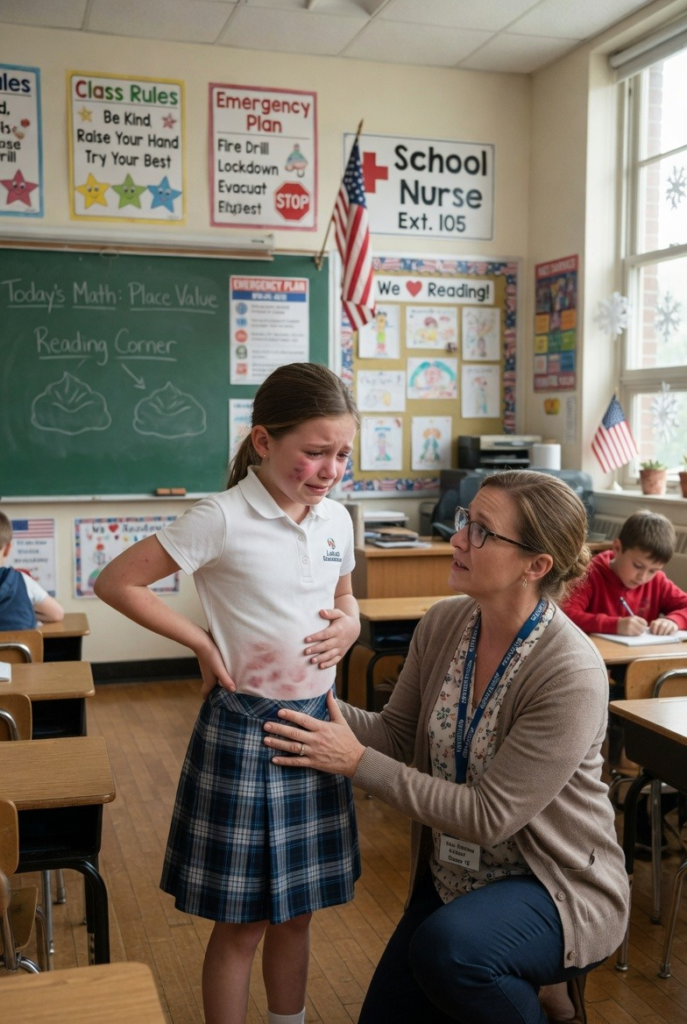
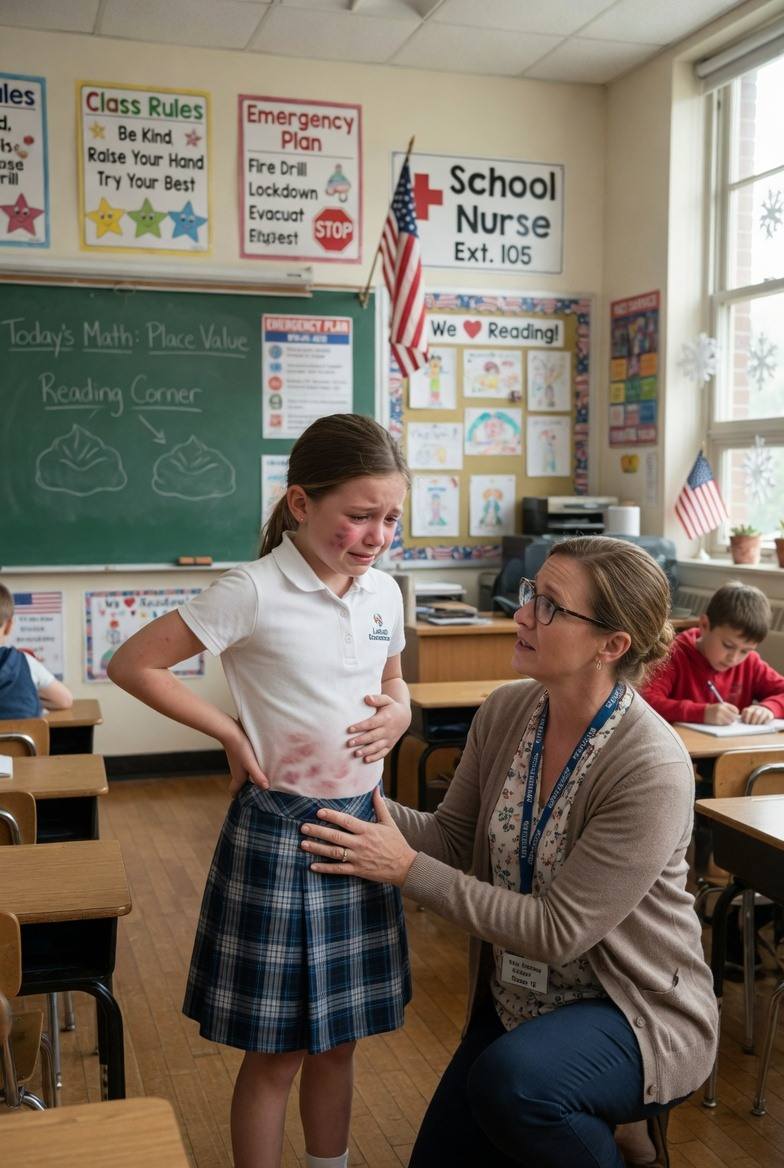
Valerie had seen children come to school with stomachaches, ear infections, new glasses, bruised knees from bikes, and the kind of tiredness that meant a baby had cried all night in the next room.
This was not that.
This was a child trying to make her body disappear without making the movement noticeable.
At 8:19, Valerie marked attendance.
At 8:27, the morning announcements crackled over the speaker.
The principal reminded everyone about picture retake forms and the canned food drive.
The Pledge followed, and the small American flag near the whiteboard hung still in the stale classroom air.
Lila stood with everyone else.
She did not put her hand on her heart right away.
First she braced one palm on the desk.
Then she got upright.
Then she lifted her hand.
It all happened in less than three seconds, and nobody else in the room seemed to see it.
Valerie did.
Some teachers notice when children cannot read yet.
Some notice when lunch accounts are unpaid too many days in a row.
Some notice when a child laughs at the wrong moment, or never laughs at all.
Valerie noticed movement.
Her own mother had been a physical therapist at a rehab clinic outside Pittsburgh, and Valerie had grown up hearing phrases like guarding, compensating, pain response.
She did not diagnose children.
She did not pretend to be a doctor.
But she knew when a body was telling the truth before a mouth was ready.
By 8:42, the class was working on two-digit addition.
Valerie moved between desks, bending to check place value boxes and whisper encouragement over wrong answers that were mostly right thinking.
Lila’s paper was neat.
Too neat, almost.
Every number sat exactly inside its box.
The eraser marks were light because she had not pressed hard enough to make mistakes messy.
“Nice job lining up your tens and ones,” Valerie said softly.
Lila looked up and smiled.
That smile was the second thing that bothered Valerie.
It came quickly.
It left quickly.
It looked less like happiness and more like a door closing.
“Thank you, Ms. Kincaid,” Lila said.
Her voice was polite.
Her body was not.
Her shoulders were tight inside the cardigan.
Her left foot hovered half an inch off the floor, then lowered as if she had remembered to make it behave.
Valerie kept walking.
That was the hardest part sometimes.
Not reacting too fast.
Not turning one child into a spectacle because your own fear had gotten louder than your judgment.
A classroom can become a stage in one second, and children who have learned to hide will punish themselves later for being seen.
So Valerie taught.
She corrected a backwards 3.
She found a missing pencil.
She reminded Jason not to draw dinosaurs in the margin until the work was finished.
She kept Lila in the corner of her eye.
At 8:57, she asked the class to bring their math worksheets to the front.
Usually that meant a crooked line, a little pushing, and at least one child trying to be first even when first did not matter.
That morning, the line formed with its normal soft disorder.
Papers fluttered.
Sneakers shuffled.
A girl with pink beads in her hair asked if she could use the bathroom.
Valerie took each worksheet and laid it on the growing stack.
Lila stayed seated.
She did not look scared yet.
That made it worse.
She looked resigned, like she was waiting for her turn to endure a small task that everyone else could do without thinking.
When the last child before her stepped away, Lila placed both hands flat on her desktop.
She pushed.
Her face changed.
Not much.
Just a pinch around the mouth and a brief closing of the eyes.
Then she stood.
A few papers from her folder slid sideways, and she caught them with one hand against her stomach.
Valerie held herself still.
The aide, Mrs. Carter, was kneeling by the reading shelf, helping two children sort library books.
No one was watching closely enough to understand what was happening.
Lila took one step.
Then another.
The third step landed wrong.
It was not a limp in the movie sense.
No dragging foot.
No dramatic stumble.
It was a small broken rhythm, the kind adults excuse because admitting what they saw would require them to do something.
“Lila,” Valerie said, keeping her voice light. “Are you feeling okay this morning?”
The room did not stop.
That was important.
The question floated under the classroom noise, private enough to let the child answer without a jury.
Lila took a breath.
Her shoulders lifted under the blue cardigan.
They dropped.
“I’m fine, Ms. Kincaid,” she said. “I just need to sit up straight.”
Valerie had heard rehearsed sentences before.
A boy who said, “Mommy says we are between apartments,” while sleeping in the same sweatshirt for a week.
A girl who said, “My uncle is just loud,” while flinching every time the custodian rolled the trash can past the door.
A child who said, “We ate before we came,” with a stomach growling loud enough to interrupt silent reading.
The words matter.
The words behind the words matter more.
“I just need to sit up straight.”
No seven-year-old invented that sentence alone.
Valerie nodded.
She did not ask who told you that.
She did not say, are you hurt.
Not in front of the class.
Not when the child’s face had already gone pale with the effort of standing there.
She only reached for the worksheet.
“Thank you, sweetheart,” she said.
Lila’s fingers opened.
The top page slid free.
Then all the pages went.
White paper fanned out across the tile like startled birds.
For one clean second, there was no sound except the ceiling lights.
Then Lila’s knees folded.
Valerie moved before she thought.
The marker from her hand clattered somewhere near the desk.
She caught Lila under the arms, one hand behind her shoulder blade, the other bracing her side without squeezing.
The child’s weight came into her so suddenly that Valerie’s own knees bent.
She smelled the faint laundry soap in Lila’s cardigan.
She felt how cold the child’s hand was where it brushed her wrist.
She heard somebody gasp.
“Mrs. Carter,” Valerie said.
Her voice sounded calmer than she felt.
“Please call the nurse right now.”
The aide was already moving.
One child started to cry.
Another whispered, “Is she dead?”
“She fainted,” Valerie said, because classrooms need words that do not leave holes for terror to fill. “Everyone stay in your seats. Jason, please pick up the pencil by your foot and put it on your desk. Mia, breathe with me.”
She lowered Lila carefully to the floor but kept the child’s head supported.
Lila’s lashes fluttered.
Her lips had gone almost colorless.
The school nurse arrived in less than a minute, though afterward Valerie would swear those sixty seconds stretched wide enough to live inside.
Nurse Donna Reese came in with the small red medical bag she carried for playground falls and asthma flares.
Her eyes moved quickly.
Child on floor.
Teacher supporting head.
No visible bleeding.
Pale.
Responsive but drifting.
“Lila, honey, can you hear me?” Donna asked.
Lila made a sound, not quite a word.
Donna checked her pulse at the wrist, then looked at Valerie.
“Let’s get her to the office cot.”
They moved carefully.
No rushing.
No panic.
The children watched with round faces.
Valerie wanted to tell them that adults always know what to do.
She did not, because it was not true.
What adults know, when they are good adults, is that fear is not allowed to be louder than the child who needs you.
In the nurse’s office, everything looked too bright.
The paper on the cot crinkled under Lila’s small body.
A laminated emergency chart hung near the door.
There was a first-aid poster, a handwashing poster, and a cluttered bulletin board with permission slips pinned beneath a tiny American flag.
Donna wrapped a blood pressure cuff around Lila’s arm.
The Velcro made a rough ripping sound.
Valerie stood near the foot of the cot with the fallen math worksheets gathered in both hands.
She had picked them up automatically.
Now she could not put them down.
The top one had Lila’s name written in careful pencil at the upper corner.
Lila Mercer.
Room 204.
Thursday.
Donna wrote 9:03 a.m. on the intake pad.
“Pulse is fast,” she said quietly.
She pumped the cuff again.
The room filled with the small rubbery breath of it.
“Blood pressure’s low.”
“Could she be dehydrated?” Valerie asked.
It was not really a question.
It was a door.
A normal door.
A door everyone in that room would have preferred to walk through.
Donna glanced at the child’s face.
“Could be,” she said.
Then she looked at Lila’s hands.
They were gripping the edge of the cot paper.
Not the blanket.
Not her cardigan.
The paper beneath her.
As if she needed to hold on to proof that she was still there.
Lila’s eyes opened.
They found the ceiling tiles first.
Then Donna.
Then Valerie.
Something in her face shifted when she saw Valerie, and it broke the teacher more than tears would have.
Trust, when it appears in a frightened child’s eyes, does not feel like a compliment.
It feels like responsibility.
Valerie crouched beside the cot.
“Hi, sweetheart,” she said. “You gave us a scare.”
“I’m sorry,” Lila whispered.
“You are not in trouble.”
The answer came too fast.
“Okay.”
Donna’s pen moved across the intake pad.
Time.
Observed fainting episode.
Low blood pressure.
Classroom collapse.
Parent contact pending.
Those process words mattered.
They were dry and plain and nothing like the pressure building in Valerie’s chest.
But dry words are how frightened moments survive being challenged later.
A note.
A time.
A direct quote.
A record made before anyone can explain it away.
Donna asked, “Did you eat breakfast?”
Lila nodded.
“What did you have?”
The child paused.
“Toast.”
“With anything on it?”
Another pause.
“No.”
Valerie watched Donna write again.
The nurse did not change her tone.
“Okay. Any headache?”
Lila shook her head.
“Stomachache?”
Another shake.
“Does anything hurt?”
The room became too quiet around that question.
Even the front office copier beyond the wall seemed to stop.
Lila’s fingers tightened.
The cot paper wrinkled under her hand.
Valerie could see the tendons stand out on the back of those tiny fingers.
“My dad said it wouldn’t hurt,” Lila whispered. “But it does.”
Donna’s pen stopped.
Not for long.
A second, maybe less.
Then she wrote the sentence down exactly.
Quotation marks.
No interpretation.
No softening.
No adult translation.
Valerie felt heat rush to her face and then drain away.
There are moments when anger tries to dress itself as action.
It tells you to demand, to shake answers out of the air, to run down the hallway and find the person who put fear into a child’s mouth.
But rage is not care.
Care is staying useful.
So Valerie stayed useful.
“What hurts, honey?” Donna asked.
Lila looked toward the closed office door.
That was the answer before the answer.
Valerie saw it.
Donna saw it.
Neither of them said so out loud.
The phone rang.
All three of them flinched in different ways.
Donna reached for it.
“School nurse’s office.”
She listened.
Her face did not change, which told Valerie everything.
“Yes,” Donna said. “She’s with me right now.”
A pause.
“No, do not send him back.”
Lila’s hands flew to her mouth.
Valerie moved closer to the cot, not touching her yet, just close enough that the child could see she was not alone.
Donna turned slightly away from Lila and lowered her voice.
“Tell Mr. Mercer she is being assessed. Ask him to wait in the main office. I’m calling administration.”
She hung up.
For a moment nobody spoke.
Outside the small office, the school day continued to pretend it was ordinary.
A locker door closed somewhere.
A child laughed in the hallway.
The PA system clicked, then stayed silent.
Lila began to shake.
Not big sobs.
Not a scene.
Just one tremor through her shoulders, then another.
Valerie sat beside the cot and placed her palm flat on the mattress, a few inches from Lila’s hand.
She did not grab.
She did not force comfort.
She made the choice visible and let the child decide.
After several seconds, Lila’s fingers moved.
They touched Valerie’s sleeve.
That was all.
It was enough.
Donna had already pulled the district incident form from the side drawer.
She wrote the date.
She wrote the time.
She wrote Room 204.
She wrote Valerie’s name as witness.
Then she picked up the phone again and called the principal.
“Mark,” she said when he answered. “I need you in the nurse’s office. Now. And keep Mr. Mercer in the front office.”
The principal came quickly.
Mr. Hanley was a quiet man with silver hair, reading glasses on a cord, and the tired patience of someone who had spent twenty-nine years learning how many kinds of trouble can fit inside a school building.
He stepped in, saw Lila on the cot, saw Valerie’s face, saw Donna’s incident form, and did not ask a foolish question.
Donna handed him the pad.
He read the direct quote once.
Then again.
His jaw tightened.
“Has a guardian been notified?” he asked.
“Father is in the main office,” Donna said. “He arrived before we called home.”
That detail settled over the room.
Valerie saw it land in the principal’s face.
Before we called home.
Mr. Hanley looked at Lila, then softened his voice.
“Hi, Lila. I’m going to stand over here by the door, okay? Ms. Kincaid and Nurse Reese are staying with you.”
Lila nodded without looking at him.
That, too, told them something.
Donna stepped into the hallway with Mr. Hanley for less than a minute.
Valerie heard only pieces.
Mandated report.
County line.
Documented statement.
No private release until guidance is clear.
When Donna returned, her face was composed.
“Lila,” she said, “we’re going to make a few calls to get help from people whose job is to keep kids safe.”
At the word calls, Lila’s eyes filled.
“Will he be mad?”
Valerie’s throat tightened.
She wanted to say no.
She wanted to promise what no adult had the right to promise.
Instead she said, “You did the right thing by telling us you hurt.”
Lila stared at her.
“I didn’t mean to.”
“I know,” Valerie said. “Sometimes the truth comes out because your body needs help before your voice is ready.”
The child blinked, and one tear slipped sideways into her hair.
In the main office, Mr. Mercer’s voice rose.
It was muffled by walls and hallway distance, but everyone heard the shape of it.
A man insisting.
A secretary answering.
A chair leg scraping.
Lila’s breathing changed.
Valerie leaned forward.
“Look at me,” she said softly. “Just at me.”
Lila did.
“Can you count the blue things in this room?”
The child’s eyes flicked around.
“My sweater.”
“Yes.”
“The cup.”
“Yes.”
“The poster.”
“Good.”
“The pen.”
Donna held up the blue pen without making a big deal of it.
Lila breathed in.
The counting helped.
Not enough.
But help does not need to be enough to be worth giving.
Mr. Hanley opened the door halfway and stepped in, keeping his body between the hallway and the cot.
“He’s asking to take her to a doctor himself,” he said.
Donna did not look surprised.
“Emergency medical evaluation is already being arranged,” she said.
Valerie looked at her.
Donna met her eyes.
No one had said ambulance yet in front of the child.
No one had said report in front of the father.
The adults were building a wall out of plain steps.
Call administration.
Document statement.
Keep child supervised.
Notify proper channels.
Arrange medical evaluation.
Do not let fear walk her out the door.
At 9:21 a.m., Donna copied Lila’s exact sentence onto the district incident form.
At 9:24 a.m., Mr. Hanley logged the father’s early arrival in the front office record.
At 9:28 a.m., Valerie wrote a short statement of what she had observed in Room 204: difficulty standing, uneven gait, collapse, child’s quote in nurse’s office.
She did not add guesses.
She did not add anger.
She wrote what happened.
That was harder than it sounded.
Anger wanted adjectives.
Care required facts.
In the hallway, the front office secretary’s voice stayed polite, but firmer than before.
“Sir, you’ll need to remain here.”
A door opened.
Another adult voice entered.
Low.
Official.
Lila heard it and pressed closer to Valerie’s sleeve.
“Is he coming?”
“Not in here,” Valerie said.
This time she could promise that.
The nurse’s office door remained closed.
The math worksheets sat on Donna’s desk, the top page still showing neat rows of tens and ones.
Valerie looked at them and felt a terrible tenderness for the order of them.
A child in pain had still tried to line up her numbers.
A child afraid enough to watch doors had still waited her turn.
A child whose body could not make it across a classroom had apologized for fainting.
That was what stayed with Valerie.
Not only the sentence.
The training covered the sentence.
The forms held the sentence.
The adults responded to the sentence.
What stayed was everything before it.
The hand on the desk.
The too-neat smile.
The instruction disguised as an answer.
I just need to sit up straight.
By lunchtime, Room 204 had a substitute for thirty minutes while Valerie gave her written statement.
The children were told that Lila was being helped and that they had done a good job staying calm.
One little boy asked if he could make her a card.
Valerie said yes.
He drew a sun with long orange lines and wrote, Get better soon, Lila, in letters that leaned uphill.
He did not know what adults knew.
That was a mercy.
By the end of the day, Valerie walked back into her classroom and found one math worksheet still under the edge of her desk.
It must have slid there when Lila fell.
She picked it up carefully.
There was a smudge near the corner where a small hand had gripped too tightly.
She did not throw it away.
She placed it in the folder with her statement because sometimes the smallest paper in the room is the one that tells the truth first.
Weeks later, Valerie would still think about that morning whenever the first cold air of fall came through the classroom door.
She would still hear the scrape of chair legs.
She would still see the pale blue cardigan.
She would still remember the exact discipline it took not to let horror show on her face when a child finally trusted the room enough to whisper.
The world often tells teachers they are there to teach reading, math, spelling, and how to stand in line without poking the person in front of you.
That is true.
It is just not the whole truth.
Sometimes a teacher is the first adult to notice that a child is walking like every step has a secret.
Sometimes a teacher is the first person who understands that quiet does not always mean okay.
And sometimes the most important lesson in the room is not written on the board at all.
It is written in the way an adult lowers her voice, kneels beside a cot, and says without saying it: I see you.
You are not in trouble.
We are not sending you back into the hallway alone.
Valerie never told the class everything that happened.
She never needed to.
The room changed anyway.
The children became gentler for a while.
They left space when someone moved slowly.
They stopped laughing when somebody dropped papers.
And every morning after that, when Valerie took attendance, her eyes did what they had always done, only with sharper devotion.
She looked beyond raised hands.
She watched how children stood.
She listened for sentences that sounded too practiced.
She paid attention to the child who waited until last.
Because that Thursday in October, Lila Mercer did not ask for rescue with a scream.
She asked with a limp, a worksheet, a collapse, and seven words that turned an ordinary school morning into the kind of memory a good teacher carries forever.
“My dad said it wouldn’t hurt… but it does.”
And Valerie Kincaid made sure the room answered correctly.