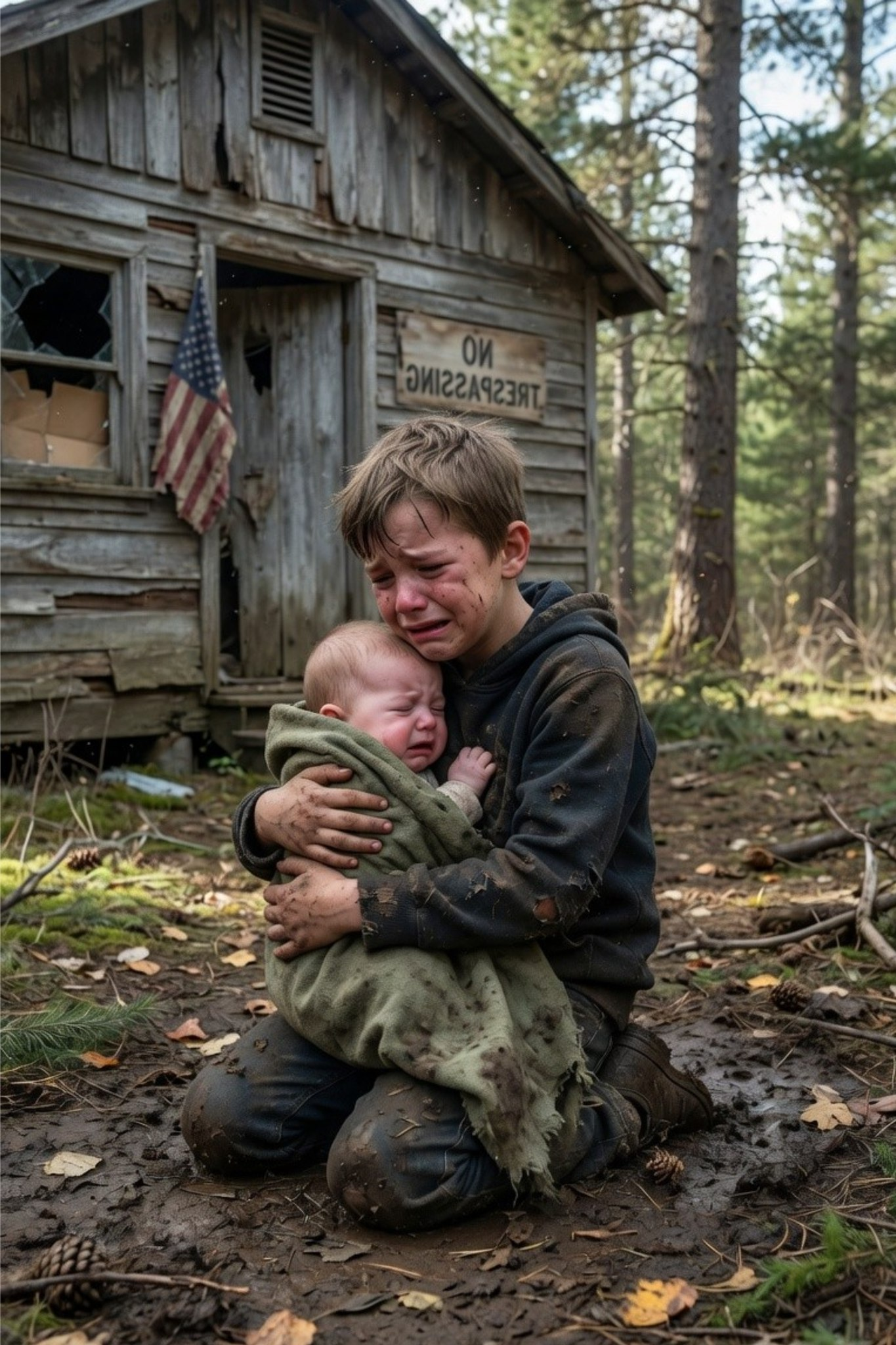
Because I knew those woods.
Every child near San Jerónimo knew them.
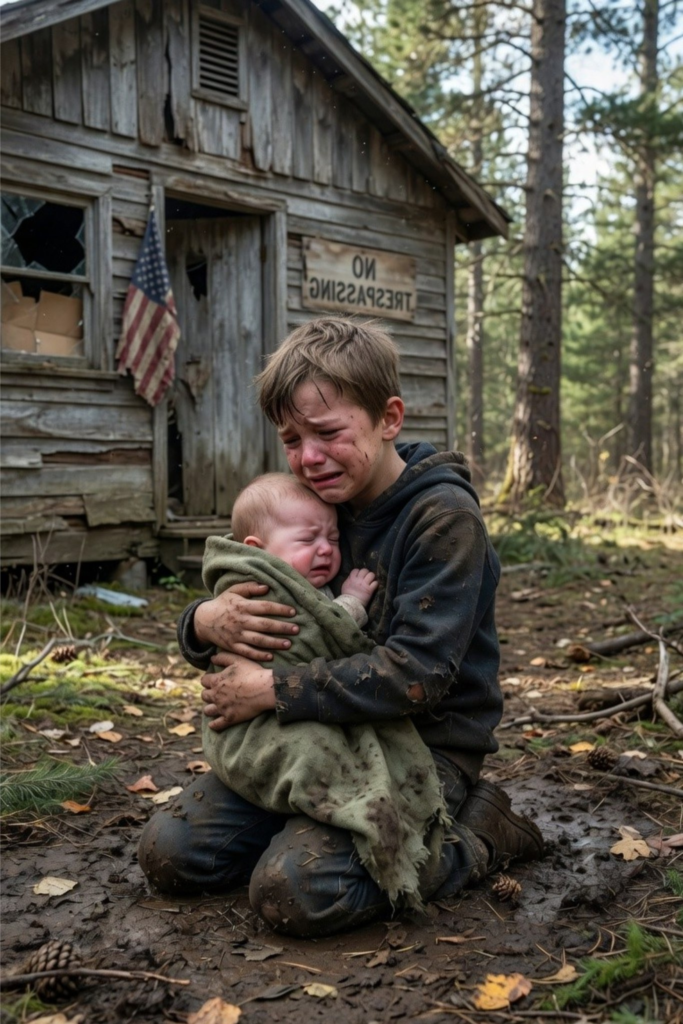
The lumber men cut through the eastern ridge twice a month, and hunters crossed the creek during rabbit season. There was no cabin in that clearing. No chimney. No lantern hook. No path leading toward it.
Yet there it stood.
Dark wood.
Small porch.
A thin ribbon of smoke rising from the chimney into the dying October sky.
Violeta stirred weakly in my arms and coughed against my neck.
That decided it.
I forced myself up from the frozen ground and walked toward the cabin carefully, every step making the pine needles crack softly beneath my boots.
The closer I came, the stranger the place felt.
Not abandoned.
Not ruined.
Lived in.
The windows glowed amber with firelight. A stack of chopped wood stood neatly beside the wall. Snowberries hung drying from a cord beneath the porch roof.
And the smell—
God.
Warm bread.
Real bread.
After two days of cold air and hunger, the scent nearly made my knees fail again.
I climbed the porch steps slowly.
The boards creaked under my weight.
For one terrible moment, I imagined Bernarda opening the door somehow, smiling that thin smile she used when she wanted suffering to last longer.
Instead, the door opened before I touched it.
An old woman stood there holding an oil lamp.
Her hair was white as frost and braided down one shoulder. Deep lines folded around her mouth, but her eyes were sharp and dark like wet earth after rain.
She looked first at me.
Then at Violeta.
And something in her face changed instantly.
Not surprise.
Recognition.
As if she had been waiting.
“You took too long,” she said softly.
I froze.
The lamp flickered between us.
“I…” My throat cracked. “Ma’am, we don’t want trouble. My sister’s sick.”
The old woman ignored me completely.
She stepped aside and opened the door wider.
“Bring the child inside before the cold keeps her forever.”
The heat hit us first.
Thick.
Heavy.
Wonderful.
My frozen fingers burned as feeling rushed back into them. Violeta whimpered against my chest when the warmth touched her cheeks.
Inside, the cabin was larger than it looked from outside.
Bundles of herbs hung from the ceiling beams. Jars lined rough wooden shelves. A black iron stove crackled beside a table scarred by years of knife marks and hot pans.
And there was food.
A loaf of bread wrapped in cloth.
Beans simmering in a pot.
Dried apples.
A wedge of white cheese.
I stared too long because the woman said quietly:
“You can look at food without apologizing in this house.”
Those words nearly undid me.
She pointed toward a chair beside the stove.
“Sit.”
I obeyed immediately.
My legs trembled so badly I almost dropped Violeta lowering myself into the chair.
The old woman moved quickly after that.
Blankets.
Warm water.
A spoon.
She touched Violeta’s forehead and frowned deeply.
“How long has the fever been climbing?”
“I don’t know.”
“When did she last eat?”
I swallowed.
“Yesterday morning.”
The woman closed her eyes for one long second.
Not angry.
Worse.
Heartbroken.
She took Violeta gently from my arms, and panic shot through me instantly.
“No—”
“She needs both hands tending her,” the woman said firmly. “And you’re shaking hard enough to fall over.”
Only then did I realize she was right.
My whole body trembled uncontrollably.
The old woman wrapped Violeta in thick quilts near the stove and began mixing something bitter-smelling in a cup.
I stood halfway from the chair.
“What is that?”
“Willow bark. Honey. Pine resin.”
“Will it help?”
“If God allows.”
That answer frightened me.
She cooled the spoon with her breath and carefully fed Violeta tiny drops. My sister barely swallowed at first. Then a little more.
The old woman nodded once.
“Good girl.”
I watched every movement.
Every breath.
Every blink.
The woman noticed.
“You’ve been taking care of her alone for a long time.”
I looked down at my torn boots.
“She cries less with me.”
Silence settled after that.
Not uncomfortable silence.
The kind that lets exhausted people breathe.
The old woman finally handed me a thick slice of bread spread with dripping butter.
I stared at it.
Real butter.
I could smell the salt.
“Eat,” she said.
I took one bite too fast and pain stabbed my stomach instantly.
She clicked her tongue.
“Slowly. Your body forgot abundance.”
Nobody had ever spoken to me like that before.
As if hunger were an injury instead of a failure.
Hours passed.
Outside, darkness swallowed the woods completely. Wind scratched branches against the cabin roof.
Inside, the stove glowed red.
Violeta’s breathing slowly deepened beneath the blankets.
For the first time in two days, she stopped shivering.
I nearly cried from relief.
The old woman sat across from me mending a shirt by lamplight.
Finally, she asked:
“What is your name?”
“Mateo.”
“And the child?”
“Violeta.”
At the sound of her name, the woman’s sewing needle stopped moving.
Only for a second.
Then she continued.
“How old?”
“She turned two in August.”
Again that strange look crossed the woman’s face.
Recognition.
Grief.
Something else too old for me to understand then.
“And your father?” she asked carefully.
“Tomás Aguirre.”
The needle slipped from her fingers.
It struck the floorboards with a tiny metallic click.
The room went very still.
Even the fire seemed quieter.
The woman lifted her eyes slowly toward me.
“What did you say?”
“My father’s name.”
Her face had gone pale.
Older somehow.
“What happened to your mother?”
I touched the medal in my pocket automatically.
“She died when Violeta was born.”
The woman stood abruptly so fast her chair scraped backward.
She turned away from me toward the fire.
One hand covered her mouth.
Her shoulders shook once.
Then she whispered something I almost did not hear.
“No… he told me they both died.”
Cold moved through my stomach.
Not outside cold.
Something worse.
“What?”
The woman looked at me again, and suddenly I understood something terrifying:
She knew my father.
Not casually.
Personally.
Very personally.
She crossed the room slowly and crouched in front of me.
Up close, I noticed her eyes shining with tears.
“What was your mother’s name?”
“Lucía.”
The old woman made a broken sound deep in her throat.
Then she reached trembling fingers toward my face like she could not believe what she was seeing.
And whispered:
“I am your grandmother.”PART 3
I did not understand the words at first.
Grandmother.
The room felt suddenly too warm, too small, too bright.
Because my mother had never spoken about parents.
Not once.
When I was little and asked whether she had a mother like other children did, she would smooth my hair quietly and say only:
“Some people lose their families before death takes them.”
That was all.
So I stared at the old woman while the stove cracked softly behind her.
“You’re lying,” I whispered automatically.
Not because I wanted to hurt her.
Because hope is dangerous when you are starving.
The woman nodded slowly like she expected that answer.
“I would not blame you for believing that.”
She rose carefully and crossed toward an old cedar chest near the back wall. From inside, she removed a bundle wrapped in faded cloth.
Her hands trembled opening it.
Inside lay several letters tied with blue ribbon.
And a photograph.
Very old.
Edges cracked.
She handed it to me.
A young woman stood beside a river wearing a plain white dress. Wind lifted strands of dark hair across her cheek. Her eyes looked serious even while smiling.
My chest tightened painfully.
Because I knew that face.
I had seen it reflected every morning in a cracked washbasin mirror.
My mother.
Younger than I remembered her.
Alive.
Beside her stood the old woman now kneeling before me.
Only younger too.
Dark-haired.
Proud.
One hand resting protectively on my mother’s shoulder.
“I took that picture in the spring of 1878,” the woman whispered. “Your mother was seventeen.”
I looked from the photograph to her face.
Same eyes.
Same jaw.
My stomach twisted.
“Why didn’t she ever tell me about you?”
The old woman closed her eyes.
“Because my husband forbade her from ever speaking our name again.”
Outside, wind slammed branches against the cabin.
The sound made Violeta stir beneath the blankets.
The old woman—my grandmother—looked toward her instantly with raw fear in her expression, as though terrified the child might vanish if left unwatched too long.
Then she turned back to me.
“My name is Elena Vargas,” she said softly. “And your mother was my only daughter.”
I stared at the letters.
At the photograph.
At the face that looked too much like my own to deny.
“But… my father said Mama had nobody.”
Elena laughed once.
A terrible sound.
“Telling lies becomes easier when the truth embarrasses a man.”
I stiffened immediately.
Nobody spoke badly about my father.
Not even Bernarda.
Especially not strangers.
Yet something inside me already feared she was telling the truth.
Elena sat slowly beside the stove and folded her weathered hands together.
“When Lucía was eighteen, she fell in love with your father. Tomás worked at the sawmill then. Handsome. Charming. Poor.”
The fire popped sharply.
“My husband despised him.”
“Why?”
“Because Tomás owned nothing. No land. No cattle. No respectable family name.”
I looked down.
That sounded exactly like the grandfather I imagined from my mother’s silences.
“He forbade your mother from seeing him. Locked her inside the house twice.”
My throat tightened.
“But your mother…” Elena smiled sadly. “Your mother had more courage than obedience.”
For the first time since entering the cabin, warmth touched the story.
I could almost see my mother laughing somewhere beneath it.
“Eloped?” I whispered.
Elena nodded.
“One stormy night, she climbed from her bedroom window and ran away with your father.”
I looked again at the photograph.
My mother’s smile suddenly seemed different.
Not peaceful.
Determined.
“What happened after?”
Elena’s face darkened.
“My husband disowned her by morning.”
Silence settled heavily.
“He told the entire valley she was dead to us. Burned her letters unread. And when I tried to contact her secretly…”
Her voice cracked.
“He beat me.”
I froze.
Elena stared into the fire for several moments before continuing.
“Three years later, I learned Lucía had given birth to you.”
My breath caught.
“I begged to see her.”
“Did you?”
She shook her head slowly.
“Your father refused.”
That struck me harder than anything else.
Refused.
“Why?”
At this, Elena hesitated.
And hesitation frightened me more than anger.
Finally she whispered:
“Because by then, Tomás had discovered something.”
The room seemed to lean closer around us.
“What?”
Elena looked directly into my eyes.
“The land your father worked on did not belong to the sawmill.”
I frowned.
“I don’t understand.”
“It belonged to me.”
The wind outside moaned through the trees.
Elena stood and crossed toward the window, pulling the curtain aside slightly to stare into the dark woods.
“This cabin,” she said quietly, “and the forest around it were part of my family’s property long before your father was born.”
I looked around the room differently then.
The strong beams.
The careful shelves.
The thick quilts.
Not poor.
Simple, yes.
But not poor.
“When my husband died in 1887, everything passed to me.”
She let the curtain fall.
“And suddenly the daughter he had exiled became useful again.”
Cold crept slowly into my stomach.
“You mean my father came back?”
Elena nodded.
“He arrived drunk one winter evening carrying flowers and apologies.”
I could picture it too easily.
Tomás smiling.
Tomás promising.
Tomás saying exactly what people wanted to hear.
“I wanted to believe him,” Elena admitted. “Because believing your child chose love over pain is easier than accepting the opposite.”
Her eyes filled again.
“So I forgave him.”
The fire cracked.
Violeta coughed weakly in her sleep.
Elena rushed immediately to adjust the blanket around her tiny shoulders before continuing.
“Months later, your mother died giving birth to your sister.”
I lowered my head.
Even after four years, hearing it aloud still hurt like fresh injury.
“She bled for hours,” Elena whispered. “And your father never sent for me.”
I looked up sharply.
“You knew?”
“A midwife from town told me afterward.”
Her jaw tightened with old rage.
“Lucía begged for me before she died.”
Something inside my chest tore open.
I remembered my mother only in pieces now.
Warm hands.
A humming voice.
The smell of soap.
But suddenly grief flooded back so violently I could barely breathe.
Elena crouched before me again.
“He told me she died peacefully,” she whispered. “But the midwife said your mother cried until the end asking for her children to know they were loved.”
Tears blurred my vision instantly.
I covered my face.
And for the first time since Bernarda shoved us into the woods, I cried like a child instead of a brother.
Elena pulled me carefully against her shoulder.
Not forcing.
Just there.
Steady.
Like she had been waiting years to hold someone from her daughter again.
After a long time, she spoke softly into my hair.
“Do you know why Bernarda truly threw you out?”
I wiped my face.
“She hated us.”
“Yes,” Elena said. “But hate alone does not abandon children to die in October.”
Fear crawled slowly up my spine.
“Then why?”
Elena looked toward the cedar chest.
Toward the letters.
Toward something buried much deeper than memory.
“Because three weeks ago,” she whispered, “your father discovered what Lucía inherited before she died.”
The room went silent.
“What did she inherit?”
Elena’s expression hardened into something dangerous.
“This land.”
My heart stumbled.
“What?”
“Your mother was my only child,” Elena said. “Everything I own legally passed to her after my death.”
I stared blankly.
Then understanding began creeping slowly into place.
After Lucía died…
That inheritance should have passed to us.
To me.
To Violeta.
Elena nodded as though hearing my thoughts.
“And if both of you disappeared…”
The horror landed all at once.
My father.
Bernarda.
The fourteen pesos.
The hunger.
The cold.
Not neglect.
Preparation.
They had not thrown us away because feeding us cost too much.
They threw us away because dead children cannot claim land.