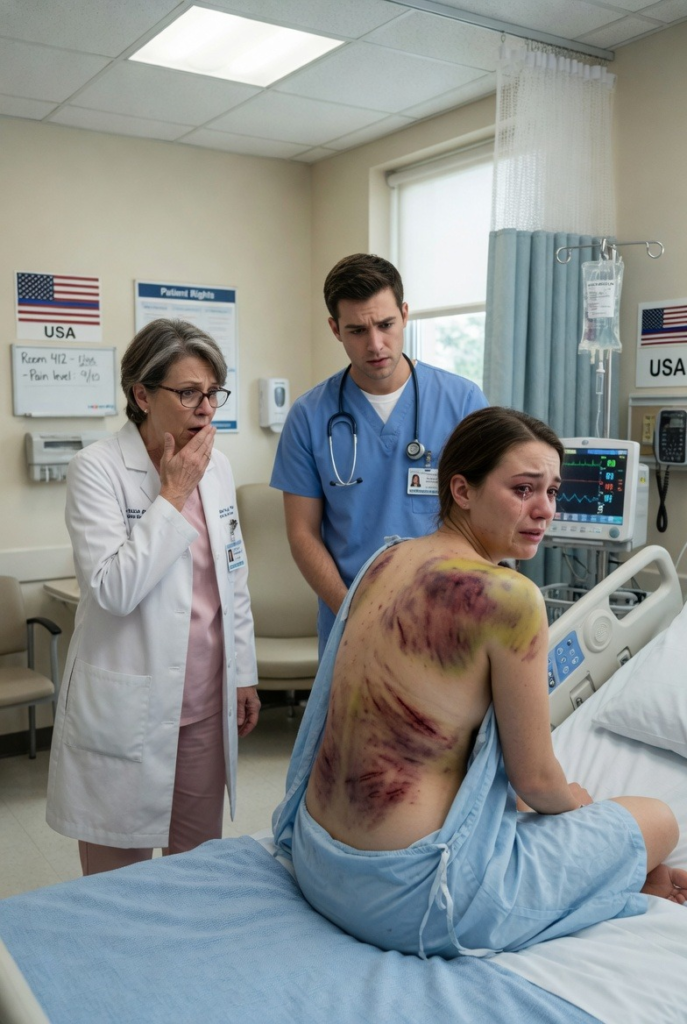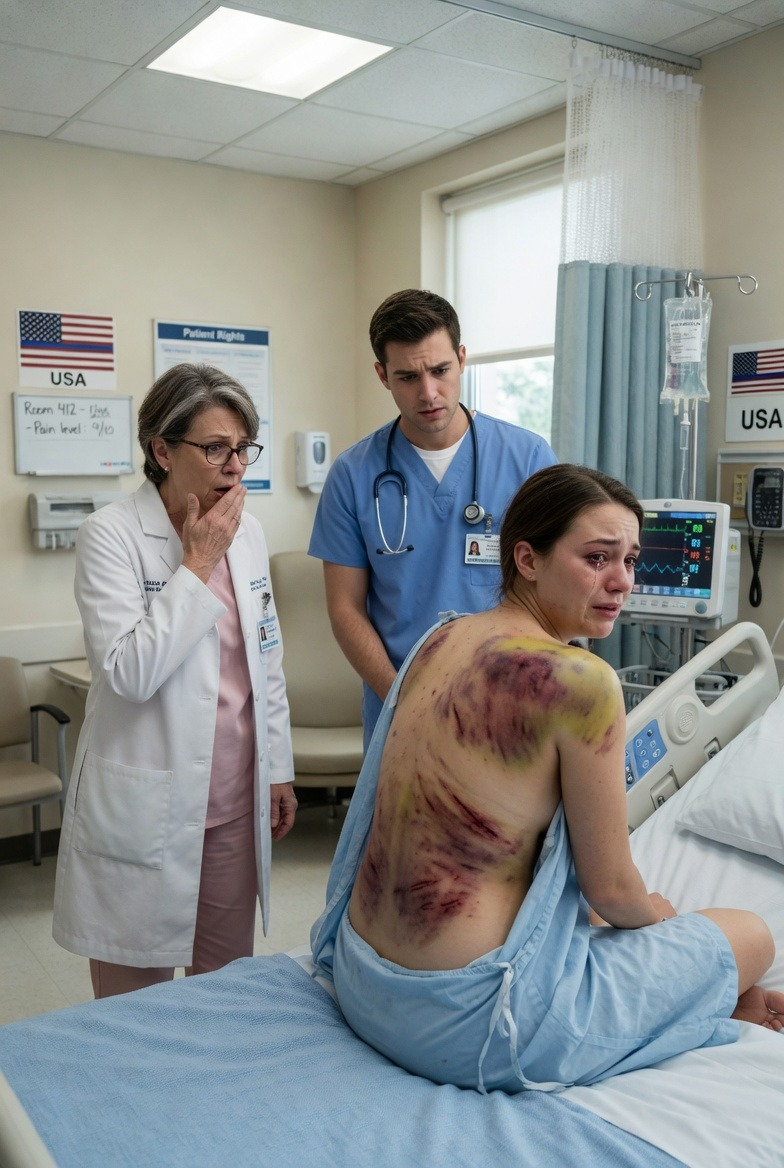
Daniel straightened immediately.
“Claire,” he said with practiced charm, “thank God. This whole thing is getting blown out of proportion.”
She didn’t answer him.
That frightened him more than anger would have.
Claire Bennett had spent fifteen years handling legal risk for St. Catherine’s. She was the person hospitals called when lawsuits were coming, when reporters started circling, when families screamed in hallways, when doctors made mistakes they prayed nobody discovered. She knew exactly how dangerous silence could become.
And she was staring at Anna’s back.
Not glancing.
Staring.
Then she looked at Ellis.
“Are the photographs uploaded?”
“Yes.”
“Nurse statements?”
“Completed.”
“Patient testimony?”
Anna swallowed painfully. “I gave it.”
Claire nodded once. Clinical. Controlled.
Then she turned toward Daniel.
“Sir,” she said calmly, “security is on the way.”
The smile vanished from his face entirely.
“I beg your pardon?”
“You are no longer permitted near the patient.”
“That’s my wife.”
“And she has formally stated she is afraid of you.” Claire’s voice never rose. “That changes several things.”
Daniel laughed again, but too loudly this time. “This is insane. Margaret’s poisoning her against me because she hates me.”
“No,” I said quietly. “I simply see you clearly.”
He pointed at me. “She’s unstable. She’s old. Ask anyone.”
I almost pitied him then.
Men like Daniel survive because they believe reality is negotiable. Charm here. Intimidation there. A smile at church. Donations at galas. Expensive wine with the right people. They think reputation is armor.
But hospitals keep records.
And bruises do not lie politely for wealthy men.
Claire opened the file.
“I reviewed prior admissions,” she said.
Ellis went still beside me.
Daniel’s eyes narrowed.
“Anna was treated here four months ago for cracked ribs.”
Anna closed her eyes.
“Sixteen months ago for a concussion.”
The hallway became perfectly silent.
“Two years ago,” Claire continued, “she arrived with a fractured wrist and claimed she slipped on ice. The attending nurse documented visible fear responses whenever her husband entered the room.”
Daniel’s face changed then—not guilt.
Calculation.
He was measuring exits.
“I want a lawyer,” he snapped.
Claire nodded. “That’s probably wise.”
Two security officers appeared at the end of the corridor.
Not rushing.
That was the beauty of institutional power when it finally decided to wake up. It moved slowly. Calmly. Like a glacier splitting mountains.
Daniel looked at Anna.
And for the first time all night, his mask slipped completely.
Pure hatred.
“You stupid little—”
The officer stepped between them instantly.
“Sir. You need to come with us.”
Daniel jerked backward. “She’s lying!”
Anna flinched so hard she whimpered.
That sound did it.
Not for me.
For the nurses.
One of them—the young one clutching the clipboard—suddenly spoke.
“I heard him threaten her last time.”
Everyone looked at her.
Her face went pale, but she kept going.
“She begged him not to be angry because she talked to a male resident.” Her voice shook violently. “I should’ve reported it then.”
Daniel stared at her in disbelief.
Another nurse lifted her hand slowly.
“He grabbed her arm during discharge six months ago.”
Then the resident near the computer spoke without turning around.
“I documented bruising patterns inconsistent with a fall.”
Truth spreads strangely.
Silence is heavy at first. Then one person breaks, and suddenly everyone remembers they still possess a spine.
Daniel realized it too late.
“You’re all making a mistake,” he said.
But now his voice sounded thin.
The officers moved closer.
He looked at me then with naked venom.
“This is your fault.”
“No,” I answered. “This is yours.”
They escorted him toward the elevators.
Halfway down the hall, he twisted violently and shouted toward Anna:
“You think she can protect you forever?”
Anna started shaking.
I leaned close and took her hand.
“Yes,” I said before the doors closed. “I do.”
The elevator swallowed him.
And the entire floor exhaled.
For a long moment, nobody moved.
Rain battered the windows at the far end of the corridor. Somewhere nearby, a machine alarm chirped twice before a nurse silenced it. Life continuing. Ordinary sounds wrapped around extraordinary damage.
Anna’s fingers trembled inside mine.
“I tried to leave,” she whispered.
I pulled a chair beside her bed and sat carefully.
“Tell me.”
Her swollen eye filled with tears.
“The first time he hit me, he cried afterward.” Her voice cracked. “He said stress made him lose control. Then he bought flowers. Then he promised therapy.”
Classic.
Abusers rarely begin with fists.
They begin with permission.
“One day,” Anna whispered, “I realized I spent all my time trying not to upset him.”
I looked at the bruises striping her back.
The old ones hurt me more than the fresh ones.
Because old bruises mean isolation. Adaptation. Survival.
How many dinners had she sat through smiling? How many holidays? How many phone calls had ended with “I’m just tired, Mom”?
And how had I missed it?
That question cut deeper than any scalpel I had ever held.
Ellis touched my shoulder gently.
“Margaret,” he said, “there’s something else.”
His expression told me before he spoke.
My stomach tightened.
“She’s pregnant.”
The world stopped again.
Anna began crying immediately.
Not softly.
Not delicately.
The sound that came out of her was the sound of a human being finally collapsing after carrying terror alone for too long.
“Oh God,” she sobbed. “Oh God, Mom, I didn’t know what to do…”
I wrapped both arms around her carefully, mindful of every bruise hidden beneath the hospital gown.
And suddenly I understood something terrifying:
Daniel was never going to let her leave alive.
Not now.
Not with a child.
Men who believe they own women become most dangerous when ownership is threatened.
I had seen it before.
Not in operating rooms.
In obituary photographs.
Ellis crouched beside us.
“We contacted the police,” he said quietly. “And a domestic violence advocate is already on the way.”
Good.
Because now this was no longer about surviving the night.
It was about war.
And Daniel had made one catastrophic mistake.
He thought Anna’s mother was just an old woman with white hair and tired hands.
He had forgotten what those hands were capable of saving
The domestic violence advocate arrived at 1:12 a.m.
She introduced herself as Rosa and spoke in the calm, steady voice people use around frightened animals and bomb squads. She sat beside Anna’s bed with a legal pad on her knee while rain crawled down the emergency room windows in silver veins.
I watched my daughter carefully.
Every time footsteps passed the curtain, she tensed.
Every male voice in the hallway made her shoulders tighten.
That told me more than the bruises.
Trauma rewires the body long after the skin heals.
Rosa explained restraining orders. Emergency shelter options. Police procedures. Secure maternity care. The practical architecture of escape.
Anna stared at the blanket while she listened.
Then she whispered the question every abused woman eventually asks:
“What if he gets angry?”
Rosa’s face softened with unbearable sadness.
“Honey,” she said gently, “he already is.”
Anna broke again after that.
Not loudly this time.
Just silent tears sliding sideways across the pillow.
I stood by the sink washing my hands for no reason other than instinct. Surgeons wash when they need to think. Hot water. Soap. Repetition. Ritual creates the illusion of control.
But my mind kept replaying details.
The cracked ribs.
The concussion.
The way Anna flinched before Daniel even raised his voice.
The worst injuries are often the ones nobody photographs.
At 2:03 a.m., the police arrived.
Two officers. One young, one older. Both tired.
The older officer recognized me.
“Dr. Whitmore,” he said quietly.
I nodded.
Twenty years earlier, I had operated on his wife after a ruptured aneurysm. I remembered because she had nearly died twice on my table and lived anyway.
Funny what survives in memory.
He looked toward Anna’s bed and his expression hardened.
“We’ll handle this carefully.”
I appreciated that he said carefully instead of properly.
Properly gets women killed every day.
They took photographs again. Recorded statements. Asked Anna whether Daniel owned firearms.
Yes.
Had he threatened her before?
Yes.
Had he threatened the baby?
Anna hesitated too long before whispering yes again.
The younger officer stopped writing for half a second.
There it was.
The moment strangers stop viewing domestic violence as “marital problems” and finally recognize predation.
The older officer closed his notebook slowly.
“We’re filing for emergency protective custody tonight.”
Good.
But still not enough.
Because men like Daniel rarely explode all at once. They erode people gradually, strategically, until the victim no longer trusts her own instincts.
I had spent years teaching surgical residents how to identify hidden bleeding.
Domestic abuse was the same.
By the time symptoms became obvious, damage was already catastrophic.
At 2:40 a.m., Anna finally fell asleep.
Exhaustion overtook fear for a little while.
Her face looked younger sleeping there beneath the fluorescent lights. Younger and heartbreakingly familiar. I could still see the six-year-old who used to run barefoot through our kitchen holding construction-paper drawings against her chest.
I sat beside her bed in silence.
Ellis handed me terrible coffee in a paper cup.
“You okay?” he asked.
“No.”
He nodded like he expected that answer.
“I should’ve seen it sooner,” I said.
Ellis leaned against the wall.
“Margaret, abusive men don’t groom only victims. They groom witnesses too.”
I looked at him sharply.
“He was charming,” Ellis continued. “Polite. Generous. He volunteered at fundraisers. Remember?”
I remembered.
Daniel carrying auction chairs at charity galas.
Daniel sending expensive flowers after my knee replacement.
Daniel calling me “Doctor Whitmore” with admiring eyes.
Predators study audiences as carefully as prey.
“You know what bothers me most?” Ellis asked quietly.
I waited.
“He wasn’t afraid tonight.”
That chilled me because it was true.
Daniel had stood in a hospital full of witnesses and still believed he controlled the outcome.
Which meant one of two things:
Either he was stupid.
Or he had gotten away with cruelty for so long that consequences no longer felt real.
My phone buzzed at 3:07 a.m.
Unknown number.
I answered immediately.
Silence.
Then breathing.
Slow.
Intentional.
I said nothing.
Finally Daniel spoke.
“You think this changes anything?”
His voice was calm again now. Calm was more dangerous.
“You called a traumatized pregnant woman a liar in front of police officers,” I said. “I don’t think you’re in a position to negotiate.”
A soft laugh.
“You always did underestimate me.”
“No,” I answered. “I understood you tonight.”
His tone sharpened.
“She’ll come back.”
I glanced toward Anna sleeping beneath warm blankets and heart monitors.
“No,” I said.
“You can’t protect her forever.”
There it was again.
Ownership.
Possession.
Not love.
I lowered my voice.
“You made one mistake, Daniel.”
“What’s that?”
“You hurt her badly enough that she stopped hiding it.”
Silence.
Then the line disconnected.
Ellis had heard enough to go pale.
“We need hospital security posted outside her room,” he said immediately.
“They already are,” Claire said from the doorway.
Neither of us had heard her approach.
She stepped inside holding another folder.
“There’s more.”
My stomach tightened instantly.
Claire opened the file.
“Three years ago, Daniel’s former girlfriend was treated at Mercy General.”
Ellis swore under his breath.
“She reported falling down stairs,” Claire continued. “But the attending physician documented suspected abuse.”
“Was he charged?” I asked.
“No.”
Of course not.
Claire met my eyes.
“She disappeared from follow-up care two weeks later.”
The room went cold.
Not metaphorically.
Actually cold.
The kind of cold that moves across skin before disaster.
“Where is she now?” Ellis asked.
Claire hesitated.
“Nobody knows.”
We stared at her.
“She moved out of state,” Claire said carefully. “At least officially.”
Officially.
I had spent decades around lawyers and administrators. I knew coded language when I heard it.
Something was wrong.
Very wrong.
Claire lowered her voice.
“Margaret… there’s a reason I came downstairs personally tonight.”
A knot formed in my chest.
“What reason?”
She looked toward Anna sleeping.
“Daniel’s father sits on the hospital board.”
Everything snapped into focus at once.
The confidence.
The smirking.
The certainty.
Not stupidity.
Protection.
Power wraps dangerous men in layers of disbelief. People hesitate to accuse them because accusations become expensive.
But suddenly I understood something else too.
Claire wouldn’t have warned us unless she was frightened herself.
“Who else knows?” I asked.
“The board chairman called me twenty minutes ago.”
“And?”
“He advised discretion.”
I almost laughed.
Discretion.
Such a polished word for cowardice.
“What did you tell him?”
Claire’s eyes hardened.
“That the photographs already exist.”
Good woman.
Then she said the sentence that changed the night completely:
“Margaret… I think they’re preparing to make this disappear.”