, and in front of the whole family, they sent my children to sit next to the potted plants: “That’s how they learn their place.”
I stayed quiet, asked for the invoice, and signed just one change… but nobody imagined what that night would uncover.
“Your kids can sit over there, next to the potted plants,” my father said, as casually as if he were talking about two backpacks left in the way.
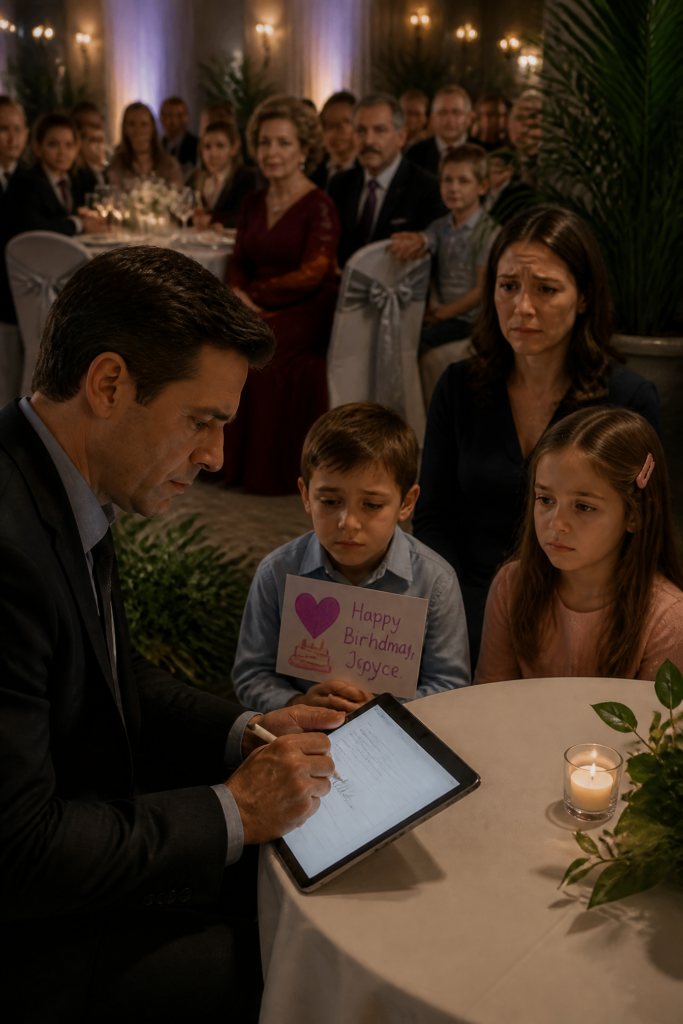
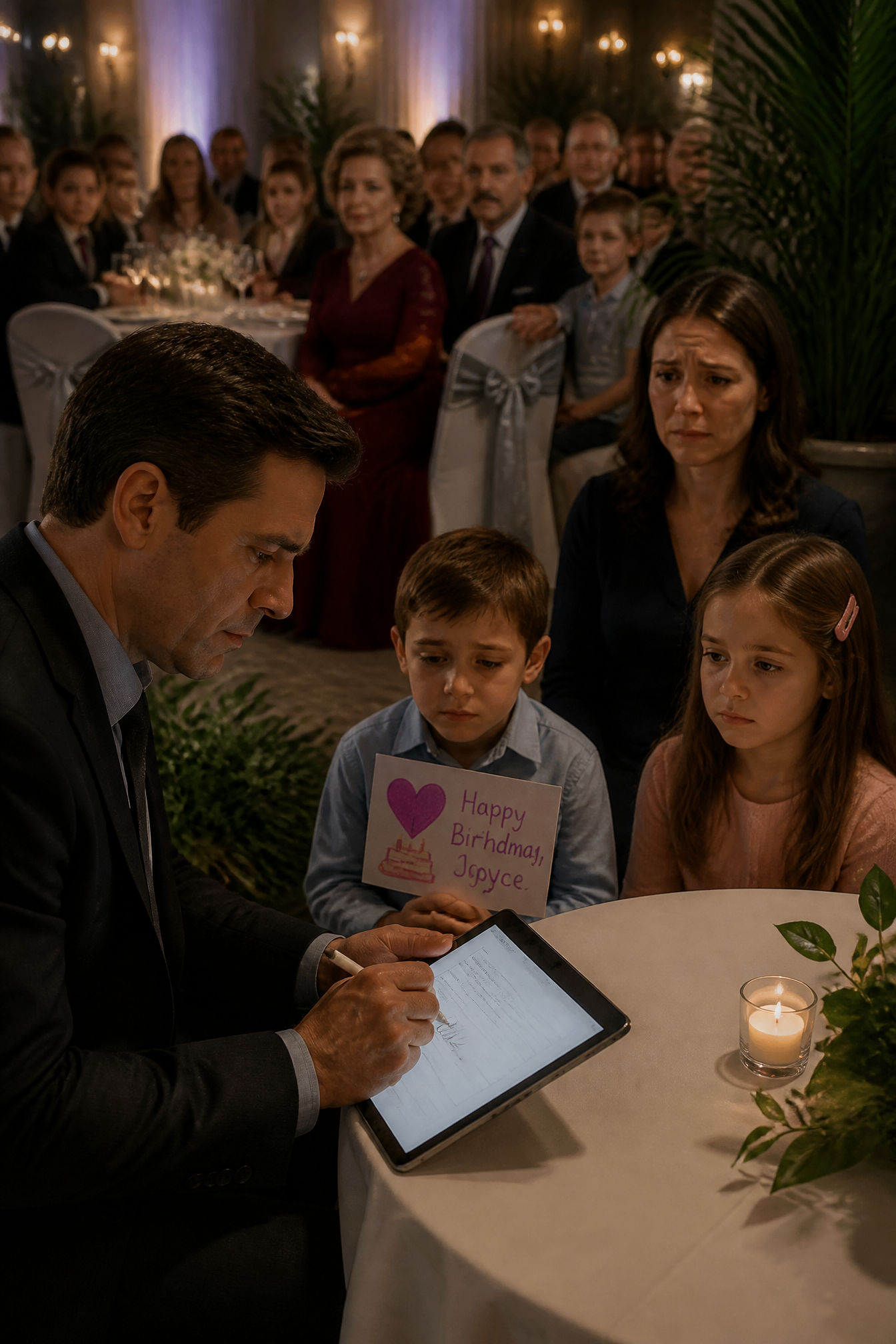
My daughter Emily, eight years old, squeezed my fingers. My son Noah, six, held a birthday card he had made for his grandmother with both hands: uneven hearts, a cake with candles, and a message written in purple marker: “Happy Birthday, Grandma Joyce.”
At the main table, my sister Brenda’s children were already seated like royalty: chairs with silver bows, fine plates, soft drinks served in glasses, and little candy bags with their names printed on gold labels.
My mother, wearing a burgundy outfit that I had paid for, barely looked up.
“Don’t start, Kenneth. Children need to learn that they can’t always be in the front row.”
That hurt more than anything. She didn’t say it angrily. She said it as if humiliating my children were an important life lesson.
My name is Kenneth Miller. I’m thirty-nine years old, and for half my life I confused being a good son with letting people use me. I worked as a manager for a construction company in Omaha. I wasn’t rich, but I earned enough for my family to decide that my wallet belonged to everyone.
I paid for my parents’ medications, Brenda’s overdue rent, my nephews’ school tuition, repairs, family meals, emergencies, and celebrations. Nobody ever asked whether I could afford it. They simply said:
“Kenneth will take care of it.”
My wife Sarah, an elementary school teacher, war:ned me many times.
“Your family doesn’t come to you. They bill you.”
I would get upset and tell her she was exaggerating. I said that’s just how families are, that parents should be cared for, that Brenda had been through hard times. But every family gathering proved Sarah was right.
Brenda was always the favorite child. If she got into debt, it was because she had “bad luck.” If she quit a job, it was because “nobody appreciated her talent.” If she asked me for money, my mother would say:
“Help her. She’s your sister.”
Meanwhile, I was never allowed to get tired.
My mother’s seventieth birthday had to be “magazine-worthy.” A banquet hall in Franklin, mariachi music, a dessert table, an open bar, a photographer, and a three-tier cake. The contract arrived in my WhatsApp without a single question. Just a message from my father:
“Transfer the money today so we can reserve everything.”
And I did.
That Saturday, I arrived early with Sarah and the children. The venue sparkled with white lights, fresh flowers, and immaculate tablecloths. My mother entered smiling and greeting people like a queen. My father walked around proudly. Brenda arrived late, yet everyone welcomed her as if she had organized the entire event.
When Emily asked where we would sit, I led her toward the family table.
That was when my father said it.
“Your kids can sit over there, next to the potted plants.”
I looked at my mother, expecting her to correct him. Instead, she simply said:
“Not everything revolves around them.”
My throat tightened.
Sarah lowered her head to hide her tears. Noah hid the card behind his back. Emily looked at her cousins and understood far too quickly that, to this family, she and her brother mattered less.
I didn’t yell. I didn’t make a scene. I simply nodded.
“Perfect.”
I took my children to an empty table far away from everyone else. At that moment, the event coordinator approached me holding a tablet.
“Mr. Miller, I need your final authorization to release the premium bar, the special desserts, and the full service package.”
I took a deep breath.
And nobody had any idea what I was about to do.
What would you have done in Kenneth’s place: endure it for the sake of family, or set a boundary right then and there?Kenneth looked at the coordinator’s tablet, then at the room filled with people who had already decided what he was worth.
The laughter from the main table carried across the hall like nothing had happened. Brenda was showing something on her phone. His mother was smiling for a photo. His father was already mid-story, enjoying the attention.
And his children were sitting beside potted plants like forgotten decorations.
Emily was trying not to cry. Noah still held that handmade card, like it might somehow protect him.
The coordinator waited politely.
“Mr. Miller?”
Kenneth exhaled slowly.
For years, he had confused silence with strength. He had paid to keep peace that only ever existed for everyone else.
He tapped the screen.
“Don’t release anything,” he said quietly.
The coordinator blinked. “Sir?”
“I want the event paused. Effective immediately.”
The woman hesitated, then nodded. “Understood. I’ll place the service on hold.”
Kenneth didn’t raise his voice. He didn’t need to.
He stood up.
“Sarah,” he said gently, “take the kids outside with you for a moment.”
His wife looked at him, unsure. That look said everything—fear, hope, disbelief.
“Ken…” she whispered.
“I’ve got this,” he said.
Sarah gathered Emily and Noah. As they walked past him, Noah reached for his hand.
“Dad… are we in trouble?”
That question nearly broke him.
“No,” Kenneth said softly. “Not anymore.”
He watched them leave the hall.
Then he turned back toward the room.
The music was still playing.
Someone at the main table laughed loudly, unaware that anything had shifted.
Kenneth walked forward.
Slowly.
Not angry. Not rushed.
Just decided.
He stopped near the coordinator again. “Cancel the bar. Cancel the premium menu. Cancel the cake upgrade. Everything extra I paid for—pause it.”
The coordinator typed carefully, sensing the tension.
Then Kenneth added, “And notify the photographer they’re done for the night.”
That finally made the coordinator pause. “All of it, sir?”
“Yes.”
A ripple of confusion moved through the staff.
At the main table, Brenda finally noticed something was off.
“Why is the coordinator talking to Kenneth like that?” she asked.
His father frowned. “What are you doing over there?”
Kenneth didn’t answer them yet.
Instead, he walked toward the microphone stand at the front of the hall.
The one meant for speeches.
His mother noticed him now.
“Kenneth, what are you doing? Sit down. We’re about to cut the cake soon.”
He picked up the microphone.
The sound echoed sharply through the room.
The laughter faded.
All eyes slowly turned.
Even the music cut out as the DJ sensed something changing.
Kenneth looked at the crowd—relatives, friends, people who had benefited from his silence for years.
Then he spoke calmly.
“This celebration was paid for entirely by me.”
A few murmurs spread.
His mother gave a tight smile. “Of course, darling, but let’s not make things awkward—”
He continued, voice steady.
“And yet my children were told to sit next to potted plants.”
The room went still.
A fork paused mid-air at one table.
Brenda’s smile disappeared.
Kenneth didn’t raise his voice, but something in him had finally stopped bending.
“I want to make something clear,” he said. “If my children are not welcome at the table, then neither is my money at this event.”
A sharp inhale spread across the room.
His father stood up. “Now listen here—”
Kenneth held up a hand. Not aggressively. Just enough.
“No,” he said. “You listen.”
Silence fell harder this time.
He looked at his mother.
“I paid for this so you could feel loved. Not so my kids could be reminded they’re less important than anyone else’s.”
His voice tightened slightly—but he kept control.
“And I won’t fund disrespect toward them. Not tonight. Not ever again.”
For the first time, his mother looked unsettled.
Because this wasn’t the Kenneth they were used to.
This one wasn’t apologizing.
Brenda leaned forward. “You’re seriously going to ruin Mom’s birthday over seating arrangements?”
Kenneth turned his head slightly toward her.
“No,” he said. “You all did that when you decided my children didn’t belong.”
The coordinator stepped forward cautiously. “Sir, should we proceed with closing the event?”
Kenneth paused.
Every instinct he had ever learned screamed at him to soften it. To fix it. To keep peace.
Then he thought of Emily’s face.
Of Noah’s card clutched in small hands.
He nodded.
“Yes,” he said. “Close it.”
A silence followed that felt heavier than any argument.
Some guests began standing, unsure what to do. Others whispered in disbelief. A few looked embarrassed, suddenly aware they had been enjoying luxury built on someone else’s patience.
At the table, his mother finally spoke, her voice smaller now.
“Kenneth… we’re family.”
He looked at her for a long moment.
Then he said something he had never said before.
“Family doesn’t sit my children next to plants.”
He placed the microphone back.
And walked out.
Outside, the night air was cooler.
Sarah was waiting with the children by the entrance.
Emily ran to him immediately. “Dad… did we do something wrong?”
He dropped to one knee.
“No,” he said firmly. “You did everything right.”
Noah looked up. “Then why were they mean to us?”
Kenneth hesitated.
Because the truth was complicated.
But not that part.
“Because I allowed it for too long,” he said honestly.
Sarah stepped closer, watching him carefully. “What happens now?”
Kenneth looked back at the glowing hall through the glass doors.
The celebration was still going on inside—but without him. Without his money holding it together.
Then he looked at his family.
“Now,” he said quietly, “we learn what happens when I stop paying for disrespect.”
And for the first time in years, he didn’t feel like he was losing something.
He felt like something was finally ending.