My Neighbor’s MMA Champion Son Mocked Me, Challenged Me in Front of the Entire Neighborhood, and Mistook My Silence for Fear—He Never Realized I Had Spent Years Staying Quiet for a Reason, Until One Unexpected Moment Taught Him a Lesson He Would Never Forgetj
Logan noticed me at the community mailbox on a Wednesday morning, when his motorcycle was blocking the curb cut and Noah asked him to move it.
Noah had waited nearly five minutes while a woman pushing a stroller tried to squeeze around the bike, and when he finally spoke, his voice was polite.
“Could you park a little closer to the curb?” he asked.
Logan looked down at my fifteen-year-old son as though the question itself had insulted him.
“Could you mind your own business?”
Noah’s face tightened, but he did not step back.
I had taught him that courage did not require volume, yet I could see the calculation beginning behind Logan’s eyes—the quick assessment bullies make when they think they have found someone smaller, younger, and easier to embarrass.
Logan placed one hand on Noah’s bicycle handlebar.
“Go home,” he said.
I crossed the street carrying my coffee.
“Take your hand off his bike.”
Logan turned, saw a forty-two-year-old woman in jeans and an old gray sweatshirt, and smiled.
He did not move his hand.
“You his mom?”
“Yes.”
“He needs to learn some respect.”
“He asked you to stop blocking the sidewalk.”
“He told me what to do.”
“No,” I said. “He asked you to do what every decent neighbor would have done without being asked.”
A few garage doors were open, and two people collecting their mail had stopped pretending not to listen.
Logan glanced at them, then tightened his grip on the handlebar because he suddenly had an audience.
I set my coffee on top of the mailbox unit.
“Let go.”
He laughed softly.
Then he leaned toward me and said, “Or what?”
I did not threaten him, raise my voice, or explain my background.
I simply placed two fingers against the inside of his wrist and changed the angle of his hand.
His grip opened before he understood why.
I released him immediately.
There was no dramatic takedown and no pain beyond the brief shock of discovering that his arm had obeyed someone else.
Logan stared at his empty hand.
I picked up my coffee.
“Move the motorcycle.”
He moved it.
Noah and I walked home without another word, but halfway up our driveway he looked at me and asked, “What exactly was that?”
“A reminder.”
“You barely touched him.”
“That was the point.”
I assumed the incident was finished.
I underestimated how much humiliation could grow inside a man who had built his identity around never appearing weak.
By that afternoon, Logan had told people I had attacked him.
By evening, the story had become a former soldier ambushing him while his back was turned.
The following day, Grant Whitmore appeared beside my driveway while I was unloading groceries from my pickup.
He wore sunglasses, held a paper coffee cup, and spoke in the calm businesslike tone of a man accustomed to making pressure sound reasonable.
“My son says you put your hands on him.”
“Your son put his hand on my child’s bicycle and refused to release it.”
“He says you used some kind of military move.”
“I made him let go.”
Grant smiled as though we were negotiating a property line.
“Logan is a trained fighter.”
“I know.”
“He could have hurt you.”
“He didn’t.”
That answer bothered him more than an argument would have.
Grant had already searched my name online, because the next thing he said was, “Colonel Bennett, I think it would be better for everyone if you apologized.”
I looked at him over the grocery bag in my arms.
“Better for whom?”
“For the neighborhood.”
“The neighborhood wasn’t blocking the mailbox.”
His smile thinned.
“People around here value peace.”
“So do I.”
I carried the groceries inside and closed the door.
For the next three days, Logan made sure I saw him training in his driveway.
He hit pads while Grant filmed, jumped rope near the curb when Noah rode past, and posted short videos about people who relied on titles instead of real strength.
He never used my name, but everyone on Juniper Hollow Drive knew whom he meant.
Noah pretended it did not bother him.
That bothered me more.
On Friday night, I found him in the garage rubbing a clean cloth across the dented tailgate of my pickup even though the dent had been there for years.
“You don’t have to fix that,” I said.
“I know.”
He kept rubbing.
“Kids at school found Logan’s video.”
I leaned against the workbench.
“What are they saying?”
“That you grabbed him because I couldn’t stand up for myself.”
“You did stand up for yourself.”
“They don’t care what happened.”
“No,” I said. “They care what they can replay.”
He dropped the cloth onto the tailgate.
“Why don’t you just tell people who you are?”
I knew what he meant.
Not my name, rank, or current assignment.
He wanted me to explain the years I had spent training soldiers, the commands I had held, and the Ranger operations I had led in places most of our neighbors would never see.
“I moved here so we could have a life that wasn’t built around my uniform,” I said.
“Maybe you got that life.”
The words landed harder than he intended.
He looked away first.
“What did I get?” he asked.
Before I could answer, music began pounding from the Whitmores’ garage.
The next afternoon, Grant’s white SUV was parked across the mouth of the cul-de-sac, and folding lawn chairs had appeared along three driveways.
Grant told people Logan was filming a neighborhood training demonstration.
Logan told his online followers that a decorated Army officer had agreed to test herself against a real fighter.
I had agreed to nothing.
Noah and I were returning from the grocery store when we found nearly half the street waiting.
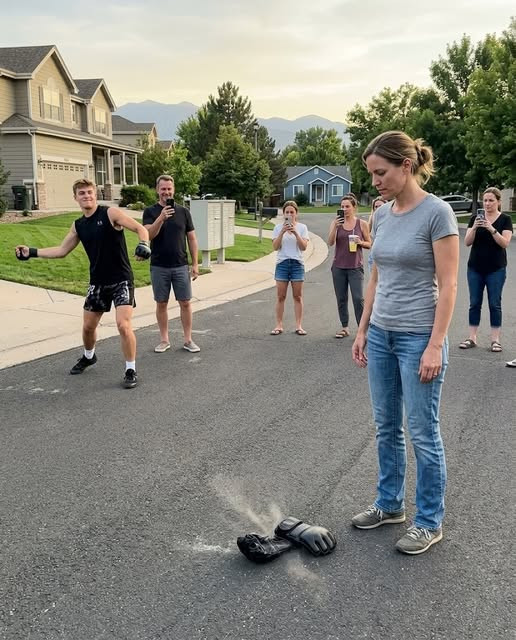
Logan stood in the center of the road wearing a sleeveless black training shirt, shin guards, and a pair of gloves.
A second pair lay beside his gym bag.
Grant held his phone horizontally and announced our arrival like he had been waiting for a celebrity guest.
“There she is.”
Noah stopped beside me.
“Mom, don’t.”
“I’m not planning to.”
Logan walked forward, removed the spare gloves from the bag, and threw them at my feet.
They landed an inch from my sneakers.
The street went quiet enough for me to hear ice cracking inside someone’s plastic cup of lemonade.
Logan rolled his shoulders.
“Come on, Colonel,” he said. “Show everybody what you’ve got.”
I looked at the gloves, then at the phones rising around us.
“Are you sure?” I asked.
He mistook the question for fear.
His smile widened.
“I’ll go easy on you.”
“I wasn’t asking about me.”
A few people laughed, but Grant stepped closer with his phone.
“This is friendly,” he said. “One controlled round. Nothing serious.”
“You arranged an audience and brought spare gloves.”
“I thought you might want a fair opportunity to clear up what happened.”
“What happened is already clear.”
“Not online.”
There it was.
This was not about Logan’s pride alone.
Grant wanted a video that could replace the one story he could not control—the story of his son releasing a bicycle because a quiet woman had told him to.
I stepped around the gloves.
“No.”
Logan moved into my path.
People shifted in their chairs.
Noah came forward, but I held one hand behind me, and he stopped.
Logan looked past me at him.
“Your mom always fight your battles?”
“No,” Noah said. “She just finishes them.”
Grant’s phone tilted slightly as he laughed.
Logan did not.
He reached down, picked up the gloves, and pressed them against my chest.
“Put them on.”
I looked at his hands, then at his father.
Grant was smiling at his screen, watching the number of viewers climb.
I finally understood that walking away would not end the performance.
They would follow us with the camera, edit my refusal into cowardice, and make Noah carry the cost at school while Logan’s father turned the humiliation into publicity.
So I took the gloves.
Noah whispered, “Mom.”
I turned to him.
“I’m not doing this because he challenged me.”
“Then why?”
“Because he thinks stopping is the same as losing.”
I pulled the gloves on and faced Logan.
“One round,” I said. “No elbows, knees, head strikes, or attacks after either person says stop.”
Logan shrugged.
“Whatever makes you comfortable.”
“Repeat the rules.”
His eyes narrowed.
Grant said, “They’re on video, Colonel.”
“I wasn’t asking you.”
Logan repeated them.
Then he raised his hands.
He was faster than the neighbors expected and more skilled than his online critics would have admitted.
His first step closed the distance cleanly, and his lead hand touched my shoulder before I moved outside his second strike.
The crowd reacted as though he had already won.
Grant shouted, “That’s it. Keep pressure on her.”
Logan advanced with disciplined combinations, cutting off the open side of the street and forcing me toward the curb.
I did not counter.
I watched his feet, breathing, and eyes.
Every few seconds, his gaze flicked toward his father’s phone.
Not long enough for anyone else to notice, but long enough to tell me whom he was truly fighting for.
He kicked toward my ribs.
I turned just enough to absorb it across my arm.
Pain traveled from my elbow to my shoulder, sharp and honest.
Logan heard the neighbors gasp and became less careful.
“Thought you commanded Rangers,” he said.
“I did.”
“Then do something.”
“I am.”
He lunged again.
This time, I changed levels, guided his arm past me, and used his forward momentum to take his balance.
His knee touched the pavement.
I released him before his other hand landed.
The entire exchange lasted less than two seconds.
Logan sprang up, embarrassed rather than hurt.
Grant lowered his phone just enough to say, “Don’t let her make you look stupid.”
Logan’s jaw tightened.
I saw the words enter him like a command.
Until that moment, I had believed Logan’s arrogance was the center of the problem.
Then I saw Grant’s expression.
He was not worried about his son’s safety, confidence, or judgment.
He was worried about the footage.
Logan attacked harder.
His technique began to unravel under the need to create a dramatic ending, and the more his father shouted, the more he abandoned the discipline that had earned him those three amateur victories.
I blocked a wide hook, stepped away from a kick, and said, “Slow down.”
He heard pity instead of instruction.
“Stop talking to me like I’m a kid.”
“Then stop fighting like one.”
He charged.
The heel of his rear foot slipped against a patch of loose gravel near the curb, but he was already committed to a turning strike.
His body rotated faster than his balance could follow.
For one instant, his head and shoulder were moving directly toward the concrete edge beside Grant’s SUV.
I could have stepped aside.
Instead, I moved in.
I caught his upper arm, braced across his torso, and redirected his fall away from the curb.
We hit the pavement together, but I controlled the descent and kept his head from striking the concrete.
Before he could recover, I trapped his wrist and shoulder in a position that made the next choice unmistakable.
He fought it for two seconds.
Then he tapped the pavement.
Once.
Twice.
Three times.
I released him immediately and stood.
Logan remained on one knee, breathing hard, staring at the curb where his head would have landed.
Grant kept filming.
“Get up,” he called. “She got lucky.”
Logan looked at him.
“I tapped.”
“It’s a street demonstration. Keep going.”
“I said I tapped.”
Grant gestured impatiently with the phone.
“People are watching.”
Logan’s expression changed—not because he had lost, but because he finally understood that his father preferred a better video to an honest ending.
I removed the gloves and placed them on the pavement between us.
Grant swung the phone toward me.
“You attacked my son after he slipped.”
“No,” Logan said.
Grant ignored him.
“You used military training against a civilian in a neighborhood street.”
“You announced the rules while recording,” I said. “Your son agreed to them, and I released him when he tapped.”
Several neighbors lowered their phones, but none deleted what they had captured.
Grant looked around and realized his recording was no longer the only version of the story.
He reached for Logan’s shoulder.
Logan pulled away.
“She stopped me from hitting the curb,” he said.
“You don’t know that.”
“I felt it.”
Grant’s mouth tightened.
“Get inside.”
Logan stood slowly.
For the first time since I had met him, he did not look toward his father for approval.
He looked at Noah.
“I shouldn’t have touched your bike.”
Noah folded his arms.
“No.”
“I shouldn’t have posted about your mom either.”
“No.”
Logan gave a short nod, accepting that an apology did not erase the cost.
Then he took Grant’s phone from his hand and ended the livestream.
Grant stared at him.
“What are you doing?”
“Stopping.”
“You’re throwing away everything we’ve built.”
“You built a channel,” Logan said. “I was supposed to be building a career.”
Grant reached for the phone, but Logan stepped back.
The movement was small.
The distance it created was not.
Grant turned toward me.
“You think you proved something?”
“No.”
“Then what was this?”
I looked at Logan, still breathing hard, one hand resting against the shoulder I had controlled.
“A warning he was willing to hear.”
Grant laughed without humor.
“You expect everyone to believe a middle-aged single mother just happened to know how to do that?”
I had spent months avoiding this moment because I did not want rank, service, or old authority following me onto my porch.
Yet Noah was standing beside me, and I understood that silence could be peaceful only when it did not require someone else to absorb the consequences.
“I served more than twenty years,” I said. “I trained soldiers, commanded Ranger operations, and learned a long time ago that control matters more than force.”
Grant’s eyes moved from me to the neighbors.
The sentence had not frightened him.
It had taken away the story he planned to sell.
Logan bent down and picked up the gloves.
He did not throw them again.
That evening, Noah and I ate sandwiches on the porch because neither of us felt like cooking.
The neighborhood was unusually quiet, though phones continued buzzing inside houses all along the cul-de-sac.
Noah held his sandwich without eating it.
“You could have taken him down sooner, couldn’t you?”
“Yes.”
“Why didn’t you?”
“Because I needed to know whether he wanted a fight or an audience.”
“And?”
“He wanted his father to respect him.”
Noah looked toward the Whitmore house.
“That’s not the same thing.”
“No.”
He finally took a bite.
After a while, he asked, “Did you really move here just for peace?”
“I moved here for you.”
“That wasn’t what I asked.”
I let the question sit between us.
“I thought giving you a normal neighborhood would make up for all the times duty came first,” I said. “I thought if nobody here knew who I had been, I could just be your mom.”
“You were already my mom.”
“I know that now.”
He looked down at the sandwich in his hands.
“I don’t need you to tell everyone everything.”
“What do you need?”
“I need you not to disappear when people use me to get to you.”
The words were quiet, direct, and more difficult to receive than any insult Logan had thrown.
“I won’t,” I said.
Across the street, the Whitmore garage door closed.
The next week, Logan stopped training in the driveway.
The motorcycle no longer roared beneath my window at six in the morning, and it was never again parked across the community mailbox.
Grant continued telling people that the match had been misunderstood, but each explanation required him to ignore his own voice ordering Logan to continue after he tapped.
No one organized a campaign against him, and his business did not collapse overnight.
Something simpler happened.
Neighbors stopped pretending his behavior was normal.
They asked him to move his SUV when it blocked the street.
They interrupted when he spoke over people.
They no longer laughed automatically when he made someone else the joke.
His power had depended less on money than on everyone agreeing that confronting him would be impolite.
Once that agreement ended, so did much of his control.
Logan left the gym his father helped fund and began training elsewhere, paying his own fees with work he picked up on weekends.
He did not announce the decision online.
He simply stopped appearing in Grant’s videos.
Three Saturdays after the challenge, someone knocked on my front door before eight in the morning.
Logan stood on the porch holding the black gloves.
No camera followed him.
His shoulder was fine, though his pride was still healing.
“I cleaned them,” he said.
I waited.
“I came to apologize without an audience.”
“That’s a better place to start.”
He looked past me toward the garage, where Noah was trying to straighten the pickup’s dented tailgate with more determination than skill.
“I owe him one too.”
“Yes.”
Logan walked to the garage and spoke to Noah privately.
Noah did not forgive him immediately, and I did not ask him to.
When they finished, Logan returned to the porch and placed the gloves on the rail.
“Can you teach me what you did?”
“The takedown?”
“The stopping part.”
I studied him for a moment.
Then a metallic bang came from the garage, followed by Noah muttering something I pretended not to hear.
I handed Logan a wrench.
“Start by helping him with the tailgate.”
By fall, the black MMA gloves were still in my garage, resting on a shelf beside a coffee can filled with bolts.
They were not a trophy, and they were not proof that I could defeat a younger man.
Most Saturdays, Logan walked past them, pulled on a pair of ordinary work gloves, and helped Noah repair something neither of them would have had the patience to fix alone.
I usually sat near the open garage with my coffee, listening to tools scrape, the pickup radio play softly, and two young men learn that strength did not have to make the loudest sound on the street.