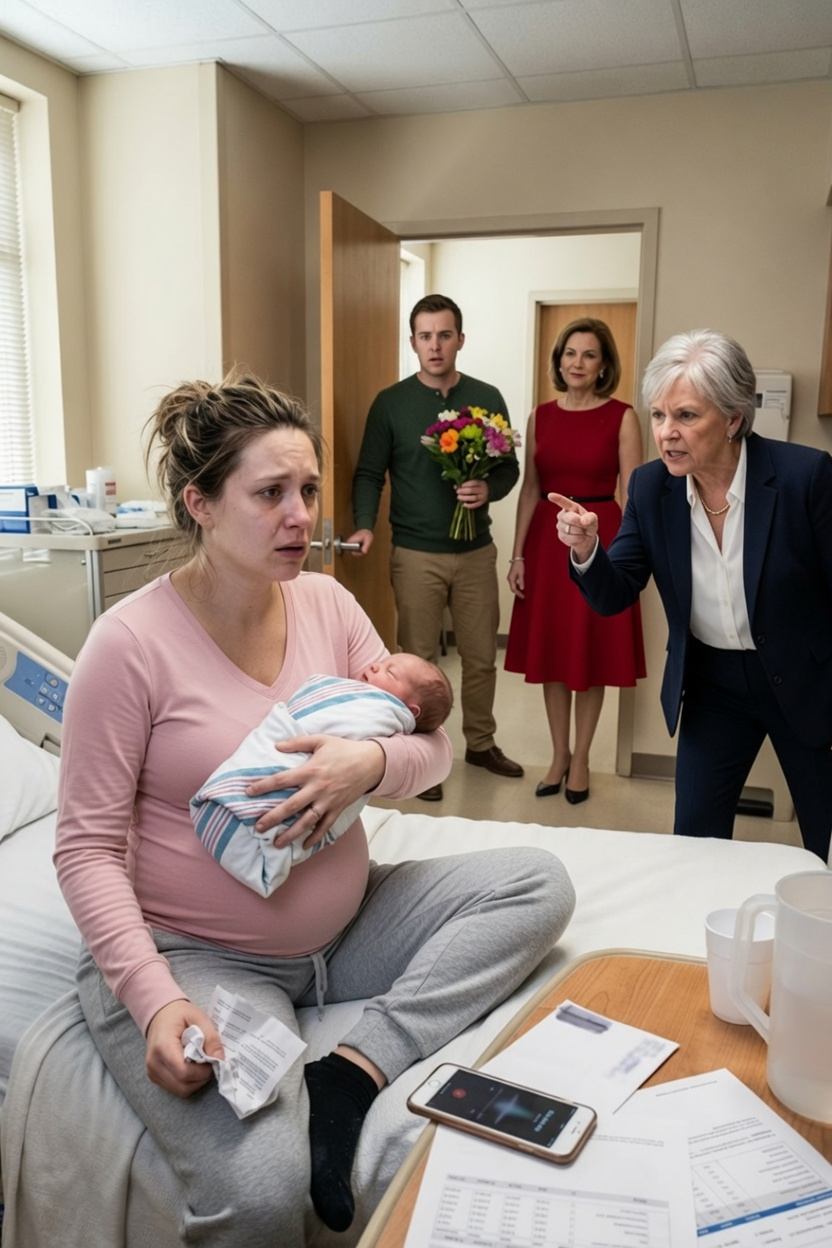
My grandmother said it from the doorway of my hospital room while I was holding my newborn daughter against my chest, and for one strange, weightless second, I honestly thought I had misunderstood English.
The room was dim except for the thin blue light from the muted television mounted on the wall and the soft glow spilling in from the hallway every time a nurse passed. Rain ticked steadily against the window, the kind of fine, cold rain that blurred the city into streaks of silver and black. The air smelled like antiseptic, warm plastic, sour milk, and the faintly metallic scent of my own exhausted body. Somewhere beyond the door, a machine beeped in a rhythm that had begun to feel like part of my heartbeat. I had slept perhaps forty minutes in the last two days, never more than ten minutes at a time. My body was still trembling from birth. My hair was greasy and matted at the back of my neck. My lips were split from dehydration. My daughter, Chloe, was curled against my chest beneath a hospital blanket, no heavier than a secret and no louder than a breath.
I was wearing the same faded gray sweatshirt I had slept in for two nights. The cuffs were frayed. The collar had stretched loose from too many wash cycles. It had a small bleach mark near the hem from the night I had cleaned our kitchen sink at midnight because Liam had said it smelled “neglected.” I had chosen it for the hospital because it was comfortable, because I was too tired to care how I looked, and because some part of me had quietly absorbed the idea that buying anything new for myself—even for the birth of my first child—would be selfish.
The hospital billing envelope lay folded face down on the side table beneath a glossy parenting magazine. I had put it there because I could not bear to look at it again. I had already opened it three times that morning. Each time, the numbers seemed to rearrange themselves into something more impossible. Each time, my throat closed, my pulse kicked hard, and I imagined Liam’s expression when I told him. Not anger, exactly. Worse. That disappointed, patient look he had perfected, as if my anxiety was a childish expense he had already budgeted for.
We had talked about money constantly during my pregnancy. Or rather, Liam had talked and I had listened. Cash flow was tight. His deals were delayed. The quarter had turned unexpectedly complicated. We had to think long term. We had to be disciplined. We had to stop living like single people and start protecting the family structure. Those were his words. Family structure. As if love were an office building and I had been carelessly leaving the windows open.
So I had cut back. Then I had cut deeper. I canceled every small thing that had ever made my days softer. Prenatal massage, gone. New maternity coat, unnecessary. Lactation consultant, later maybe. Grocery delivery, wasteful. A better crib mattress, indulgent. I learned to compare prices with the intensity of a woman preparing for famine. I stood in grocery aisles with swollen feet, deciding between oat milk and prenatal vitamins, then crying quietly in the car because I had become the kind of person who could not justify both. I picked up overnight inventory shifts at a pharmacy warehouse downtown, scanning boxes under fluorescent lights while my lower back burned and my ankles disappeared into swollen flesh. I told myself this was marriage. This was sacrifice. This was what strong women did when their families needed them.
And then my grandmother stood in the doorway, elegant in a dark wool coat, pearl earrings catching the hospital light, and asked if three hundred thousand dollars a month had not been enough.
For a moment, everything went silent inside me. Not outside me—the rain continued, the television continued, Chloe made a tiny sleepy sound against my skin—but inside, there was only a hollow, widening stillness.
“Grandma,” I whispered, my voice raw from labor and tears and too many hours of pretending I was fine. “What are you talking about?”
Margaret Harrington did not answer immediately. She looked at me the way she used to look at contracts when something inside them displeased her. Not offended. Not surprised. Focused. Her eyes moved over the room slowly, collecting evidence. The faded sweatshirt. The frayed leggings. The cheap overnight bag near the closet, one zipper broken, one strap knotted where it had torn. The generic lip balm beside my water cup. The stack of discharge papers. The lactation support form I had declined because it cost extra. The magazine I had placed over the hospital bill with the desperate, childish belief that hidden paper meant hidden debt.
Then her eyes returned to me.
Margaret Harrington had built Harrington Storage Group from six warehouse buildings and a regional delivery contract into a private empire that owned cold-storage facilities, medical office parks, industrial lots, logistics hubs, and more land than most people could understand without a map. She had been widowed at fifty-one and had not only preserved my grandfather’s business but sharpened it into something far stronger. Men underestimated her because she was beautiful when she was young and refined when she was older, because she wore silk scarves and sent handwritten thank-you notes, because she remembered birthdays and never raised her voice. But I had seen powerful people go pale when she set down a teacup and said, “Let’s be precise.”
That was the expression she wore now.
“Was three hundred thousand dollars a month not enough?” she repeated, slower this time, and the sentence cut through the room like a blade drawn cleanly from a sheath.
My mouth opened, but no sound came out. My body felt wrong, heavy and hollow at once, as if childbirth had left me slightly outside myself. Chloe’s cheek was warm against my chest. Her tiny fist rested beneath her chin. She looked impossibly peaceful, unaware that the floor beneath her mother’s life had just cracked open.
“I don’t know what you mean,” I said.
My grandmother took one step into the room. “I have wired three hundred thousand dollars on the first business day of every month since your wedding.”
The words entered me out of order. Wired. Three hundred thousand. Every month. Since your wedding.
I stared at her.
“I assumed,” she continued, her voice level in a way that made my skin prickle, “that you and Liam were choosing to live simply. I assumed you were saving, investing, building something prudent. I assumed you were exercising discretion. I did not assume this.”
This. The sweatshirt. The bill hidden under a magazine. The generic hospital socks on my feet. The hunger I had not told anyone about because pregnant women were not supposed to complain when their husbands were “handling things.” The way I had counted grocery money while carrying the child of a man who kissed my forehead and told me to trust him.
“I never received a single dollar,” I said.
I said it quietly, but the room seemed to recoil from it.
My grandmother did not gasp. She did not rush forward. She did not perform shock. That was not her way. She opened her handbag, took out her phone, and dialed with one perfectly steady finger.
“Susan,” she said when the call connected. “I need you at St. Jude’s immediately. Bring everything you can pull in the next hour. Yes. Now.”
She listened for three seconds.
“The Sterling account,” she said.
Another pause.
“All of it.”
She ended the call and slid the phone back into her bag.
The baby shifted on my chest. My hand moved automatically to her back, palm spread wide over the blanket, as if I could protect her from words, from numbers, from whatever monster had just stepped out of the shadows wearing my husband’s name.
“What account?” I asked.
My grandmother came to the side of the bed and pulled the vinyl chair closer, but for a moment she did not sit. She looked at Chloe for the first time, really looked at her, and something in her face changed. The cold severity cracked, and through it came love so deep and sudden that it nearly undid me.
“She is beautiful,” Margaret whispered.
My eyes filled. “Her name is Chloe Grace.”
“I know.” She reached out but stopped just before touching the baby, as if asking permission without words. I nodded. She brushed one finger over the blanket near Chloe’s shoulder. “Hello, my darling girl.”
Chloe slept on, making that soft newborn breathing sound that seemed too delicate to trust.
Then my grandmother sat down, crossed one knee over the other, and became again the woman who had survived boardrooms full of wolves.
“When you married Liam,” she said, “I established a household support transfer. It was not structured as a trust, which I now recognize was an extraordinary mistake. It was a monthly transfer into an account designated for household use. Mortgage, medical expenses, staff if needed, childcare, household savings, investments, personal freedom. I wanted you to never have to ask anyone’s permission to keep yourself safe.”
The last sentence moved through me slowly. Permission. Safe.
I remembered standing in a pharmacy aisle eight months pregnant, holding a bottle of iron supplements in one hand and my phone in the other, calculating whether I could wait until Friday. I remembered Liam saying, “Do we really need that appointment this week?” when I told him my doctor wanted an extra blood pressure check. I remembered apologizing when I ordered takeout after a fourteen-hour day because I could not stand long enough to cook. I remembered his hand on my shoulder, gentle and possessive, while he said, “I know it’s hard, Clara. But discipline now means freedom later.”
Freedom later. Always later.
“Liam said cash flow was tight,” I said.
Margaret’s expression hardened.
“He said his deals were delayed. He said we had to be careful until the next quarter closed. He said I needed to stop thinking like a girl with a family safety net and understand how capital actually moved.”
My grandmother was silent.
The silence made me talk faster. Once truth begins to move, it does not walk politely. It drags furniture, breaks glass, tears open doors you swore were locked.
“I picked up overnight shifts. Inventory shifts. At a pharmacy warehouse downtown. I told him I could do it just twice a week, then sometimes it was three. I stopped last week because Dr. Patel said my blood pressure was too high and if I didn’t slow down I was putting myself at risk.” I laughed once, a dry, broken sound. “I thought we desperately needed the money.”
Margaret closed her eyes. When she opened them, she looked older, not fragile, not defeated, but older in the way stone looks older after a storm reveals the cracks.
“How much access did you have to the account?” she asked.
“I had a debit card.”
“A login?”
“At first.”
“At first?”
“He changed the password after a security breach. He said someone had tried to access our accounts and that it was safer if he consolidated everything for a while.”
“When was that?”
I tried to think. Time had blurred during pregnancy. Months had been measured in appointments, swelling, nausea, and Liam’s moods. “Maybe a year ago. Maybe a little less.”
“Did you receive notifications?”
“No. They went to his phone. He said it was easier because he handled the auto-pay.”
“Statements?”
“Digital.”
“Did you ask to see them?”
“Yes.”
“And?”
“He said he had it covered. He said I made myself anxious by looking at numbers I didn’t fully understand.”
I heard myself then. Really heard it. Each answer sounded smaller than the last. I felt humiliation rising under my skin, hot and suffocating. I wanted to explain that I was not stupid. I wanted to say I had a degree, that before Liam I had managed my own money, that I had once been confident and funny and direct. I wanted to defend the woman I had been before marriage had taught me to confuse obedience with peace.
“I know how this sounds,” I said.
My grandmother leaned forward. “Do not do that.”
I blinked. “Do what?”
“Do not take responsibility for the architecture of someone else’s deception just because you are embarrassed you lived inside it.”
The sentence landed so gently and so firmly that I started to cry.
Not loudly. I did not have the energy for loud grief. Tears simply slipped down my face and disappeared into the neckline of my sweatshirt. Chloe stirred, opened her tiny mouth, then settled again.
“I should have known,” I whispered.
“Perhaps,” Margaret said. “But he knew you trusted him. That matters.”
It was the first merciful thing anyone had said to me in months.
I had not realized how starved I was for mercy until it arrived.
For a while, neither of us spoke. My grandmother sat beside me in the dim room while rain stitched silver lines down the window. She asked a few more questions, each one precise and terrible. Which bills had I paid? Which cards had been declined? Had Liam encouraged me to work? Had he discouraged me from calling her? Had he ever suggested I was unstable, forgetful, overwhelmed? Every question revealed another beam in a structure I had been living inside without seeing the floor plan.
Yes, he had encouraged me to work, though always in the language of admiration. “I love that you want to contribute.” “You’re not fragile.” “It’s healthy for you to stay active.” Yes, he had discouraged me from calling her. “Your grandmother thinks money fixes everything.” “We need to establish our own household.” “Don’t run to Margaret every time adulthood feels uncomfortable.” Yes, he had suggested I was unstable. Not directly. Never directly. He was too careful for that. He said pregnancy made me interpret things emotionally. He said I forgot conversations. He said I heard judgment where there was only concern. He said I had a talent for creating pressure around normal financial timing.
By the time we heard footsteps in the hallway, my hands had gone numb.
The door opened forty minutes after my grandmother’s phone call.
Liam walked in carrying an enormous bouquet of white lilies wrapped in thick paper and tied with a satin ribbon. His mother, Patricia Sterling, came in behind him, smiling like a woman entering a room where she expected everyone to turn gratefully toward her.
The smell of lilies hit first, sweet and heavy, almost nauseating over the antiseptic. Liam looked impossibly rested. That was the detail that struck me with such force I nearly flinched. He was clean-shaven. His dark blond hair was damp and perfectly styled, his navy cashmere sweater smooth over a crisp white shirt, tailored trousers falling neatly over polished shoes. The heavy luxury watch on his wrist caught the light when he shifted the bouquet from one arm to the other. He had told me the watch was a gift from a grateful client. I remembered believing him because disbelief had become too expensive.
Patricia wore cream, of course. Patricia always wore cream when she wanted to look maternal and expensive. A camel hair coat hung over one arm, and in her hand was a pale blue designer gift bag tied with silver ribbon. Her silver-blond hair was blown out smooth, her makeup soft but exact. She carried herself with the serene entitlement of a woman who believed all rooms could be arranged around her comfort.
They entered smiling.
Then Liam saw my grandmother.
His smile remained for one second too long.
That was when I first understood his face as machinery. Not expression. Mechanism. I watched the calculation happen behind his eyes: surprise, risk, adjustment, performance. The loving husband mask shifted, then settled into respectful concern.
“Margaret,” Patricia said warmly. “What a lovely surprise.”
My grandmother did not look at her. Her gaze stayed on Liam.
“Where is my granddaughter’s money?” she asked.
No greeting. No softness. No polite road toward accusation. She simply stood in the truth and waited for him to step into it.
Liam slowly set the bouquet on the windowsill. It bought him two seconds. I could see him using them.
“I’m sorry,” he said, brow furrowing. “I’m not entirely sure which funds you’re referring to.”
“Do not insult my intelligence and waste your own time in the same sentence,” Margaret replied.
Patricia’s smile stiffened.
Liam exhaled through his nose, as if disappointed by the tone of the meeting. “Things are much more complicated than that.”
“Then simplify them.”
“There were tax obligations. Liquidity timing issues. Reinvestment decisions. I was protecting our portfolio.”
“Our portfolio?” I repeated.
My voice sounded thin. It did not sound like mine.
Liam turned to me, softening his face with frightening ease. “Clara, sweetheart, you just gave birth. This is not the time—”
“The time for what?” I asked. “For me to understand where three hundred thousand dollars a month went?”
His eyes flicked to my grandmother, then back to me. “You’re exhausted. We can talk when you’re home.”
“I thought we were broke.”
He frowned. “I never said broke.”
“You said cash flow was tight.”
“That is not the same thing.”
“I worked overnight shifts in a warehouse at thirty-six weeks pregnant because I thought we needed money for bills.”
Patricia stepped forward, lowering her voice into the soothing, patronizing tone she used with waiters, contractors, and me. “Clara, darling, you’re emotional. That is completely natural after childbirth. Your body is full of hormones. This is absolutely not the moment to process complex financial structures.”
My grandmother turned her head slowly.
“If your name appears anywhere on any of that money, Patricia,” she said, “absolute silence would be the wisest choice currently available to you.”
Patricia froze. The blue gift bag swung gently from her hand, ribbon trembling.
Liam’s jaw tightened. “This is becoming hostile.”
“No,” Margaret said. “This became hostile when my granddaughter hid a hospital bill under a magazine while you rerouted her household money.”
He looked at me then, really looked at me, and for the first time in our marriage I saw something like anger beneath the polish. Not wild anger. Not the kind that loses control. The kind that emerges when control is threatened.
“Clara,” he said quietly, “I need you to think very carefully about what you’re allowing your grandmother to do.”
Something inside me, something battered and small but not dead, lifted its head.
“Don’t,” I said.
He blinked.
“Don’t what?”
“Don’t talk to me like I’m a problem you’re managing.”
The sentence exhausted me. My body hurt. My stitches pulled. Chloe moved against my chest. But the air changed.
My grandmother stood. “Clara and the baby are leaving with me tonight.”
“That is completely unnecessary,” Liam said quickly.
“It is happening.”
“I’m her husband.”
“And I am the person currently standing between her and whatever you have done.”
His face hardened. “You have no right to interfere with my family.”
My grandmother smiled then, but there was no warmth in it. “Liam, I have spent forty years watching men use the word family when what they mean is access. Choose your next sentence very carefully.”
Patricia recovered enough to speak. “Surely we can discuss this privately.”
“Privacy,” Margaret said, “appears to have served you both extremely well. We will try documentation.”
The nurses came and went. Forms were signed. Calls were made. Liam tried to object, then tried to charm, then tried to stand close enough to the bed that I would feel his presence like gravity. My grandmother did not leave my side. When Chloe needed to be placed in the bassinet so I could dress, Margaret stood between the bassinet and the door, her body angled in a way I would not understand until much later. She was not being dramatic. She was protecting evidence. She was protecting custody. She was protecting me from a man who had not yet accepted that his ownership had ended.
By evening, I left the hospital not with the man who had vowed to protect me, but with the woman who actually would.
I remember the ride to my grandmother’s estate in fragments. The black car waiting under the hospital awning. Rain glittering in the headlights. Chloe buckled into the infant seat, impossibly small beneath the straps. My grandmother’s house manager, Arthur, driving with a tension in his shoulders I had never seen before. Margaret sitting beside me, one hand resting near Chloe’s carrier, not touching it, just near enough. My phone buzzing over and over in my coat pocket until she gently took it from me and placed it face down in her handbag.
“You do not have to absorb him tonight,” she said.
I turned my head toward the window. The city passed in wet streaks. I saw restaurants lit warmly from within, couples under umbrellas, a young woman laughing as she stepped over a puddle. Life continuing everywhere, offensively ordinary.
At the estate, Arthur had already prepared the east guest room. It was the room I loved as a child, with pale blue walls, a fireplace, thick curtains, and a view of the winter garden. Someone had placed a bassinet beside the bed and stocked the dresser with diapers, wipes, formula, bottles, burp cloths, nursing pads, water, crackers, and every small thing I had been rationing in my own home as if tenderness had to be earned.
The kindness nearly destroyed me.
At 4:00 a.m., I sat awake in that room with Chloe sleeping against me. The house was silent except for the soft click of old pipes and the distant ticking of a grandfather clock downstairs. I had not cried since leaving the hospital. I think some part of my mind had entered emergency mode and refused all feelings that did not help immediate survival. But in the dark, with my daughter safe and Liam’s voice temporarily locked outside the walls, the horror began to arrive in full.
Three hundred thousand dollars a month.
Every month.
For years.
While I apologized for buying fresh berries.
While I put back a winter coat.
While I worked under fluorescent lights with swollen feet.
While I learned to make one pack of chicken stretch across three dinners and called it discipline.
While Patricia sat in my kitchen wearing diamonds and told me pregnancy made women “dramatic about comfort.”
They had not merely stolen money. Money was only the surface. They had stolen reality. They had taken the facts of my life and replaced them with a controlled narrative in which exhaustion was virtue, deprivation was maturity, and asking questions was weakness. They had built a cage out of calm explanations and locked it from the outside.
Susan Vance arrived at 8:15 that morning.
She did not look like anyone’s idea of comfort. She was narrow-framed, sixty-two years old, with cropped steel-gray hair and eyes like broken glass. She had been my grandmother’s lead attorney for over twenty years, and I had grown up hearing adults speak about her in the hushed tone people usually reserve for surgeons and storms. She could enter a boardroom full of shouting executives, set down a manila folder, and make everyone remember urgent appointments elsewhere.
But the first thing she did was wash her hands.
Then she came to the sofa where I sat with Chloe and looked at my daughter.
“She is exquisite,” Susan said.
“Thank you,” I whispered.
“May I?”
I nodded. Susan touched the edge of Chloe’s blanket with one finger, almost reverently. Then she straightened, turned toward the long mahogany dining table my grandmother had converted into a command center, and became terrifying.
“Start at the beginning, Clara,” she said, clicking her pen. “Do not edit. Do not improve it. Do not make yourself sound wiser than you felt. Truth is useful. Shame is not.”
So I started at the beginning.
I told her about marrying Liam Sterling two years earlier in a summer wedding that had looked, from the outside, like the joining of two fortunate families. I had been twenty-eight then, still close enough to youth to mistake admiration for intimacy. Liam was thirty-three, handsome, charming, educated, and fluent in the language of ambition. He worked in private advisory, or at least that was how he described it at dinner parties. He knew how to talk about capital without sounding crude, how to make risk sound elegant, how to make wealthy older men feel clever and wealthy older women feel seen. When he focused on me, I felt chosen by a bright and dangerous light.
I told Susan how he had insisted we merge household finances after the wedding because separate accounts were “bad optics” and “immature.” I told her how he praised my independence while gradually turning it into a personality flaw. I told her how the household account had originally worked: a debit card in my wallet, a login saved on my laptop, occasional conversations about spending. Then came the supposed security breach. The password changed. The notifications rerouted. The statements “handled.” The auto-pay “streamlined.” Every reasonable convenience became one less door I could open.
I told her about the declined card at the grocery store when I was five months pregnant. The cashier had been kind in a way that made it worse. I had stood there with milk, eggs, spinach, and prenatal vitamins while the line grew behind me, heat climbing my neck. I called Liam from the parking lot afterward, crying, and he sighed as if I had called him away from surgery.
“I told you not to use that card for groceries,” he said.
“You didn’t.”
“I did, Clara. This is what I mean. You panic before you listen.”
I apologized.
I told Susan about canceling appointments, delaying dental work, skipping meals when nausea made cooking impossible but takeout felt irresponsible. I told her about the overnight shifts at the pharmacy warehouse, how I wore compression socks under my leggings, how one supervisor kept asking if I was sure I should be there, how I smiled and said exercise was good for the baby. I told her how Liam called me brave for doing it, then later used my exhaustion as evidence that I was emotionally fragile.
Margaret sat at the head of the table the entire time. Her face was still as carved stone. Once, when I described counting quarters from a jar to pay for parking at a prenatal appointment, her hand tightened around her coffee cup so hard I thought the porcelain might crack.
Susan interrupted only to clarify.
“Did he ever forbid you from contacting your grandmother?”
“No.”
“Did he discourage it?”
“Yes.”
“How?”
“He said she would overreact. He said we needed boundaries. He said she would infantilize me.”
“Did he ever accuse you of being irresponsible with money?”
“Constantly, but gently. As a joke sometimes. As concern.”
“Did he ever suggest your memory was unreliable?”
“Yes.”
“How often?”
I stared down at Chloe, who was sleeping with her mouth slightly open. “Often enough that I started writing things down.”
Susan looked up sharply. “Do you still have those notes?”
“Maybe. On my phone. In a notes app.”
“Good.”
There was no comfort in the word. Only momentum.
When I finished, my throat was dry and my hands shook. Susan opened the thick folder she had brought with her. It made a heavy sound against the table.
“I pulled emergency records last night through the channels available to us,” she said. “What I have is preliminary. It is also sufficient to begin.”
She slid the first sheet toward me.
Thirty incoming transfers. Harrington Family Holdings to Sterling Household Operating. Three hundred thousand dollars each. Same date pattern. Same amount. Month after month after month.
The numbers were so clean they looked unreal.
“Within forty-eight to seventy-two hours of each incoming transfer,” Susan continued, tapping a column with one red fingernail, “substantial amounts were moved out. First into Liam’s personal brokerage account. Then into an entity called Sterling Strategic Advisory LLC. Liam is listed as sole manager and controller.”
I looked at the outflows. Two hundred sixty-five thousand. Two hundred seventy thousand. Two hundred eighty-two thousand. Sometimes smaller amounts stayed behind, enough to pay visible household expenses and maintain the illusion of normalcy.
“He left crumbs,” Susan said. “Enough to make the account appear active for household purposes. Enough to create plausible confusion if no one looked closely.”
My stomach twisted.
Susan turned another page. “There is also a secondary benefit stream.”
She placed a statement in front of Margaret, then one in front of me.
“Patricia Sterling was listed as an authorized user on a premium black card paid from the brokerage side. Five-star hotels. Luxury spas. High-end retail. Jewelry. Private club charges. And a recurring monthly consulting retainer paid to a shell entity.”
I read the name of the shell entity and felt something cold move through me. Sterling Grace Consulting. Grace. My daughter’s middle name. My grandmother’s mother’s name. A name I had chosen for love, already used by them for concealment.
“I don’t understand,” I said, though I did. I simply needed someone else to speak the ugliness aloud.
“Your husband appears to have diverted household support funds into accounts he controlled,” Susan said. “Some of those funds appear to have enriched his mother directly. We will confirm the full flow through subpoenas.”
My grandmother’s voice was quiet. “How much?”
“Preliminarily? Several million. Likely more once we include investment gains, improper benefits, and related structures.”
Several million.
I thought of myself eating toast over the sink because groceries were expensive and I had convinced myself hunger was just another form of discipline. I thought of Liam telling me we were building legacy. I thought of Patricia touching my belly at brunch and saying, “Motherhood teaches women to simplify.”
Susan reached into the folder again.
“Then there is this,” she said.
It was a transcript. The header indicated it had been recovered from a smart speaker in Patricia’s kitchen through a preservation process I did not yet understand. Several lines were highlighted.
Patricia: She still thinks tight means temporary.
Liam: She trusts the process as long as I say it calmly.
Patricia: What if she calls Margaret?
Liam: She won’t. Not if she thinks asking for help proves she failed.
Patricia: Pregnancy makes women dependent.
Liam: That is why we keep her tired. Not panicked. Just tired.
I read the last line once. Then again. Then the paper blurred.
That is why we keep her tired. Not panicked. Just tired.
The room did not spin. I almost wished it had. Spinning would have given my body something to do. Instead, a stillness came over me so complete it felt like freezing from the inside out.
They had known.
They had studied me. Managed me. Calibrated me. They had understood exactly how exhausted I needed to be to stop asking questions and exactly how hopeful I needed to remain to avoid calling my grandmother. Not panicked. Panic might make a person run. Tired made a person comply. Tired made a person apologize. Tired made a person accept smaller and smaller rooms as long as the ceiling lowered slowly.
I looked at my daughter and felt an unfamiliar emotion move through my grief.
It was not rage yet. Rage was too hot. This was colder. Cleaner.
Susan watched me carefully. “There is more.”
“Of course there is,” I said.
My grandmother looked at me.
I did not recognize my own voice.
Susan continued. “Liam signed an eleven-million-dollar term sheet with a private capital group two weeks ago. Based on the documents I have, his financial reputation is central to the close. If we file aggressively now, it will disrupt that transaction immediately. Possibly permanently.”
“Good,” Margaret said.
Susan held up one finger without looking at her. “The decision is Clara’s.”
The table went silent.
I looked down at the transcript again. That is why we keep her tired.
I thought of Liam walking into the hospital with lilies, rested and handsome, while I hid a bill and wondered if my baby’s birth would bankrupt us. I thought of Patricia calling my postpartum body hormonal in the same room where my daughter slept. I thought of every apology I had given them, every question I had swallowed, every time I had chosen trust because suspicion felt disloyal.
“File it,” I said.
Susan nodded once.
My grandmother reviewed the first draft of the notice before it went out. She stood near the window in her library, gold pen in hand, reading with absolute stillness. Outside, the rain had turned to wet snow.
One sentence read: These unfortunate circumstances require immediate clarification before closing.
Margaret drew a thick line through the word unfortunate.
“Nothing about this was unfortunate,” she said. “It was engineered.”
Susan removed the word.
The first call from Liam came before dinner.
I was in the east guest room, sitting in the rocking chair while Chloe slept in my arms, when my phone began to vibrate on the side table. His name lit up the screen. LIAM. For months, seeing that name had made my body tighten automatically, preparing to explain, apologize, reassure, adjust. Now I watched it pulse silently until it stopped.
Then it started again.
Then again.
Finally, a voicemail appeared.
I did not listen at first. Susan did. She played it on speaker in my grandmother’s library while I stood near the fireplace with Chloe against my shoulder.
“Clara,” Liam’s voice said, controlled but strained, “please pick up. Your grandmother doesn’t understand how these structures work. Her lawyers are distorting normal financial planning into something ugly. I was protecting our capital. I was building a legacy for us. For Chloe. You are exhausted and vulnerable right now, and I’m very concerned about the influence she’s having over you. Please call me before this becomes something we can’t repair privately.”
Privately.
The word landed in the room like a rotten fruit.
Susan made a note.
Texts followed.
You are highly emotional after birth.
Do not let Margaret weaponize a normal marriage.
Think about Chloe’s future.
This is not who you are.
We can fix this privately.
I read them once. My thumb hovered over the screen. For years, my instinct had been to answer quickly. Silence made Liam displeased. Delay made things worse. A missed call meant later I would have to endure his patient sadness, his calm lecture about partnership and respect.
This time, I did not answer.
It was one of the hardest things I had ever done.
People imagine bravery as an explosion, a dramatic stand, a slammed door. Sometimes bravery is sitting very still while a phone vibrates and choosing not to hand your mind back to the person who trained it to obey.
Within three days, the private capital group paused Liam’s second close.
Within five days, they requested expanded financial disclosures.
Within a week, Liam was calling from numbers I did not recognize. I blocked them all. Sometimes he left messages. Sometimes he whispered. Sometimes he cried. Sometimes he sounded furious beneath a thin layer of concern. He said my grandmother was destroying our family. He said Susan was a predator. He said no court would take a postpartum woman’s financial paranoia seriously. He said he loved me. He said I was making him into a villain. He said Chloe needed her father. He said I was not thinking clearly.
Every message was saved.
Every text was preserved.
Every attempt to reach me became another thread in the net tightening around him.
The temporary preservation order came faster than I expected. Susan’s team moved with surgical speed. Accounts froze before Liam could drain them. The offshore brokerage was flagged. Sterling Strategic Advisory LLC became the subject of urgent discovery. Subpoenas went out to banks, accountants, credit card companies, investment firms, private clubs, and anyone else whose name appeared in the preliminary records. Institutions that might have moved slowly under ordinary circumstances became surprisingly cooperative once Susan’s filings placed the words fraud, postpartum, newborn, and misappropriated household funds within the same legal universe.
My grandmother’s home office became a war room.
Printers ran until Arthur complained that the house smelled like hot ink. Junior attorneys moved in and out carrying banker boxes. Susan sat at the center of the chaos with reading glasses low on her nose, marking pages with colored tabs. Margaret reviewed documents in silence, sometimes with Chloe sleeping in the crook of one arm and a bank record in the other hand. There was something surreal about watching my grandmother bottle-feed my daughter while circling suspicious wire transfers. Love and war at the same table.
I drifted through those early days in a haze of recovery and revelation. My body healed slowly. My milk came in painfully. I cried without warning. I woke in the night convinced I had forgotten to pay something, forgotten to ask something, forgotten to protect my baby from a danger I could not name. Sometimes I opened the banking app connected to the temporary account Susan had helped me establish just to look at it. My own login. My own password. My own notifications. I would stare at the balance and feel both relief and terror. Money I could see still felt like money that might vanish if I blinked.
Margaret never rushed me. She never told me to be strong. She had too much respect for damage to decorate it with slogans.
Instead, she sat with me.
Sometimes we talked. Sometimes she read while I fed Chloe. Sometimes she simply came into the room, placed a cup of tea where I could reach it, and left without demanding gratitude. She understood, better than anyone, that control had made me perform constant emotional labor. Real care did not need applause.
Liam’s legal response arrived dressed in expensive language.
His attorneys described the situation as a “marital misunderstanding involving complex household tax structures.” They suggested that I had been “understandably overwhelmed by the demands of childbirth and early motherhood.” They offered mediation. They expressed concern that litigation would “exacerbate postpartum emotional distress.” They suggested the immediate return of certain funds in exchange for confidentiality, mutual non-disparagement, and a cooperative family resolution.
Susan read the letter aloud, then smiled.
It was not a friendly smile.
“I was hoping they would be stupid enough to put your mental capacity in writing,” she said.
Margaret looked up. “Can we use it?”
“Oh, we will frame it.”
Liam had always believed language could make reality kneel. He had done it to me for years. Tight did not mean broke. Control meant protection. Isolation meant boundaries. Exhaustion meant strength. Theft meant reinvestment. Abuse meant financial planning.
But in court filings, words behaved differently. Susan pinned them down. Defined them. Compared them against records. She took Liam’s elegant evasions and placed them beside timestamps, bank statements, and transcripts until they looked not sophisticated but obscene.
Still, he might have survived longer if he had stayed quiet.
He did not.
A week and a half after we filed, Liam attended an elite charity finance dinner in Manhattan. He should not have gone. Any intelligent attorney would have chained him to a radiator before letting him circulate through a room full of capital, gossip, and expensive wine. But Liam’s deepest addiction was not money. It was narrative control. He needed rooms to believe him. He needed sympathy from powerful people. He needed to walk among men in tailored jackets and remind them he was still one of them.
So he talked.
He told people I was experiencing a severe postpartum psychological break. He said my grandmother had manipulated me while I was medically vulnerable. He said I had taken Chloe from the marital home and refused reasonable contact. He said I had become paranoid about normal financial arrangements. He said he was devastated but trying to protect his daughter from instability. He said he hoped compassion would prevail.
The tragedy for Liam was that he picked the wrong room.
A woman from the hospital foundation board heard him and disliked the smell of the story. A managing partner who had once considered co-investing with him listened carefully and remembered Susan Vance’s name. A widower who had played tennis with my grandfather for thirty years heard my grandmother described as manipulative and nearly choked on his drink. Two people sent messages before dessert. One called Susan directly from the coat check.
By nine the next morning, Susan had every useful detail.
By noon, a defamation claim was added.
By three, amended filings with supporting documents were distributed to parties already reviewing Liam’s fitness as a steward of other people’s money.
The effect was immediate and spectacular.
The eleven-million-dollar term sheet died.
At first, Liam tried to pretend it was temporary. His messages shifted from pleading to accusation. Did you know what your grandmother has done? Do you understand what this costs Chloe? Are you proud of yourself? Then came silence for almost thirty-six hours, and I knew, with a strange calm, that something important had broken.
His firm began distancing itself. Not publicly. That was not how men like Liam were discarded. There were no dramatic announcements, no moral condemnations. Calls simply became harder to return. Meetings were delayed. His name disappeared from certain emails. A senior associate left abruptly. A family office withdrew from co-investment talks. Gala invitations dried up. People who had once leaned toward him at cocktail parties now referred to him in the cautious past tense.
Reputation in Liam’s world had never been about goodness. It was about risk.
He had become risk.
That hurt him more than losing me ever could.
On a freezing Thursday morning, Patricia Sterling arrived at my grandmother’s wrought-iron gate wearing her cream coat, dark oversized sunglasses, and sorrow arranged so carefully it looked applied by a professional. Arthur saw her first on the security monitor.
“She is buzzing again,” he announced from the library doorway, offended on behalf of architecture, weather, and all household peace.
Margaret looked at the monitor. Patricia stood beside a black car, one gloved hand pressed to the intercom, chin lifted as if expecting cameras to admire her restraint.
“Do not open the gate,” Margaret said.
Patricia buzzed again.
Arthur’s mouth tightened. “She says it is urgent.”
“It is not.”
“She says she is family.”
“Even less urgent.”
I stood from the sofa. Chloe was asleep upstairs with the night nurse my grandmother had insisted on hiring for two weeks, despite my protests. “I want to hear what she says.”
Margaret looked at me for a long moment. She had been doing that lately—measuring not whether I was fragile, but whether the situation deserved my energy.
“No,” she said finally. “You stay here.”
“I need to hear.”
“You need to heal.”
“I need to stop being protected from the people who hurt me.”
That reached her. She nodded once.
“From the hall, then.”
We went toward the front of the house. Arthur opened the heavy door but did not invite Patricia in. Cold air spilled across the marble floor.
“Margaret,” Patricia said, voice trembling with perfect restraint. “Please. This witch hunt has gone far enough.”
My grandmother said nothing.
“We are family now. We have a child between us. There has obviously been a misunderstanding, but lawyers are turning it into something monstrous.”
“If you wanted fewer lawyers,” Margaret said, “you should have stolen less money.”
Patricia inhaled sharply. “I did not steal anything.”
“You benefited from money intended for my granddaughter’s household while she worked nights in a warehouse during a high-risk pregnancy.”
“You have no idea what Liam was building for them.”
“I know exactly what he was stealing.”
Patricia’s voice lowered. “Clara is not well.”
The temperature in the hall seemed to drop.
“You will not say that again,” my grandmother said.
“She is postpartum. She is overwhelmed. Anyone can see that. You have taken advantage of her exhaustion and filled her head with poison.”
“No, Patricia. Your son took advantage of her exhaustion. I merely arrived after the damage became visible.”
“He loves her.”
“Then he has a catastrophic way of expressing it.”
“You are destroying your granddaughter’s marriage.”
My grandmother’s reply came softly. “No. I arrived long after he finished.”
There was silence. Then Patricia’s voice changed. The velvet tore. Under it was wire.
“You think your money makes you God.”
“No,” Margaret said. “I think my documentation makes me prepared.”
Arthur closed the door before Patricia could reply.
I stood in the hall, one hand pressed to the wall. I was shaking.
“She sounded so sure,” I whispered when my grandmother turned toward me.
“People often sound most certain when certainty is the last asset they have left to spend,” she said.
I wanted that to comfort me. Instead, it made me cry.
Because Patricia had sounded sure. Liam always sounded sure. That was one of the cruelest parts of what they had done. They had never needed to scream. They had simply wrapped lies in certainty and handed them to me until I carried them willingly.
The case widened.
Forensic accountants reconstructed the transfers month by month. Every dollar became a path. Some paths led to accounts Liam controlled. Some led through business entities with names chosen to sound legitimate. Some led to Patricia’s cards, her consulting shell, her retail purchases, her spa memberships, her hotel stays, her jewelry. Some led to investments Liam had intended to claim as his own professional success. The pattern was not messy. It was disciplined. Repetition gave it away. Same incoming amount. Same rapid movement. Same remaining crumbs. Same explanation ready if questioned.
Susan called it “systematic.”
Margaret called it “predatory.”
I called it what it felt like: being slowly erased while still alive.
Documents revealed more than money. There were emails between Liam and accountants in which he described me as “not financially active.” There were notes about limiting household visibility. There were messages to Patricia about managing my “expectations.” There were reminders to keep certain statements paperless. One spreadsheet contained household expense projections so precise it made me nauseous. He had budgeted my deprivation. He had calculated exactly how little I could see before fear might overcome trust.
In one column, under “Clara discretionary,” he had written: keep low; justify with liquidity narrative.
I read that line and had to leave the room.
My grandmother found me in the downstairs powder room twenty minutes later, sitting on the closed toilet lid with Chloe’s burp cloth clutched in my fist. I had not even realized I was holding it.
“I was a line item,” I said.
Margaret knelt in front of me despite her expensive trousers.
“No,” she said. “He tried to make you one. There is a difference.”
“I don’t feel like there is.”
“There will be.”
“When?”
She did not lie. “Not soon enough.”
The first settlement offer arrived when Chloe was four months old.
By then, my body had begun to feel like mine again in brief intervals. I could walk without wincing. I could sleep in stretches longer than ninety minutes. Chloe had learned to smile, a sudden gummy explosion of joy that made the whole room rearrange itself around hope. Some mornings, when sunlight came through the nursery curtains, I almost felt normal. Then an email from Susan would arrive, or Liam’s name would appear in a legal document, and the old cold would move through me again.
The settlement offer was thick, expensive, and cowardly.
Liam proposed returning a portion of the funds, establishing a modest account for Chloe, and resolving all marital claims privately. In exchange, everything would be sealed. The details of his offshore accounts. Patricia’s benefits. The transcripts. The defamatory statements. The financial structure. All of it buried under a strict confidentiality agreement. He wanted to buy his reputation back with money he had stolen from the household he claimed to be protecting.
Susan read the offer twice, then laughed so loudly Arthur appeared in the doorway to make sure no one had been injured.
“They want a secret settlement,” Susan said.
Margaret did not laugh. “Counter with reality.”
Reality was brutal.
Full restitution of every misappropriated dollar traced to Liam or Patricia. Investment gains included. Punitive penalties. My legal fees. Independent forensic accounting costs. A major trust for Chloe, untouchable by Liam, Patricia, or any future spouse of mine unless reviewed by independent counsel. A legally binding correction of Liam’s statements about my mental health, issued to everyone reasonably identified as having heard them. No unsupervised access to Chloe until completion of a custody evaluation. Full cooperation with any federal or regulatory inquiries. Permanent relinquishment of any present or future claim to Harrington funds, entities, distributions, or family assets. No contact with me outside approved legal or custody channels. No gifts, no money, no back-channel messages through relatives, friends, staff, or business associates.
When Susan finished reading the counter-demand aloud, I sat very still.
“It sounds like war,” I said.
Susan looked at me over her glasses. “It is a peace treaty written for someone who invaded.”
Liam refused immediately.
Then Susan submitted three additional boxes of forensic documents to the court.
Liam reconsidered.
Patricia was more complicated. She had been careful in the way people are careful when they have spent a lifetime near money without wanting fingerprints on it. She had not signed every document. She had not controlled the primary account. She had benefited, encouraged, advised, and mocked, but direct theft was harder to prove. Her attorneys painted her as a supportive mother confused by her son’s sophisticated financial arrangements.
One brief described her as “an elderly woman with no meaningful understanding of complex private capital structures.”
Margaret read that sentence aloud at the dining table and gave a sound of disgust.
“Elderly,” she said.
Susan did not look up from her laptop. “She is sixty-four.”
“Then she is more than old enough to know Cartier jewelry is not a consulting fee.”
Patricia fought until the deposition approached.
The thought of Susan questioning her under oath must have done what moral concern had not. Three days before the scheduled deposition, Patricia settled. She returned what could be strictly documented, liquidated jewelry to cover additional improper benefits, resigned from two charitable boards rather than endure quiet removal, and signed a statement admitting she had received improper benefits from funds intended for my household.
It was not an apology.
It was, however, a legal admission with teeth.
I read it alone in my grandmother’s library after Chloe fell asleep. Improper benefits. Such a small phrase for the sight of Patricia in my kitchen, stirring imported honey into tea while I worried about the electric bill. Such a bloodless phrase for spa weekends and diamond bracelets bought with money meant to keep me safe. But I had learned by then that law did not always give the heart language. Sometimes it gave structure, and structure had to be enough.
The custody evaluation was its own slow torture.
Liam performed fatherhood beautifully. He arrived for supervised visits freshly shaved, gentle, soft-voiced, carrying age-appropriate toys and books. He sat on the floor with Chloe and made her laugh. He knew how to look devastated but respectful. He knew how to say, “I just want what’s best for my daughter,” with his eyes lowered at precisely the right angle. The social worker noted that he was attentive and affectionate.
I watched through one-way glass, hands curled around a paper cup of coffee I never drank.
The first time Chloe reached for him, I had to leave the observation room.
I hated myself for it. Then I hated him for making fatherly tenderness something I could not see without suspicion. Then I hated the entire world for insisting that a man could steal from a child’s mother, call her unstable, engineer her exhaustion, and still bounce the baby gently on his knee in a supervised room while everyone used words like bond and continuity.
Susan found me in the hallway.
“I know,” she said.
“No, you don’t.”
“You’re right,” she said. “I don’t. But I know the law will not punish him as completely as your pain wants it to.”
That made me laugh bitterly. “Is that supposed to help?”
“No. It is supposed to keep you from being surprised.”
The final global settlement was signed when Chloe was seven months old.
I wore a black dress and no jewelry. I expected to feel triumphant. Instead, I felt tired in a new way, emptied by victory. Liam sat across the conference table with his attorneys, thinner than before but still handsome, still composed, still able to make silence seem like injury. He did not look at me at first. When he finally did, his expression was a masterpiece of restrained sorrow.
For the first time, it did not work on me.
The document stack was enormous. I signed where Susan indicated. My hand did not shake. Each signature felt less like revenge and more like reclaiming a room inside myself. Page by page, clause by clause, the structure of his access was dismantled.
Restitution.
Trust.
Correction.
Restrictions.
No claims.
No contact outside channels.
Full cooperation.
When it was done, Liam remained seated for a moment.
“Clara,” he said.
Susan’s head lifted.
I looked at him.
His eyes were red. Whether from anger, exhaustion, or performance, I did not know. Once, I would have cared enough to solve the puzzle.
“I loved you,” he said quietly.
I believed, strangely, that in some twisted portion of himself, he thought that was true.
“No,” I said. “You liked owning the version of me who believed you.”
He flinched. It was small, but I saw it.
Then I stood and left the room.
By then, I had already moved into the small white house three streets from my grandmother’s estate. It had a narrow porch, a stubborn front door that stuck in damp weather, a tiny fenced backyard, and morning light in the kitchen so lovely it made even cheap coffee feel ceremonial. My grandmother purchased it through a trust structured so carefully that three attorneys reviewed it before I signed a single page. Susan insisted I hire my own independent lawyer for the transaction.
“You are not trusting Margaret instead of Liam,” she told me. “You are building structure around love so love never has to pretend it is paperwork.”
I signed every page myself.
The first night in the house, after Chloe fell asleep in her crib by the window, I stood barefoot in the kitchen and opened my banking app. My own login. My own password. My own notifications. The balance was there. The bills were there. The mortgage trust structure was there. Everything visible. Everything labeled. Nothing disappearing through doors I could not open.
I sat down on the floor and cried.
Not because I was sad, exactly. Not because I was relieved, exactly. Because my nervous system did not yet understand safety. It kept searching for the trick. Waiting for the correction. Waiting for Liam’s voice to say, “Actually, that money isn’t available,” or “You misunderstood,” or “This is why I handle things.”
There was no voice.
Only the refrigerator humming. Chloe breathing through the baby monitor. Rain against the kitchen window.
A week later, I bought a winter coat.
It was not extravagant by Harrington standards. It was simply warm, well-made, and beautiful in a quiet way. Deep charcoal wool, lined properly, with buttons that felt solid under my fingers. I tried it on in a department store and stood before the mirror for a long time.
The saleswoman said, “It suits you.”
I nearly took it off.
Liam’s voice rose in my mind, smooth as ever. Do we really need that right now? Think long term. Cash flow is tight. Don’t let comfort become carelessness.
My chest tightened. My hand went to the price tag. I could afford it. More than afford it. That was not the problem. The problem was that my body had been trained to experience self-protection as betrayal.
I bought the coat.
In the parking lot, I sat behind the wheel wearing it, hands on the steering wheel, and cried so hard I could not start the car. Then, suddenly, absurdly, I laughed. A woman walking past with shopping bags glanced at me and hurried along.
Freedom is not always fireworks. Sometimes it is a woman crying in a parking lot because she bought a coat without asking permission from a ghost.
I wore it home.
Chloe grew.
At first, her world was bottles, naps, soft pajamas, and my face. Then she discovered ceiling fans, her toes, the dog in my grandmother’s kitchen, and the joy of dropping spoons from her high chair to test whether gravity and adults remained reliable. She became round-cheeked and bright-eyed, with a laugh that began in her belly and burst out as if joy had startled her. On hard days, she was the reason I got up. On better days, she was the reason I noticed sunlight.
I started working part-time with a medical nonprofit that supported maternal health access. At first, I only handled donor communications from home. Later, I helped coordinate grants. The work mattered in a way that felt both healing and painful. I met women who had been dismissed, ignored, overcharged, under-supported, told their pain was normal, told their fear was hormonal, told their exhaustion was motherhood. I learned how many systems depended on women being too tired to argue.
I became very good at arguing.
Not loudly. I had learned from Margaret and Susan. Precision was louder than volume when used correctly.
Liam’s supervised visits continued twice a month. For a long time, I hated those days before they even arrived. I hated packing Chloe’s bag. I hated labeling bottles. I hated driving to the visitation center and watching other families pretend not to notice each other’s wounds. I hated the cheerful murals on the walls. I hated that Liam always looked gentle with her. I hated that Chloe, being a baby, knew nothing of court orders or stolen money or defamation. She only knew that a familiar man smiled at her and held out his arms.
My therapist, Dr. Elaine Morris, told me that hatred was information, not a home.
I disliked that sentence deeply for several months.
Therapy was another structure I resisted before I learned to trust it. In the beginning, I went because Susan recommended it for custody optics and because Margaret, though she did not say so directly, looked relieved when I agreed. I sat in Elaine’s office under a framed print of a quiet lake and explained my story like a deposition. Dates. Accounts. Transfers. Transcripts. Legal filings. I could speak of millions stolen with perfect composure. But when Elaine asked, “What did it feel like when he called you irresponsible?” I cried for twenty minutes.
Financial abuse, she called it.
Coercive control.
Reality manipulation.
Gaslighting.
Words I had heard before but never applied to myself. They sounded too dramatic at first, too internet, too much like something that happened to women in obvious danger, not women in good neighborhoods with wedding china and husbands who wore cashmere. Elaine did not force the language on me. She simply kept laying it gently beside my memories until I could no longer pretend the shape did not match.
“Abuse is not defined by whether he ever hit you,” she said one afternoon. “It is defined by the pattern of control.”
I stared at the tissue twisted in my hands. “But he was kind sometimes.”
“Most controlling people are. Kindness is part of the pattern when it keeps you attached.”
That sentence stayed with me for weeks.
Because Liam had been kind sometimes. That was the part I had not known how to explain without sounding as if I were defending him. He brought me tea when I was sick. He kissed my forehead in public. He remembered that I liked the corner piece of brownies. He held my hand during the first ultrasound and cried when we heard Chloe’s heartbeat. He could be tender. He could be funny. He could make me feel like the only person in the room.
But tenderness that depends on obedience is not tenderness. It is reward.
I learned that slowly.
Margaret visited every Saturday morning. She claimed it was because Chloe needed consistency, but I knew she needed it too. My grandmother had spent a lifetime mastering control, and guilt was a country where even she did not know the roads. She blamed herself for the transfers, for the structure, for trusting my marriage because I did. She had wanted to give me freedom and had accidentally supplied the wrong man with opportunity.
One Saturday, when Chloe was ten months old, we sat in my kitchen while the baby crawled beneath the table trying to eat a board book. Morning light came through the windows. Coffee steamed between us.
“I should have structured it differently,” Margaret said.
I looked up. She was watching Chloe, but her mind was elsewhere.
“You thought you were helping,” I said.
“I was helping badly.”
“You didn’t steal from me.”
“No,” she said. “But I built a door without checking who held the key.”
I reached across the table. She looked at my hand, then took it.
“I thought I was giving you freedom,” she continued. “What I gave him was access. I trusted your marriage because you trusted it. Then I allowed that trust to substitute for oversight. You paid a terrible price for that.”
“So did you.”
Her mouth tightened. “Not the same price.”
“No,” I admitted.
Chloe slapped the board book against the floor and shouted delighted nonsense.
Margaret looked at her and softened. “We will never confuse trust with lack of oversight again.”
“No,” I said. “We won’t.”
That became the pillar of my new life.
Not suspicion. Structure.
Not cynicism. Clarity.
Not isolation. Access with boundaries.
I did not want Chloe to grow up in a fortress built from my fear. I also refused to raise her in a house where secrecy could wear the costume of love. So I built rituals.
Friday became numbers day.
At first, numbers day was just for me. After Chloe went to sleep, I made tea, opened my laptop, and reviewed every account. Bank statements. Credit card charges. Trust reports. Bills. Savings. Donations. Mortgage documents. Everything visible. Everything named. I checked not because I expected betrayal behind every line, but because attention was a form of care. Over time, the ritual stopped feeling like panic and started feeling like maintenance, like brushing my teeth or locking the door at night.
When Chloe was old enough to sit on the counter without immediately launching herself toward danger, she joined me.
“Numbers day?” she would ask, kicking her little feet.
“Numbers day,” I said.
I gave her a calculator that was not connected to anything and old envelopes to scribble on. She pressed buttons with great seriousness while I paid bills.
“What’s that?” she asked once, pointing to the screen.
“That is the electric bill.”
“What’s electric?”
“What makes the lights turn on.”
She looked up at the ceiling, awed. “We pay for lights?”
“We pay for using them.”
She considered this deeply. “Can I pay?”
“You can press the button with me.”
So she did. One tiny finger over mine.
As she grew, I built language carefully.
“Your dad and I live in different homes.”
“Some adults make choices that hurt trust.”
“Money is something grown-ups must be honest about.”
“Questions are always allowed.”
That last one mattered most.
Questions are always allowed.
I said it when she asked why the moon followed our car. I said it when she asked why Grandma Margaret had a lawyer at Sunday lunch sometimes. I said it when she asked why some mail went into folders and some into the recycling bin. I said it when she asked why she had two houses but only one bedroom with glow-in-the-dark stars on the ceiling.
Questions are always allowed.
I wanted the sentence planted so deeply inside her that no charming person could ever convince her curiosity was disloyal.
Liam changed, but not in the way movies promise. He did not become a dramatic villain shaking his fist from the shadows. He did not transform into a repentant saint either. He became smaller.
Consequences did that to him.
His firm eased him out with careful language. His old circles cooled. He eventually found work at a smaller advisory group willing to accept his skills at a discount to his reputation. He still wore good suits. He still spoke softly. He still knew how to charm a room. But rooms no longer rearranged themselves around him. People watched him now with the faint caution reserved for expensive things that had once malfunctioned.
Our custody arrangement shifted gradually, painfully, under court supervision. After evaluations, compliance, and structured review, Liam earned limited unsupervised time. I hated it. Margaret hated it more. Susan argued as far as she could within the law, then told me privately that imperfect outcomes were still outcomes we had to manage.
“He never gets financial access,” she said. “He never enters your home. He never communicates outside channels. Chloe gets older, and older children can speak.”
That was the sentence I held onto.
Chloe gets older.
And she did.
At three, she insisted on wearing rain boots everywhere, including the bathtub once, briefly. At four, she asked why Patricia was not at her birthday parties and accepted “because not everyone is part of every celebration” with suspicious but temporary calm. At five, she developed a passion for worms, sparkly stickers, and correcting adults who mispronounced dinosaur names. At six, she asked what a lawyer did, and Susan, without missing a beat, said, “I help people put truth into documents.”
Chloe adored Susan after that.
Patricia attempted contact occasionally, always through improper channels at first. A gift sent to the house. A card addressed in looping script. A silver rattle engraved with Chloe’s initials delivered through an attorney near her first birthday. I returned everything through Susan.
No gifts outside agreed legal channels.
Susan described the note as “beautifully cold.”
“I had good teachers,” I said.
Chloe’s first birthday party was in my backyard.
It was small and sunny, with bright balloons tied to the porch railing and a homemade banner that leaned slightly to the left no matter how many times Arthur adjusted it. Margaret came wearing pale lavender and sensible shoes because Chloe had recently begun grabbing necklaces. Susan came with a gift wrapped so neatly it looked court-admissible. Arthur brought a massive cake from a bakery because he believed professional frosting was superior to homemade and considered disagreement beneath serious adults.
A few friends from the nonprofit came with toddlers who toddled through the yard like cheerful drunks. Chloe wore a yellow sundress and smashed vanilla cake into her hair with the grim determination of a CEO managing a hostile takeover. Everyone laughed. I took photographs until my phone battery nearly died.
I did not invite Liam. His court-mandated visitation was the following weekend. I did not invite Patricia. I did not think about how the party looked to anyone who was not there. There was no performance. No positioning. No strategic family image. Just sunlight, cake, a happy baby, and a life no one was secretly starving.
That evening, after everyone left, I stood alone in the backyard while Chloe slept inside. Bits of ribbon moved in the breeze. Frosting smeared the high chair. A few paper plates lay stacked on the porch table. It was an ordinary mess, made by joy.
I cried then too.
Healing, I learned, was not linear. It was embarrassing that way. It ignored narrative structure. Some days I felt strong enough to speak publicly about financial transparency at nonprofit events. Other days, a declined coupon at the grocery store made my hands go cold. Some nights, I slept peacefully. Other nights, I woke from dreams in which Liam stood in my kitchen calmly explaining that everything I owned had always belonged to him.
But the nightmares changed over time.
At first, I was trapped in them. Later, I began asking questions. Where is the statement? Who signed that? Why do you need my password? Dream-Liam always hated those questions. Waking from them became easier.
One spring morning when Chloe was almost two, I went back to the townhouse where Liam and I had lived during our marriage. Not alone. Susan sent a paralegal, Margaret sent Arthur, and my therapist told me to plan something comforting afterward. The house had already been legally processed, inventoried, and prepared for division. Most of the furniture looked staged rather than lived in. That was how our marriage had been, I realized. Beautiful surfaces, hidden systems.
I moved through rooms collecting what still felt like mine. Books. A ceramic bowl my mother had loved. A framed photograph of my grandfather holding me as a child. A box of maternity clothes shoved into the back of the guest room closet. I hesitated before taking it. Those clothes belonged to the worst period of my life. But some stubborn part of me refused to leave any version of myself behind in that house.
Months later, after the settlement was done and my new life had settled into rhythms, I opened that box in my own bedroom.
There were leggings, stretched shirts, a black dress I had worn to a prenatal appointment, compression socks, and the faded gray sweatshirt from the hospital. I lifted it out carefully. It smelled like cardboard and old detergent. The cuff was worse than I remembered. A small folded piece of paper fell from the pocket and landed on the floor.
I stared at it.
For several seconds, I did not move.
Then I picked it up and unfolded it.
It was a receipt from a private investigator.
The date was three months before Chloe’s birth.
The description was vague, but not vague enough. Surveillance hours. Vehicle confirmation. Location documentation. Domestic movements.
My hands went cold.
I sat down on the edge of the bed and read it again.
Liam had not only been stealing from me. He had been watching me. Or having me watched. Three months before Chloe was born, when I was waddling through heat and nausea and swollen exhaustion, convinced my marriage was under financial strain, he had paid someone to follow me. To make sure I was not secretly visiting banks, attorneys, perhaps my grandmother. To make sure the cage held.
For a moment, the old terror rose so sharply I tasted metal.
I imagined myself then: pregnant, tired, walking slowly through a parking lot with one hand under my belly, unaware that a stranger might be taking notes from a car. I imagined Liam reading those notes, satisfied. I imagined him saying, She trusts the process as long as I say it calmly.
The receipt trembled in my hand.
Then something unexpected happened.
I laughed.
Not because it was funny. It was monstrous. But because the receipt felt suddenly pathetic. A paper ghost. Evidence of a man so desperate to control reality that he had paid someone to confirm his exhausted pregnant wife was too exhausted to escape. It was ugly, yes. But it no longer had power.
I took it downstairs, struck a match, and burned it in the kitchen sink.
The flame curled the paper black. The ink vanished. The ash broke apart under running water.
I did not call Susan. I did not add it to the case. The case was done. Liam’s paranoia did not deserve another hour of my life. That receipt had arrived too late to become evidence and just in time to become a ritual.
He was a ghost.
I was alive.
Years passed in the ordinary, extraordinary way years do when survival slowly becomes life.
Chloe started school. She lost two teeth in one week and wrote a note to the tooth fairy demanding clarification about market rates. She learned to ride a bike in the driveway, crashed into a hydrangea, screamed that she would never bike again, then demanded another try three minutes later. She loved books about brave girls, ocean animals, and complicated families. She disliked peas, hair brushing, and being told “because I said so.”
I considered that last dislike one of my greatest parenting successes.
Liam remained in her life, limited but present. I documented everything. Pickups. Drop-offs. Messages. Schedule changes. I kept communication brief, factual, and written. The parenting app became a border wall made of timestamps. He tested it sometimes. A casual comment here. A request there. Could we discuss this by phone? It would be easier if we were less formal. Chloe deserves parents who communicate warmly.
I replied with variations of the same sentence.
Please keep all communication on this platform.
At first, each message made my heart race. Later, it became routine. Boundaries are heavy until repetition turns them into muscle.
Chloe never saw the worst of it. That was intentional, and sometimes it cost me more restraint than I thought I possessed. I did not tell her details she was too young to carry. I did not poison her love for her father. But I did not lie in ways that would make her distrust her own instincts later.
When she asked why Daddy and I did not sit together at school events, I said, “Some adults can both love the same child and still need distance from each other.”
When she asked if he had hurt me, I said, “He made choices that hurt my trust very badly, and I made choices to keep our home peaceful.”
When she asked if money was bad, I said, “No. Money is a tool. Secrets about money can hurt people.”
When she asked if questions made people mad, I said, “Safe people can feel uncomfortable and still answer.”
She repeated that once at seven years old to a substitute teacher who refused to explain a changed homework rule. Margaret laughed for five full minutes when I told her.
My grandmother aged but did not soften exactly. She became more direct about love, perhaps because nearly losing access to me had frightened her more than any business loss ever had. She still served tea in porcelain cups and corrected grammar in charity invitations, but she also learned to say, “I was worried,” instead of “That seems imprudent.” Chloe adored her. They built elaborate block towers, reviewed picture books as if conducting literary arbitration, and made pancakes every other Sunday. Margaret taught Chloe chess at five and contract basics at eight, which Chloe found less interesting until money metaphors appeared.
“A promise should be clear,” Margaret told her one afternoon.
Chloe asked, “What if somebody says, ‘You know what I meant’?”
Margaret glanced at me. “Then you ask them to write it down.”
Susan never fully left our lives either. Officially, she remained counsel. Unofficially, she became something stranger and warmer. She came to birthdays. She sent Chloe books with inscriptions that sounded like closing arguments. She once attended a school career day and terrified an entire group of second graders into respecting contracts. Chloe drew her a picture labeled Truth Lady. Susan framed it.
The public correction Liam issued became old news quickly to everyone except me.
It was bloodless, drafted by attorneys, and painfully insufficient. He acknowledged that statements he had made regarding my mental health were inaccurate and inappropriate. He clarified that no finding supported the allegations he had shared socially. He expressed regret for any confusion caused.
Confusion.
I hated that word.
There had been no confusion. There had been strategy. But the correction still mattered. It went to the people who had heard his story. It entered the record. It placed an official stake through the heart of one of his ugliest lies.
The first time I read the final version, I felt nothing.
Two hours later, while washing bottles in my kitchen, my hands began to shake so violently that one slipped into the sink and cracked. I sank to the floor as water ran, soap bubbles sliding down the cabinets, and sobbed until my ribs hurt.
He had used my postpartum body against me. My exhaustion. My milk-stained shirts. My shaking hands. My tenderness toward my baby. He had taken the most physically vulnerable days of my life and tried to turn them into evidence that I could not be trusted with reality.
The correction did not heal that wound.
But it named the weapon.
Sometimes naming is the first stitch.
When Chloe was seven, she found the gray sweatshirt in a storage box in the attic.
We were looking for Halloween decorations, which in our house meant opening six wrong boxes before finding the one labeled clearly in my own handwriting. Chloe sat cross-legged beneath the attic window, dust in her curls, surrounded by old costumes and tangled orange lights. She pulled out the sweatshirt by its sleeves.
“Mom,” she said, wrinkling her nose, “why do you still have this? It’s so old.”
I turned.
For a moment, the attic disappeared.
I was back in the hospital room. Rain against glass. Chloe’s newborn weight on my chest. My grandmother in the doorway. Was three hundred thousand a month not enough? The bill under the magazine. Liam with lilies. Patricia in cream. My own voice saying, I never received a single dollar.
Then the attic returned.
Sunlight. Dust. My daughter’s curious face.
“I wore that the day you were born,” I said.
Chloe looked down at it, suddenly reverent. “Really?”
“Really.”
She pressed it to her face. “It smells like a box.”
I laughed. “It probably does.”
“Can I keep it?”
My first instinct was no. It felt too heavy, too soaked in fear, too private. But then Chloe hugged it against her chest, and I understood something that loosened a knot I had carried for seven years.
Objects can change ownership.
Memory can change shape.
The sweatshirt did not have to belong forever to terror. It could belong to the day Chloe arrived. To the day my grandmother walked in. To the day truth broke through. To the beginning of rescue.
“Sure,” I said. “You can keep it.”
She smiled and shoved it into her pile of treasures between a plastic pumpkin and a stuffed dolphin.
That night, after she went to bed, I sat in my kitchen with tea and thought about the woman I had been in that hospital bed.
I used to feel ashamed of her.
I was ashamed that she had not known. Ashamed that she had apologized so much. Ashamed that she had let passwords disappear and statements become mysteries. Ashamed that she had worked nights while millions moved through accounts with her household name attached. Ashamed that she had believed the man sleeping beside her.
But shame, I had learned, is often loyalty to someone else’s lie.
So I tried to see her differently.
She was exhausted, yes. Frightened, yes. Isolated, yes. But she was also surviving inside a system designed to make survival look like failure. She had carried a child through a reality someone else kept altering. She had loved in good faith. She had trusted because trust is not stupidity; trust is what decent people offer before they learn who plans to spend it.
I wanted to reach back through time and sit beside her in that hospital room. I wanted to move the bill out from under the magazine and tell her paper cannot shame you. I wanted to smooth her hair, place water in her hand, and say, “You are not weak. You are under attack, and you do not know it yet.” I wanted to tell her that the baby on her chest would grow into a loud, funny, stubborn girl who asked magnificent questions. I wanted to tell her that she would one day buy a coat without fear, sign documents without trembling, and teach her daughter that love and transparency must live in the same house.
I could not go back.
So I told Chloe instead, in age-appropriate pieces, year by year, until the story belonged not to secrecy but to wisdom.
When she was ten, she asked more directly.
“Did Dad take money from you?”
We were in the car after piano practice. Rain moved over the windshield in thin lines, just like it had on the day she was born. I had known the question would come eventually. Children collect fragments long before adults think they are listening.
I pulled into our driveway and turned off the engine. For a moment, we sat in the soft ticking quiet.
“Yes,” I said. “He took money that was meant to help our household, and he lied about it.”
She stared forward. “From me too?”
The question hurt in a place I had no armor.
“Some of it was meant to make life safe for both of us,” I said carefully. “So yes, in a way.”
Her jaw tightened. She had Margaret’s jaw when angry. “Why?”
“Because he wanted control. And because he thought no one would find out.”
“Did Grandma find out?”
“Grandma asked the right question at the right time.”
“What question?”
I looked at her.
“Where the money went.”
Chloe was quiet for a long moment. “I would have asked sooner.”
I smiled sadly. “I hope so.”
She turned to me, suddenly fierce. “No, I mean it. I would’ve asked.”
“I believe you.”
“Would you be mad?”
“If you asked where money went?”
“If I asked anything.”
I reached for her hand. “Never because you asked. I might feel uncomfortable. I might need time. But questions are allowed.”
She nodded, storing it somewhere deep.
That conversation stayed with me for days. There was grief in it, but there was also victory. Chloe could imagine asking. She could imagine having the right. At ten years old, she already possessed something I had lost and rebuilt: the assumption that her curiosity deserved space.
That was the revenge Liam never understood.
Not the lawsuit, though the lawsuit mattered. Not the restitution, though every returned dollar carried its own justice. Not the collapse of his deal, though I would be lying if I said there was no satisfaction in watching the doors he worshiped close one after another. Not Patricia selling jewelry she once flaunted in my kitchen, though Susan and I did drink excellent champagne the day that paperwork finalized.
The best revenge was quieter.
It was my own front door.
My own accounts.
My daughter pressing buttons on numbers day.
My grandmother laughing in my kitchen.
Susan’s framed Truth Lady drawing.
A winter coat by the door.
A house where bills were not hidden under magazines.
A life where calm voices no longer automatically won.
When people hear a story like mine, they often want the villain to look obvious from the beginning. It makes them feel safer. They want the husband to shout, the mother-in-law to sneer, the abuse to announce itself with broken dishes and locked doors. They want betrayal to wear a mask so ugly no sensible woman would ever kiss it.
But betrayal often arrives well dressed.
It carries lilies into hospital rooms.
It speaks softly about legacy.
It praises your strength while spending it.
It says, “I’m protecting us,” while moving the walls closer.
It uses your love of peace as a place to hide.
Liam never needed to forbid me from seeing the accounts. He only needed to make asking feel immature. He never needed to lock me away from my grandmother. He only needed to convince me that calling her meant I had failed at marriage. He never needed to make me panic. Panic might have saved me sooner. He kept me tired. Tired enough to accept. Tired enough to postpone. Tired enough to believe that discomfort was proof I was becoming stronger.
I know better now.
Strength is not how much deprivation you can endure for someone else’s comfort.
Love is not measured by how many questions you suppress.
Trust is not the absence of verification.
And peace that requires your silence is only captivity with soft lighting.
Years after the settlement, I attended a fundraising luncheon for the nonprofit where I worked. I had been asked to speak briefly about maternal financial vulnerability and the importance of direct access to resources. I almost declined. Public speaking still activated something old in me, the fear of being judged unstable, dramatic, too emotional. But Chloe was twelve by then, old enough to understand the outline of my work, and when I told her I was nervous, she shrugged with devastating preteen confidence.
“Just tell the truth,” she said. “You’re good at that.”
So I did.
I stood in a room full of donors, physicians, attorneys, and community leaders, wearing my charcoal coat over a navy dress, and spoke about women who disappear inside systems no one thinks to question. I did not use Liam’s name. I did not need to. I spoke about access. Statements. Passwords. Medical costs. Maternity leave. Household money. The danger of assuming that a comfortable address means a woman controls her life. I spoke about exhaustion as a tool of control. I spoke about the sentence that had saved me.
Was three hundred thousand a month not enough?
People laughed softly at first, thinking perhaps it was an opening line with a joke behind it. Then they understood it was not.
Afterward, a woman in a green dress approached me near the coffee urns. She was perhaps thirty-five, visibly pregnant, one hand resting on her belly. Her eyes were bright in a way I recognized.
“My husband handles everything,” she said quietly.
I waited.
“He says it’s easier.”
I nodded. “It might be.”
She swallowed. “But I should still know.”
“Yes,” I said. “You should still know.”
She pressed her lips together and looked away. “I feel stupid asking now.”
I thought of my grandmother’s voice beside a hospital bed.
“Do not take responsibility for the architecture of someone else’s secrecy just because you are embarrassed you lived inside it,” I said.
The woman began to cry.
I stayed with her until she stopped.
That night, I told Margaret about it. We were sitting on my porch while Chloe finished homework inside, the late summer air warm and full of crickets.
“You sounded like Susan,” Margaret said.
“I know. It frightened me too.”
She laughed, then grew quiet. “Your grandfather would have been proud of you.”
I looked toward the yard, where Chloe’s old swing hung from the maple tree. “I wish he had been here.”
“So do I.”
For a while, we listened to the crickets.
“Do you still blame yourself?” I asked.
Margaret did not pretend not to understand. “Sometimes.”
“You shouldn’t.”
“Neither should you.”
I smiled faintly. “We’re both stubborn.”
“Yes,” she said. “Fortunately.”
Chloe came out then, asking if someone could explain fractions in a way that did not make her want to abandon education entirely. Margaret stood, brushed invisible lint from her trousers, and said fractions were merely contracts between numbers. Chloe groaned so dramatically the neighbors probably heard.
I watched them go inside.
My daughter and my grandmother, crossing the threshold of my home. Mine. Not Liam’s. Not controlled by hidden accounts or strategic narratives. Mine.
There are still things I do not forgive.
I do not forgive the warehouse nights.
I do not forgive the hunger I called discipline.
I do not forgive the hospital bill under the magazine.
I do not forgive Patricia’s voice saying hormones while my newborn slept against me.
I do not forgive Liam telling strangers I was mentally unstable because truth had finally cornered him.
Maybe someday forgiveness will mean something different to me. Maybe not. I have stopped treating forgiveness as rent I owe the universe for surviving. I have built a good life without it.
What I have done is release the need for Liam to understand.
For a long time, I wanted him to know exactly what he had done. Not legally. Not financially. Personally. I wanted him to feel the warehouse floor under my swollen feet. I wanted him to hear the grocery card decline. I wanted him to sit in that hospital bed, bleeding and exhausted, with a bill hidden beneath a magazine, and realize that someone he trusted had designed the fear around him. I wanted his remorse to be so complete it could somehow balance the scales.
But remorse cannot be subpoenaed.
Understanding cannot be forced into someone who benefits from not having it.
So I stopped waiting for Liam to become a mirror. I had documents. I had memory. I had my daughter. I had the truth.
That became enough.
When Chloe was thirteen, she asked to use the gray sweatshirt for a school project about family history. I nearly said no again, even after all those years. The sweatshirt had become hers in a casual way—something she wore over pajamas on cold mornings, something that appeared in laundry baskets and blanket forts. But family history sounded heavier.
“What are you going to say about it?” I asked.
She shrugged. “That you wore it when I was born.”
“That’s all?”
“And that Grandma Margaret came to the hospital and helped us.”
I looked at her. “Do you know why she helped us?”
Chloe gave me the patient look teenagers reserve for parents moving too slowly. “Because Dad lied and money was missing and you needed somebody who wasn’t afraid of him.”
The sentence took my breath for a moment.
“Is that how you understand it?” I asked.
“Pretty much.” She hesitated. “Is that wrong?”
“No,” I said. “That’s very clear.”
She hugged the sweatshirt to her chest. “I’m not going to make it weird.”
I laughed softly. “It is a little weird.”
“Everything in this family is a little weird.”
That was also true.
Her project came home two weeks later. She had taken a photograph of the sweatshirt folded beside a baby picture of herself. Under it, in her careful handwriting, she had written: This sweatshirt was worn by my mom on the day I was born. It reminds our family that asking questions can protect people, and that love should never require secrets.
I read it three times.
Then I called Margaret.
She cried, though she denied it. Susan cried openly when I sent her a picture, then claimed allergies in writing, which I told her would not hold up in court.
That sentence—love should never require secrets—became something I carried with me.
Because that was the lesson, wasn’t it? Not that love should be suspicious. Not that every shared account hides theft. Not that every charming man is dangerous. The lesson was simpler and more demanding: love must be able to withstand light. The right kind of love does not flinch from statements, passwords, questions, records, boundaries, second opinions, separate counsel, or a woman saying, “I need to understand this for myself.”
Liam’s love had required dimness.
Mine would not.
The last time I saw Patricia Sterling in person, Chloe was fourteen. It was at a school concert, of all places. Patricia had not been invited by me, but Liam had brought her during his custodial time. She entered the auditorium wearing dove gray instead of cream, older now, though still meticulously arranged. For a moment, when I saw her scanning the room, my body remembered fear. Not as strongly as before, but enough. A tightening in the chest. A coldness in the fingers.
Then Chloe saw her and gave a polite wave. Not warm. Not cruel. Polite.
Patricia’s face shifted with some emotion I could not name. Regret, perhaps. Or calculation softened by age. She approached me during intermission while Liam was speaking to another parent.
“Clara,” she said.
I held my program in both hands. “Patricia.”
“You look well.”
“I am.”
Her eyes moved over my face, searching for an opening. “Chloe is remarkable.”
“Yes,” I said. “She is.”
“I have missed so much.”
I said nothing.
Patricia swallowed. “I know you think I was cruel.”
There it was. Not I was cruel. You think.
The old me might have stepped into that gap and helped her across. The new me let her stand on her side.
“You were cruel,” I said.
Color rose under her makeup.
“I was protecting my son.”
“No,” I said. “You were protecting access.”
Her mouth tightened. For a moment, the old Patricia flashed through: offended, superior, certain. Then she looked toward the stage where Chloe stood laughing with friends, and it passed.
“I regret some things,” she said.
“I hope you do.”
She looked back at me. “Does that matter?”
I thought about it.
“No,” I said. “Not to my life.”
It was not a cruel answer. It was a true one.
The lights flickered to signal the end of intermission. I returned to my seat beside Margaret and Susan, who had both been watching with the subtlety of surveillance professionals.
“Well?” Susan whispered.
“She regrets some things.”
Margaret sniffed. “How economical of her.”
The concert began. Chloe stood in the second row, tall and bright-eyed, her hair pulled back messily, her mouth forming the words with complete seriousness. I watched her sing and felt the old story loosen another notch.
Not because Patricia regretted anything.
Because I no longer needed her to.
When the final song ended, Chloe found us in the crowd. She hugged me first, then Margaret, then Susan. Liam approached after, careful as always, smiling the public smile that asked everyone nearby to see him as reasonable. He congratulated Chloe. She thanked him. The exchange was normal, and normal no longer felt like defeat.
That was another form of healing: allowing ordinary moments to exist without letting them rewrite history.
Liam and Patricia stood a few feet away as Chloe talked excitedly about a missed note, a friend’s solo, and whether we could get fries on the way home. I looked at my daughter, at my grandmother, at Susan, at the life assembled around me through truth and structure and stubborn love.
I did not feel victorious.
I felt free.
There is a difference.
Victory still looks backward to see who fell. Freedom looks forward and decides where to put the porch furniture.
If Chloe asks me one day what betrayal looked like, I will not begin with the stolen millions.
Money was the measurable damage. It was not the deepest wound.
I will tell her betrayal looked like calm answers to direct questions. It looked like a husband praising my strength while secretly using that strength as a budget line. It looked like a mother-in-law calling me hormonal in a hospital room while wearing elegance purchased with my safety. It looked like being kept tired enough not to run. It looked like lilies on a windowsill and a bill hidden under a magazine. It looked like a man saying legacy when he meant control.
Then I will tell her what rescue looked like.
A grandmother in a doorway, asking one impossible question.
A lawyer saying, “Start at the beginning.”
A bank account with my own name on it.
A winter coat.
A burned receipt in a kitchen sink.
A child learning that questions are always allowed.
And finally, I will tell her what healing looked like.
Not forgetting.
Not pretending the people who hurt us were simply confused.
Not handing the truth back to those who mishandled it.
Healing looked like light. Relentless, practical, ordinary light. Statements opened on Fridays. Documents reviewed before signing. Love with clear edges. Doors that locked from the inside. A kitchen where numbers were explained instead of hidden. A daughter who knew that safe people answer questions, and unsafe people teach you not to ask.
Sometimes, late at night, when the house is quiet and Chloe is asleep down the hall, I still think of that hospital room. I see the rain. The lilies. The magazine over the bill. The tiny bracelet around my daughter’s wrist reading Chloe Grace Sterling. My own bracelet reading Clara Sterling, a name that then felt less like a marriage and more like a label someone had placed on me for inventory.
I remember my grandmother’s voice.
Was three hundred thousand dollars a month not enough?
At the time, it sounded like the beginning of ruin.
Now I know it was the beginning of return.
Because the question did not only expose where the money went. It exposed where I had gone. Into silence. Into exhaustion. Into a marriage that had slowly trained me to disappear from my own life.
And once I saw that, truly saw it, I began the long, painful work of coming back.
I came back in court documents and therapy sessions. I came back in grocery aisles where I bought everything my daughter needed without shame. I came back in passwords only I controlled. I came back in the first laugh after burning that receipt. I came back in every boundary Liam tested and failed to cross. I came back in the morning light of my kitchen, in the stubborn front door of my small white house, in the sound of Chloe shouting, “Numbers day!” as if financial transparency were a game we had invented together.
I came back slowly.
Then all at once.
And if there is one thing I know now, one truth I would carve into the foundation of every house where a woman has been told not to worry her pretty little head over money, it is this:
Love that cannot survive a question was never love strong enough to build a life on.
So ask.
Ask where the money went.
Ask who changed the password.
Ask why the statement disappeared.
Ask why tiredness is being praised more than peace.
Ask why someone who claims to protect you needs you confused.
Ask even if your voice shakes. Ask even if they sigh. Ask even if they call you emotional, difficult, hormonal, paranoid, ungrateful, dramatic, or cruel.
Ask because your life is not a private account someone else gets to manage in the dark.
Ask because the truth may hurt, but darkness costs more.
Ask because somewhere, perhaps, there is a version of you sitting in a dim hospital room with a newborn on her chest, believing that love means endurance, believing that comfort is selfish, believing that if she can just be strong enough, quiet enough, disciplined enough, everything will finally become safe.
And she deserves to know.
She was never the debt.
She was the one being robbed.My grandmother said it from the doorway of my hospital room while I was holding my newborn daughter against my chest, and for one strange, weightless second, I honestly thought I had misunderstood English.
The room was dim except for the thin blue light from the muted television mounted on the wall and the soft glow spilling in from the hallway every time a nurse passed. Rain ticked steadily against the window, the kind of fine, cold rain that blurred the city into streaks of silver and black. The air smelled like antiseptic, warm plastic, sour milk, and the faintly metallic scent of my own exhausted body. Somewhere beyond the door, a machine beeped in a rhythm that had begun to feel like part of my heartbeat. I had slept perhaps forty minutes in the last two days, never more than ten minutes at a time. My body was still trembling from birth. My hair was greasy and matted at the back of my neck. My lips were split from dehydration. My daughter, Chloe, was curled against my chest beneath a hospital blanket, no heavier than a secret and no louder than a breath.
I was wearing the same faded gray sweatshirt I had slept in for two nights. The cuffs were frayed. The collar had stretched loose from too many wash cycles. It had a small bleach mark near the hem from the night I had cleaned our kitchen sink at midnight because Liam had said it smelled “neglected.” I had chosen it for the hospital because it was comfortable, because I was too tired to care how I looked, and because some part of me had quietly absorbed the idea that buying anything new for myself—even for the birth of my first child—would be selfish.
The hospital billing envelope lay folded face down on the side table beneath a glossy parenting magazine. I had put it there because I could not bear to look at it again. I had already opened it three times that morning. Each time, the numbers seemed to rearrange themselves into something more impossible. Each time, my throat closed, my pulse kicked hard, and I imagined Liam’s expression when I told him. Not anger, exactly. Worse. That disappointed, patient look he had perfected, as if my anxiety was a childish expense he had already budgeted for.
We had talked about money constantly during my pregnancy. Or rather, Liam had talked and I had listened. Cash flow was tight. His deals were delayed. The quarter had turned unexpectedly complicated. We had to think long term. We had to be disciplined. We had to stop living like single people and start protecting the family structure. Those were his words. Family structure. As if love were an office building and I had been carelessly leaving the windows open.
So I had cut back. Then I had cut deeper. I canceled every small thing that had ever made my days softer. Prenatal massage, gone. New maternity coat, unnecessary. Lactation consultant, later maybe. Grocery delivery, wasteful. A better crib mattress, indulgent. I learned to compare prices with the intensity of a woman preparing for famine. I stood in grocery aisles with swollen feet, deciding between oat milk and prenatal vitamins, then crying quietly in the car because I had become the kind of person who could not justify both. I picked up overnight inventory shifts at a pharmacy warehouse downtown, scanning boxes under fluorescent lights while my lower back burned and my ankles disappeared into swollen flesh. I told myself this was marriage. This was sacrifice. This was what strong women did when their families needed them.
And then my grandmother stood in the doorway, elegant in a dark wool coat, pearl earrings catching the hospital light, and asked if three hundred thousand dollars a month had not been enough.
For a moment, everything went silent inside me. Not outside me—the rain continued, the television continued, Chloe made a tiny sleepy sound against my skin—but inside, there was only a hollow, widening stillness.
“Grandma,” I whispered, my voice raw from labor and tears and too many hours of pretending I was fine. “What are you talking about?”
Margaret Harrington did not answer immediately. She looked at me the way she used to look at contracts when something inside them displeased her. Not offended. Not surprised. Focused. Her eyes moved over the room slowly, collecting evidence. The faded sweatshirt. The frayed leggings. The cheap overnight bag near the closet, one zipper broken, one strap knotted where it had torn. The generic lip balm beside my water cup. The stack of discharge papers. The lactation support form I had declined because it cost extra. The magazine I had placed over the hospital bill with the desperate, childish belief that hidden paper meant hidden debt.
Then her eyes returned to me.
Margaret Harrington had built Harrington Storage Group from six warehouse buildings and a regional delivery contract into a private empire that owned cold-storage facilities, medical office parks, industrial lots, logistics hubs, and more land than most people could understand without a map. She had been widowed at fifty-one and had not only preserved my grandfather’s business but sharpened it into something far stronger. Men underestimated her because she was beautiful when she was young and refined when she was older, because she wore silk scarves and sent handwritten thank-you notes, because she remembered birthdays and never raised her voice. But I had seen powerful people go pale when she set down a teacup and said, “Let’s be precise.”
That was the expression she wore now.
“Was three hundred thousand dollars a month not enough?” she repeated, slower this time, and the sentence cut through the room like a blade drawn cleanly from a sheath.
My mouth opened, but no sound came out. My body felt wrong, heavy and hollow at once, as if childbirth had left me slightly outside myself. Chloe’s cheek was warm against my chest. Her tiny fist rested beneath her chin. She looked impossibly peaceful, unaware that the floor beneath her mother’s life had just cracked open.
“I don’t know what you mean,” I said.
My grandmother took one step into the room. “I have wired three hundred thousand dollars on the first business day of every month since your wedding.”
The words entered me out of order. Wired. Three hundred thousand. Every month. Since your wedding.
I stared at her.
“I assumed,” she continued, her voice level in a way that made my skin prickle, “that you and Liam were choosing to live simply. I assumed you were saving, investing, building something prudent. I assumed you were exercising discretion. I did not assume this.”
This. The sweatshirt. The bill hidden under a magazine. The generic hospital socks on my feet. The hunger I had not told anyone about because pregnant women were not supposed to complain when their husbands were “handling things.” The way I had counted grocery money while carrying the child of a man who kissed my forehead and told me to trust him.
“I never received a single dollar,” I said.
I said it quietly, but the room seemed to recoil from it.
My grandmother did not gasp. She did not rush forward. She did not perform shock. That was not her way. She opened her handbag, took out her phone, and dialed with one perfectly steady finger.
“Susan,” she said when the call connected. “I need you at St. Jude’s immediately. Bring everything you can pull in the next hour. Yes. Now.”
She listened for three seconds.
“The Sterling account,” she said.
Another pause.
“All of it.”
She ended the call and slid the phone back into her bag.
The baby shifted on my chest. My hand moved automatically to her back, palm spread wide over the blanket, as if I could protect her from words, from numbers, from whatever monster had just stepped out of the shadows wearing my husband’s name.
“What account?” I asked.
My grandmother came to the side of the bed and pulled the vinyl chair closer, but for a moment she did not sit. She looked at Chloe for the first time, really looked at her, and something in her face changed. The cold severity cracked, and through it came love so deep and sudden that it nearly undid me.
“She is beautiful,” Margaret whispered.
My eyes filled. “Her name is Chloe Grace.”
“I know.” She reached out but stopped just before touching the baby, as if asking permission without words. I nodded. She brushed one finger over the blanket near Chloe’s shoulder. “Hello, my darling girl.”
Chloe slept on, making that soft newborn breathing sound that seemed too delicate to trust.
Then my grandmother sat down, crossed one knee over the other, and became again the woman who had survived boardrooms full of wolves.
“When you married Liam,” she said, “I established a household support transfer. It was not structured as a trust, which I now recognize was an extraordinary mistake. It was a monthly transfer into an account designated for household use. Mortgage, medical expenses, staff if needed, childcare, household savings, investments, personal freedom. I wanted you to never have to ask anyone’s permission to keep yourself safe.”
The last sentence moved through me slowly. Permission. Safe.
I remembered standing in a pharmacy aisle eight months pregnant, holding a bottle of iron supplements in one hand and my phone in the other, calculating whether I could wait until Friday. I remembered Liam saying, “Do we really need that appointment this week?” when I told him my doctor wanted an extra blood pressure check. I remembered apologizing when I ordered takeout after a fourteen-hour day because I could not stand long enough to cook. I remembered his hand on my shoulder, gentle and possessive, while he said, “I know it’s hard, Clara. But discipline now means freedom later.”
Freedom later. Always later.
“Liam said cash flow was tight,” I said.
Margaret’s expression hardened.
“He said his deals were delayed. He said we had to be careful until the next quarter closed. He said I needed to stop thinking like a girl with a family safety net and understand how capital actually moved.”
My grandmother was silent.
The silence made me talk faster. Once truth begins to move, it does not walk politely. It drags furniture, breaks glass, tears open doors you swore were locked.
“I picked up overnight shifts. Inventory shifts. At a pharmacy warehouse downtown. I told him I could do it just twice a week, then sometimes it was three. I stopped last week because Dr. Patel said my blood pressure was too high and if I didn’t slow down I was putting myself at risk.” I laughed once, a dry, broken sound. “I thought we desperately needed the money.”
Margaret closed her eyes. When she opened them, she looked older, not fragile, not defeated, but older in the way stone looks older after a storm reveals the cracks.
“How much access did you have to the account?” she asked.
“I had a debit card.”
“A login?”
“At first.”
“At first?”
“He changed the password after a security breach. He said someone had tried to access our accounts and that it was safer if he consolidated everything for a while.”
“When was that?”
I tried to think. Time had blurred during pregnancy. Months had been measured in appointments, swelling, nausea, and Liam’s moods. “Maybe a year ago. Maybe a little less.”
“Did you receive notifications?”
“No. They went to his phone. He said it was easier because he handled the auto-pay.”
“Statements?”
“Digital.”
“Did you ask to see them?”
“Yes.”
“And?”
“He said he had it covered. He said I made myself anxious by looking at numbers I didn’t fully understand.”
I heard myself then. Really heard it. Each answer sounded smaller than the last. I felt humiliation rising under my skin, hot and suffocating. I wanted to explain that I was not stupid. I wanted to say I had a degree, that before Liam I had managed my own money, that I had once been confident and funny and direct. I wanted to defend the woman I had been before marriage had taught me to confuse obedience with peace.
“I know how this sounds,” I said.
My grandmother leaned forward. “Do not do that.”
I blinked. “Do what?”
“Do not take responsibility for the architecture of someone else’s deception just because you are embarrassed you lived inside it.”
The sentence landed so gently and so firmly that I started to cry.
Not loudly. I did not have the energy for loud grief. Tears simply slipped down my face and disappeared into the neckline of my sweatshirt. Chloe stirred, opened her tiny mouth, then settled again.
“I should have known,” I whispered.
“Perhaps,” Margaret said. “But he knew you trusted him. That matters.”
It was the first merciful thing anyone had said to me in months.
I had not realized how starved I was for mercy until it arrived.
For a while, neither of us spoke. My grandmother sat beside me in the dim room while rain stitched silver lines down the window. She asked a few more questions, each one precise and terrible. Which bills had I paid? Which cards had been declined? Had Liam encouraged me to work? Had he discouraged me from calling her? Had he ever suggested I was unstable, forgetful, overwhelmed? Every question revealed another beam in a structure I had been living inside without seeing the floor plan.
Yes, he had encouraged me to work, though always in the language of admiration. “I love that you want to contribute.” “You’re not fragile.” “It’s healthy for you to stay active.” Yes, he had discouraged me from calling her. “Your grandmother thinks money fixes everything.” “We need to establish our own household.” “Don’t run to Margaret every time adulthood feels uncomfortable.” Yes, he had suggested I was unstable. Not directly. Never directly. He was too careful for that. He said pregnancy made me interpret things emotionally. He said I forgot conversations. He said I heard judgment where there was only concern. He said I had a talent for creating pressure around normal financial timing.
By the time we heard footsteps in the hallway, my hands had gone numb.
The door opened forty minutes after my grandmother’s phone call.
Liam walked in carrying an enormous bouquet of white lilies wrapped in thick paper and tied with a satin ribbon. His mother, Patricia Sterling, came in behind him, smiling like a woman entering a room where she expected everyone to turn gratefully toward her.
The smell of lilies hit first, sweet and heavy, almost nauseating over the antiseptic. Liam looked impossibly rested. That was the detail that struck me with such force I nearly flinched. He was clean-shaven. His dark blond hair was damp and perfectly styled, his navy cashmere sweater smooth over a crisp white shirt, tailored trousers falling neatly over polished shoes. The heavy luxury watch on his wrist caught the light when he shifted the bouquet from one arm to the other. He had told me the watch was a gift from a grateful client. I remembered believing him because disbelief had become too expensive.
Patricia wore cream, of course. Patricia always wore cream when she wanted to look maternal and expensive. A camel hair coat hung over one arm, and in her hand was a pale blue designer gift bag tied with silver ribbon. Her silver-blond hair was blown out smooth, her makeup soft but exact. She carried herself with the serene entitlement of a woman who believed all rooms could be arranged around her comfort.
They entered smiling.
Then Liam saw my grandmother.
His smile remained for one second too long.
That was when I first understood his face as machinery. Not expression. Mechanism. I watched the calculation happen behind his eyes: surprise, risk, adjustment, performance. The loving husband mask shifted, then settled into respectful concern.
“Margaret,” Patricia said warmly. “What a lovely surprise.”
My grandmother did not look at her. Her gaze stayed on Liam.
“Where is my granddaughter’s money?” she asked.
No greeting. No softness. No polite road toward accusation. She simply stood in the truth and waited for him to step into it.
Liam slowly set the bouquet on the windowsill. It bought him two seconds. I could see him using them.
“I’m sorry,” he said, brow furrowing. “I’m not entirely sure which funds you’re referring to.”
“Do not insult my intelligence and waste your own time in the same sentence,” Margaret replied.
Patricia’s smile stiffened.
Liam exhaled through his nose, as if disappointed by the tone of the meeting. “Things are much more complicated than that.”
“Then simplify them.”
“There were tax obligations. Liquidity timing issues. Reinvestment decisions. I was protecting our portfolio.”
“Our portfolio?” I repeated.
My voice sounded thin. It did not sound like mine.
Liam turned to me, softening his face with frightening ease. “Clara, sweetheart, you just gave birth. This is not the time—”
“The time for what?” I asked. “For me to understand where three hundred thousand dollars a month went?”
His eyes flicked to my grandmother, then back to me. “You’re exhausted. We can talk when you’re home.”
“I thought we were broke.”
He frowned. “I never said broke.”
“You said cash flow was tight.”
“That is not the same thing.”
“I worked overnight shifts in a warehouse at thirty-six weeks pregnant because I thought we needed money for bills.”
Patricia stepped forward, lowering her voice into the soothing, patronizing tone she used with waiters, contractors, and me. “Clara, darling, you’re emotional. That is completely natural after childbirth. Your body is full of hormones. This is absolutely not the moment to process complex financial structures.”
My grandmother turned her head slowly.
“If your name appears anywhere on any of that money, Patricia,” she said, “absolute silence would be the wisest choice currently available to you.”
Patricia froze. The blue gift bag swung gently from her hand, ribbon trembling.
Liam’s jaw tightened. “This is becoming hostile.”
“No,” Margaret said. “This became hostile when my granddaughter hid a hospital bill under a magazine while you rerouted her household money.”
He looked at me then, really looked at me, and for the first time in our marriage I saw something like anger beneath the polish. Not wild anger. Not the kind that loses control. The kind that emerges when control is threatened.
“Clara,” he said quietly, “I need you to think very carefully about what you’re allowing your grandmother to do.”
Something inside me, something battered and small but not dead, lifted its head.
“Don’t,” I said.
He blinked.
“Don’t what?”
“Don’t talk to me like I’m a problem you’re managing.”
The sentence exhausted me. My body hurt. My stitches pulled. Chloe moved against my chest. But the air changed.
My grandmother stood. “Clara and the baby are leaving with me tonight.”
“That is completely unnecessary,” Liam said quickly.
“It is happening.”
“I’m her husband.”
“And I am the person currently standing between her and whatever you have done.”
His face hardened. “You have no right to interfere with my family.”
My grandmother smiled then, but there was no warmth in it. “Liam, I have spent forty years watching men use the word family when what they mean is access. Choose your next sentence very carefully.”
Patricia recovered enough to speak. “Surely we can discuss this privately.”
“Privacy,” Margaret said, “appears to have served you both extremely well. We will try documentation.”
The nurses came and went. Forms were signed. Calls were made. Liam tried to object, then tried to charm, then tried to stand close enough to the bed that I would feel his presence like gravity. My grandmother did not leave my side. When Chloe needed to be placed in the bassinet so I could dress, Margaret stood between the bassinet and the door, her body angled in a way I would not understand until much later. She was not being dramatic. She was protecting evidence. She was protecting custody. She was protecting me from a man who had not yet accepted that his ownership had ended.
By evening, I left the hospital not with the man who had vowed to protect me, but with the woman who actually would.
I remember the ride to my grandmother’s estate in fragments. The black car waiting under the hospital awning. Rain glittering in the headlights. Chloe buckled into the infant seat, impossibly small beneath the straps. My grandmother’s house manager, Arthur, driving with a tension in his shoulders I had never seen before. Margaret sitting beside me, one hand resting near Chloe’s carrier, not touching it, just near enough. My phone buzzing over and over in my coat pocket until she gently took it from me and placed it face down in her handbag.
“You do not have to absorb him tonight,” she said.
I turned my head toward the window. The city passed in wet streaks. I saw restaurants lit warmly from within, couples under umbrellas, a young woman laughing as she stepped over a puddle. Life continuing everywhere, offensively ordinary.
At the estate, Arthur had already prepared the east guest room. It was the room I loved as a child, with pale blue walls, a fireplace, thick curtains, and a view of the winter garden. Someone had placed a bassinet beside the bed and stocked the dresser with diapers, wipes, formula, bottles, burp cloths, nursing pads, water, crackers, and every small thing I had been rationing in my own home as if tenderness had to be earned.
The kindness nearly destroyed me.
At 4:00 a.m., I sat awake in that room with Chloe sleeping against me. The house was silent except for the soft click of old pipes and the distant ticking of a grandfather clock downstairs. I had not cried since leaving the hospital. I think some part of my mind had entered emergency mode and refused all feelings that did not help immediate survival. But in the dark, with my daughter safe and Liam’s voice temporarily locked outside the walls, the horror began to arrive in full.
Three hundred thousand dollars a month.
Every month.
For years.
While I apologized for buying fresh berries.
While I put back a winter coat.
While I worked under fluorescent lights with swollen feet.
While I learned to make one pack of chicken stretch across three dinners and called it discipline.
While Patricia sat in my kitchen wearing diamonds and told me pregnancy made women “dramatic about comfort.”
They had not merely stolen money. Money was only the surface. They had stolen reality. They had taken the facts of my life and replaced them with a controlled narrative in which exhaustion was virtue, deprivation was maturity, and asking questions was weakness. They had built a cage out of calm explanations and locked it from the outside.
Susan Vance arrived at 8:15 that morning.
She did not look like anyone’s idea of comfort. She was narrow-framed, sixty-two years old, with cropped steel-gray hair and eyes like broken glass. She had been my grandmother’s lead attorney for over twenty years, and I had grown up hearing adults speak about her in the hushed tone people usually reserve for surgeons and storms. She could enter a boardroom full of shouting executives, set down a manila folder, and make everyone remember urgent appointments elsewhere.
But the first thing she did was wash her hands.
Then she came to the sofa where I sat with Chloe and looked at my daughter.
“She is exquisite,” Susan said.
“Thank you,” I whispered.
“May I?”
I nodded. Susan touched the edge of Chloe’s blanket with one finger, almost reverently. Then she straightened, turned toward the long mahogany dining table my grandmother had converted into a command center, and became terrifying.
“Start at the beginning, Clara,” she said, clicking her pen. “Do not edit. Do not improve it. Do not make yourself sound wiser than you felt. Truth is useful. Shame is not.”
So I started at the beginning.
I told her about marrying Liam Sterling two years earlier in a summer wedding that had looked, from the outside, like the joining of two fortunate families. I had been twenty-eight then, still close enough to youth to mistake admiration for intimacy. Liam was thirty-three, handsome, charming, educated, and fluent in the language of ambition. He worked in private advisory, or at least that was how he described it at dinner parties. He knew how to talk about capital without sounding crude, how to make risk sound elegant, how to make wealthy older men feel clever and wealthy older women feel seen. When he focused on me, I felt chosen by a bright and dangerous light.
I told Susan how he had insisted we merge household finances after the wedding because separate accounts were “bad optics” and “immature.” I told her how he praised my independence while gradually turning it into a personality flaw. I told her how the household account had originally worked: a debit card in my wallet, a login saved on my laptop, occasional conversations about spending. Then came the supposed security breach. The password changed. The notifications rerouted. The statements “handled.” The auto-pay “streamlined.” Every reasonable convenience became one less door I could open.
I told her about the declined card at the grocery store when I was five months pregnant. The cashier had been kind in a way that made it worse. I had stood there with milk, eggs, spinach, and prenatal vitamins while the line grew behind me, heat climbing my neck. I called Liam from the parking lot afterward, crying, and he sighed as if I had called him away from surgery.
“I told you not to use that card for groceries,” he said.
“You didn’t.”
“I did, Clara. This is what I mean. You panic before you listen.”
I apologized.
I told Susan about canceling appointments, delaying dental work, skipping meals when nausea made cooking impossible but takeout felt irresponsible. I told her about the overnight shifts at the pharmacy warehouse, how I wore compression socks under my leggings, how one supervisor kept asking if I was sure I should be there, how I smiled and said exercise was good for the baby. I told her how Liam called me brave for doing it, then later used my exhaustion as evidence that I was emotionally fragile.
Margaret sat at the head of the table the entire time. Her face was still as carved stone. Once, when I described counting quarters from a jar to pay for parking at a prenatal appointment, her hand tightened around her coffee cup so hard I thought the porcelain might crack.
Susan interrupted only to clarify.
“Did he ever forbid you from contacting your grandmother?”
“No.”
“Did he discourage it?”
“Yes.”
“How?”
“He said she would overreact. He said we needed boundaries. He said she would infantilize me.”
“Did he ever accuse you of being irresponsible with money?”
“Constantly, but gently. As a joke sometimes. As concern.”
“Did he ever suggest your memory was unreliable?”
“Yes.”
“How often?”
I stared down at Chloe, who was sleeping with her mouth slightly open. “Often enough that I started writing things down.”
Susan looked up sharply. “Do you still have those notes?”
“Maybe. On my phone. In a notes app.”
“Good.”
There was no comfort in the word. Only momentum.
When I finished, my throat was dry and my hands shook. Susan opened the thick folder she had brought with her. It made a heavy sound against the table.
“I pulled emergency records last night through the channels available to us,” she said. “What I have is preliminary. It is also sufficient to begin.”
She slid the first sheet toward me.
Thirty incoming transfers. Harrington Family Holdings to Sterling Household Operating. Three hundred thousand dollars each. Same date pattern. Same amount. Month after month after month.
The numbers were so clean they looked unreal.
“Within forty-eight to seventy-two hours of each incoming transfer,” Susan continued, tapping a column with one red fingernail, “substantial amounts were moved out. First into Liam’s personal brokerage account. Then into an entity called Sterling Strategic Advisory LLC. Liam is listed as sole manager and controller.”
I looked at the outflows. Two hundred sixty-five thousand. Two hundred seventy thousand. Two hundred eighty-two thousand. Sometimes smaller amounts stayed behind, enough to pay visible household expenses and maintain the illusion of normalcy.
“He left crumbs,” Susan said. “Enough to make the account appear active for household purposes. Enough to create plausible confusion if no one looked closely.”
My stomach twisted.
Susan turned another page. “There is also a secondary benefit stream.”
She placed a statement in front of Margaret, then one in front of me.
“Patricia Sterling was listed as an authorized user on a premium black card paid from the brokerage side. Five-star hotels. Luxury spas. High-end retail. Jewelry. Private club charges. And a recurring monthly consulting retainer paid to a shell entity.”
I read the name of the shell entity and felt something cold move through me. Sterling Grace Consulting. Grace. My daughter’s middle name. My grandmother’s mother’s name. A name I had chosen for love, already used by them for concealment.
“I don’t understand,” I said, though I did. I simply needed someone else to speak the ugliness aloud.
“Your husband appears to have diverted household support funds into accounts he controlled,” Susan said. “Some of those funds appear to have enriched his mother directly. We will confirm the full flow through subpoenas.”
My grandmother’s voice was quiet. “How much?”
“Preliminarily? Several million. Likely more once we include investment gains, improper benefits, and related structures.”
Several million.
I thought of myself eating toast over the sink because groceries were expensive and I had convinced myself hunger was just another form of discipline. I thought of Liam telling me we were building legacy. I thought of Patricia touching my belly at brunch and saying, “Motherhood teaches women to simplify.”
Susan reached into the folder again.
“Then there is this,” she said.
It was a transcript. The header indicated it had been recovered from a smart speaker in Patricia’s kitchen through a preservation process I did not yet understand. Several lines were highlighted.
Patricia: She still thinks tight means temporary.
Liam: She trusts the process as long as I say it calmly.
Patricia: What if she calls Margaret?
Liam: She won’t. Not if she thinks asking for help proves she failed.
Patricia: Pregnancy makes women dependent.
Liam: That is why we keep her tired. Not panicked. Just tired.
I read the last line once. Then again. Then the paper blurred.
That is why we keep her tired. Not panicked. Just tired.
The room did not spin. I almost wished it had. Spinning would have given my body something to do. Instead, a stillness came over me so complete it felt like freezing from the inside out.
They had known.
They had studied me. Managed me. Calibrated me. They had understood exactly how exhausted I needed to be to stop asking questions and exactly how hopeful I needed to remain to avoid calling my grandmother. Not panicked. Panic might make a person run. Tired made a person comply. Tired made a person apologize. Tired made a person accept smaller and smaller rooms as long as the ceiling lowered slowly.
I looked at my daughter and felt an unfamiliar emotion move through my grief.
It was not rage yet. Rage was too hot. This was colder. Cleaner.
Susan watched me carefully. “There is more.”
“Of course there is,” I said.
My grandmother looked at me.
I did not recognize my own voice.
Susan continued. “Liam signed an eleven-million-dollar term sheet with a private capital group two weeks ago. Based on the documents I have, his financial reputation is central to the close. If we file aggressively now, it will disrupt that transaction immediately. Possibly permanently.”
“Good,” Margaret said.
Susan held up one finger without looking at her. “The decision is Clara’s.”
The table went silent.
I looked down at the transcript again. That is why we keep her tired.
I thought of Liam walking into the hospital with lilies, rested and handsome, while I hid a bill and wondered if my baby’s birth would bankrupt us. I thought of Patricia calling my postpartum body hormonal in the same room where my daughter slept. I thought of every apology I had given them, every question I had swallowed, every time I had chosen trust because suspicion felt disloyal.
“File it,” I said.
Susan nodded once.
My grandmother reviewed the first draft of the notice before it went out. She stood near the window in her library, gold pen in hand, reading with absolute stillness. Outside, the rain had turned to wet snow.
One sentence read: These unfortunate circumstances require immediate clarification before closing.
Margaret drew a thick line through the word unfortunate.
“Nothing about this was unfortunate,” she said. “It was engineered.”
Susan removed the word.
The first call from Liam came before dinner.
I was in the east guest room, sitting in the rocking chair while Chloe slept in my arms, when my phone began to vibrate on the side table. His name lit up the screen. LIAM. For months, seeing that name had made my body tighten automatically, preparing to explain, apologize, reassure, adjust. Now I watched it pulse silently until it stopped.
Then it started again.
Then again.
Finally, a voicemail appeared.
I did not listen at first. Susan did. She played it on speaker in my grandmother’s library while I stood near the fireplace with Chloe against my shoulder.
“Clara,” Liam’s voice said, controlled but strained, “please pick up. Your grandmother doesn’t understand how these structures work. Her lawyers are distorting normal financial planning into something ugly. I was protecting our capital. I was building a legacy for us. For Chloe. You are exhausted and vulnerable right now, and I’m very concerned about the influence she’s having over you. Please call me before this becomes something we can’t repair privately.”
Privately.
The word landed in the room like a rotten fruit.
Susan made a note.
Texts followed.
You are highly emotional after birth.
Do not let Margaret weaponize a normal marriage.
Think about Chloe’s future.
This is not who you are.
We can fix this privately.
I read them once. My thumb hovered over the screen. For years, my instinct had been to answer quickly. Silence made Liam displeased. Delay made things worse. A missed call meant later I would have to endure his patient sadness, his calm lecture about partnership and respect.
This time, I did not answer.
It was one of the hardest things I had ever done.
People imagine bravery as an explosion, a dramatic stand, a slammed door. Sometimes bravery is sitting very still while a phone vibrates and choosing not to hand your mind back to the person who trained it to obey.
Within three days, the private capital group paused Liam’s second close.
Within five days, they requested expanded financial disclosures.
Within a week, Liam was calling from numbers I did not recognize. I blocked them all. Sometimes he left messages. Sometimes he whispered. Sometimes he cried. Sometimes he sounded furious beneath a thin layer of concern. He said my grandmother was destroying our family. He said Susan was a predator. He said no court would take a postpartum woman’s financial paranoia seriously. He said he loved me. He said I was making him into a villain. He said Chloe needed her father. He said I was not thinking clearly.
Every message was saved.
Every text was preserved.
Every attempt to reach me became another thread in the net tightening around him.
The temporary preservation order came faster than I expected. Susan’s team moved with surgical speed. Accounts froze before Liam could drain them. The offshore brokerage was flagged. Sterling Strategic Advisory LLC became the subject of urgent discovery. Subpoenas went out to banks, accountants, credit card companies, investment firms, private clubs, and anyone else whose name appeared in the preliminary records. Institutions that might have moved slowly under ordinary circumstances became surprisingly cooperative once Susan’s filings placed the words fraud, postpartum, newborn, and misappropriated household funds within the same legal universe.
My grandmother’s home office became a war room.
Printers ran until Arthur complained that the house smelled like hot ink. Junior attorneys moved in and out carrying banker boxes. Susan sat at the center of the chaos with reading glasses low on her nose, marking pages with colored tabs. Margaret reviewed documents in silence, sometimes with Chloe sleeping in the crook of one arm and a bank record in the other hand. There was something surreal about watching my grandmother bottle-feed my daughter while circling suspicious wire transfers. Love and war at the same table.
I drifted through those early days in a haze of recovery and revelation. My body healed slowly. My milk came in painfully. I cried without warning. I woke in the night convinced I had forgotten to pay something, forgotten to ask something, forgotten to protect my baby from a danger I could not name. Sometimes I opened the banking app connected to the temporary account Susan had helped me establish just to look at it. My own login. My own password. My own notifications. I would stare at the balance and feel both relief and terror. Money I could see still felt like money that might vanish if I blinked.
Margaret never rushed me. She never told me to be strong. She had too much respect for damage to decorate it with slogans.
Instead, she sat with me.
Sometimes we talked. Sometimes she read while I fed Chloe. Sometimes she simply came into the room, placed a cup of tea where I could reach it, and left without demanding gratitude. She understood, better than anyone, that control had made me perform constant emotional labor. Real care did not need applause.
Liam’s legal response arrived dressed in expensive language.
His attorneys described the situation as a “marital misunderstanding involving complex household tax structures.” They suggested that I had been “understandably overwhelmed by the demands of childbirth and early motherhood.” They offered mediation. They expressed concern that litigation would “exacerbate postpartum emotional distress.” They suggested the immediate return of certain funds in exchange for confidentiality, mutual non-disparagement, and a cooperative family resolution.
Susan read the letter aloud, then smiled.
It was not a friendly smile.
“I was hoping they would be stupid enough to put your mental capacity in writing,” she said.
Margaret looked up. “Can we use it?”
“Oh, we will frame it.”
Liam had always believed language could make reality kneel. He had done it to me for years. Tight did not mean broke. Control meant protection. Isolation meant boundaries. Exhaustion meant strength. Theft meant reinvestment. Abuse meant financial planning.
But in court filings, words behaved differently. Susan pinned them down. Defined them. Compared them against records. She took Liam’s elegant evasions and placed them beside timestamps, bank statements, and transcripts until they looked not sophisticated but obscene.
Still, he might have survived longer if he had stayed quiet.
He did not.
A week and a half after we filed, Liam attended an elite charity finance dinner in Manhattan. He should not have gone. Any intelligent attorney would have chained him to a radiator before letting him circulate through a room full of capital, gossip, and expensive wine. But Liam’s deepest addiction was not money. It was narrative control. He needed rooms to believe him. He needed sympathy from powerful people. He needed to walk among men in tailored jackets and remind them he was still one of them.
So he talked.
He told people I was experiencing a severe postpartum psychological break. He said my grandmother had manipulated me while I was medically vulnerable. He said I had taken Chloe from the marital home and refused reasonable contact. He said I had become paranoid about normal financial arrangements. He said he was devastated but trying to protect his daughter from instability. He said he hoped compassion would prevail.
The tragedy for Liam was that he picked the wrong room.
A woman from the hospital foundation board heard him and disliked the smell of the story. A managing partner who had once considered co-investing with him listened carefully and remembered Susan Vance’s name. A widower who had played tennis with my grandfather for thirty years heard my grandmother described as manipulative and nearly choked on his drink. Two people sent messages before dessert. One called Susan directly from the coat check.
By nine the next morning, Susan had every useful detail.
By noon, a defamation claim was added.
By three, amended filings with supporting documents were distributed to parties already reviewing Liam’s fitness as a steward of other people’s money.
The effect was immediate and spectacular.
The eleven-million-dollar term sheet died.
At first, Liam tried to pretend it was temporary. His messages shifted from pleading to accusation. Did you know what your grandmother has done? Do you understand what this costs Chloe? Are you proud of yourself? Then came silence for almost thirty-six hours, and I knew, with a strange calm, that something important had broken.
His firm began distancing itself. Not publicly. That was not how men like Liam were discarded. There were no dramatic announcements, no moral condemnations. Calls simply became harder to return. Meetings were delayed. His name disappeared from certain emails. A senior associate left abruptly. A family office withdrew from co-investment talks. Gala invitations dried up. People who had once leaned toward him at cocktail parties now referred to him in the cautious past tense.
Reputation in Liam’s world had never been about goodness. It was about risk.
He had become risk.
That hurt him more than losing me ever could.
On a freezing Thursday morning, Patricia Sterling arrived at my grandmother’s wrought-iron gate wearing her cream coat, dark oversized sunglasses, and sorrow arranged so carefully it looked applied by a professional. Arthur saw her first on the security monitor.
“She is buzzing again,” he announced from the library doorway, offended on behalf of architecture, weather, and all household peace.
Margaret looked at the monitor. Patricia stood beside a black car, one gloved hand pressed to the intercom, chin lifted as if expecting cameras to admire her restraint.
“Do not open the gate,” Margaret said.
Patricia buzzed again.
Arthur’s mouth tightened. “She says it is urgent.”
“It is not.”
“She says she is family.”
“Even less urgent.”
I stood from the sofa. Chloe was asleep upstairs with the night nurse my grandmother had insisted on hiring for two weeks, despite my protests. “I want to hear what she says.”
Margaret looked at me for a long moment. She had been doing that lately—measuring not whether I was fragile, but whether the situation deserved my energy.
“No,” she said finally. “You stay here.”
“I need to hear.”
“You need to heal.”
“I need to stop being protected from the people who hurt me.”
That reached her. She nodded once.
“From the hall, then.”
We went toward the front of the house. Arthur opened the heavy door but did not invite Patricia in. Cold air spilled across the marble floor.
“Margaret,” Patricia said, voice trembling with perfect restraint. “Please. This witch hunt has gone far enough.”
My grandmother said nothing.
“We are family now. We have a child between us. There has obviously been a misunderstanding, but lawyers are turning it into something monstrous.”
“If you wanted fewer lawyers,” Margaret said, “you should have stolen less money.”
Patricia inhaled sharply. “I did not steal anything.”
“You benefited from money intended for my granddaughter’s household while she worked nights in a warehouse during a high-risk pregnancy.”
“You have no idea what Liam was building for them.”
“I know exactly what he was stealing.”
Patricia’s voice lowered. “Clara is not well.”
The temperature in the hall seemed to drop.
“You will not say that again,” my grandmother said.
“She is postpartum. She is overwhelmed. Anyone can see that. You have taken advantage of her exhaustion and filled her head with poison.”
“No, Patricia. Your son took advantage of her exhaustion. I merely arrived after the damage became visible.”
“He loves her.”
“Then he has a catastrophic way of expressing it.”
“You are destroying your granddaughter’s marriage.”
My grandmother’s reply came softly. “No. I arrived long after he finished.”
There was silence. Then Patricia’s voice changed. The velvet tore. Under it was wire.
“You think your money makes you God.”
“No,” Margaret said. “I think my documentation makes me prepared.”
Arthur closed the door before Patricia could reply.
I stood in the hall, one hand pressed to the wall. I was shaking.
“She sounded so sure,” I whispered when my grandmother turned toward me.
“People often sound most certain when certainty is the last asset they have left to spend,” she said.
I wanted that to comfort me. Instead, it made me cry.
Because Patricia had sounded sure. Liam always sounded sure. That was one of the cruelest parts of what they had done. They had never needed to scream. They had simply wrapped lies in certainty and handed them to me until I carried them willingly.
The case widened.
Forensic accountants reconstructed the transfers month by month. Every dollar became a path. Some paths led to accounts Liam controlled. Some led through business entities with names chosen to sound legitimate. Some led to Patricia’s cards, her consulting shell, her retail purchases, her spa memberships, her hotel stays, her jewelry. Some led to investments Liam had intended to claim as his own professional success. The pattern was not messy. It was disciplined. Repetition gave it away. Same incoming amount. Same rapid movement. Same remaining crumbs. Same explanation ready if questioned.
Susan called it “systematic.”
Margaret called it “predatory.”
I called it what it felt like: being slowly erased while still alive.
Documents revealed more than money. There were emails between Liam and accountants in which he described me as “not financially active.” There were notes about limiting household visibility. There were messages to Patricia about managing my “expectations.” There were reminders to keep certain statements paperless. One spreadsheet contained household expense projections so precise it made me nauseous. He had budgeted my deprivation. He had calculated exactly how little I could see before fear might overcome trust.
In one column, under “Clara discretionary,” he had written: keep low; justify with liquidity narrative.
I read that line and had to leave the room.
My grandmother found me in the downstairs powder room twenty minutes later, sitting on the closed toilet lid with Chloe’s burp cloth clutched in my fist. I had not even realized I was holding it.
“I was a line item,” I said.
Margaret knelt in front of me despite her expensive trousers.
“No,” she said. “He tried to make you one. There is a difference.”
“I don’t feel like there is.”
“There will be.”
“When?”
She did not lie. “Not soon enough.”
The first settlement offer arrived when Chloe was four months old.
By then, my body had begun to feel like mine again in brief intervals. I could walk without wincing. I could sleep in stretches longer than ninety minutes. Chloe had learned to smile, a sudden gummy explosion of joy that made the whole room rearrange itself around hope. Some mornings, when sunlight came through the nursery curtains, I almost felt normal. Then an email from Susan would arrive, or Liam’s name would appear in a legal document, and the old cold would move through me again.
The settlement offer was thick, expensive, and cowardly.
Liam proposed returning a portion of the funds, establishing a modest account for Chloe, and resolving all marital claims privately. In exchange, everything would be sealed. The details of his offshore accounts. Patricia’s benefits. The transcripts. The defamatory statements. The financial structure. All of it buried under a strict confidentiality agreement. He wanted to buy his reputation back with money he had stolen from the household he claimed to be protecting.
Susan read the offer twice, then laughed so loudly Arthur appeared in the doorway to make sure no one had been injured.
“They want a secret settlement,” Susan said.
Margaret did not laugh. “Counter with reality.”
Reality was brutal.
Full restitution of every misappropriated dollar traced to Liam or Patricia. Investment gains included. Punitive penalties. My legal fees. Independent forensic accounting costs. A major trust for Chloe, untouchable by Liam, Patricia, or any future spouse of mine unless reviewed by independent counsel. A legally binding correction of Liam’s statements about my mental health, issued to everyone reasonably identified as having heard them. No unsupervised access to Chloe until completion of a custody evaluation. Full cooperation with any federal or regulatory inquiries. Permanent relinquishment of any present or future claim to Harrington funds, entities, distributions, or family assets. No contact with me outside approved legal or custody channels. No gifts, no money, no back-channel messages through relatives, friends, staff, or business associates.
When Susan finished reading the counter-demand aloud, I sat very still.
“It sounds like war,” I said.
Susan looked at me over her glasses. “It is a peace treaty written for someone who invaded.”
Liam refused immediately.
Then Susan submitted three additional boxes of forensic documents to the court.
Liam reconsidered.
Patricia was more complicated. She had been careful in the way people are careful when they have spent a lifetime near money without wanting fingerprints on it. She had not signed every document. She had not controlled the primary account. She had benefited, encouraged, advised, and mocked, but direct theft was harder to prove. Her attorneys painted her as a supportive mother confused by her son’s sophisticated financial arrangements.
One brief described her as “an elderly woman with no meaningful understanding of complex private capital structures.”
Margaret read that sentence aloud at the dining table and gave a sound of disgust.
“Elderly,” she said.
Susan did not look up from her laptop. “She is sixty-four.”
“Then she is more than old enough to know Cartier jewelry is not a consulting fee.”
Patricia fought until the deposition approached.
The thought of Susan questioning her under oath must have done what moral concern had not. Three days before the scheduled deposition, Patricia settled. She returned what could be strictly documented, liquidated jewelry to cover additional improper benefits, resigned from two charitable boards rather than endure quiet removal, and signed a statement admitting she had received improper benefits from funds intended for my household.
It was not an apology.
It was, however, a legal admission with teeth.
I read it alone in my grandmother’s library after Chloe fell asleep. Improper benefits. Such a small phrase for the sight of Patricia in my kitchen, stirring imported honey into tea while I worried about the electric bill. Such a bloodless phrase for spa weekends and diamond bracelets bought with money meant to keep me safe. But I had learned by then that law did not always give the heart language. Sometimes it gave structure, and structure had to be enough.
The custody evaluation was its own slow torture.
Liam performed fatherhood beautifully. He arrived for supervised visits freshly shaved, gentle, soft-voiced, carrying age-appropriate toys and books. He sat on the floor with Chloe and made her laugh. He knew how to look devastated but respectful. He knew how to say, “I just want what’s best for my daughter,” with his eyes lowered at precisely the right angle. The social worker noted that he was attentive and affectionate.
I watched through one-way glass, hands curled around a paper cup of coffee I never drank.
The first time Chloe reached for him, I had to leave the observation room.
I hated myself for it. Then I hated him for making fatherly tenderness something I could not see without suspicion. Then I hated the entire world for insisting that a man could steal from a child’s mother, call her unstable, engineer her exhaustion, and still bounce the baby gently on his knee in a supervised room while everyone used words like bond and continuity.
Susan found me in the hallway.
“I know,” she said.
“No, you don’t.”
“You’re right,” she said. “I don’t. But I know the law will not punish him as completely as your pain wants it to.”
That made me laugh bitterly. “Is that supposed to help?”
“No. It is supposed to keep you from being surprised.”
The final global settlement was signed when Chloe was seven months old.
I wore a black dress and no jewelry. I expected to feel triumphant. Instead, I felt tired in a new way, emptied by victory. Liam sat across the conference table with his attorneys, thinner than before but still handsome, still composed, still able to make silence seem like injury. He did not look at me at first. When he finally did, his expression was a masterpiece of restrained sorrow.
For the first time, it did not work on me.
The document stack was enormous. I signed where Susan indicated. My hand did not shake. Each signature felt less like revenge and more like reclaiming a room inside myself. Page by page, clause by clause, the structure of his access was dismantled.
Restitution.
Trust.
Correction.
Restrictions.
No claims.
No contact outside channels.
Full cooperation.
When it was done, Liam remained seated for a moment.
“Clara,” he said.
Susan’s head lifted.
I looked at him.
His eyes were red. Whether from anger, exhaustion, or performance, I did not know. Once, I would have cared enough to solve the puzzle.
“I loved you,” he said quietly.
I believed, strangely, that in some twisted portion of himself, he thought that was true.
“No,” I said. “You liked owning the version of me who believed you.”
He flinched. It was small, but I saw it.
Then I stood and left the room.
By then, I had already moved into the small white house three streets from my grandmother’s estate. It had a narrow porch, a stubborn front door that stuck in damp weather, a tiny fenced backyard, and morning light in the kitchen so lovely it made even cheap coffee feel ceremonial. My grandmother purchased it through a trust structured so carefully that three attorneys reviewed it before I signed a single page. Susan insisted I hire my own independent lawyer for the transaction.
“You are not trusting Margaret instead of Liam,” she told me. “You are building structure around love so love never has to pretend it is paperwork.”
I signed every page myself.
The first night in the house, after Chloe fell asleep in her crib by the window, I stood barefoot in the kitchen and opened my banking app. My own login. My own password. My own notifications. The balance was there. The bills were there. The mortgage trust structure was there. Everything visible. Everything labeled. Nothing disappearing through doors I could not open.
I sat down on the floor and cried.
Not because I was sad, exactly. Not because I was relieved, exactly. Because my nervous system did not yet understand safety. It kept searching for the trick. Waiting for the correction. Waiting for Liam’s voice to say, “Actually, that money isn’t available,” or “You misunderstood,” or “This is why I handle things.”
There was no voice.
Only the refrigerator humming. Chloe breathing through the baby monitor. Rain against the kitchen window.
A week later, I bought a winter coat.
It was not extravagant by Harrington standards. It was simply warm, well-made, and beautiful in a quiet way. Deep charcoal wool, lined properly, with buttons that felt solid under my fingers. I tried it on in a department store and stood before the mirror for a long time.
The saleswoman said, “It suits you.”
I nearly took it off.
Liam’s voice rose in my mind, smooth as ever. Do we really need that right now? Think long term. Cash flow is tight. Don’t let comfort become carelessness.
My chest tightened. My hand went to the price tag. I could afford it. More than afford it. That was not the problem. The problem was that my body had been trained to experience self-protection as betrayal.
I bought the coat.
In the parking lot, I sat behind the wheel wearing it, hands on the steering wheel, and cried so hard I could not start the car. Then, suddenly, absurdly, I laughed. A woman walking past with shopping bags glanced at me and hurried along.
Freedom is not always fireworks. Sometimes it is a woman crying in a parking lot because she bought a coat without asking permission from a ghost.
I wore it home.
Chloe grew.
At first, her world was bottles, naps, soft pajamas, and my face. Then she discovered ceiling fans, her toes, the dog in my grandmother’s kitchen, and the joy of dropping spoons from her high chair to test whether gravity and adults remained reliable. She became round-cheeked and bright-eyed, with a laugh that began in her belly and burst out as if joy had startled her. On hard days, she was the reason I got up. On better days, she was the reason I noticed sunlight.
I started working part-time with a medical nonprofit that supported maternal health access. At first, I only handled donor communications from home. Later, I helped coordinate grants. The work mattered in a way that felt both healing and painful. I met women who had been dismissed, ignored, overcharged, under-supported, told their pain was normal, told their fear was hormonal, told their exhaustion was motherhood. I learned how many systems depended on women being too tired to argue.
I became very good at arguing.
Not loudly. I had learned from Margaret and Susan. Precision was louder than volume when used correctly.
Liam’s supervised visits continued twice a month. For a long time, I hated those days before they even arrived. I hated packing Chloe’s bag. I hated labeling bottles. I hated driving to the visitation center and watching other families pretend not to notice each other’s wounds. I hated the cheerful murals on the walls. I hated that Liam always looked gentle with her. I hated that Chloe, being a baby, knew nothing of court orders or stolen money or defamation. She only knew that a familiar man smiled at her and held out his arms.
My therapist, Dr. Elaine Morris, told me that hatred was information, not a home.
I disliked that sentence deeply for several months.
Therapy was another structure I resisted before I learned to trust it. In the beginning, I went because Susan recommended it for custody optics and because Margaret, though she did not say so directly, looked relieved when I agreed. I sat in Elaine’s office under a framed print of a quiet lake and explained my story like a deposition. Dates. Accounts. Transfers. Transcripts. Legal filings. I could speak of millions stolen with perfect composure. But when Elaine asked, “What did it feel like when he called you irresponsible?” I cried for twenty minutes.
Financial abuse, she called it.
Coercive control.
Reality manipulation.
Gaslighting.
Words I had heard before but never applied to myself. They sounded too dramatic at first, too internet, too much like something that happened to women in obvious danger, not women in good neighborhoods with wedding china and husbands who wore cashmere. Elaine did not force the language on me. She simply kept laying it gently beside my memories until I could no longer pretend the shape did not match.
“Abuse is not defined by whether he ever hit you,” she said one afternoon. “It is defined by the pattern of control.”
I stared at the tissue twisted in my hands. “But he was kind sometimes.”
“Most controlling people are. Kindness is part of the pattern when it keeps you attached.”
That sentence stayed with me for weeks.
Because Liam had been kind sometimes. That was the part I had not known how to explain without sounding as if I were defending him. He brought me tea when I was sick. He kissed my forehead in public. He remembered that I liked the corner piece of brownies. He held my hand during the first ultrasound and cried when we heard Chloe’s heartbeat. He could be tender. He could be funny. He could make me feel like the only person in the room.
But tenderness that depends on obedience is not tenderness. It is reward.
I learned that slowly.
Margaret visited every Saturday morning. She claimed it was because Chloe needed consistency, but I knew she needed it too. My grandmother had spent a lifetime mastering control, and guilt was a country where even she did not know the roads. She blamed herself for the transfers, for the structure, for trusting my marriage because I did. She had wanted to give me freedom and had accidentally supplied the wrong man with opportunity.
One Saturday, when Chloe was ten months old, we sat in my kitchen while the baby crawled beneath the table trying to eat a board book. Morning light came through the windows. Coffee steamed between us.
“I should have structured it differently,” Margaret said.
I looked up. She was watching Chloe, but her mind was elsewhere.
“You thought you were helping,” I said.
“I was helping badly.”
“You didn’t steal from me.”
“No,” she said. “But I built a door without checking who held the key.”
I reached across the table. She looked at my hand, then took it.
“I thought I was giving you freedom,” she continued. “What I gave him was access. I trusted your marriage because you trusted it. Then I allowed that trust to substitute for oversight. You paid a terrible price for that.”
“So did you.”
Her mouth tightened. “Not the same price.”
“No,” I admitted.
Chloe slapped the board book against the floor and shouted delighted nonsense.
Margaret looked at her and softened. “We will never confuse trust with lack of oversight again.”
“No,” I said. “We won’t.”
That became the pillar of my new life.
Not suspicion. Structure.
Not cynicism. Clarity.
Not isolation. Access with boundaries.
I did not want Chloe to grow up in a fortress built from my fear. I also refused to raise her in a house where secrecy could wear the costume of love. So I built rituals.
Friday became numbers day.
At first, numbers day was just for me. After Chloe went to sleep, I made tea, opened my laptop, and reviewed every account. Bank statements. Credit card charges. Trust reports. Bills. Savings. Donations. Mortgage documents. Everything visible. Everything named. I checked not because I expected betrayal behind every line, but because attention was a form of care. Over time, the ritual stopped feeling like panic and started feeling like maintenance, like brushing my teeth or locking the door at night.
When Chloe was old enough to sit on the counter without immediately launching herself toward danger, she joined me.
“Numbers day?” she would ask, kicking her little feet.
“Numbers day,” I said.
I gave her a calculator that was not connected to anything and old envelopes to scribble on. She pressed buttons with great seriousness while I paid bills.
“What’s that?” she asked once, pointing to the screen.
“That is the electric bill.”
“What’s electric?”
“What makes the lights turn on.”
She looked up at the ceiling, awed. “We pay for lights?”
“We pay for using them.”
She considered this deeply. “Can I pay?”
“You can press the button with me.”
So she did. One tiny finger over mine.
As she grew, I built language carefully.
“Your dad and I live in different homes.”
“Some adults make choices that hurt trust.”
“Money is something grown-ups must be honest about.”
“Questions are always allowed.”
That last one mattered most.
Questions are always allowed.
I said it when she asked why the moon followed our car. I said it when she asked why Grandma Margaret had a lawyer at Sunday lunch sometimes. I said it when she asked why some mail went into folders and some into the recycling bin. I said it when she asked why she had two houses but only one bedroom with glow-in-the-dark stars on the ceiling.
Questions are always allowed.
I wanted the sentence planted so deeply inside her that no charming person could ever convince her curiosity was disloyal.
Liam changed, but not in the way movies promise. He did not become a dramatic villain shaking his fist from the shadows. He did not transform into a repentant saint either. He became smaller.
Consequences did that to him.
His firm eased him out with careful language. His old circles cooled. He eventually found work at a smaller advisory group willing to accept his skills at a discount to his reputation. He still wore good suits. He still spoke softly. He still knew how to charm a room. But rooms no longer rearranged themselves around him. People watched him now with the faint caution reserved for expensive things that had once malfunctioned.
Our custody arrangement shifted gradually, painfully, under court supervision. After evaluations, compliance, and structured review, Liam earned limited unsupervised time. I hated it. Margaret hated it more. Susan argued as far as she could within the law, then told me privately that imperfect outcomes were still outcomes we had to manage.
“He never gets financial access,” she said. “He never enters your home. He never communicates outside channels. Chloe gets older, and older children can speak.”
That was the sentence I held onto.
Chloe gets older.
And she did.
At three, she insisted on wearing rain boots everywhere, including the bathtub once, briefly. At four, she asked why Patricia was not at her birthday parties and accepted “because not everyone is part of every celebration” with suspicious but temporary calm. At five, she developed a passion for worms, sparkly stickers, and correcting adults who mispronounced dinosaur names. At six, she asked what a lawyer did, and Susan, without missing a beat, said, “I help people put truth into documents.”
Chloe adored Susan after that.
Patricia attempted contact occasionally, always through improper channels at first. A gift sent to the house. A card addressed in looping script. A silver rattle engraved with Chloe’s initials delivered through an attorney near her first birthday. I returned everything through Susan.
No gifts outside agreed legal channels.
Susan described the note as “beautifully cold.”
“I had good teachers,” I said.
Chloe’s first birthday party was in my backyard.
It was small and sunny, with bright balloons tied to the porch railing and a homemade banner that leaned slightly to the left no matter how many times Arthur adjusted it. Margaret came wearing pale lavender and sensible shoes because Chloe had recently begun grabbing necklaces. Susan came with a gift wrapped so neatly it looked court-admissible. Arthur brought a massive cake from a bakery because he believed professional frosting was superior to homemade and considered disagreement beneath serious adults.
A few friends from the nonprofit came with toddlers who toddled through the yard like cheerful drunks. Chloe wore a yellow sundress and smashed vanilla cake into her hair with the grim determination of a CEO managing a hostile takeover. Everyone laughed. I took photographs until my phone battery nearly died.
I did not invite Liam. His court-mandated visitation was the following weekend. I did not invite Patricia. I did not think about how the party looked to anyone who was not there. There was no performance. No positioning. No strategic family image. Just sunlight, cake, a happy baby, and a life no one was secretly starving.
That evening, after everyone left, I stood alone in the backyard while Chloe slept inside. Bits of ribbon moved in the breeze. Frosting smeared the high chair. A few paper plates lay stacked on the porch table. It was an ordinary mess, made by joy.
I cried then too.
Healing, I learned, was not linear. It was embarrassing that way. It ignored narrative structure. Some days I felt strong enough to speak publicly about financial transparency at nonprofit events. Other days, a declined coupon at the grocery store made my hands go cold. Some nights, I slept peacefully. Other nights, I woke from dreams in which Liam stood in my kitchen calmly explaining that everything I owned had always belonged to him.
But the nightmares changed over time.
At first, I was trapped in them. Later, I began asking questions. Where is the statement? Who signed that? Why do you need my password? Dream-Liam always hated those questions. Waking from them became easier.
One spring morning when Chloe was almost two, I went back to the townhouse where Liam and I had lived during our marriage. Not alone. Susan sent a paralegal, Margaret sent Arthur, and my therapist told me to plan something comforting afterward. The house had already been legally processed, inventoried, and prepared for division. Most of the furniture looked staged rather than lived in. That was how our marriage had been, I realized. Beautiful surfaces, hidden systems.
I moved through rooms collecting what still felt like mine. Books. A ceramic bowl my mother had loved. A framed photograph of my grandfather holding me as a child. A box of maternity clothes shoved into the back of the guest room closet. I hesitated before taking it. Those clothes belonged to the worst period of my life. But some stubborn part of me refused to leave any version of myself behind in that house.
Months later, after the settlement was done and my new life had settled into rhythms, I opened that box in my own bedroom.
There were leggings, stretched shirts, a black dress I had worn to a prenatal appointment, compression socks, and the faded gray sweatshirt from the hospital. I lifted it out carefully. It smelled like cardboard and old detergent. The cuff was worse than I remembered. A small folded piece of paper fell from the pocket and landed on the floor.
I stared at it.
For several seconds, I did not move.
Then I picked it up and unfolded it.
It was a receipt from a private investigator.
The date was three months before Chloe’s birth.
The description was vague, but not vague enough. Surveillance hours. Vehicle confirmation. Location documentation. Domestic movements.
My hands went cold.
I sat down on the edge of the bed and read it again.
Liam had not only been stealing from me. He had been watching me. Or having me watched. Three months before Chloe was born, when I was waddling through heat and nausea and swollen exhaustion, convinced my marriage was under financial strain, he had paid someone to follow me. To make sure I was not secretly visiting banks, attorneys, perhaps my grandmother. To make sure the cage held.
For a moment, the old terror rose so sharply I tasted metal.
I imagined myself then: pregnant, tired, walking slowly through a parking lot with one hand under my belly, unaware that a stranger might be taking notes from a car. I imagined Liam reading those notes, satisfied. I imagined him saying, She trusts the process as long as I say it calmly.
The receipt trembled in my hand.
Then something unexpected happened.
I laughed.
Not because it was funny. It was monstrous. But because the receipt felt suddenly pathetic. A paper ghost. Evidence of a man so desperate to control reality that he had paid someone to confirm his exhausted pregnant wife was too exhausted to escape. It was ugly, yes. But it no longer had power.
I took it downstairs, struck a match, and burned it in the kitchen sink.
The flame curled the paper black. The ink vanished. The ash broke apart under running water.
I did not call Susan. I did not add it to the case. The case was done. Liam’s paranoia did not deserve another hour of my life. That receipt had arrived too late to become evidence and just in time to become a ritual.
He was a ghost.
I was alive.
Years passed in the ordinary, extraordinary way years do when survival slowly becomes life.
Chloe started school. She lost two teeth in one week and wrote a note to the tooth fairy demanding clarification about market rates. She learned to ride a bike in the driveway, crashed into a hydrangea, screamed that she would never bike again, then demanded another try three minutes later. She loved books about brave girls, ocean animals, and complicated families. She disliked peas, hair brushing, and being told “because I said so.”
I considered that last dislike one of my greatest parenting successes.
Liam remained in her life, limited but present. I documented everything. Pickups. Drop-offs. Messages. Schedule changes. I kept communication brief, factual, and written. The parenting app became a border wall made of timestamps. He tested it sometimes. A casual comment here. A request there. Could we discuss this by phone? It would be easier if we were less formal. Chloe deserves parents who communicate warmly.
I replied with variations of the same sentence.
Please keep all communication on this platform.
At first, each message made my heart race. Later, it became routine. Boundaries are heavy until repetition turns them into muscle.
Chloe never saw the worst of it. That was intentional, and sometimes it cost me more restraint than I thought I possessed. I did not tell her details she was too young to carry. I did not poison her love for her father. But I did not lie in ways that would make her distrust her own instincts later.
When she asked why Daddy and I did not sit together at school events, I said, “Some adults can both love the same child and still need distance from each other.”
When she asked if he had hurt me, I said, “He made choices that hurt my trust very badly, and I made choices to keep our home peaceful.”
When she asked if money was bad, I said, “No. Money is a tool. Secrets about money can hurt people.”
When she asked if questions made people mad, I said, “Safe people can feel uncomfortable and still answer.”
She repeated that once at seven years old to a substitute teacher who refused to explain a changed homework rule. Margaret laughed for five full minutes when I told her.
My grandmother aged but did not soften exactly. She became more direct about love, perhaps because nearly losing access to me had frightened her more than any business loss ever had. She still served tea in porcelain cups and corrected grammar in charity invitations, but she also learned to say, “I was worried,” instead of “That seems imprudent.” Chloe adored her. They built elaborate block towers, reviewed picture books as if conducting literary arbitration, and made pancakes every other Sunday. Margaret taught Chloe chess at five and contract basics at eight, which Chloe found less interesting until money metaphors appeared.
“A promise should be clear,” Margaret told her one afternoon.
Chloe asked, “What if somebody says, ‘You know what I meant’?”
Margaret glanced at me. “Then you ask them to write it down.”
Susan never fully left our lives either. Officially, she remained counsel. Unofficially, she became something stranger and warmer. She came to birthdays. She sent Chloe books with inscriptions that sounded like closing arguments. She once attended a school career day and terrified an entire group of second graders into respecting contracts. Chloe drew her a picture labeled Truth Lady. Susan framed it.
The public correction Liam issued became old news quickly to everyone except me.
It was bloodless, drafted by attorneys, and painfully insufficient. He acknowledged that statements he had made regarding my mental health were inaccurate and inappropriate. He clarified that no finding supported the allegations he had shared socially. He expressed regret for any confusion caused.
Confusion.
I hated that word.
There had been no confusion. There had been strategy. But the correction still mattered. It went to the people who had heard his story. It entered the record. It placed an official stake through the heart of one of his ugliest lies.
The first time I read the final version, I felt nothing.
Two hours later, while washing bottles in my kitchen, my hands began to shake so violently that one slipped into the sink and cracked. I sank to the floor as water ran, soap bubbles sliding down the cabinets, and sobbed until my ribs hurt.
He had used my postpartum body against me. My exhaustion. My milk-stained shirts. My shaking hands. My tenderness toward my baby. He had taken the most physically vulnerable days of my life and tried to turn them into evidence that I could not be trusted with reality.
The correction did not heal that wound.
But it named the weapon.
Sometimes naming is the first stitch.
When Chloe was seven, she found the gray sweatshirt in a storage box in the attic.
We were looking for Halloween decorations, which in our house meant opening six wrong boxes before finding the one labeled clearly in my own handwriting. Chloe sat cross-legged beneath the attic window, dust in her curls, surrounded by old costumes and tangled orange lights. She pulled out the sweatshirt by its sleeves.
“Mom,” she said, wrinkling her nose, “why do you still have this? It’s so old.”
I turned.
For a moment, the attic disappeared.
I was back in the hospital room. Rain against glass. Chloe’s newborn weight on my chest. My grandmother in the doorway. Was three hundred thousand a month not enough? The bill under the magazine. Liam with lilies. Patricia in cream. My own voice saying, I never received a single dollar.
Then the attic returned.
Sunlight. Dust. My daughter’s curious face.
“I wore that the day you were born,” I said.
Chloe looked down at it, suddenly reverent. “Really?”
“Really.”
She pressed it to her face. “It smells like a box.”
I laughed. “It probably does.”
“Can I keep it?”
My first instinct was no. It felt too heavy, too soaked in fear, too private. But then Chloe hugged it against her chest, and I understood something that loosened a knot I had carried for seven years.
Objects can change ownership.
Memory can change shape.
The sweatshirt did not have to belong forever to terror. It could belong to the day Chloe arrived. To the day my grandmother walked in. To the day truth broke through. To the beginning of rescue.
“Sure,” I said. “You can keep it.”
She smiled and shoved it into her pile of treasures between a plastic pumpkin and a stuffed dolphin.
That night, after she went to bed, I sat in my kitchen with tea and thought about the woman I had been in that hospital bed.
I used to feel ashamed of her.
I was ashamed that she had not known. Ashamed that she had apologized so much. Ashamed that she had let passwords disappear and statements become mysteries. Ashamed that she had worked nights while millions moved through accounts with her household name attached. Ashamed that she had believed the man sleeping beside her.
But shame, I had learned, is often loyalty to someone else’s lie.
So I tried to see her differently.
She was exhausted, yes. Frightened, yes. Isolated, yes. But she was also surviving inside a system designed to make survival look like failure. She had carried a child through a reality someone else kept altering. She had loved in good faith. She had trusted because trust is not stupidity; trust is what decent people offer before they learn who plans to spend it.
I wanted to reach back through time and sit beside her in that hospital room. I wanted to move the bill out from under the magazine and tell her paper cannot shame you. I wanted to smooth her hair, place water in her hand, and say, “You are not weak. You are under attack, and you do not know it yet.” I wanted to tell her that the baby on her chest would grow into a loud, funny, stubborn girl who asked magnificent questions. I wanted to tell her that she would one day buy a coat without fear, sign documents without trembling, and teach her daughter that love and transparency must live in the same house.
I could not go back.
So I told Chloe instead, in age-appropriate pieces, year by year, until the story belonged not to secrecy but to wisdom.
When she was ten, she asked more directly.
“Did Dad take money from you?”
We were in the car after piano practice. Rain moved over the windshield in thin lines, just like it had on the day she was born. I had known the question would come eventually. Children collect fragments long before adults think they are listening.
I pulled into our driveway and turned off the engine. For a moment, we sat in the soft ticking quiet.
“Yes,” I said. “He took money that was meant to help our household, and he lied about it.”
She stared forward. “From me too?”
The question hurt in a place I had no armor.
“Some of it was meant to make life safe for both of us,” I said carefully. “So yes, in a way.”
Her jaw tightened. She had Margaret’s jaw when angry. “Why?”
“Because he wanted control. And because he thought no one would find out.”
“Did Grandma find out?”
“Grandma asked the right question at the right time.”
“What question?”
I looked at her.
“Where the money went.”
Chloe was quiet for a long moment. “I would have asked sooner.”
I smiled sadly. “I hope so.”
She turned to me, suddenly fierce. “No, I mean it. I would’ve asked.”
“I believe you.”
“Would you be mad?”
“If you asked where money went?”
“If I asked anything.”
I reached for her hand. “Never because you asked. I might feel uncomfortable. I might need time. But questions are allowed.”
She nodded, storing it somewhere deep.
That conversation stayed with me for days. There was grief in it, but there was also victory. Chloe could imagine asking. She could imagine having the right. At ten years old, she already possessed something I had lost and rebuilt: the assumption that her curiosity deserved space.
That was the revenge Liam never understood.
Not the lawsuit, though the lawsuit mattered. Not the restitution, though every returned dollar carried its own justice. Not the collapse of his deal, though I would be lying if I said there was no satisfaction in watching the doors he worshiped close one after another. Not Patricia selling jewelry she once flaunted in my kitchen, though Susan and I did drink excellent champagne the day that paperwork finalized.
The best revenge was quieter.
It was my own front door.
My own accounts.
My daughter pressing buttons on numbers day.
My grandmother laughing in my kitchen.
Susan’s framed Truth Lady drawing.
A winter coat by the door.
A house where bills were not hidden under magazines.
A life where calm voices no longer automatically won.
When people hear a story like mine, they often want the villain to look obvious from the beginning. It makes them feel safer. They want the husband to shout, the mother-in-law to sneer, the abuse to announce itself with broken dishes and locked doors. They want betrayal to wear a mask so ugly no sensible woman would ever kiss it.
But betrayal often arrives well dressed.
It carries lilies into hospital rooms.
It speaks softly about legacy.
It praises your strength while spending it.
It says, “I’m protecting us,” while moving the walls closer.
It uses your love of peace as a place to hide.
Liam never needed to forbid me from seeing the accounts. He only needed to make asking feel immature. He never needed to lock me away from my grandmother. He only needed to convince me that calling her meant I had failed at marriage. He never needed to make me panic. Panic might have saved me sooner. He kept me tired. Tired enough to accept. Tired enough to postpone. Tired enough to believe that discomfort was proof I was becoming stronger.
I know better now.
Strength is not how much deprivation you can endure for someone else’s comfort.
Love is not measured by how many questions you suppress.
Trust is not the absence of verification.
And peace that requires your silence is only captivity with soft lighting.
Years after the settlement, I attended a fundraising luncheon for the nonprofit where I worked. I had been asked to speak briefly about maternal financial vulnerability and the importance of direct access to resources. I almost declined. Public speaking still activated something old in me, the fear of being judged unstable, dramatic, too emotional. But Chloe was twelve by then, old enough to understand the outline of my work, and when I told her I was nervous, she shrugged with devastating preteen confidence.
“Just tell the truth,” she said. “You’re good at that.”
So I did.
I stood in a room full of donors, physicians, attorneys, and community leaders, wearing my charcoal coat over a navy dress, and spoke about women who disappear inside systems no one thinks to question. I did not use Liam’s name. I did not need to. I spoke about access. Statements. Passwords. Medical costs. Maternity leave. Household money. The danger of assuming that a comfortable address means a woman controls her life. I spoke about exhaustion as a tool of control. I spoke about the sentence that had saved me.
Was three hundred thousand a month not enough?
People laughed softly at first, thinking perhaps it was an opening line with a joke behind it. Then they understood it was not.
Afterward, a woman in a green dress approached me near the coffee urns. She was perhaps thirty-five, visibly pregnant, one hand resting on her belly. Her eyes were bright in a way I recognized.
“My husband handles everything,” she said quietly.
I waited.
“He says it’s easier.”
I nodded. “It might be.”
She swallowed. “But I should still know.”
“Yes,” I said. “You should still know.”
She pressed her lips together and looked away. “I feel stupid asking now.”
I thought of my grandmother’s voice beside a hospital bed.
“Do not take responsibility for the architecture of someone else’s secrecy just because you are embarrassed you lived inside it,” I said.
The woman began to cry.
I stayed with her until she stopped.
That night, I told Margaret about it. We were sitting on my porch while Chloe finished homework inside, the late summer air warm and full of crickets.
“You sounded like Susan,” Margaret said.
“I know. It frightened me too.”
She laughed, then grew quiet. “Your grandfather would have been proud of you.”
I looked toward the yard, where Chloe’s old swing hung from the maple tree. “I wish he had been here.”
“So do I.”
For a while, we listened to the crickets.
“Do you still blame yourself?” I asked.
Margaret did not pretend not to understand. “Sometimes.”
“You shouldn’t.”
“Neither should you.”
I smiled faintly. “We’re both stubborn.”
“Yes,” she said. “Fortunately.”
Chloe came out then, asking if someone could explain fractions in a way that did not make her want to abandon education entirely. Margaret stood, brushed invisible lint from her trousers, and said fractions were merely contracts between numbers. Chloe groaned so dramatically the neighbors probably heard.
I watched them go inside.
My daughter and my grandmother, crossing the threshold of my home. Mine. Not Liam’s. Not controlled by hidden accounts or strategic narratives. Mine.
There are still things I do not forgive.
I do not forgive the warehouse nights.
I do not forgive the hunger I called discipline.
I do not forgive the hospital bill under the magazine.
I do not forgive Patricia’s voice saying hormones while my newborn slept against me.
I do not forgive Liam telling strangers I was mentally unstable because truth had finally cornered him.
Maybe someday forgiveness will mean something different to me. Maybe not. I have stopped treating forgiveness as rent I owe the universe for surviving. I have built a good life without it.
What I have done is release the need for Liam to understand.
For a long time, I wanted him to know exactly what he had done. Not legally. Not financially. Personally. I wanted him to feel the warehouse floor under my swollen feet. I wanted him to hear the grocery card decline. I wanted him to sit in that hospital bed, bleeding and exhausted, with a bill hidden beneath a magazine, and realize that someone he trusted had designed the fear around him. I wanted his remorse to be so complete it could somehow balance the scales.
But remorse cannot be subpoenaed.
Understanding cannot be forced into someone who benefits from not having it.
So I stopped waiting for Liam to become a mirror. I had documents. I had memory. I had my daughter. I had the truth.
That became enough.
When Chloe was thirteen, she asked to use the gray sweatshirt for a school project about family history. I nearly said no again, even after all those years. The sweatshirt had become hers in a casual way—something she wore over pajamas on cold mornings, something that appeared in laundry baskets and blanket forts. But family history sounded heavier.
“What are you going to say about it?” I asked.
She shrugged. “That you wore it when I was born.”
“That’s all?”
“And that Grandma Margaret came to the hospital and helped us.”
I looked at her. “Do you know why she helped us?”
Chloe gave me the patient look teenagers reserve for parents moving too slowly. “Because Dad lied and money was missing and you needed somebody who wasn’t afraid of him.”
The sentence took my breath for a moment.
“Is that how you understand it?” I asked.
“Pretty much.” She hesitated. “Is that wrong?”
“No,” I said. “That’s very clear.”
She hugged the sweatshirt to her chest. “I’m not going to make it weird.”
I laughed softly. “It is a little weird.”
“Everything in this family is a little weird.”
That was also true.
Her project came home two weeks later. She had taken a photograph of the sweatshirt folded beside a baby picture of herself. Under it, in her careful handwriting, she had written: This sweatshirt was worn by my mom on the day I was born. It reminds our family that asking questions can protect people, and that love should never require secrets.
I read it three times.
Then I called Margaret.
She cried, though she denied it. Susan cried openly when I sent her a picture, then claimed allergies in writing, which I told her would not hold up in court.
That sentence—love should never require secrets—became something I carried with me.
Because that was the lesson, wasn’t it? Not that love should be suspicious. Not that every shared account hides theft. Not that every charming man is dangerous. The lesson was simpler and more demanding: love must be able to withstand light. The right kind of love does not flinch from statements, passwords, questions, records, boundaries, second opinions, separate counsel, or a woman saying, “I need to understand this for myself.”
Liam’s love had required dimness.
Mine would not.
The last time I saw Patricia Sterling in person, Chloe was fourteen. It was at a school concert, of all places. Patricia had not been invited by me, but Liam had brought her during his custodial time. She entered the auditorium wearing dove gray instead of cream, older now, though still meticulously arranged. For a moment, when I saw her scanning the room, my body remembered fear. Not as strongly as before, but enough. A tightening in the chest. A coldness in the fingers.
Then Chloe saw her and gave a polite wave. Not warm. Not cruel. Polite.
Patricia’s face shifted with some emotion I could not name. Regret, perhaps. Or calculation softened by age. She approached me during intermission while Liam was speaking to another parent.
“Clara,” she said.
I held my program in both hands. “Patricia.”
“You look well.”
“I am.”
Her eyes moved over my face, searching for an opening. “Chloe is remarkable.”
“Yes,” I said. “She is.”
“I have missed so much.”
I said nothing.
Patricia swallowed. “I know you think I was cruel.”
There it was. Not I was cruel. You think.
The old me might have stepped into that gap and helped her across. The new me let her stand on her side.
“You were cruel,” I said.
Color rose under her makeup.
“I was protecting my son.”
“No,” I said. “You were protecting access.”
Her mouth tightened. For a moment, the old Patricia flashed through: offended, superior, certain. Then she looked toward the stage where Chloe stood laughing with friends, and it passed.
“I regret some things,” she said.
“I hope you do.”
She looked back at me. “Does that matter?”
I thought about it.
“No,” I said. “Not to my life.”
It was not a cruel answer. It was a true one.
The lights flickered to signal the end of intermission. I returned to my seat beside Margaret and Susan, who had both been watching with the subtlety of surveillance professionals.
“Well?” Susan whispered.
“She regrets some things.”
Margaret sniffed. “How economical of her.”
The concert began. Chloe stood in the second row, tall and bright-eyed, her hair pulled back messily, her mouth forming the words with complete seriousness. I watched her sing and felt the old story loosen another notch.
Not because Patricia regretted anything.
Because I no longer needed her to.
When the final song ended, Chloe found us in the crowd. She hugged me first, then Margaret, then Susan. Liam approached after, careful as always, smiling the public smile that asked everyone nearby to see him as reasonable. He congratulated Chloe. She thanked him. The exchange was normal, and normal no longer felt like defeat.
That was another form of healing: allowing ordinary moments to exist without letting them rewrite history.
Liam and Patricia stood a few feet away as Chloe talked excitedly about a missed note, a friend’s solo, and whether we could get fries on the way home. I looked at my daughter, at my grandmother, at Susan, at the life assembled around me through truth and structure and stubborn love.
I did not feel victorious.
I felt free.
There is a difference.
Victory still looks backward to see who fell. Freedom looks forward and decides where to put the porch furniture.
If Chloe asks me one day what betrayal looked like, I will not begin with the stolen millions.
Money was the measurable damage. It was not the deepest wound.
I will tell her betrayal looked like calm answers to direct questions. It looked like a husband praising my strength while secretly using that strength as a budget line. It looked like a mother-in-law calling me hormonal in a hospital room while wearing elegance purchased with my safety. It looked like being kept tired enough not to run. It looked like lilies on a windowsill and a bill hidden under a magazine. It looked like a man saying legacy when he meant control.
Then I will tell her what rescue looked like.
A grandmother in a doorway, asking one impossible question.
A lawyer saying, “Start at the beginning.”
A bank account with my own name on it.
A winter coat.
A burned receipt in a kitchen sink.
A child learning that questions are always allowed.
And finally, I will tell her what healing looked like.
Not forgetting.
Not pretending the people who hurt us were simply confused.
Not handing the truth back to those who mishandled it.
Healing looked like light. Relentless, practical, ordinary light. Statements opened on Fridays. Documents reviewed before signing. Love with clear edges. Doors that locked from the inside. A kitchen where numbers were explained instead of hidden. A daughter who knew that safe people answer questions, and unsafe people teach you not to ask.
Sometimes, late at night, when the house is quiet and Chloe is asleep down the hall, I still think of that hospital room. I see the rain. The lilies. The magazine over the bill. The tiny bracelet around my daughter’s wrist reading Chloe Grace Sterling. My own bracelet reading Clara Sterling, a name that then felt less like a marriage and more like a label someone had placed on me for inventory.
I remember my grandmother’s voice.
Was three hundred thousand dollars a month not enough?
At the time, it sounded like the beginning of ruin.
Now I know it was the beginning of return.
Because the question did not only expose where the money went. It exposed where I had gone. Into silence. Into exhaustion. Into a marriage that had slowly trained me to disappear from my own life.
And once I saw that, truly saw it, I began the long, painful work of coming back.
I came back in court documents and therapy sessions. I came back in grocery aisles where I bought everything my daughter needed without shame. I came back in passwords only I controlled. I came back in the first laugh after burning that receipt. I came back in every boundary Liam tested and failed to cross. I came back in the morning light of my kitchen, in the stubborn front door of my small white house, in the sound of Chloe shouting, “Numbers day!” as if financial transparency were a game we had invented together.
I came back slowly.
Then all at once.
And if there is one thing I know now, one truth I would carve into the foundation of every house where a woman has been told not to worry her pretty little head over money, it is this:
Love that cannot survive a question was never love strong enough to build a life on.
So ask.
Ask where the money went.
Ask who changed the password.
Ask why the statement disappeared.
Ask why tiredness is being praised more than peace.
Ask why someone who claims to protect you needs you confused.
Ask even if your voice shakes. Ask even if they sigh. Ask even if they call you emotional, difficult, hormonal, paranoid, ungrateful, dramatic, or cruel.
Ask because your life is not a private account someone else gets to manage in the dark.
Ask because the truth may hurt, but darkness costs more.
Ask because somewhere, perhaps, there is a version of you sitting in a dim hospital room with a newborn on her chest, believing that love means endurance, believing that comfort is selfish, believing that if she can just be strong enough, quiet enough, disciplined enough, everything will finally become safe.
And she deserves to know.
She was never the debt.
She was the one being robbed.