The day Richard called me a broken vessel, I was lying on the nursery floor with my cheek pressed against a wool rug the color of winter wheat, staring at a painted oak tree that would never shade the child I had imagined beneath it.
The room was too beautiful for what had just happened inside it. That was the cruelest part. It had been designed for softness, for lullabies, for sleepy mornings and tiny fingers curling around mine. The walls were a warm, milky cream. The curtains were pale linen that filtered the sunlight into something gentle. A white crib stood against the far wall, dressed in bedding I had chosen with the embarrassing tenderness of a woman who still believed wanting could eventually become having. Above the crib stretched the oak tree mural I had painted myself over months of cautious hope. Its roots spread wide near the baseboards; its trunk rose with careful shading; its branches reached across the ceiling as if offering shelter. Tiny painted leaves drifted down one corner of the wall, each one made by my own hand during the hours when fertility drugs made me dizzy and waiting rooms made me feel less human than specimen.
I had painted the tree because I could not grow anything else.
That morning, Crestview Fertility Institute had been aggressively bright, the way expensive medical places always are, as though enough white light could bleach out grief. The waiting room smelled faintly of eucalyptus, rubbing alcohol, bleached linen, and the expensive floral arrangements placed near the reception desk to disguise the fact that hope came there to be cut open. Women sat with their husbands or alone, scrolling through phones, gripping paper cups of water, pretending not to study one another’s bellies. I had learned all the faces of that room over the years—the women still glowing with early optimism, the women who had begun dressing in armor, the women who stared straight ahead because eye contact might invite collapse.
I had been one of the armored ones by then.
My body was bruised with injection sites, my abdomen tender from procedures, my veins mapped with punctures and medical tape. I knew the language of follicles, beta levels, retrieval counts, transfer grades, uterine linings, chemical pregnancies, embryos that looked perfect until they vanished without explanation. I knew how to smile at nurses because they were kind and because kindness made me cry. I knew how to sit very still while a doctor folded her hands and delivered the news with professional sorrow.
Another negative. Another almost. Another tiny spark of life that had refused to anchor.
The doctor’s lips had moved. I watched them. She said words like unfortunate and future options and sometimes the body simply does not respond as expected. She said we could reassess protocols. She said we could consider donor eggs, surrogacy, adoption, grief counseling. She said Richard’s name once, asking if he had any questions.
Richard checked his watch.
The metallic click of his Rolex sounded louder than the doctor’s voice. He sat in the chair beside the examination table, one ankle crossed over the opposite knee, his charcoal Brioni suit immaculate, his phone face down on his thigh. He had the faintly impatient expression he wore during delayed flights and inefficient meetings. He did not touch my hand. He did not look at my face. He watched the doctor with the chilly detachment of a man receiving disappointing quarterly figures.
I remember thinking, absurdly, that he was beautiful in that moment. That beauty had been part of my undoing. Richard Vale had a face made for rooms with chandeliers and polished wood: silver threaded through dark hair at the temples, sharp cheekbones, a clean jaw, pale eyes that could warm on command and freeze without warning. He was the founder and CEO of Vale Meridian Holdings, a real estate and technology conglomerate that specialized in turning land, data, and influence into wealth. He spoke in strategic arcs. He considered hesitation a moral defect. When we married, people told me I was lucky to be chosen by a man who knew exactly where he was going.
No one warned me that men who are always going somewhere often step over whoever falls in their path.
On the ride home from Crestview, I cried into my hands while he sent emails. The city slid past the tinted windows of his Aston Martin in gray, indifferent blocks. Twice, I tried to speak. Twice, I failed. At a red light, Richard finally sighed and said, “Audrey, please. Not in the car.”
Not in the car. As though grief were a wet umbrella I had opened over his leather seats.
By the time we reached the mansion in the hills, I was no longer crying loudly. That seemed to make him comfortable. Quiet devastation required less of him. I walked directly upstairs to the nursery because I could not think of any other place to go. The room pulled me in the way wounds pull the hand toward them. I stood before the painted oak tree and pressed one palm against the trunk. The paint was smooth beneath my fingers. I had mixed three shades of brown to make it look alive.
A sound came out of me then. Not a sob, exactly. Something lower and more animal. I sank to the rug, then folded over myself until my forehead nearly touched my knees. The divorce papers landed in the room before I understood he had followed me.
The manila envelope struck the mattress of the empty crib with a dull, final sound.
“I’ve filed,” Richard said.
I lifted my head slowly. He stood in the doorway, framed by the hall’s long spill of light, flanked by two oxblood leather suitcases. His suitcases. They were monogrammed. Of course they were. Even his exit had luggage.
“What?” My voice was barely human.
“It’s an ambush,” he said, not apologizing, merely naming the tactic. “But efficiency is necessary.”
I stared at him, unable to make the image hold meaning. The doctor’s room still clung to me. The smell of disinfectant seemed trapped in my hair. My skin felt foreign, swollen with hormones and failure. “Richard.”
“Camilla is four months along.” His tone did not change. “With a boy.”
The name struck harder than the diagnosis.
Camilla. His executive assistant. Twenty-six, with a bright polished smile, collagen-plumped lips, hair the color of wheat under studio lights, and the careful laugh of a woman who understood powerful men preferred amusement without challenge. She ordered Richard’s coffees, arranged his travel, hovered at charity events with an iPad against her chest, and once told me, with unbearable sympathy, that she admired how gracefully I handled “the fertility journey.”
Four months along.
A boy.
The nursery seemed to tilt around me.
“My firm requires an heir,” Richard continued. “My bloodline requires continuity. And my life requires a mother who actually functions.”
I could not breathe.
He stepped fully into the room then, not toward me, but past me. His polished shoe came close enough to my hand that I pulled my fingers back instinctively. He did not look down. He moved around my collapsed body the way someone steps around a spilled drink.
“A man needs a true legacy, Audrey,” he said. “Not a broken vessel.”
Some sentences do not enter the memory as words. They become weather. They become rooms you live in long after the speaker leaves. Broken vessel. I felt the phrase crack through me and settle into places no doctor had ever touched.
He glanced at the mural. “You get the house. It’s fitting, really. It’s as massive and empty as your future.”
Then he turned and walked away.
There was no dramatic final argument, no thrown ring, no pleading scene under the vaulted ceiling. Richard Vale did not waste energy once a decision was made. His footsteps moved down the hall, then down the grand staircase, measured and final. The front door slammed with enough force to vibrate through the floorboards. Seconds later, the Aston Martin roared down the circular drive, engine fading into the hills.
I remained on the floor.
The nursery was silent after he left. Not peaceful. Silent the way water is silent above a drowning person. I crawled to the crib, pulled the envelope down, and held the divorce papers against my chest. The legal language blurred behind tears. Petition. Dissolution. Property division. Irreconcilable differences. Such clean, bloodless words for abandonment.
I do not know how long I lay there. Long enough for afternoon light to slip across the mural. Long enough for my cheek to ache from the rug. Long enough for shame to begin whispering that he was right.
Then my phone rang.
At first, I thought the sound was inside my head. It buzzed from the pocket of the coat I had dropped near the rocking chair. I dragged myself toward it, fingers clumsy. The screen glowed through tears.
State Department of Child and Family Services.
For a moment, I stopped breathing.
Six months earlier, in one of the quietest rebellions of my marriage, I had filled out a foster placement inquiry behind Richard’s back. It had been after our third failed transfer and before the fourth round of injections. I had been alone in the library with my laptop, searching for adoption timelines, embryo donation, donor options, anything that might let motherhood find a door into my life. The state site had appeared almost accidentally. Children waiting for placement. Sibling groups. Emergency homes. Trauma-informed training. I submitted the form at 1:17 a.m. with shaking hands and never told Richard because I already knew what he would say. Foster care was complicated. Messy. Unpredictable. Not legacy. Not blood. Not the polished future he believed he deserved.
The phone kept ringing.
Answering that call felt like reaching toward a rope thrown into a storm. It might pull me from the wreckage. It might drag me into deeper water. I pressed accept.
“Mrs. Vale?” a woman asked.
I closed my eyes. “Yes.”
“My name is Denise Holloway. I’m calling from Child and Family Services. I know this may be unexpected, but you previously expressed interest in emergency foster placement.”
My hand tightened around the phone.
“We have a sibling group,” she continued. “Four children. They are currently in temporary shelter. We have exhausted available placement options that keep them together.”
Four.
The number should have frightened me. It did frighten me. I could barely stand. My marriage had ended ten minutes earlier. My body was a battlefield. My future had been insulted, emptied, and served to me in a manila envelope. And yet the sound of those four children, existing somewhere in the machinery of the state, waiting for a home that did not want to split them apart, cut through my grief like first light through smoke.
“How old?” I asked.
“Nine, seven, five, and three.”
I looked at the painted oak tree. Its branches spread across the empty wall, ridiculous and waiting.
“Tell me what they need,” I whispered.
Denise did not sugarcoat it. That was the first reason I trusted her. The children had been removed from severe neglect, instability, and multiple unsafe environments. The eldest boy was parentified and defensive. The seven-year-old girl rarely spoke and had a history of destructive behavior. The five-year-old boy hoarded food and had violent panic responses to hunger. The youngest girl suffered night terrors and attachment disruptions. They had been labeled difficult, high-needs, likely unadoptable if not stabilized, nearly impossible to place as a unit.
“Mrs. Vale,” Denise said gently, “I need to be clear. This is not a symbolic placement. It will be hard. Very hard.”
I almost laughed.
Hard had lost its power as a warning.
“I have a house,” I said. “I have rooms. I have resources. I have nothing else to do tonight but survive.”
There was a pause on the line.
“Are you certain?”
No. I was devastated. I was bleeding invisibly. I was not certain of anything except that the empty nursery was killing me and somewhere four children had been taught by life that belonging was temporary.
“Yes,” I said. “I’m certain.”
Two years evaporated after that, though the days themselves often moved with the miserable slowness of wet cement.
People later asked whether I had acted impulsively. The honest answer is yes. Also no. I had no business opening my home to four traumatized children on the day my husband abandoned me for his pregnant mistress. I was unstable with grief, swollen with hormones, surrounded by lawyers, and sleeping in a mansion full of echoes. But I had also spent years preparing my heart for motherhood, only to be told that biology had revoked my credentials. The state did not ask whether my womb worked. It asked whether I could keep four children safe through the night.
That was a question I could answer.
They arrived two days after Richard left.
Silas came through the front door first, nine years old and already carrying himself like a small soldier. He had straight dark hair cut unevenly, eyes too watchful for a child, and one arm held protectively in front of the others. He scanned the foyer before he stepped fully inside, noting exits, stairs, furniture placement, me. He wore a backpack that seemed too light to contain a life. When I smiled, he did not smile back.
“I keep us together,” he said.
It was not a request. It was a warning.
“I understand,” I said.
“No, you don’t.”
He was right.
Harper followed, seven years old, silent and narrow-shouldered, clutching a broken handheld radio to her chest. Her eyes moved constantly but avoided faces. She had a small screwdriver tucked into one sock. Later, I would learn she dismantled objects when overwhelmed because machines made more sense than people. Machines did not promise anything they could not perform.
Rowan came next, five, with coppery hair, scraped knees, and a body vibrating with anxious energy. He darted toward the dining room before anyone could stop him, grabbed two rolls from a basket left over from lunch, and shoved one into each sock. When Denise gently told him he did not need to hide food, he screamed so loudly the chandelier seemed to tremble.
Clara was last, three years old, carried on the hip of a caseworker whose face looked carved by fatigue. Clara had huge brown eyes, a tangled halo of curls, and a thumb in her mouth. She stared at me with the solemnity of someone much older. When the caseworker tried to set her down, Clara clung so hard her little fingers went white. That night, she woke screaming at 2:13 a.m., 3:40, and 5:05, thrashing against invisible hands.
Motherhood did not arrive like the pastel dream I had painted on the nursery wall.
It arrived like a house fire.
There were shattered plates on marble floors, food hidden in vents, locks removed from pantry doors because locks made Rowan sob, screaming matches over shoes, over baths, over seat belts, over whether someone could take a banana without asking. Silas tried to negotiate every rule as if he were defending clients in a courtroom. Harper disassembled the remote controls, the doorbell camera, two lamps, and once the expensive espresso machine Richard had insisted we buy from Milan. Rowan bit a therapist during a meltdown and later cried because he thought biting meant I would send him away. Clara wet the bed every night for four months and woke from terrors so violent I learned to sit near her without touching until her body returned to the present.
The mansion was all wrong for us.
Its marble floors amplified every scream. Its glass walls reflected fear. Its long corridors turned small children into ghosts. Richard had left it to me because he thought emptiness was a fitting punishment, and for several weeks, he was right. Then one morning, after finding Harper asleep under the grand piano with wires from a dismantled music box arranged in careful rows beside her, I called a realtor.
I sold the mausoleum within a month of the divorce finalizing.
The society pages wrote about it, of course. “Audrey Vale quietly lists estate following split from tech magnate.” Quietly. As though anything about my life had been quiet. The house sold to a film producer with a young wife and no imagination. I did not look back when I left.
With the settlement funds, I bought a sprawling old farmhouse on the edge of the city. It had uneven floors, a wraparound porch, too many drafty windows, a sagging barn, and a yard large enough for children to run without feeling watched. It smelled like dust, rain, wood, and possibility. The first time Silas saw it, he stood on the porch steps and said, “It looks breakable.”
“So do most living things,” I said.
He gave me a suspicious look, but he went inside.
We painted the rooms ourselves. Harper chose green but refused to explain why. Rowan wanted blue, then yellow, then both, then cried because choosing felt like losing something. Clara wanted stars on the ceiling, so I painted them after she fell asleep, one tiny constellation at a time. Silas said he did not care, so I painted his room a warm gray and let him pretend not to like the desk I bought him.
I turned the formal dining room into a learning room. Shelves, books, sensory tools, whiteboards, baskets of fidgets, bins of art supplies, old electronics Harper could safely dismantle, snacks in clear containers always visible. Food where they could see it. Doors that did not lock from the outside. Rules written down and reviewed without shame. Calm charts, bedtime routines, morning routines, emergency plans. I learned that love without structure can feel like chaos to children raised inside chaos. I learned that structure without love can feel like prison. Every day, I tried to build both.
I also needed income.
Richard’s settlement was substantial, but I refused to build our future on a finite pile of money while raising children who needed to see survival as something we created, not something we inherited. I had spent years before my marriage working in educational strategy and child development philanthropy. I began taking consulting clients from the farmhouse kitchen between school meetings, therapy appointments, tantrums, and court hearings. At first, it was messy and nearly impossible. I wrote grant proposals at midnight with Clara asleep across my lap. I joined conference calls while Rowan sat under my desk eating cereal from a cup. Silas hovered in doorways, listening. Harper fixed my printer three times before she ever said good morning.
The firm grew slowly. Audrey Vale Educational Consulting became Audrey Arden Strategies after I reclaimed my maiden name. I helped small schools build trauma-informed programs, advised nonprofits on educational access, designed transition plans for foster youth aging into public school systems, and eventually consulted on state-level policy. It was not glamorous. It barely paid at first. But every invoice carried the quiet satisfaction of being mine.
Richard, meanwhile, bought himself the version of life he preferred.
I saw it unwillingly because the world kept placing him in front of me. His wedding to Camilla in Lake Como appeared in glossy magazines under headlines about second chances and modern family legacy. Camilla wore lace that probably cost more than my first car. Richard stood beside her in a cream dinner jacket, one hand resting possessively near the curve of her pregnant belly. The photographs were staged against water and stone and sunset. Every image screamed continuity.
When their son was born, they named him Gregory Richard Vale. The christening appeared in Forbes Life: “The Vale Dynasty Welcomes Its Next Generation.” There he was, my ex-husband, silver at his temples, smiling down at the baby in Camilla’s arms as if he had invented fatherhood. Articles called him a family man, a visionary, a builder of generational legacy. They mentioned me only once, politely, as his former wife.
I told myself I did not care.
Then I found myself crying in the laundry room one afternoon, gripping a towel in both hands while the washing machine shook violently beside me. It was not that I wanted Richard back. I did not. It was not even that I envied Camilla, though for a while the shape of her motherhood felt like a weapon. What hurt was how easily the world accepted his version. He had discarded me on the floor of an empty nursery and stepped into a magazine spread. I had four children with night terrors, court dates, food trauma, and school records so broken they seemed written by people who had never met them. His legacy photographed well. Mine threw mashed potatoes.
And yet.
The first time Clara called me Mom, she was four, feverish, and furious. I had been awake most of the night sponging her forehead while she whimpered and kicked beneath the blankets. Around dawn, she reached for me with one damp hand and mumbled, “Mom, don’t go.”
I did not move for three hours.
The first time Harper spoke a full sentence to me, she was under the kitchen table repairing a toaster she had no permission to take apart. I crouched nearby and asked if she wanted lunch. She said, without looking up, “The heating element is the part that lies.”
I slid a plate of apple slices toward her and said, “Then we should replace it.”
She accepted the plate.
The first time Rowan left food unfinished on his plate, he watched me closely, waiting for punishment. I wrapped the leftovers, wrote his name on the container, and placed it in the refrigerator where he could see. He checked six times before bed. The next morning, when it was still there, something in his shoulders lowered.
The first time Silas asked for help, he did it angrily. He stood in the doorway of my office holding a math worksheet and said, “This is stupid.”
“Is it stupid,” I asked, “or is it hard?”
His face flushed. “Same thing.”
“No,” I said. “Stupid means it does not deserve effort. Hard means you do.”
He stood there for a long moment. Then he dropped the paper on my desk. “Fine. Explain it.”
I explained.
He listened.
That was how we became a family. Not in one sweeping emotional scene, but in microscopic survivals. A bite not punished. A nightmare endured. A question answered. A door left open. A child returning after rage and finding dinner still warm.
Two years after Richard left, on a rainy Tuesday in late November, the farmhouse smelled of wet wool, baked ziti, grape juice, and the faint burnt edge of garlic bread I had forgotten in the oven. Rain struck the windows in hard silver lines. Clara, now five, was wailing because Rowan had used the purple cup, which was apparently a betrayal of international significance. Rowan was defending himself with the passion of a man falsely accused before a tribunal. Harper sat cross-legged on the kitchen floor with the back panel removed from an old radio, ignoring everyone while secretly hearing everything. Silas, eleven and already too serious, hunched at the kitchen island over algebra homework, insisting the problem was defective.
I had grape juice down one sleeve and Clara on one hip. I was trying to explain variables to Silas while gently removing Rowan’s hand from the ziti dish and reminding Harper that screws did not belong in her mouth.
The mail sat damp on the counter.
Among the bills and flyers was a thick, glossy envelope with gold embossing.
I should have known from the weight. Richard always loved paper that announced itself.
Inside was a Christmas card.
Not a card, really. A production. Professional photograph, heavy stock, tasteful typography. Richard stood in front of a massive stone fireplace beside Camilla, who looked slim, serene, and expensive. Their toddler son, Gregory, wore a velvet jacket and stared at the camera with the bored entitlement of a child already surrounded by people applauding his existence. Behind them, stockings hung from a mantel thick with garland. The image was warm, curated, dynastic.
On the back, in Richard’s sharp slashing handwriting, was a note.
Hope you found some peace in your quiet, solitary life.
Best,
Richard
Quiet.
Solitary.
I stood in the center of my kitchen with a crying child on my hip, another hiding pasta in his pocket, one dismantling electronics on the floor, and one arguing that letters had no business invading math. For one fraction of a second, the old wound opened. He wanted me to feel empty. He wanted me to picture his fireplace, his son, his functioning vessel, his legacy in velvet, and compare it to the life he assumed I had: barren, silent, alone.
Then Clara hiccuped against my shoulder, and Silas reached over without being asked to wipe grape juice from her chin with a napkin.
Rowan looked at Harper and whispered, “If I give you a noodle, can you make the radio talk to airplanes?”
Harper, still silent, held out her hand.
The kitchen was chaos. Sticky, loud, expensive in ways no magazine would ever understand. It vibrated with need, fear, repair, and love so intense it sometimes frightened me. These children had stopped asking when they were leaving. They had begun leaving their shoes by the door. Rowan had food in the pantry with his name on it. Clara had stars on the ceiling. Harper had a drawer full of broken machines she called mine. Silas had started correcting people who called me Mrs. Vale.
I looked at Richard’s card one more time.
Then I walked to the sink.
“What’s that?” Silas asked.
“Trash,” I said.
I fed the glossy legacy into the garbage disposal and turned it on.
The grinding sound made Clara stop crying. Rowan cheered. Harper looked up with the first hint of a smile. Silas watched me carefully, as though he understood more than I had said.
After dinner, I pulled all four of them into a hug in the middle of the kitchen. They resisted at first because children like mine did not trust sudden tenderness. Then Clara melted against me. Rowan wrapped both arms around my waist. Harper leaned into my side without looking at anyone. Silas remained stiff for three seconds before placing one arm around the pile of us, as if guarding the hug from collapse.
My true empire was there. Not polished. Not genetic. Not photographed before a roaring fireplace. Sticky, frightened, brilliant, stubborn, alive.
Later that night, after the house finally settled into silence, I sat at the kitchen table with a cold cup of coffee and opened my laptop to review the firm’s accounts. We were not desperate, but we were thin. Several nonprofit clients were late paying invoices. A school district contract had been delayed. The farmhouse needed roof repairs before winter deepened. I scrolled through spreadsheets with the grim focus of a woman who had learned sentiment did not pay electric bills.
Then I saw the email.
It sat at the top of my inbox with a subject line that seemed designed to raise blood pressure.
Notice of Acquisition Intent and Immediate Response Requirement.
The sender was a legal department I did not recognize. The tone was aggressive, polished, predatory. The company had acquired certain outstanding notes and vendor obligations connected to two of my larger clients. They alleged contractual conflicts, dependency concerns, and intellectual property exposure. They were prepared to initiate litigation unless I agreed to a forced acquisition of Audrey Arden Strategies under terms that would effectively erase my ownership and bury my work under their corporate umbrella.
I read it once. Then again.
My blood chilled as I scrolled to the bottom and saw the parent company.
Vale Meridian Holdings.
Richard.
For several seconds, I sat motionless in the pool of kitchen light while the rest of the farmhouse slept around me. Rain tapped against the windows. The refrigerator hummed. Somewhere upstairs, Rowan turned over in bed and mumbled in his sleep.
Richard had sent the Christmas card as cruelty.
The email was strategy.
He had not been content to discard me. He had not been content to parade his replacement and son through magazines. He had seen me build something small and mine, something rooted in children he considered damaged, and he had reached out from his marble tower to crush it.
I wanted to scream. Instead, I printed the email.
Then I opened a new folder, labeled it Vale, and saved every document.
That was the night something in me changed from survivor to strategist.
I did not win that first battle dramatically. There were no headlines, no public reversals, no triumphant courtroom speeches. I won the way women with children and insufficient sleep often win: by outlasting, documenting, asking better questions, and refusing to collapse on schedule. I hired a lawyer I could barely afford. I called every client. I renegotiated contracts. I exposed the conflict between Richard’s shell entities and a public school vendor pipeline, making the acquisition messy enough to lose appeal. I sold jewelry from my former life, including the diamond tennis bracelet Richard had given me on our fifth anniversary, and used the money for legal fees and roof repairs. I slept in pieces. I cried in the pantry once because Harper found me there and handed me a screwdriver without explanation.
“What’s this for?” I asked.
She shrugged. “Fixing.”
I kept it on my desk for years.
Richard withdrew quietly after six months, not because he felt mercy, but because the cost exceeded the pleasure. By then, I understood something vital: he would always believe power belonged to the person with the larger machine. He did not understand roots. He did not understand what could grow in soil he dismissed.
Seventeen years is a lifetime in the corporate world.
It is also exactly enough time to raise a forest.
By my late fifties, Audrey Arden Strategies had become far more than the small consulting firm Richard tried to crush. We had expanded into educational infrastructure, foster youth transition planning, trauma-informed school design, nonprofit stabilization, and eventually investment advisory for social impact funds. We were not the largest firm in our sector, but we were sharp, respected, and annoyingly difficult to absorb. I had learned to negotiate with superintendents, state officials, venture philanthropists, union boards, and donors who believed good intentions excused poor governance. I did not suffer fools, though I learned to bill them when appropriate.
The children became adults in ways that still astonished me.
Silas grew into a corporate attorney so precise and frightening that opposing counsel often underestimated him once and never again. He had taken all that childhood vigilance, all that need to read danger before it entered the room, and refined it into a legal mind that could detect weakness in a contract the way some people smell smoke. He graduated top of his class, clerked, joined a major firm, then left to build something more dangerous with us.
Harper became a tech genius, though she hated the word genius and preferred functional. Machines had always been her first language; eventually, she taught herself to make them speak back. Her encryption software began as a security tool for child welfare agencies protecting sensitive foster records. Within a few years, it was licensed by hospitals, banks, and government systems that needed privacy without bureaucratic theater. She remained quiet, direct, and allergic to praise, but when she spoke in boardrooms, people leaned forward as if receiving classified weather.
Rowan, my anxious little boy who once hid rolls in his socks, became a financial prodigy. Hunger had made him study scarcity with religious intensity. Numbers calmed him because they told the truth when properly interrogated. By twenty-two, he could read market trends with eerie fluency, mapping risk across debt structures, liquidity gaps, and distressed assets as if seeing currents beneath water. He still carried protein bars in every coat pocket. He still called me when markets crashed, not because he was afraid, but because old fear liked to check whether dinner remained available.
Clara became impossible to ignore. The child whose night terrors once shook the farmhouse grew into a woman with charisma sharp enough to cut glass and warmth bright enough to make strangers confess secrets. She built a media and public relations empire before she turned twenty-four, beginning with advocacy campaigns for foster youth and expanding into crisis communications for institutions that preferred not to be eaten alive by public scrutiny. She understood narrative because she had survived one written by adults who failed her. She could turn a whisper into a storm by breakfast.
They all took my maiden name legally when they turned eighteen. Not because I asked. I never would have. Silas arrived at the kitchen table one Sunday with paperwork already drafted.
“We want to be Ardens,” he said.
I cried so hard Rowan panicked and offered me crackers.
Three years before Richard’s final fall, Silas found the old Vale folder.
I had kept everything. The divorce papers. The fertility records. The hostile acquisition email. The Christmas card destroyed in the disposal was gone, but I had photographed the note before feeding it to the blades. Richard’s words existed in a scan: Hope you found some peace in your quiet, solitary life. The legal threats. Shell company names. Old board connections. Every attempt he had made to reduce me, carefully preserved because I had learned that memory is powerful, but documentation is harder to gaslight.
Silas came to me at the farmhouse, now renovated but still gloriously imperfect, holding the folder in both hands.
“Mom,” he said.
I knew from his voice that childhood had ended again in some private way.
He had read everything.
I made tea neither of us drank. One by one, the others came. Harper first, silent and pale. Rowan with a laptop already open. Clara barefoot in a silk blouse, rage glowing behind her eyes like a controlled burn. They sat around the kitchen table where they had done homework, hidden food, repaired radios, signed college applications, fought over chores, and become mine.
I told them the full story. Not the softened version. Not the age-appropriate one. The nursery floor. Broken vessel. Camilla’s pregnancy. The boy. The empty future. The Christmas card. The corporate attack.
When I finished, the kitchen was silent.
Then Harper said, “He tried to erase us before he knew us.”
Rowan whispered, “He thought Mom was alone.”
Clara smiled without warmth. “That’s adorable.”
Silas closed the folder. “We’re going to buy him.”
“No,” I said immediately.
All four looked at me.
“I raised you for yourselves,” I said. “Not revenge.”
Silas leaned forward. “This is not revenge. This is correction.”
“It sounds like revenge wearing a better suit.”
“Most useful things do,” Clara said.
I gave her a look. She did not apologize.
Rowan turned his laptop toward me. “Vale Meridian is overleveraged. Quietly. Publicly they look stable, but the underlying debt stack is ugly. Their real estate arm is carrying obsolete assets. Their tech division is inflated by contracts they may not renew. Gregory is involved in liquidity drains.”
“Gregory is what?” I asked.
Rowan winced. “I’ve seen patterns. Gambling markers. Macau. Private credit. Nothing admissible yet, but it’s there.”
Harper spoke next. “Their data security is performative.”
“That does not mean you are hacking them,” I said.
She looked offended. “I don’t need to hack bad architecture. It collapses when audited.”
Clara tapped the folder. “He built his empire on legacy. We build ours on acquisition.”
“No,” I repeated, but less firmly.
Silas softened. “Mom, you taught us never to let powerful people discard vulnerable people in private and profit in public.”
“That was about foster systems and schools.”
“It was about life.”
I looked at their faces. These were not damaged children anymore, though damage had shaped them. They were brilliant, loyal, dangerous adults with their own agency and their own anger. I could not protect them from knowing what Richard had done. I could only insist that they not become him while answering it.
“If we do anything,” I said slowly, “we do it cleanly. Legally. No cruelty for sport. No collateral damage to employees who had nothing to do with him. No destroying people just because we can.”
Silas nodded. “Agreed.”
Rowan nodded faster. Harper said, “Obviously.” Clara sighed and said, “Fine, limited theatrical cruelty.”
“Clara.”
“I said limited.”
That was how Vanguard began.
The name was Clara’s idea. She wanted something that sounded old, impenetrable, inevitable. Officially, The Vanguard Group was a private equity and strategic restructuring firm focused on distressed educational, civic infrastructure, and adaptive real estate assets. In practice, it became the vehicle through which my children and I pooled capital, intelligence, relationships, and patience. We did not exist to save Richard. We existed to position ourselves where, when his empire finally cracked, our hands would already be on the fault line.
It took three years.
Rowan mapped debt. Silas traced covenants. Harper reviewed public filings, security weaknesses, and digital exposure through legal channels that made lesser minds call her lucky. Clara shaped the market narrative without ever touching Richard’s name directly, elevating stories about aging founder-led firms collapsing under nepotism, hidden gambling debts, succession failure, and hollow biological legacy. I made calls. Quiet calls. The kind Richard used to make. Former board members. Institutional investors. Philanthropic partners. Civic leaders who remembered when Vale Meridian funded public projects and then squeezed municipalities dry. I did not threaten. I listened. Listening, I had learned, was often more devastating than speech.
Meanwhile, Richard rotted inside his own myth.
His precious heir, Gregory, grew into exactly what bloodline obsession often produces: a young man praised for existing until existence itself seemed like achievement. He attended expensive schools, failed upward through internships, and entered Vale Meridian as a vice president of strategic development despite lacking strategy, development, or discipline. He gambled. At first quietly. Then extravagantly. Baccarat in Macau. Private rooms. Credit extended on the strength of his last name. Markers covered through company-adjacent entities. Liquidity drained in amounts large enough to matter and small enough, at first, to hide.
Camilla detached early. She had spent youth converting beauty into leverage and motherhood into a throne, but Richard’s empire losing shine changed the temperature of her loyalty. She began living mostly in Paris, appearing beside him only when cameras required it. Their marriage became a calendar managed by attorneys.
Richard, aging and increasingly desperate, pursued one final salvation: a charity gala at the city’s grandest museum.
The stated purpose was youth innovation funding. The actual purpose was to impress Vanguard, the mysterious private equity firm that had spent a year quietly buying up Vale Meridian’s distressed debt. Richard believed Vanguard could refinance, restructure, and restore him. He believed, because men like Richard often do, that every threat can become a partner if flattered in the right room.
The gala invitation arrived on heavy ivory stock embossed in gold.
The Vanguard Partners.
No individual names. He still did not know who we were.
On the evening of the gala, we gathered in Vanguard’s penthouse boardroom overlooking the city. The glass walls reflected us back like a portrait I once would not have dared imagine. Silas stood at the head of the table in a midnight suit, broad-shouldered, controlled, carrying a black dossier thick enough to alter blood pressure. Harper sat with a tablet, hair cut bluntly at her chin, expression unreadable. Rowan paced near the window, tie loosened, running mental models faster than speech could follow. Clara lounged in an emerald gown that looked like a threat disguised as silk, texting with one hand while monitoring three newsrooms, two influencers, and a financial wire service.
I sat at the head of the table in an ivory pantsuit tailored so precisely it felt like armor. My silver-streaked hair was pulled into a sharp twist. I wore no diamonds from my old life. Only small pearl earrings Clara had given me after her first major media contract, and a ring with four tiny stones, one for each child.
Silas opened the dossier.
“He’s bleeding capital,” he said. “Gregory dropped another two million in Macau over the weekend. Richard is mortgaging the downtown headquarters to cover margin calls and short-term obligations. The board is fractured. Three members sold their positions to us through intermediaries this afternoon.”
“Four,” Rowan said, glancing at his phone. “Telford signed at 4:03.”
Silas nodded. “Four.”
Harper looked up. “Offshore accounts tied to restricted collateral are exposed. The fiduciary breach notice is ready. We have enough for immediate seizure action once he confirms dependency on those assets during tonight’s appeal.”
Clara smiled at her phone. “Financial press is primed. Not detonated. Primed. Gregory’s casino trail goes live when I say.”
I looked at them, my four children, once labeled unadoptable by systems that mistook trauma for destiny. The boy who guarded doorways now controlled acquisitions. The silent girl who dismantled radios now breached empires legally by understanding how badly they were wired. The child who hid bread now read capital markets like scripture. The little girl with night terrors now commanded public narrative with a flick of her thumb.
I had not raised them for revenge.
But I had raised them never to accept being discarded.
“He wanted an heir to build an empire,” I said, touching the invitation with two fingers. “Let’s show him what a real empire looks like when it comes to collect.”
Clara’s phone buzzed. She read the message, then looked at me.
“Showtime.”
The museum ballroom was a cathedral of borrowed wealth.
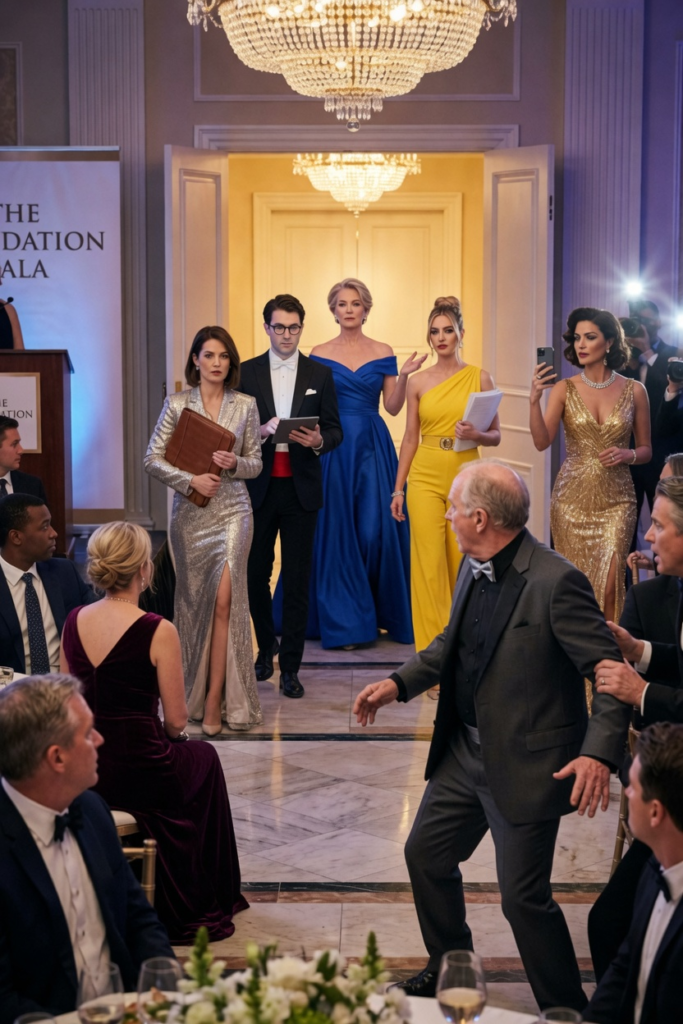
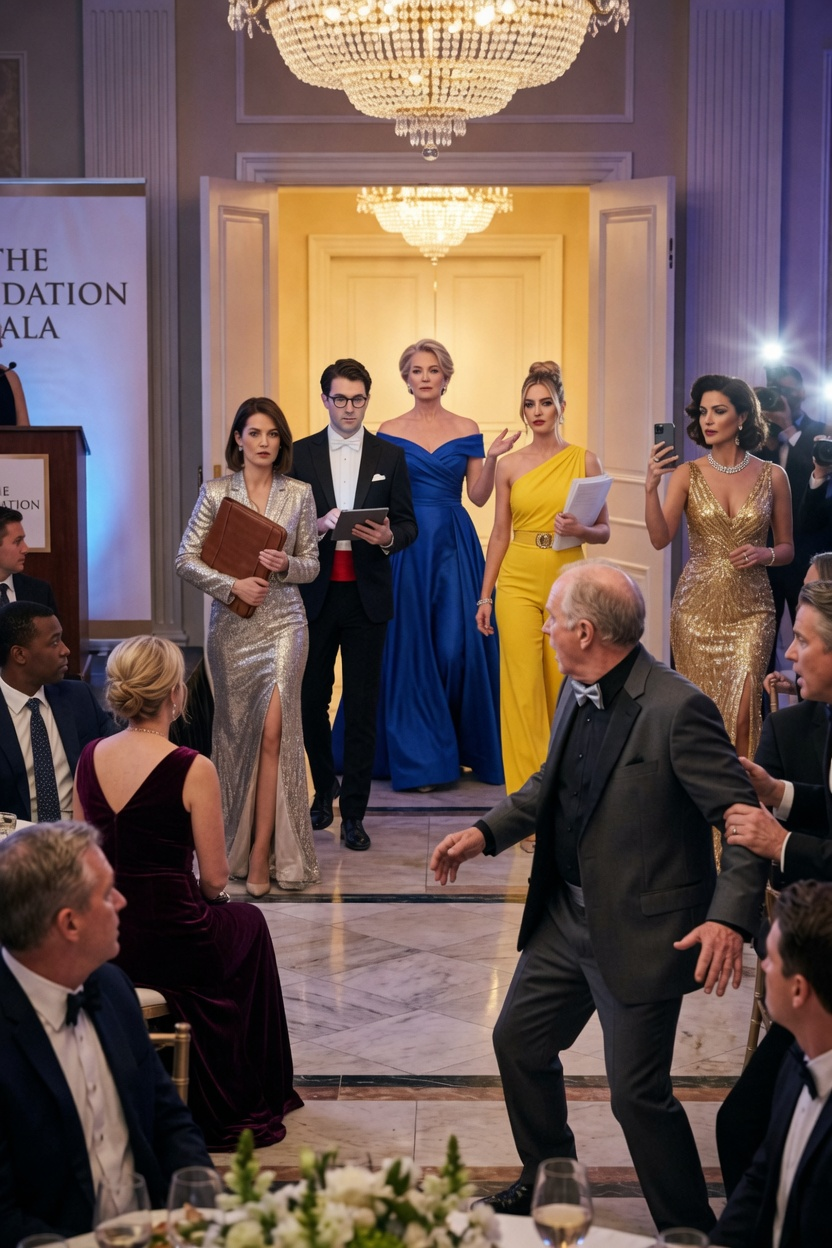
White lilies towered in crystal vases. Champagne moved through the crowd on silver trays. Marble pillars rose toward a ceiling painted with gods who had seen too many rich men pretend philanthropy was virtue. The city’s elite glittered beneath chandeliers, murmuring about legacy, markets, art, and the delicious rumor that Vale Meridian had secured a mysterious new financial partner.
Richard stood on the grand stage, spotlight burnishing the silver in his hair. He looked older than the last time I had seen him in person, but age had not humbled him. It had sharpened his desperation into polish. His tuxedo was flawless. His smile remained unnaturally white. He spoke into the microphone about family values, stewardship, innovation, building for the next generation, and the sacred obligation to leave something of one’s own blood behind.
Blood.
Even after all those years, the word had teeth.
I waited in the shadowed vestibule behind the closed ballroom doors. Security staff stood nearby, but they were ours now through contract, payment, and legal authority tied to the event’s financing. Richard did not know that. Richard knew very little by then. That was the danger of surrounding oneself with people paid to preserve delusion.
At precisely eight o’clock, the doors opened.
Silas entered first.
He did not rush. None of them did. That had been Clara’s instruction. “Power does not hurry unless the building is on fire, and tonight we are the fire.” Silas moved down the center aisle, black dossier in hand. Harper walked beside him, calm and pale as moonlight. Rowan followed, eyes scanning the room, already reading reactions like market signals. Clara glided last among them, smiling faintly, every camera in the room turning toward her because she had spent years teaching cameras to obey.
The crowd parted.
Richard’s speech faltered.
He stepped away from the podium, visibly relieved beneath the confusion, believing his saviors had arrived at last. He moved toward them with his old charismatic urgency, hands outstretched.
“Vanguard,” he said warmly. “At last. We are honored—”
Then I stepped into the light behind my children.
I watched recognition move across his face.
At first, nothing. Then irritation, as if memory had placed the wrong person in the wrong room. Then confusion. Then horror.
“Audrey?” he breathed.
The ballroom went quiet in widening rings. Those closest heard him. Those farther back sensed something had shifted and turned accordingly. I walked forward with the unhurried calm of a woman who had once crawled from a nursery floor and spent seventeen years learning not to tremble in rooms built by men like him.
Richard tried to recover. “What are you doing here? This is a private event.”
“It is,” Silas said.
Richard looked at him, irritation flaring. “Excuse me?”
“Private. For Vanguard partners.” Silas handed him the black folder. “I’m Silas Arden, head of acquisitions.”
The name landed. Arden. Not Vale. Richard’s eyes flicked from Silas to me.
Silas gestured without looking away. “Harper Arden, chief technology officer. Rowan Arden, managing partner for distressed assets. Clara Arden, communications and strategic influence.”
Clara gave a little wave. Several people in the room checked their phones at once, recognizing her.
Richard’s smile twitched. “This is absurd.”
“No,” Harper said quietly. “It’s audited.”
Silas opened the folder for him. “Vanguard now holds controlling positions in your distressed debt. We also purchased four board interests by close of business today. At 4:03, to be precise. Your offshore collateral structure triggered multiple fiduciary covenant breaches, which Harper has already referred through appropriate channels. Rowan completed the headquarters debt acquisition this afternoon. Clara has prepared public disclosure packets regarding Gregory’s embezzlement and casino liabilities.”
The ballroom seemed to inhale.
Richard’s face drained of color.
He looked at me then, really looked, perhaps for the first time in his life. Not as a wife. Not as a failed vessel. Not as an inconvenience. As an adversary who had arrived with children he dismissed before knowing their names.
I took a flute of champagne from a nearby waiter. His hand shook slightly. I smiled at him, then turned back to Richard.
“You left me because I couldn’t give you a legacy,” I said. My voice carried in the silence. “So I built one myself.”
His mouth opened. Nothing came out.
“And tonight,” I continued, “my legacy bought yours for pennies on the dollar.”
The room erupted.
Phones buzzed in waves as Clara’s media packages went live. Financial news alerts. Casino receipts. Board exits. Debt exposure. Federal inquiry speculation. Cameras flashed. Whispers became gasps. Donors stepped backward from Richard as if scandal were contagious. On the far side of the room, I saw Gregory Vale near the bar, young, pale, and terrified. He looked less like an heir than a boy caught stealing matches beside a burning house.
Richard spun toward him.
“Gregory,” he barked. “Call Danton. Call the defense team now.”
Gregory backed away.
“Dad,” he said. His voice cracked. “I can’t.”
Richard lunged and grabbed him by the lapels. “What did you do?”
Gregory shoved him back with surprising force. “I made a deal.”
The sentence cut through the noise.
“I gave them everything,” Gregory said, tears standing in his eyes. “The transfers. The Macau markers. The headquarters collateral. I signed this morning. I’m sorry.”
For one second, I almost pitied Richard. Not because he deserved pity. Because the thing he worshiped most, bloodline loyalty, had finally answered him in his own language: self-preservation.
Then the brass doors at the back of the ballroom opened again.
Men and women in dark FBI windbreakers moved down the aisle with purposeful silence. The crowd split faster for them than it had for us. Richard turned slowly, the last fragments of his public mask collapsing. One agent spoke his name. Another took his arm.
No one laughed.
That, somehow, made it cleaner.
The disintegration of Richard Vale’s life over the next forty-eight hours was absolute.
His assets were frozen under federal mandate. Vale Meridian’s emergency board session removed him before noon the next day. The company’s stock plunged, then stabilized only after Vanguard announced a restructuring plan protecting core employees, pension obligations, and public infrastructure contracts while isolating criminal exposure at the executive level. Clara controlled the narrative with devastating precision: this was not a corporate raid, but a rescue from negligent dynastic mismanagement. Reporters loved it. Investors loved it more.
Camilla attempted to leave through JFK with a duffel bag full of unappraised jewelry and two passports. Paparazzi photographed her in sunglasses, one hand over her face, while federal customs officers asked questions she had clearly not rehearsed. By Tuesday afternoon, the mansion Richard had traded me for—the mausoleum where Gregory had grown up under portraits of invented permanence—was foreclosed, its gates chained, its doors padlocked by the bank.
Richard sat in a windowless interrogation room stripped of his Brioni suit, his shoelaces, his watch, and the illusion that wealth could always purchase distance. Federal agents laid out documents. His son’s testimony. His board’s withdrawals. His collateral violations. His company’s internal transfers. His life reduced to exhibits.
While he shivered under fluorescent lights, we went to a diner.
Not a fashionable one. Not an ironic one with curated nostalgia and twenty-dollar milkshakes. A real late-night diner on the edge of the city with sticky linoleum tables, cracked red vinyl booths, burnt coffee, fluorescent signs, and pie rotating in a glass case like a sacred object. The air smelled of frying grease, old sugar, and rain-damp pavement.
It was perfect.
I sat squeezed into a semi-circular booth between Rowan and Clara. Across from us, Silas and Harper argued over the last slice of cherry pie with a seriousness neither of them had shown while seizing a multinational conglomerate.
“You seized offshore accounts yesterday,” Silas said, pointing his fork at Harper. “Let me have the pie.”
“I identified the breach,” Harper said. “The accounts seized themselves.”
“That is the most irritating thing you’ve ever said.”
“It is not in the top ten,” Rowan muttered.
Clara slid her fork casually toward the plate. Harper blocked her with a spoon.
“No media manipulation for pie,” Harper said.
“I would never,” Clara replied, offended. “For pie, I use direct action.”
I watched them and felt peace settle over me, not gentle but anchoring. We had unimaginable leverage now. Wealth. Influence. Power. But this—this ridiculous argument over diner pie after dismantling Richard’s empire—was the truth of us. Not the gala. Not the cameras. Not the financial wires. The booth. The coffee. The way Rowan automatically pushed extra napkins toward Clara because she always spilled. The way Harper gave Silas the cherry from the top while pretending she had not. The way Silas saw me watching and softened.
“We did it, Mom,” he said quietly.
The table went still.
Nobody called me Audrey in moments that mattered. Always Mom.
His sharp features shifted, and beneath the attorney, beneath the acquisitions strategist, I saw the nine-year-old boy who had entered my foyer promising to keep everyone together.
“Nobody will ever look down on you again,” he said.
I reached across the table and covered his hand with mine. Clara rested her head on my shoulder. Rowan leaned into my side. Harper looked down, but her fingers found my sleeve.
“They never could, sweetheart,” I whispered. My eyes blurred, and I did not try to stop the tears. “Because every time I looked at the four of you, even on the hardest days, I knew I was the richest woman in the world.”
Silas closed his eyes.
For a while, we simply sat there in the sticky booth, five people made from rejection and stubbornness, passing forks and coffee and history between us.
Near midnight, as we stepped out into the amber glow of streetlights, my phone buzzed.
It was an email from Denise Holloway, the state director who had called me seventeen years earlier from Child and Family Services. She was older now, promoted several times, but she still sent Christmas cards and occasionally asked for advice when systems failed in new and creative ways. The subject line was urgent. A major facility housing hundreds of children was facing a budget crisis. State funds had been delayed. Private donors had withdrawn. They needed emergency support, long-term restructuring, advocacy, everything.
Could I help?
I smiled and typed one word.
Yes.
Before I could press send, the screen shifted.
Incoming call.
Unknown encrypted number.
Silas saw my expression change. “Mom?”
I showed him the screen. His face sharpened.
“That’s a federal routing mask,” he said. “Top-tier.”
Clara leaned over. “Answer it.”
I did.
The voice on the other end belonged to Senator Elias Moreau, chair of the federal subcommittee reviewing upcoming zoning laws tied to youth housing, adaptive reuse, and public-private care facilities. He congratulated me on the gala, though politicians never congratulate without reaching for something. He wanted to discuss a mutually beneficial arrangement. His office had been studying Vanguard’s restructuring capabilities. The country needed new models for youth facilities, foster transition housing, educational campuses, and safe emergency placements. Federal zoning reform was coming. He wanted partners who could move quickly.
“Senator,” I said, looking at my children under the diner’s flickering sign, “I’m listening.”
A year later, the dust had not merely settled.
We had paved over it, planted trees, and built doors where walls had been.
Richard was serving a twenty-year sentence in a federal penitentiary upstate. His name had vanished from the high-society circles that once treated him as inevitable. Vale Meridian existed in altered form under professional management, stripped of its dynastic rot, its viable assets folded into Vanguard’s civic infrastructure portfolio. Gregory served a reduced sentence under his cooperation agreement and later entered treatment for gambling addiction, a fact I learned from a legal update and felt no need to investigate emotionally. Camilla fought several civil claims from Europe and occasionally appeared in tabloids looking both expensive and cornered.
I did not gloat.
Not because I was too pure for satisfaction. I had enjoyed the look on Richard’s face at the gala. I would not insult myself by pretending otherwise. But gloating is a form of lingering, and I had already given Richard too many years of my life. His ruin was not the point. It was a clearing.
On a crisp autumn morning, I stood before a massive silk ribbon holding oversized golden scissors while a hundred cameras flashed like tiny storms. Behind me rose the newly minted Vanguard Youth Foundation campus: a sprawling, state-of-the-art youth center, emergency placement facility, school, therapy hub, legal clinic, and long-term transition residence fully funded and endowed in perpetuity. The old facility Denise had written about had been unsafe, underfunded, and patched together by exhausted people doing holy work with broken tools. We did not patch it. We replaced it.
The new campus smelled of fresh paint, clean wood, soil, and possibility. There were classrooms with flexible seating, sensory rooms, medical suites, family visitation spaces designed not to feel like punishment, gardens, playgrounds, apartments for aging-out youth, art studios, technology labs, kitchens where children could see food and learn it would remain, bedrooms with windows that opened to trees. Harper had designed the security systems so children were protected without feeling imprisoned. Rowan structured the endowment so no single political tantrum could starve it. Silas built legal protections into the operating charter. Clara made the opening impossible to ignore.
Reporters crowded the courtyard. Politicians lined the front rows. Community leaders, teachers, social workers, former foster youth, donors, and skeptical bureaucrats filled the space beyond the ribbon.
But my eyes found only four faces.
Silas stood in the front row, dark suit, arms crossed, watching me with fierce pride. Harper stood beside him, uncomfortable with the crowd but present because she loved me more than she hated cameras. Rowan smiled through nerves, one hand in his pocket probably gripping a granola bar. Clara stood radiant in deep blue, already half aware of every angle and yet looking at me not as a media strategist, but as my youngest child.
I stepped to the microphone.
Feedback whined, then quieted.
For a moment, I saw the nursery again. The painted oak tree. The empty crib. Richard’s shoes stepping around my hand. Broken vessel. Massive and empty as your future.
Then the image changed. Silas at nine, saying I keep us together. Harper under the table with wires. Rowan checking the refrigerator for saved leftovers. Clara reaching through fever and calling me Mom. Four children under a kitchen light while Richard’s Christmas card vanished down the disposal. The farmhouse. The diner. The gala. The forest growing.
“Seventeen years ago,” I began, my voice steady, “I was told I was barren. I was told I was a broken vessel. I was told I could not contribute to the future because my body did not produce the kind of legacy a powerful man wanted to see.”
The crowd fell silent.
“For a time, I believed that pain was the end of my story. I believed empty rooms could define a woman. I believed biology had the authority to decide whether I was allowed to be a mother.”
I looked at my children.
“Then four children arrived at my door with broken records, frightened eyes, and more courage than any adult had the right to ask from them. They did not need perfection. They needed permanence. They did not need blood. They needed someone who would stay.”
Silas looked down. Harper blinked hard. Clara’s smile trembled.
“This foundation exists because no child should be labeled unadoptable by a system too underfunded to imagine healing. No child should be separated from siblings because adults failed to build enough rooms. No young person aging out of care should enter adulthood with a trash bag of belongings and a file full of trauma. We can do better. We will do better. And today, we begin here.”
Applause rose, then faded as I continued.
“Blood can make people related,” I said. “But loyalty, sacrifice, and unconditional love make a family. I was told I could not grow a single branch.”
I smiled then, not for the cameras, not for Richard, not for history, but for the four lives in front of me.
“So I cultivated a forest.”
The crowd erupted.
The sound rolled over the courtyard, loud enough to shake the air. I brought the golden scissors down and cut the ribbon. Silk fell away. Doors opened behind me. Children waiting inside with caseworkers and staff began clapping too, some shyly, some wildly, some only because everyone else was doing it and joy can be learned by imitation at first.
I stepped off the stage and was immediately swallowed by my children.
Silas hugged me first, fierce and careful. Harper leaned in from the side. Rowan wrapped his arms around all of us. Clara crushed herself into the middle and said, “My makeup is too expensive for this,” while crying directly onto my jacket.
Reporters surged. Cameras flashed. Politicians prepared remarks. Staff tried to organize the next photo. But for several seconds, the five of us formed our own weather.
Then Clara lifted her head, her media smile returning even as her eyes remained wet.
“Mom,” she whispered near my ear, “the senator is here.”
I glanced toward the second floor of the main building. Dark tinted windows concealed the private VIP lounge. Behind one of them, Senator Moreau waited to discuss zoning, federal partnerships, and the next phase of what Clara called, with slightly too much delight, “benevolent domination.”
“He wants to talk about the mutually beneficial arrangement,” she continued. “And he brought two committee chairs.”
Silas’s eyes narrowed. “Good.”
Harper said, “I hope they read the briefing this time.”
Rowan checked his phone. “Markets like the opening. Also, we should eat within an hour.”
I looked from one child to the next and felt an old darkness finally release its last claim.
Richard had wanted a legacy that looked like him.
I had built one that could outlive me.
I smoothed my jacket, lifted my chin, and looked toward the tinted windows.
A slow smile crept across my face.
The chapter of Richard Vale had closed long ago, no matter what the newspapers thought. What began today was not revenge. Revenge had been too small for what we had become. This was cultivation. Expansion. Shelter. Power redirected from vanity into roots.