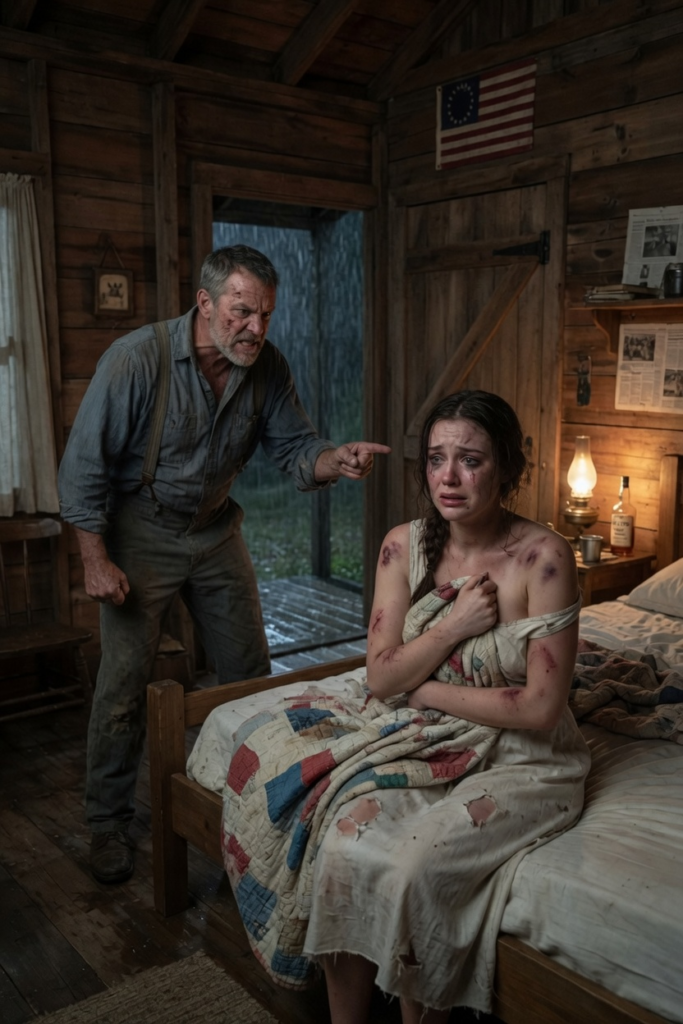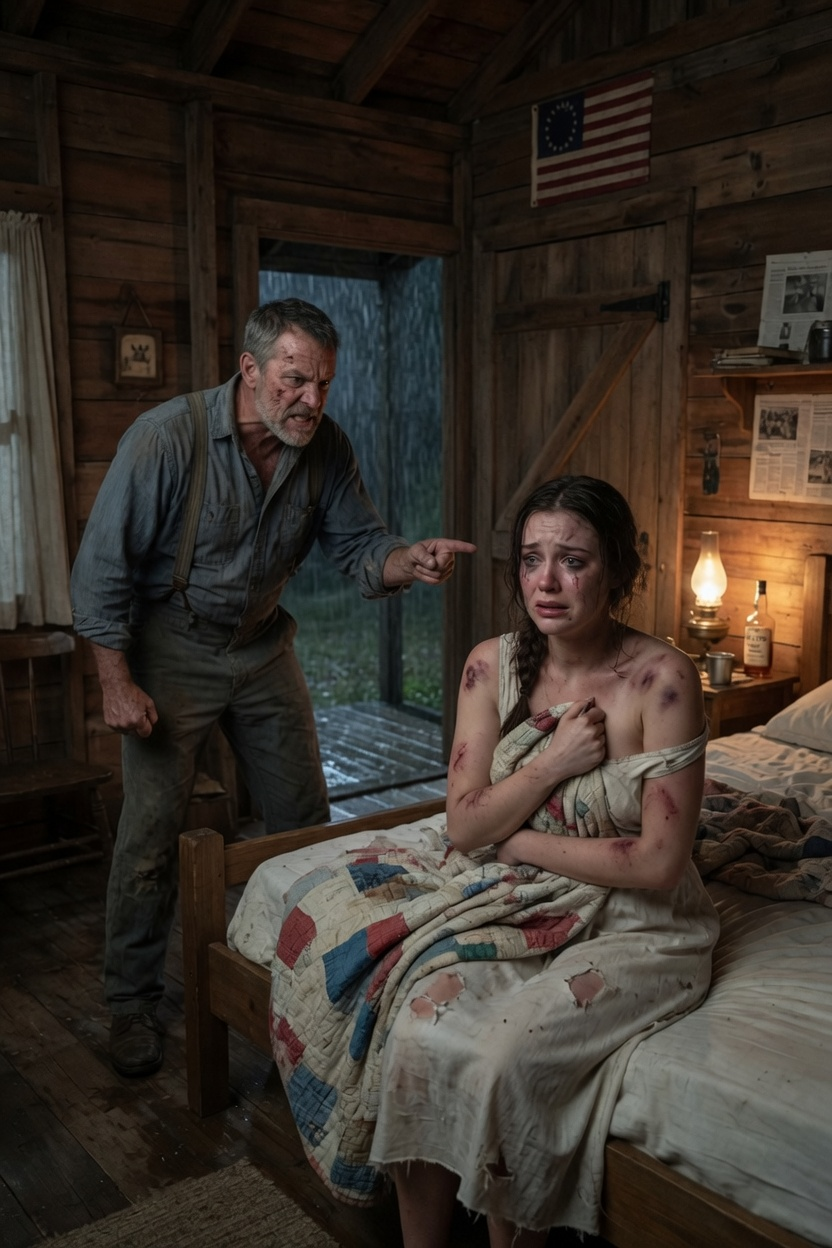
Dust drifted from the ceiling beams.
Mateo did not open the door.
Instead, he slid the heavy iron bolt into place with a slow, deliberate scrape that echoed through the cabin like a warning.
Outside, Rogelio Vargas laughed once.
Not with humor.
With ownership.
“Boy,” he shouted through the storm, “that girl belongs to me.”
Behind Mateo, Isabela made a broken sound in her throat.
Not surprise.
Recognition.
The kind a beaten animal makes when it hears the hunter’s boots again.
Mateo’s blood turned cold.
He had spent years around ranch hands, drunks, gamblers, and violent men. He knew the sound of cruelty. Most cruelty barked loudly because it wanted witnesses.
But this voice—
This voice carried confidence.
The confidence of a man who had hurt someone for years and never once been stopped.
Rogelio pounded the door again. “Open it before I break it down.”
Mateo finally spoke.
“She’s my wife now.”
Silence followed.
Then came another laugh.
“That paper means nothing.”
The words hit harder than the blows on the door.
Because evil always reveals itself in the moments it forgets to pretend.
Mateo glanced back.
Isabela sat curled against the bedframe, white-knuckled beneath the blanket. Her eyes were fixed on the door, already preparing herself to be dragged through it.
That look decided everything.
Not anger.
Not pride.
Not manhood.
Something older.
A line inside him that refused to move.
Mateo walked to the hearth and picked up the iron poker.
The metal glowed faint orange at the tip from the dying fire.
Outside, Rogelio’s boots crunched across the dirt porch.
“You think you’re protecting her?” he called. “Ask her who fed her. Ask her who kept a roof over her head after her mother died.”
Mateo opened the small drawer beside the table and removed the revolver he kept wrapped in cloth.
The cylinder spun softly beneath his thumb.
One bullet chambered.
Then another.
Behind him, Isabela whispered shakily, “He’ll kill you.”
Mateo looked at her for a long moment.
For the first time since entering the cabin, she met his eyes directly.
Fear lived there.
But beneath it—
Something smaller.
Hope so fragile it almost hurt to see.
“He’s killed before,” she whispered. “People just… disappear around him.”
The wind howled against the cabin walls.
Rogelio struck the door hard enough to rattle the hinges.
“ISABELA!”
She flinched violently.
Mateo’s jaw tightened.
“No more,” he said quietly.
The words surprised even him.
Outside, Rogelio’s voice dropped lower, uglier.
“You think he’ll keep you after he learns what you are?”
Isabela’s face crumpled.
There it was.
The poison.
Years of being taught she was ruined.
Used.
Dirty.
Mateo suddenly understood why she had spoken those words in bed like an apology instead of a confession.
Someone had stolen shame from the guilty and nailed it onto her instead.
Rogelio spat toward the porch. “Open this damn door or I swear to God—”
Mateo yanked it open himself.
The storm exploded inward.
Rain sprayed across the floorboards.
Rogelio Vargas stood beneath the porch lantern in a dark coat slick with water, thick beard dripping, one hand already lifting in outrage before he saw the revolver aimed directly at his chest.
He stopped.
For the first time that night, surprise crossed his face.
Mateo stepped onto the porch.
The poker hung at his side.
The gun stayed steady.
Behind him, Isabela gasped softly.
Rogelio recovered quickly. Men like him always did.
“You threatening me over my own blood?” he sneered.
Mateo’s voice came out flat as stone.
“She’s not your property.”
Rogelio’s eyes darkened.
“You know what she is?”
“Yes,” Mateo answered.
The older man smirked cruelly. “Then you know she’s spoiled.”
Mateo moved before he realized he’d decided to.
The iron poker slammed across Rogelio’s mouth with a crack that sent blood spraying into the rain.
Rogelio staggered backward, roaring.
Mateo descended the porch steps slowly.
Forty-three years of grief, silence, loneliness, and buried rage stood inside him like loaded powder finally meeting flame.
“You touch that girl again,” he said, “and they’ll bury what’s left of you in these hills.”
Rogelio spat blood into the mud and reached beneath his coat.
Mateo cocked the revolver instantly.
Everything froze.
Rain hammered the earth.
Wind screamed through the mesquite trees.
Rogelio’s hand stopped halfway to the knife at his belt.
Not because he feared death.
Because he finally recognized something worse.
A witness.
A man willing to stand in front of Isabela and not move.
Rogelio’s swollen lip curled. “You think the law cares what happens to women?”
Mateo’s eyes never left his.
“No,” he said. “But I do.”
For one endless second, neither man breathed.
Then hoofbeats sounded faintly down the road.
Lantern light flickered through the storm.
Rogelio glanced toward it instinctively.
Two riders were approaching the ranch.
Fast.
The parish priest.
And beside him—
Deputy Esteban Ruiz.
Someone had followed Rogelio from town.
The moment Rogelio realized he no longer controlled the night, hatred twisted across his face like a wound.
He pointed at Isabela through the open doorway.
“She’ll always belong to me.”
Mateo raised the revolver higher.
“No,” he said quietly.
Then he stepped fully between them.
“She belongs to herself.”The deputy’s horse skidded through the mud hard enough to spray dirt across the porch steps.
Deputy Esteban Ruiz swung down first, one hand already resting near the rifle strapped to his saddle.
The priest followed slower, older knees stiff from the ride, rain soaking through his black coat.
Rogelio stepped back at once.
Not frightened.
Calculating.
Men like him survived by changing masks faster than other people changed shirts.
By the time the deputy reached the porch, Rogelio had already arranged his face into injured outrage.
“Thank God,” he barked. “This old bastard kidnapped my stepdaughter.”
Inside the cabin, Isabela recoiled like she’d been struck.
Mateo saw it.
Saw how quickly Rogelio reshaped reality.
How many times had he done this before?
How many doors had closed behind him while decent people nodded and believed the respectable man over the trembling girl?
Deputy Ruiz looked between them carefully.
His eyes lingered on Mateo’s revolver.
Then on the bruise swelling across Rogelio’s mouth.
Then finally on Isabela standing barefoot beside the bed, wrapped tightly in the blanket.
And he went still.
Not because of fear.
Recognition.
The deputy had daughters.
Mateo knew that.
Two little girls who sometimes ran through town chasing chickens while Ruiz pretended not to smile.
A father recognizes terror differently than other men do.
“Señorita,” Ruiz said gently, “did this man force you to stay here?”
Isabela opened her mouth.
No sound came out.
Rogelio seized the silence instantly.
“She’s confused,” he snapped. “The girl has always been emotional.”
Mateo’s grip tightened on the revolver.
Emotional.
There it was again.
The favorite word of cruel men whenever truth threatened them.
The priest stepped forward uneasily. “Perhaps everyone should calm down—”
“No,” Isabela whispered.
The word barely carried over the storm.
But everyone heard it.
She swallowed hard.
Her hands trembled violently inside the blanket.
Then she looked directly at Deputy Ruiz.
And for the first time that night, she spoke without lowering her eyes.
“He hurt me.”
Rogelio’s face changed.
Not guilt.
Fury.
Pure animal fury at being disobeyed publicly.
“You lying little—”
“Enough,” Ruiz snapped.
The deputy’s voice cracked through the rain like a whip.
Rogelio stopped.
Not because he respected the law.
Because predators understand tone.
Ruiz stepped into the cabin slowly.
“Who hurt you, hija?”
Isabela’s lips parted.
Mateo could almost see the war inside her.
Years of fear battling one desperate chance to escape it.
Then the words finally came.
“My stepfather.”
Silence swallowed the room.
The priest crossed himself immediately.
Rogelio laughed in disbelief. “You can’t seriously believe this filth.”
But nobody looked at him now.
Ruiz’s eyes had already found the bruises on Isabela’s wrists.
The yellowing fingerprints around her upper arm.
The old scar near her collarbone.
Evidence.
Not rumor.
Not gossip.
Evidence.
The deputy’s face hardened slowly.
“How long?” he asked quietly.
Isabela stared at the floor.
“Since my mother died.”
Even the storm seemed to pause.
Mateo felt sick.
Not angry anymore.
Beyond anger.
There are crimes so rotten they stop feeling human.
The priest whispered, horrified, “Sweet Virgin…”
Rogelio suddenly lunged forward.
“Don’t listen to her!”
Mateo slammed him against the wall before he reached her.
The cabin shook.
The revolver pressed hard beneath Rogelio’s jaw.
“Move again,” Mateo said softly, “and I’ll bury you myself.”
For one dangerous second, it nearly happened.
Mateo could feel the man’s pulse hammering against the barrel.
Could smell whiskey and rain and blood.
Could imagine how easy it would be.
One pull.
One sound.
One monster gone forever.
Then Isabela spoke behind him.
“Please.”
Not begging for Rogelio.
For Mateo.
Begging him not to lose himself too.
Mateo stepped back slowly.
Ruiz moved immediately, wrenching Rogelio’s arms behind his back.
“You’re making a mistake!” Rogelio shouted as the deputy bound his wrists. “She’s damaged! Ask anyone in Puebla! Everyone knows what she is!”
Isabela flinched.
Mateo saw shame try to crawl back into her like an old sickness.
So he crossed the room and stood beside her.
Close enough for Rogelio to see.
“She is not the shame here,” Mateo said.
Rogelio stared at him with naked hatred.
Then his expression shifted suddenly.
Smug.
Cruel.
“You touched her tonight, didn’t you?”
The cabin went still again.
Rogelio smiled through bloody teeth.
“That means you’re no different than me.”
The words landed like poison.
Isabela’s breathing stopped.
The priest looked horrified.
Even Ruiz hesitated slightly.
And Mateo—
Mateo understood the trap instantly.
Because evil men survive by making goodness feel contaminated.
He looked at Isabela.
Really looked at her.
At the fear still trembling in her shoulders.
At the tears she kept trying to hide.
At the way she waited for disgust every time someone learned the truth.
Then Mateo lowered the revolver onto the table.
“I stopped the moment I understood she was afraid,” he said calmly.
Rogelio sneered. “Afraid is still afraid.”
“No,” Mateo answered quietly. “Fear caused by confusion is not the same as fear caused by ownership.”
The room fell silent.
Even Deputy Ruiz looked at him differently after that.
Mateo turned toward Isabela slowly.
“If you wish,” he said carefully, “this marriage can be annulled. You never have to share my bed. You never have to touch me. You never have to fear another locked door again.”
Isabela stared at him like she did not understand the language.
Because freedom sounds impossible to people raised without it.
A tear slid down her face.
Then another.
“You would still let me stay?” she whispered.
Mateo’s chest tightened painfully.
She asked it like shelter was too much kindness to expect from the world.
“Yes,” he said.
No hesitation.
No bargain.
Just yes.
And something inside Isabela finally broke.
Not badly.
Not violently.
Like chains rusting apart after years in the rain.
She covered her mouth and sobbed for the very first time not from terror—
but relief.Rogelio Vargas was still cursing when Deputy Ruiz dragged him into the rain.
Mud swallowed the older man’s boots with every step.
“You’ll regret this!” he shouted. “All of you!”
Nobody answered.
The storm answered for them.
Thunder rolled across the hills while the deputy tied Rogelio’s wrists to the saddle horn. The priest remained near the porch, pale and shaken, clutching his cross so tightly his knuckles looked bloodless.
Inside the cabin, Isabela sat on the edge of the bed wrapped in the wool blanket.
She had stopped crying.
That frightened Mateo more than the tears.
People only go that quiet when pain has exhausted even grief.
The priest stepped carefully through the doorway. “Daughter… there are procedures for these matters. We should take her somewhere proper.”
Isabela instantly stiffened again.
Mateo saw panic return to her eyes.
Somewhere proper.
Another room.
Another authority.
Another man deciding where she belonged.
“She stays here tonight,” Mateo said firmly.
The priest frowned. “Mateo—”
“She stays.”
Deputy Ruiz entered behind them, rainwater dripping from the brim of his hat.
For a long moment, he studied Isabela silently.
Then he nodded once.
“She stays.”
The priest looked uncomfortable but said nothing further.
Outside, Rogelio continued shouting threats from the horse.
But his voice sounded smaller now.
Distance changes monsters.
Mateo shut the cabin door.
This time, he locked it to keep danger out.
Not trap someone inside.
The difference mattered.
The fire in the hearth had nearly died, so Mateo knelt and fed it fresh wood until flames climbed slowly upward again. Warm light spread across the cabin walls, softening the shadows that had seemed so cruel earlier.
Isabela watched him carefully.
Like someone observing an unfamiliar animal.
Waiting to discover whether gentleness was real or simply another disguise.
Mateo understood that look.
Trust was not born in speeches.
Trust was earned in repetitions.
In doors left open.
In voices that stayed calm.
In hands that stopped when asked.
He rose slowly and placed the revolver high on the shelf far from both of them.
Then he moved the iron poker too.
Not because he feared himself.
Because frightened people notice weapons first.
“There’s stew left from supper,” he said quietly. “You should eat something.”
“I’m not hungry.”
Her voice was automatic.
A habit.
Mateo remembered hearing widows say the same thing after funerals.
The body refusing food because survival itself felt suspicious.
Still, he ladled stew into a bowl and set it near her anyway.
The smell of beans, garlic, and slow-cooked beef filled the room.
Isabela stared at it without touching the spoon.
After a while, she whispered, “He used to make me thank him afterward.”
Mateo froze beside the fire.
She kept her eyes on the bowl.
“As if he had done me kindness.”
Each word sounded scraped raw from her throat.
“When I cried, he said women cry during marriage too. He said pain was part of belonging to a man.”
The flames cracked softly between them.
Mateo thought of all the people in Puebla who must have seen bruises and chosen comfort over questions.
Neighbors.
Shopkeepers.
Relatives.
Maybe even priests.
Cruelty survives longest where silence feeds it.
“He told everyone I tempted men,” Isabela continued faintly. “After enough years… I started wondering if maybe he was right.”
“No.”
The word came out sharper than Mateo intended.
Isabela looked up.
He forced himself to soften his voice.
“What happened to you was violence. Not temptation. Not sin. Violence.”
She stared at him for a long time.
Like she was trying to fit his words into a place inside herself where nothing clean had lived for years.
Then finally, slowly, she picked up the spoon.
That small movement nearly broke his heart.
Near midnight, Deputy Ruiz prepared to leave for town with Rogelio in custody.
Before mounting his horse, he pulled Mateo aside beneath the porch roof.
“Puebla won’t like this,” Ruiz warned quietly. “Vargas has friends. Money too.”
Mateo looked toward the cabin window where Isabela’s shadow moved faintly beside the fire.
“I know.”
“They may claim she’s unstable.”
“She’s terrified,” Mateo replied. “There’s a difference.”
Ruiz studied him carefully.
“You mean to stand beside her through this?”
Mateo answered without hesitation.
“Yes.”
The deputy nodded once, slow and respectful.
Then he glanced toward Rogelio, tied to the horse like a sack of rotten grain.
“Good,” Ruiz muttered. “Because men like that count on everyone leaving eventually.”
After they rode away, silence settled over the ranch again.
But it was a different silence now.
Not the silence of fear.
The silence after survival.
Mateo returned inside and found Isabela asleep against the headboard, the untouched bowl still cooling beside her hand.
Exhaustion had finally claimed her.
Even sleeping, her body remained tense.
As if she expected violence to arrive the moment she relaxed.
Mateo pulled a chair near the door and sat down heavily.
He did not approach the bed.
Did not touch her.
He simply kept watch while the fire burned low.
Near dawn, Isabela stirred suddenly from a nightmare.
Her breath caught hard.
For one wild instant, terror flooded her face—
until she saw him sitting across the room.
Not beside her.
Not over her.
Just there.
Guarding the door.
The fear in her eyes loosened slightly.
Mateo rubbed tiredness from his face. “You’re safe.”
No grand speech.
Just truth.
Outside, the first pale light of morning spread slowly over the hills.
A new day crawling into existence after the longest night of both their lives.
Isabela looked toward the window as if she had forgotten mornings still happened.
Then she whispered something so quietly Mateo almost missed it.
“No one ever stayed before.”
The words settled deep in his chest.
Because suddenly he understood something terrible:
Rogelio Vargas had not only taught her to fear men.
He had taught her to expect abandonment from anyone kind enough to notice the damage.
Mateo stood slowly and crossed to the stove.
“I make terrible coffee,” he said gruffly. “But it’s hot.”
A tiny sound escaped her then.
Not quite laughter.
But close.
And in that fragile, trembling moment, with dawn touching the cabin walls gold for the very first time—
hope entered the room too.