Dinner began with Mark carving turkey and telling everyone how difficult the year had been for him.
No one mentioned that Claire had worked two jobs after her divorce, while Mark called her irresponsible for needing help once.
No one mentioned Lily’s school awards, her kindness, or the way she had practiced saying “Happy Thanksgiving” in the mirror.
The food passed from hand to hand like a ritual.
Turkey passed.
Mashed potatoes passed.
Green beans passed.
Cranberry sauce passed.
Warm rolls passed twice.
Lily waited with both hands in her lap because Claire had raised her to be polite, even when politeness cost too much.
Her plate stayed empty.
Claire reached for the turkey, but Heather touched the platter first.
“Oh,” Heather said lightly, “we almost forgot Lily’s special serving.”
The room shifted before Claire understood why.
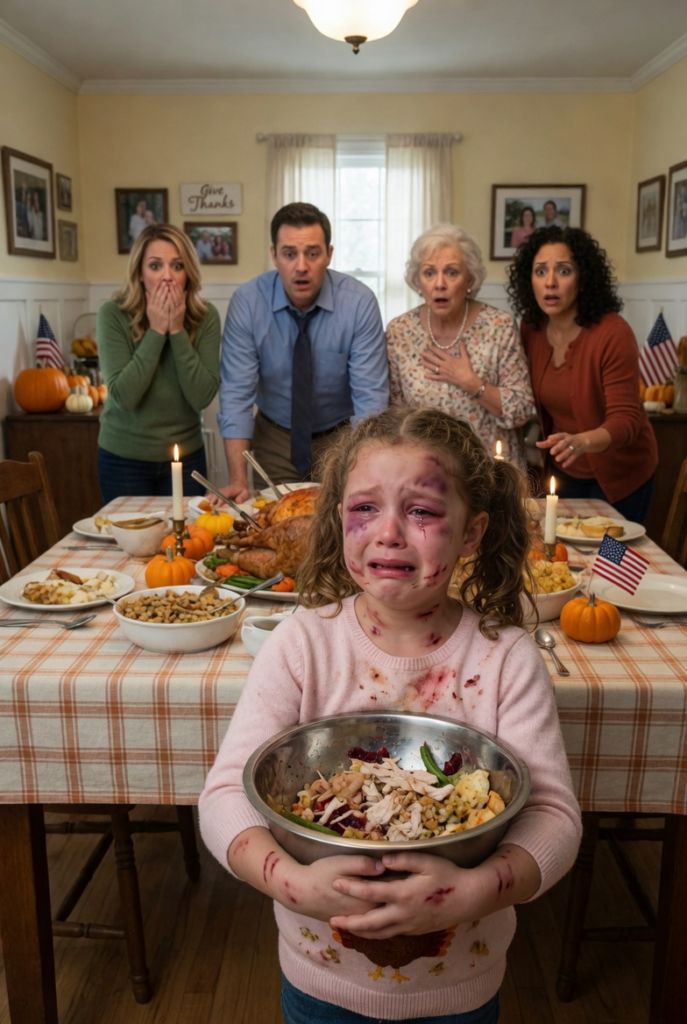
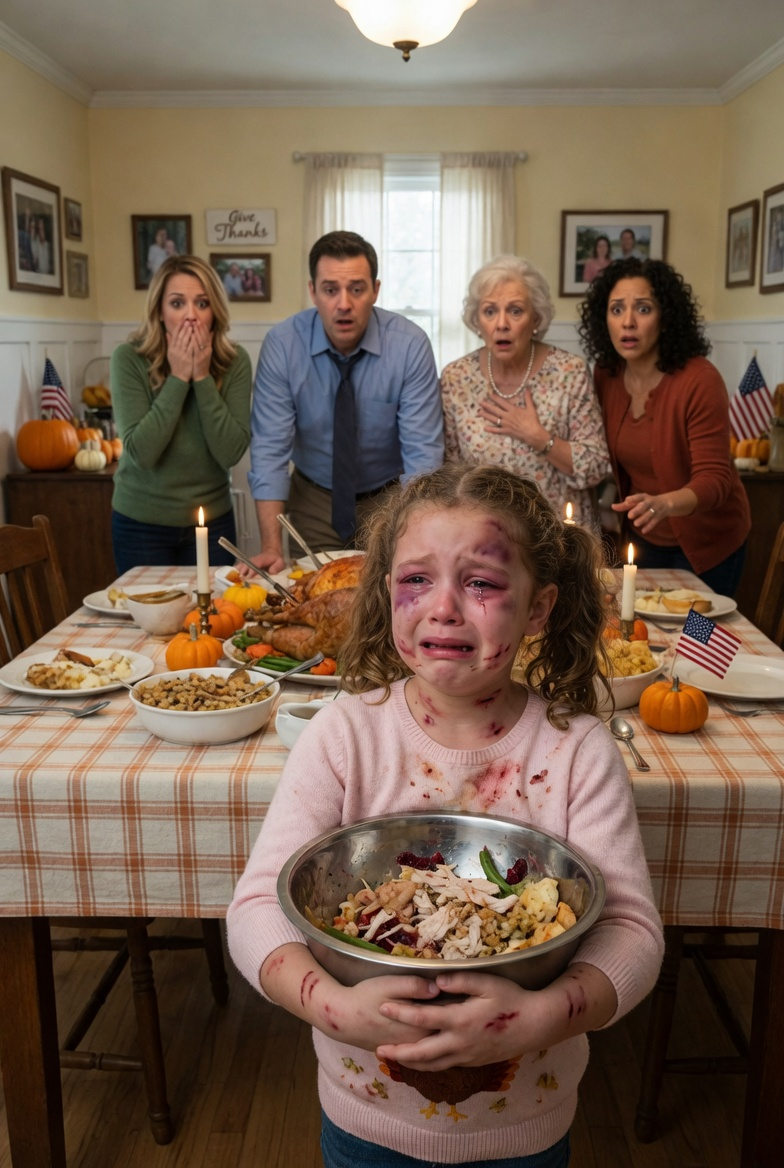
Heather disappeared into the kitchen, and when she returned, she was carrying a scratched metal dog bowl.
Inside were cold scraps, folded turkey skin, burned stuffing, and peas sliding through gray gravy.
She placed it in front of Lily like a punchline.
The sound of the bowl scraping against the table seemed louder than every conversation in the house.
For one second, even cruelty paused to admire itself.
Then Mark leaned back in his chair and laughed.
“Dogs eat last,” he said loudly, looking straight at Lily.
He let the words hang there, then smiled wider.
“And since your mother keeps begging this family for help, I guess that makes you the household dog.”
Lily looked at the bowl.
Then she looked at the adults.
Her face changed in a way Claire would never forget, because it was not only sadness.
It was a child realizing that the people around her had agreed, silently or loudly, to make her small.
Claire stood so quickly her chair crashed backward.
“Apologize,” she said.
Mark rolled his eyes.
“Relax, Claire,” he said. “It is a joke.”
Claire’s voice dropped lower.
“That was not a joke.”
Diane sighed as though Claire had interrupted a prayer.
“Do not ruin Thanksgiving,” Diane said. “Lily needs to understand that not everyone gets special treatment.”
Special treatment.
A clean plate was special treatment.
Basic dignity was special treatment.
Not humiliating a child at dinner was apparently special treatment inside the Bennett family.
Lily pushed away from the table and ran through the back door into the cold November yard.
Claire followed without a coat, without hesitation, without looking back.
Behind her, Mark muttered something about drama.
Heather laughed softly, the way some people laugh when they want cruelty to sound elegant.
The backyard was silver with frost, and Lily was crouched behind the garage, shaking so hard her small shoulders trembled.
Claire dropped to her knees on the frozen ground.
“Am I really a dog?” Lily whispered.
That question cut deeper than anything Mark had said.
Claire pulled her daughter into her arms and held her tightly.
“No, baby,” she said. “You are not a dog.”
Lily buried her face against Claire’s chest.
“You are the only decent person in that house,” Claire whispered.
Through the kitchen window, Claire could still see them eating.
Mark carved another slice of turkey.
Heather lifted her wineglass.
Diane remained seated.
Not one of them came outside.
That was when Claire noticed the small black security camera above the back door.
Mark had bragged about the new Bennett Home Security system all summer, calling it state-of-the-art and impossible to miss.
The blue light was blinking.
Recording.
Claire looked through the window again and saw the dog bowl still on the table.
She saw Lily’s paper turkey lying on the floor beneath Mark’s chair.
She saw every person in that room pretending nothing important had happened.
For the first time that night, Claire smiled.
Because Mark had recorded everything himself.
Two days later, each person at that Thanksgiving table woke up to the same message.
The file name was simple.
LILY_BENNETT_THANKSGIVING_DOG_BOWL.mp4
There was no dramatic caption.
There was no emotional speech.
There was only the video, the timestamp, the voices, the laughter, and a child running from the table in tears.
Mark saw it first because he always checked his phone before speaking to his wife.
Heather opened it three minutes later.
Diane saw the thumbnail and called Claire immediately.
Claire let the phone ring on the kitchen counter while Lily slept under two blankets in the next room.
By 6:20 a.m., the family group chat had gone silent.
It was not the silence of confusion.
It was the silence of people calculating how much damage the truth could do.
Then Claire sent the second message.
It was a screenshot from the Bennett Home Security app.
The image showed the dining room camera angle, the audio indicator, the date, and the exact moment Mark called Lily the household dog.
Under it, Claire wrote one sentence.
Since everyone thought it was funny, I saved it properly.
Heather broke first.
She called six times.
Then she texted.
Then she deleted the text.
Then she left a voicemail with a voice so shaky Claire almost did not recognize it.
“Claire, please,” Heather said. “You do not understand what this could do to Mark.”
Claire listened once.
Then she deleted it.
Because Heather had not said what this did to Lily.
She had not asked whether Lily was eating, sleeping, crying, or afraid to visit family again.
She only cared what the truth could do to Mark.
That was the difference between shame and remorse.
Shame worries about exposure.
Remorse worries about the person you hurt.
At 9:00 a.m., the doorbell rang.
Claire looked through the peephole and saw Lily’s school counselor standing on the porch with a dark coat and a folder.
Claire opened the door slowly.
The counselor’s eyes were gentle, but her expression was serious.
“Mrs. Bennett,” she said, “Lily came to school this morning very quiet.”
Claire felt her stomach tighten.
The counselor continued carefully.
“She told her teacher she was afraid to eat lunch because maybe she did not deserve a plate.”
Claire gripped the doorframe.
For a moment, all the air left her body.
The counselor looked toward the kitchen table, where Claire had printed one still image from the video.
The image showed the dog bowl in front of Lily, Mark laughing behind it, and Diane looking down at her plate.
“I need to ask what happened Thanksgiving night,” the counselor said.
Claire stepped aside.
“Come in,” she said.
That was the moment the Bennett family lost control of the story.
Not because Claire posted the video publicly.
Not because she screamed online.
Not because she begged strangers for sympathy.
They lost control because people outside the family finally saw what happened inside it.
The counselor watched the video once.
She did not gasp.
She did not perform outrage.
She simply took notes, asked questions, and looked at Claire with the steady concern of someone who recognized emotional harm.
“Has Lily been treated this way before?” she asked.
Claire wanted to say no.
She wanted to believe this was one shocking moment, one cruel joke, one holiday that had gone too far.
But truth does not become false because it hurts to admit.
Claire remembered Diane calling Lily too sensitive.
She remembered Mark mocking Lily’s clothes.
She remembered Heather refusing to let Lily sit with the other children because she said Lily was “clingy.”
She remembered every small humiliation Claire had explained away because family was supposed to be forgiven.
“Yes,” Claire said finally. “Not like this. But yes.”
The counselor nodded.
“Then we need to protect her from more of it.”
That sentence changed everything.
By noon, Mark had switched from silence to threats.
He texted Claire that she had stolen private security footage.
He said she was trying to ruin his reputation.
He said family matters should stay inside the family.
Claire stared at that sentence for a long time.
Family matters should stay inside the family.
That was always what cruel families said when daylight reached the room.
Diane called next.
This time, Claire answered.
Her mother did not ask about Lily.
She did not apologize.
She began with, “You are blowing this out of proportion.”
Claire closed her eyes.
“Mom,” she said, “your granddaughter was served food in a dog bowl.”
Diane exhaled sharply.
“It was inappropriate,” she admitted, “but Mark did not mean it that way.”
Claire laughed once, without humor.
“He said dogs eat last.”
Diane went quiet.
Claire continued.
“He called my daughter the household dog because I needed help after my divorce.”
Diane said nothing.
Claire’s voice hardened.
“You sat there.”
Diane finally spoke.
“I did not know what to do.”
Claire looked toward Lily’s room.
“You could have picked up the bowl,” she said.
Then she ended the call.
That afternoon, Claire received another message, this time from Uncle Rob.
He wrote that he should have spoken up.
He wrote that he was ashamed.
He wrote that watching the video made him feel sick.
Claire did not comfort him.
She did not tell him it was okay.
It was not okay.
Too many people believe guilt becomes courage if confessed after the damage is done.
But Lily had not needed silent guilt.
She had needed one adult at that table to say no.
By evening, the story began to spread without Claire posting it.
A cousin told his girlfriend.
Heather complained to her sister.
Mark contacted a lawyer who warned him that threatening Claire could make him look worse.
Diane called two relatives trying to “explain the misunderstanding,” and somehow made the truth sound even uglier.
By the next morning, people were choosing sides.
Some relatives said Claire had gone too far.
They said exposing family cruelty was cruel too.
They said Mark’s joke was disgusting, but Claire should have handled it privately.
Others said privacy was exactly how families like the Bennetts kept hurting people.
They said Lily deserved protection more than Mark deserved comfort.
They said every adult at that table had failed a child.
The argument exploded across phones, kitchens, offices, and comment sections after someone described the incident without names online.
The question became bigger than one Thanksgiving dinner.
What do you do when family humiliates a child and calls it a joke?
Who is worse, the person who says the cruel thing or the room that laughs?
At what point does keeping peace become participating in harm?
Claire did not read every comment.
She had no interest in becoming the face of a viral debate.
But she did print one message from a stranger and taped it inside her closet door.
It said, “A child never forgets who laughed, but she also never forgets who came after her.”
Claire wanted Lily to remember that part.
Not the bowl.
Not Mark’s laugh.
Not Diane’s silence.
She wanted Lily to remember cold grass, shaking hands, and a mother who ran after her.
Three days after Thanksgiving, Mark came to Claire’s apartment.
He arrived in an expensive coat, angry enough to knock too hard, but careful enough to stand where neighbors could see him.
Claire opened the door only as far as the chain allowed.
Mark’s face was tight.
“You need to delete it,” he said.
Claire looked at him.
“No.”
“You have no idea what people are saying.”
“I know what you said.”
His jaw clenched.
“It was one joke.”
Claire stepped closer to the gap in the door.
“Then explain it to Lily.”
For the first time, Mark looked uncertain.
“She is a child,” he muttered.
“Yes,” Claire said. “That is why everyone is so angry.”
Mark looked past her, as if trying to see inside.
“Where is she?”
Claire’s voice became ice.
“Safe from you.”
He scoffed, but the sound lacked confidence.
“You are turning her against us.”
Claire smiled sadly.
“No, Mark. You did that with a dog bowl.”
She closed the door before he could answer.
That night, Lily asked if she had ruined Thanksgiving.
Claire sat beside her bed and felt rage rise again, clean and sharp.
“No,” Claire said. “The adults ruined Thanksgiving.”
Lily twisted the edge of her blanket.
“Are they mad at me?”
Claire shook her head.
“They are mad because people saw what they did.”
Lily thought about that.
Then she whispered, “I do not want to go back there.”
Claire kissed her forehead.
“You never have to.”
The words frightened Claire as soon as she said them, because they meant choosing distance, conflict, and possibly permanent exile from her own family.
But then Lily’s shoulders relaxed for the first time in days.
That was enough.
Some families demand loyalty after destroying safety.
Some families call boundaries disrespect.
Some families want children to forgive adults who have not even apologized.
Claire had lived inside that pattern for too long.
Lily would not inherit it.
One week later, Diane mailed Lily a card.
Inside was a check, a stiff apology, and a sentence Claire read twice.
“We hope Lily can move past this unfortunate misunderstanding.”
Claire tore the check in half.
Then she placed the card in a folder with the printed screenshots, the counselor’s notes, and Mark’s messages.
Not because she wanted revenge.
Because she had finally learned that documentation is what keeps cruel people from rewriting history.
Lily later made another paper turkey at school.
This one did not say she was thankful for family.
It said, I am thankful for Mom.
Claire cried when she saw it.
Not because it was sweet, though it was.
She cried because children should not have to learn so early that love and relatives are not always the same thing.
The Bennett family still argued about what happened that Thanksgiving.
Mark insisted the video made him look worse than he was.
Heather said Claire had destroyed the family’s reputation.
Diane said everyone had made mistakes.
Claire disagreed.
A mistake is spilling gravy.
A mistake is burning rolls.
A mistake is forgetting dessert in the oven.
Serving a child scraps in a dog bowl is not a mistake.
Laughing when she cries is not a mistake.
Calling cruelty a joke is not a mistake.
It is a choice.
And sometimes, the only way to stop a family from laughing at someone’s pain is to let the world hear the joke exactly as they told it.