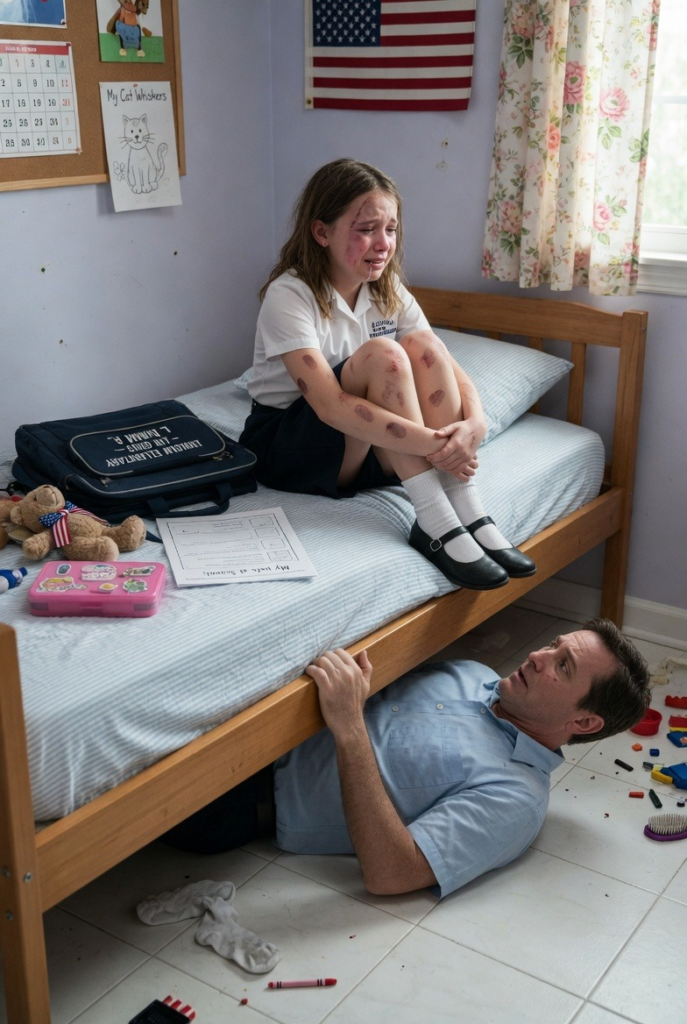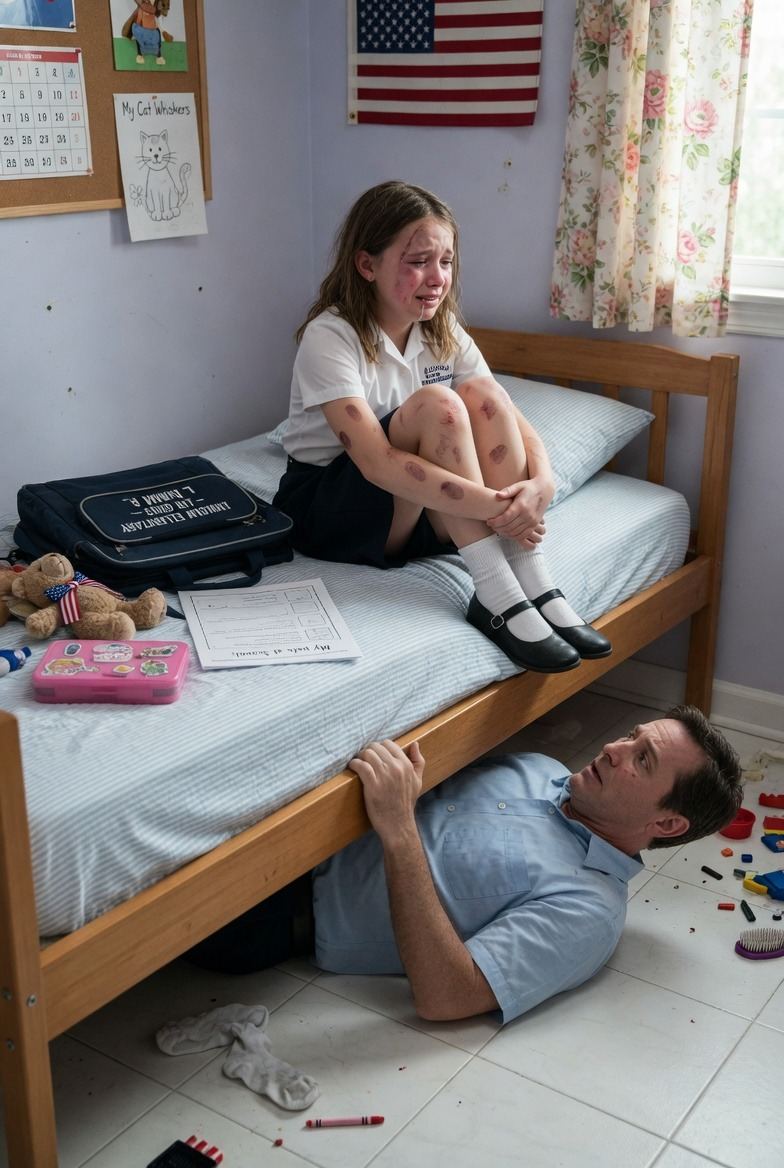
Then she whispered words that made the whole room tilt. “Dad, if I tell you, you have to promise you won’t hate Mom.” Tomás felt his heart strike once, hard, and then seem to stop.
He came out slowly. Lucía saw his hand first and froze. When she saw his face, she did not scream. She simply folded forward over the papers and sobbed, “I tried to tell her first.”
On the floor between them were three artifacts no parent could explain away: an attendance report, a printed screenshot marked 2:47 p.m., and a sealed envelope with Tomás’s full name written in Lucía’s trembling hand.
The screenshot came from a group chat Lucía called La Caja. The messages were cruel in the small, precise way children can be cruel when they have an audience. They mocked her clothes, her father’s job, her quietness.
But the worst part was not the insults. The worst part was the arrangement. If Lucía kept doing assignments for three classmates and stopped reporting them, they promised not to spread an edited recording of her crying.
The recording made it sound like she had admitted cheating. She had not. She had begged them to stop using her name, and one of them had cut the audio until her voice sounded guilty.
Verónica had found the first warning from school before Tomás did. Lucía had told her enough to ask for help, not enough to survive alone. Verónica, frightened of scandal, told her not to make it bigger.
“She said schools protect their names before they protect girls,” Lucía whispered. “She said if I accused them and couldn’t prove everything, it would follow me forever.”
Tomás did not shout. That surprised Lucía most. He gathered every paper from the floor and placed them in order on the bed: attendance report, screenshot, guidance-office slip, envelope, then the phone with the saved voice notes.
He asked permission before touching the phone. Lucía nodded. Together, they made a folder, copied the files, and wrote down the dates. Tomás had spent his life measuring walls; now he measured proof.
When Verónica came home, Tomás had the documents on the kitchen table. The room smelled of reheated tomato sauce again. Lucía sat beside him, not behind him, and Doña Estela waited by the open front door.
Verónica looked from the papers to Lucía’s face and understood at once that denial would not carry her across the room. “I was trying to protect her,” she said, but the sentence collapsed before it reached anyone.
“From whom?” Tomás asked. He did not raise his voice. “From them, or from people knowing?” Verónica covered her mouth. Lucía looked at the table instead of her mother.
That was the first real silence in the house, not the old kind that hid things, but the new kind that forced them into the light. Verónica cried, apologized, and admitted she had been more afraid of shame than harm.
The next morning, Tomás went to Escuela Preparatoria 18 with Lucía, Verónica, the printed screenshots, the attendance report, and a USB drive containing the original voice notes. Doña Estela wrote a statement about the screams she had heard.
The director tried to speak carefully at first. Then Tomás placed the timeline on the desk: April 9 notice, 2:47 p.m. screenshot, saved audio files, absences, and the guidance-office slip with the crossed-out line.
Careful language disappeared after that. The school opened a formal investigation. The three classmates were removed from Lucía’s classes while administrators reviewed the evidence. Tomás filed a report with the local cybercrime office and kept copies of every document.
There was no instant miracle. Real healing rarely arrives like applause. Lucía still woke some nights reaching for her phone. Verónica still had to earn back trust one ordinary, uncomfortable day at a time.
Tomás changed shifts when he could. He learned the names of Lucía’s teachers. He sat at the table while she did homework, not hovering, just present. Sometimes fatherhood is not a speech. It is a chair that stays occupied.
Months later, Lucía laughed again. Not loudly at first, not the way she used to, but enough that Tomás looked up from repairing a cabinet handle and felt his throat tighten.
Doña Estela heard it through the wall before anyone told her. The next evening, she handed Lucía a plate of sweet bread and said only, “I like this sound better.” Lucía smiled and took it.
Tomás never forgot the moment under the bed. He had believed he was uncovering a teenage tantrum, but what he found was a nightmare that had been happening right in front of him without him seeing it.
That truth did not destroy him. It corrected him. A good father was not only the man who filled the fridge. A good father was the man who noticed when his child stopped eating.Tomás did not realize how deeply fear had rooted itself in the apartment until the first afternoon he came home and did not hear silence.
Lucía was in the kitchen.
Not hiding in her room. Not curled beneath blankets with headphones pressed over her ears. She stood beside Doña Estela, carefully slicing strawberries while the old woman argued that nobody cut fruit thin enough anymore.
The smell of cinnamon and warm milk filled the apartment.
Tomás stopped in the doorway with his tool belt still hanging from one shoulder.
Lucía looked up first. For one terrible second, instinct crossed her face — that automatic panic children develop when they expect bad news every time an adult appears unexpectedly.
Then she relaxed.
“Hi, Papá.”
Two words.
Ordinary words.
Tomás nearly broke apart hearing them sound normal again.
Doña Estela noticed before anyone else. She always did.
“You’re blocking the light,” she snapped at him without looking up. “Either come help or stand somewhere useful.”
Lucía laughed softly.
The sound hit him harder than any scream ever had.
He moved into the kitchen slowly, as if sudden movement might scare the moment away.
Outside, rain tapped against the apartment windows. Inside, the stove hissed quietly beneath a dented pot of chocolate caliente. The entire room glowed gold under the weak ceiling light.
For months, the apartment had felt like a hospital waiting room.
Now it felt alive.
Not healed.
Healing was slower than movies lied about.
There were still meetings with the school counselor. Still calls from investigators. Still whispers from parents outside the school gates who preferred gossip over truth.
One mother stopped Verónica outside a pharmacy and quietly asked whether the rumors about Lucía were “really necessary to report.”
Verónica came home shaking with rage after that.
Before, she might have collapsed into shame.
Now she said, “Necessary? My daughter was drowning.”
Tomás watched her carefully when she spoke those words.
People think forgiveness arrives like lightning — one dramatic moment, one tearful apology, one embrace.
But forgiveness, he learned, is mostly repetition.
Verónica showing up.
Again.
And again.
And again.
She attended every school meeting now. She stopped worrying about appearances and started asking dangerous questions out loud. She demanded copies of reports. Names. Dates. Policies.
Once, after a meeting with administrators, she sat in the car gripping the steering wheel so tightly her knuckles whitened.
“I failed her,” she whispered.
Tomás stared through the windshield for a long time before answering.
“Yes,” he said honestly.
Verónica closed her eyes as though the truth physically hurt.
Then he added quietly, “But you stayed.”
That mattered too.
Lucía began sleeping better after the cybercrime office confirmed the edited recording had been traced and recovered. The original audio proved she had never confessed to cheating.
One of the boys responsible broke down crying during questioning.
Another blamed everyone else.
The third refused to speak at all.
Tomás discovered something ugly then:
Cruelty in children often arrived wearing ordinary faces.
No horns.
No warning signs.
Just kids who laughed while another child disappeared piece by piece.
The school eventually expelled two students and placed the third in mandatory behavioral intervention after evidence showed months of coordinated harassment through fake accounts, edited recordings, and shared homework extortion.
Some parents protested the punishment.
Tomás did not attend those meetings.
If he had, he might have forgotten how to remain calm.
Instead, he stayed home rebuilding the loose cabinet doors in the kitchen while Lucía studied nearby.
The rhythm of repair soothed him.
Tighten the hinge.
Measure twice.
Sand the edge smooth.
Fix what can be fixed.
One night, near midnight, Tomás woke to muffled crying.
His body reacted instantly now.
He crossed the hallway barefoot and found Lucía sitting upright in bed, phone clutched in trembling hands.
“They made another account,” she whispered.
The message on the screen was short:
you think you won?
Tomás felt cold rage crawl slowly through his chest.
But he remembered something important.
The first time, Lucía had faced everything alone.
This time, she was opening the door.
That was the difference.
“Okay,” he said calmly.
Not angry.
Not panicked.
Just steady.
“Then we deal with this one too.”
Lucía looked at him carefully, like someone testing whether a bridge could hold weight.
“You’re not tired of this?” she asked.
The question nearly destroyed him.
Tired of this.
As if love had limits.
Tomás sat beside her bed and answered the only way that mattered.
“I will never get tired of carrying this with you.”
Lucía burst into tears after that, but not the hopeless kind.
These tears sounded different.
Like something poisoned finally leaving the body.
Weeks later, spring arrived.
The jacaranda trees outside Escuela Preparatoria 18 bloomed purple across the sidewalks. The city smelled like rain and exhaust and flowering branches.
Lucía walked through the school gates beside her father.
Not behind him.
Beside him.
Students still looked sometimes.
Whispered sometimes.
But whispers lose power when shame no longer lives inside the person they target.
At lunch, a quiet girl from Lucía’s literature class sat beside her for the first time.
Then another.
Pain recognizes pain.
And survival recognizes survival even faster.
By summer, Lucía began helping younger students report anonymous harassment accounts safely. The guidance counselor asked whether she wanted to join a peer-support program.
She hesitated before answering.
Then said yes.
The first meeting terrified her.
Afterward, though, she came home and told Tomás something that left him speechless.
“There are more girls hiding than people think.”
That night, after everyone slept, Tomás stood alone on the apartment balcony.
The city stretched below him in flickering orange lights.
He thought about the man he had been before all this.
A provider.
A worker.
A father who believed love was automatic if bills were paid and food stayed in the fridge.
He understood differently now.
Children do not always scream when they are suffering.
Sometimes they grow quieter.
Sometimes they stop eating.
Sometimes they sleep with their phones under their pillows because terror follows them into dreams.
And sometimes the bravest thing a child can say is not “help me.”
Sometimes it is:
“Promise you won’t hate Mom.”