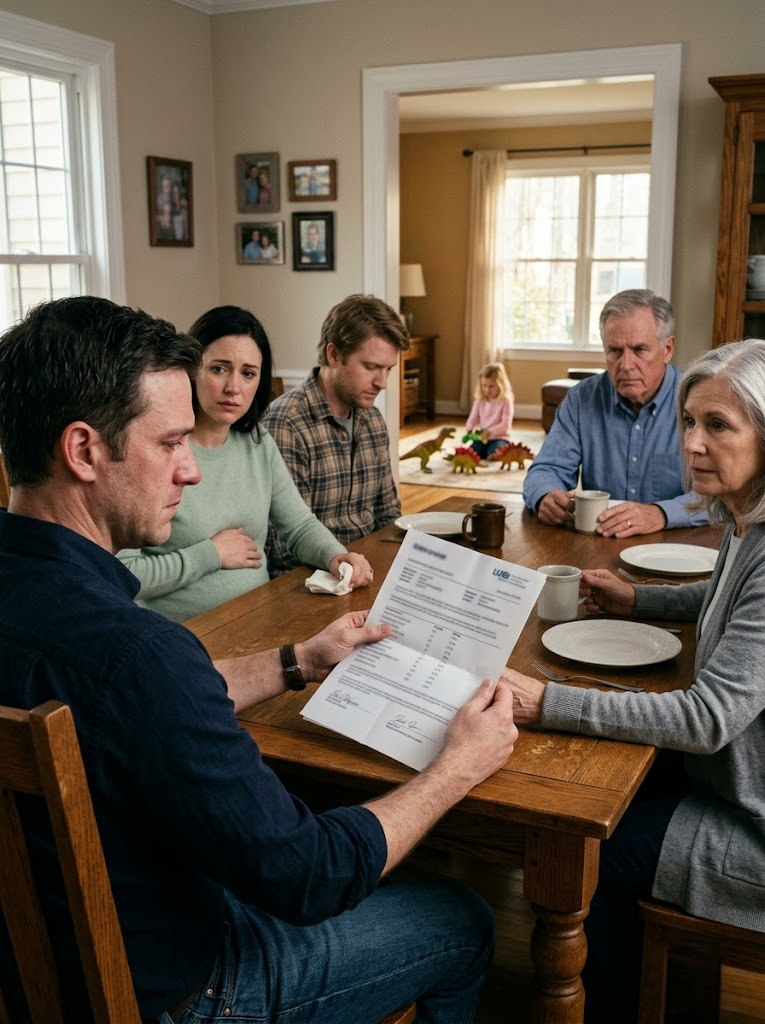
The paper slid across my parents’ oak dining table like a bridge inspection report, clean and clinical, full of numbers that looked harmless until you understood what they were measuring.
My father’s hand released it halfway between his coffee mug and my folded arms. My mother looked at me like she was already sorry for the way I was going to react. My younger brother stared at a knot in the tabletop as if the wood grain had suddenly become fascinating. My wife sat across from me with one hand pressed flat against her stomach, and the gesture told me more than the typed words did.
From the living room, my six-year-old daughter shouted, “Dad, the T. rex is winning!”
Nobody at the table moved.
That was the sound I remember most clearly. Not my father clearing his throat. Not my mother whispering my name. Not Alora’s breath catching when I picked up the paper. Not Rowan’s cowardly silence. I remember Isla’s voice from twenty feet away, high and bright and untouched, narrating a dinosaur battle on my parents’ living room rug while the adults at the dining table prepared to destroy the only world she had ever known.
I looked down.
The lab’s name was unfamiliar. The formatting was professional. The language was sterile in the way official documents are sterile, as if human devastation can be made manageable by percentages and signatures.
Mother: Alora Hayes.
Alleged father: Rowan Hayes.
Probability of paternity: 99.97%.
Gestational age: approximately eight weeks.
I read it once.
Then again.
Then a third time because engineers are trained to verify, to check assumptions, to confirm the load before declaring structural failure. Numbers matter. Testing conditions matter. Source matters. If something collapses, you find the cause. You identify whether it was corrosion, overloading, poor design, neglected maintenance, an unseen crack traveling silently through steel.
But some structures do not need forensic analysis.
Some things break right in front of you, and the only question left is whether you are willing to stand under them when they fall.
My name is Caleb Hayes. I am a civil engineer. I spend my days designing things that must hold: bridges, retaining walls, culverts, water systems, municipal structures no one notices unless they fail. I understand stress. I understand pressure. I understand that every material has a limit, even when it looks solid from the outside. Concrete can carry entire highways until one hidden flaw meets one bad day. Steel can flex beautifully until it doesn’t. Soil can seem stable until water finds a path through it and the whole slope gives way.
I should have recognized the signs in my own life.
The quiet week.
Alora’s sudden concern for my parents.
The way she had been going over there after work, claiming she was helping my mother organize the garage, as if Judith Hayes had ever allowed anyone to touch her carefully labeled plastic bins without supervision. The way my father had called three days earlier and said, “Saturday afternoon, son. Family meeting. Important,” in a voice that sounded less like a request than a summons.
Family meeting.
Those two words should have told me everything. My family never held meetings unless they had already decided the outcome and needed me to carry the cost.
Still, I came.
I brought Isla because my mother specifically asked for her. “We haven’t seen our girl in a while,” Judith had said, even though they had seen her the previous Sunday. “Bring her along. She can play while we talk.”
Now I understood.
They wanted her nearby.
Not because they missed her.
Because her presence was leverage.
The oak dining table had been in my parents’ house since I was nine years old. My father bought it from an estate sale in Raleigh, strapped it badly to the roof of his truck, and drove home at twenty miles an hour while my mother followed behind with hazard lights blinking, screaming at him through the windshield every time it shifted. That table was where I had done math homework while Rowan spilled cereal on the floor and somehow made everyone laugh. It was where my mother served Sunday pot roast, where Dad lectured us about honesty, where I announced my engagement to Alora eight years earlier while my mother cried and Rowan made a joke about finally getting his bedroom back from my emotional baggage.
It was where Isla had blown out birthday candles.
It was where my wife’s affair with my brother became a family inconvenience they expected me to manage.
“We wanted to handle this together,” my mother said.
Together.
I held the paper by its top corner and looked at her.
Judith Hayes had always been good at soft authority. She was a retired elementary school librarian, the kind of woman neighbors trusted to water plants and teachers loved because she returned volunteer forms early. She had silver-streaked brown hair, tidy nails, and a talent for making commands sound like kindness. When she said “together,” she meant everyone should move in the direction she had chosen.
My father, Warren, sat at the head of the table, shoulders squared, jaw tight. He had spent thirty-five years managing a regional hardware supply company and believed every conflict could be resolved if men shook hands, swallowed pride, and returned to work before lunch. At sixty-four, he still wore collared shirts even on Saturdays. His world was built around family reputation, church parking lot conversations, and the idea that good men kept unpleasant truths indoors.
Rowan sat to his right.
My brother was thirty-two, three years younger than me, though he had lived as if time applied differently to him. He had my father’s eyes, my mother’s dimples, and none of the restraint that should have come with being loved so loudly. Rowan was charming, funny, reckless, and forgiven as naturally as other people breathed. He had drifted through college for six years and still somehow hosted a graduation party. He had burned through jobs, apartments, girlfriends, savings accounts, and second chances. My parents called him sensitive. They called him creative. They called him misunderstood.
I called him what he was.
A man who had been allowed to confuse desire with entitlement.
He would not look at me.
Of course he wouldn’t.
Alora was crying quietly, but the tears did not move me the way they once would have. She sat across from me in the pale green sweater I bought her the previous Christmas, her dark hair tucked behind one ear, her wedding ring still on her finger. My wife had always been beautiful in a grounded way that made strangers trust her. Warm brown eyes. Soft mouth. Quick laugh. A way of touching your forearm while she spoke that made you feel like the only person in the room.
I had loved that about her.
Now I wondered how many rooms she had made Rowan feel that way in.
“It just happened,” she whispered.
I looked at her hand on her stomach.
“How long?”
The question came out flat.
No one answered.
That told me the answer was not one mistake.
Rowan finally shifted.
“Does it matter?”
I turned my head slowly.
He regretted speaking as soon as my eyes landed on him. I could see it. The quick twitch near his mouth. The defensive set of his shoulders. Rowan wanted the protection of being central without the burden of being accountable.
“Yes,” I said. “It matters.”
He looked away again.
Coward.
My father cleared his throat.
“Look,” Warren said. “This is terrible. Nobody is denying that. But we need to think clearly. Alora is pregnant. Rowan is the father. Isla is in the next room. There’s a child coming. There’s a child already here. This family doesn’t need a war.”
I stared at him.
He had rehearsed that sentence. I could hear it in the rhythm. Family. Children. War. He had probably said it to my mother at midnight over tea, said it to Rowan after telling him to stop pacing, said it to Alora while she sobbed and he patted her shoulder like she was the injured party.
My mother reached across the table.
I moved my hand before she could touch it.
Her fingers hovered in the air for a second, then curled back toward her palm.
“These things happen,” she said.
I almost smiled.
These things.
A flat tire happens.
A pipe freezes.
A thunderstorm cancels a Little League game.
Your wife getting pregnant by your brother does not happen. It is done. Chosen. Repeated. Hidden. Protected.
“You’ve always been the responsible one,” Judith continued, her voice careful. “The steady one. We need you to be the bigger man here.”
The bigger man.
There it was.
The role assigned before I was old enough to understand it was a trap.
I had been the bigger man since childhood. Bigger when Rowan broke my model bridge before the science fair because he “wanted to see if it could really hold weight,” and my parents told me not to ruin his confidence by making him feel bad. Bigger when he stole cash from my summer job envelope and my mother said he had been embarrassed about needing money for a date. Bigger when I worked two jobs through college while my parents paid his rent because he was “still finding his footing.” Bigger when he crashed Dad’s truck and I spent a Saturday helping fix the fence he hit because family pulled together.
The bigger man is just the person expected to absorb impact.
My whole life, I had been engineered as a shock absorber for my brother.
Not today.
“Think about legacy,” my father said.
That word did something to me.
Legacy.
I looked toward the living room, where Isla had gone quiet for a moment, probably arranging her plastic dinosaurs for the next battle. My daughter was six years old, gap-toothed, stubborn, funny, obsessed with dinosaurs, and convinced that every creature in the Jurassic period had either been a “meat-eater,” a “leaf-eater,” or “probably misunderstood.” She had my eyes and Alora’s smile. She believed her Uncle Rowan was silly and her grandparents were safe and her mother hung the moon.
Legacy.
What would mine be if I stayed at that table and let them teach her this was how love worked?
That betrayal became family business.
That children were reasons to swallow poison.
That peace meant protecting the people who caused the damage.
That a good man allowed himself to be humiliated so everyone else could avoid consequences.
“Dad!” Isla called again. “Come see! T. rex is fighting Triceratops, but I think they’re actually friends!”
I stood.
All four adults at the table tensed.
They were waiting for the explosion. The yelling. The accusations. The chair shoved back. The dramatic scene they could later retell as proof that I was unstable, grief-stricken, too emotional to make decisions. They wanted me to give them something to manage.
I gave them nothing.
I set the DNA report back on the table.
I looked at Warren.
Then Judith.
Then Rowan.
Then Alora.
“One word,” my father would later tell people. “He said one word and walked out like we were strangers.”
He was wrong.
I walked out because they were family.
That was what made it necessary.
“Okay,” I said.
Alora blinked.
“Caleb?”
I did not answer.
I walked into the living room.
Isla looked up from the rug, smiling.
“Daddy, look! The T. rex was mad because the Triceratops took his mountain, but then he said sorry.”
I crouched and kissed her forehead.
“Sounds like a good story, bug.”
“Are we going home?”
“Yes.”
“But I didn’t finish.”
“We’ll finish at home.”
She looked past me toward the dining room.
“Is Mommy coming?”
Not yet, I thought.
Maybe not ever the way you mean.
“Just us right now.”
I helped her gather three dinosaurs and shoved them into her little purple backpack. I took her hand. She skipped beside me through the hallway, still chattering about volcanoes and misunderstood carnivores.
Behind me, a chair scraped.
“Where are you going?” Alora called.
I opened the front door.
No one stopped me.
That was the last moment they had a chance to try.
They let me walk out because they thought leaving was part of my process. They thought I would cool down, circle back, remember my role, and come sit at the table again. They thought distance was temporary because every boundary I had ever set before had eventually been negotiated down by guilt.
They did not understand that something had shifted in me.
Not shattered.
Shifted.
Like a bridge after an earthquake that remains standing but is no longer safe to cross.
In the car, Isla asked for chicken nuggets.
So I made chicken nuggets.
That is what fatherhood is during disaster. You do not collapse in the driveway. You do not scream into the steering wheel while your child watches from the booster seat. You answer questions about dinosaurs, stop at the right lights, and remember that the purple cup is for dinner because the blue cup is for breakfast. You keep the small rituals intact while the adult world burns down behind the kitchen door.
We drove home through Raleigh suburbs washed in late afternoon sunlight. Isla narrated the entire dinosaur story from the back seat, adding details with wild seriousness. I made the proper dad sounds.
“No way.”
“Then what happened?”
“Sounds like that T. rex needed to apologize.”
Inside my head, I was calculating.
Not emotionally.
Logistically.
That is what I do when the impossible happens. I turn it into sequence.
Food.
Bath.
Bedtime.
Bank.
Lawyer.
Documents.
Custody.
Relocation.
Protection.
The house looked normal when we pulled into the driveway. That almost offended me. The maple tree we planted when Isla was born still stood in the front yard, its summer leaves full and green. The porch light had not yet come on. Alora’s flowerpots lined the steps, cheerful and watered. Her SUV was not there, because she had stayed behind at my parents’ house after the ambush they called a family meeting.
Our home had three bedrooms, two and a half baths, a backyard with one crooked oak, a kitchen with blue cabinets Alora had insisted on repainting herself and then hated halfway through. We had bought it eleven years earlier, just after I made senior engineer and before Alora opened her small interior design studio. We had hosted barbecues there, sleepovers, birthdays, Christmas mornings, arguments, reconciliations, flu seasons, laughter, exhaustion. The hallway had pencil marks where we measured Isla’s height every birthday.
It had been a home.
Now I saw it as an asset under dispute.
That was harsh.
It was also necessary.
I made dinosaur chicken nuggets, apple slices, carrot sticks she refused to eat, and a small dish of ketchup shaped like a smiley face. Isla talked about Professor Whiskers, the class hamster, who apparently escaped during reading time and “made Mrs. Delgado say a grown-up word.”
I laughed when she laughed.
I asked follow-up questions.
I wiped ketchup from her chin.
I gave her the purple cup.
After dinner, I ran the bath. She lined the edge of the tub with plastic dinosaurs, informed me that the stegosaurus was the lifeguard, and made bubble beards on every herbivore. I washed her hair while she explained that the baby in Mommy’s tummy would probably like dinosaurs too.
The shampoo bottle slipped in my hand.
“Maybe,” I said.
“Can babies like dinosaurs before they’re born?”
“I don’t know, bug.”
“I think they can hear stuff.”
“They can hear some things.”
“Then we should tell the baby about dinosaurs.”
I closed my eyes for half a second.
The baby.
My niece or nephew.
My wife’s child.
My brother’s child.
A life that had done nothing wrong and yet existed as proof of everything wrong.
“Maybe someday,” I said.
She accepted that because six-year-olds are merciful when they do not know the wound they are touching.
After bath came pajamas with moons on them, two chapters from a book about a girl detective and a missing library turtle, one glass of water, one more hug, one more question about whether T. rex arms were embarrassing, and then finally the nightlight.
“Love you, Dad,” she said, already half asleep, stuffed brontosaurus tucked beneath one arm.
“I love you too, kiddo.”
I stood in her doorway after closing it halfway, watching the warm stripe of hallway light fall across her carpet.
The house was quiet.
That was when I stopped being calm.
Not outwardly. No plates thrown. No shouting. No dramatic collapse. I simply walked downstairs, sat at the kitchen table, opened my laptop, and let my hands tremble for exactly twelve seconds.
Then I got to work.
Joint savings: $94,316.
We had built that account slowly. Years of careful planning. A bigger house someday. College contributions. Emergency repairs. A buffer against layoffs, medical bills, bad luck, ordinary life. I stared at the number and felt a bitterness so clean it almost burned. Alora had smiled over spreadsheets with me, agreed on budgets, discussed mortgage rates, and planned a future while carrying on with Rowan long enough to create another child.
I transferred exactly half.
$47,158.
Not a cent more.
Clean. Documented. Timestamped.
I opened a new account under my name only. I downloaded statements. I took screenshots. I made a folder labeled Separation.
I hated the word.
Then I used it anyway.
At 11:49 p.m., I Googled divorce attorney near me.
Most offices were closed. Most websites were full of reassuring phrases and photos of smiling partners in blue suits. Then I found Denzel Hargrove.
Thirty-two years of family law. Former prosecutor. Emergency custody. High-conflict divorce. Clear fees. No nonsense.
His website had an after-hours number.
I called.
He answered on the third ring.
“This better be good,” he said.
His voice was rough, older, deeply unimpressed by the world.
“My wife is eight weeks pregnant with my younger brother’s baby,” I said. “DNA confirmed. I need emergency custody of my six-year-old daughter and divorce papers filed Monday morning.”
Silence.
Then he said, “How old is the daughter?”
“Six.”
“You have the test results?”
“Yes.”
“Any history of abuse?”
“No.”
“Substance issues?”
“No.”
“Who arranged the meeting where you were told?”
“My parents. They were all present.”
“Your brother?”
“Yes.”
“They asked you to forgive it?”
“Yes.”
A low whistle.
“Messy. You in North Carolina?”
“Yes.”
“Wake County?”
“Yes.”
“My office. Tomorrow morning. Nine sharp. Bring financials, birth certificates, marriage certificate, the test results, any messages, school records, medical records, mortgage documents, everything you can carry.”
“Tomorrow is Sunday.”
“Betrayal doesn’t observe office hours.”
He hung up.
For the first time that night, I felt something close to relief.
Not happiness.
Not even hope.
Just the feeling of finding a load path in a damaged structure.
There was a way through.
I went upstairs and pulled two suitcases from the closet.
I packed for Isla first.
Favorite clothes. School uniforms. Two pairs of sneakers. Pajamas. Stuffed brontosaurus backup, because the original was in bed with her and some items are too sacred to disturb. Toothbrush. Hairbrush. Her dinosaur encyclopedia with torn pages. Medication records. Birth certificate. Social Security card. Passport. School forms. Medical insurance card.
Then my things.
Work clothes. Jeans. boots. Laptop. External hard drive. Personal documents. Passport. Financial records. The framed photo of Isla on her first day of kindergarten. One photo of my mother holding Isla as a newborn, which I stared at for a long time before leaving behind.
That woman in the photo looked proud.
The woman at the oak table had looked strategic.
At some point, the two had become impossible for me to reconcile.
I stood in the closet looking at Alora’s side.
Her dresses sorted by color. Shoes lined neatly on shelves. Scarves looped over a hanger. A half-packed tote from one of her design clients near the floor. Lavender perfume on the dresser. Her wedding photo on the wall: Alora in lace, me in a navy suit, Rowan grinning behind us in a groomsman’s tie.
Rowan had given a speech at our wedding.
I remembered it with sudden, vicious clarity.
“Caleb has always been the guy who gets things right,” he had said, raising his glass. “And Alora, lucky for him, you’re the best thing he ever got right.”
People laughed.
I had hugged him afterward.
I left the photo on the wall.
Let her have it.
Let the house hold the lies until it sold.
At 2:17 a.m., I opened my work email and searched relocation.
There it was.
Subject: Director Opportunity – Asheville Office.
Three months earlier, my company had asked if I would consider relocating to Asheville for a director-level role overseeing regional water infrastructure projects. Better pay. Better title. Larger team. I had been interested. Excited, even. Asheville had always appealed to me: mountains, rivers, old neighborhoods, a growing engineering office doing meaningful municipal work.
Alora had said no before I finished explaining.
“My clients are here,” she’d said. “Your parents are here. Isla’s school is here. Our life is here.”
Our life.
Now I understood that her life was here.
At my parents’ house.
In my brother’s bed.
I drafted a response but did not send it.
Not yet.
Engineers do not move loads until supports are ready.
Sunday morning, I made pancakes.
Chocolate chips for Isla. Black coffee for me. She wore mismatched socks and told me the pancakes looked like “sad planets” because I had flipped them too early.
“You still eating them?” I asked.
“Yes. Sad planets are delicious.”
At eight-thirty, I dropped her at Felix’s house.
Felix Moreno had been my college roommate, then best man, then one of the few friends who survived marriage, fatherhood, work, and distance. He and his wife had three children, a backyard full of plastic toys, and the kind of home where chaos felt safe. I told him I had urgent legal work to handle and asked if Isla could stay until afternoon.
He looked at my face and did not ask questions.
“Of course,” he said. “Take all day if you need.”
Isla ran inside to join his kids, already shouting about dinosaurs.
Felix caught my arm before I left.
“You okay?”
“No.”
His grip tightened once.
“Call if you need me.”
I nodded and drove to Hargrove’s office.
The building was old brick near downtown Raleigh, wedged between a bail bonds office and a coffee shop that seemed designed for people who liked exposed ductwork and complicated milk. Hargrove’s office was on the second floor. No receptionist on Sundays. He opened the door himself, wearing jeans, a wrinkled button-down, and reading glasses low on his nose.
Denzel Hargrove was Black, mid-sixties, broad-shouldered, with close-cropped gray hair and the air of a man who had heard every lie people tell in divorce court and ranked them by laziness.
He took the documents from me, pointed to a chair, and began reading.
For twenty minutes, he said nothing.
Then he looked up.
“Your wife is pregnant by your brother. Your parents know and are pushing reconciliation. Your daughter was present in the home during disclosure. Your wife is currently staying at your parents’ house?”
“Yes.”
“Your brother there too?”
“I assume.”
“You have no reason to believe your daughter is physically unsafe with her mother?”
“No.”
“Emotionally?”
I looked at the DNA report on his desk.
“She thought the baby was her sibling.”
Hargrove’s mouth tightened.
“That matters.”
“Can I get emergency custody?”
“Temporary emergency custody is not automatic. Judges don’t like parents using infidelity as a weapon. But this is not garden-variety adultery. The affair partner is your brother. Your parents are pressuring reconciliation. Your wife concealed paternity. The child has already been exposed to unstable family dynamics. If we show relocation serves stability and you are the primary consistent parent, we have a strong case.”
“I am.”
“Prove it.”
So I did.
School drop-off records. Pediatric appointment calendars. Soccer registration in my name. Photos from school events Alora missed because of client meetings. Texts where Alora asked me to handle bedtime, pickups, doctor calls. Not because she was a bad mother, exactly. She had loved Isla in ways. But I had been the structure. The routine. The one who remembered the purple cup, the library book, the class snack schedule, the dinosaur facts that changed weekly depending on which documentary she watched.
Hargrove read everything.
Then he said, “We file Monday morning. You do not confront your wife beyond necessary logistics. You do not threaten. You do not withhold the child illegally. You keep your messages brief and civil. You document everything. You do not answer family calls unless I tell you. You understand?”
“Yes.”
“You want revenge?”
I paused.
The honest answer was yes.
Part of me wanted Rowan ruined. Alora abandoned. My parents exposed in front of every person they had ever performed respectability for. I wanted my father to feel his word legacy break in his teeth. I wanted my mother to watch the family she protected collapse under the weight of her own favoritism.
But across town, my daughter was playing with Felix’s kids.
Revenge was not a foundation.
“No,” I said. “I want my daughter safe.”
Hargrove nodded.
“Good. Revenge makes clients stupid. Stability wins cases.”
Monday morning, I was first in the school drop-off line.
Isla sat in the back seat, backpack on her lap, braiding one dinosaur’s tail around another.
“Dad?”
“Yeah, bug?”
“Is Mommy mad?”
My fingers tightened on the steering wheel.
“Mommy has big feelings right now.”
“About the baby?”
“Yes.”
“Are you mad?”
I looked at her in the rearview mirror. Her eyes were too serious for six.
“I have big feelings too.”
She considered that.
“Mrs. Delgado says big feelings need deep breaths.”
“Mrs. Delgado is smart.”
She took an exaggerated breath, cheeks puffing.
I did too.
She giggled.
At the curb, I kissed her forehead and told her I would pick her up at three. She skipped toward the building, backpack bouncing, ponytail swinging, safe for the next six hours.
By 10:00 a.m., the divorce petition was filed.
By 10:18, the emergency custody motion was submitted.
By 10:42, Hargrove emailed confirmation.
By noon, I walked into HR.
The director, Sarah Leland, looked up from her monitor when I appeared in her doorway.
“Caleb. Everything okay?”
“No,” I said. “But I’m handling it.”
That got her attention.
I had spent eight years at the firm being reliable to the point of invisibility. I did not bring personal drama to work. I did not miss deadlines. I did not hover in doorways with that tone.
“The Asheville position,” I said. “Is it still open?”
She sat back.
“The director role? No. We filled it internally last month.”
My stomach dropped.
“But,” she continued, turning to her computer, “we have a senior regional role opening there. Water systems and municipal infrastructure. Bigger scope, actually. They were going to post it next week.”
“I want it.”
She studied me.
“This is sudden.”
“Yes.”
“Does Alora know?”
“No.”
One second passed.
Then another.
Sarah had met Alora at company events. She had also seen enough engineers divorce to understand when not to ask questions.
“How soon can you start?”
“Three weeks.”
“That’s fast.”
“I can make it work.”
She pulled up the internal listing.
“Senior regional project lead. Thirty-five percent salary increase. Relocation assistance possible. Six-month review for director track.”
“I’ll take it.”
“You haven’t seen the package.”
“I’ll take it.”
She printed the paperwork.
I signed before my lunch break.
At three, I picked up Isla.
At five, Hargrove called.
“Judge granted temporary emergency custody pending hearing,” he said. “Primary physical custody to you. Mother gets supervised visitation schedule to be determined. You are permitted to relocate for employment, subject to review, because you have a signed employment transfer and support structure pending. Do not celebrate. This is temporary, but it gives us footing.”
I stood in the laundry room with a basket of Isla’s socks in my hand.
Temporary.
That word had hurt at my parents’ table.
Now it felt like oxygen.
“Thank you,” I said.
“You’re not done.”
“I know.”
“Your wife will be served tomorrow.”
“She’s coming Friday,” I said. “She texted that she wants to talk.”
“Keep it civil. If possible, record within legal limits.”
I did.
Friday afternoon, I had most of our necessary things packed and staged in the garage. Isla was at a playdate with Felix’s kids. I was checking a list on my phone when I heard the front door open.
A key turned.
Alora stepped inside.
“Hello?” she called.
Her voice cracked slightly.
I walked out from the kitchen.
She froze when she saw me.
For a moment, memory tried to sabotage me. This was the woman I had loved for eight years. The woman who danced barefoot with me in the kitchen the night we found out she was pregnant with Isla. The woman who once drove two hours to bring me clean clothes when a storm trapped me at a job site. The woman who cried when our daughter took her first steps and whispered, “We made a person.” The woman who knew where we kept spare batteries, which grocery store had the best peaches, and how to fold fitted sheets in a way I still believed was witchcraft.
Then she looked past me and saw the half-empty bookshelves.
The missing framed photos.
The packed boxes near the hallway.
Her face changed.
“What did you do?”
“Filed for divorce Monday,” I said.
She swallowed.
“What?”
“You’ll be served tomorrow. Temporary emergency custody was granted. I have Isla.”
Her eyes widened.
“No.”
“Yes.”
“No, you can’t just take her. She’s my daughter.”
The words hit something hot in me.
“Was that a consideration when you were sleeping with my brother?”
She flinched.
Good.
I am not proud that it felt good.
But it did.
“Caleb,” she said, voice shaking. “Please. You’re hurt. I understand that. But we cannot blow up Isla’s entire life because of one mistake.”
“One?”
She looked away.
“How long?” I asked.
She pressed her lips together.
“How long, Alora?”
“Four months.”
The room became very still.
Four months.
I did the math without wanting to.
Four months included my birthday.
Our anniversary.
The weekend we took Isla to the science museum and Rowan came over for dinner afterward. He had played soccer with Isla in the backyard while Alora and I cleaned up dishes. Later that night, she had kissed me in bed and fallen asleep with one hand on my chest.
Four months.
“You let him come into our home,” I said.
“Not like that.”
“Did he sit at our table?”
Her eyes filled.
“That’s not fair.”
“Did he?”
“Yes,” she whispered.
I stepped back because suddenly there was not enough air.
She rushed toward the opening.
“It wasn’t planned. I was lonely, and you were always working, and Rowan listened. He made me feel seen. I know that’s not an excuse, but—”
“No.”
She stopped.
“No what?”
“No to the speech where my work schedule becomes the door you walked through to get to my brother.”
Her tears spilled then.
“I am sorry.”
“I believe you.”
Hope flickered in her eyes.
“I’m still done.”
The hope died.
“Couples therapy,” she said quickly. “Anything. I’ll cut him off. We can move. You want Asheville? Fine. I’ll go to Asheville. We can start over. The baby—”
“Stop.”
“But—”
“No.”
Her face twisted.
“You planned all this in a week?”
“Yes.”
“That’s cruel.”
“Cruel is betrayal. This is logistics.”
My phone buzzed on the counter.
Rowan.
Then again.
Dad.
Then Mom.
Alora glanced at it.
“They’re worried about you.”
“They’re worried about control.”
“They love you.”
“They love the version of me that absorbs damage quietly.”
“That’s not true.”
I answered my father’s call and put it on speaker.
“Son,” Warren said, relief flooding his voice. “Thank God. Listen, we need to sit down again. Everyone is emotional. Nothing good happens when people make rash decisions.”
“I filed for divorce.”
Silence.
“What?”
“Temporary custody granted. I’m relocating to Asheville for work. Isla comes with me.”
“Now wait just a damn minute.”
There he was.
The father beneath the mediator.
“Alora made a mistake,” he said. “Rowan made a mistake. But you’re talking about tearing apart a family.”
“They did that.”
“You’re being vindictive.”
“I’m being precise.”
“Think about your daughter.”
“I am.”
“You think taking her away from her mother is good for her?”
“I think raising her around adults who expect me to pretend this is forgivable for their comfort is bad for her.”
Judith’s voice appeared in the background, faint and frantic.
“Put me on.”
Then my mother: “Caleb, please. Please don’t do this. You know Rowan. He has always struggled. Alora is scared. There is a baby coming. We need to come together.”
“No,” I said.
“Family forgives.”
“Family also doesn’t sleep with family members’ spouses.”
A sharp inhale.
My mother began to cry.
I felt nothing.
That scared me for a second, but only a second.
“I was the bigger man,” I said. “I said okay. I am okay with never seeing any of you again.”
I hung up.
Alora stared at me.
“You don’t mean that.”
“I do.”
“You’ll come around.”
“No.”
“Isla needs grandparents.”
“She needs healthy adults.”
“They’re your parents.”
“That doesn’t make them healthy.”
She tried for twenty more minutes.
Tears. Anger. Bargaining. Shame. Soft memories. The song from our wedding. Isla’s first Christmas. The house. The idea of forgiveness as maturity. The baby as innocence. Rowan as weakness. My parents as aging. Me as harsh. Me as cold. Me as responsible for holding together what everyone else had broken.
I let her talk.
When she finally ran out, I said, “You need to leave.”
She looked at me like I had slapped her.
“My clothes—”
“You can arrange pickup through Hargrove.”
“This is my house too.”
“Legally, yes. Emotionally, no.”
That one hurt her.
I could see it.
I let it.
When she left, she slammed the door so hard a photo frame rattled on the hallway wall.
Two weeks later, the U-Haul sat in the driveway.
I took less than people expected.
Isla’s bed. Her books. Clothes. Important documents. My desk. Kitchen essentials. Tools. Photos of me and Isla. A few boxes of personal items. I left the living room furniture, the dining table, Alora’s design samples, the bedroom set, most of the decor. The house would be sold in the settlement anyway. Let the market decide what our memories were worth.
Isla sat in the front seat of my truck, legs swinging, holding her stuffed brontosaurus.
“Dad?”
“Yeah?”
“Why are we moving?”
I had practiced the answer.
“New adventure. New job. New house with a big backyard.”
“Will Mommy visit?”
“Maybe sometime.”
“Will Grandma and Grandpa visit?”
My hands paused on the door handle.
“Not right now.”
She frowned.
“Are they in trouble?”
I looked at her little face, too smart, too trusting.
“The grown-ups need some space.”
“Like timeout?”
I smiled despite myself.
“Kind of.”
She considered this deeply.
“Can I get a tire swing?”
“Yes.”
“A big one?”
“Biggest one the tree can handle.”
She grinned.
For her, the crisis became a tire swing.
I loved her so much it hurt.
Before getting in the truck, I looked once at the house.
Eleven years. One marriage. One child. One maple tree. One million ordinary moments. A driveway chalk drawing still faintly visible near the garage. The porch where Alora and I drank coffee on Saturday mornings before Isla was born. The window where Isla used to press her hands and wave when I left for work. The roof I had patched during a storm. The yard where Rowan had stood at a barbecue last summer, laughing with Alora while I grilled burgers ten feet away.
I turned away.
Then I drove.
Six hours later, we crossed into Asheville.
The Blue Ridge Mountains rose in soft layers beyond the road, blue-gray and patient. Isla slept through most of the last hour, mouth open, dinosaur clutched to her chest. I drove carefully, both hands on the wheel, feeling fatigue settle into my bones but not regret.
The rental house was small but solid.
Three bedrooms. Fenced yard. Good school district. Older kitchen. Porch with peeling paint. A maple tree in the backyard strong enough for a tire swing if I installed it right. The air smelled different. Cleaner. Damp soil. Leaves. Rain somewhere nearby.
I carried Isla inside and put her in the smaller bedroom first. I had brought her bedding, her nightlight, her books, the stuffed animals, and the dinosaur poster from her old room. I worked quietly while she slept, turning a bare room into something familiar before she woke.
My phone sat on the kitchen counter.
Eighteen missed calls.
Fifty-seven texts.
Warren. Judith. Rowan. Alora. Extended family. Alora’s friend Marcy. A cousin I had not seen in years. Felix.
The screen lit again.
Rowan.
I stared at his name.
Then I opened settings.
Blocked: Alora.
Blocked: Rowan.
Blocked: Warren.
Blocked: Judith.
Blocked: Marcy.
Blocked: cousin.
One by one.
Methodical.
Final.
I did not block Felix. Not yet.
Then I set the phone down and looked around my new kitchen.
Empty counters.
No history.
No ghosts.
Just space.
The first week was hard in all the ways that do not make good drama but make real life nearly impossible.
School registration required forms I had packed in the wrong box. The pediatrician’s office needed vaccination records faxed twice because the first copy came through unreadable. The rental’s water heater made a sound like an injured animal every morning. Work onboarding required video calls, new project files, municipal briefing documents, and a crash course in North Carolina permitting differences I should have found interesting but could barely process. Isla cried the second night because she missed her room, her teacher, her friends, and “the smell of our old hallway.”
I sat on the edge of her bed while she clutched the brontosaurus and sobbed.
“I know, bug.”
“I want to go home.”
I swallowed.
“This is home now.”
“No, it isn’t.”
“Not yet,” I admitted. “But we’ll make it home.”
“Promise?”
“Yes.”
“Pinkie promise?”
I hooked my pinkie around hers.
“Engineering-grade promise.”
She sniffed.
“That sounds serious.”
“It is.”
By week three, she stopped asking when we were going back.
By week four, she came home talking about Quincy, a girl in her class with two missing teeth, rainbow shoelaces, and strong opinions about pterodactyls.
By week six, she drew a picture of our house at school: two stick figures, one swing set, three dinosaurs, and a sun in the corner. On the back, in careful first-grade spelling, she wrote: Me and Dad and are new home.
I kept it.
Work became easier before life did.
That surprised me. The Asheville office was smaller than Raleigh but sharper in some ways. People there knew my name because I was new, not because they knew my family. My boss, Elaine Porter, was direct, smart, and allergic to excuses. She handed me four infrastructure projects in my first month and said, “I need clean timelines, clean budgets, and no heroics that burn out the team.”
“I can do that.”
By the end of the month, she called me efficient.
“Different from the last guy,” she said. “He needed a parade for every task.”
“I just do the work.”
She smiled. “Keep doing that.”
I did.
Hargrove called every other week.
“Alora’s attorney wants summers,” he said in October.
“No.”
“Wants the house outright.”
“No.”
“Wants alimony.”
“No.”
He chuckled. “You know, some clients pay me by the hour to have emotional reactions.”
“I’m sure you bill them happily.”
“Damn right.”
The judge sided with us on the major points. The house would be sold and proceeds split according to equity and marital contribution. Alora’s adultery with Rowan, the confirmed pregnancy, and the family pressure were all part of the record. She could request supervised visitation if she relocated within fifty miles of Asheville and established consistent involvement. She did not.
That was what hurt Isla later, though I tried to shield her from it.
Not the move.
Not the divorce.
The inconsistency.
At first, Alora sent video-call requests through the court-approved parenting app. She missed the first scheduled call because she “had a medical appointment.” The second lasted six minutes before she cried and Isla got confused. The third, she asked Isla whether she missed her old house. I ended the call and documented it. The fourth never happened. After that, the requests became irregular, then rare.
I never told Isla her mother did not care.
Children do not need adult conclusions handed to them like bricks.
I simply said, “Mom is having a hard time right now.”
Isla would nod and return to her dinosaurs.
Kids adapt, but adaptation is not absence of harm. It is survival.
I knew that because I had been adapting my whole life.
My mother emailed in October.
Subject: Please read this.
I opened it while Isla was at soccer practice and I had twenty minutes to waste. That was my mistake.
Caleb,
You are punishing your daughter to punish Alora. This is cruel. Rowan made a terrible mistake. Alora made a terrible mistake. But Isla should not lose her entire family because adults are hurt. Family forgives. Family endures. You were raised better than this. Your father is heartbroken. Rowan is devastated. Alora is carrying a child and is under terrible stress. Please call me. We need to fix this before it becomes permanent.
Mom
I read it once.
Then again.
Family endures.
No, I thought.
Sometimes family exploits the person willing to endure the longest.
I deleted the email and blocked her address.
Rowan found me through a new Instagram account two weeks later.
The profile had no photo, but I knew from the message.
The baby is coming soon. Don’t you even care? We’re still brothers. Nothing changes that.
I stared at the message for a long time.
Then I typed: I care that my daughter has stability. Your consequences are not my responsibility.
I blocked the account.
Then I deleted Instagram entirely.
It felt wonderful.
November brought cold weather, a promotion track, and soccer.
I had signed Isla up for a local youth team because she needed friends and because running in circles after a ball seemed healthier than sitting in her room absorbing adult grief. The coach needed help with drills, so I volunteered. By the end of the season, the original coach moved for work, and I somehow became head coach of nine first-graders with neon cleats and no understanding of field positions.
We were not good.
But we were joyful.
Isla played forward with the ferocity of a child who believed every ball belonged to her personally. Quincy played defense and mostly tackled air. A boy named Mason ran the wrong direction twice and celebrated anyway. I learned how to tie tiny cleats, carry extra water, and explain that passing was not “giving up.”
After the final game, which we won only because the other team scored on itself, I took Isla for ice cream.
She ordered mint chocolate chip in a waffle cone and got it everywhere.
“Dad,” she said, cheeks sticky.
“Yeah?”
“I like it here.”
I looked at her.
“You do?”
“Yeah. Quincy invited me to her birthday party. And Coach Dad is funny.”
“Coach Dad?”
“That’s what Mason calls you.”
I laughed.
“Should I put it on business cards?”
She nodded solemnly.
“Yes. But with a dinosaur.”
That was the moment I knew we were going to be okay.
Not because everything was fixed.
Because something new had taken root.
The house sale finalized in December.
Hargrove sent the documents by courier. Net proceeds after mortgage and fees: $187,000. A handwritten note from Alora’s attorney was clipped to the top.
Client requests one phone call. She is desperate. Please consider.
I stood at the kitchen counter holding the note while Isla did homework at the table.
“What’s that?” she asked.
“Nothing important.”
I meant it.
I deposited the check the next morning.
In January, I bought the rental house.
The owner had been planning to sell in the spring. I made a fair offer. Not dramatic. Not impulsive. Practical. The mortgage payment was less than the Raleigh house. The school district was right. The yard was fenced. The maple tree could hold a tire swing. Isla had stopped calling it the rental weeks earlier.
“This is ours?” she asked when I told her.
“Yes.”
“Like forever?”
“As long as we want.”
She ran outside in pajamas and hugged the maple tree.
I installed the tire swing first.
It took an entire Saturday, three trips to the hardware store, one minor argument with the instruction manual, and a lot of Isla standing nearby with a plastic wrench saying, “I’m supervising.”
When it was done, she climbed on carefully.
“Ready?” I asked.
“Ready!”
I pushed.
She flew forward, hair streaming, laughter breaking out of her so purely that I had to look away for a second.
This, I thought.
This is legacy.
Not protecting Warren’s image.
Not forgiving Rowan.
Not making Alora’s consequences easier to bear.
This.
A child laughing in a yard where no one asked her father to swallow betrayal for the sake of appearances.
Her room came next.
She chose teal paint because “blue is too obvious and green is too leafy.” We painted together, badly. She got more paint on her elbows than on the wall. I built her bookshelves and let her arrange dinosaurs by “personality.” She made a sign for her door that said Isla’s Dino Lab. No grown-ups unless invited.
I knocked every time.
The divorce decree arrived in February.
Final.
Clean break.
Alora retained supervised visitation rights only if she relocated within fifty miles and complied with court requirements. She never did. No alimony. House proceeds distributed. Parenting order confirmed.
Hargrove’s email was short.
You are legally free.
I sat at my desk for a long time after reading it.
Free did not feel like celebration.
It felt like quiet.
Quiet can be enough.
In March, I was officially promoted to senior project lead. Four major regional builds. Six direct reports. A raise large enough to change my breathing when bills came due. I opened a real college fund for Isla, not the old vague savings we had once planned around a marriage that no longer existed, but a dedicated account with automatic deposits, projections, and a password only I knew.
I bought a lawn mower.
That felt more adult than divorce.
Spring came gently to Asheville.
Dogwoods bloomed. The mountains softened. Rain turned the yard bright green. Isla started soccer again and scored her first real goal in April during a playoff game she would later retell as if it were a World Cup final.
We were tied two to two with four minutes left. I was standing on the sideline trying not to shout too much because parents who become coaches must learn not to sound insane. Isla got the ball near midfield, looked briefly terrified, then remembered she was apparently fearless now. She dribbled past one defender, then another, cut left, cut right, and kicked from fifteen yards out.
Upper corner.
The goalie did not move.
For half a second, everyone froze.
Then the field erupted.
Isla sprinted toward me with both arms up, gap-toothed grin splitting her face.
“Dad! Did you see?”
I caught her and lifted her off the ground.
“I saw, bug. That was perfect.”
She hugged my neck.
Her teammates swarmed us, shrieking. Quincy’s mom took photos. Someone’s little brother threw a water bottle in excitement. The other coach laughed and shook his head.
My phone buzzed in my pocket.
I ignored it.
Ice cream mattered more.
Later, after the team celebration, I checked.
Blocked contact attempted to call.
I deleted the notification without looking.
That life no longer had the right to interrupt this one.
Felix texted me in April.
Your brother’s baby was born. Thought you should know.
I read it while sitting in the parking lot outside Isla’s school.
A baby.
A child who shared blood with Isla in a way no family tree could explain neatly. A child born into the wreckage adults made before he ever opened his eyes. Felix sent another text before I replied.
His name is River.
River Hayes.
My nephew.
My almost-stepchild in some grotesque alternate universe my parents had tried to force me into accepting.
I typed: Thanks. Not my concern.
Felix replied: Fair enough. Your family’s asking about you. What should I say?
Nothing. Please don’t give them information.
Understood. You okay?
Better than okay.
And I was.
Felix did not mention them again for a while.
Then, in February of the next year, he sent one last message.
Your parents hired a PI to find you. Thought you should know.
I stared at it for a full minute.
Then I blocked Felix too.
That may sound harsh. Maybe it was. But clean breaks require clean edges. Felix meant well, but information can be a door. I was done leaving doors unlocked for people who kept sending storms through them.
I changed my phone number the following week.
New number to seven people: Hargrove, Elaine, Isla’s school, pediatrician, Quincy’s mom, Paula from the community center, and the alarm company.
Paula came later.
I met her at a school community event in January, six months after the move. She coordinated youth programs, had curly dark hair, a calm voice, and a way of speaking to children like they were people instead of interruptions. Isla liked her immediately because Paula knew the difference between a brontosaurus and a brachiosaurus, which apparently mattered deeply.
Paula did not rush me.
That was why I trusted her.
She knew the basics: divorced, single dad, complicated family, no contact. She did not pry for pain as entertainment. She never tried to mother Isla. She never called my boundaries walls. She simply showed up when invited and left when the evening ended.
On our fourth date, she asked, “Is there anything you need me to understand about your life that you haven’t said yet?”
We were walking near the French Broad River, spring light on the water, Isla at a birthday party with Quincy.
I thought about lying with something easy.
Instead, I told her the truth in broad strokes.
My wife. My brother. The pregnancy. My parents. The move. The silence.
She listened.
When I finished, she said, “You must have been very lonely.”
That nearly undid me.
Not That’s terrible.
Not How could they?
Not You’re so strong.
You must have been very lonely.
Yes.
That was the part no one had named.
I had been surrounded by people and completely alone inside the truth.
I did not kiss her that day, though I wanted to.
I simply said, “I was.”
She took my hand.
“Are you now?”
I looked toward the river, then back at her.
“Not as much.”
One year after the oak-table meeting, Isla turned seven.
I woke to her jumping on my bed at 6:12 a.m.
“Dad! Dad! I’m seven!”
“How did that happen?”
“I grew.”
“Without permission?”
She nodded solemnly.
“I’m very advanced.”
We made chocolate chip pancakes. There is no other acceptable birthday pancake, according to Isla’s constitution. She wore a shirt with a glitter dinosaur and insisted the birthday girl should not have to clear plates. I told her that sounded legally questionable. She told me I was not a lawyer.
At dawn, before she woke, I had hung streamers in the backyard, set up folding tables, arranged decorations, and inspected the bounce house rental like it was a municipal structure under my jurisdiction. Paula arrived at eleven-thirty carrying a cake carrier and wearing a yellow sundress.
“You need help?” she asked.
“I think I’ve achieved controlled chaos.”
She glanced at the backyard.
“You are one gust of wind from structural failure.”
“I respect your assessment.”
She kissed my cheek and set down the cake.
The party began at noon.
Fifteen children arrived with the energy of a small invading army. Quincy came first, carrying a gift wrapped in dinosaur paper. Mason arrived wearing soccer cleats despite it not being a soccer party. Kids ran between the swing set, bounce house, and snack table. Parents I now knew by first name stood near the fence drinking lemonade and discussing school calendars, summer camps, and how expensive children’s shoes were considering how quickly children destroyed them.
I grilled burgers.
Paula handled drinks.
Isla stood at the center of it all, radiant and loud, showing off the tire swing like it was a national monument.
For three hours, no one mentioned divorce.
No one mentioned Alora.
No one mentioned Rowan, Warren, Judith, or a baby named River.
No one asked me to forgive.
No one asked me to endure.
The cake had teal frosting and a plastic stegosaurus on top. Isla blew out candles while her friends screamed the final line of Happy Birthday off-key and too fast. She opened gifts on a picnic blanket, hugged everyone, and fell asleep on the couch at four-thirty with a book open on her chest.
After the last family left, Paula helped me collect paper plates and abandoned party favors from the yard.
“Good day?” she asked.
I looked toward the window, where Isla slept safely inside our house.
“Really good day.”
Paula smiled.
“I’m glad.”
After she left, I sat alone on the back porch.
The swing set moved slightly in the breeze. The yard was a mess. A balloon had gotten stuck in the shrubs. There was frosting on one chair, a juice box under another, and confetti everywhere despite my explicit request for no confetti.
I thought of my father’s voice exactly one year earlier.
Think about legacy.
I had.
My daughter had spent her seventh birthday surrounded by friends in a home where she felt safe, celebrated by adults who showed up, protected from people who wanted to use her as emotional leverage. That was legacy. Not bloodlines. Not family reputation. Not pretending rot was foundation because the structure looked pretty from the street.
My phone buzzed.
Hargrove.
Alora’s attorney officially withdrew visitation petition. She is not pursuing further contact. Case closed.
I read it once.
Then again.
A strange grief moved through me.
Not for myself.
For Isla.
Because someday she would understand. Not all at once. Not at seven. But eventually, the absence would sharpen. She would ask harder questions. She would want to know why her mother did not fight harder. Why grandparents who once bought her dinosaur puzzles disappeared. Why Uncle Rowan became a name no one used.
I could not protect her from every future hurt.
Only from the people who caused the first one.
I typed back: Thank you.
Then I set the phone down and watched the swing move.
People ask, in stories like this, whether I ever forgave them.
The honest answer is no.
But not because I spend my life hating them. Hate is a kind of contact. It keeps you tied to the people who hurt you. It gives them a room in your head and asks you to pay rent on it.
I do not hate Alora.
I do not hate Rowan.
I do not hate my parents.
I have simply withdrawn access.
That is different.
Alora may have loved me once. I believe that. Rowan may have admired me once. My parents may have thought they were preserving family. All of those things can be true and still not matter enough to reopen the door. Love without accountability is sentiment. Family without respect is a trap. Forgiveness without safety is just surrender in nicer clothes.
They wanted me to forgive so they could sleep at night.
So Rowan could become a father without shame.
So Alora could become a mother again without losing the first family she damaged.
So Warren could tell himself his sons were still brothers.
So Judith could hold both grandchildren in the same living room and call the picture healing.
They wanted forgiveness to mean restoration.
I wanted peace.
Peace required absence.
The Monday after Isla’s birthday, I dropped her at school like any other morning.
She hugged me at the curb.
“Love you, Dad.”
“Love you too, bug.”
“Pick me up after?”
“Always.”
She ran toward the building, backpack bouncing, ponytail swinging, then stopped to wave once before disappearing inside.
I sat in the car for a moment after she was gone.
Coffee in the cup holder. Radio low. Phone silent. Workday waiting. Mountains faint in the distance beyond the school roof.
No ghosts.
No what-ifs.
No one calling me the bigger man while handing me the bill for everyone else’s damage.
I drove to work.
The civic center project was ahead of schedule. Elaine had asked me to review a stormwater redesign. My team needed direction. A lunch meeting with the county engineer would probably run long. Ordinary problems. Honest problems. Problems that could be solved with time, math, cooperation, and people acting in good faith.
I had built bridges for years.
But the most important structure I ever designed was not made of concrete, steel, or reinforced earth.
It was the life I built after walking away.
Its foundation was one word spoken at an oak dining table.
Okay.
Okay, I see who you are.
Okay, I understand what you expect from me.
Okay, I will not argue you into decency.
Okay, I will not perform pain for your comfort.
Okay, I am leaving.
People think walking away is dramatic.
It is not.
The drama is what happens before: the betrayal, the pleading, the family meeting, the tears, the demand that you carry what others broke. Walking away is quiet. One hand holding your daughter’s backpack. One foot across the threshold. One door closing behind you while everyone waits for you to turn around.