The steady, mechanical rhythm of the heart monitor filled the sterile air of Room 512 like a metronome marking time that refused to move forward. Beep… beep… beep… Each pulse echoed off the pale walls of Seattle Grace Medical Center, a constant reminder that while the world outside hurried on—cars splashing through rain-slicked streets, executives closing deals in glass towers, families laughing in parks—Ethan Walker’s life had frozen solid three years earlier.
Ethan stood at the window, staring at the gray Seattle skyline. Rain traced erratic paths down the glass, mirroring the chaos in his soul. Once a titan of finance, he had built an empire through razor-sharp instincts and unyielding ambition. Markets shifted at his commands; billions flowed through the decisions he made before his morning coffee. Yet here, in this hushed sanctuary of suffering, none of that power mattered. His tailored suit, usually crisp and commanding, hung loosely on his frame, wrinkled from endless nights in the vinyl chair beside his daughter’s bed. Dark circles etched deep shadows beneath his eyes, and his once-strong shoulders slumped under the weight of unrelenting grief.
On the narrow hospital bed lay Olivia, his only child. She had been six on that fateful night—bright-eyed, full of questions about stars and why the rain sounded like applause on the car roof. Now she was nine, though her body remained suspended in time: small, fragile, pale skin almost translucent under the fluorescent lights. Tubes and wires connected her to machines that breathed for her, fed her, and monitored every faint flutter of life. Her chestnut hair, which Ethan still brushed gently each morning, fanned across the pillow like a halo. Three years of coma. Three years of one-sided conversations, bedtime stories whispered into silence, and prayers offered to a God who seemed to have turned away.
The accident replayed in Ethan’s mind with merciless clarity every night. It had been a vicious storm on the I-90 outside Seattle. Visibility near zero, rain hammering the windshield like bullets. Ethan, distracted by a urgent call from Tokyo about a volatile merger, had misjudged a curve. Tires screeched. Metal crumpled with a sickening roar. The world spun into darkness. He had walked away with bruises and a shattered collarbone. Olivia had not. The impact had stolen her from him in an instant, leaving her trapped in an endless sleep from which no specialist could rouse her.
Each day blurred into the next. Ethan had transformed the hospital room into a second home. He read her favorite books—*The Little Prince*, *Charlotte’s Web*—his voice steady even as his heart fractured. He played recordings of her laughter from old videos, hoping some echo would reach her. Nurses knew him by name; doctors offered sympathetic nods that grew heavier with time. Private specialists from Switzerland and Japan had flown in at his expense, only to shake their heads at the unchanged scans.
That particular morning, the senior neurologist, Dr. Elena Ramirez, had pulled him into the hallway. The fluorescent lights buzzed overhead like judgmental whispers.
“Mr. Walker,” she began softly, her eyes kind but resolute, “we’ve exhausted every avenue. Olivia’s brain activity has continued to decline. Her vital organs are weakening. At this point, maintaining life support isn’t healing—it’s prolonging what nature is trying to conclude.”
Ethan’s world narrowed to a pinpoint. Rage surged first, hot and blinding. “You’re giving up? After everything?” He demanded second opinions, experimental trials, anything. Denial followed, bargaining with a higher power he had long ignored. But the charts and MRI images were merciless: cold lines on paper spelling out the inevitable.
Hours later, hollow and broken, Ethan returned to Room 512. His hand rested on the door handle, trembling. This was it—the moment he would authorize the removal of support. He would hold Olivia’s hand as the machines fell silent, whispering final words of love into her unhearing ears. The weight of that decision pressed on his chest like a physical force.
“Don’t do it, sir. Don’t go in there to say goodbye.”
The voice was calm, young, and carried an unexpected certainty that cut through the sterile hush of the corridor.
Ethan turned slowly. Standing a few feet away was a boy of about ten. His clothes were threadbare—a faded hoodie with frayed cuffs, jeans patched at the knees, and sneakers so worn the canvas split at the toes. Dirt smudged his cheeks, and his dark hair fell unkempt over his forehead. He looked every bit the street child who had slipped past security, perhaps seeking warmth or food. Yet his eyes—deep, steady, and impossibly peaceful—held Ethan captive. There was no fear in them, only quiet assurance.
“My name is Gabriel,” the boy said simply. “She isn’t gone. She’s just lost in the dark. I can help her find her way back.”
Under any other circumstances, Ethan would have summoned security immediately. Hallucinations born of grief, perhaps. Or some elaborate scam. But in that moment, with nothing left but ashes of hope, he felt a fragile spark ignite. Grief has a way of cracking open doors to the impossible.
“Come inside,” Ethan whispered, his voice hoarse.
They entered together. The room felt smaller, the air thicker. Gabriel approached the bed without hesitation, his small frame casting a faint shadow across the white sheets. He gazed at Olivia with a tenderness that seemed far beyond his years.
“Do you believe it’s possible?” Gabriel asked, turning those serene eyes on Ethan.
Ethan sank to his knees beside the bed, tears he had held back for years finally spilling over. “Yes. God help me, yes. Please… bring her back to me.”
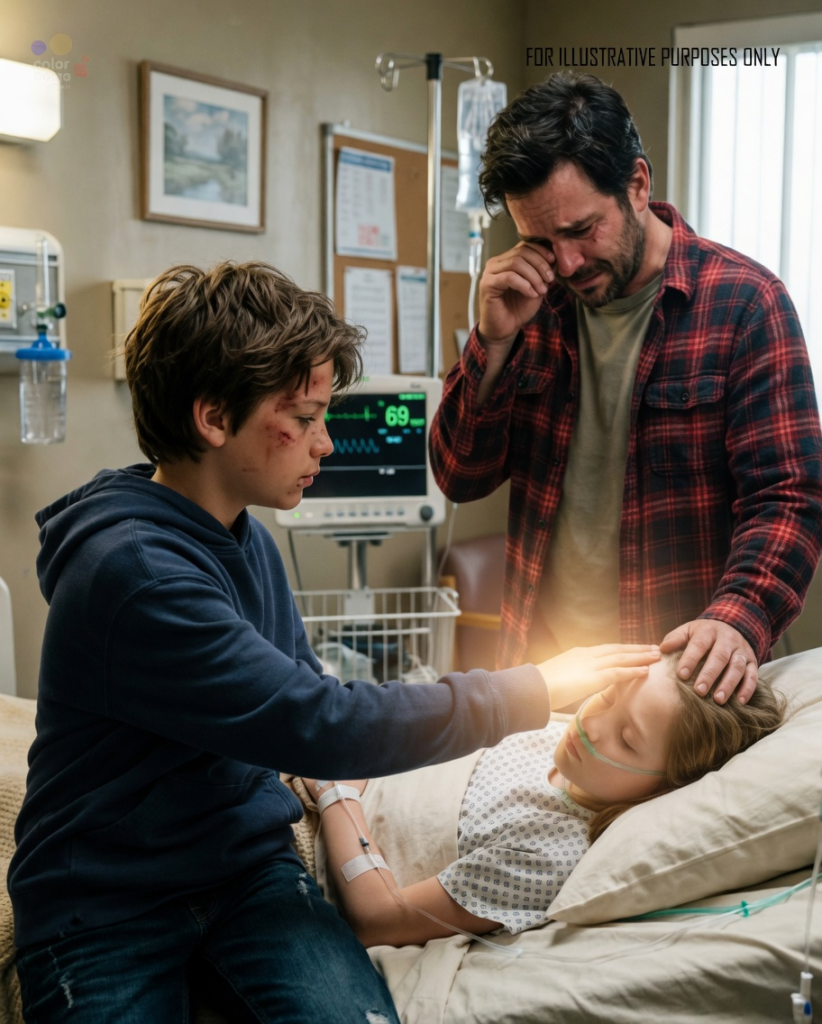
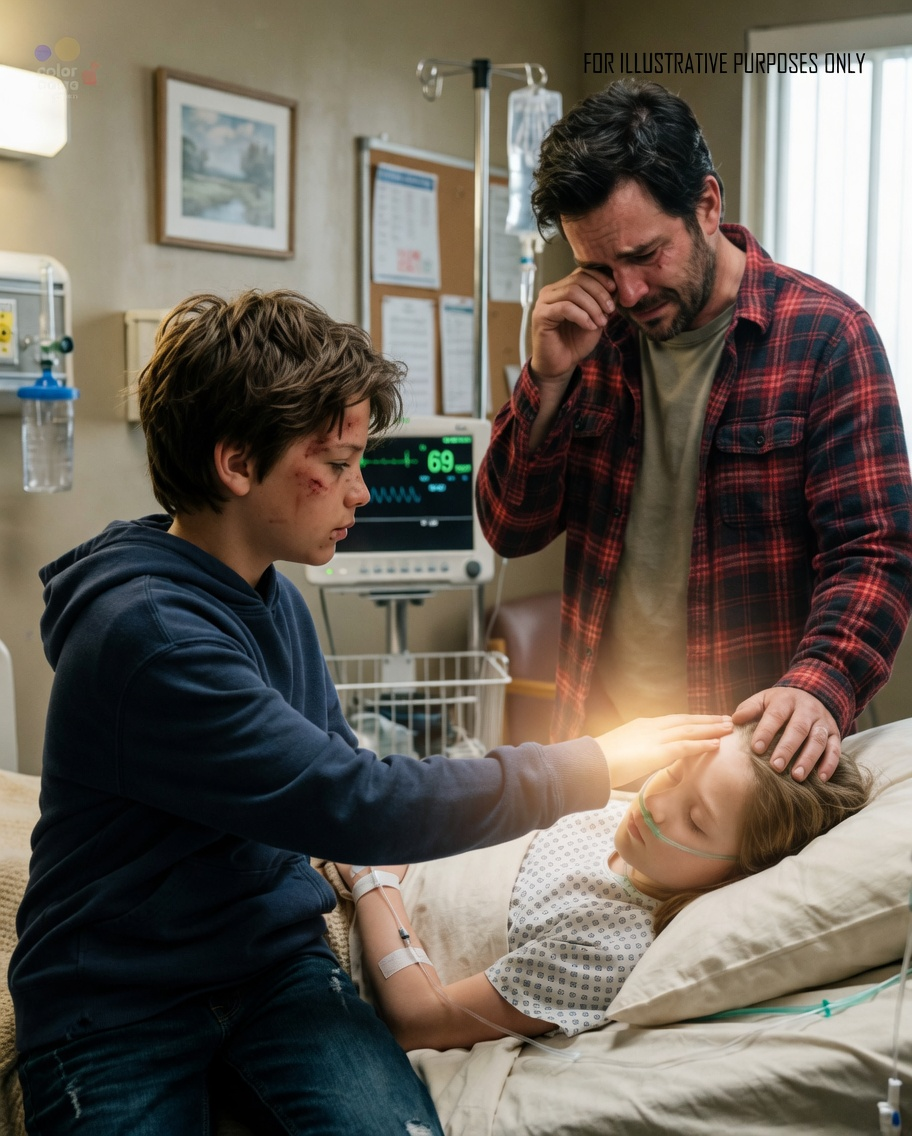
Gabriel nodded once. He placed one small, surprisingly warm hand on Olivia’s forehead. His eyes closed in concentration. For a long moment, nothing happened. Then the air in the room shifted—charged with an electric stillness that made the hairs on Ethan’s arms rise. A soft, golden glow began to emanate from beneath Gabriel’s palm, faint at first, then growing warmer, like sunlight breaking through storm clouds. The heart monitor’s rhythm quickened noticeably. Olivia’s fingers, which had lain limp for three years, twitched once, then again.
Ethan gasped, reaching out instinctively. “Olivia?”
The glow pulsed gently, bathing her face in ethereal light. Her eyelids fluttered but did not open. The machines hummed with renewed energy.
“Why did you stop?” Ethan asked desperately as the light gradually faded and Gabriel withdrew his hand, looking suddenly pale and weary, as if he had run a great distance.
“It’s enough for today,” the boy replied softly. “She heard the call. She’s starting to remember the way. Tomorrow, when the sun rises, she will wake.”
Ethan spent that night in a fever of anticipation and doubt. He barely slept, alternating between watching his daughter and pacing the room. Nurses noted the slight uptick in her vitals but attributed it to nothing more than random fluctuation. He told no one about the boy. Who would believe him?
The following morning, as the first rays of sunlight filtered through the blinds, painting the room in strokes of gold and rose, Gabriel returned. He appeared at the doorway as if he had never left, still in the same worn clothes, carrying the same quiet resolve.
“It’s time,” he whispered.
Ethan stood back, heart pounding. Gabriel placed both hands gently on Olivia’s head this time. The glow returned, brighter and more intense, filling the room with a warmth that chased away the clinical chill. The monitors erupted into a frenzy of beeps and alarms. Olivia’s chest rose and fell more deeply. Her lips parted.
Nurses and doctors rushed in, faces etched with alarm. “What’s happening? Her readings are spiking!”
“Daddy…”
The word emerged hoarse, cracked, but unmistakable. Olivia’s eyes—those beautiful hazel eyes Ethan had feared he would never see again—fluttered open. She blinked slowly, confusion giving way to recognition as she focused on her father.
“Olivia!” Ethan collapsed against the bed, burying his face in her shoulder, sobs wracking his powerful frame. Joy, relief, and disbelief crashed over him in waves. Doctors stood frozen, murmuring about “medically inexplicable recovery” and “unprecedented neural reactivation.”
In the midst of the controlled chaos—nurses checking vitals, doctors shining lights into her eyes—Gabriel slipped quietly toward the door.
“Wait!” Ethan called out, rising and kneeling before the boy. Tears streamed down his face unchecked. “You saved her. You brought my daughter back. I’ll give you anything. A home, money, education—whatever you need. Please, let me help you the way you helped us.”
Gabriel smiled, a gentle, ancient smile that seemed misplaced on such a young face. “I don’t need anything, sir. Just make sure she’s happy. That’s enough for me.”
With that, he turned and walked out into the hallway, vanishing around the corner.
Days blurred into a whirlwind of tests and celebrations. Olivia recovered at a pace that astonished the entire medical team. No lasting neurological damage. No deficits in speech, memory, or motor skills. She asked for her favorite ice cream—strawberry swirl—and laughed at her father’s terrible jokes as if no time had passed. Ethan stayed by her side constantly, reading stories now met with responses, holding her hand as it squeezed back with life.
One quiet afternoon, as sunlight dappled the room and Olivia sketched pictures of birds on hospital paper, she looked up thoughtfully.
“The boy from my dream came, didn’t he, Daddy?”
Ethan froze, a chill running down his spine. “What boy, sweetheart?”
“The one who helped me when I was lost in the dark. It was like a big forest with no paths. He took my hand and showed me the light. His name was Gabriel Hayes.”
Ethan had never mentioned the name. His blood ran cold.
That night, after Olivia had fallen into peaceful sleep, curiosity and dread drove him to his laptop. Fingers trembling, he typed: “Gabriel Hayes Seattle car accident.”
The first result hit him like a physical blow.
“10-Year-Old Boy Dies in Multi-Car Pileup on I-90 During Storm.”
The date matched exactly—three years ago, the same night. Ethan clicked with shaking hands. The article described how a driver losing control in heavy rain had triggered a chain reaction. A smaller family car had been sideswiped. Most survived with injuries. Except for their youngest son.
Gabriel Hayes, age 10. Bright student, kind-hearted, known for helping classmates and volunteering at shelters. A school photo filled the screen: soft smile, deep steady eyes. The same eyes.
The boy who had appeared in the hospital was the innocent child whose life had been taken in the very accident Ethan had caused.
Tears blurred the screen as Ethan read further. No anger in the family’s statements—only profound grief and calls for safer roads. Gabriel had been an organ donor; his gift had saved others. But this… this was something beyond medical explanation.
Not vengeance. Not accusation. Pure, selfless forgiveness.
The boy Ethan’s mistake had killed had returned—not to haunt, but to heal. To restore what was lost.
Ethan stood by the hospital window that night, gazing at the stars piercing the Seattle sky. For the first time in three years, he felt truly small. Not diminished by failure, but humbled by grace. The weight of guilt that had crushed him lifted, replaced by overwhelming gratitude.
He returned to Olivia’s bedside and kissed her forehead gently. “Thank you, Gabriel,” he whispered into the quiet room. “I won’t waste this second chance. I promise.”
Olivia stirred in her sleep, a faint, peaceful smile curving her lips.
The true miracle was not merely a little girl awakening from darkness. It was a broken father’s heart finding its way back to light—guided by the forgiveness of a child who had every reason to withhold it, yet chose instead to give everything.
In the weeks that followed, Ethan sold portions of his empire to fund pediatric coma research and support programs for families of accident victims. He visited the Hayes family, sharing the story with tears and humility. Together, they planted a garden in Gabriel’s memory—a place of life and renewal.
Olivia grew stronger each day, her laughter filling their home once more. And in quiet moments, Ethan would catch her staring at the stars, as if listening to a friend only she could see.
Some gifts, he learned, transcend life and death. And some truths, once revealed, change everything.