Mara Bennett was thirty-four years old the night she stopped being useful in the way her family preferred and became dangerous in the way truth always is.
By the time Vanessa raised her plastic wine glass at the Bennett family picnic, Mara already knew her sister had been building toward something all afternoon. The signs were small, but Mara had spent years learning to read small things. The brighter Vanessa’s smile became, the thinner it got at the edges. The more affection she poured into her voice, the more likely it was that a knife was hidden in it. That was her talent. She could make humiliation sound festive. She could lace poison into a toast and still seem like the social heartbeat of the gathering.
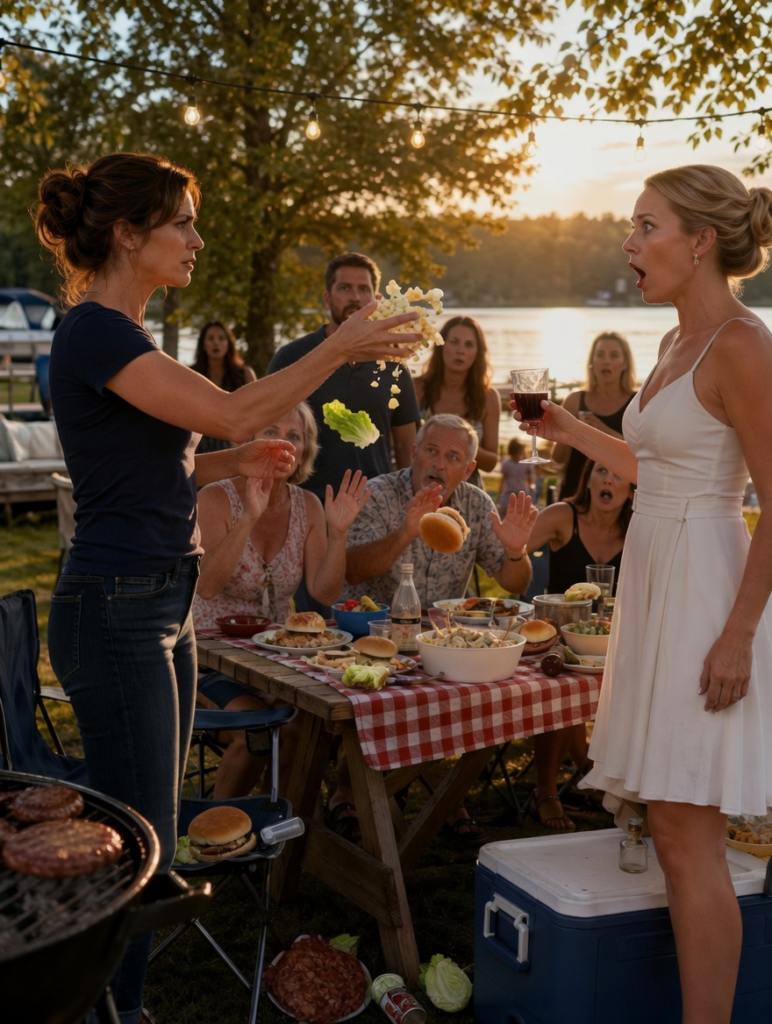
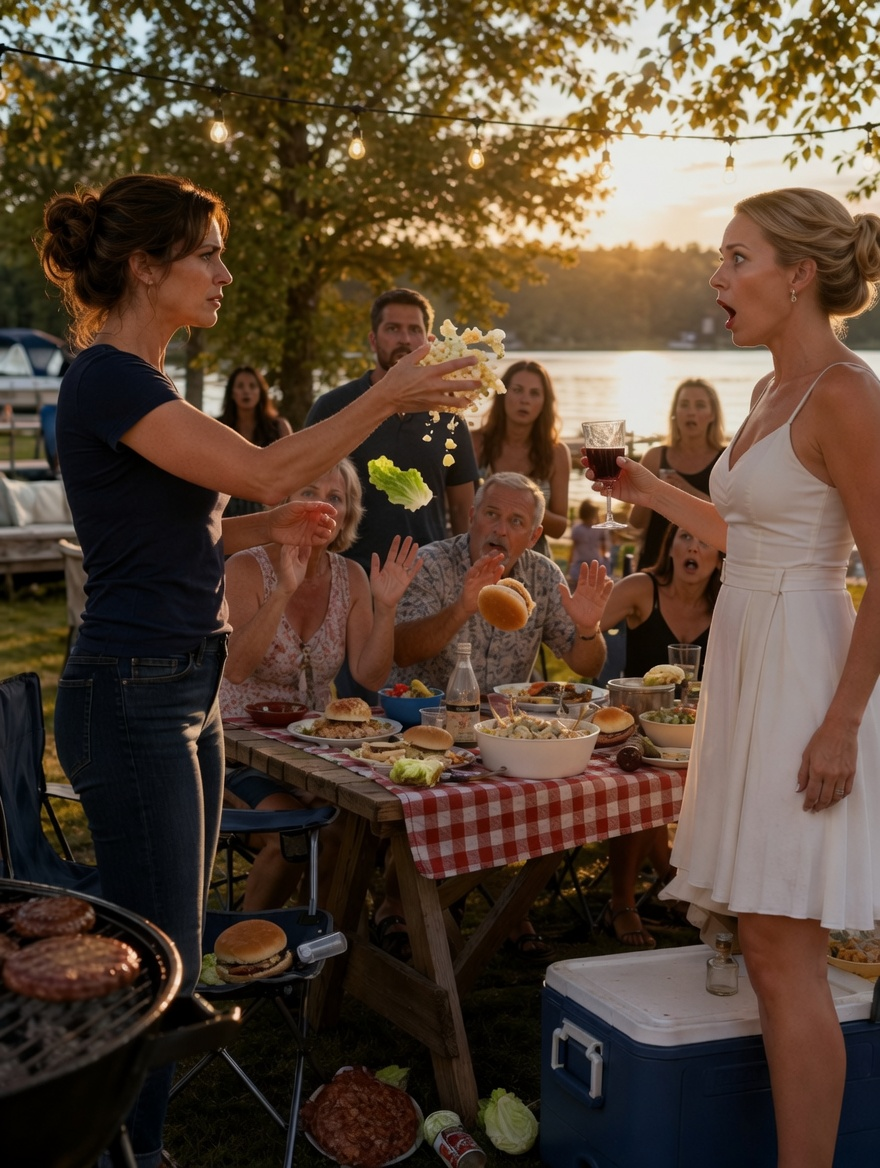
It was late evening at Maple Hollow Lake, where the Bennett family had gathered under a sky turning gold at the edges. Folding tables stood in rows under a grove of cottonwoods. Aluminum trays of burgers, corn, and potato salad sweated in the heat. Children ran barefoot through the grass with popsicles staining their mouths. Someone had turned on a country playlist low enough to feel tasteful. The air smelled like charcoal smoke, citronella, sunscreen, and the kind of effort families make when they want a holiday to look better from a distance than it feels up close.
Vanessa stood, tapped her cup with a fork, and smiled.
“Here’s to the one who always shows up broke, needy, and still hoping to matter.”
Carol Bennett laughed first because Carol often laughed at the wrong things when they came wrapped in confidence. Richard Bennett looked down into his plate and smiled in that cowardly, noncommittal way men sometimes do when they know something is cruel but don’t want to be the one to disturb the atmosphere. A cousin snorted. Another covered her mouth. A few of the relatives glanced toward Mara to see whether this would become one of those familiar, awkward moments everyone later pretended had not happened.
Mara picked up her drink, stood, and looked straight at Vanessa.
“Then let’s raise one,” she said, her voice calm enough to make people pay closer attention, “to the desperate one who borrows from the person she mocks, lies about it in front of family, and still expects applause.”
The whole yard went still.
Vanessa’s smile dropped first, then her shoulders, then the easy superior posture she wore the way some women wear jewelry. Carol’s face lost color. Richard finally looked up. Across the tables, conversations stopped mid-sentence. A cousin near the grill froze with a paper plate in his hand. Jenna Walsh, Mara’s friend from work, stood near the cooler with a bottle of lemonade and the stunned expression of someone who had just realized that half the things she had suspected were worse than she imagined.
Before Mara could even feel what she had set in motion, Vanessa recovered. She always recovered fast. That was another talent. Vanessa could slip on ice in front of a crowd and get back up looking offended at the sidewalk.
“Wow, Mara,” she said lightly, touching the rim of her sunglasses. “So we’re doing this? At a family picnic?”
The tone was soft, but the accusation was sharp. You’re making this ugly. You’re the problem for answering. That had always been the structure of things between them. Vanessa cut, Mara bled, and everyone turned to Mara to ask why she was staining the carpet.
“You started it,” Mara said. “Don’t act shocked because I finally answered.”
“Girls,” Carol said, leaning forward with that breathy soothing voice she used when she wanted peace without accountability, “not here. Not now. Not in front of people.”
That had always been the rule when Vanessa crossed a line. The problem was never the wound. The problem was always that someone might see it.
Vanessa shrugged. “I was making a joke.”
“You always say that after.”
“You turn everything into drama because you’re insecure.”
Some cousins looked away. Others watched with that fascinated, hungry discomfort people reserve for car wrecks and televised trials. Mara set her cup down before she crushed it in her hand.
“A joke?” she said. “You borrowed three thousand dollars from me in February because your commission check was delayed. You borrowed nine hundred in April for your car. You borrowed again in June because the rent on your downtown apartment was due and you didn’t want Liam to know you were behind. Which part was the joke?”
Vanessa’s face changed at the edges first. That was the thing about her. She had trained her mouth better than she had trained her eyes. Her smile held for one extra second, but panic had already surfaced.
“You didn’t have to say numbers,” she snapped.
“Exactly,” Mara said. “You didn’t have to toast me like I was your family charity case.”
A low murmur spread down the tables. An uncle stopped turning corn at the grill. One of the younger cousins stared openly at Vanessa the way children stare when adulthood suddenly reveals itself to be made of weak materials.
Vanessa crossed her arms. “So now you want to meddle because you helped your sister a few times?”
“No,” Mara said. “I wanted basic respect. That would have cost you less.”
Even Richard shifted at that. He had spent years mistaking Mara’s silence for strength. To him, because she handled things, she needed nothing. Because Vanessa complained loudly, she must have needed more. That was how some families divided care—not by fairness, but by who made the most noise when they hurt.
Vanessa stepped closer. “Tell them the rest, Mara. Tell them how you act like you’re better than everybody because you have your sad little jobs and your savings spreadsheets and your thrift-store clothes. You want everybody here to think you’re some saint? Fine. Tell them how impossible you are. Tell them how you judge everyone.”
Mara laughed once because the shamelessness of it almost deserved admiration.
“I restore damaged documents for the state museum all day,” she said. “Then I spend nights at a frame shop so I can keep my own life stable. I don’t drink my paycheck. I don’t lease luxury I can’t afford. I don’t insult people who cover for me.”
A hush passed again across the yard, but this one had weight. This one was different. It was the hush of a room realizing it had been listening to the wrong person for years.
Vanessa looked toward their parents, waiting for rescue. That was when Mara knew she was more afraid than angry. Powerful people attack. Exposed people look around for backup.
“Mara, sweetheart, enough,” Carol said, but there was no authority left in it.
Richard cleared his throat. “This doesn’t need to become a spectacle.”
Mara turned to him. “Then why was everybody comfortable when I was the spectacle five minutes ago?”
He had no answer. He looked toward the lake as though sunlight on water might offer an escape route. Vanessa saw the hesitation and did what cornered people do when they feel the floor shifting under them.
“You’re unbelievable,” she said. “After everything this family has done for you, you stand here acting like a victim?”
That almost made Mara laugh again. Not because it was funny, but because it was so perfectly dishonest.
“What exactly has this family done for me, Vanessa?” she asked. “Say it clearly.”
Vanessa opened her mouth, then closed it. She was excellent at implication, at tone, at social theater. She was far weaker with facts.
Aunt Diane jumped in from the far end of the table. “Your parents have always included you, Mara. They’ve always supported you girls equally.”
“Equally?” Mara said. “That’s interesting.”
She reached into her tote bag and pulled out the small accordion folder she had started carrying two years earlier after finally accepting that memory was not enough protection around people who revised history to flatter themselves. Museum work had changed her in subtle ways. When you spent your days preserving evidence, you stopped accepting emotion as proof simply because it arrived first.
“Mara,” Carol said sharply, seeing the folder. “Don’t.”
“No,” Mara said. “Today we do this properly.”
She opened the folder and drew out printed bank transfers, copies of text messages, and one folded handwritten note Vanessa had slipped into her mailbox months earlier asking for help with rent and begging her not to tell their parents. Mara did not wave them dramatically. She did not raise her voice. She simply laid the papers on the table beside the potato salad as if presenting records in a courtroom.
“February twelfth,” she said. “Three thousand dollars. Memo line: temporary. Don’t tell Mom and Dad. April fourth. Nine hundred twenty for your car repair. June twenty-first. Fifteen hundred because Liam thought you’d already covered your half of rent. August second. Eight hundred for the destination bachelorette trip you swore you couldn’t back out of because appearances mattered.”
Vanessa went white.
One cousin whispered, “Oh my God.”
Diane stopped talking. Richard stared at the documents like they were written in a language he had hoped never to learn.
“You kept receipts?” Vanessa asked.
“Of course I did,” Mara said. “You taught me to.”
That was the most honest sentence of the evening.
Mara had not started life suspicious. She had become suspicious after too many retellings changed in Vanessa’s favor, after too many favors somehow became proof of Vanessa’s generosity because she had allowed Mara to help, after too many humiliations came dressed as jokes.
Jenna quietly moved from the cooler to stand near Mara. She didn’t touch her. She didn’t speak. She simply stood there, which was somehow more loyal than anything louder could have been.
Vanessa looked around wildly. “Are you all really going to let her do this?”
Richard rubbed a hand over his jaw. “Did you borrow this money?”
She hesitated. That was all the answer anyone needed.
“That’s private,” she said finally.
“No,” Mara said. “It was private when I was protecting you. You made it public when you used me for a punchline.”
Vanessa took a step toward the papers. Mara put a hand over them.
“Don’t,” she said quietly. “You’ve been rewriting me for years. You don’t get to rewrite documents too.”
A few relatives looked ashamed. Not all of them. Some people will watch injustice for a decade and still think the true offense is when the victim becomes articulate.
Vanessa sensed the shift in the room and lashed out harder.
“Maybe if you weren’t bitter about ending up alone,” she said, “you wouldn’t be this obsessed with money.”
The line landed exactly where she meant it to. Mara had ended an engagement two years earlier after discovering her fiancé had quietly opened a credit card in both their names and expected her to absorb the debt because she was “better with responsibility.” Vanessa knew that history. She knew how hard Mara had worked to rebuild her finances and her sense of self. And she used it anyway, between paper plates and lemonade and cousins pretending not to stare.
Mara looked at her for a long moment.
“That’s fine,” she said. “Keep talking.”
Vanessa lifted her chin, mistaking calm for surrender. “No, really. Tell them more. Tell them how miserable you are. Tell them why you can’t stand seeing other people happy.”
“Happy?” Mara repeated. “Vanessa, you aren’t happy. You’re expensive.”
That froze the room again. One uncle coughed to hide a laugh. Another cousin failed to hide it at all. Humiliation finally broke through Vanessa’s polished surface.
“You jealous, bitter little—”
“Finish that sentence,” Mara said, “and I’ll read the text where you called me crying from the grocery store because your card declined and you said, You’re the only one who ever fixes this.”
That stopped her.
For the first time in Mara’s adult life, her sister had reached the edge of what charm and performance could save.
Humiliation in families rarely arrives as one dramatic event. More often it is built from years of tiny permissions. One mean joke no one corrects. One favor never repaid. One child praised for sparkle while another is praised for endurance, as though endurance is not neglected love wearing sturdy shoes.
Standing there at that picnic, with receipts on a folding table and her sister shaking with anger, Mara realized she was not ending a fight. She was ending a role.
“Here’s what happens now,” she said. “Since we all like public statements so much, let’s make one. From today forward, I am done covering your rent, your bills, your emergencies, your image, and your lies.”
Vanessa laughed once, but it came out thin. “You’re being dramatic.”
“No,” Mara said. “I’m being exact.”
She took one sheet from the stack and held it up. “Total unpaid amount, including the money you promised to return last summer: seven thousand two hundred eighty dollars.”
Carol made a small shocked sound. Richard looked at Vanessa with a stunned disappointment Mara had never before seen directed at her. Vanessa saw it too, and it rattled her more than anything else that night.
“I was going to pay it back,” she said.
“When?” Mara asked. “After the next brunch? After the next spray tan? After the next lease renewal on an apartment you can’t afford?”
“Mara,” Carol whispered, but there was no conviction left in it.
Vanessa’s fiancé, Liam, who had been avoiding the center of the drama with the expression of a man trying not to step on a land mine, finally walked over from the grill.
“Wait,” he said slowly. “You told me your bonus covered the back rent.”
Vanessa turned toward him so fast the movement looked violent. “This is not the time.”
“Actually,” he said, “it seems like exactly the time.”
That changed the shape of everything. Until then, Vanessa had still been fighting from high ground, or trying to. But now someone from her curated adult life had discovered he had been standing on cardboard scenery.
“You lied to me?” Liam asked.
“Don’t do this here,” she hissed.
“You lied to everyone,” Mara said. “And every time I stayed quiet, you used my silence to build a better version of yourself.”
Vanessa pointed at Mara. “You love this. You love making me look bad.”
“No,” Mara said. “You did the looking bad part yourself. I just stopped editing.”
There it was, the sentence she wished she had learned at twenty-five instead of thirty-four.
Richard stood. He was not a large man, but he looked older than Mara had ever seen him. Not weak. Just tired. Tired in the way people look when they realize their comfort has been financed by someone else’s restraint.
“Vanessa,” he said, “is the number real?”
Vanessa hesitated again. “It’s not that simple.”
“That means yes,” Mara said.
Diane tried once more. “Families help each other.”
Mara looked right at her. “Families don’t mock the person helping them and call it a toast.”
That shut her up.
Liam stepped back from Vanessa as if he physically needed space to think. “You told me Mara was always asking for help,” he said quietly. “You told me she was irresponsible.”
Vanessa opened her mouth, but there was nothing believable left in the room for her to pick up.
People began moving away from her. Not dramatically. Just enough. A cousin drifted toward the drinks table. Diane sat down and stared at her lap. Carol stopped smoothing the air. Richard stopped defending peace at all costs. Vanessa was still standing in the center of the yard, but suddenly she was alone.
Mara stacked the papers again, neat and controlled.
“I’ll send you a repayment schedule tonight,” she said. “If you ignore it, I’ll consider the money a lesson fee and never answer another emergency call from you again.”
Vanessa stared. “You’d cut off your own sister?”
“I’d stop funding my own humiliation.”
Then Mara turned to her parents.
“And before either of you asks me to be the bigger person, don’t. I have been the bigger person so long you all mistook it for my permanent shape.”
No one spoke. A breeze off the lake lifted a paper napkin and dropped it again. Somewhere behind them, a little kid asked whether dessert was ready, which felt almost insultingly normal. That was how family rupture worked. The sky stayed blue. The grill still smoked. Mosquitoes still drifted over the grass. The world did not pause for the truth. It simply revealed itself.
Relatives started leaving early after that.
That would have offended Carol on any other holiday. But that evening she barely noticed. A picnic built on appearances cannot survive honesty for very long.
As people folded chairs and loaded coolers, Mara heard fragments of the new version of the family story spreading in low shocked voices.
“I had no idea.”
“Seven thousand?”
“She called Mara broke?”
“That’s unbelievable.”
Not everyone came around instantly. Some still thought Mara had gone too far. Some still believed the old family religion that public peace mattered more than private fairness. But the spell had broken, and family spells, once cracked, rarely return in the same shape.
Vanessa tried twice to corner people into sympathy. First Diane. Then Liam. Neither conversation lasted long. Diane, who had spent years admiring Vanessa’s polished life and expensive hair, finally said the most useful thing Mara had ever heard from her.
“I can’t defend you tonight.”
Liam did not yell. He looked worse than angry men look. He looked embarrassed to have been made into an audience member in his own relationship.
He handed the grill tongs to Richard, said he was taking a walk, and disappeared down the path by the lake.
Mara stood by the dock while twilight deepened, turning the water dark blue and the yard strangely soft. Jenna came to stand beside her and handed her a bottle of water.
“I used to think you were exaggerating,” Jenna said. “Not about Vanessa exactly. About how alone you felt in your own family.”
Mara unscrewed the bottle and looked out over the water. “Most people don’t understand family scapegoats unless they’ve been one.”
“You were never broke,” Jenna said. “You were carrying people.”
Mara gave a brief, tired laugh. “That should go on a greeting card.”
But the truth of it landed hard. That was the insult beneath everything, wasn’t it? Broke. Not financially, though they liked pretending that. In their minds, Mara was broke because she lived carefully. Because she drove a twelve-year-old Subaru and wore practical shoes and packed her lunch and turned down destination weekends she couldn’t justify. Because she had chosen stability over spectacle after nearly letting the wrong man ruin her credit and her peace. To Vanessa, restraint looked like failure because Vanessa had never learned the dignity of enough.
Mara remembered a night sixteen months earlier when Vanessa had called her crying from outside a boutique hotel downtown. Locked out after a birthday dinner. Too embarrassed to ask Liam for money. Too proud to admit she had spent rent again. Mara had driven forty minutes with cash in an envelope, sat in the car while Vanessa fixed her lipstick in the mirror, and listened to her promise it was the last time. Two days later Vanessa had posted smiling rooftop photos with the caption Blessed beyond measure.
That memory had always stayed with Mara because it captured the architecture of their relationship. Mara handled the invisible beams. Vanessa threw parties in the finished room.
By the time the last cousins left, the yard looked tired. Half-empty trays. Damp paper cups in the grass. A watermelon split open on the table. Smoke drifting from a cooling grill. Carol and Richard stood near the patio waiting for Mara, and from the shape of their silence she knew the second half of the evening had arrived.
Not the public part.
The honest part.
Vanessa sat under the string lights with her arms wrapped around herself. Without the audience she no longer looked glamorous. She looked cornered.
Good, Mara thought, and then hated herself for that thought before accepting it. Consequences always feel cruel to people who never expected any.
“Mara,” Richard said. “Come sit down.”
She didn’t want to. Sitting suggested comfort. She was not here to comfort anyone. Still, she pulled out a chair across from them. Jenna squeezed her shoulder and headed to her car, leaving the Bennetts to their blood and damage.
Carol folded and unfolded a paper napkin in her lap. “You blindsided us,” she said.
It was such a mother sentence. Not We failed you. Not We should have seen this. Blindsided us. As if the injury was their late arrival to the truth.
“No,” Mara said. “I’ve been signaling for years. You just didn’t want to read it.”
Richard looked at Vanessa. “Go inside.”
Vanessa stared at him. “Why am I the only one being treated like I did something wrong?”
He did not raise his voice. “Because tonight, you did.”
It was small. It was late. It was also the first time Mara had ever heard him correct Vanessa without wrapping the correction in explanation.
Vanessa stood so fast the chair scraped the patio. She looked to Carol for rescue, found none, and stormed inside, slamming the screen door hard enough to rattle the frame.
When the yard settled again, Richard leaned forward, forearms on his knees.
“How long has this been going on?” he asked.
“Depends what you mean.”
“The borrowing.”
“About four years.”
“The insults?”
“Longer.”
“The expectation that you’ll absorb whatever she creates?”
“M-most of my adult life.”
Carol’s eyes filled. “Why didn’t you tell us?”
“I did,” Mara said. “Just not in ways you respected. I said I was tired. I said I couldn’t keep doing it. I said her comments were cruel. Every time, I got told she was stressed, or sensitive, or didn’t mean it, or that I was stronger and should let it go. You didn’t hear me because the role you gave me was useful.”
That hit where it needed to. Her parents had loved her. She believed that. But they had loved her lazily. They loved the daughter who solved, absorbed, forgave, remembered birthdays, brought side dishes, answered late-night calls, and never asked for an audit of the family’s emotional economy. Once she stopped performing that version of herself, they were forced to meet the actual daughter in front of them, and she was tired.
“We were proud of you,” Carol said weakly. “You were steady. Capable. You never seemed like you needed rescuing.”
“I didn’t need rescuing,” Mara said. “I needed fairness. I needed somebody to notice that being dependable is not the same thing as being unaffected.”
Richard shut his eyes for a second. “Your mother’s not wrong that Vanessa always needed more managing.”
“That is not the compliment you think it is,” Mara said. “All it means is you taught her that difficulty gets rewarded.”
He had no answer. Neither of them did.
Then Mara told them more than she had planned to. About the grocery store call. About the rent. About the hotel room in her own name when Vanessa’s card was maxed out. About the utility shutoff notice followed by salon highlights and an online caption about self-care. Carol covered her mouth. Richard seemed to age by the minute.
But Mara was not done.
“Do you know what hurt most?” she asked. “Not the money. Not even the insults. It was hearing you both laugh tonight before you knew I was going to answer. It was realizing that somewhere along the way, I became safe to disrespect.”
Carol started crying for real then—not performative, not fragile-parent crying, but the kind that comes when a self-image cracks and there is no one left to blame for the sound.
“I’m sorry,” she whispered. “I’m so sorry.”
Richard’s voice was rough. “I should have shut that toast down the second it started.”
“Yes,” Mara said. “You should have.”
Some people would call that harsh. Mara called it accurate. Accuracy is not cruelty merely because it refuses to decorate itself.
Richard nodded once. “You’re right.”
The words were simple. They changed the air.
Mara’s whole life peace had depended on her swallowing the truth faster than other people created damage. Hearing her father say she was right without racing to excuse Vanessa felt almost physically strange.
Carol wiped her face. “What do you need from us now?”
That was the best question of the night because it finally centered her reality instead of their discomfort.
“First,” Mara said, “stop asking me to take calls, lend money, smooth things over, or explain Vanessa to herself. Second, don’t tell me to forgive quickly just because the house feels tense. Third, if she insults me again in front of you, I want you to address it immediately, not later. And fourth, do not confuse access to me with entitlement to me.”
Carol nodded through tears. Richard nodded too.
“That’s fair,” he said.
“It’s necessary,” Mara corrected.
Then he asked what she knew was coming. “Do you want us to make her repay you?”
Mara thought for a moment. Not because she doubted the answer, but because she wanted to be honest about what the money meant.
“Yes,” she said. “But not because I need every dollar to survive. I need the debt acknowledged because the lie has been expensive in more than one way.”
Richard leaned back. “Then that’s what happens. She repays you. And if she needs to change her lifestyle, she changes it.”
“No more rescuing,” Carol said quietly.
There was silence again, but now it held work.
“I think,” Carol said after a while, “we made a habit of admiring Vanessa’s shine and relying on your structure.”
Mara looked at her. “That is the most honest sentence you’ve said all year.”
Carol almost laughed and then didn’t. Richard gave a bitter little smile. “And structure doesn’t sparkle,” he said, “so we took it for granted.”
“Exactly.”
Mara folded her hands in her lap so they would not see them shake. Public truth ran on adrenaline. Private truth ran on grief.
“I love you both,” she said, “but I’m not doing this anymore. If the only way to stay close to this family is to keep getting diminished, then distance will be healthier than closeness.”
Carol reached toward her hand and stopped halfway, asking permission without words. Mara let her take it. Not because anything was fixed. Nothing was fixed. But boundaries are not walls when used properly. They are doors with locks. For the first time, Mara’s hand was on the key.
Vanessa came back outside twenty minutes later with mascara smudged and her anger rearranged into wounded pride. Liam was with her, but he stood a little apart, as though proximity had become a decision instead of a habit. Mara’s parents looked at Vanessa differently now. That was the quiet miracle of the night. Not that they suddenly stopped loving her. Parents rarely do. The miracle was that love had finally stopped blinding them.
“Sit down,” Richard said.
Vanessa did.
No sigh. No theatrical delay. Just a stiff drop into the chair across from them.
Carol spoke first. “You owe Mara an apology.”
Vanessa gave a short humorless laugh. “So that’s what this is? A tribunal?”
“No,” Mara said. “It’s the first normal conversation this family has had about your behavior in years.”
“You humiliated me.”
“You announced me as broke in front of thirty people.”
“As a joke.”
“No,” Richard said, and all four of them turned because he almost never interrupted her. “It was not a joke. It was mean. And you knew exactly what you were doing.”
Vanessa stared at him as though he had switched languages.
Carol swallowed hard. “And the money is not a misunderstanding. It’s debt.”
Debt.
Not help. Not sisterly support. Not a temporary patch between family. Debt. The word stripped away years of cosmetic storytelling and left the bare thing on the table.
Vanessa looked toward Liam for backup. He had none left to give.
“Did you tell Mara I covered the rent?” he asked quietly.
She said nothing.
“Did you tell your parents she was the one always asking for help?”
Silence.
“Vanessa.”
“Yes,” she muttered.
Richard said, “You will repay Mara every dollar. We can help you build a plan, but we are not paying it for you.”
Her head jerked up. “You’d make me struggle over this?”
“No,” Carol said before anyone else could. “We’re making you face what you created.”
Liam rubbed the back of his neck. “I’m going home.”
Vanessa stared. “Seriously?”
“Yes,” he said. “Because I don’t know which part is worse. The debt, the lying, or the way you publicly tore down the person who covered for you.”
He looked at Mara. “I’m sorry I believed it.”
Then he left.
That was the second real consequence of the night. The first had been exposure. The second was loss.
Vanessa stood halfway to follow him, then sat again because there was no dramatic exit left to make. Richard gestured at the chair.
“Sit.”
She sat.
Mara had never seen her look small before. Not because she had become innocent, but because arrogance had finally been separated from protection.
“You are going to apologize properly,” Carol said.
Vanessa looked at Mara with wet eyes full of rage and shame and the stubbornness of someone forced to meet herself without flattering light.
“I’m sorry,” she said flatly.
Richard shook his head. “Try again.”
She closed her eyes. When she opened them, her voice was different. Lower. Less polished.
“I’m sorry I used you,” she said. “I’m sorry I kept taking your help and then acting like you were beneath me. I’m sorry I lied to Liam. And I’m sorry I made you look like the problem.”
Mara looked at her for a long time.
An apology, she knew, was not the same thing as a change. It was only a door cracked open. Some people apologize because they understand harm. Others apologize because the cost of not apologizing has finally become visible. Mara did not know which kind this was yet.
“Thank you,” she said. “Now prove it.”
Vanessa flinched. “How?”
“By paying me back. By not making me carry your emergencies anymore. By not turning me into the villain whenever you feel small. And by telling the truth the next time my name comes up.”
For a second Vanessa looked young. Not younger in the flattering sense. Younger in the unfinished sense. As if the years of presentation and performance had hidden how underdeveloped some part of her still was.
“Fine,” she said. “I will.”
Mara stood. “Good.”
She gathered her folder. Her knees felt hollow. Her heart was pounding so hard it hurt. She could feel the full force of what the night had cost and saved at the same time.
As she crossed the yard toward her car, she did not look back.
The next morning the family text thread exploded before eight.
Diane led the charge with false reasonableness, which Mara had long ago learned was the favored dialect of people who wanted injustice softened but never corrected.
I think everyone was emotional last night. Maybe we should all remember family is more important than money.
Another aunt added a praying hands emoji.
A cousin sent We love you both! as if love were a blanket capable of covering mold.
Mara stared at the messages from her kitchen table with a mug of coffee cooling beside her. Her apartment in downtown Cedar Bluff was quiet except for the hum of the refrigerator and the old radiator ticking awake even though spring had fully arrived. The place was small but orderly. Bookshelves along one wall. A fern in the window. A framed nineteenth-century map she had restored herself. The kitchen chairs were mismatched because she had bought them one at a time from estate sales and made them work together anyway. That was how she had built her life—patiently, practically, without splash.
She typed once, deleted it, and typed again.
Family is exactly why this matters. Please don’t ask me to confuse silence with harmony.
Then she put the phone face down and went to work.
The state museum occupied a sandstone building near the capitol, grand from the outside and climate-controlled inside to a degree that made most visitors assume history was naturally cold. Mara worked in paper conservation, which sounded dull to people who believed drama only existed in loud professions. In truth, the room where she spent her days was full of evidence of how human beings tried to survive themselves—letters written by soldiers who never came home, ledgers from towns that no longer existed, land grants signed by men who believed paper could sanctify theft, diaries whose ink had nearly surrendered to time.
The lab smelled faintly of wheat starch paste, old paper, and filtered air. Mara liked that history asked for patience. It did not need charm. It needed care.
When she entered the lab that morning, Edwin Morales was already there peering through magnification at a torn railroad map.
Edwin had worked at the museum for twenty-eight years and looked like a professor who had misplaced the campus. Silver hair. Soft sweaters in every season. Glasses forever slipping down his nose. He was one of those people whose kindness had edges, which was why Mara trusted him.
He glanced up. “You look like either justice or a migraine visited your family barbecue.”
“Both,” Mara said, hanging her bag.
He studied her. “Do you want coffee or silence?”
“Coffee.”
“Ah. Then it was definitely family.”
By lunch half the lab knew something had happened because Mara almost never arrived with her shoulders that tight. Jenna stopped by on her break from administrative offices and brought a sandwich Mara hadn’t asked for.
“You haven’t looked at your phone, have you?” Jenna asked.
“No.”
“Good.”
“That bad?”
“Worse than bad. Predictable.”
Jenna sat on the edge of the break-room table and scrolled. “Aunt Diane has decided this is a mutual misunderstanding. Your cousin Mallory thinks you should have discussed finances privately. Your mother has not said anything. Your father texted just once: We’re handling it.”
Mara nodded slowly. Richard’s message meant more than all the others. He was not a man of great emotional vocabulary. If he said he was handling something, that meant wheels were turning somewhere in the quiet machinery of his conscience.
“What about Vanessa?” Mara asked.
Jenna checked. “Nothing public. Her social media is dead silent, which honestly scares me more than if she’d posted a quote about betrayal.”
“That means she’s regrouping.”
“Or crying in a robe while shopping for legal advice and bronzer online.”
Mara smiled despite herself. “Both is possible.”
Jenna’s face softened. “How are you, really?”
Mara considered the question seriously, because Jenna was one of the few people in her life who did not use How are you as a conversational garnish.
“Tired,” she said. “Lighter. Guilty in a way I know I shouldn’t be. Angry that I still feel guilty.”
“That’s normal.”
“I know.” Mara looked at the sandwich in her hands. “I keep waiting for someone to tell me I imagined everything.”
“They will,” Jenna said. “Some of them. Because if they admit you were right, then they have to rethink their own behavior too.”
Mara leaned back against the counter. “I don’t even need them all to agree with me anymore. I just need not to go back.”
“That,” Jenna said, pointing at her, “is the whole job.”
The first formal crack in Vanessa’s life appeared two days later.
Mara had just finished humidifying a brittle set of Civil War letters when her phone vibrated with a message from Liam.
Can we talk?
She stared at the text for a moment before answering.
About what?
About what I was told. About what I believed. About Vanessa. About you.
Mara almost ignored it. She owed him nothing. But Liam had not actually harmed her. He had simply been gullible in a direction that benefited Vanessa, which was not the same thing. Also, part of her wanted to know whether Vanessa’s private life was collapsing or merely wobbling.
They met after work at a coffee shop near the river. Liam arrived five minutes early and looked like a man who had slept badly in expensive sheets. He was handsome in a clean, corporate way—well-cut jaw, careful hair, the sort of man who always seemed to smell faintly of cedar and expensive detergent. For years Mara had not minded him, though she had never trusted how easy it was for him to accept Vanessa’s version of people.
“Thanks for coming,” he said.
She nodded and sat.
For a minute neither of them touched their drinks. Outside, traffic rolled through the early evening. Inside, an espresso machine hissed like an irritated witness.
“I owe you an apology,” Liam said. “A real one. Not the kind people say because things are awkward.”
Mara didn’t rush to help him. He would either say what he meant or he wouldn’t.
“I believed her,” he continued. “About you. About money. About the way your family worked. I thought you were… I don’t know. Resentful. Critical. Hard to please.”
“That story was useful to her,” Mara said.
“I see that now.”
“Do you?”
He took the hit without flinching. “Not completely. But more than I did. Enough to know I’ve been stupid.”
Mara looked at him. “Stupid isn’t quite it. Comfortable is closer. You believed the version that let you enjoy her without looking at the scaffolding.”
He exhaled. “That’s fair.”
“And?”
“And I moved out this morning.”
That surprised her more than she showed. “That was quick.”
“It should’ve been slower, probably. But once I started asking real questions, everything got weirdly simple. Credit card balances she said didn’t exist. Bills she’d hidden. Stories that changed while she was telling them.” He rubbed his thumb along the paper cup seam. “And then there was the way she talked about you when she thought I already agreed.”
Mara’s expression hardened. “What did she say?”
He hesitated, which was enough answer by itself.
“Say it.”
“She called you a martyr with a ledger. Said you only helped people because it gave you leverage.” He looked ashamed even repeating it. “Said you wanted everyone indebted so you’d never have to admit no one chooses you first.”
That one landed deep, not because Mara believed it, but because it was close enough to an old wound to sting.
“And did you agree?” she asked.
“No,” he said immediately. Then, after a pause: “I think maybe I half agreed because it fit the version I’d been given. You were always the serious one. The corrected one. The one who didn’t sparkle.”
Mara barked one short bitter laugh. “There it is.”
“What?”
“Sparkle. Everybody forgives sparkle for being empty if it’s bright enough.”
Liam looked down. “You’re right.”
The waitress passed by refilling water glasses. Neither of them moved.
“What are you going to do?” Mara asked.
“About Vanessa?”
“About your life.”
He smiled without humor. “Recalculate. Cancel a wedding venue, probably. Tell my parents their favorite future daughter-in-law turns out to have financed champagne with your emergency fund.”
Mara winced. “That’ll be a fun brunch.”
He finally managed a real smile. “You joke like your father.”
“I absolutely do not.”
“You do when you’re trying not to feel too much.”
She sat back, annoyed at how accurate that was.
Liam’s face changed slightly then, his expression turning more careful. “There’s something else.”
Mara waited.
“She told me once that your engagement ended because you panicked. That you sabotaged it because stability makes you feel trapped.”
Mara looked right at him. “No.”
He nodded. “I know that now. She told me enough at the picnic that I put together the real shape of it. Debt. Shared credit. You getting out before it got worse.”
“Yes.”
He swallowed. “I’m sorry she used that against you.”
“Me too.”
He hesitated, then said quietly, “For what it’s worth, I don’t think you’re the kind of person no one chooses first. I think you’re the kind of person careless people assume will keep standing there while they wander.”
Mara looked away toward the window because something about that sentence made her throat feel suddenly tight.
When they left the café, Liam did not ask for friendship or absolution. He simply said, “If she ever tells anyone I paid you back for her, I didn’t,” which was so specific and so plausible that Mara almost laughed.
“I’ll note it in the archive,” she said.
Back at her apartment that night, Mara found an email from Richard with the subject line Repayment Plan.
Inside was a simple spreadsheet attachment and three sentences.
I sat down with your mother and Vanessa this afternoon. She has agreed to monthly payments beginning May 1st. If she misses two in a row, we are done stepping between this and you can make whatever decision you need to make. I should have done this years ago.
Mara read the email twice.
Then, after a long minute, she wrote back:
Thank you. Keep it about action, not guilt.
Richard replied six minutes later.
Understood.
It was not warmth, exactly. But it was movement.
The weeks that followed were quieter on the surface than Mara expected and louder underneath. That was another thing families did after rupture. They resumed normal behaviors while reorganizing emotionally around what could no longer be denied.
At the museum, Mara sank into work with a hunger that surprised her. Once you stopped carrying everyone else’s instability, your own life suddenly had extra room in it. She took on an additional restoration project involving a nineteenth-century women’s aid society ledger that had water damage along the lower half of each page. She volunteered to help prep a summer exhibition on local political scandals. She slept better. She woke without the low-grade dread that had been living in her chest for years and masquerading as personality.
The frame shop, where she worked three evenings a week, also felt different now. It sat on a side street near the old theater district, a narrow brick storefront smelling of sawdust, mat board, and the bitter little machine that made tolerable coffee for staff. The owner, Pete Hollenbeck, had the practical soul of a man who believed most problems could be improved with clamps or soup.
“You look less haunted,” Pete told her one Thursday while cutting archival backing.
“Thank you?”
“That was a compliment.”
“I assumed so. Just not the phrasing I’d expect on a business card.”
Pete grunted. “People don’t come in here because life is smooth. They bring in diplomas, dead relatives, kids’ drawings, wedding photos, military flags. Frames are for the stuff people are scared to lose. You can tell when somebody’s carrying too much. You looked like that for years.”
Mara stopped aligning a print and glanced at him. “Did everyone know except me?”
“No. Some of us just know what strain looks like.”
He measured, cut, and added, “You’re not obligated to be your family’s shock absorber forever.”
The strange thing about being told the truth by several people in different rooms was that eventually it stopped feeling like a theory and started feeling like a structure.
Vanessa made her first payment on time.
Mara nearly laughed when she saw the transfer notification. Eight hundred dollars. The memo line read repayment. No apology. No exclamation point. Just the word.
It was the first money Vanessa had ever returned without attaching a performance to it. Mara stared at the screen, then forwarded the confirmation to the folder she had now labeled Bennett—Financial.
Three days later Vanessa texted.
Can we talk?
Mara looked at the screen for a long moment before setting the phone down. Ten minutes later it buzzed again.
I mean in person. Not to fight. I need to explain some things.
Mara typed, deleted, and finally sent:
You can email.
Vanessa answered almost immediately.
That feels cold.
Yes, Mara wrote back. That’s why I chose it.
The email arrived that night. It was long, defensive in places, self-pitying in others, but threaded through with something Mara had not expected: fear.
She had not understood how bad things were, Vanessa wrote. She had been in over her head for longer than anyone knew. The commission job looked better than it paid. The apartment had become part of a life she did not know how to downsize without feeling like a failure. She had felt constantly behind, constantly ashamed, constantly aware that Mara seemed to know how to survive without applause while Vanessa did not know who she was unless somebody was watching. The insults, she admitted, had partly come from resentment. Mara’s stability made her feel both inferior and dependent, and she hated both feelings.
Mara read the email twice, then a third time.
Some of it was manipulation. She could tell. Words like pressure and stress and not myself had been used too often for her to trust them fully. But not all of it felt false. Some parts were ugly in a way lies usually are not.
Mara did not answer that night.
Instead she walked to the window and looked out at the alley behind her building where a couple from the second floor were carrying in groceries and arguing gently about whether they already had enough pasta. The ordinariness of their lives almost undid her. It struck her that some people passed whole evenings discussing dinner because nobody in their family was detonating their nervous system for sport.
She finally replied the next morning.
I believe you were ashamed. That doesn’t excuse what you did. If you want a better relationship with me, start by becoming honest when no audience is present.
Vanessa’s response came an hour later.
I’m trying.
Mara stared at that phrase. It was the kind of sentence people used when they wanted credit for being near change.
Good, she wrote. Keep trying.
In June, Carol asked Mara to meet for lunch.
They chose a small tea room in Rose Market, the kind of place with heavy curtains and china cups that made everyone speak slightly more softly than usual. Carol arrived ten minutes early, which meant she was nervous. Her hair was styled. Her lipstick was too careful. She wore the pale blue blouse she always chose when she wanted to seem gentle and blameless at the same time.
Mara sat across from her and waited.
“I know you think I’m going to ask something from you,” Carol said.
Mara raised an eyebrow. “You usually do.”
Carol flinched, then nodded. “Fair.”
They ordered. The waitress brought cucumber sandwiches that looked too delicate for the subject matter.
“I’ve been thinking about what you said,” Carol began. “About being safe to disrespect.”
Mara did not rescue her from the discomfort.
“I don’t like how accurate it was,” Carol said. “I keep replaying things. Comments I should have shut down. Times I told you not to be so sensitive when what I meant was please don’t make me handle this.”
That was more honesty than Carol had managed in years.
Mara picked up her tea cup. “What do you want from me?”
“Nothing,” Carol said quickly. Then, after a pause, “Maybe understanding eventually. But not now. Mostly I wanted to say it aloud.”
Mara studied her mother’s face. The lines around her mouth seemed deeper. Her prettiness, which had once depended on smoothness and social grace, now had to compete with self-knowledge, and self-knowledge does not flatter the same way. Still, there was something sturdier in her than before.
“How’s Vanessa?” Mara asked.
Carol exhaled. “Downsizing. Angry. Embarrassed. She sold some handbags.”
“Tragic.”
Carol almost smiled. “You really do joke like your father.”
“I deny that entirely.”
“She misses Liam more than she misses the apartment.”
“Maybe because Liam asked questions.”
Carol stirred honey into her tea though she took it unsweetened. “She told me something last week that I can’t stop thinking about. She said she always believed if she looked successful enough for long enough, eventually she’d become the kind of person who didn’t need saving.”
Mara let that sit between them.
Carol looked up. “I’m not telling you this to make you forgive her.”
“Good.”
“I’m telling you because I’m trying to understand what I helped build.”
That sentence landed in Mara with strange softness. It did not erase anything. But it mattered.
“What do you think you built?” Mara asked.
Carol took a careful breath. “I think your father and I overpraised charm and underpraised character. I think we liked how easy it was to show Vanessa off. I think we admired your self-sufficiency because it relieved us of duties we should have kept.” She looked down. “I think I called you strong when what I meant was convenient.”
Mara had expected lunch to exhaust her. Instead it opened a tired place she had kept locked for years and let air into it.
“Thank you for saying it,” she said quietly.
Carol’s eyes filled but she held herself together this time. “I don’t want to lose you, Mara.”
“You already almost did.”
“I know.”
It was the first time Carol had accepted that sentence without trying to soften it.
On the walk back to the museum, Mara felt both heavier and more intact. Some truths healed exactly because they could not be prettied up.