“He doesn’t mean it like that.”
“He just believes children need respect.”
Respect, in our house, had always meant silence from whoever was smaller.
Brooke learned the rules better than I did.
She became the easy daughter, the pretty daughter, the daughter who smiled before anyone asked her to.
I became the one who stepped wrong.
The one who answered back.
The one who left too early and came back too often because some foolish part of me kept believing family could become safe if I loved them carefully enough.
Then I had Maisie.
For five years, I told myself the past could end with me.
I told myself I could visit on holidays, keep my distance from the old arguments, leave before Ray drank too much or Diane’s voice sharpened into blame.
I told myself Brooke’s house was different because Brooke was softer than our father.
That was the lie I carried into that afternoon.
It was a Saturday cookout at Brooke’s place, the kind with burgers smoking in the backyard and lemon cleaner shining on the hardwood inside.
Brooke’s husband’s family had come too, which meant Diane wanted everything to look perfect.
Perfect table.
Perfect paper plates stacked by the counter.
Perfect smiling daughters.
Perfect granddaughter who did not speak too loud, run too fast, touch the wrong centerpiece, or embarrass anyone.
Maisie did not know those rules.
She was five.
She wanted a cupcake, a tiara, and someone to clap when she spun in the living room.
At first, people laughed.
Then Ray told her to stop running.
Maisie slowed down for maybe thirty seconds.
Then one of Brooke’s nephews chased her around the coffee table, and she squealed because she was happy.
The sound cut through the room.
I saw Ray’s face change.
That was the first warning.
I stepped toward her, already saying, “Maisie, come here, baby.”
But Diane caught my arm.
“Don’t make a scene,” she muttered.
A scene.
That was what my family called the moment right before they expected me to swallow something sharp.
I pulled my arm away.
Then Maisie bumped the edge of the side table.
A framed photo tipped over.
It did not break.
It barely made a sound.
But Ray stood.
The whole living room changed around him.
Forks froze halfway to mouths.
A paper plate bent in someone’s hand.
Brooke’s mother-in-law looked toward the kitchen as if she had suddenly remembered something urgent there.
The ceiling fan kept turning above us, slow and useless.
Nobody moved.
Ray said, “That child needs discipline.”
I said, “She is five.”
He looked at me like I had challenged him in front of a jury.
Maisie had stopped smiling by then.
She stood beside the couch with her tiara crooked and her hands tucked under her chin, trying to read the room the way children do when adults turn dangerous.
“Come here,” Ray said.
I said, “No.”
That was when he reached for his belt.
There are moments when anger becomes so hot it almost gives you clarity.
For one ugly second, I pictured knocking him backward.
I pictured grabbing the nearest lamp.
I pictured screaming so loudly that the neighbors came running.
But Maisie was between us, and rage does not help a child if it makes the room less safe.
So I moved for her.
Ray moved faster.
I will not dress up what happened.
I will not make it neat.
There was the snap of leather.
There was Maisie’s small cry.
There was a thud that seemed to pull all the air out of the house.
Then she was on the rug.
Silent.
For half a second, nobody even breathed.
Then Brooke whispered, “Dad.”
Not stop.
Not what did you do.
Just Dad, like she was afraid to use the wrong word.
I dropped to my knees beside Maisie.
Her eyes were closed.
Her lips were parted.
I touched her cheek and said her name.
Nothing.
I said it again.
“Maisie.”
Her lashes did not move.
Somebody in the dining room made a small choking sound.
Ray still stood above us with the belt in his hand, breathing hard through his nose.
Diane’s first words were not about Maisie.
They were about shame.
“Honestly, Sarah, take her and go,” she said, voice sharp and dry. “You embarrassed us in front of Brooke’s husband’s family. Don’t come back here again.”
I looked at my mother.
I looked at my father.
I looked at Brooke, who had both hands over her mouth and tears in her eyes like she wanted credit for feeling bad.
That was when something in me finally stopped begging them to become different people.
I gathered Maisie into my arms.
She felt too light.
That frightened me more than the weight would have.
Her sneaker lace dragged over my wrist as I stood.
The living room smelled like grilled meat, lemon cleaner, and panic.
Brooke’s in-laws stood in the doorway with plates in their hands.
One man stared at the rug.
Image
One woman pressed a napkin to her lips.
No one stepped between me and Ray.
No one touched Maisie.
No one asked if she was breathing.
That is how families like mine survive men like Ray.
They make silence look like manners.
They make cowardice look like peace.
They make the person carrying the injured child feel rude for bleeding on the carpet.
I walked down the hallway past the framed photos.
Brooke in her graduation gown.
Brooke with Mom at a church luncheon.
Brooke and her husband cutting a cake.
Brooke smiling in the center of everything.
Me at the edge of one picture, half cropped out, holding Maisie as a baby.
The wall had been telling the truth for years.
I just had not wanted to read it.
At the front door mirror, I caught a glimpse of myself.
Hair falling from its clip.
Lipstick smeared.
Maisie’s pale cheek pressed against my black sweater.
I looked like a woman leaving a burning building with the only thing worth saving.
Then I shoved the door open with my hip.
The afternoon outside was bright enough to feel cruel.
Sprinklers clicked over the lawn.
A dog barked behind a fence.
A kid rode his bike in slow circles two houses down, completely untouched by the fact that my world had just cracked open.
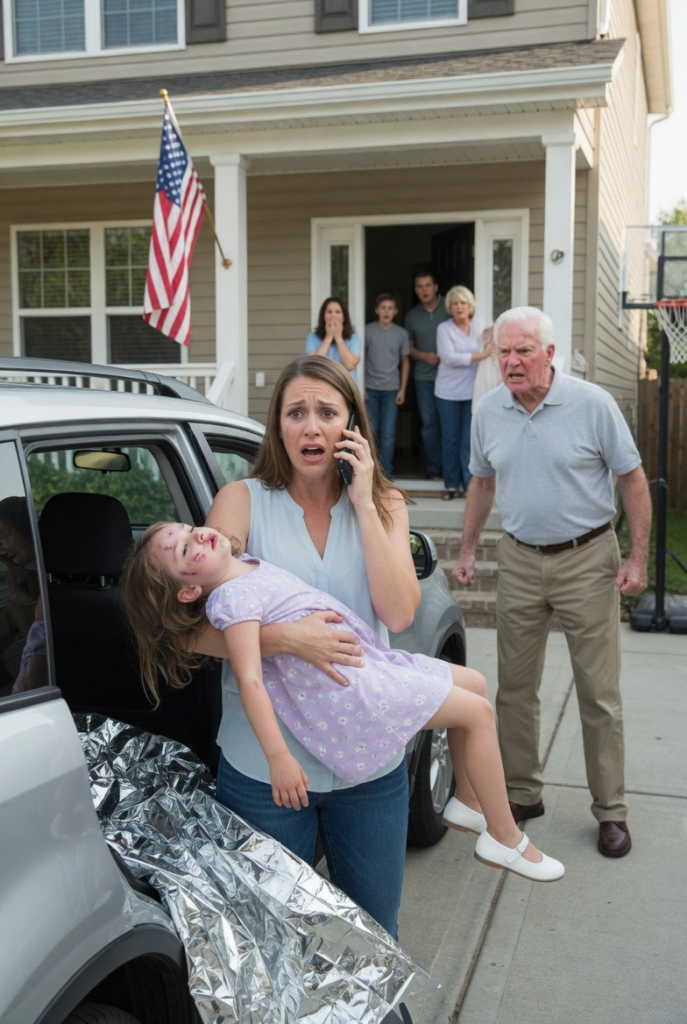
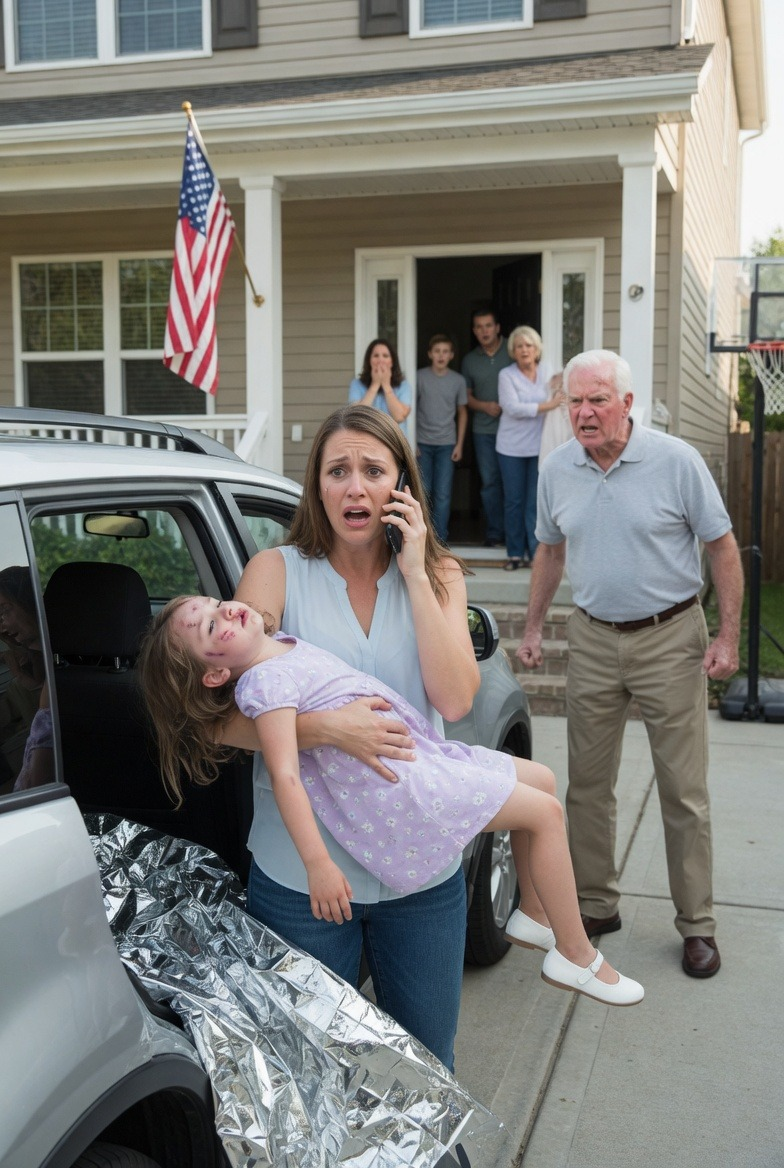
My old Honda sat in the driveway beneath the small American flag Ray kept mounted on the porch post.
He cared about that flag.
He cared about the lawn.
He cared about being respected by neighbors.
He did not care that his granddaughter was limp in my arms.
I opened the back door and laid Maisie across the emergency blanket I kept there for spilled juice, school pickup chills, and scraped knees.
Every mother keeps supplies for small disasters.
This was not small.
My hands shook so hard I almost dropped my phone.
The screen read 4:18 p.m.
I hit 911.
“911, what’s your emergency?”
“My daughter,” I said.
My voice sounded like it belonged to someone far away.
“She’s five. She isn’t waking up. My father hit her.”
The operator did not gasp.
She did not judge.
Her calm voice became the first steady thing I had heard all afternoon.
“What’s your location?”
I gave her my parents’ address.
It was ridiculous how easily I still knew it by heart.
“Is she breathing?”
I bent over the back seat so fast my shoulder hit the car frame.
I watched Maisie’s chest.
Nothing.
Then a shallow lift.
So small I almost missed it.
“Yes,” I whispered. “Yes, but she won’t open her eyes.”
“Stay on the line. EMS is on the way. Keep her airway clear. Do not move her unless there is immediate danger.”
I did exactly what she told me.
I tilted Maisie’s chin gently.
I kept one hand on her shoulder.
I said her name over and over because silence felt too close to surrender.
“Maisie, baby, it’s Mommy. Stay with me. Stay right here.”
The dispatcher asked about visible injuries.
She asked about consciousness.
She asked if the person who hurt her was still nearby.
I looked at the house.
The locked windows.
The polished porch.
The flag snapping lightly in the warm air.
Every ordinary detail suddenly looked like evidence.
“Yes,” I said. “He’s still here.”
Then the front door opened.
Diane stepped onto the porch first.
Her arms were folded tight across her chest.
Her face was pinched with irritation instead of fear.
“What exactly do you think you’re doing?” she snapped.
I did not answer.
I was listening for Maisie’s breathing.
Then Ray appeared behind her.
He still had the belt in his hand.
For one second, my body wanted to move between him and the car so hard that I almost forgot the dispatcher’s instruction not to move Maisie unless there was immediate danger.
Then Brooke appeared in the hallway behind them.
She was crying now in a way that did not look performative anymore.
Her face had collapsed.
Her hand was shaking.
Something glowed in her palm.
Her phone.
“Brooke,” Diane hissed without turning around. “Go back inside.”
Brooke did not go back inside.
Ray looked over his shoulder.
That single look almost folded her in half.
But she stayed where she was.
“Sarah,” she whispered.
The dispatcher said in my ear, “Ma’am, what is happening now?”
“My mother and father are on the porch,” I said, keeping my voice as steady as I could. “My sister is in the doorway. She’s holding a phone.”
Brooke’s thumb moved.
For a moment, all I heard was static and the thin outside noises of the neighborhood.
Then Maisie’s voice came from Brooke’s phone.
Tiny.
Terrified.
“Grandpa, please. I didn’t mean it.”
My mother’s arms dropped.
Ray’s face changed.
Not with regret.
With recognition.
That was worse.
Brooke pressed the phone to her chest and slid down the hallway wall until she was sitting on the floor.
“I recorded it,” she said.
Diane turned slowly toward her.
“What did you do?”
Brooke looked at me, then at Maisie in the back seat.
“I was going to delete it,” she whispered.
The sentence hit me almost as hard as the rest of it.
Not because she had recorded him.
Because deleting it had been an option in her mind.
Family loyalty can become a sickness when it asks you to protect the person holding the belt instead of the child on the floor.
Brooke began to sob.
“I didn’t know she stopped moving. I swear I didn’t know.”
Ray stepped forward.
“Give me that phone.”
Image
The dispatcher heard him.
Her voice sharpened for the first time.
“Sarah, are you in immediate danger?”
I looked at my father.
He had raised me to shrink when he lowered his voice.
He had trained every woman in that house to measure his moods before we measured our own pain.
But my daughter was in the back seat.
My daughter was breathing shallowly under my hand.
My daughter was the end of that training.
“Yes,” I said. “He’s coming toward us.”
Then we heard the siren.
It started low, somewhere beyond the end of the block.
Ray heard it too.
His eyes flicked toward the street.
Diane whispered, “Ray.”
Brooke held the phone up higher, still shaking, and said, “I’m not giving it to you.”
It was the first brave thing I had ever heard her say to him.
The siren grew louder.
A neighbor’s front door opened.
The boy on the bike stopped pedaling.
Ray looked at Brooke, then at me, then at the belt in his own hand as if he had just realized other people could see it.
That was the moment his world began to narrow.
Not because he suddenly understood what he had done.
Because other people were about to know.
The ambulance turned onto the street first.
A police cruiser followed close behind.
Blue and red light washed over the porch, the mailbox, the driveway, the small flag Ray had always kept so neat.
The dispatcher said, “Sarah, stay on the line until officers are with you.”
I did.
Two paramedics came toward the car.
One asked Maisie’s age.
“Five,” I said.
One asked what happened.
“My father hit her,” I said.
Ray barked from the porch, “That is not what happened.”
Brooke lifted the phone.
“Yes, it is,” she said.
Her voice broke on the last word, but it held.
An officer moved between Ray and the driveway.
“Sir, set the belt down.”
Ray laughed once, the ugly kind of laugh he used when he thought authority belonged to him.
“This is a family matter.”
The officer did not smile.
“Set it down.”
For the first time in my life, Ray Caldwell obeyed someone in his own front yard.
He dropped the belt on the porch boards.
The sound was small.
It still made Brooke flinch.
The paramedics lifted Maisie onto a stretcher.
I climbed into the ambulance beside her without looking back at my mother.
Diane called my name once.
I did not answer.
At the hospital intake desk, they asked for Maisie’s full name, date of birth, allergies, and what had happened.
I answered every question.
I watched a nurse put a wristband around Maisie’s arm.
I watched someone start a chart.
I heard the words “possible head injury” and felt my knees nearly give.
But Maisie was breathing.
That became the only fact I could hold.
A hospital social worker came in with a soft voice and a clipboard.
An officer asked for my statement.
The 911 call had a timestamp.
The responding officers had Ray’s belt in an evidence bag.
Brooke’s phone had the video.
By 6:42 p.m., the story my family wanted to tell had already begun falling apart on paper.
Diane tried to call me twelve times that night.
I did not pick up.
Ray did not call.
Men like him do not apologize when they are scared.
They plan.
Brooke came to the hospital just after midnight.
She looked smaller than I had ever seen her.
No makeup.
Hair pulled back badly.
Hands wrapped around a paper coffee cup she had not been drinking.
For a long time, she stood outside the room and looked at Maisie through the glass.
Then she came in and said, “I’m sorry.”
I did not tell her it was okay.
It was not okay.
She sat down and cried into both hands.
“I thought if I showed anyone, Dad would destroy me.”
I looked at her.
“He destroyed her instead.”
Brooke nodded like the sentence had been waiting for her.
Then she told me the truth.
She had started recording because Ray had been getting worse for months.
Not just loud.
Not just angry.
Careless.
Dangerous.
He had shoved a chair into a wall at Thanksgiving.
He had grabbed Brooke’s wrist hard enough to leave marks in March.
He had told Diane that grandchildren today were “soft” and needed to be “broken before the world broke them.”
Brooke had recorded small pieces of him because she was afraid no one would believe her.
Then, when the moment came, she had frozen.
That was the part she could barely say.
She froze while Maisie cried.
She froze while I ran.
She froze while Diane tried to turn the whole thing into an embarrassment.
I wanted to hate her for that.
Part of me did.
But another part of me knew freezing was the family inheritance Ray left all of us.
Some people inherit silver.
We inherited fear.
Maisie opened her eyes at 2:16 a.m.
The nurse had just adjusted her blanket.
I was sitting beside the bed with one hand on her ankle because I needed to feel that she was still there.
Her lashes fluttered.
Then her eyes opened.
“Mommy?”
I leaned over her so fast the chair scraped backward.
“I’m here, baby.”
Her voice was tiny.
“Am I in trouble?”
That question broke something in me more cleanly than any scream could have.
I pressed my lips to her hand.
“No,” I said. “You are not in trouble. You did nothing wrong.”
She blinked slowly.
Image
“Grandpa was mad.”
“I know.”
“Did I ruin the party?”
I closed my eyes.
Behind me, Brooke made a sound like she had been punched.
“No,” I said again, and this time my voice did not shake. “The party was not more important than you.”
That became the sentence I repeated for months.
To Maisie.
To myself.
To anyone who tried to soften what happened into a misunderstanding.
The party was not more important than her.
The family name was not more important than her.
Ray’s pride was not more important than her.
The police report was filed.
The hospital record was completed.
The video was preserved.
Brooke gave a statement.
So did one of her in-laws, the woman who had pressed the napkin to her mouth and said nothing in the living room.
She called me three days later crying.
“I should have helped,” she said.
“Yes,” I told her.
It was not cruel.
It was true.
Diane tried to rewrite the story first.
She said Ray only meant to scare Maisie.
She said I overreacted.
She said Brooke had betrayed the family by handing over the phone.
Then the officer asked her whether she had watched the video.
After that, she stopped talking.
Ray’s lawyer tried to call it discipline.
The video did not.
The 911 recording did not.
The hospital chart did not.
The belt in the evidence bag did not.
Paper has a way of refusing family mythology.
It just sits there with the time, the date, the words, and the damage.
For a long time, Maisie would not wear the pink sneakers.
I did not push her.
I put them in the hallway closet beside the emergency blanket, washed and folded, because some objects become too loud after a terrible day.
She started sleeping with the bedroom light on.
She asked whether Grandpa knew where we lived.
I changed the locks even though he had never had a key.
I told the school office in writing who was allowed to pick her up.
I gave them a photo.
I signed every form.
I became the kind of mother who documents everything because I had learned what silence costs.
Brooke changed too, though not quickly.
She moved out of her house for two weeks because Ray kept showing up and demanding that she “fix what she had done.”
For the first time, she did not fix it.
She gave the video to the officer.
She gave a full statement.
She told Diane no.
That single word looked painful in her mouth.
But she said it.
Months later, when Maisie asked why Aunt Brooke cried so much, I told her adults can be scared and still be responsible for what they do next.
I said it for Maisie.
I said it for Brooke.
Maybe I said it for the girl I used to be too.
The case did not heal us like a movie ending.
Real life rarely gives you one clean final scene.
There were hearings.
There were calls I ignored.
There were relatives who said I should not have involved police.
There were relatives who privately said they always knew Ray would go too far, which made me wonder why they had waited until after my daughter was in a hospital bed to become honest.
There was one afternoon when Diane showed up at my apartment complex and stood beside the mailbox crying.
She said, “He’s still your father.”
I said, “She is still my daughter.”
Then I went inside.
I did not slam the door.
I did not need to.
The strongest door I ever closed was quiet.
Maisie got better.
Slowly.
She returned to kindergarten with a new backpack and a note from her doctor.
Her teacher kept an eye on her during recess.
The school counselor let her draw when words got too big.
For a while, every picture had a car in it.
Then a house.
Then a girl with a crown.
One day, she drew the girl standing on a porch with her mother beside her.
The mother was holding the girl’s hand.
There was a small flag by the door.
There was no grandfather in the picture.
I kept that drawing.
It is in a folder with the hospital discharge papers, the police report copy, and the school safety note.
Not because I want to live inside what happened.
Because proof matters when people spend years telling you your memory is too dramatic.
The last time I saw Ray in person, he would not look at me.
That surprised me.
I had spent my whole life afraid of his eyes.
But without obedience feeding him, he looked smaller.
Not harmless.
Just smaller.
Diane sat two rows behind him.
Brooke sat beside me.
Her hands shook the entire time.
When it was over, she whispered, “I should have done it sooner.”
I said, “Yes.”
Then, after a moment, I added, “But you did it.”
That was all the grace I had to give her.
It was enough.
Maisie is older now.
She still loves tiaras.
She still hates when her sneaker laces come loose.
Sometimes she asks about that day, and I answer only what she is old enough to carry.
I tell her she was brave.
I tell her Mommy came.
I tell her help came.
I tell her grown-ups are supposed to keep children safe, and when they do not, other grown-ups have to tell the truth.
I do not tell her that her family called her an embarrassment while she lay silent in my arms.
Not yet.
Maybe not ever.
But I do tell her this.
The party was not more important than her.
The house was not more important than her.
The family lie was not more important than her.
And the day I carried her out of that house, I did not lose my family.
I stopped handing my child to people who had already shown me what they would protect first.