Inside my chest, something cracked open, not loudly, but with the quiet finality of understanding something too late, something that had been in front of me the entire time without me recognizing its shape.
Daniel’s voice returned on speaker, sharper now, asking why Noah was talking, why he was in the room, and why I was letting a doctor interfere with our family matters.
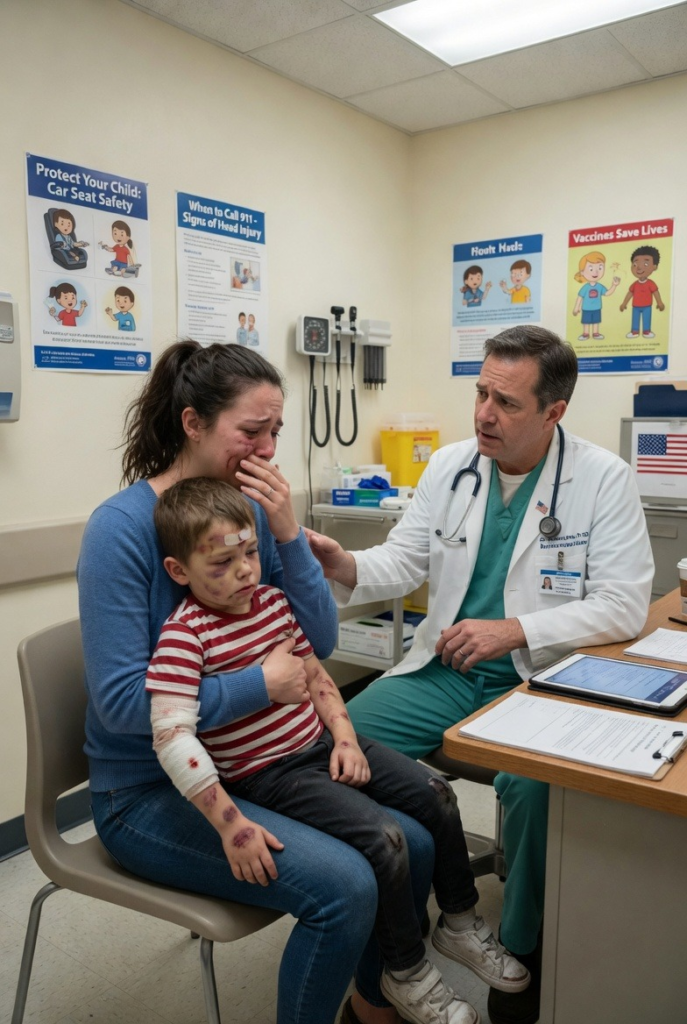
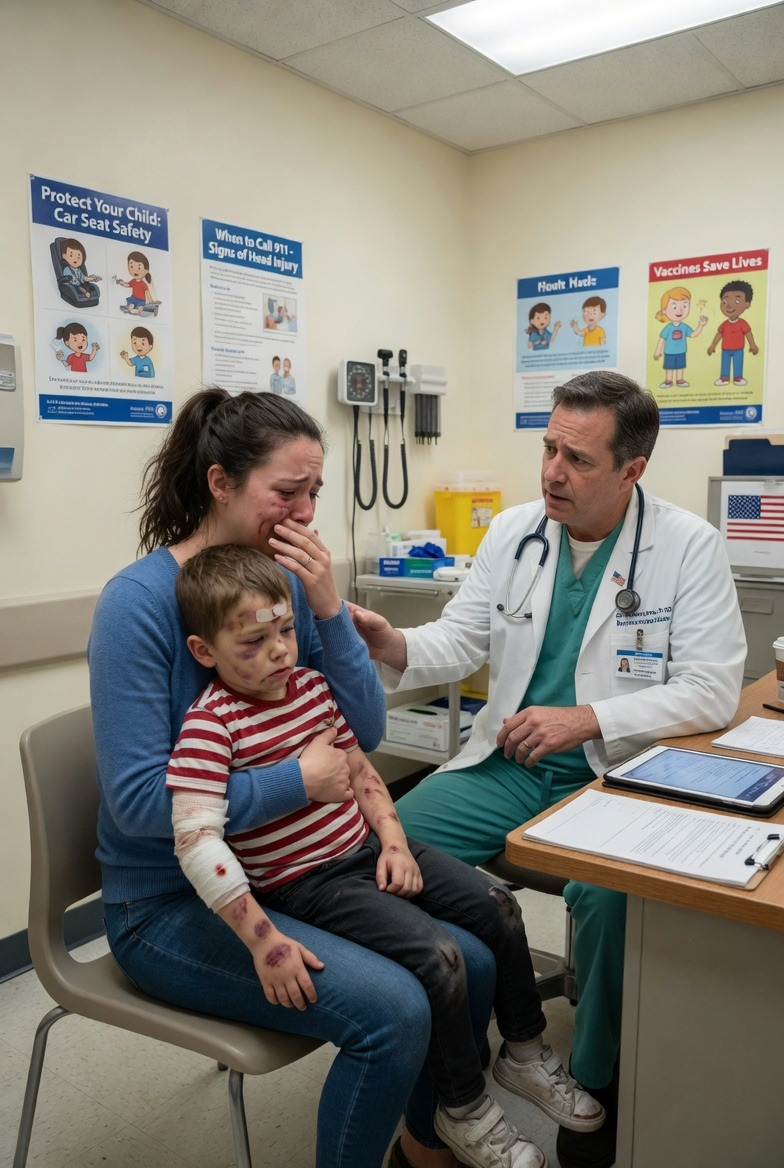
But Dr. Reeves finally spoke directly into the phone, his voice calm but no longer gentle, stating that this conversation had been recorded and would now be reviewed by child protection services immediately.
A pause followed, heavier than anything before it, and I could hear Daniel breathing on the other end, controlled, slow, the sound of someone realizing that a long-maintained structure was beginning to collapse.
Then he said something I did not expect, something almost normal, almost soft, asking me to come home and talk privately because misunderstandings were dangerous and outsiders never understood our family situation correctly.
But Noah flinched again at the word “home,” and that single reaction became louder than anything else in the room, louder than explanations, louder than denial, louder than every carefully constructed version of reality.
Dr. Reeves stood up and told me that we were not going anywhere alone, not until child protective authorities arrived, and I realized this was no longer a medical appointment but an unfolding legal intervention.
The hospital hallway suddenly felt like a different world, as staff began moving more quickly, speaking in lower voices, doors opening and closing with a rhythm that suggested something official had been activated.
I held Noah closer, feeling his heartbeat against my ribs, and I wondered how many years of silence could fit inside such a small body without breaking it completely from the inside.
When the social worker arrived, everything slowed down again, but not into peace, instead into careful documentation, quiet questions, and the kind of observation that sees patterns adults try hard to hide.
Noah was asked simple questions in a soft room with colored walls, and each time he answered, his voice grew slightly stronger, as if every word weakened a chain that had once held it down.
I sat behind the glass watching him, realizing I had never actually witnessed my son learning to speak, because I had always assumed he simply could not, rather than being unable to safely try.
The social worker asked me questions too, about routines, about discipline, about injuries, about moments that felt strange but had been normalized over years of exhaustion and misplaced trust in explanations that sounded reasonable.
Every answer I gave felt like stepping on uneven ground, because memories I had dismissed suddenly began rearranging themselves into a pattern I did not want to recognize but could no longer ignore.
Daniel was not present, but his presence filled every question, every silence, every hesitation, like an invisible structure that had once organized our lives without me realizing how tightly it was holding everything together.
Hours later, I was told Noah would not be going home that night, and the words should have felt like loss, but instead they felt like the first moment I could finally breathe properly.
That night, in a quiet room away from everything familiar, my son slept without tension in his shoulders for the first time I could remember, and I stayed awake watching him like someone relearning reality.
The next morning brought more questions, more interviews, more documents, and slowly the story that had once been my life began to split into two versions that could no longer coexist.
One version was the life I thought I had lived, filled with a husband who was supportive, a child who was silent for unclear medical reasons, and a family trying its best.
The other version was something harder to accept, a pattern of fear responses, conditioned silence, and carefully managed behavior that suggested control had been happening in places I had refused to look closely enough.
When I was finally allowed to see Noah again, he ran into my arms immediately, and this time he said my name, not perfectly, not loudly, but clearly enough to make my knees nearly give out.
In that moment, I understood that silence was not absence, but something imposed, something learned, something that could be reversed only when fear finally stopped being the language of survival.
Weeks passed as investigations continued, and I learned that truth does not arrive in a single dramatic explosion, but in layers, each one removing another piece of denial until nothing familiar remains.
Daniel’s explanations shifted as evidence accumulated, but explanations no longer held the same power, because once a child speaks freely after years of silence, every earlier certainty becomes suspect.
Noah began therapy designed not to fix speech, but to rebuild safety around speech itself, and slowly his words became less fragile, more present, more like something belonging to him again.
I learned to sit in silence with him differently now, not as absence of communication, but as space where he could choose whether or not the world felt safe enough to speak into.
The final report described patterns of coercive control and psychological intimidation that had shaped behavior over years, not through dramatic incidents alone, but through repeated fear responses reinforced quietly over time.
Reading those words did not feel like closure, but like standing in the aftermath of a storm and realizing that rebuilding would require learning how to trust even basic perceptions again.
Noah’s voice became stronger month by month, sometimes hesitant, sometimes suddenly confident, but always real, and every word felt like proof that silence had never been his true condition.
And I finally understood the doctor’s first sentence, the one I could not process in that sterile room, that sometimes the absence of speech is not a medical mystery, but a history of fear that no test can detect