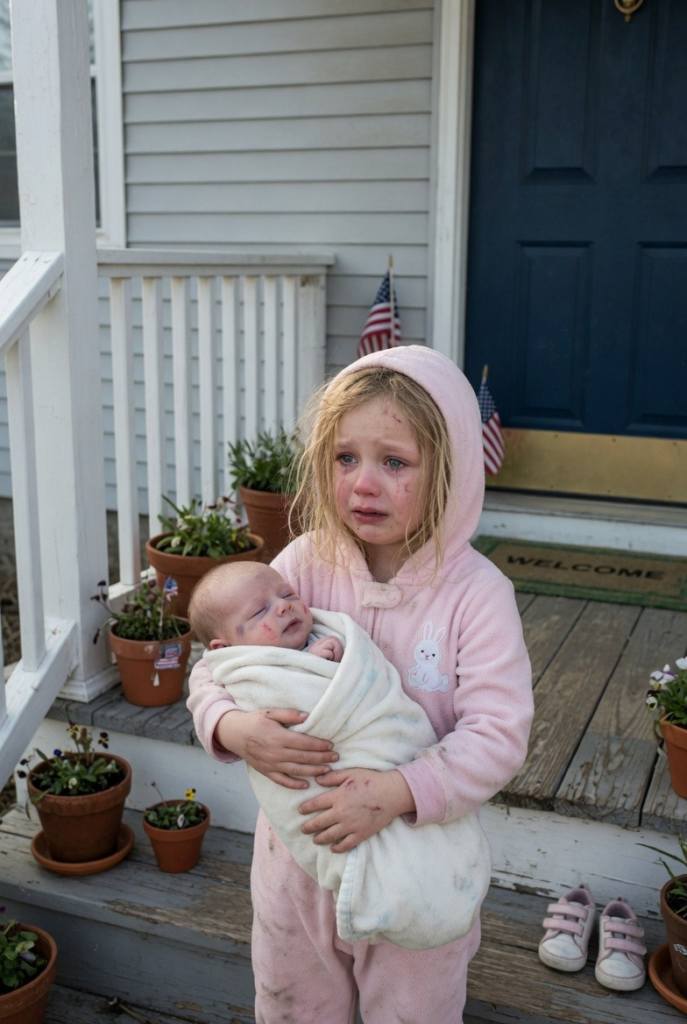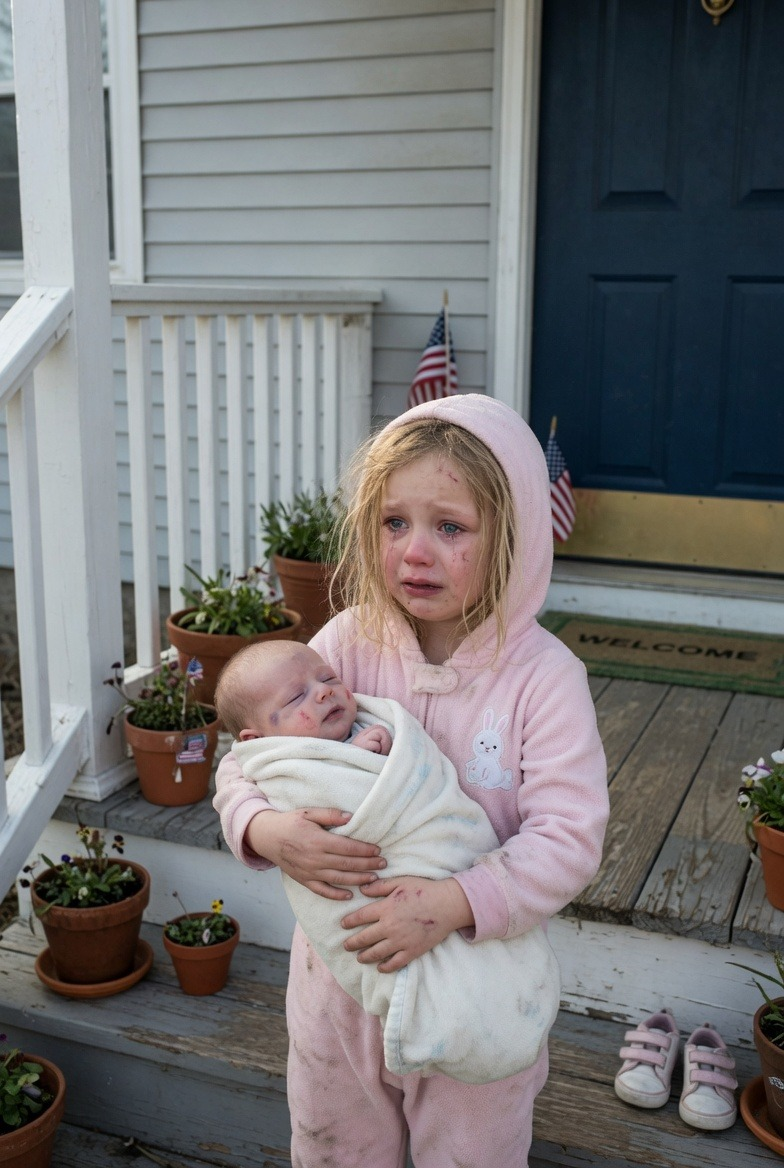
Isobel asked him why Talia would say such a thing. He looked toward the window instead of answering. That was when Cora’s tires crunched into the driveway.
Cora entered with a bakery bag in her hand. Daniel whispered, “Mom, don’t.” It was the first sentence that made Isobel understand Cora had not walked into confusion. She had walked into consequence.
The baby shifted in Isobel’s arms, and a small plastic hospital wristband slipped from the blanket. It landed on the tile. Cora picked it up before Daniel could.
Her face drained. “Daniel,” she whispered, “tell me you didn’t sign that form.”
The 911 dispatcher heard enough to sharpen her voice. She told Isobel to keep the infant warm and not let Daniel leave. Officers and paramedics were already on the way.
Daniel reached toward the wristband. Cora pulled it back. Talia hid behind Isobel’s shoulder, shaking so hard her teeth chattered. The newborn made another thin sound under the towel.
Ridgeview EMS arrived first. The paramedic cut through the room with calm hands and a thermal blanket. She asked Isobel how long the baby had been outside. No one answered at first.
Then Talia spoke again.
“He was by the side path when I found him,” she said. “Daddy put him there before the sun came all the way up.”
The deputy from the county sheriff’s office arrived minutes later. His body camera captured the blue blanket, the dropped watering can, the hospital wristband, and Daniel standing near the hallway with his hands open.
Daniel tried to say Talia was confused. He tried to say he had gone out to check a noise. He tried to say he had never touched the child.
But the wristband changed the room. It tied the baby to Ridgeview Memorial Hospital, where a newborn discharge alert had already been flagged after staff discovered irregular paperwork and a missing infant band.
Cora broke before Daniel did. She sat at the kitchen table with both hands around a mug no one had filled and told the deputy Daniel had called her before dawn.
He had said a woman from his past had delivered a baby and listed him on paperwork. He had sounded terrified, not tender. Cora told him to take the baby to a lawful safe place immediately.
Daniel had not done that. He had driven home. He had hidden the newborn near the barn, planning to “find” him later after inventing a story that made himself look like a rescuer.
The deputy asked Cora why she had not called anyone. She lowered her eyes. “Because he’s my son,” she said, and the sentence sounded smaller than the damage it had caused.
At the hospital, the baby’s temperature stabilized. He was dehydrated and cold, but alive. The emergency physician wrote “probable exposure, timely discovery by minor child” on the medical record.
Isobel stood beside Talia in the waiting area while a social worker asked careful questions. Talia kept looking at her own hands, as if she still felt the weight of the baby there.
“Did I do something bad?” she asked.
Isobel knelt in front of her. “No. You told the truth. You saved him.”
The investigation moved faster than Daniel expected. The sheriff’s incident report included the 911 audio, the hospital wristband, Cora’s statement, and tire tracks by the barn matching Daniel’s truck.
A neighbor’s security camera showed Daniel’s truck leaving the road before sunrise and returning without headlights. The bakery receipt in Cora’s bag timestamped her arrival. The order of the morning became impossible to rearrange.
Daniel’s final story was not noble. He had panicked. He had wanted time. He had wanted Isobel to discover the baby under circumstances he could control, with no one asking why he knew more than he should.
Months later, Daniel accepted responsibility for abandoning the newborn in unsafe conditions and making false statements during the initial investigation. Cora was not charged, but she lost something quieter and more permanent: Talia’s trust.
The baby survived. He was placed under protective care while the court handled custody and paternity. Isobel was not allowed to know every private detail, but she knew the only detail that mattered.
He lived because Talia heard him.
Isobel filed for divorce before the first hearing. She moved Talia’s bedroom to the front of the house in their new rental, where no barn shadows crossed the window at night.
For weeks, Talia slept with the light on. She asked whether grown-ups could lie even when they tucked you in. Isobel answered honestly, because gentleness without truth had already cost too much.
People later repeated the story as if it were only one sentence: my daughter, 8, found a newborn baby near our barn, and when my husband asked, “Who would do this?” she said, “Daddy… I saw you.”
But Isobel remembered the smaller sentence too, the one her body would never forget. Daniel didn’t look shocked. He didn’t look confused. He looked frozen.
That was the moment her marriage ended, even before the sirens came. Not in court. Not with papers. In the kitchen, with bacon burning, a baby crying, and a child brave enough to point at the truth.