She did not ask us to wait.
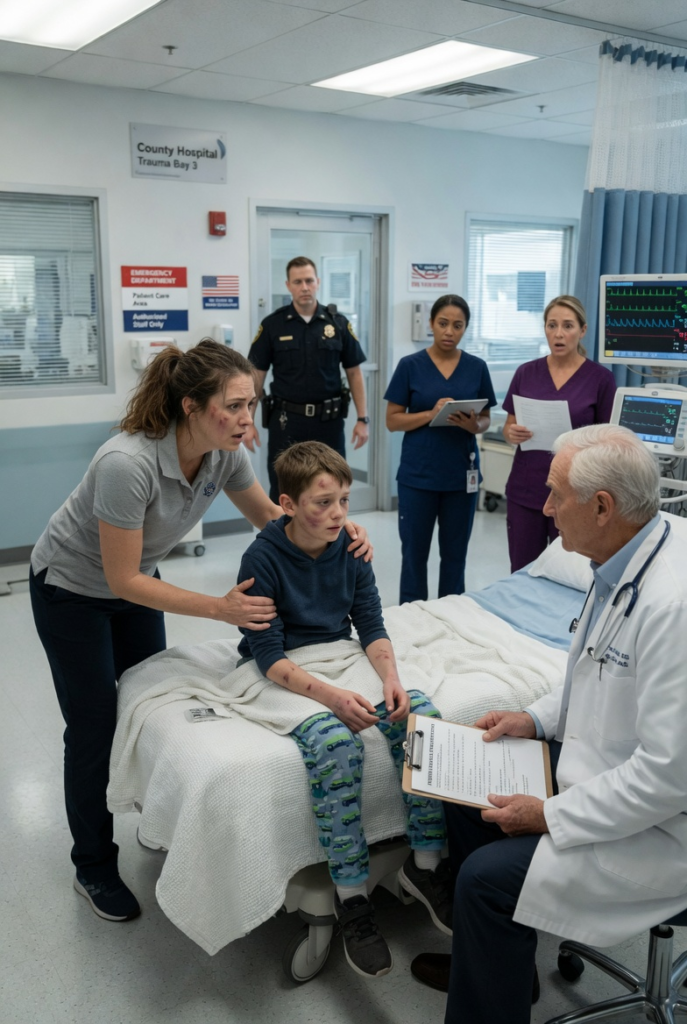
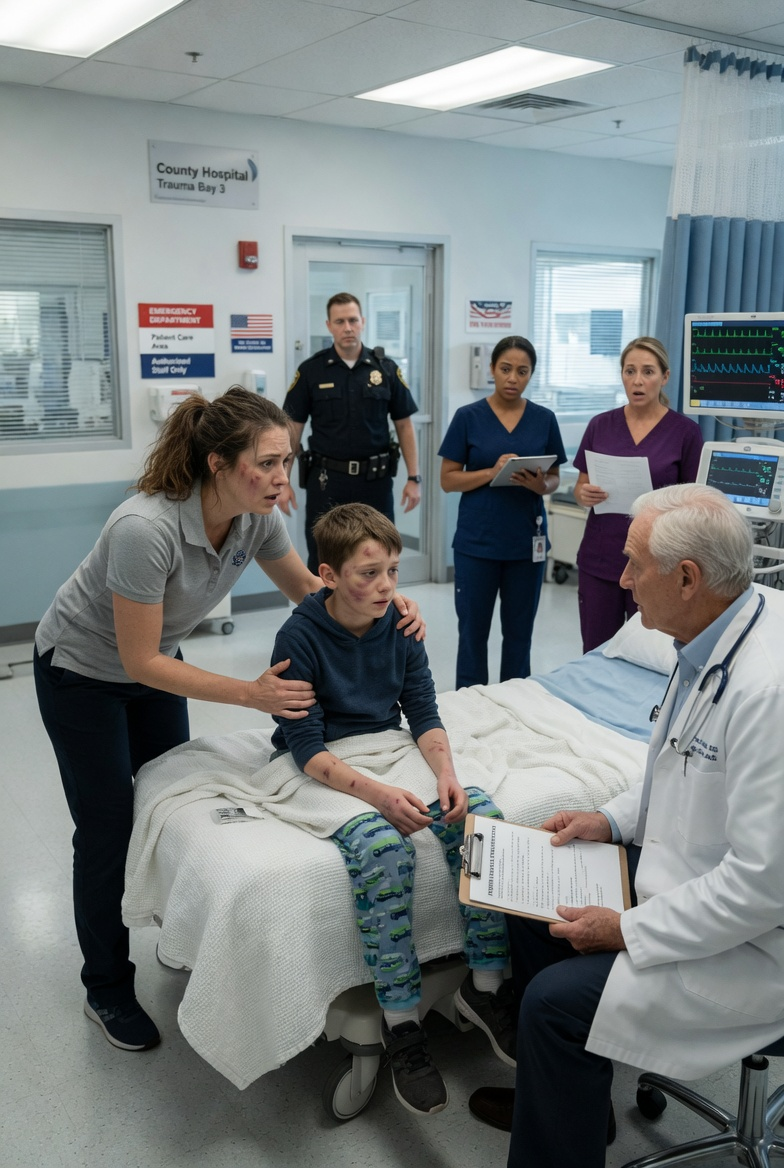
At 10:06 p.m., another nurse wrote the time across the top of the hospital intake form. She clipped it to a board and led us behind a pale curtain into pediatric bay four.
A second nurse began the injury chart. She photographed Mason’s cheek, his arm, the marks near his shoulder. Every click of the camera felt like both proof and betrayal.
Proof has its own language. Timestamps. Forms. Photographs. People only call it drama when there is no paper trail.
The doctor came in a few minutes later. He was elderly, with silver hair, tired eyes, and a softness in his posture that told me he knew how not to frighten a child.
His badge said Dr. Harlan.
He did not tower over Mason. He pulled a stool beside the bed and knelt slightly, bringing his face closer to Mason’s level. That one choice changed my son’s breathing.
“Mason,” he said, “you are not in trouble. Your mom brought you somewhere safe. Can you tell me what happened?”
Mason looked at me. I nodded, though my throat felt packed with glass. I wanted to promise him everything would be fixed by morning, but good mothers do not lie when truth is already bleeding through.
He leaned toward Dr. Harlan’s ear and whispered.
I could not hear the words over the monitor beside the bed. I heard only the beep, the rain against distant glass, and my own pulse in my ears.
Then I saw Dr. Harlan’s face.
The color left him. His hand stilled on the bed rail. The nurse behind him froze with gauze halfway unwound between her fingers.
A tech stopped at the curtain holding a tablet. In the next bay, a woman lowered her phone to her lap and stared at nothing, as if the whole room had understood before I did.
Nobody moved.
Dr. Harlan stood slowly. He looked at Mason first. Then he looked at me with the kind of horror professionals try to hide and human beings cannot.
“Ma’am,” he said quietly, “I think you should sit down.”
I did not sit. My legs felt hollow, but I stayed standing because Mason was watching me. He needed to see that I could remain upright under the weight of whatever he had said.
Dr. Harlan handed the injury chart to the nurse. She wrote suspected physical abuse in black ink, careful and final, as if the letters themselves had to be brave.
I called 911 from beside the bed.
The dispatcher asked where I was. I gave Tampa General Hospital, emergency department, pediatric bay four. I gave my name. I gave Mason’s age. I gave what I could without making him repeat himself.
Then Mason grabbed my sleeve with both hands.
“Mommy,” he whispered, tears finally breaking down his face, “please don’t let him come back here.”
Before I could ask who, the automatic doors at the end of the ER hall opened. A Tampa police officer stepped inside, rain glistening on his uniform shoulders.
Dr. Harlan walked straight toward him with Mason’s chart in his hand.
The officer read quickly. His expression changed slowly, not because he was calm, but because he was trained. Calm is sometimes just a uniform people wear over outrage.
“Is there anyone with access to your home tonight?” he asked me.
I started to answer, but Mason shook his head and whispered, “He has a key.”
That was the moment the promise I had built our home around cracked open. Not a stranger. Not some nameless threat outside our door. Someone close enough to enter.
The nurse covered her mouth. Dr. Harlan looked down for one second, and I saw him stop being only a doctor. I saw him become a grandfather, a father, a man who had heard too much.
The officer stepped into the hallway and used his radio. Another officer was dispatched to our rental. A hospital social worker was called. The intake form, injury chart, and photographs were copied into the hospital record.
Mason did not have to go home that night.
That was the first mercy.
The second was that people finally moved around him with purpose. A nurse brought warm blankets. The social worker asked questions without pushing. Dr. Harlan explained every step before anyone touched Mason again.
By 11:32 p.m., a preliminary report had been started. By midnight, the officer had taken my statement. By 12:18 a.m., I had given the name Mason was finally able to say.
I will not pretend I was noble in that moment. I wanted consequences before paperwork. I wanted a door kicked open. I wanted the world to rearrange itself around my child’s pain.
But I had learned something hard over the years: fury feels powerful, but documentation survives the morning.
The investigation that followed was not clean or fast. It involved interviews, medical records, photographs, and a police report that made my hands go numb when I saw Mason’s name printed on the first page.
The person who had used access to our home was removed from our lives. The key was taken back, the locks were changed, and a protective order followed through the proper channels.
None of that erased what happened.
People like to imagine justice as one dramatic moment. A door opens. An officer arrives. A guilty person trembles. Real justice is slower. It is signatures, appointments, follow-up calls, and children waking at night.
Mason had nightmares for weeks. Sometimes he asked if the windows were locked. Sometimes he slept with his hoodie beside him like it was armor.
We started therapy with a counselor recommended through the hospital. The first session was mostly silence. The second, Mason drew a house with no doors.
By the sixth session, he drew the same house again. This time there was a door, but beside it he drew me, taller than the roof, holding a key in one hand.
I cried in the parking lot after that appointment, but not where he could see. Mothers learn to fold themselves around grief and still drive home safely.
Months later, when the case moved forward, I understood why Dr. Harlan had insisted on every photograph, every timestamp, every form. The paper trail mattered. The hospital record mattered. The 911 call mattered.
So did Mason’s whisper.
He had been afraid of being heard that night, but in the end, being heard was what saved him.
I still think about our living room under that yellow lamp. The stale popcorn. The rainwater smell. The cartoons flashing over his face while my son sat on the sofa, bruised and silent.
For three years, I had promised Mason he would never be afraid of the place where he slept. After that night, I understood promises are not proven by saying them.
They are proven at 9:47 p.m. with your hands shaking on a steering wheel. They are proven at 10:06 p.m. on a hospital intake form. They are proven when anger wants to explode and you choose evidence instead.
Home is not walls. Home is the person who believes you quickly enough to leave.
Mason is older now. He still startles at sudden noises sometimes, but he laughs more easily. He chooses blueberry waffles on Saturdays. He lines up his toy cars less perfectly.
And every once in a while, when he passes the hook by the door, he zips up that old blue hoodie all the way and asks, “Mom, are we safe?”
I always answer the same way.
“Yes, baby. I heard you. And I will always come.”