Lavender and manipulation.
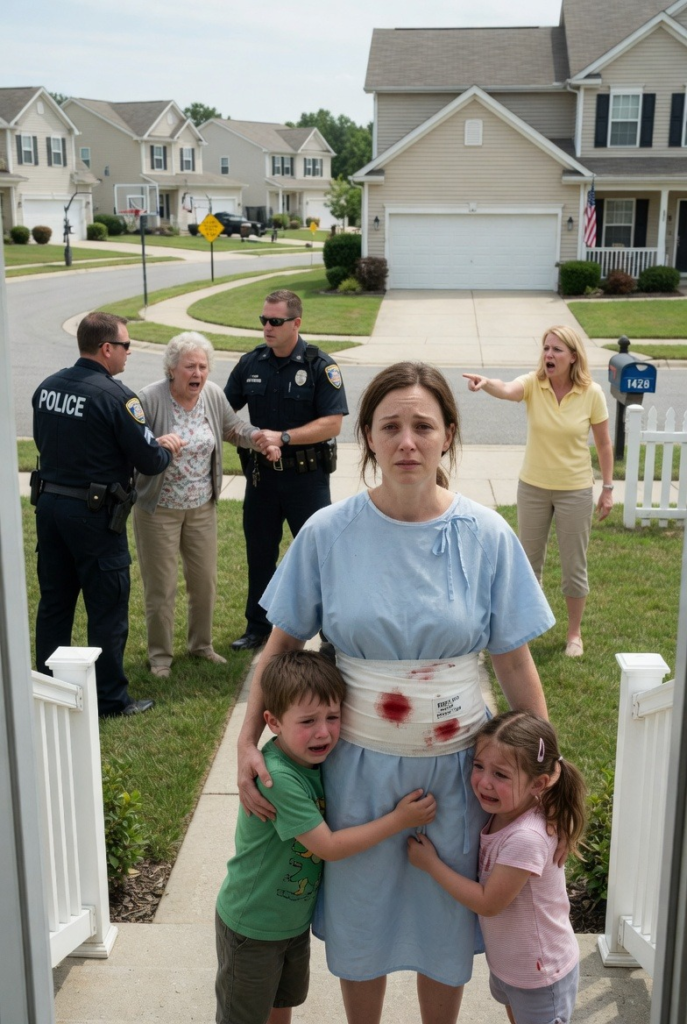
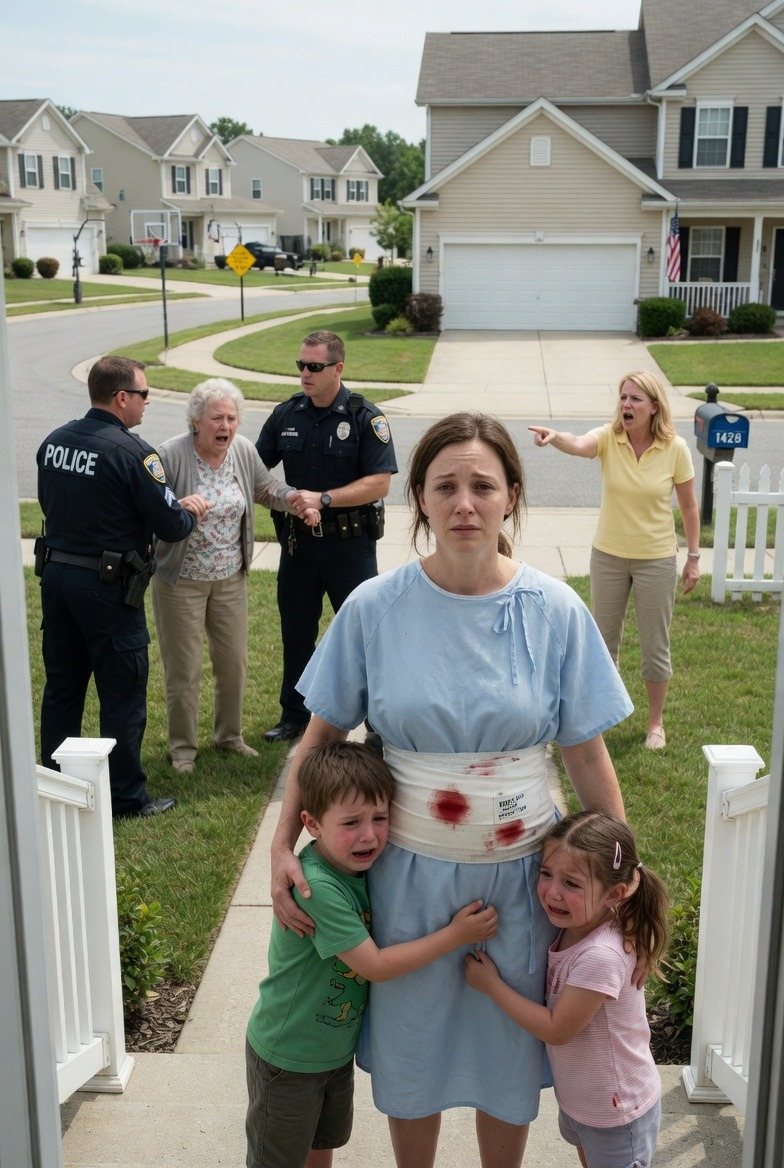
I opened the door just enough to block the entrance with my body.
Behind me, Sophie sat curled on the couch clutching her stuffed rabbit. Oliver stood near the hallway pretending not to listen, but I could see the tension in his little shoulders.
My mother smiled too brightly.
“I brought muffins,” she said. “Blueberry. Sophie’s favorite.”
I stared at the bag like it contained poison.
“You abandoned my children.”
Her smile faltered only slightly. “Whitney, don’t start being dramatic again.”
Dramatic.
The word hit harder than the surgery incision.
I almost laughed.
My seven-year-old daughter had cried herself sick because she thought nobody was coming back for her, and somehow I was dramatic.
“You left them alone,” I repeated slowly. “For three hours.”
“They were sleeping when we left!”
“They woke up!”
“Well, how was I supposed to know that?” she snapped. “Amber was already late to her appointment and your father was stressed—”
I held up a hand.
“No.”
Something in my voice finally made her stop talking.
“You do not get to explain this away. Not today.”
She crossed her arms instantly, defensive now. “I said I was sorry.”
“No, you didn’t.”
Silence.
Then came the familiar look. The one she used whenever she realized guilt wouldn’t work.
Annoyance.
“You know,” she muttered, “everything always has to revolve around you.”
There it was.
The truth underneath everything.
Not concern for the children.
Not concern for me after surgery.
Resentment.
Because for once, Amber wasn’t the center of the universe.
I felt strangely calm.
“You should go.”
My mother blinked. “Excuse me?”
“You heard me.”
Her face hardened. “After everything we’ve done for you?”
I almost asked what exactly that was.
Was it the birthdays they skipped because Amber had dance competitions?
Was it missing my college graduation because Amber “had a rough week”?
Was it the time they borrowed money from me for “medical bills” only for Amber to show off a designer handbag two days later?
Or maybe it was abandoning my children while I was unconscious in an operating room.
Instead, I said quietly:
“You chose your favorite daughter. Again. But this time, you endangered my kids to do it.”
“That’s ridiculous!”
“No,” I said. “What’s ridiculous is that Oliver knew not to call you when Sophie started crying.”
My mother went still.
I swallowed hard.
“He told Mrs. Doyle, ‘Grandma won’t come back if she gets mad.’”
For the first time, guilt flickered across her face.
Tiny.
Brief.
But there.
And then she ruined it.
“Oh please. Children exaggerate.”
Something cold settled into my chest.
Not anger anymore.
Not heartbreak.
Finality.
I reached beside the door and handed her an envelope.
She frowned. “What’s this?”
“Inside are copies of my updated emergency contacts, the new pickup authorization list for the school, and a formal notice that you are no longer permitted to take my children anywhere without my written consent.”
Her mouth fell open.
“You can’t be serious.”
“I’ve never been more serious in my life.”
My father suddenly appeared from the driveway behind her.
He looked irritated already, like this confrontation was inconveniencing him personally.
“For God’s sake, Whitney,” he barked, “your mother made one mistake.”
“One mistake?”
“Yes! The kids are fine!”
I stared at him.
“You left a four-year-old and an eight-year-old alone outside in July heat.”
“They weren’t hurt!”
I took a slow breath.
“That’s because my neighbor saved them.”
Neither of them spoke.
“And if she hadn’t?”
My father’s jaw clenched.
My mother tried another tactic then, softer this time.
“You know your sister has always needed more support.”
I laughed.
Actually laughed.
Because there it was.
The family religion.
Amber needs more.
Amber cries louder.
Amber matters more.
Amber wins.
Always.
I looked directly at my mother.
“And what happens when my children realize they’ll always come second too?”
Her eyes widened slightly.
Good.
Let it land.
For years, I tolerated what they did to me because I was trained to.
I was the dependable daughter.
The easy daughter.
The daughter who cleaned up every mess while Amber got applause for existing.
But they were not going to do it to my children.
That ended now.
My father pointed toward the envelope. “This is insane.”
“No,” I said evenly. “Changing the locks was sane. Updating my will was sane. Removing both of you from medical authority was sane.”
My mother looked stunned.
“You removed us?”
“Yes.”
“You’d really do that to your own parents?”
I met her gaze.
“You left my babies alone while I was under anesthesia.”
Silence.
Heavy.
Ugly.
Then my mother whispered the sentence that finally shattered whatever microscopic piece of love I still had left for her.
“You’re punishing us over one little favor.”
One little favor.
Not my children’s terror.
Not my surgery.
Not betrayal.
Just inconvenience to her.
I nodded slowly.
And in that moment, I realized something devastating:
They truly did not believe they had done anything wrong.
Not really.
People like my parents rewrite reality faster than anyone can confront it.
They minimize.
Deflect.
Rationalize.
Until your pain sounds unreasonable even to you.
But not anymore.
I opened the door wider just enough to place the grocery bag back into my mother’s hands.
“Leave.”
My father scoffed. “You’ll get over this.”
“No,” I said quietly. “I’ll heal from it. That’s different.”
Then I closed the door.
My hands shook afterward.
Not because I regretted it.
Because deep down, some wounded little part of me had spent thirty-six years hoping they would finally choose me.
Choose my children.
Choose decency.
Instead, they chose Amber’s hair appointment.
Again.
That night, after the kids fell asleep beside me in my bed, I opened my laptop and stared at the manila folder from the hospital.
Inside were documents for something I hadn’t told my parents yet.
A job offer.
Seattle.
Higher salary.
Company-paid relocation.
A fresh start.
I looked around the quiet house.
At the locks I had changed.
At the silence where my parents used to force themselves into every corner of my life.
Then I signed the acceptance paperwork.
Three weeks later, we moved 3,000 miles away without giving them the address.
And for the first time in my entire life…
I stopped being the family’s backup plan.
I became my children’s safe place instead.The first message came four days after we arrived in Seattle.
Not from my mother.
Not from my father.
From Amber.
Of course.
I was standing in the tiny kitchen of our rental townhouse unpacking coffee mugs when my phone buzzed.
WOW.
So you really took the kids and disappeared?
Mom’s been crying for days. Dad’s furious.
You seriously need therapy.
I stared at the screen for a long moment before laughing softly to myself.
Therapy.
The favorite child’s favorite weapon.
Whenever accountability appeared, suddenly I was unstable.
Too emotional.
Too sensitive.
Too dramatic.
I typed exactly four words back.
Did you get highlights?
Three dots appeared instantly.
Then vanished.
Then appeared again.
Finally:
You are SUCH a bitch.
I blocked her.
Immediately.
No hesitation.
No guilt.
Just peace.
And that terrified me a little.
Because I was beginning to understand how exhausted I truly had been all these years.
—
Seattle felt unreal at first.
Like stepping into someone else’s life.
The air smelled like rain and coffee instead of hot pavement and old resentment. The kids laughed more. Oliver stopped chewing the sleeves of his shirts. Sophie finally slept through the night again.
Trauma leaves children quietly sometimes.
Not with screaming.
With little things.
Like asking every ten minutes if you’re still in the house.
Like panicking when adults are late.
Like crying because someone closed a door too loudly.
One night, about a month after the move, I tucked Sophie into bed and she wrapped her tiny fingers around my wrist.
“Mommy?”
“Yeah, baby?”
Her voice became very small.
“If Grandma comes, you won’t leave me with her, right?”
My heart physically hurt.
I sat beside her on the bed.
“Never.”
“Promise?”
“I promise.”
She studied my face carefully, like children do when they’re trying to determine whether adults are lying.
Then she whispered:
“Okay.”
And fell asleep holding my hand.
I cried in the hallway afterward.
Not loudly.
The exhausted kind of crying.
The kind that leaks out silently after holding itself together too long.
—
Two months later, my father found my work email.
SUBJECT: Enough of this nonsense.
No greeting.
No “how are the kids.”
Just:
Your mother is devastated. This punishment has gone too far.
Families fight. Adults move on.
You embarrassed us by disappearing like criminals.
Amber says you’ve become bitter and paranoid.
Call your mother immediately.
I read it twice.
Then forwarded it directly to a folder labeled Evidence.
Because therapy had taught me something important:
When toxic people lose access to you, they escalate.
And documentation matters.
I didn’t reply.
That bothered them more than anger ever could.
See, my family understood conflict.
What they couldn’t understand was absence.
Silence.
Boundaries.
The complete removal of access.
That was the one thing they could never control.
—
December arrived cold and silver.
Our first real winter in Seattle.
The kids and I decorated a tiny artificial Christmas tree while music played from my phone.
Sophie hung candy canes too low.
Oliver tried to pretend he was too old for ornaments while secretly fixing every crooked branch.
It wasn’t perfect.
But it was peaceful.
No screaming.
No criticism.
No Amber demanding attention.
No mother weaponizing guilt.
Just us.
And then the knock came.
Three sharp hits against the front door.
My stomach dropped instantly.
Nobody used the front door except strangers.
I looked through the peephole.
And froze.
My parents.
My mother stood clutching her coat dramatically, eyes already red.
My father looked irritated.
Amber stood between them scrolling on her phone.
Of course she came too.
I didn’t open the door.
Instead, I spoke through it.
“How did you find me?”
My father answered immediately.
“You didn’t think we’d never track down our own daughter, did you?”
Ice slid down my spine.
“You need to leave.”
My mother’s voice cracked theatrically. “Whitney, please. It’s Christmas.”
I almost opened the door then.
Not because I forgave them.
Because some reflex inside me still responded to her crying.
Thirty-six years of conditioning doesn’t disappear overnight.
Then Amber spoke.
“Oh my God, stop being insane and let us in.”
And just like that, the moment died.
I closed my eyes briefly.
“You came across the country without permission.”
“We’re FAMILY,” my father snapped.
“No,” I said quietly through the door. “Family doesn’t abandon children.”
My mother started crying harder.
“I said I was sorry!”
“No,” I replied. “You said I was dramatic.”
Silence.
Then came the guilt.
Predictable.
Weaponized.
“Your father’s blood pressure has been terrible,” she sobbed. “Do you even care?”
I almost laughed.
Because there it was again.
Their health.
Their feelings.
Their suffering.
Never mine.
Never the children’s.
Always theirs.
Behind me, I heard Sophie’s tiny voice trembling.
“Mommy…?”
I turned.
Both kids stood at the hallway entrance staring at the door in terror.
Oliver immediately moved in front of his sister protectively.
That sight decided everything for me.
Not anger.
Not revenge.
Clarity.
My children were afraid.
In their own home.
Because of the people outside that door.
I walked back slowly and deadbolted the top lock.
Then the second.
Then the third.
My father banged once against the wood.
“You’re making a huge mistake!”
I spoke calmly.
“No. I made a huge mistake thinking you’d ever change.”
Then I picked up my phone.
And called the police.
Not dramatically.
Not emotionally.
Just calmly.
The dispatcher must have heard something in my voice because officers arrived fast.
By the time the patrol car lights reflected across the wet street, my mother was hysterical.
“You called the POLICE on us?”
“Yes.”
“You’re treating us like criminals!”
“No,” I said softly.
“You did that yourselves.”
The officers were professional but firm. My parents argued. Amber rolled her eyes repeatedly and muttered that I was “literally psychotic.”
One officer finally asked me quietly:
“Do you want them formally trespassed from the property?”
My mother gasped like she’d been shot.
I looked at my children.
Sophie was shaking.
Oliver looked furious in that heartbreakingly adult way children sometimes do.
And I realized something.
Kids learn what love looks like by watching what we tolerate.
If I let my parents stay in our lives, my children would grow up believing love means abandonment followed by guilt.
I would die before teaching them that lesson.
So I answered clearly.
“Yes.”
My mother broke down screaming as the officers escorted them away.
My father looked stunned.
Amber looked disgusted.
And me?
I felt free.
For the first time.
Actually free.
That night, after the kids went to sleep, I sat alone beside the Christmas tree with only the white lights glowing in the dark.
My phone buzzed once more.
A text from an unknown number.
You’ll regret this when they die.
I stared at it a long time.
Then blocked the number too.
Because that’s the thing nobody tells you about breaking generational trauma:
It feels horrible before it feels peaceful.
Like pulling shards of glass out of your own skin.
But eventually…
You stop bleeding