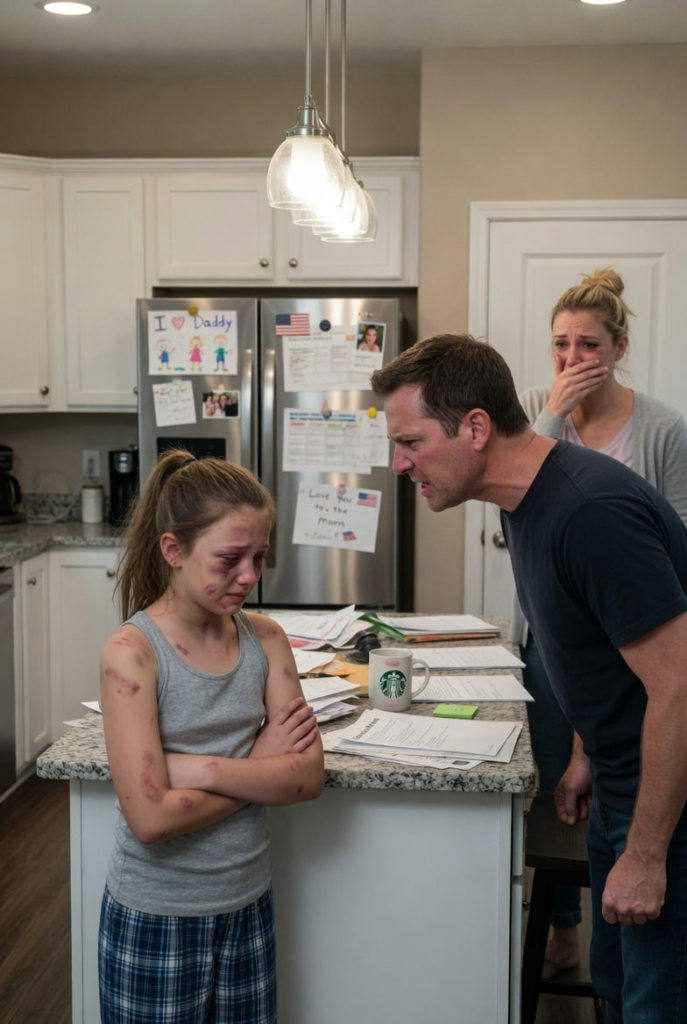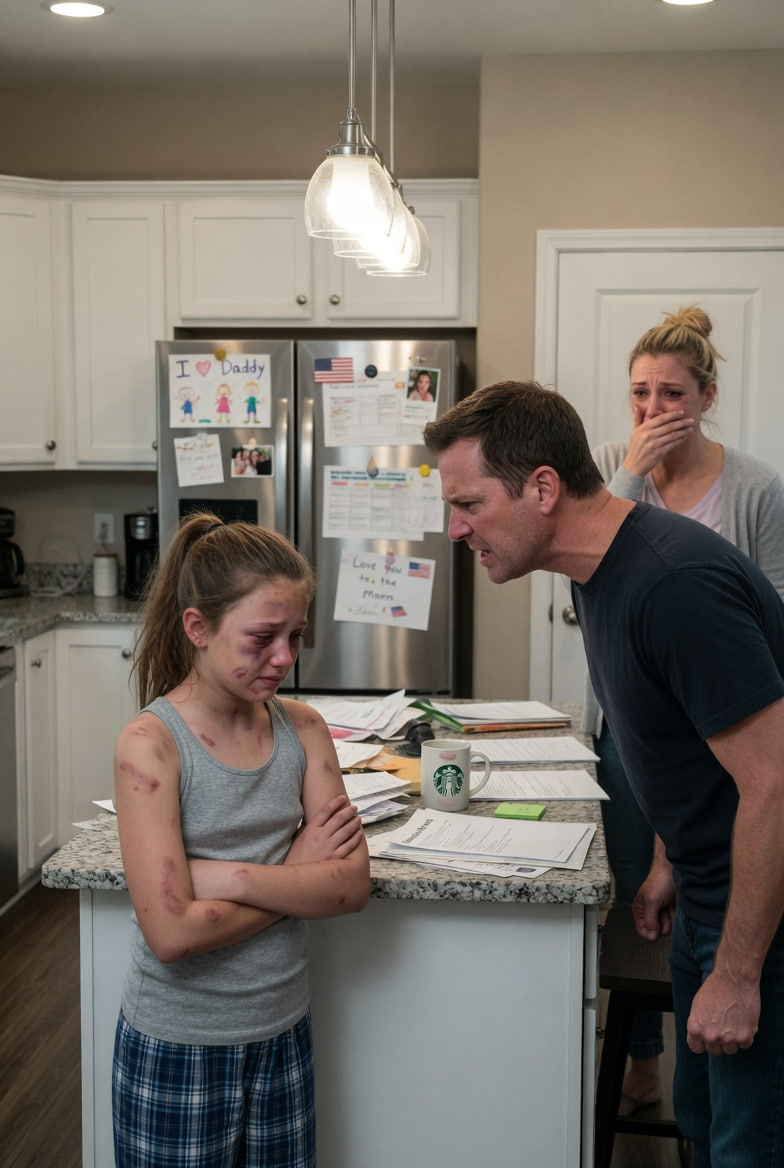
Officer Elena Ruiz.
She looked at me once and immediately understood more than my mother wanted her to.
Not because of the bruises.
Because of the way I flinched when footsteps passed the doorway.
Abused kids learn to hear danger before they see it.
Karen stood up too quickly when the officers entered. Her purse slid from her lap, spilling lipstick, receipts, and loose pills across the floor.
“She fell down the stairs,” my mother repeated immediately.
Too fast.
Too rehearsed.
Officer Ruiz didn’t answer right away. She crouched instead and helped gather the items that had fallen from Karen’s purse.
Then she quietly asked, “Ma’am, when exactly did she fall?”
Karen hesitated.
“One hour ago.”
The second officer, a broad man with gray at his temples, looked toward the doctor standing near the nurses’ station.
The doctor spoke carefully.
“She has older injuries.”
The room changed after that.
Not loudly.
Not dramatically.
Just enough.
The officers stopped looking at my mother like a worried parent and started looking at her like a witness.
Or an accomplice.
Karen sensed it immediately.
Her breathing became shallow.
“You don’t understand,” she whispered. “My husband would never—”
“Ma’am,” Officer Ruiz interrupted gently, “we need to speak with Lily alone.”
Karen’s eyes snapped toward me so fast it almost looked violent.
Fear.
Not fear for me.
Fear of me.
That was the moment something inside me finally shifted.
Because innocent people are terrified of monsters.
Guilty people are terrified of victims speaking clearly.
“I’m her mother,” Karen argued.
“And I’m asking you to step outside.”
Karen looked at me desperately.
A warning passed between us silently.
Don’t talk.
Don’t ruin this family.
Don’t make him angry.
The same message she had fed me for years.
Officer Ruiz opened the door for her.
Karen walked out slowly, heels clicking against hospital tile like a countdown.
The second the door closed, the room became quiet enough for me to hear the heart monitor from another patient down the hall.
The older officer pulled a chair beside my bed.
“No one else can hear you now,” he said softly.
I stared at my broken arm wrapped in temporary splints.
Then at the bruises on my legs.
Then finally at them.
“How much trouble is she in?” I asked.
Officer Ruiz frowned slightly. “Who?”
“My mother.”
The officers exchanged a glance that told me everything.
Children from violent homes almost never ask what happens to themselves first.
They ask what happens to everyone else.
The older officer leaned forward carefully.
“Lily… can you tell us what really happened tonight?”
My throat tightened.
Not because I didn’t want to tell them.
Because I had imagined this moment for seven months and still wasn’t ready for how terrifying honesty felt.
I looked toward the cracked window where rain streaked against the glass.
Then I whispered:
“He broke my arm.”
Officer Ruiz nodded once.
No shock.
No disbelief.
Just patience.
“How?”
“He twisted it.”
“And the bruises on your neck?”
I swallowed.
“He grabbed me last week because I locked my bedroom door.”
The officer’s jaw tightened visibly.
“How long has this been happening?”
I gave a tiny laugh that sounded ugly even to me.
“Which time?”
Silence filled the room.
Then slowly, carefully, I reached for my backpack beside the bed with my good hand.
Inside was the old phone.
The cracked one.
The one Richard never bothered checking because he thought fear made people stupid.
My fingers trembled as I handed it over.
“There are recordings,” I said. “Photos too. Dates. Everything.”
Officer Ruiz took the phone like it weighed something sacred.
The older officer opened the gallery first.
His face changed within seconds.
Bruises.
Split lips.
Finger marks.
A photograph of my back from February so dark with bruising it looked painted.
Then audio files.
One labeled:
MARCH_11_11:38PM
Officer Ruiz pressed play.
Richard’s voice filled the small hospital room instantly.
“You think anyone would choose you over me?”
A crash.
My crying.
Then Karen’s voice.
Soft. Exhausted.
“Richard, please… not her face this time.”
The officers went completely still.
I stared at the blanket over my knees because hearing it aloud suddenly made everything real in a way survival never allowed.
Officer Ruiz locked the phone screen carefully.
“Has he ever sexually assaulted you?”
The question hit like ice water.
I shook my head immediately.
“No.”
She nodded, relief flickering across her face.
“Has he threatened to kill you?”
Another pause.
Then:
“Yes.”
The older officer exhaled slowly through his nose.
“What did he say?”
“He told me if I ever called the police, they’d find my body in the river before they found him.”
Officer Ruiz stood up immediately and walked to the door.
I heard her speaking low into her radio.
“Possible felony child abuse. Escalate immediately. Suspect may be armed and intoxicated.”
Everything accelerated after that.
Nurses moved differently around me.
The doctor returned with another woman wearing plain clothes and carrying a leather folder.
Child Protective Services.
Her badge read:
Dana Mercer.
Karen saw her enter the room from the hallway and completely unraveled.
“No,” my mother said sharply, rushing forward. “No, this is unnecessary—”
“Ma’am,” Dana interrupted calmly, “please sit down.”
Karen looked at me like I had set our entire life on fire.
Maybe I had.
But some houses deserve to burn.
“You talked?” she whispered.
I stared at her for a long moment.
Then finally asked the question that had lived inside me since childhood.
“Why didn’t you stop him?”
Karen’s mouth opened.
Closed.
Opened again.
Nothing came out.
Because there was no answer good enough.
Not fear.
Not dependence.
Not love.
Nothing erased standing in doorways while your child got hurt.
Tears filled her eyes anyway.
“You don’t understand what he’s like when he’s angry.”
The words almost made me laugh.
I held up my broken arm.
“Oh,” I whispered. “I understand perfectly.”
Karen started crying harder after that, but strangely, I felt nothing watching it.
No satisfaction.
No comfort.
Just exhaustion.
Officer Ruiz returned twenty minutes later.
Richard had been arrested at the house.
Apparently he answered the door drunk and smiling.
That smile disappeared when officers walked past him and saw blood still dried near the kitchen sink.
The broken plate remained exactly where it shattered.
And in the garage, officers found something worse:
A locked toolbox containing zip ties, a stun gun, and photographs of me taken without my knowledge through my bedroom window.
Officer Ruiz didn’t tell me immediately.
I overheard her outside the room.
“…possible escalation behavior… fixation… control trophies…”
The words made my stomach turn cold.
Because suddenly even I realized something terrifying:
Richard had been getting worse.
Not better.
Worse.
Dana from CPS sat beside my bed near dawn while rain softened outside.
“You have an aunt in Minneapolis,” she said gently. “Your school records list her as emergency family contact.”
Aunt Claire.
I hadn’t seen her in four years.
Richard hated her because she asked too many questions.
Karen stopped inviting her after Claire once saw bruises on my wrist during Thanksgiving dinner.
I remembered Claire kneeling beside me afterward in the bathroom whispering:
“If you ever need help, call me day or night.”
I never called.
Partly because Richard monitored everything.
Mostly because abused kids start believing rescue belongs to other people.
Dana smiled slightly.
“She’s already on her way.”
I blinked at her.
“What?”
“She booked a flight thirty minutes ago.”
Something inside my chest cracked then.
Not pain.
Not fear.
Something worse.
Relief.
Real relief hurts when you’ve lived without it too long.
For the first time in years, I started crying so hard I couldn’t breathe.
Not because Richard hit me.
Not because my arm was broken.
Because somebody came.
Somebody actually came for me.
And down the hospital hallway, while police photographed evidence and my mother sat alone realizing silence would no longer protect her, Richard Holloway was learning the most dangerous truth a man like him can ever face:
His victim survived long enough to be heard.Richard Holloway was still smiling when detectives brought him into the station.
That was the detail Officer Ruiz told me later.
Not angry.
Not nervous.
Smiling.
Men like Richard mistake fear for loyalty for so long that they eventually believe themselves untouchable.
He thought Karen would protect him.
He thought I would stay quiet.
He thought bruises disappeared faster than truth.
By sunrise, he had learned otherwise.
The police interview room smelled like burnt coffee and stale air-conditioning. Richard sat with one ankle resting casually over his knee while detectives arranged printed photographs across the metal table.
Bruises.
Medical reports.
Time-stamped recordings.
The cracked phone had become a weapon.
Richard laughed when he first saw the pictures.
“Teenage girls bruise easy.”
Then Detective Warren played the audio file from April 2.
The room filled with Richard’s voice:
“If you ever tell anyone, your mother will swear you’re lying.”
Then my crying.
Then the sound of something hitting a wall.
Richard stopped smiling.
Not because he felt guilty.
Because he realized evidence could not be punched into silence.
Back at Mercy General, dawn leaked slowly through the hospital windows in pale gray streaks. Nurses changed shifts. Intercoms crackled overhead. Somewhere down the hall, a baby cried.
Normal life continued while mine sat in pieces beside a hospital bed.
My arm had been set in a cast just below the elbow. Purple bruises bloomed beneath my skin like poison spreading under water. Every inch of my body felt heavy.
Dana from CPS stayed nearby while I ate dry hospital toast I could barely swallow.
“You did something very brave,” she said softly.
I stared at the untouched apple juice beside my tray.
“No,” I answered after a while. “I just got tired.”
That was closer to the truth.
People imagine survival as courage.
Sometimes survival is simply exhaustion finally outweighing fear.
Around 9:15 a.m., Karen asked to speak with me alone.
Officer Ruiz refused at first.
But I surprised everyone by saying yes.
Karen entered the room slowly like she expected me to scream at her.
I didn’t.
That almost seemed harder for her.
Without makeup, she looked older than forty-three. Her mascara had dried in cracked shadows beneath her eyes. She sat carefully in the chair beside my bed and twisted her wedding ring so hard her knuckles whitened.
For a long time, neither of us spoke.
Then she whispered:
“He wasn’t always like this.”
I looked out the window.
Rainwater slid down the glass in crooked lines.
“Yes,” I said quietly. “He was.”
Karen flinched.
“He used to bring me flowers every Friday.”
“That doesn’t erase what he did.”
“He wasn’t cruel in the beginning.”
“No,” I replied. “Just patient.”
The truth settled heavily between us.
Predators rarely arrive monstrous.
They arrive charming.
Useful.
Safe.
That is how they get invited inside homes.
Karen covered her face with trembling hands.
“I thought if I kept things calm, he wouldn’t hurt you as badly.”
The sentence hollowed the room.
Not because it excused her.
Because it revealed how deeply cowardice can disguise itself as protection.
I finally turned toward her fully.
“You watched him break my arm.”
Tears spilled through her fingers instantly.
“I know.”
“You heard him threaten me.”
“I know.”
“You saw the bruises.”
Karen nodded weakly.
Every admission sounded like another stone dropping into water.
I asked the question carefully this time.
Not angry.
Not loud.
Just honest.
“Why was keeping him more important than keeping me safe?”
Karen broke completely then.
Real sobs.
Violent ones.
But grief is not redemption.
A person can cry and still have failed you.
“He said he’d ruin us,” she whispered. “He controlled all the money. The house. Everything.”
I looked around the hospital room slowly.
At the plastic chairs.
The stained curtains.
The cheap ceiling tiles.
Then back at her.
“And now?”
Karen’s face crumpled because she finally understood.
She had sacrificed me to save a life that collapsed anyway.
By noon, detectives returned with a warrant.
The search of our house uncovered more evidence than even I knew existed.
Hidden cameras.
Folders containing printed photographs of me at school.
Copies of my report cards with angry notes written across them in red ink:
DISRESPECTFUL
UNGRATEFUL
WATCH HER CLOSELY
And inside Richard’s locked desk drawer, detectives found a handgun beside a notebook filled with dates and “punishments.”
Officer Ruiz looked sick telling me.
“There’s more,” she said carefully.
My stomach tightened.
“What?”
She hesitated.
“We believe he was planning escalation.”
The words chilled my blood instantly.
Detective Warren later explained it more directly.
Abusers become more dangerous when they feel control slipping.
I had started hiding my phone better.
Avoiding him.
Applying for out-of-state colleges secretly.
Richard noticed.
And men like Richard treat independence like betrayal.
A cold realization settled into me slowly:
If the hospital had not called police that night…
I might not have survived another year.
Maybe not another month.
At 2:40 p.m., Aunt Claire arrived.
I recognized her immediately despite the years.
Same sharp eyes.
Same dark curls.
Same expression that always looked halfway between compassion and fury.
The second she saw me in the hospital bed, she stopped walking.
Her hand flew to her mouth.
“Oh, Lily…”
Nobody had said my name like that in years.
Like it belonged to someone worth protecting.
I started crying again before she even reached me.
Claire wrapped her arms around me carefully, avoiding the cast, and held me so tightly I could feel her heartbeat.
“I’m sorry,” she whispered over and over. “I’m so sorry I didn’t come sooner.”
Karen stood frozen near the doorway watching us.
Claire looked up.
And the softness vanished from her face instantly.
“You knew,” she said coldly.
Karen looked down.
Claire stood slowly.
“You let that man torture your daughter.”
Karen burst into tears again.
“I was afraid—”
“And Lily wasn’t?”
The room went silent.
Claire stepped closer.
“I saw bruises four years ago. Four years, Karen. I asked you directly if he was hurting her.”
Karen shook violently now.
“I thought I could manage him.”
Claire’s expression hardened with disgust.
“You managed your own comfort.”
Karen slapped a hand over her mouth like the words physically struck her.
Because truth often does.
Later that evening, CPS informed me Richard would be denied bail until formal hearings began.
Three charges became seven.
Then eleven.
Felony child abuse.
Aggravated assault.
Criminal intimidation.
Unlawful surveillance.
Possession of illegal restraint devices connected to a minor.
Each new charge made the nurses exchange glances when they thought I wasn’t looking.
By nightfall, local news stations had already begun calling the hospital.
Someone at the police department leaked details.
“Construction Businessman Arrested in Child Abuse Investigation.”
Richard would hate that headline.
Good.
For years he controlled every room he entered.
Now strangers would say his name with disgust.
At 8:13 p.m., Officer Ruiz returned one final time before her shift ended.
She carried a paper cup of vending-machine hot chocolate.
“Hospital coffee tastes like gasoline,” she explained awkwardly.
I took the cup carefully with my good hand.
The warmth stung my fingers.
Then she handed me something else.
A small evidence bag.
Inside was the silver necklace I wore almost every day.
Bent nearly in half.
Richard snapped it during an attack three months earlier.
My throat tightened.
“I thought this was gone.”
“We found it under the kitchen radiator.”
I stared at the necklace for a long moment.
A tiny thing.
Cheap.
Damaged.
But mine.
Officer Ruiz rested against the doorway quietly.
“You know,” she said, “most abuse cases never get this much evidence.”
I looked at the cracked phone beside my bed.
“I thought nobody would believe me.”
Her expression softened painfully.
“That’s what men like him count on.”
The hospital room fell quiet again.
Outside, rain finally stopped.
For the first time in years, the world no longer sounded like something approaching.
And miles away in a holding cell that smelled like sweat and concrete, Richard Holloway sat alone while detectives prepared enough evidence to bury him for the rest of his life.
But the thing destroying him most wasn’t prison.
It was this:
The girl he trained to stay silent had learned how to speak in documents, photographs, recordings, and scars.
And now every secret he buried was learning daylight.