That detail stayed with me afterward.
Not the smell. Not the screaming. Not even the sight of what was underneath that cast.
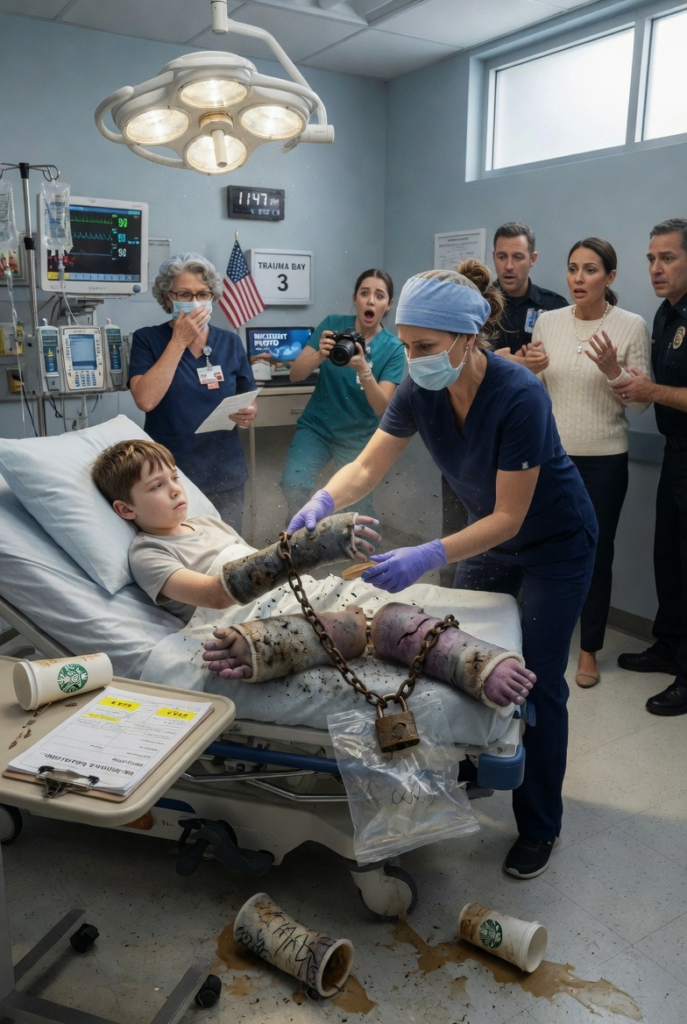
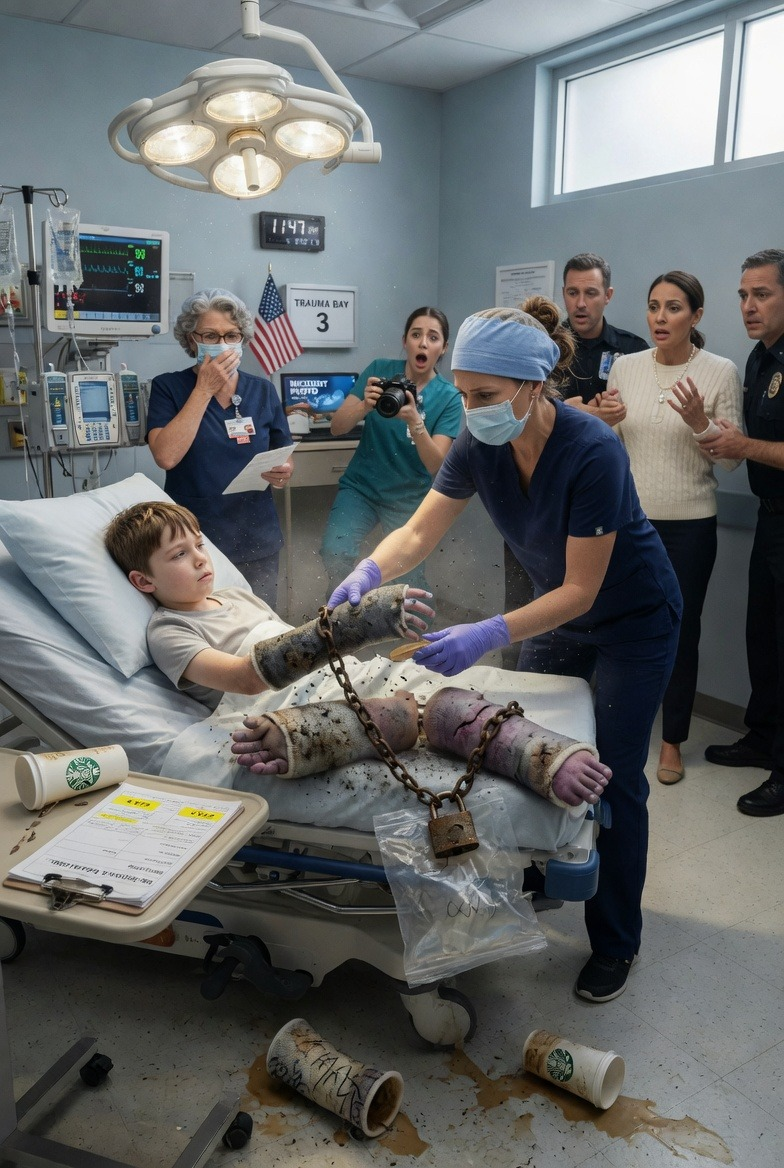
The bag itself was warm against my glove, like it had been sitting against infected skin for weeks.
I peeled it free slowly while Clara aimed her phone camera downward for documentation. The chain clinked softly against the metal bed rail. Marcus had returned with a surgical mask pressed tight against his face, though his eyes already looked haunted.
Inside the plastic bag were three things.
A tiny silver key.
A folded photograph.
And six pink tablets wrapped in tissue paper.
For half a second, nobody in the room spoke.
Then the boy made a sound.
Not a cry.
Not even a word.
Just a weak animal whimper from somewhere deep inside him.
I looked down at his arm.
And finally saw what the cast had been hiding.
The skin beneath had partially fused around the chain.
The wrist was ulcerated to the bone in places, black tissue spreading upward through the forearm. Pus leaked from deep pressure wounds where the metal had cut through swollen flesh. Maggots writhed inside pockets of dead skin near the elbow crease, feeding on necrotic tissue trapped beneath the airtight fiberglass.
Clara stumbled backward and slammed into the supply cart.
Marcus turned and vomited into a red biohazard bin.
Even Security Guard Thompson swore under his breath.
But the mother—
Martha Harris—
closed her eyes like someone finally watching a secret crawl into daylight.
“Oh my God,” Clara whispered.
No.
Not God.
People did this.
I forced my voice steady. “Get vascular surgery. Pediatric ICU. Infectious disease. And page CPS right now.”
The monitor screamed another alarm.
Heart rate 148.
Blood pressure crashing lower.
The boy’s breathing had become shallow, tiny chest barely lifting under the dinosaur T-shirt two sizes too small for him.
“What’s his name?” I asked sharply.
Martha stared at the floor.
“What is your son’s name?”
Silence.
Then finally:
“Eli.”
I leaned closer to him. “Eli, I’m Dr. Sarah. I need you to stay with me, okay?”
His eyelids fluttered slightly.
That was all.
But it was enough.
We moved fast after that.
Antibiotics wide open through the IV. Fluids. Blood cultures. Oxygen. Trauma surgery called down from the OR floor.
The room exploded into motion while the smell of rot hung over all of us like something alive.
I picked up the folded photograph from the bag carefully.
It showed Eli standing beside a little girl around six years old with crooked bangs and missing front teeth. Both children smiled into bright sunlight somewhere outdoors, arms wrapped around each other tightly.
Written across the back in black marker:
DON’T LET HER FIND ME.
A coldness slid down my spine.
“Who’s the girl?” I asked.
Martha’s face drained white.
She whispered, “I don’t know.”
Lie.
Instant lie.
I had spent enough years in emergency medicine to recognize the exact moment truth chooses self-preservation over morality.
The silver key still sat in my palm.
Tiny.
Rust-specked.
The kind used for cheap padlocks.
I looked back at the chain embedded in Eli’s wrist.
“Where’s the other key?”
Martha began shaking her head before I even finished speaking.
“I didn’t do this.”
Nobody answered her.
Because every person in that room understood something horrible already:
chains do not accidentally end up sealed inside a child’s cast.
At 7:42 p.m., Detective Alvarez from county child crimes was notified.
At 7:46, Eli coded for the first time.
The monitor dropped into a shrill flatline that snapped the room into pure instinct.
“Starting compressions!”
Marcus climbed onto the stool immediately, hands pumping over the tiny chest while Clara pushed epinephrine.
I intubated him with blood and bile coating the back of his throat.
Eight years old.
Eighty-three pounds.
Septic shock tearing through his organs while adults shouted numbers over his body.
And through all of it, Martha sat frozen in the corner whispering the same sentence over and over under her breath.
“I told him this would happen.”
Not I was afraid.
Not Please save my son.
I told him this would happen.
“Who?” I snapped while adjusting the tube. “Who did you tell?”
She looked up slowly.
And for the first time since arriving, she seemed genuinely terrified.
“My husband.”
The room went still again.
I felt it immediately—that shift.
The moment a case becomes larger than one cruel parent.
“Where is he?” Detective Alvarez asked from the doorway. None of us had even heard him enter.
Martha swallowed hard.
“He travels for work.”
“What kind of work?”
Silence.
Alvarez stepped closer. “Mrs. Harris, your child may die tonight. Start talking.”
Her eyes flicked toward Eli.
Then toward the photograph in my hand.
And suddenly she started crying.
Not polished tears.
Real ones.
Ugly, shaking sobs that bent her double.
“He locks them up,” she whispered.
Every person in the room stopped moving.
“The girl too?”
Martha nodded once.
My stomach turned.
“How many children are there?”
She covered her mouth.
“How many?”
“…Three.”
Clara whispered, “Jesus Christ.”
Martha shook violently now. “I tried to leave once. He found us before we reached Knoxville.”
Detective Alvarez was already speaking into his radio.
I barely heard him.
Because my eyes had landed on Eli’s left ankle.
There was a bruise there.
Not random.
Circular.
Dark purple around the edges.
The exact size of a cuff.
I pulled back the hospital blanket farther.
Another bruise.
Then another.
Old restraint marks.
My pulse started hammering.
“Martha,” I said carefully, “where are your other children right now?”
She looked directly at me.
And I will never forget the emptiness in her face when she answered.
“In the basement.”
The entire trauma room froze.
Even the monitor alarms seemed distant suddenly.
Detective Alvarez moved first.
“Address. Right now.”
She gave it through sobs while officers repeated it into radios.
Thirty-two minutes away.
Rural property.
Old farmhouse outside Mill Creek.
Alvarez’s jaw tightened. “SWAT’s en route.”
Eli coded again before they reached the driveway.
This time longer.
Marcus’s arms trembled during compressions. Sweat soaked through Clara’s scrub collar. One of the surgical residents cried silently while preparing emergency central line equipment.
And still we fought for him.
Because sometimes medicine becomes personal whether you allow it to or not.
I kept seeing the photo.
Two children smiling in sunlight.
Proof that at some point, before chains and casts and locked basements, Eli had known what happiness looked like.
At 8:19 p.m., we got a pulse back.
Weak.
Barely there.
But enough.
The surgical team rushed him upstairs for emergency debridement and probable amputation.
As they rolled the bed out, Eli’s eyes opened for one single second.
Cloudy.
Fever-bright.
Terrified.
His lips moved around the breathing tube.
I leaned closer.
“What is it, sweetheart?”
A tiny sound escaped him.
“…Emma…”
The little girl from the photograph.
Then he slipped unconscious again.
The doors slammed shut behind the trauma team.
The room looked like a battlefield afterward.
Blood wrappers.
Discarded syringes.
Rotting cast fragments on the floor beside streaks of coffee from Martha’s spilled cup.
And that smell.
God.
That smell still clung to everything.
Detective Alvarez stood near the doorway listening to updates through an earpiece.
Then suddenly his expression changed.
Sharp.
Focused.
“What?” I asked.
He looked at me carefully.
“They found the basement.”
Nobody spoke.
Alvarez swallowed once before continuing.
“There were two children inside.”
Clara pressed a trembling hand over her mouth.
“Alive?” Marcus asked.
A pause.
Then:
“Yes.”
The relief hit so hard my knees almost gave out.
But Alvarez wasn’t finished.
“There was also another cast.
Nobody moved after that.
The fluorescent lights hummed overhead while the words settled across Trauma Room 2 like ash.
There was also another cast.
Clara sat down hard on the rolling stool behind her as if her legs had simply stopped cooperating. Marcus stared at Detective Alvarez with blood still smeared across the front of his scrub top. One of the security guards quietly stepped into the hallway and removed his cap.
I looked down at the ruined fiberglass pieces scattered across the floor.
Then at the tiny silver key still resting in the kidney tray beside the bed.
“How old?” I asked.
Alvarez’s face tightened.
“The little girl is six.”
Emma.
The child from the photograph.
A memory flashed through me then—not mine, but Eli’s, somehow carried inside that picture. Two children standing in sunlight. Arms around each other. Smiling like normal kids before somebody turned their world into a locked room.
“Condition?” I asked carefully.
Alvarez hesitated.
“The deputies are requesting pediatric transport now.”
Which meant bad.
Very bad.
The ER doors burst open again at 8:31 p.m., and a deputy hurried in carrying a faded pink backpack sealed in evidence plastic.
“You need to see this,” he told Alvarez.
The backpack looked filthy, as if it had been dragged across concrete for years. Cartoon rabbits covered the front pocket beneath stains too dark to identify.
Alvarez unzipped it slowly on the trauma desk.
Inside were children’s clothes folded with painful neatness.
Three juice boxes long expired.
A flashlight.
And dozens of handwritten notes.
Small ones.
Written in crayon.
Marcus picked one up carefully.
His face changed immediately.
“What?” Clara whispered.
He handed it to me.
The paper was torn from a spiral notebook. Purple crayon pressed so hard it had ripped through parts of the page.
It read:
IF YOU FIND THIS PLEASE TELL MY MOM WE WERE GOOD TODAY
Another:
DADDY SAID WE MAKE PEOPLE SAD WHEN WE CRY
Another:
ELI LET ME HAVE THE BLANKET LAST NIGHT
Clara started crying silently.
I kept turning pages.
Each note had dates.
Over two years’ worth.
Two years.
Children had been hidden in that basement for two years while teachers marked absences, neighbors waved politely at the mailbox, and grocery cashiers smiled at Martha Harris buying cereal like she belonged to an ordinary life.
The final note was different.
Written shakily in pencil instead of crayon.
ELI SAYS IF I GET SICK HE WILL HELP ME HIDE IT
My throat closed.
Because suddenly the cast made terrible sense.
The chain.
The fiberglass layers.
The secrecy.
Someone had hidden evidence inside that cast.
Not from doctors.
From a man.
Detective Alvarez understood it too.
“He used the casts as restraints,” he muttered.
Martha, still seated against the wall under guard, began sobbing again.
“You don’t understand him,” she whispered. “He watches everything.”
Alvarez rounded on her instantly. “You let your children rot in a basement.”
She screamed back with shocking force. “You think I didn’t try?”
The room froze.
Martha’s perfectly controlled mask had finally shattered.
“He kept cameras everywhere,” she cried. “Doors alarmed. Windows nailed shut. He said if I ran again he’d bury Emma where nobody would ever find her.”
She looked at me then, eyes bloodshot and wild.
“You think I don’t know what that cast became? I begged him to take Eli to a doctor.”
“Begged?” Clara snapped.
Martha flinched.
“I tried to cut it off once while he was asleep,” she whispered. “Eli screamed because the skin came with it.”
Marcus turned away hard, jaw flexing.
I stared at her for a long moment.
There are forms of abuse that transform victims into accomplices through exhaustion, terror, and survival. Emergency medicine teaches you that human beings can adapt to almost anything except helplessness.
But there are still choices.
And Martha Harris had chosen silence over rescue for far too long.
Alvarez’s radio crackled again.
He listened.
Then his face lost all remaining color.
“What?” I asked.
He looked toward Martha.
“They found your husband.”
Silence.
“Where?”
“Three miles from the property.”
Martha’s breathing stopped.
“He had another child in the truck.”
Every person in that room went cold.
“How old?” Clara whispered.
“Maybe four,” Alvarez said. “Male. Malnourished. Deputy says he’s wearing a dog collar.”
Marcus slammed his fist against the counter so hard metal instruments rattled.
“Jesus Christ.”
Alvarez was already issuing orders into the radio again.
APBs.
Roadblocks.
FBI notification requests.
The situation had exploded far beyond county jurisdiction now.
I leaned back against the trauma bed trying to steady myself.
And then I noticed something under the mattress.
A folded piece of paper.
Probably shaken loose during CPR.
I pulled it free carefully.
Different handwriting.
Not childish.
Eli’s.
Blocky but older.
It read:
THE KEY IS FOR EMMA
Below that:
IF MY ARM GETS BAD MAKE THEM LOOK UNDER IT
My chest tightened painfully.
The plastic bag.
The hidden key.
The photograph.
Eli had known.
That little boy had trapped evidence inside his own infected cast because he knew someday someone would have to cut it open to save his life.
Eight years old.
And already planning like a hostage.
Clara covered her face and wept openly now.
I stared at the note in my hands while something heavy settled inside me.
Children should not know how to hide evidence from monsters.
Children should not understand survival this well.
The overhead speakers crackled suddenly:
“Dr. Jenkins to OR Three. Dr. Jenkins immediately.”
My heart dropped.
Eli.
I ran.
The surgical floor smelled different from the ER—colder somehow. Sharper antiseptic. Cleaner fear.
OR Three’s doors were already open when I arrived.
Inside, surgeons stood elbow-deep in catastrophe.
The infected tissue spread farther than anyone hoped.
Up the forearm.
Past the elbow.
Dark streaking infection climbing toward the shoulder.
Machines beeped violently around the operating table.
Dr. Patel glanced up at me through his face shield.
“We’re losing him.”
Eli lay impossibly small beneath surgical drapes, blond hair damp with sweat, chest rising mechanically through the ventilator.
And on the tray beside him sat the rusted chain.
Cut open now.
I realized then it was not just wrapped around his wrist.
Part of it had embedded into the flesh so deeply the skin healed over sections of metal.
Weeks.
Maybe months.
Dr. Patel’s voice lowered. “The arm can’t be saved.”
I looked at Eli’s tiny face.
At the freckles scattered across his nose.
At the cartoon dinosaur socks someone had forgotten to remove before surgery.
Eight years old.
And about to wake up missing part of himself because adults built hell around him one decision at a time.
“Do it,” I whispered.
The surgery lasted nearly four hours.
During hour two, federal agents arrived downstairs.
During hour three, social workers began filling entire conference rooms.
During hour four, they identified three more properties connected to Eli’s father.
The story spreading outward became uglier with every minute.
Fake homeschooling records.
False medical exemptions.
Children hidden under aliases.
Neighbors who “never noticed anything strange.”
But evil rarely looks dramatic from the outside.
Sometimes it mows lawns.
Pays taxes.
Waves politely at church.
At 1:12 a.m., Dr. Patel finally emerged from surgery.
His face looked exhausted.
“He made it.”
The relief nearly dropped me to my knees.
“But…” Patel removed his cap slowly. “There’s significant organ damage from sepsis. The next forty-eight hours are critical.”
I nodded numbly.
Then asked the question already waiting inside me.
“Emma?”
Patel exhaled heavily.
“She’s alive.”
The pause afterward told me everything else.
“She had a cast too,” he said quietly. “Left leg.”
I closed my eyes.
“Was there—”
“No chain.”
Thank God.
But Patel wasn’t finished.
“She did have seventeen healed fractures.”