Mason didn’t drive straight home.
He couldn’t.
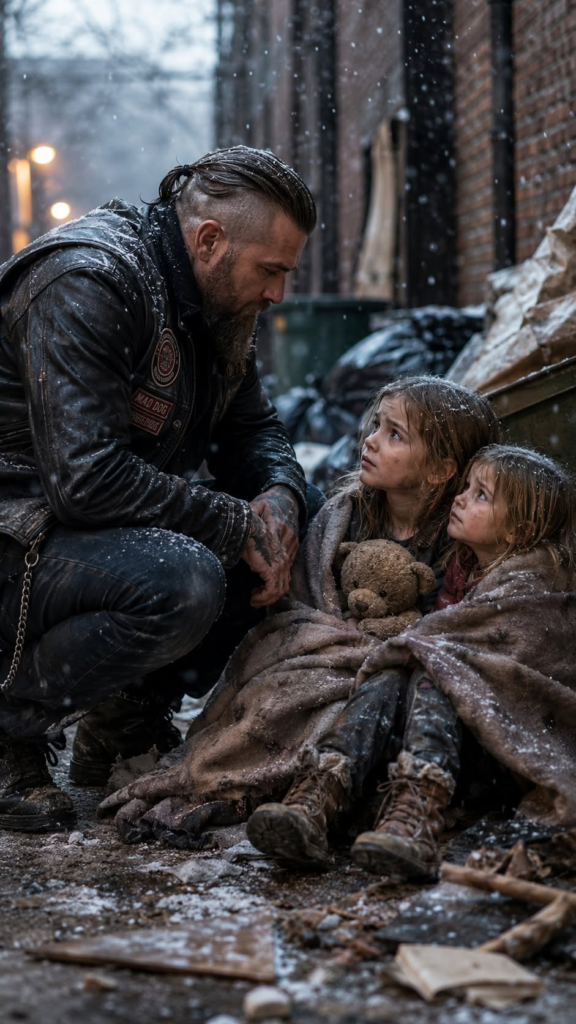
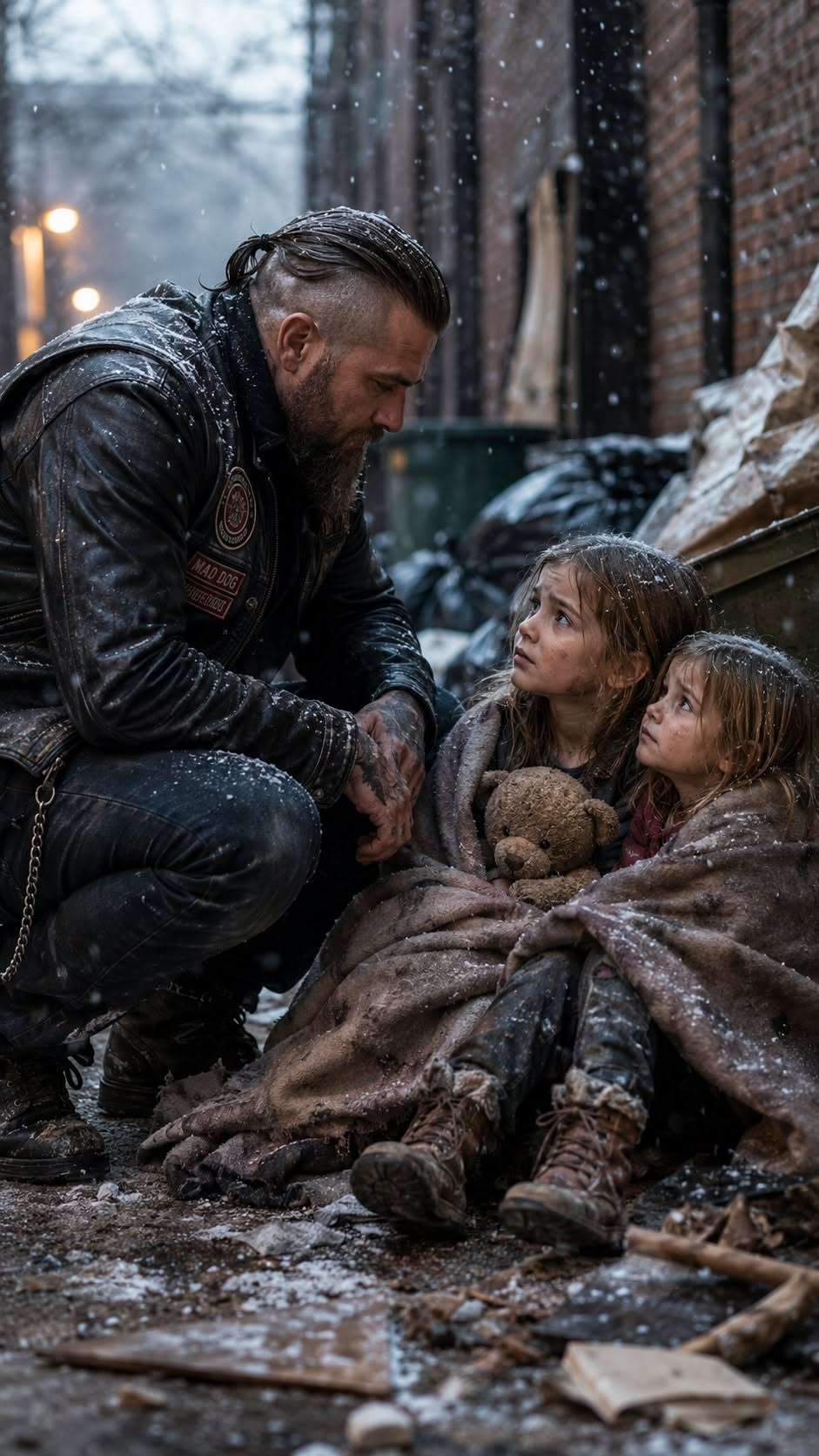
Not with two small bodies wrapped in his jacket, shivering in the back seat like the world had already taught them to expect nothing warm.
The heater in the truck roared, but it didn’t reach them fast enough.
Lily sat upright, one arm wrapped tightly around Rose. The teddy bear was still clutched in Rose’s hands, pressed against her chest like it was the only thing she was allowed to keep.
Every few minutes, Lily glanced at Mason in the rearview mirror.
Like she was waiting for him to change his mind.
Like kindness was temporary.
Mason noticed.
But he didn’t say anything yet.
He just drove.
At a red light, Rose finally spoke.
Her voice was so small it almost got lost in the engine noise.
“Are we in trouble?”
Mason’s grip tightened slightly on the steering wheel.
“No,” he said immediately. “No, sweetheart. You’re not in trouble.”
Lily didn’t believe him right away.
People had said things like that before.
Then left anyway.
When they reached his small rental house, Mason parked and sat still for a moment.
The porch light flickered.
The yard was empty.
Just him.
Or at least… it used to be.
He stepped out, walked around, and opened the back door.
“Alright,” he said gently. “We’re here for now.”
Lily hesitated.
“For now?”
Mason nodded honestly. “For now is all we need tonight.”
That answer didn’t fully calm her.
But it didn’t scare her either.
And that mattered.
Inside the house, warmth hit them slowly.
Not the emotional kind yet—the physical kind first.
Mason turned the heater up and pulled out every blanket he owned. He didn’t have a guest room. He didn’t even have much furniture. But he had a couch, an old rug, and a kitchen light that still worked.
He made a bed on the living room floor.
Soft layers. Thick blankets. His own jacket folded at the edge.
Rose refused to let go of Lily.
So Mason didn’t try to separate them.
He just placed them together.
Side by side.
Safe distance. Safe space.
“Do you like hot chocolate?” he asked quietly.
Lily nodded slowly.
Rose whispered, “What’s that?”
That question hit him harder than it should have.
Ten minutes later, he handed them two mismatched mugs.
Too big for their hands.
Too warm for their fingers.
Lily blew on hers carefully. Rose just stared at it like it might disappear if she blinked.
Mason sat on the floor across from them.
He didn’t try to stand over them.
He stayed low.
At their level.
“You don’t have to be scared here,” he said.
Lily looked at him.
“You don’t even know us,” she replied.
Mason nodded. “That’s true.”
A pause.
Then he added, “But I know what it looks like when kids are left where they shouldn’t be.”
Silence followed that.
A heavy silence.
Rose leaned into Lily a little more.
Later that night, after the mugs were empty and the girls had finally drifted into half-sleep, Mason stayed awake.
He sat on the couch, elbows on his knees, staring at the small heap of blankets on the floor.
Two kids.
Left behind.
On Christmas Eve.
He rubbed his face slowly.
“This isn’t something you ignore,” he whispered to himself.
Then he stood up and grabbed his phone.
The first call was to a friend who used to ride with him.
“Yeah,” Mason said quietly. “I need advice. Legal advice. Foster care. Emergency placement.”
A pause.
Then he added, “No, I’m not walking away from them.”
The next morning changed everything.
Not because the world suddenly got easier.
But because Mason made a decision that most people wouldn’t.
He showed up at the child services office still in his same leather jacket.
Still tired.
Still unsure.
But steady.
“I found two girls last night,” he said. “They’re not going back out there.”
The social worker looked at him carefully.
“You’re a single man,” she said.
“I know.”
“No permanent address of stability for children.”
Mason nodded once. “I can fix that.”
“That’s not how this works.”
Mason leaned forward slightly.
“Then change how it works,” he said quietly. “Because I’m not leaving them.”
Back at the house, Lily and Rose waited.
They had stopped asking when someone would come back for them.
That silence was worse than crying.
But around noon, Mason returned.
Not alone.
A woman from child services stood beside him.
Lily tensed instantly.
Rose hid behind her sister.
Mason knelt down immediately.
“Hey,” he said gently. “Listen to me.”
Lily’s eyes were wide.
“They’re taking us?”
“No,” Mason said firmly. “They’re making sure I can keep you safe.”
That word—keep—made Lily freeze.
“You’re keeping us?” she asked.
Mason nodded.
“If I’m allowed to,” he said.
That night, for the first time, Lily didn’t sleep curled tightly like she was trying to disappear.
She slept next to Rose.
And for the first time, Mason didn’t sit up alone in the dark.
He sat on the floor beside them.
Watching.
Guarding.
Not because he had to.
Because he chose to.
And somewhere in that quiet house, Christmas didn’t feel empty anymore.The days after that Christmas Eve didn’t feel magical.
They felt uncertain.
And uncertainty, Mason learned quickly, was harder than fear.
Because fear had a shape—you could react to it.
Uncertainty just sat in the room and waited.
By the third day, the house had changed in small ways.
Not fixed.
Not transformed.
Just… lived in.
A second toothbrush appeared in the bathroom.
Then a third.
A small pair of socks was draped over the couch armrest.
Rose had started following Mason from room to room without asking permission.
Lily still watched him carefully—but less like a trapped animal, and more like someone trying to decide if the world was lying again.
On the fourth morning, Lily woke up early.
Mason found her standing by the window.
Still in pajamas.
Barefoot.
Watching the snow outside like it had answers.
“You don’t sleep much,” Mason said gently.
Lily didn’t turn around.
“People come back in the morning,” she said.
Mason paused.
That wasn’t a question.
It was history.
He stepped closer but didn’t crowd her.
“Who told you that?”
Lily shrugged slightly.
“People.”
That word carried too much in her voice.
That afternoon, Mason took them to the grocery store.
It was supposed to be simple.
Milk. Bread. Basics.
But for Lily and Rose, the store was overwhelming.
Too many lights.
Too many voices.
Too many things they had never been allowed to choose.
Rose froze in the cereal aisle.
All those colorful boxes lined up like promises she didn’t understand.
“I can pick one?” she whispered.
Mason nodded. “Any one you want.”
Rose looked at him like she didn’t trust that kind of power.
Slowly, she picked a box with a cartoon bear on it.
Lily didn’t choose anything at first.
She just followed Mason closely, one hand lightly holding the edge of his jacket.
At the checkout, the cashier smiled.
“Cute kids,” she said casually.
Lily flinched at the word kids like it was unfamiliar.
Mason noticed.
And his jaw tightened slightly.
Later that night, after they got home, Lily finally asked the question she had been holding in for days.
“Are we allowed to stay here when it’s not Christmas?”
Mason stopped what he was doing.
He turned to her.
The room went quiet except for the hum of the heater.
“Yeah,” he said.
A pause.
“As long as it takes.”
Lily studied his face carefully.
Like she was looking for cracks.
Then she whispered, “What if someone says you can’t keep us?”
That question landed heavy.
Mason walked over and crouched in front of her so he was eye level again.
“I didn’t ask if I could care about you,” he said.
Lily blinked.
“I just started doing it.”
Two weeks later, the official visits began.
Paperwork. Inspections. Interviews.
People in clean coats asking messy questions about stability, safety, income.
Mason answered everything.
Not perfectly.
But honestly.
Always honestly.
One social worker looked around his house and said, “You know this is still a temporary approval process.”
Mason nodded.
“I know.”
“And you understand they could still be placed elsewhere?”
That sentence made Lily freeze immediately.
Rose clutched Mason’s hand tighter.
Mason looked at them first.
Then back at the worker.
“Then you better do your job fast,” he said calmly. “Because they’re already home.”
That night, Lily couldn’t sleep.
She stood outside Mason’s bedroom door.
Small.
Silent.
Waiting.
Mason opened the door gently.
“You okay?” he asked.
Lily hesitated.
Then said the words she never stopped feeling.
“What if they take us in the morning?”
Mason knelt down.
He didn’t promise something impossible.
He didn’t lie.
He just said:
“Then I’ll stand in front of every door they try.”
A pause.
“And if that’s not enough… I’ll stand again.”
Lily’s eyes filled slowly.
“You don’t even know us,” she whispered.
Mason smiled faintly.
“I know enough,” he said.
Then softer:
“And I’m learning the rest every day.”
Months passed.
The paperwork slowed.
The system softened.
And one afternoon, a letter arrived.
Approved placement.
Permanent guardianship pending final review.
Mason read it twice.
Then a third time.
Lily and Rose stood behind him, holding their breath like they were afraid even good news could be taken back.
Mason turned slowly.
He didn’t show them the paper first.
He just crouched down.
And said:
“You’re not visitors anymore.”
A pause.
“You’re mine to take care of.”
Rose’s face crumpled instantly.
Lily didn’t move for a second.
Then she ran forward and hugged him so tightly he almost lost his balance.
Not fragile this time.
Not scared.
Just certain.
And for the first time since that freezing Christmas Eve behind the alley…
the word nobody wants us stopped belonging to them.Spring came slowly to Ashford.
Snow didn’t disappear all at once—it gave up in pieces. Thin patches on rooftops. Wet corners on sidewalks. The last stubborn piles beside parking lots where winter refused to admit it had lost.
Inside Mason’s house, though, things were already changing.
Not loudly.
Just steadily.
Like a life learning how to breathe again.
Rose started talking more.
Not full sentences at first—just little bursts of curiosity.
“Why does the sun make the floor warm?”
“Do dogs get Christmas?”
“Can we keep the cereal box forever?”
Mason answered everything seriously.
Even the cereal box question.
“Yes,” he said once. “If it matters to you, we can keep it.”
Rose nodded like that made perfect sense.
Lily, on the other hand, was harder to read.
She smiled sometimes now—but only when she forgot to think about it first.
Mason noticed she still kept track of exits.
Every room.
Every door.
Every window.
He never told her to stop.
Instead, he quietly unlocked more of them.
Not physically.
Emotionally.
One Saturday morning, Mason found Lily sitting on the porch step with her knees pulled to her chest.
She was watching a bird hop across the yard.
Careful.
Quiet.
Like it didn’t owe anyone anything.
Mason sat down beside her without speaking.
For a long time, they just watched the bird.
Then Lily said softly, “Do you think people can forget being left?”
Mason didn’t answer immediately.
Because that wasn’t a question you rush.
Finally, he said, “No.”
Lily looked at him quickly.
“But it gets quieter,” he added. “Until one day, it doesn’t feel like the only thing you are anymore.”
Lily stared at the yard.
“I don’t want it to be part of me,” she said.
Mason nodded.
“That’s fair,” he replied. “But even if it stays… it doesn’t get to decide what comes next.”
That made her quiet again.
But not in a scared way.
In a thinking way.
A few weeks later, the biker club showed up.
Not roaring. Not loud. Not intimidating.
Just… present.
A handful of men stood awkwardly in Mason’s yard holding things they clearly didn’t know how to hold.
One carried a giant teddy bear.
Another had a stack of books.
Someone else brought a small wooden swing seat.
Rose’s eyes widened immediately.
“Are they your friends?” she whispered.
Mason nodded. “Yeah.”
Rose tilted her head. “They look like they fight people.”
Mason almost smiled.
“Sometimes,” he said. “But mostly they fix things.”
That seemed to satisfy her.
Lily stayed closer to Mason that day.
Watching.
Observing.
Waiting.
One of the bikers—an older man with a rough voice—walked up slowly and crouched down a few feet away.
“I heard you like animals,” he said gently.
Lily didn’t respond.
He didn’t push.
Instead, he just placed a small wooden birdhouse on the porch.
“I made this,” he said. “Takes a while for birds to trust it. But they do eventually.”
Then he stood up and walked away.
No pressure.
No expectation.
Just an offering.
Lily stared at the birdhouse for a long time after that.
That night, Rose fell asleep early on the couch.
Curled up with her teddy bear and one of Mason’s old jackets.
Lily stayed awake.
She stood in the hallway, watching Mason clean up the kitchen.
He noticed her reflection in the window.
“You okay?” he asked without turning around.
Lily hesitated.
Then walked closer.
“I think… I want to try something,” she said.
Mason turned.
“What kind of something?”
Lily pointed toward the birdhouse outside.
“I want to see if something stays,” she said quietly.
Mason understood immediately.
He didn’t overreact.
Didn’t turn it into a lesson.
He just nodded.
“Okay,” he said.
A pause.
“We’ll wait together.”
That night, for the first time, Lily didn’t fall asleep listening for footsteps that meant someone was leaving.
She fell asleep listening for something else.
Quiet hope.
Weeks turned into months again.
The legal process finally ended.
Final approval.
Permanent guardianship granted.
No more “pending.”
No more “temporary.”
Just real.
The day the papers were signed, the social worker looked at Mason.
“You understand this is lifelong responsibility,” she said.
Mason nodded.
“I’ve understood that since Christmas Eve,” he replied.
She studied him for a moment.
Then glanced at Lily and Rose, who were waiting outside with ice cream cones Mason had insisted they get afterward.
“They’re lucky,” she said quietly.
Mason shook his head.
“No,” he said. “I am.”
That evening, back at the house, Lily stood in the doorway holding her ice cream.
She looked at Mason.
“Are we really staying?” she asked.
Mason didn’t hesitate.
“Yes.”
Lily nodded slowly.
Then, for the first time, she said it without fear:
“Okay.”
Just that.
Okay.
And in that simple word, everything they had been surviving finally started to feel like something else.
Something they could build on.
Something that didn’t end with a door closing.
Something that stayed.