The poem begins:
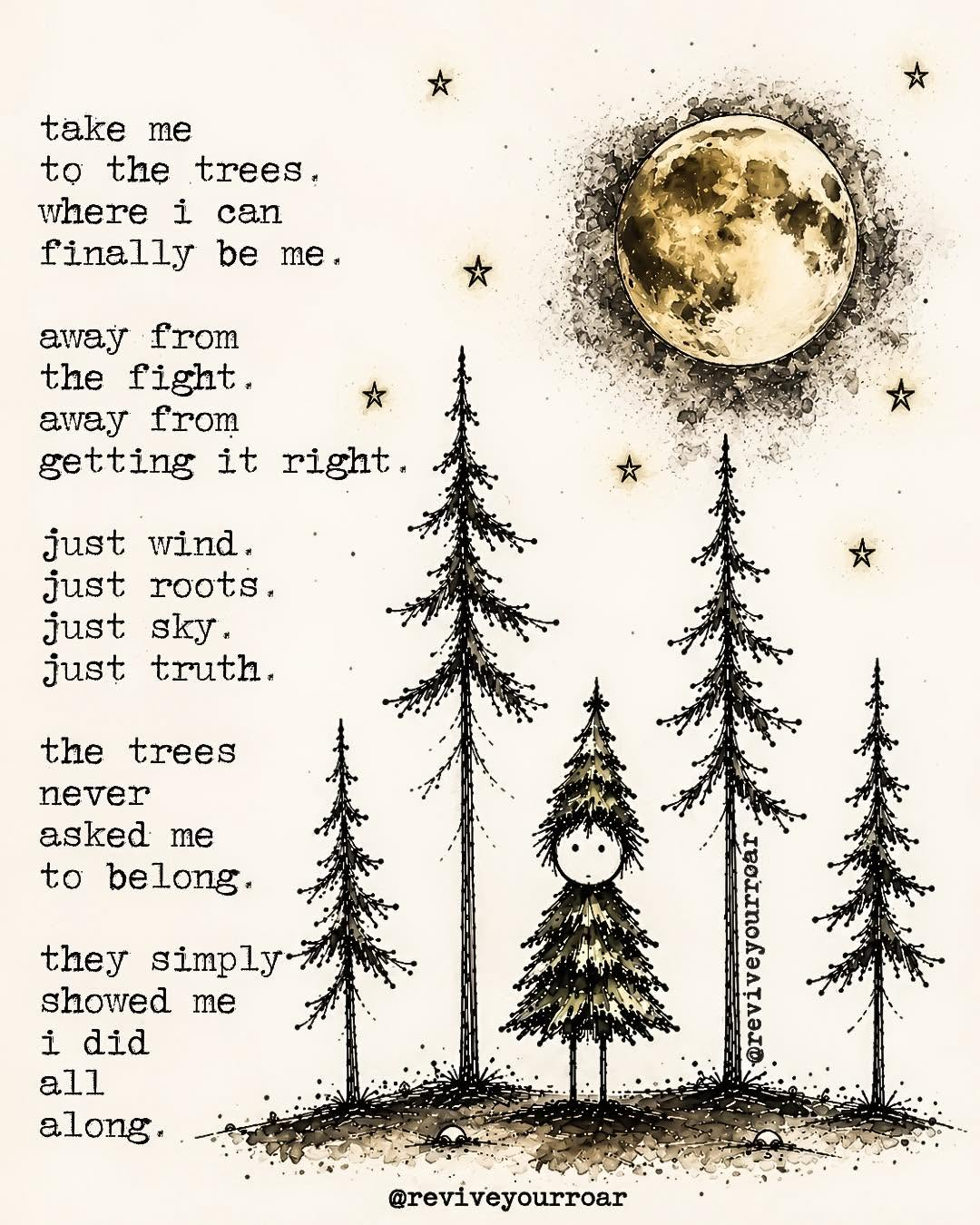
“take me to the trees
where i can finally be me.”
This suggests a desire to escape from the pressures of society, expectations, judgment, and constant struggle. The speaker feels exhausted from trying to fit into a world that demands perfection or conformity.
When the poem says:
“away from the fight.
away from getting it right.”
it is talking about freedom from the endless effort to please others, prove oneself, or live up to impossible standards. Many people spend years worrying about whether they are successful enough, attractive enough, accepted enough, or doing everything correctly. The speaker longs to leave those worries behind.
The next lines say:
“just wind.
just roots.
just sky.
just truth.”
Nature becomes a symbol of simplicity and authenticity. Trees do not pretend to be something they are not. They grow according to their nature. The wind, roots, and sky represent a life stripped of artificial expectations. In nature, there is no competition for approval—only existence.
The Most Powerful Message
The heart of the poem appears in these lines:
“the trees never asked me to belong.
they simply showed me i did all along.”
This is the emotional climax.
Many people spend their lives searching for acceptance. They seek validation from family, friends, workplaces, or society. Often, they feel like outsiders who don’t fit anywhere.
The poem suggests a profound realization:
Belonging is not something that must be earned.
The trees never demanded that the speaker change, prove worth, or become someone else. Simply being present was enough. Through nature, the speaker discovers that they were never truly separate in the first place.
The trees “showed” them that they already belonged—not because they met certain conditions, but because they existed.
The Symbolism of the Small Tree
The illustration adds another layer of meaning.
Among the tall trees stands a smaller tree with a simple face. It looks different from the others, almost as if it doesn’t belong.
At first glance, the little tree seems isolated or unusual.
But when viewed more closely, it is standing among the forest, surrounded and accepted.
The message is powerful:
Being different does not mean being separate.
The little tree may feel out of place, but it is still part of the forest.
This mirrors how many people feel in life. They may think they are too different, too sensitive, too quiet, too unusual, or too broken to belong. Yet the poem suggests that belonging is not determined by similarity.
The small tree belongs simply because it exists within the forest.
The Moon’s Meaning
The moon overhead symbolizes reflection, healing, and self-discovery.
Unlike the sun, which reveals everything clearly, the moon illuminates gently. It represents the quiet moments when people stop listening to the noise around them and begin listening to themselves.
Under the moonlight, the speaker finds clarity:
They don’t need to become someone new.
They don’t need permission to belong.
They don’t need to win every fight or get everything right.
Overall Interpretation
This poem is about coming home to yourself.
It speaks to anyone who has ever felt misunderstood, lonely, different, exhausted, or disconnected from the world around them.
Its message is that true peace comes when we stop chasing acceptance and realize that our worth was never dependent on anyone else’s approval.
The forest becomes a metaphor for life itself—a place where every tree grows in its own way, yet all are part of the same landscape.
The final realization is beautiful:
The speaker went into the woods looking for a place to belong, only to discover that they had belonged all along.A Deeper Meaning of the Image
This image is not really about trees.
It is about the human desire to find a place where we no longer have to perform, compete, explain ourselves, or apologize for who we are.
The forest represents a world untouched by human judgment.
In everyday life, people are constantly evaluated. They are judged by their appearance, income, education, achievements, age, mistakes, and even their opinions. Many spend years trying to become the version of themselves they think others will accept.
The poem imagines escaping from all of that.
Not to run away from life.
But to remember what life feels like without the pressure.
The Search for Identity
The line:
“where i can finally be me”
reveals that the speaker has spent a long time feeling disconnected from their true self.
Many people wear masks.
A mask for work.
A mask for family.
A mask for friends.
A mask for social media.
Over time, those masks can become exhausting.
The forest symbolizes a place where masks are unnecessary.
A tree does not try to become another tree.
An oak never wishes it were a pine.
A small sapling does not compare itself to a giant cedar.
Each simply grows according to its nature.
The speaker longs for that same freedom.
Escaping Perfection
One of the most important lines is:
“away from getting it right.”
This speaks to perfectionism.
Many people live with the constant feeling that they are one mistake away from failure.
They worry:
- Did I say the right thing?
- Did I make the right decision?
- Am I successful enough?
- Am I enough?
The poem suggests that peace begins when we stop trying to achieve perfection.
Nature is imperfect.
Trees lose branches.
Storms leave scars.
Roots twist in unexpected directions.
Yet none of these things make a tree less worthy.
Likewise, our flaws do not make us less valuable.
The Meaning of Roots
The word “roots” carries powerful symbolism.
Roots represent:
- Identity
- Heritage
- Stability
- Inner strength
- Connection
Roots are mostly invisible.
People see a tree’s height but not the system beneath it that keeps it standing.
The same is true for human beings.
Others see achievements.
They do not always see the struggles, sacrifices, heartbreaks, lessons, and resilience that support those achievements.
The poem reminds us that our deepest strengths are often hidden beneath the surface.
Why the Trees Never Asked Anything
One of the most profound ideas in the poem is that the trees never asked the speaker to prove anything.
They never demanded:
- Success
- Popularity
- Wealth
- Beauty
- Perfection
The trees simply existed.
And by existing alongside them, the speaker realizes something extraordinary:
Nature accepts existence itself.
A tree is valuable because it is alive.
Not because it is the tallest.
Not because it grows the fastest.
Not because it is admired.
Just because it is.
The poem suggests humans deserve that same grace.
The Loneliness Hidden Inside the Poem
There is also sadness here.
The poem hints that the speaker has spent a long time feeling like an outsider.
The line:
“the trees never asked me to belong”
implies that other places may have.
Perhaps people demanded that the speaker change.
Perhaps they felt excluded.
Perhaps they spent years wondering where they fit.
Many readers connect deeply with this because nearly everyone has experienced moments of feeling different.
The image gently argues that belonging is not something granted by others.
It is something already present.
The Small Tree’s Journey
The small tree in the center may symbolize the speaker.
It is shorter.
Different.
Less imposing.
At first glance, it seems out of place among the towering trees.
But look again.
The forest does not reject it.
The taller trees do not push it away.
The moon shines on it just as brightly.
The earth supports it just as fully.
The same wind touches every branch.
Its difference never removes its place in the forest.
This mirrors a truth many people spend years learning:
You do not have to be like everyone else to belong.
The Spiritual Interpretation
Many people also read the poem as a spiritual message.
The forest becomes a symbol of the universe, creation, or a higher power.
In this interpretation, the speaker discovers that they were never truly alone.
They were connected all along.
The feeling of separation was an illusion.
The trees become teachers.
Without speaking, they reveal a truth:
You are already part of something larger than yourself.
You always were.
The Final Lesson
The poem begins with a request:
“take me to the trees”
It sounds like the speaker is searching for something.
A place.
A feeling.
A home.
But by the end, the discovery is unexpected.
The trees do not give the speaker belonging.
They reveal it.
The speaker realizes that peace was never hidden in the forest.
The peace was hidden beneath years of self-doubt.
The belonging was never waiting somewhere else.
It was already there.
That is why the final lines feel so powerful:
“they simply showed me i did all along.”
The greatest journey in the poem is not traveling into the woods.
It is traveling back to oneself.