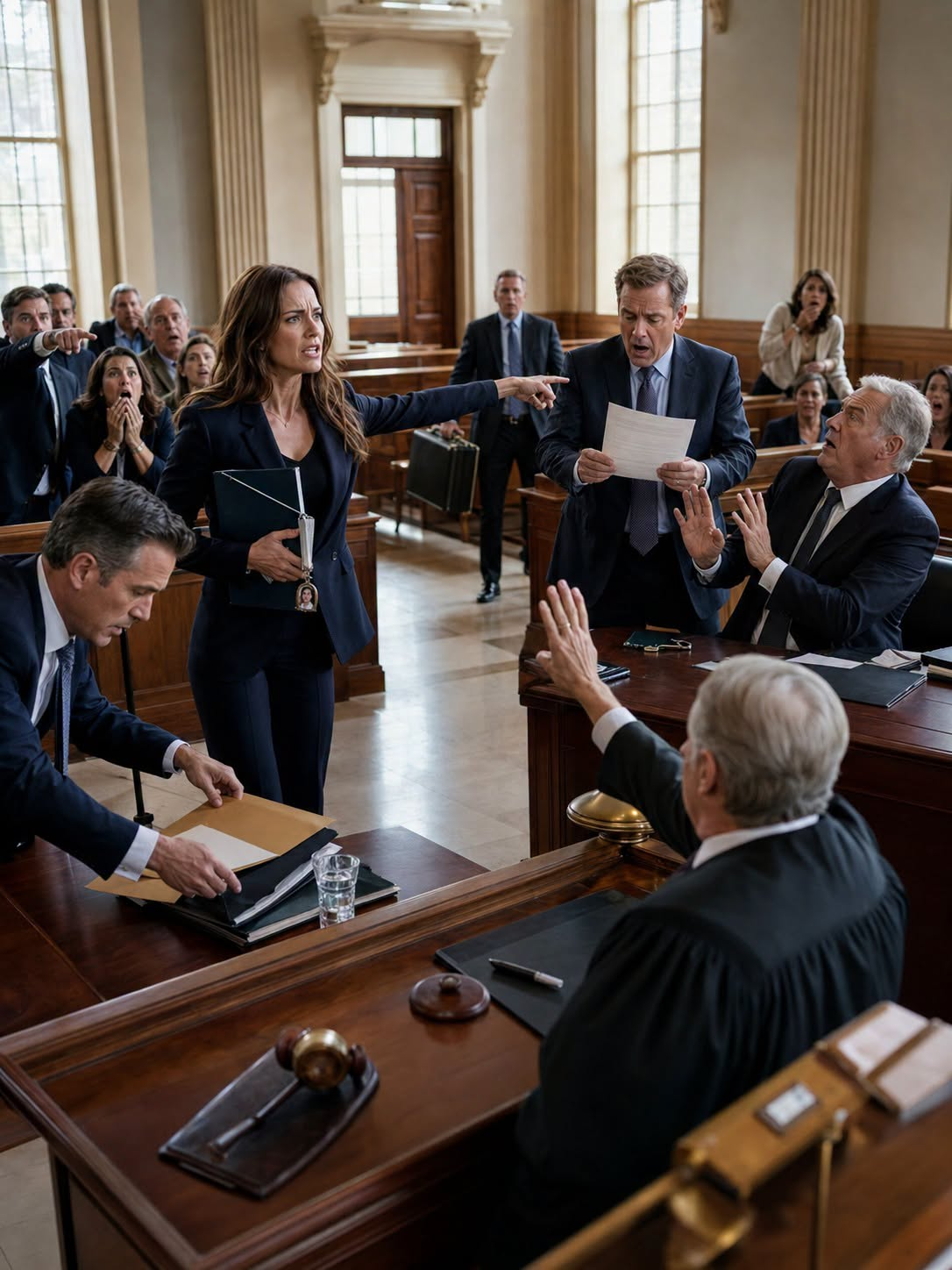
—But He Had No Idea the Judge Hearing His Case Was the Father of the Man Who Died in My Arms
My Father Produced A Notarized Letter With My Signature, Dated August 14th. His Attorney Read It Aloud Like A Verdict. I Said, “I Left The Country On August 11th. I Was Not In Texas.” The Judge Set His Pen Down. “His Son Died In My Arms.”
Part 1
My father sued me for $63,000 and said I owed it to him.
That was the number printed on the civil complaint, neat and black on the kind of paper that makes ordinary lies look official. Sixty-three thousand dollars. My grandmother’s money. My name. My father’s signature at the bottom of the claim, accusing me of walking away from my family and then coming back with my hand out.
He didn’t know what else I had carried back.
My name is Claire Anne Weston. I’m thirty-eight years old, a captain in the United States Army Medical Corps, and for most of my adult life, my family has treated my silence like a confession.
I learned early that in the Weston house, if you did not explain yourself fast enough, someone else would explain you. Usually my father. Donald Ray Weston had a voice built for rooms with polished tables. He was a commercial real estate developer in Corpus Christi, Texas, a deacon at First Baptist, a Rotary Club man, the kind who could talk about square footage and sacrifice in the same breath and make both sound holy.
When I commissioned out of ROTC in 2010, he clapped twice.
Two dry little claps in a gymnasium that smelled like floor wax, cheap flowers, and nervous sweat. My mother cried quietly into a tissue. My brother Bradley whistled too loud from the bleachers because he didn’t know how else to be proud. My father checked his watch before the ceremony ended.
He clapped longer for Bradley’s eighth-grade basketball trophy.
I counted.
Back then, I still thought if I did enough good things in a row, my father would eventually look at me and see what everyone else seemed to see. Discipline. Purpose. A steady hand. I didn’t understand that he didn’t want a daughter with a steady hand. He wanted a daughter who stayed where he put her.
The Army did not make me quiet. It only gave my quiet a uniform.
By 2014, I was on my second combat deployment, assigned to a forward medical position in Anbar Province. I won’t name the unit. Some pieces of that year are still tied behind classification rules, and others are tied behind something older than rules. The desert was 112 degrees on a good day. The air tasted like diesel, dust, and sun-baked metal. The medical tent had a permanent copper smell no amount of bleach could kill.
On Tuesday, September 9, 2014, I wrote the date on the inside of my wrist with a ballpoint pen because I had been awake too long and the days were starting to smear together.
That same afternoon, back in Corpus Christi, my mother sat up in her bed at a memory care facility on Leopard Street and asked the duty nurse to call me.
She said she had something to tell me.
The nurse tried my number. No answer. My phone was in a locker inside a plywood building two meters behind me, as useless as a seashell. The nurse tried Bradley’s number next. He was at a job site and didn’t pick up either.
My mother waited for an hour.
Then she lay back down.
Three days later, Bradley texted me.
Mom had a bad day. You probably couldn’t have done anything anyway.
I read those words in a supply tent while a generator coughed outside and somebody yelled for more saline. I folded the phone. I walked back to my station. I snapped on a pair of nitrile gloves, and that sharp, clean pop against my skin was the only sound in the world that made sense.
Two weeks later, when I finally got a satellite connection clear enough to call the facility, they patched me through to her room. The screen was grainy. Her face looked washed in gray-blue light.
My mother smiled at me like I was a kind stranger.
“That’s nice,” she said.
She never knew my name again.
I told myself I would deal with that later. That is what you tell yourself in a combat zone. Later is a place you store grief until the next litter comes through the flap. Later is where you put fear, rage, birthdays, Christmas mornings, and the memory of your father clapping twice.
But later has a way of waiting with its arms crossed.
When I came home in early 2015, my grandmother was dead, my mother was gone in every way that mattered, and my father was sitting behind his glass desk with a story already prepared.
The inheritance account was empty.
And when I asked where my share had gone, he looked at me like I had interrupted a meeting and said, “You agreed to contribute it to the family while you were away.”
I remember the office smelled like leather chairs, coffee, and lemon polish. I remember the drone photographs of his strip malls framed on every wall. I remember my left forearm burning under my sleeve, even though the wound had long since closed.
“I didn’t agree to that,” I said.
My father leaned back. “Claire, you’ve been gone a long time. Maybe you don’t remember every conversation.”
That was the first time I understood he wasn’t confused.
He had counted on my absence.
And somewhere, in some drawer or file or locked cabinet, he had something with my name on it that I had never signed.
Part 2
I drove back to San Antonio that evening with the radio off and my left hand wrapped around the steering wheel so tight my knuckles ached.
Corpus Christi humidity clung to the windshield. The road out of town shimmered. Gas stations, pawn shops, fast food signs, and church billboards slid past in the gold heat. Every mile should have made me feel farther from my father’s office, but I could still smell the coffee on his breath when he said maybe you don’t remember.
I remembered everything.
That was the problem.
I remembered my grandmother’s kitchen, yellow curtains over the sink, a ceramic rooster by the stove, the sound of her bracelets tapping together when she stirred beans on Sunday afternoons. I remembered her telling me, “Don’t let your daddy make you smaller just because he needs to feel tall.”
I was sixteen when she said it. I laughed because I thought she was being dramatic.
At twenty-eight, sitting in a rental car with my uniform hanging in the back seat and dried desert still trapped in the seams of my boots, I stopped laughing.
The inheritance was not life-changing money. Sixty-three thousand dollars would not buy me peace. It would not give my mother back her memory or erase the years my father had spent turning my absence into a moral failure. But it was mine because my grandmother had wanted it to be mine. That mattered.
Three weeks after I confronted him, I received a letter from his attorney.
Donald Ray Weston was suing me.
According to the complaint, I had taken no responsibility for “family expenses” while deployed. I had allegedly promised to surrender my share of my grandmother’s estate, then “reversed position” after returning stateside. He wanted the court to declare the money properly used and order me to pay associated costs.
He wasn’t just keeping the inheritance.
He wanted a judge to say I had deserved losing it.
The exhibit attached to the complaint was a notarized letter dated August 14, 2013.
I, Claire Anne Weston, voluntarily relinquish my claim to any inheritance from the estate of Margaret Ellen Harper as a gesture of family responsibility.
The signature at the bottom looked like mine if you didn’t know where to look. The C swept right. The A in Anne had the small open top. The Weston was almost correct, except the tail of the W lifted too sharply, like someone had copied the shape but not the rhythm.
My father had always been good at appearances.
On August 14, 2013, I was not in Texas. I was not at a notary’s desk. I was not agreeing to anything in Corpus Christi. I was already moving through the military machine toward Anbar Province, with deployment orders folded in my cargo pocket and my stomach full of the hard quiet that comes before leaving.
But Donald did not need me present.
He only needed the court to believe I could have been.
I called Bradley first.
He answered on the fifth ring, breathless, with wind in the background. “Claire?”
“Did Dad show you the letter?”
There was a pause just long enough to be an answer. “He said you signed something before you left.”
“I didn’t.”
“He said there was a lot going on then.”
“There was. I was deploying.”
“Claire…”
The way he said my name made me close my eyes. He sounded tired. Not guilty yet. Just tired, like a man carrying groceries someone else had packed too heavy.
“What did he ask you to do?” I said.
Bradley exhaled. “He just asked me to tell the truth.”
“That’s not what I asked.”
Another pause. A truck beeped somewhere behind him. I pictured him standing at a construction supply yard in a wrinkled polo shirt, turning away from workers so nobody would see his face.
“He said you told him the family had done enough for you,” Bradley said quietly. “He said you wanted the money to go toward Mom’s care.”
My laugh came out once, dry and ugly. “Mom was already covered by her long-term care policy. Grandma helped set that up.”
“I don’t know all the details.”
“That has never stopped you from repeating his.”
He didn’t answer.
I wanted him to get angry. Anger would have meant there was still something alive under all that obedience. But Bradley only went quiet, and in my family, quiet had always been claimed by whoever spoke next.
So Donald spoke next.
Over the following months, his version spread through the family with the efficiency of mold. Cousins stopped texting. An aunt sent me a Christmas card with only her name signed inside. At church, people told my father they were praying for him. He told them his oldest daughter had chosen the Army over blood.
Chosen.
That word followed me through training rotations, hospital corridors, and another deployment. Chosen strangers. Chosen silence. Chosen duty. As if duty had not also been the thing that kept me from my mother’s bedside when she still knew enough to ask for me.
The suit dragged on because I deployed again. Kuwait, 2016 into 2017. My father’s attorney called the delay “further evidence of pattern behavior.”
Pattern behavior.
That phrase appeared in one of the filings. I stared at it for a long time beneath fluorescent barracks lights while sand tapped softly against the window.
By then, I had a scar running from my left wrist toward my elbow, pale and smooth and raised in places where the burn had healed wrong. I kept it covered because people asked questions, and there were answers I was not allowed to give.
My ex-husband, Kevin, stopped sleeping well beside me after that deployment. He never said the scar bothered him. He just shifted in the dark whenever my sleeve rode up.
Some silences are too heavy to share a bed with.
When Kevin left in 2019, my father told people it proved his point.
But the forged letter stayed in my files like a loaded weapon.
And in October 2024, the court finally set a hearing date in Nueces County, where my father believed the whole world still worked the way his office did.
He did not know the judge’s name meant something to me.
At first, neither did I.
Part 3
The Nueces County Courthouse looked washed out in the October heat, pale stone under a sky too blue to trust.
Corpus Christi never knows when summer is over. The air sat heavy on the parking lot, rising off the asphalt in silver waves. I parked between a white pickup and a dented sedan with a rosary swinging from the rearview mirror. For three minutes, I stayed in the car with both hands resting on my knees.
Not fear.
Inventory.
Keys. Wallet. Phone. Legal pad. Pen. Deployment orders. Certified service record. Copy of my grandmother’s estate addendum. Combat medical citation, partly redacted. Index card in the inside breast pocket of my navy blazer.
I touched the pocket once.
Then I got out.
I wore charcoal slacks, a white Oxford shirt, flat shoes I could move in, and a structured blazer that made me look more like an officer than a daughter. My left sleeve ended at mid-forearm. The edge of the burn scar showed beneath it, pale against my skin.
I did not pull the sleeve down.
Inside, the courthouse air-conditioning hit like a refrigerator. The fluorescent lights flattened every face. People stood around with folders pressed to their chests, whispering in the frightened, irritated voices people use when the government has called them into a room.
Bradley was in the hallway outside the courtroom.
He wore a tie I was pretty sure he had tied in the car. The knot sat too low, and the narrow end stuck out behind the wide one. He had put on weight through the middle, but his face was still the same one from childhood: open, anxious, always waiting to see which way Dad wanted him to lean.
“Claire,” he said.
“Bradley.”
He looked over his shoulder toward the courtroom doors. “Dad said you wouldn’t show.”
“I know.”
“He said you’d do what you always do.”
I could have asked what that meant. I didn’t need to. I had heard my father’s favorite line secondhand for years.
She goes quiet. That’s all she knows how to do.
Bradley rubbed his thumb over the side of his wedding ring. “He’s upset.”
“That sounds uncomfortable for him.”
His eyes flicked to my scar, then away. He had seen it before. Thanksgiving 2018, from across my father’s dining table, when my sleeve slipped while I reached for the salt. He had looked then too. He had not asked.
Nobody in my family ever asked about wounds. They only assigned meaning to silence.
I walked past him into the courtroom.
My father was already seated at the plaintiff’s table.
Donald Ray Weston wore a navy suit, gold cufflinks, and the expression of a man who considered courtrooms an extension of conference rooms. His hair had thinned at the crown, but he still kept it sprayed into obedience. His attorney, Kathleen Davis, sat beside him in a sharp gray suit with a file stack arranged by color-coded tabs.
The forged letter was in a clear plastic exhibit sleeve on top.
She placed one hand near it as I entered, almost possessive.
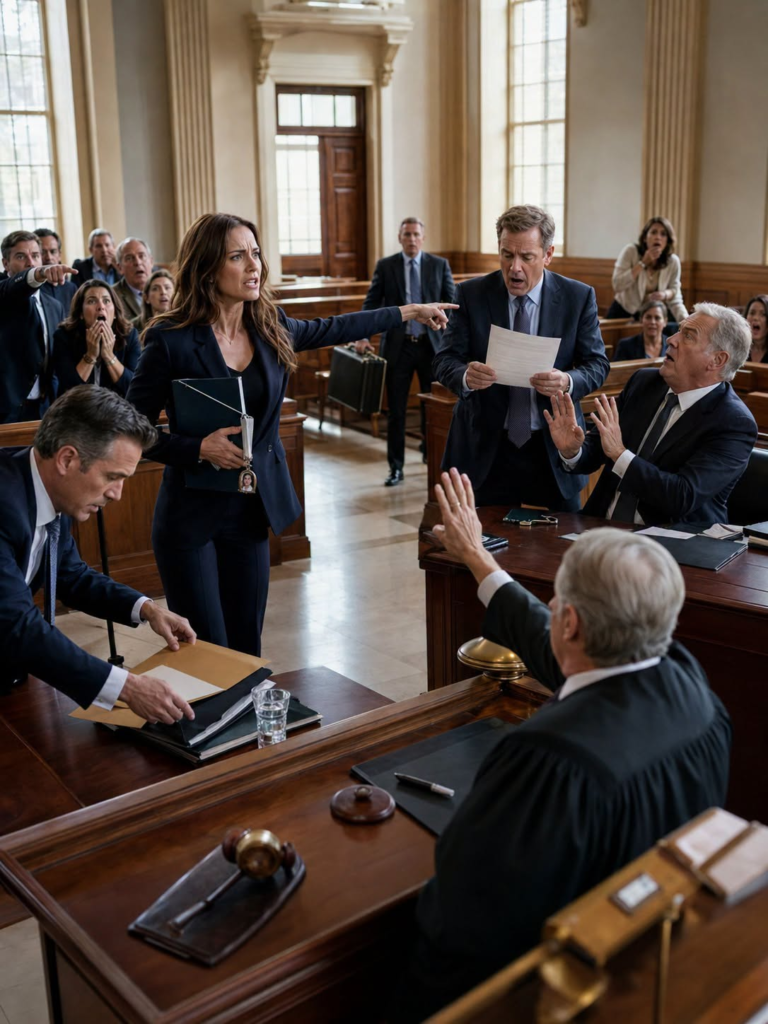
At the bench sat the Honorable Thomas Allen Brennan.
Late sixties. Gray at the temples. Reading glasses low on his nose. He had the stillness of a man who had spent decades listening to people lie in expensive clothes and cheap ones. His face gave away nothing. He was reading the docket summary, pen moving in small, precise strokes.
The name Brennan stirred something in me, but not enough to catch.
That happens when you have too many dead men filed away in your head. Names blur. Faces do not. Last words do not. The sound of a chest trying to pull air through blood never does.
I took my seat at the defense table. My attorney had retired suddenly three months earlier for medical reasons, and I had chosen to represent myself rather than let another delay give my father more room to perform outrage. I knew enough law to be dangerous and enough procedure to be careful.
More importantly, I knew how to sit under pressure without filling the silence.
The hearing began at 9:15.
Kathleen Davis stood first.
“Your Honor, this matter concerns a voluntary relinquishment of inheritance rights by the defendant, Captain Claire Anne Weston, followed by an attempt years later to reclaim funds already applied to family obligations.”
Her voice was smooth. Professional. She did not look at me when she said voluntary.
She introduced Exhibit A, the notarized letter dated August 14, 2013. The plastic sleeve caught the overhead light as she lifted it. My signature shimmered at the bottom, almost mine, close enough to insult me.
She read the letter aloud.
My father watched the judge while she read, his chin slightly lifted. He liked having words read into records. It made them feel permanent.
Then Bradley took the stand.
He raised his right hand. Swore to tell the truth. Sat down. Unfolded a prepared statement.
My stomach went cold before he spoke because I recognized the paper. Not the page itself. The style. Short declarative sentences. Moral conclusions dressed as facts. My father’s voice in twelve-point font.
“My sister communicated to our father that she understood the family had carried significant financial burden during her extended absence,” Bradley read, “and that it was only fair for her to release her claim on our grandmother’s estate.”
His hand shook on the word absence.
He did not look at me.
He finished, stepped down, and sat behind Donald like a boy returning to his assigned seat.
Then my father took the stand.
He buttoned his jacket before sitting. Swore on the Bible. Placed both hands on his knees.
Kathleen Davis asked him to describe my relationship to the family during my service years.
Donald sighed first. A small, practiced sound.
Then he began.
He talked about sacrifice. Not mine. His. He talked about aging parents, difficult decisions, unanswered calls, missed holidays. He said the Army had become my real family. He said I had chosen to be absent when my mother needed me most.
He never raised his voice.
He didn’t have to.
“When someone chooses not to be part of a family for fourteen years,” he said, turning just enough to look at me, “when they can’t be there for a dying mother, can’t take a phone call, can’t attend a single Christmas, I think it is fair to say the agreement she made was one she meant.”
He expected me to look down.
I did not.
I held his gaze across the courtroom with my hands folded on the table and the index card against my heart.
And for the first time that morning, something in Judge Brennan’s pen stopped moving.
Part 4
Kathleen Davis began cross-examining me at 9:52.
I know because I looked at the silver watch I wear on the inside of my wrist. Operator habit. The habit had outlived the places that taught it to me.
She carried a yellow legal pad to the center of the courtroom and gave me a polite smile that did not reach her eyes.
“Captain Weston, when did you first become aware of your grandmother’s inheritance addendum?”
“Early 2015, after returning stateside.”
“Before that, had you discussed the estate with your father?”
“No.”
“Had you discussed contributing money to family expenses?”
“No.”
“Did your mother require care during that period?”
“Yes.”
“Were you physically present to assist with that care?”
“No.”
She let that no hang in the air like a wet coat.
My father shifted behind her. I could feel his satisfaction without looking. This was the shape of his case: not the law, not the money, but the image of me absent from a room where a daughter should have been.
Davis stepped back to her table and lifted the plastic sleeve.
“Do you recognize the signature on Exhibit A?”
“I recognize an imitation of my signature.”
A few people in the gallery stirred. My father’s jaw tightened.
“But you deny signing it?”
“I did not sign that document.”
“Can you prove that?”
“Yes.”
She blinked once, not expecting the answer to be that clean.
“The notarization date is August 14, 2013,” I said. “My deployment orders show I was wheels up on August 11, 2013.”
“Orders can change.”
“They can. These did not.”
“You are asking the court to accept military documents that are partly redacted.”
“I am asking the court to accept the unredacted portions that establish date, movement status, and theater.”
She pressed her lips together. Her heels clicked once as she shifted.
Davis was not a bad attorney. I could tell by the way she adapted. She realized quickly that the forged letter was weaker than Donald had promised her. So she moved to the thing my father had always trusted more than paper.
Character.
“Captain Weston, you’ve testified that your absence was due to military service.”
“Yes.”
“But your father has testified that your communication with the family was minimal for years.”
“Yes.”
“You don’t dispute that?”
“I dispute the cause, not the fact.”
“Can you clarify for the court?”
“No.”
The word landed flat.
Davis waited.
I let her wait.
A courtroom silence is different from a battlefield silence. Courtroom silence has fabric in it, shoes on tile, someone swallowing, a pen scratching, the low electrical buzz of lights. Battlefield silence has pressure. It pushes against your teeth.
I had survived worse silences than hers.
Davis turned slightly toward Judge Brennan, inviting him to make me explain. He looked down at his pad, wrote something, and said nothing.
So she tried another path.
“Captain Weston, can you identify the exact unit with which you served in Anbar Province during 2013 and 2014?”
“No.”
A murmur moved through the gallery. My father’s eyes brightened.
“Why not?”
“Some records require classification review before being discussed in open court.”
Davis raised her eyebrows. “So the court cannot independently verify the details of your claimed service in the Fallujah sector?”
“The court has my service record, deployment orders, individual assignment documentation, and combat medical citation in the supplemental filing. The unit designation remains under review.”
“But you cannot state it here.”
“No.”
She turned a page on her pad.
This was the red herring she had been waiting to expose. A decorated officer who could not name her unit. A daughter who could not explain her absence. A woman asking a Texas courtroom to believe in invisible service over a notarized document.
I could almost admire the strategy.
Almost.
“Captain Weston,” she said, voice softening, “is it possible that the restrictions you’re describing are being used to avoid answering questions about where you truly were?”
My father looked at me with a small expression of triumph.
I looked at the water glass on the witness stand. Condensation slid down the side and pooled in a ring on the wood.
“No.”
“Then help the court understand. In general terms, what were your duties during that deployment?”
I turned my head slightly, not toward Donald, not toward Bradley, but toward the back wall. There was a scuff mark near the baseboard shaped like a crescent. I fixed my eyes on it and let the courtroom fall away.
The tent returned in pieces.
Dust against my teeth. Iodine on gauze. The ragged rip of Velcro. Someone shouting pressure’s dropping. The sticky heat inside gloves. A young man’s eyes searching mine because I was the last face he had.
“My duties included emergency trauma stabilization under forward conditions,” I said.
“Can you be more specific?”
“A chest seal is applied to a penetrating thoracic wound to reduce the risk of tension pneumothorax. You place it over the wound, ensure the valve can vent, and monitor respirations. If you are doing it with one hand because the other hand has third-degree burns, you use your knee for counterpressure and count breaths in six-second intervals.”
The room went still.
The HVAC clicked off.
The silence became complete enough to hear the fluorescent lights hum.
I looked back at Davis.
“Is that the kind of detail you needed?”
Her pen stopped moving.
Behind her, my father stared at my left forearm.
At the scar he had seen before.
At the scar he had never asked about.
And on the bench, Judge Thomas Allen Brennan slowly set down his pen.
Part 5
Davis recovered because professionals recover.
She cleared her throat, looked at her notes, and pretended the room had not just changed temperature.
“Captain Weston, can you provide any identifying designation connected to your assignment during that period?”
“I cannot name the unit.”
“Any designation at all?”
I felt the index card in my breast pocket, though my hand never moved toward it.
There are moments in life when the truth sits behind your teeth, not because you are afraid to say it, but because saying it will open a door you cannot close. I had carried one such door for ten years. It was cardboard, three by five, corners worn soft from my thumb.
I looked at Judge Brennan.
He was watching me now. Not like a judge watches a witness who might be lying. More like a man watching smoke under a door.
“I can provide my radio call sign,” I said.
Davis nodded quickly. She thought she had won something.
“Tango November Two,” I said.
Three words.
No drama. No emphasis.
Just information.
Judge Brennan’s left hand moved to the edge of the bench. His fingers curled around the wood.
It was a small movement. Most people would have missed it. I did not. You learn to read hands in trauma. Hands tell you who is holding on, who is fading, who is pretending pain hasn’t found them yet.
His jaw shifted once.
Davis looked down, writing the call sign. She did not see what I saw. Donald did not see it either. He was still studying my scar with the anger of a man who had discovered a fact too late to use it.
But Brennan had heard something.
He looked at his legal pad. Then at me. Then at my left forearm.
“Captain Weston,” Davis continued, “you stated that your communication restrictions prevented regular family contact. Yet you were able to communicate occasionally, correct?”
“Yes.”
“So you could have contacted your father regarding the estate.”
“Not during the period reflected on that document.”
“But later?”
“Yes.”
“And you did not immediately challenge the alleged agreement.”
“I was deployed.”
“Again.”
“Yes.”
She let that word sit.
Again.
My father’s favorite accusation dressed in one syllable.
I felt heat rise along the back of my neck, but my voice stayed flat. I had learned a long time ago that anger wastes oxygen when people are bleeding.
Davis paced slowly. “Captain Weston, your father describes a pattern of you being unreachable when the family needed you. Your brother has testified that you understood this created hardship. Isn’t it possible you agreed to relinquish the money informally, then later regretted it?”
“No.”
“No further explanation?”
“No.”
The judge’s eyes remained on me.
The silence stretched.
Then Brennan spoke.
“Counsel, approach.”
Davis stepped toward the bench. My father’s new confidence faltered. He leaned toward her, but she did not turn back. The judge spoke too quietly for the room to hear. Davis replied once. Brennan shook his head.
Then he looked at me.
“I’m calling a fifteen-minute recess.”
Davis stiffened. “Your Honor, we’re in the middle of—”
“Fifteen minutes.”
He did not raise his voice.
The court reporter lifted her hands from the keys. People shifted in the gallery. My father whispered sharply to Bradley, but Bradley was staring at the floor.
Then Brennan said the words that made Donald’s attorney freeze.
“Captain Weston, join me in chambers.”
Davis turned. “Your Honor, I object to any ex parte—”
“This recess concerns a potential conflict and information outside the merits of the present civil determination. Your objection is noted.”
He stood.
I stood too.
My father looked at me then, truly looked, and for one second I saw confusion break through his certainty. Donald Ray Weston did not like rooms where he did not know the rules. He had built his whole life buying, selling, developing, filing, signing, speaking first.
Now a judge had asked his daughter into chambers because of something no one else understood.
I buttoned my blazer.
The hallway to Brennan’s chambers was institutional gray, cool, and narrow. My shoes made almost no sound on the tile. I counted the walk without meaning to.
Eleven seconds.
His door was heavy oak with a brass nameplate.
The Honorable Thomas A. Brennan.
He opened it. I stepped inside. He closed it behind us.
The chamber was smaller than I expected. Bookshelves. A desk with stacked folders. A brass lamp. One window facing the parking lot, blinds half-drawn against the white glare outside. On the desk was a framed photograph of a boy about nine years old, gap-toothed and squinting into the sun.
I did not look at it for long.
I did not have to.
Brennan sat on the edge of his desk instead of behind it. His robe fell heavy around him. For the first time that morning, he looked less like a judge than a tired father trying to hold a locked room shut with his back.
He said one sentence.
“The extraction in October 2014. Was there a Marine lance corporal brought in third?”
The room tilted so quietly nobody outside would ever know.
My fingers went to the inside breast pocket of my blazer.
And before I pulled out the card, I already knew whose boy was in that frame.
Part 6
The index card had lived in my pocket for ten years.
Not always the same pocket. Uniform blouse, field jacket, winter coat, blazer, even the inside pouch of a running vest during a half-marathon I do not remember signing up for. Every morning, I moved it from yesterday’s clothing into today’s with the same automatic care other people give keys or medication.
It was ordinary now, the carrying.
That did not make it light.
The card was soft at the corners, faintly bent down the middle, the ink still black but slightly feathered where my right hand had pressed too hard. I had written the words under a headlamp with my left arm wrapped in gauze and a burned smell still trapped in my hair.
I placed it on Judge Brennan’s desk.
Tell my old man I didn’t quit.
He looked at it.
For a long time, he did not touch it. His eyes moved over the seven words again and again as if the sentence might change into something easier if he read slowly enough.
The clock on his bookshelf ticked. Outside the blinds, a truck door slammed in the parking lot. Somewhere beyond the chamber wall, courtroom voices murmured and stopped.
Finally, Brennan reached out.
His thumb touched the edge of the card, right where mine had rested for years.
“That’s my son,” he said.
“I know.”
I did not mean I had known before that morning. I meant I knew now in the way the body knows a truth before the mind finishes arranging it. Same jaw. Same grip. Same stillness under pressure. The boy in the photograph and the Marine in the trauma tent and the judge in front of me were all pieces of one line I had carried without a name.
Brennan picked up the card.
His hand trembled once. Only once.
“James,” he said.
I nodded.
Lance Corporal James Allen Brennan had been twenty-two years old when they brought him in third after the vehicle fire. The first two were gone before they reached us. The fourth screamed until the morphine found him. James came in quiet, which was worse.
Quiet makes you work faster.
His chest was open wrong. There are no gentle words for that. Smoke and shrapnel and blunt force had done what war does when it stops pretending to be abstract. My left forearm was already burned from reaching through flame for someone whose name I never learned. I remember the glove on that hand melting in places. I remember a corpsman trying to pull me back. I remember saying no.
James grabbed my sleeve with two fingers.
Not hard. He didn’t have enough left for hard.
His eyes were gray-green, unfocused, stubborn. He knew. Some patients know before anyone tells them.
“Tell my old man,” he whispered.
I leaned closer because the tent was loud, because someone was shouting for blood, because the generator kicked and the night outside kept swallowing sound.
“Tell him I didn’t quit.”
Then he tried to breathe around blood.
For forty minutes, I kept my hand over the seal and counted respirations in six-second intervals. I used my knee when my burned arm stopped answering me. I told him things I do not remember now. Probably lies. Stay with me. You’re doing good. We’ve got you.
Medical lies are not sins. They are scaffolding.
He died with his fingers still hooked in my sleeve.
Afterward, I wrote the words because I was afraid the morphine smell, the screaming, the fire, the next casualty, the next evacuation, the next order would steal them. I wrote them because last words belong somewhere. Then I waited for the Army to tell me where to send them.
But the paperwork moved through channels that did not include me. Names were redacted. Families were notified by people with clean uniforms and scripts. I was returned to work.
So I kept the card.
“I didn’t know who he was,” I told Brennan. “Not fully. Not then.”
He nodded slowly. “I didn’t know who was with him.”
We sat with that.
The chamber air smelled faintly of old books and lemon furniture polish. A half-empty mug of coffee sat near a stack of motions. The framed boy smiled from the desk, forever nine years old and squinting into sunlight, while the last thing he said at twenty-two lay between us.
Brennan closed his eyes.
When he opened them, they were wet but steady.
“He didn’t quit,” I said.
His breath caught once. He looked down at the card again.
“No,” I said, softer. “He didn’t.”
The words did not heal anything. I knew better than that. Closure is a word people use when they want grief to behave. This was not closure. This was delivery. A message had finally reached the address it was meant for.
Brennan handed the card back to me with both hands.
I took it the same way.
For a second, neither of us moved.
Then the judge returned.
I saw it happen physically. His spine straightened. His mouth settled. He placed his glasses back on, adjusted the robe at his shoulders, and turned toward the door.
“Captain Weston,” he said, voice formal again, though not empty, “there are matters I must place on the record.”
I slid the card into my breast pocket.
We walked back through the gray hallway.
Eleven seconds.
When the courtroom door opened, cold air spilled over us. Donald, Bradley, Davis, the court reporter, everyone looked exactly where I had left them.
None of them knew that the case had already cracked open in a room they would never enter.
My father looked at my face and tried to read what had happened.
For once, he could not.
Part 7
Judge Brennan took the bench with the careful movements of a man carrying glass.
The courtroom settled fast. Papers stopped rustling. The court reporter placed her fingers above the keys. Kathleen Davis stood halfway, then sat when Brennan lifted one hand.
My father leaned toward his attorney. “What was that about?” he whispered, but his whisper had the sharp edge of a demand.
Davis did not answer.
Brennan arranged the papers in front of him. One folder went on top. I recognized it from my supplemental filing: deployment orders, personnel extracts, redacted citation, letters of evaluation. Documents I had fought to have admitted while Donald’s attorney suggested their black bars made them suspicious.
The judge looked at the room.
“I am placing several matters on the record before determining the next procedural step.”
My father’s shoulders relaxed a fraction. Procedure was a language he trusted. Procedure sounded like something money could manage.
Brennan continued.
“First, I am recusing myself from final civil determination in this matter due to newly recognized personal circumstances connected to military operations referenced in testimony.”
Davis stood. “Your Honor—”
“Second,” Brennan said, not louder, just heavier, “before transfer, this court is obligated to address evidence already entered and representations made under oath.”
Davis closed her mouth.
The judge lifted the top page.
“Captain Claire Anne Weston, United States Army Medical Corps. Deployment orders confirm movement status effective August 11, 2013, in support of operations in Anbar Province.”
The air changed.
My father’s hands flattened on the table.
“The notarization date on Exhibit A is August 14, 2013.”
Brennan looked over his glasses.
“The defendant was not in Texas on that date.”
A murmur moved through the gallery. I heard a woman behind me whisper, “Oh.”
Donald did not move. Not at first. Men like my father do not react immediately to facts that threaten them. They wait for the room to correct itself.
The room did not.
Brennan read from the performance evaluation submitted with my record. His voice stayed even.
“Captain Weston demonstrated exceptional technical skill under live fire conditions, including trauma stabilization during mass casualty events in the Fallujah sector.”
Kathleen Davis stared at her legal pad.
My father turned slowly toward me. His eyes dropped again to the scar. This time he did not look away quickly. He seemed to be trying to make the pale line on my arm fit into the story he had told about me. It would not fit.
That was the trouble with truth.
It had hard edges.
Brennan set down the evaluation.
“The court further notes that the plaintiff’s claim relies materially on the allegation that Captain Weston voluntarily relinquished inheritance rights through a notarized letter dated August 14, 2013, and through verbal communication to family members regarding that relinquishment.”
He turned a page.
“Given the confirmed deployment timeline, documented communication restrictions, and the defendant’s absence from the continental United States at the time of notarization, this court finds substantial evidence that Exhibit A is not authentic.”
Davis rose fully now. “Your Honor, we would request an opportunity to brief—”
“You may brief before the reassigned judge on remaining civil issues,” Brennan said. “But this court is referring the matter to the county prosecutor’s office for investigation of potential forgery, civil fraud, and related offenses.”
My father’s face changed in stages.
First irritation. Then disbelief. Then a quick calculation, eyes moving from judge to attorney to me and back again. Finally, something I had never seen on his face before.
Fear.
Not fear of prison yet. Not fear of guilt. Fear of exposure. For Donald Ray Weston, exposure was worse than punishment. Punishment could be appealed. Exposure got into church parking lots and Rotary lunches. Exposure made men stop asking for your advice.
Brennan was not finished.
“The court also notes that sworn pretrial testimony provided by Bradley Dean Weston appears inconsistent with the deployment timeline now entered and acknowledged.”
Bradley flinched.
The judge looked at him. Not with anger. With something closer to mercy, which somehow made it worse.
“Mr. Weston, you are entitled to amend your testimony at this time. I strongly advise you to consider doing so.”
Donald turned around sharply.
That single movement told the whole story of their relationship.
It said stay seated. It said remember who feeds you. It said you are my son before you are your own man.
Bradley stood anyway.
His tie hung crooked. His face had gone pale under the courtroom lights. He kept his eyes on the rail in front of him.
“I need to correct my testimony,” he said.
Donald’s voice cut through the room. “Bradley.”
Brennan’s gaze snapped to him. “Mr. Weston, you will not coach a witness in my courtroom.”
My father sat back.
Bradley swallowed.
“The statement I gave was prepared for me,” he said. “The language wasn’t mine.”
His voice shook, but it was his voice now. Small. Human. Late.
“I did not personally hear Claire agree to give up her inheritance. I was told she had. I repeated what I was told. I didn’t verify it.”
He finally looked at me.
“I should have.”
For a moment, I saw my little brother at ten years old, standing in the driveway with a cracked baseball bat, waiting for Dad to decide if a hit counted. I felt a sudden and unwelcome tenderness.
Then I remembered him reading my abandonment into the record.
Tenderness hardened into something quieter.
Brennan nodded once. “Amended testimony will be noted.”
The courtroom was silent except for the court reporter typing fast enough to sound like rain.
Kathleen Davis requested a continuance.
Brennan denied it.
My father opened his mouth, then closed it.
For fourteen years, he had used my silence as proof.
Now the silence belonged to him.
And it was the first honest thing he had brought into the room.
Part 8
When Judge Brennan asked if I had anything to add for the record, I stood because sitting suddenly felt like surrender.
I buttoned my blazer. My fingers moved cleanly, no tremor. The index card rested against my chest, warmer now from being handled in chambers. My left forearm showed beneath the sleeve, the scar catching the fluorescent light in a thin pale stripe.
I looked at my father.
Not at the judge. Not at Kathleen Davis. Not at Bradley.
At Donald Ray Weston, who had forged my name, spent my grandmother’s money, fed my brother a lie, and built a public case from the years I was not allowed to explain.
“You spent fourteen years deciding what my silence meant,” I said. “You were wrong about all of it.”
My voice did not rise.
That disappointed some people. They expect pain to scream so they can recognize it. Mine had learned to chart itself in complete sentences.
“I didn’t come home because I couldn’t. And when I could, I came home to a mother who no longer knew my name and a family that had already decided who I was.”
Donald’s face tightened.
I saw him preparing a response even though he was not permitted one. He would have said duty runs both ways. He would have said family means showing up. He would have said every polished phrase he had used on church committees and zoning boards until people mistook volume for truth.
I did not give him room.
“You never asked what I did. You never asked what it cost. You never asked about the scar on my arm or the nights I didn’t sleep or why I kept missing calls from home.”
Bradley looked down.
Good.
“Instead, you chose the version that made you righteous. You told people I went quiet because I had nothing to say.”
I paused.
This was the sentence I had carried longer than the card.
“You built a case out of my silence. You should have asked what I was carrying.”
The words stayed in the courtroom after I sat down.
Even the air-conditioning seemed careful around them.
Brennan watched me for half a second too long, then looked at the docket.
“The fraud referral is entered. This matter will be reassigned for further civil proceedings. Court is adjourned pending transfer.”
The gavel came down once.
Not hard.
It did not need to be.
Everyone stood as he left through the door behind the bench. Before disappearing, he looked at me briefly. Not the judge’s look. The other one. The father who had finally received seven words.
Then he was gone.
Kathleen Davis gathered her files with a speed that was almost graceful. She did not speak to Donald. Her mouth was set in a line that told me she had not known everything. Attorneys can defend ugly things. They do not appreciate being made props in stupid lies.
My father remained seated.
For the first time in my life, Donald Ray Weston did not seem to know what a room required of him.
Bradley stepped into the aisle as I passed.
“Claire.”
I stopped, though every trained part of me wanted to keep moving toward the exit.
His eyes were red. “I’m sorry.”
“No,” I said.
The word made him flinch.
I softened nothing.
“Not here. Not because you got caught. Not because the judge gave you permission to tell the truth.”
His mouth folded in on itself. He nodded once, like a man taking a hit he had earned.
Behind him, my father stood.
“Claire,” Donald said.
That was all. My name, spoken like a tool he was used to picking up.
I turned.
He had recovered some color. Enough to look angry again. Fear had gone underground, where it would become strategy. His gold cufflinks flashed as he adjusted his sleeves.
“This has gotten out of hand,” he said.
I almost smiled.
Not because it was funny.
Because it was perfect.
A forged signature. A stolen inheritance. A perjured statement. A fraud referral. And to Donald Weston, the problem was not what he had done. The problem was scale. Exposure. Control lost.
“No,” I said. “It finally got into the right hands.”
His eyes hardened. “You think humiliating your family in public makes you better than me?”
There it was. The old trap. If I defended myself, I was cruel. If I stayed quiet, I was guilty. If I told the truth, I was humiliating him.
I stepped closer, just enough that he had to lower his chin to keep eye contact.
“I think you committed a crime and called it family.”
His face twitched.
“Do not call me,” I said. “Do not send messages through Bradley. Do not have church people pray at me in grocery stores. Whatever happens next happens without me protecting you from it.”
For a second, he looked like he might say I was his daughter.
I was ready for it.
He didn’t.
He said, “Your mother would be ashamed.”
That hit the room harder than the gavel.
Bradley whispered, “Dad.”
I felt the old wound open, but only briefly. My mother’s face appeared in my mind as she had been before the memory care facility: flour on her cheek, humming Patsy Cline, slipping cash into my coat pocket before I left for college because Dad said I needed to learn discipline.
I looked at Donald and felt something final settle.
“No,” I said. “She would recognize you.”
Then I walked out.
The courthouse doors opened onto October heat so bright it felt physical. Sun struck my face. Traffic hissed on the street. Somewhere, a lawn crew’s mower buzzed against the courthouse grass.
I stood on the steps and inhaled.
For the first time in ten years, I did not smell copper.
But when my phone vibrated in my pocket before I reached the car, I already knew the courtroom had only been the first collapse.
The screen showed a number from Corpus Christi I did not recognize.
And the voicemail began with, “Captain Weston, this is the county prosecutor’s office.”
Part 9
The prosecutor’s office moved faster than civil court ever had.
Civil court is paperwork wearing dress shoes. Criminal investigation has a different smell. Coffee gone stale in paper cups. Copier heat. Metal file cabinets. Deputies walking with keys at their belts. People who do not care about your reputation unless it helps prove motive.
Two weeks after the hearing, I sat in a small interview room with beige walls and a table bolted to the floor while Assistant District Attorney Marisol Vega slid copies of the forged letter toward me.
She was in her forties, compact, sharp-eyed, with a voice like she did not waste adjectives even at home. A gold cross rested at her throat. Her nails were short and unpainted. She had the calm of someone who had watched too many respectable men explain why rules should bend around them.
“Tell me about the signature,” she said.
So I did.
I explained the tail of the W. The pressure pattern. The way I crossed the t in Weston only when signing fast, and how the forged version crossed it too neatly. I showed her old documents: passport renewal, Army forms, a birthday card to my mother that I had found in a box after she moved to memory care.
Vega listened without interrupting.
Then she placed another page on the table.
It was a copy of a family financial document I had signed before my 2013 deployment. Power of attorney limitations. Emergency contact information. Banking authorization for one specific account in case I died or became unreachable.
My signature sat at the bottom.
The forged letter had been traced from it.
The realization should have shocked me. It didn’t. It clicked into place with the sick little satisfaction of a bone being reset.
“My father had access to that,” I said.
“Yes,” Vega replied. “We believe that is the source document.”
“We?”
She slid a pen between her fingers. “The notary is cooperating.”
That was the first new piece of information I had not expected.
The notary, a woman named Ellen Prichard, had worked with my father on several commercial closings. Her stamp was real. Her logbook showed an entry dated August 14, 2013, listing my name, but the ID number recorded beside it did not match my driver’s license. It matched no state-issued number at all.
“She says your father brought the document to her office already signed,” Vega said. “She admits she notarized it without you present.”
The room was cool, but sweat gathered under my collar.
“Why?”
Vega’s expression did not change. “She says he told her you were deployed and had signed before leaving. She says he pressured her. She also says he reminded her he had referred business to her for fifteen years.”
That sounded like Donald.
He rarely threatened directly. He preferred to arrange the furniture of a room until people saw the exit he wanted them to take.
Vega tapped the forged letter. “Forgery of a financial instrument. Fraud. Possible coercion of a notary. We’re also reviewing whether your brother’s original deposition creates exposure, though his in-court correction and cooperation matter.”
“Bradley cooperated?”
“He contacted our office two days after the hearing.”
I looked down at the table.
Two days.
For two days, my brother had carried the truth by himself before doing one decent thing with it.
That did not erase anything.
But I noticed it.
Vega studied me. “Do you want to make a victim impact statement when the time comes?”
The phrase victim made my skin tighten.
I had treated victims. I had cut through uniforms. I had told men to keep breathing when I knew they would not. I had learned to keep my face calm because panic spreads faster than bleeding.
I did not know how to sit in a county office and let someone put that word on me.
“I want restitution,” I said. “And I want the record corrected.”
“That’s not what I asked.”
“No,” I said. “But it’s what I can answer today.”
For the first time, Vega’s mouth softened. Not a smile. Recognition.
“Fair enough.”
By December, Corpus Christi knew.
Not officially, maybe. But small cities have circulatory systems. A nephew at the prosecutor’s office. A clerk at the courthouse. A deacon whose cousin worked records. A woman at the salon who had gone to school with Bradley’s wife.
Donald’s Rotary handshakes shortened first.
Then First Baptist got quiet around him.
By January, a broker called him about two pending leases and used the phrase reputational concern. I only knew because Bradley left it on my voicemail in a rambling apology I did not return.
My father did not call me.
That was not restraint. That was strategy.
He sent other people.
Aunt Lila texted, Families shouldn’t destroy each other over money.
I replied, He forged my name.
She did not respond.
A church woman left a voicemail saying my father had always been “complicated but loving.”
I deleted it before she finished the sentence.
Then came the letter.
No return address. Cream envelope. My name written in Donald’s blocky hand because even when trying to seem personal, he wrote like he was labeling a file.
Inside was one page.
Claire, your pursuit of this matter has created consequences beyond what I believe you intended. I am willing to discuss a private resolution that allows all parties to move forward with dignity.
Dignity.
I read the word twice.
Then I laughed so hard I had to sit down on the edge of my bed.
Not because anything was funny, but because my father had mistaken damage to his image for damage to the family. Again. Still.
At the bottom of the letter, he had written one sentence by hand.
Your grandmother would not have wanted this.
I folded the page carefully. Put it back in the envelope. Stored it in a file marked Evidence.
That night, I dreamed of Anbar for the first time in months.
Not the fire. Not James.
My mother.
She was sitting in her room on Leopard Street, holding a phone with both hands, waiting for a daughter who could not answer.
When I woke, my left arm was burning with pain that wasn’t there anymore.
And on my phone was a message from Bradley:
Dad wants me to say you’re ruining him. I don’t think that’s true anymore. I think maybe he already was.
Part 10
The civil case was reassigned in March.
The new judge did not have a son connected to my past, a grief resting under the bench, or any reason to look at me as anything except the defendant in a money dispute that had rotted into fraud. That was fine with me. I did not need a miracle twice. Once had been almost more than I could stand.
The hearing took eleven minutes.
Judge Elaine Mercer reviewed the deployment orders, the forged notarization date, the notary’s cooperation statement, Bradley’s amended testimony, and the estate addendum in which my grandmother had divided the account evenly between me and my brother.
Donald did not attend.
His attorney claimed medical reasons. I pictured my father at home in his leather recliner, blood pressure cuff on the side table, television muted, rage dressed up as stress.
Judge Mercer ordered full restitution of $63,000, plus costs and fees.
The money returned to me three weeks later.
It arrived as a wire transfer, quiet and anticlimactic. I was at Brooke Army Medical Center between training sessions when the banking alert appeared on my phone. Residents were laughing down the hallway. Someone had burned popcorn in the staff lounge. A trauma mannequin lay open on a table under clean surgical lights.
Sixty-three thousand dollars.
A number my father had turned into a weapon.
On the screen, it looked small.
I locked my phone and went back to teaching chest decompression.
That afternoon, one of the residents, a twenty-six-year-old lieutenant with anxious eyes, asked how to keep steady when a patient’s family was screaming.
“Choose the next useful action,” I told her. “Not the emotion. Not the whole outcome. Just the next useful action.”
She nodded like I had given her a technique.
I had, but it was also a confession.
My next useful action was not calling Donald.
It was not calling Bradley either.
Bradley called me twice in April.
The first time, I let it go to voicemail.
“Claire,” he said, voice low, “I’m so sorry.”
Four words.
I played them once, then deleted them.
The second time, three weeks later, I answered while sitting in my parked car outside a grocery store. Rain tapped lightly on the windshield, turning the parking lot lights into smeared yellow halos.
“What do you want?” I asked.
He breathed in. “I don’t know.”
“That’s not enough.”
“I know.”
I waited.
He cleared his throat. “I wanted to ask you something. And if you hang up, I understand.”
My hand tightened around the phone.
“What did you do over there?”
The question moved through me so sharply I almost dropped the phone.
For fourteen years, my family had asked where I was only as an accusation. They had asked why I didn’t call, why I missed Christmas, why I came home different, why Kevin left, why I wore long sleeves, why I thought service made me special.
No one had asked what I did.
Not once.
Rain clicked against the windshield. A woman pushed a cart past my car, her little boy riding underneath on the rack, sneakers dragging through puddles. Ordinary life moved around me with obscene gentleness.
“I can tell you some of it,” I said.
So I did.
I told him about heat that made IV bags warm before you could hang them. About dust settling on sterile packaging. About the smell of diesel in gauze. About learning to identify incoming helicopters by sound. About writing dates on my wrist. About my phone sitting useless two meters away while our mother asked for me.
Bradley made one sound then, like he had been hit.
I did not comfort him.
I told him what I could about the night of the vehicle fire without naming names I was not ready to share. I told him burns keep memory in the skin. I told him sometimes the people you save and the people you lose stay the same weight in your hands.
When I finished, he was quiet for so long I thought the call had dropped.
“I should have asked a long time ago,” he said.
“Yes.”
“I believed him because it was easier.”
“Yes.”
“I don’t know how to fix that.”
“You don’t.”
He swallowed audibly. “Can I try?”
I watched rain slide down the glass.
Forgiveness is not a doorbell someone rings because they feel bad. It is not owed because a person finally understands the shape of the knife after pulling it out of your back. Some betrayals do not become smaller because the betrayer cries.
But Bradley was not Donald.
That mattered.
Not enough to absolve him. Enough to keep the line from going dead forever.
“You can start by telling the truth when it costs you,” I said.
“I did.”
“Once.”
He accepted that.
We talked for six minutes. No childhood stories. No dramatic reunion. No promise to have lunch. When the call ended, I sat in the car until the rain slowed.
A door had not opened.
But maybe a lock had turned.
Donald’s arraignment happened the following week. I did not attend. I did not read the local article someone sent me. I did not need to see his mugshot or hear whether he looked remorseful in court.
Remorse is cheap when consequences are expensive.
Two days after the arraignment, a final envelope arrived from him.
This one contained no apology.
Only a cashier’s check reimbursement for legal costs and a handwritten note.
You have made your point.
I stared at those five words.
Then I took a black pen and wrote beneath them:
No. The law did.
I scanned it for my records, deposited the check, and shredded the note.
That evening, I drove home with the windows down. The Gulf air smelled like salt, wet pavement, and cut grass. I thought the story might end there.
Then Judge Brennan’s clerk called.
The judge was retiring.
And he had asked if I would come by his house.
THE END!