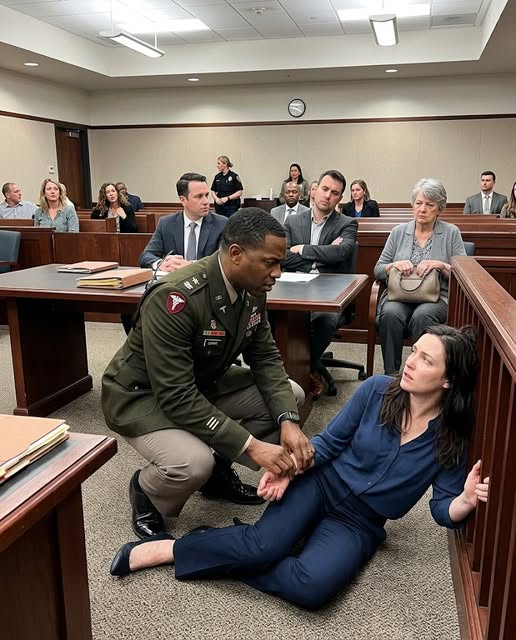
They Mocked Her Courtroom Collapse as Nothing More Than a Desperate Act to Gain Sympathy—Until a Doctor Rushed Forward, Shouted, “Call 911!” and the Entire Courtroom Realized They Had Misjudged Her in the Worst Possible Way
The bailiff reached the wall phone first.
Colonel Aaron Carter stayed beside me, one hand checking my pulse while the other kept my shoulder from rolling against the hard courtroom floor.
“Don’t try to sit up,” he said. “Stay with me. Tell me your first name.”
I knew the answer, but it took several seconds to make my mouth work.
Across the room, Daniel was still talking.
“This is exactly what I warned the court about,” he told his attorney. “She creates a crisis whenever she’s losing control.”
Colonel Carter looked over his shoulder, and whatever Daniel saw in the doctor’s face finally stopped him from moving closer.
Judge Richard Hanley ordered the center aisle cleared and directed the court reporter to preserve everything that had just been said.
Patricia stood with her purse pressed against her stomach, the unused tissues still sticking out of the top.
“She was speaking normally a minute ago,” she said. “People don’t just collapse like that.”
“They do,” Colonel Carter replied, “and arguing about it is wasting time.”
The fluorescent lights blurred into long white streaks above me as he asked whether I had eaten, whether I had chest pain, and how many times I had lost consciousness before.
I tried to tell him about the hospital visits, the dizziness, and the follow-up testing I had postponed after Daniel emptied our joint account.
Only fragments came out.
“Three visits,” I whispered. “Couldn’t finish the tests.”
Colonel Carter’s expression tightened.
The paramedics arrived with a stretcher and began taking readings while the courtroom watched from behind the rail.
One of them repeated my blood pressure because the first number seemed too low.
Daniel stepped toward the aisle.
“I’m her husband,” he said. “I can explain her history.”
I found enough strength to turn my head.
“No.”
It was one word, barely louder than the monitor beside me, but Judge Hanley heard it.
He told Daniel to remain where he was unless the emergency team requested information.
For the first time that morning, someone treated my answer as more important than my husband’s explanation.
The ambulance doors closed before Daniel could reach the courthouse steps.
At the hospital, the medical team ran bloodwork, monitored my heart, and reviewed the records from my earlier visits.
The doctor who came in that evening did not offer a dramatic diagnosis or pretend one test explained everything.
She told me the collapse had been caused by a measurable drop in blood pressure combined with an abnormal heart rhythm and severe physical stress.
The pattern in my records suggested a recurring condition that needed specialist care, not ridicule.
“You did not choose what happened in that courtroom,” she said. “And this was not a performance.”
I stared at the hospital blanket across my knees.
For months, Daniel had called every dizzy spell an episode, always with the same tone people used for a tantrum.
He had repeated the word until even I began wondering whether I was weak, unstable, or somehow causing it by being afraid.
The doctor placed copies of my discharge instructions and test results in a plain folder.
“These records won’t decide your custody case,” she said, “but they document what happened to your body. Keep that separate from what anyone claims about your character.”
That distinction felt almost unfamiliar.
Before leaving the courthouse, Colonel Carter had given the bailiff his contact information and a brief written account of what he observed.
He did not claim to know my marriage, my parenting, or the cause of my condition.
He documented only what he could support: my loss of muscle control, my delayed responses, my weak pulse, my skin temperature, the abnormal readings reported by the paramedics, and the need for immediate care.
It was narrow, factual, and devastating to the story Daniel had told.
My phone began vibrating after midnight.
Daniel’s first message said, You embarrassed yourself today.
The second said, A real medical problem makes my custody concerns stronger, not weaker.
Then came the message that changed what I understood about the emptied account.
Sign the parenting plan, stop fighting me, and I’ll restore your access to the money and cover the specialist appointments.
I read it three times.
Until then, I had believed Daniel emptied the account because he was angry and wanted to punish me during the separation.
Now he was putting the money back on the table as payment for surrendering the custody terms he wanted.
Patricia sent her own message minutes later.
Lily needs stability. Take the offer before you make this worse.
I did not answer either of them.
Instead, I asked the nurse to note that I did not consent to Daniel or Patricia entering my room or receiving medical information.
It was the first boundary I had set without explaining it until everyone else was satisfied.
Judge Hanley continued the hearing so I could recover and obtain representation.
A legal-aid attorney agreed to review the case after reading the emergency report and the messages Daniel sent from the hospital parking lot.
She warned me that one real collapse would not automatically erase months of allegations.
Daniel could still argue that a medical condition affected my ability to care for Lily.
The question was not whether I had symptoms.
The question was whether I managed them responsibly—and whether Daniel had honestly described what happened around them.
We began with the timeline Daniel had already submitted to the court.
He had listed dates under a heading called “Mother’s Unstable Incidents.”
Some entries were vague: dizzy during dinner, refused to continue conversation, lay down during disagreement.
Others included precise times, names of witnesses, and notes about Lily being present.
Daniel had intended the detail to make him look careful.
Instead, it proved he had observed the pattern for months while insisting I had invented it only when the custody dispute began.
My hospital records supplied the second part of the chronology.
On three of the dates Daniel labeled as manipulative behavior, I had sought medical care within hours.
The intake notes recorded low blood pressure, confusion, weakness, and an irregular pulse.
One report stated that I arrived without a family member even though Daniel’s own timeline placed him in the house when the episode started.
Then we compared the complete message threads with the cropped screenshots his attorney had submitted.
Daniel’s exhibits showed me asking him to come home, help with Lily, or postpone an argument.
The full conversations showed what came before and after.
On one date, I wrote, I can’t stand without the room spinning. Please take Lily to dinner and come back.
Daniel replied, You always get sick when we have plans.
On another, I told him I was on the laundry room floor and needed him to bring my phone charger because the battery was nearly dead.
He sent the message to Patricia instead.
She’s doing the dizzy thing again. If I react, she’ll keep going.
Patricia answered, Don’t reward it.
Those words did not prove they caused my condition.
They proved something more relevant to the hearing: Daniel and Patricia had made a joint decision to interpret every symptom as manipulation before checking whether I was safe.
When the hearing resumed, I entered with the hospital folder under my arm and a bottle of water in my bag.
Daniel looked directly at the folder, then leaned toward his attorney.
Patricia brought the same purse and the same tissues.
My attorney did not begin by accusing them of cruelty.
She asked Colonel Carter what he saw.
He described the collapse in clinical terms and refused every invitation to exaggerate.
When Daniel’s attorney asked whether stress could contribute to fainting, Colonel Carter said yes.
When asked whether that meant the event could be voluntary, he said no.
When asked whether he could testify that I was a fit parent, he said he had no basis to answer.
His restraint made him more credible than any angry speech could have.
Daniel’s attorney then argued that the court should focus on Lily rather than on a medical emergency involving her mother.
My attorney agreed.
“Then let’s focus on what Lily experienced during the same events Mr. Whitaker chose to document,” she said.
Daniel’s posture changed.
He had expected us to deny the episodes.
Instead, we accepted that they happened and asked why his response had always been to collect evidence rather than help.
Judge Hanley reviewed the timeline beside the hospital records.
He paused at the entry from the laundry room.
“Mr. Whitaker, your statement says you found your wife on the floor at 6:40 p.m. and believed she was pretending,” he said. “What did you do next?”
Daniel said he waited because experience taught him that attention made the behavior worse.
“How long did you wait?”
Daniel looked at his attorney.
“Maybe twenty minutes.”
“Was your daughter present?”
“She was in the house.”
“Did she see her mother on the floor?”
“I don’t know exactly what she saw.”
Patricia leaned forward before anyone asked her to speak.
“Lily was frightened because her mother frightened her,” she said. “Daniel was trying to keep the child calm.”
Judge Hanley turned toward her.
“How do you know what happened?”
Patricia said Daniel had called her.
She came to the house and found Lily near the kitchen with a phone in her hand.
“I told her not to call an ambulance,” Patricia said. “Her mother always came around.”
She said it as a defense.
The court reporter’s hands kept moving.
My attorney asked one question.
“Had you examined Mrs. Whitaker?”
“No, but I knew her pattern.”
“What medical training did you rely on when you stopped a seven-year-old from calling for help?”
Patricia’s fingers tightened around her purse.
“I was protecting my granddaughter from unnecessary drama.”
That answer changed the hearing more than Colonel Carter’s uniform, my medical folder, or Daniel’s messages.
Until then, Daniel could claim he misunderstood my symptoms.
Patricia had just admitted that a child tried to seek help and was deliberately stopped because the adults had already decided what the truth was.
Judge Hanley ordered a private, age-appropriate interview process for Lily and directed both sides not to question or coach her about the case.
Daniel objected, saying Lily was too young and easily influenced.
Then he asked that she remain with him until the process was complete.
I could have demanded that he lose all contact immediately.
Part of me wanted to.
But Lily needed safety more than I needed a public victory.
Through my attorney, I requested a temporary plan that kept her with me, allowed structured contact with Daniel, required exchanges through a neutral adult, and limited communication to written messages about Lily’s needs.
I also agreed to follow the medical plan, carry emergency information, and provide the court with confirmation that I had arranged specialist care.
Daniel’s attorney called the proposal calculated.
Judge Hanley called it specific.
The temporary order was entered that afternoon.
Lily came home to me the next day with her purple backpack, two library books, and the stuffed rabbit she still slept with when she was worried.
She stood just inside the doorway as though waiting for someone to tell her which version of the truth was allowed in my house.
I knelt slowly so I would not become dizzy.
“You are not in trouble,” I said.
Her face crumpled.
“I tried to call,” she whispered.
I pulled her against me and felt her small hands clutch the back of my sweater.
“I know.”
“Grandma said you would stop if I didn’t make it a big deal.”
“You did the right thing by trying to get help.”
“Dad took the phone.”
I closed my eyes for one breath, then opened them before she could mistake my silence for doubt.
“Calling for help is never something you have to apologize for.”
The private interview later confirmed what Lily told me that night.
She said Daniel and Patricia repeatedly described my symptoms as pretend, dramatic, or a trick to ruin plans.
Before visits with her father, Patricia practiced sentences with her about why she preferred his house.
One of those sentences was, Mom gets dizzy when she wants attention.
Lily said she hated saying it because sometimes I got dizzy while making breakfast, folding laundry, or waiting in the school pickup line—times when I was not asking anyone for anything.
She also explained the Sunday-night crying Daniel had called separation anxiety.
She cried because she was afraid I would collapse while she was gone and no one would call her.
That was the fuller truth Daniel’s timeline could not contain.
He had not merely misread a medical problem.
He had turned his interpretation into a family rule, taught it to our daughter, and then used her fear as proof that she was more stable with him.
When confronted with Lily’s account, Daniel admitted telling her not to encourage my “behavior,” but denied coaching her for court.
He blamed Patricia for using those exact words.
Patricia responded by saying Daniel had created the list of incidents and told her the custody case depended on everyone being consistent.
Their alliance finally broke, not because either one suddenly understood what they had done, but because the false story could no longer protect both of them.
Daniel then offered a settlement.
He would restore the money from the joint account, pay part of my medical expenses, and stop pursuing primary custody if I agreed to keep Lily’s statements out of any future proceedings.
The offer revealed what his courtroom arguments had hidden.
He was willing to change the custody demand, the financial pressure, and even his claims about my parenting as long as he could control the record of how he had treated Lily.
I refused.
I did not refuse because I wanted revenge or because I believed one order could repair our family.
I refused because Lily had already spent months carrying adults’ secrets in a purple backpack.
I would not make her silence the price of her own safety.
The court did not declare Daniel evil, erase him from Lily’s life, or hand me a perfect ending.
The final arrangement came after additional review, medical documentation, and time for Lily to speak without either parent in the room.
Lily’s primary residence remained with me.
Daniel received structured parenting time with clear exchange rules, written communication requirements, and a prohibition against using Lily to deliver messages or discuss the case.
Patricia was not permitted to supervise visits or question Lily about my health.
The court also required both parents to follow the emergency plan created with my medical team and Lily’s school.
My condition did not disappear because a judge finally believed it was real.
I still had appointments, medication adjustments, tired mornings, and moments when I needed to sit down before finishing an ordinary task.
What changed was that those moments were no longer treated as confessions of bad character.
Daniel returned the money only after the court addressed the account, and even then it did not undo the weeks when I had postponed care.
Our communication stayed limited to Lily’s schedule, school needs, and health information.
Patricia sent one long apology that explained more than it accepted.
I did not answer it.
Lily began meeting with a counselor who helped her separate emergencies from responsibility.
She learned that she could call an adult, follow a simple plan, and then let the adults do their jobs.
I learned to tell her when I needed to sit down without watching her face for fear.
One afternoon, several weeks after the final review, we sat at the kitchen table filling out a small emergency card for the front pocket of her backpack.
It listed my doctor’s number, two trusted contacts, and three simple steps she could follow if I became dizzy and could not answer her.
Lily read the card twice, then slid it behind the zipper.
“This stays here every time, right?” she asked.
“Yes,” I said.
She zipped the pocket closed, placed the backpack beside her shoes, and went back to coloring at the table.
For once, every time did not mean an accusation.
It meant she knew exactly where the truth was—and what to do with it.