My husband forced me to act as a maid at his graduation party, and even bragged about his mistress… but everyone was stunned when the big boss bowed to me and called me “Madam President”.
My name is Éléonore Morel. In the eyes of my husband, Laurent Dubois, I am nothing more than a simple housewife: no job, no ambition, and, according to him, no value.
What Laurent doesn’t know is that I am the secret owner of Horizon Global Holdings Group, a five-billion-euro empire, with shipping lines along the French Mediterranean coast, luxury hotels in Nice and Cannes, and technology companies based in Paris, Lyon, and other major European cities.
Why did I hide it? Because I wanted Laurent to love me for who I am, not for my money. When we met in Lyon, he was kind, hardworking, and full of dreams. But when he was promoted at the company where he worked—without knowing it was also one of my subsidiaries—he changed. He became arrogant and dismissive, and I lost the man I had fallen in love with.
The night of his graduation celebration had arrived. He had just been named Vice President of Sales for France.
I was getting ready, holding my evening gown, when Laurent walked into the room with a hanger in his hand.
“What are you doing, Eleanor?” he asked coldly. “Why do you have that dress?”
“I’m getting ready for your celebration,” I replied with a forced smile.
He laughed contemptuously. He snatched the dress from my hands and threw it on the floor.
“You’re not a guest,” he said harshly. “At this banquet, I need people who serve. We’re short on staff.”
Then he tossed the hanger at me. On it was a black server’s uniform, complete with a white apron and headband.
“Put this on. You’ll serve the drinks. That’s the only thing you know how to do, right? And one more thing… Don’t tell anyone you’re my wife. You embarrass me. Say you’re hired by the hour.”
Something broke inside me. I wanted to scream that I could buy the company he worked for. That I could fire him with a single phone call. But I stayed silent.
It was the final test.
“Very well,” I answered quietly.
When I went downstairs to the living room of our home in Paris’s 16th arrondissement, I saw a woman sitting comfortably on the sofa. It was Camille, his secretary: young, beautiful, and confident.
But what took my breath away was what she was wearing.
My grandmother’s emerald necklace—a Morel family heirloom that had disappeared from my jewelry box that very morning.
“My love, does it look good on me?” Camille asked, touching the necklace.
“It looks perfect,” Laurent replied before kissing her. “It suits you better than my wife, who has no style. Tonight you’ll sit with me at the main table. You’re the one I’ll introduce as my partner.”
I turned away in silence. As I adjusted my apron in the kitchen, I felt my dignity being stripped away, room by room… and now a piece of my family as well.
They had no idea that night would change everything.
The reception took place in the grand ballroom of a five-star hotel on Avenue Montaigne in Paris. Huge chandeliers lit the room, and a quartet played soft jazz while executives, investors, and managers raised their champagne glasses.
I entered through the back door, carrying a tray of drinks, my black uniform perfectly pressed. No one paid attention to me. I was invisible, exactly as Laurent wanted.
I spotted him immediately.
Standing in the center of the room, confident, shaking hands, smiling with pride. Beside him was Camille, dressed in an elegant red suit and wearing my grandmother’s emerald necklace as if it belonged to her.
Each step I took between the tables reminded me how far things had fallen… and how wrong I had been to keep hoping he would change.
“Mademoiselle, another glass,” one of the guests ordered without even looking at me.
I served in silence.
I passed the main table just as Laurent raised his glass.
“Thank you all for being here on such an important night. This promotion marks the beginning of a new phase for the company… and for me.”
Applause.
Camille placed her hand on his arm, feigning intimacy.
“And I want to especially thank my partner, who has always supported me,” he added, looking at her with a smile that once belonged to me.
A knot formed in my throat, but I kept moving.
Then something unexpected happened.
The large ballroom doors opened, and the murmur immediately died down.
The global CEO of the group, Alexandre Rivas, entered, accompanied by several members of the international board. His presence was unplanned; no one expected him to come from New York just for this celebration.
Laurent stiffened, surprised, and immediately adopted his professional smile.
“Mr. Rivas! What an honor to welcome you.”
Everyone stood. I kept my back turned, arranging glasses on a table.
I felt footsteps approaching.
“I was looking for someone in particular,” Rivas said.
Laurent looked confused.
“Someone? Who?”
Rivas didn’t answer. He walked straight toward me.
The entire room fell silent.
I turned slowly.
Our eyes met, and he smiled with genuine respect.
Then, before the astonished gazes of more than a hundred guests, the CEO gave a slight bow and declared clearly:
“Good evening, Madame President. We’re delighted to finally see you back.”
The sound of a glass shattering on the floor was the only noise that followed.
Camille froze. Laurent turned pale.
Whispers spread through the room.
“President?”
“What did he say?”
“Who is she?”
Laurent stepped forward, incredulous.
“There must be a mistake… She’s my wife… well… a housewife…”
Rivas looked at him with a mix of surprise and disapproval.
“A housewife?” he repeated. “Mr. Dubois, allow me to formally introduce the majority shareholder and CEO of Horizon Global Holdings.”
The silence grew heavy.
Someone dropped another glass. Others discreetly pulled out their phones.
I set the tray on a table and calmly removed the headband and apron. Underneath, I wore the elegant black dress I had hidden beneath the uniform.
The transformation was instant.
I walked toward Laurent.
His face was falling apart.
“Éléonore… I… I didn’t know…”
“I know,” I replied firmly. “That’s why I endured it for so long.”
I turned to Camille.
“That necklace belongs to my family. I would appreciate it if you returned it.”
Her hands trembled as she removed it from her neck.
Laurent was sweating.
“Darling… we can talk about this at home…”
I looked him straight in the eyes.
“No. It ends here.”
I took the necklace and continued:
“I gave you my love when you had nothing. I believed in you when no one else did. But you confused growth with superiority. And you confused patience with weakness.”
The executives watched in absolute silence.
Rivas intervened:
“Mr. Dubois, your position depends directly on decisions made by the board chaired by Madame Morel.”
Laurent gasped.
“Éléonore… please…”
I interrupted him.
“Don’t worry. I’m not firing you.”
Relief flashed briefly across his face.
“Because you just resigned. Here and now.”
A murmur swept through the room.
“I want you to receive exactly what you deserve: to start over… without anyone clearing the path for you.”
Hotel security discreetly approached.
Camille tried to speak.
“I didn’t know that…”
I looked at her.
“You knew perfectly well he was married.”
She said nothing more.
Rivas offered me his arm.
“The board is waiting for you for the official toast.”
I took a deep breath and walked toward the stage, leaving behind the life I had tried to save.
I took the microphone.
“Tonight we celebrate the growth of our company. But I would like to remind you of one essential thing: no success is worth losing our humanity.”
Sincere applause filled the room.
From the stage, I watched Laurent being escorted out, defeated, understanding too late whom he had despised.
And for the first time in years…
I felt free.
But as I stepped down from the stage, my personal assistant approached, looking worried.
“Madame President… There’s a problem.”
“What is it?”
She lowered her voice.
“One of our subsidiaries in Lyon has just been hacked. And everything points to someone from inside… someone very close to you.”
My heart quickened.
Because only three people had access to that information…
and one of them had lost everything that very night.
The real battle had just begun.
The news fell like icy rain.
“Who else has access?” I asked, walking toward a private room.
My assistant replied:
“You, the CFO… and your husband. His authorizations were still active.”
I stopped.
Of course.
Laurent had tried to take something before falling. Perhaps money. Perhaps information. Perhaps just revenge.
I took a deep breath. I felt no anger. Only a quiet sadness… and the certainty that I had to close this chapter properly.
“Block all access and activate the security protocol. And call our legal team,” I ordered.
Thirty minutes later, technicians confirmed that the sabotage attempt had been stopped in time. No losses. Only a digital trail leading directly to Laurent Dubois’s user account.
The company was safe.
So was I.
At dawn, I returned home. Our home. Or rather, the one we once shared.
The lights were off. An open suitcase in the living room suggested he had come back to collect some belongings. When I entered, he appeared in the hallway, defeated, eyes red.
There was no arrogance left. Only fear.
“Éléonore… I didn’t mean to hurt you. I was… desperate.”
I looked at him in silence.
“You didn’t lose your job tonight, Laurent,” I said calmly. “You lost the person who believed in you the most.”
His voice broke.
“I love you… I got carried away.”
I gently shook my head.
“No. You fell in love with the image of yourself you thought was superior. And to feel big, you needed to make me small.”
Silence filled the room.
I took my grandmother’s necklace from my bag and held it for a moment.
“This necklace has survived wars, bankruptcies, and losses in my family. My grandmother used to say the real value isn’t the gold… it’s knowing who you are when no one is watching.”
I put it away.
“And I know who I am.”
He lowered his gaze.
“What will happen to me?”
I answered honestly:
“The same as anyone who falls: you can get back up… but you’ll have to do it alone.”
I picked up my suitcase, ready to leave.
“The divorce will be finalized in a few days. The house will remain yours until you stabilize. I don’t need anything from here.”
He stood still, as if finally understanding that this was truly the end.
I walked to the door, but before leaving I added:
“Thank you, Laurent.”
He looked at me, surprised.
“Why?”
“Because today I understood that I don’t have to hide to be loved.”
And I closed the door.
Six months later, Horizon Global launched an international program to support female entrepreneurs forced to restart after abusive relationships or financial failure.
The press called the project “Rebirth.”
At the inauguration, a journalist asked me:
“Madame Morel, after everything that happened, do you still believe in love?”
I smiled.
“Of course. But now I know that love is not something you beg for, hide, or sacrifice at the cost of your dignity.”
I looked at the audience, filled with women and men ready to seize new opportunities.
“And when you learn to respect yourself—life always offers a new beginning.”
Applause filled the auditorium.
That night, on my way home, I took off my heels and looked at the illuminated city through the car window.
For the first time in a long time, there were no more secrets, no more tests to pass, no more masks to wear.
Only peace.
And I understood something simple, yet powerful:
The real promotion that night… was never Laurent’s.
It was mine.
And this time, no one would ever make me feel less than who I am again.Inside the bundle was a folded property deed, a pawn receipt dated twenty seven years earlier, and a photograph with curled edges. In the photo, a much younger woman stood before a half built brick home while holding a boy in her arms.
The boy’s face was feverish and thin, but his features were unmistakable. It was Gavin.
At the bottom of the bundle lay one more paper, folded carefully despite the years. The first line, written in a slanted feminine hand, made his fingers shake.
“If my son ever stands in this house as its owner, he must know whose roof he is standing on,” the letter read.
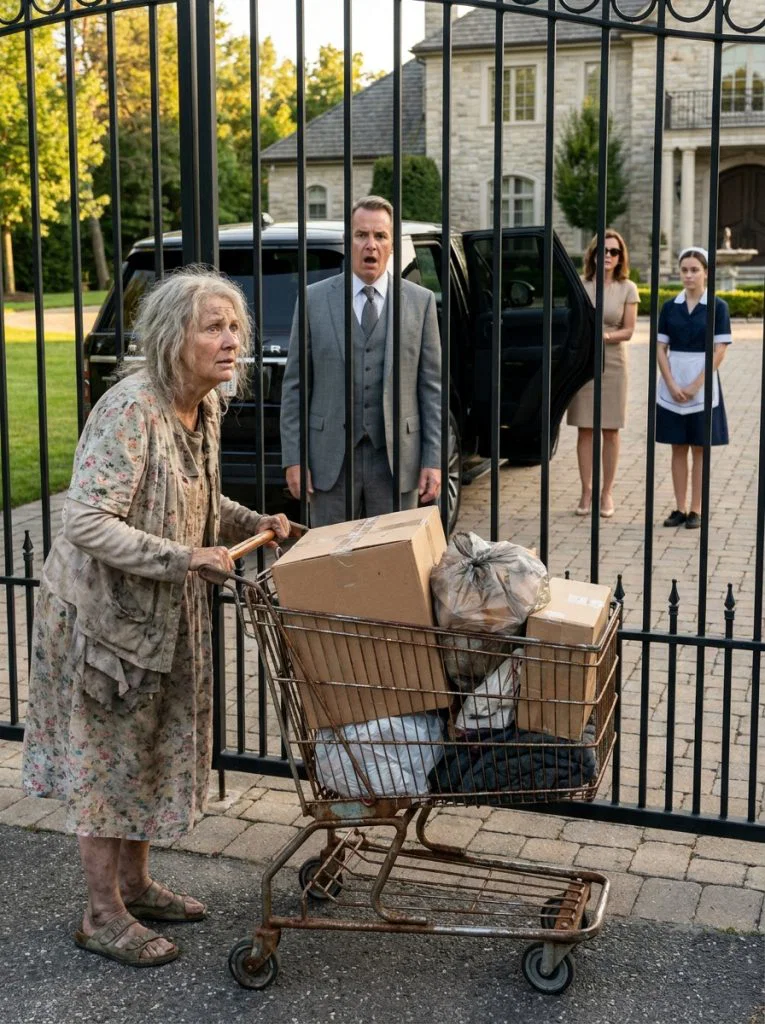
The first investors were already arriving. Doors opened farther down the driveway as men in summer suits stepped out and adjusted their jackets.
They paused only when they noticed that their host was not greeting them at the entrance. Instead, he was standing face to face with a ragged woman and a broken cart.
Victoria forced a laugh that landed nowhere. “Gavin, please, this is not the time for this,” she pleaded.
But he seemed not to hear her. He looked up at the woman, and a name long buried under years of meetings and polished surfaces rose from some untouched corner of his childhood.
“Mabel,” he said.
Her expression did not soften into triumph. It only softened into a deep weariness.
“Yes,” she answered. “Though not many remember it now.”
When Gavin was eight years old, there had been no mansion or investor dinners. There had only been a narrow lot on the edge of town and a cinderblock house with patched walls.
His father, Gideon Prescott, had not yet become the man whose surname carried weight. He was a builder with callused hands and an ambition too large for the rooms he lived in.
Gavin’s mother, Iris, stretched every meal until it became enough by sheer force of will. And next door, in a tiny house with a lemon tree out front, lived Mabel and Hank Higgins.
Mabel washed clothes for wealthier families and sold food in the mornings. Hank was a quiet mason who fixed a neighbor’s wall before fixing his own.
Promoted Content
Their house was small, but the lot beneath it mattered immensely. It had belonged to Mabel’s mother, and with it came a legal title and a working well.
Iris and Mabel became close because women with little often understand one another faster than women with everything. When Gavin scraped his knees, it was Mabel who blew on the wound while Iris stirred beans over the stove.
When Mabel lost her own infant daughter, she poured that stranded love into little Gavin. He began calling her Auntie Mabel before he could even speak clearly.
Then came Gideon’s big chance. A damaged parcel on the hillside went up for sale because nobody believed anything could be built there.
Gideon was certain it could become the beginning of something much larger. But certainty is cheap, and collateral is not.
The bank would not listen to his plans. They would, however, consider a loan if someone with land signed beside him.
Hank hesitated to risk everything they owned. But Mabel did not forget who had sat with her on the floor after her baby’s funeral.
She placed her mother’s title papers on the table and signed the documents. Gideon promised the debt would be settled in six months.
Iris cried when she hugged her friend. “When we build a real house, you will never stand outside its door,” she promised.
Six months passed, and while the business did not fail, it did not repay the loan quickly either. Every cent went into cement, labor, and survival.
Then, during one scorching August, Gavin collapsed with a raging infection. The hospital demanded a deposit before they would admit him for treatment.
Gideon had money on paper but no cash in hand. Iris begged the doctors, but they wavered.
Mabel left the hospital without a word and walked to a pawn broker. She removed the only gold rings she had left from her wedding and placed them on the counter.
By evening, the deposit was paid. Gavin was admitted and he lived.
That night, Iris removed the medal she wore on a red thread and tied it around Mabel’s wrist. “Until I can repay you properly, keep this so heaven knows which of us it still owes,” Iris whispered.
The promised repayment never arrived in the shape it should have. Gideon’s business began to rise, but success came like floodwater, carrying urgency with it.
There was always one more reason why the debt needed to wait another month. Hank kept working for Prescott Construction because Gideon swore the books would be settled soon.
Then, one windy afternoon, a scaffold gave way at a hotel site. Hank shoved three men clear and took the impact himself.
He died before Mabel could even reach the clinic. Compensation was promised, and papers were filed, but the meetings were always postponed.
Mabel received condolences, and then she received nothing but silence. Iris never stopped carrying the shame of it.
She sent food when she could and slipped cash into Mabel’s hand whenever Gideon was not looking. She wrote letters that she did not know how to make big enough for what had happened.
But illness came for Iris early. By the time Gavin turned fifteen, she was gone.
Gideon sent his son to boarding school abroad and buried his grief in expansion. Mabel’s lot was eventually absorbed during a land consolidation she could not afford to challenge.
Years later, when the empire rose high enough to build a mansion, part of the garden stood over land that had once been hers. Gavin returned from abroad as an efficient man carrying too many inherited assumptions.
Gideon died not long after. The empire passed to Gavin, who grew it further until his face was in every magazine.
Then he married Victoria, who excelled at the removal of anything that threatened her perfect image. The first time Mabel came to the new house, Victoria received her at the gate and did not care.
The second time, she told security to keep beggars away. The third time, the envelope returned unopened.
After that, Mabel stopped coming. Dignity has its own threshold for being spat on.
Now, years later, Gavin stood in his own driveway with his mother’s handwriting trembling in his hands. He unfolded the letter fully while the investors watched from a distance.
The page smelled faintly of old drawers and time. Iris’s words were careful, appearing almost apologetic.
She told him the truth about Mabel and Hank. She wrote that the land beneath his home would carry their names whether the law remembered it or not.
She wrote that Mabel’s rings had paid for the bed where her son survived. She wrote that Hank died building the fortune that now spoke of itself as destiny.“If one day you become a man this city respects, do not let that respect cost you your soul,” the letter said. “No wall raised on gratitude should ever close itself to the thirsty.”
Victoria tried to intervene once more. “Gavin, enough of this, because we can have someone handle this tomorrow,” she said.
She lowered her voice while glancing toward the investors. “You’re making a scene over old papers and a woman who could be lying to you.”
Mabel did not answer. She seemed too tired to defend herself again.
Gavin turned to the senior attorney among the guests, a man named Lawson Pendergast. “Look at this,” Gavin said.
Lawson took the deed and read the old registration stamps. “This is real, and if this release was never executed, then the western parcel was never lawfully cleared,” Lawson stated.
Victoria stared at him as if betrayal had just changed clothes. The silence that followed was structural.
It was the sound of a house discovering that its beauty had been built on denial. Gavin looked toward the staff who had laughed earlier.
“Brenda,” he said, and the girl jumped. “Bring her a glass. No, bring the silver tray with crystal and cold water.”
Brenda ran to comply. When she returned, her hands were shaking so hard the glasses chimed.
Gavin took a glass himself and held it out to Mabel with both hands. She looked at him for a long second before accepting it.
She drank slowly. That, more than anything, seemed to undo him.
He led her inside the house. Victoria stepped in front of the doorway.
“She cannot go in there like that with the guests watching,” Victoria hissed.
“The guests can watch, because tonight they should see what kind of house they are entering,” Gavin replied.
Promoted Content
So Mabel crossed the threshold she had been denied. Her worn sandals touched the polished stone while the investors stood aside.
No one dared to object. In the dining room, Gavin placed the bundle on the table where the contracts were meant to be signed.
He called for the family archives and the estate files. People hurried because real power had finally chosen a direction.
The records came, and what years of indifference had hidden began to surface. The compensation file for Hank had been marked pending and then buried.
The collateral on Mabel’s lot had never been lawfully restored. A payment Gideon drafted but never delivered was found unsigned in an old ledger.
More damning still, two of Mabel’s later letters had indeed reached the house. Victoria had instructed staff to return them without bringing them to Gavin.
One note in a log stated that the lady of the house does not receive street people. The sentence sat on the page like rot brought into the sunlight.
Victoria’s face hardened. “I was protecting you, because people like her hear one old story and decide they deserve your life,” she said.
Gavin turned to her with a cold calm. “She does not deserve my life, but she deserved justice before I ever had this life to live,” he said.
He looked around the room at the men who had come to discuss expansion. “Gentlemen, tonight’s meeting is over,” he announced.
“Any business that cannot survive the truth is not business I want,” he added.
By the next afternoon, the first transfers had begun. Lawson oversaw the legal correction personally.
A restitution fund was opened in the names of Mabel and Hank Higgins. It was calculated as a reckoning of the original value of the land compounded across the years.
Gavin also did something that made the newspapers. The western garden and the fountain Victoria loved were removed.
In its place, he built a shaded public water station and a stone courtyard. It was engraved with the names of Mabel and Hank Higgins.
Mabel did not move into the mansion. When Gavin offered, she simply smiled with exhaustion.
“I did not come here to become part of your furniture,” she told him.
Instead, he bought her a small sunlit house near the market. It had a real kitchen and a lemon tree out front.
He arranged for her medical care. He asked for her forgiveness more than once.
She did not rush to give it to him. Some wounds close slowly because they were ignored for too long.
But she did begin to let him visit once a week. As for Victoria, she did not leave dramatically.
There was only the long, humiliating collapse of a woman discovering that polished cruelty still counts as cruelty. Gavin moved her out of the master suite within days.
Lawyers became involved soon after. Society whispered for a month and then moved on toward newer scandals.
But the household never forgot the image of the woman in broken sandals. They remembered her being led through the front door while the lady of the house stood powerless.
Months later, a delivery boy stopped outside the gate. He asked the new guard if he could have a little water.
The guard did not hesitate. Neither did Brenda, who now worked under very different instructions.
She opened the gate herself and carried out a cold glass. From the courtyard, Mabel watched the scene with Gavin beside her.
He glanced at her, asking silently if a debt like this could ever be settled. Mabel looked toward the gate where no thirsty person would be turned away again.
“Now the house is beginning to pay,” she said.
The place finally felt less like a monument to wealth. It felt like a home that had remembered the cost of becoming one.