The heat in the Maldives did not feel natural that afternoon.
It felt staged, like the whole island had been upholstered in money and left under a spotlight.
From the teak deck outside the reception pavilion, I could smell salt, orchids, sunscreen, and the cold metallic scent of champagne being poured too fast.
My family drifted through the luxury as if they had finally entered the world they always believed they deserved.
None of them knew I was the one who had paid for every polished inch of it.
My sister Sarah was in the middle of the room, wrapped in layers of hand-stitched lace and praise.
Every time she laughed, my mother laughed harder.
Every time Greg lifted a glass, my father watched him with the kind of approval he had never once given me.
I stood at the edge of the deck with my daughter, Mia, trying to stay invisible in a place I technically owned.
‘Elena, don’t just stand there sulking,’ my mother called across the tables.
She was fanning herself with ridiculous peacock feathers someone from the styling team had brought out for photos.
Her eyes dragged over my plain gray silk dress with naked disgust.
‘You look like a hotel manager who wandered into the wrong event.’
A few guests laughed politely because they thought she was joking.
She was not.
‘Honestly,’ she went on, lowering her voice just enough to make it sharper, ‘thirty years old, a single mother, still clinging to that dreary accounting work.
If Sarah hadn’t begged me, I would not have wasted a first-class ticket on someone determined to be a disappointment.’
My father lifted his drink and joined in the way he always did, like cruelty was a duet they had perfected over decades.
‘Mind your manners tonight.
We are among people of means.
Try not to let your poverty pollute the atmosphere.
Greg rented a private island for two million dollars and flew everyone here without blinking.
That is class.
That is what a successful man looks like.’
He said it loudly enough for Greg’s parents to hear.
Greg’s mother smiled a stiff little smile into her champagne.
Greg himself looked at me for a fraction of a second and then away.
That look meant something.
It meant he knew the truth.
My family had always built itself around a simple structure.
Sarah was the star.
I was the warning.
When Sarah forgot homework, she was creative.
When I brought home straight A’s, I was showing off.
When Sarah maxed out credit cards in college, she was learning life lessons.
When Mia’s father walked out before her first birthday and I started working nights to cover rent, my parents told me I had made my bed and should stop expecting sympathy.
So I stopped explaining myself to them.
While they were telling relatives I was a glorified bookkeeper, I was building a forensic accounting firm from a secondhand desk in a one-bedroom apartment.
It started with fraud audits for small businesses, then larger cases, then corporate recovery work.
By the time Mia turned six, I had sold a majority stake, kept a substantial share, and bought a private island resort through a holding company that did not carry my name.
I still worked because I liked working.
My family translated that as proof I was still struggling.
I let them.
Three months before the wedding, Greg called me from an airport bathroom in Miami.
I could hear the echo of hand dryers and panic in his throat.
Sarah wanted a destination wedding with imported flowers, custom fireworks, a sunset orchestra, villas for both families, and a reception on a private island.
He had spent months pretending he could afford it because my parents treated wealth like virtue and he wanted their approval almost as badly as Sarah did.
‘I can’t cover it,’ he said.
‘Not even close.
She’ll humiliate me if I back out now.’
I should have hung up.
Instead I asked how short he was.
His silence told me everything.
By the end of that week, my events team had moved the entire wedding under my hospitality company.
Greg signed a confidentiality agreement.
My holding company covered the bill.
The official guest-facing paperwork named a luxury concierge group, and my family filled in the rest on their own.
They saw the ocean, the villas, the chef flown in from Singapore, the private seaplane transfers, and decided Greg’s family must be obscenely rich.
Nobody asked questions because the lie was prettier than the truth.
I agreed to the arrangement for one humiliating reason and one practical one.
The practical reason was that destination paperwork for the legal marriage would not be finalized until the next morning in Malé, so everything that happened on the island could still be stopped if something went wrong.
The humiliating reason was harder to admit.
Some broken part of me still hoped that if I gave Sarah the day she wanted, my daughter and I might make it through one family event without being treated like stains on the tablecloth.
By sunset, I knew better.
Mia had been trying so hard all day.
She was eight, careful, bright, and overly polite around my family because she had already learned the cost of taking up space near them.
Her hair was braided with tiny white flowers.
She had spent most of the reception counting lanterns and sneaking glances at the water because the stingrays near the dock fascinated her.
When the orchestra shifted into something soft and sweeping, Sarah turned to display the ridiculous length of her gown’s train for photos.
Mia stepped back to avoid a waiter carrying drinks.
Her sandal caught the lace.
The fabric pulled.
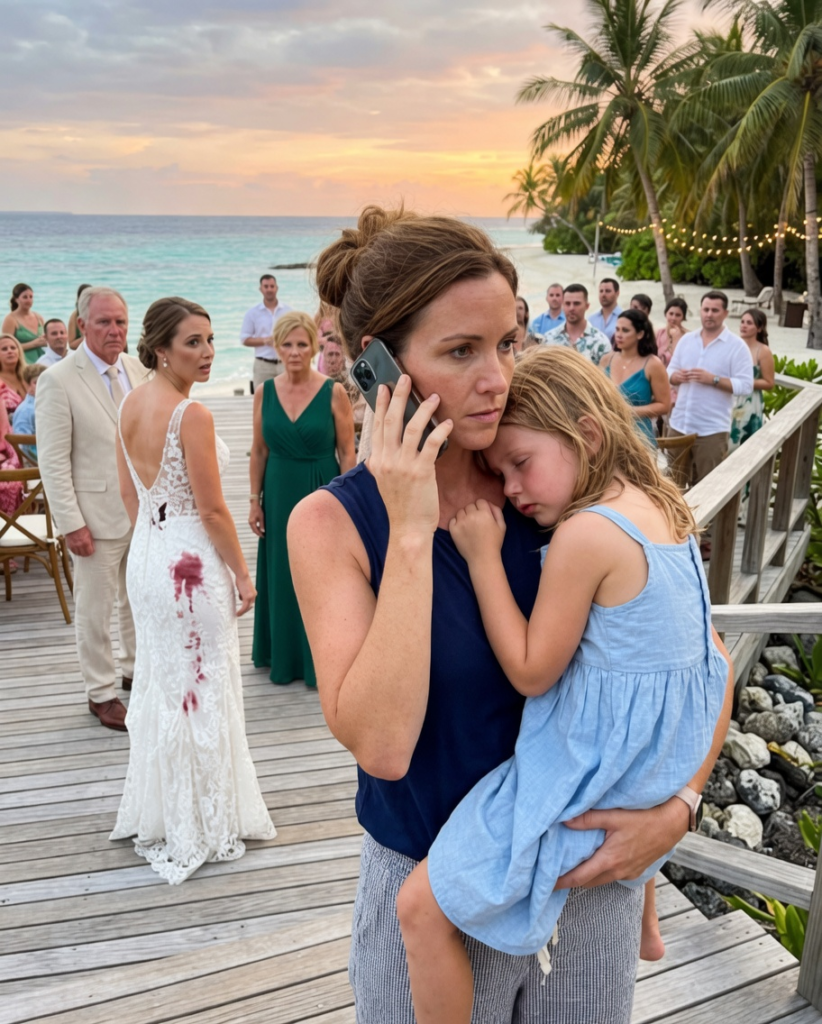
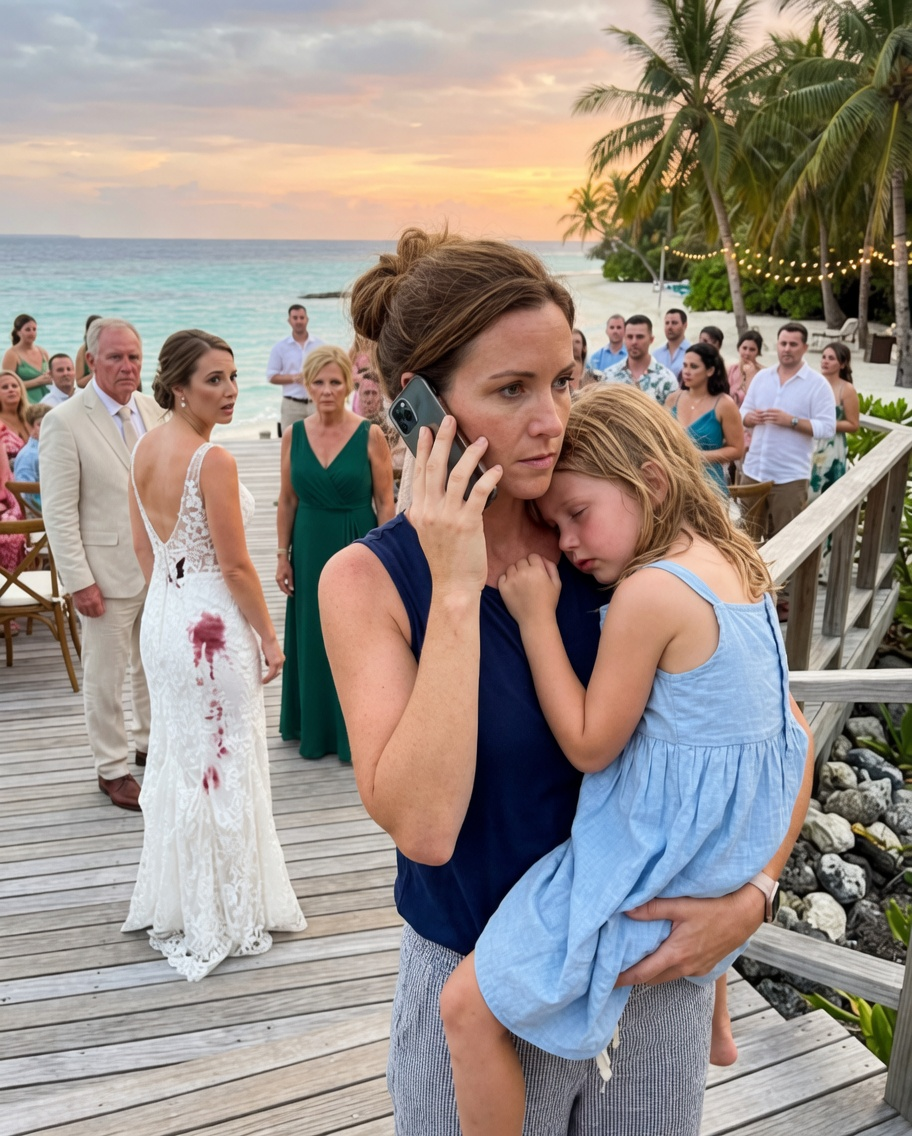
There was one awful ripping sound, loud enough to cut through the music, and the glass of red wine in Sarah’s hand sloshed across the white embroidery.
Everything stopped.
Sarah looked down at the stain.
Then she looked at Mia.
I saw the change in her face before I saw the movement.
The bride’s smile vanished.
Her features twisted into something raw and ugly.
She gave a scream that did not sound human, lunged forward, and shoved both hands into my daughter’s chest.
Mia flew backward over the low wooden railing beside the deck.
There was a two-meter drop to the decorative rock garden that edged the sand.
I heard the crack of small bodies meeting hard surfaces in a sequence my brain still replays when the house is quiet.
Mia hit the rocks, rolled once, and ended up crumpled near the edge of the beach.
I ran.
I do not remember dropping my water glass.
I remember my own voice tearing out of me.
I remember the rail digging into my palms as I leaned over it and saw Mia struggling to breathe, one arm trapped awkwardly under her.
I remember the tiny line of red at her hairline and the impossible wrongness of my child’s body on the stones below.
I grabbed my phone and hit 911 out of pure instinct.
My mother slapped my hand so hard the phone skidded across the deck.
‘Have you lost your mind?’ she hissed.
‘Stop ruining her big day, you jealous loser.’
I stared at her, unable to process the sentence.
Down below, my father was already scrambling halfway toward Mia, not to help her but to force the scene out of sight.
He crouched beside her and started striking her cheeks with the flat of his hand, sharp and impatient, like she was a child faking sleep before school.
‘Get up,’ he barked.
‘Stop pretending.
Do not make a spectacle.’
Mia cried out once and tried to curl away.
Greg stood three feet from me, white as the table linens.
He looked at Sarah, then at me, then at the guests who had begun to rise from their chairs.
He opened his mouth, closed it, and did nothing.
Something inside me did not explode.
It went quiet.
That was the worst part.
There was no dramatic surge, no shaking, no wild screaming.
The rage inside me became cold and organized.
I picked up my phone, wiped the screen with my thumb, and called the only person on the island who would move before asking permission.
Marcus answered on the first ring.
‘Code Red,’ I said.
His reply came instantly.
‘Confirmed.
Medical team en route.
Host privileges suspended.
Preserving deck footage now.’
Then I climbed down to my daughter.
Her body felt too light in my arms.
Children are supposed to feel warm and solid and alive with resistance.
Mia felt fragile, like one wrong grip might break something else.
She was conscious, barely, and trying not to cry because she knew the sound upset me.
‘I didn’t mean to step on it,’ she whispered.
‘You don’t have to explain anything,’ I told her.
‘I’ve got you.’
By the time I reached the clinic suite on the east side of the island, the music had cut off mid-note.
The string lights along the reception canopy blinked dark.
Bar service stopped.
The fireworks team received a call and began hauling crates away from the beach.
Guests in formalwear turned toward one another in confused clusters while medics in white resort uniforms rushed past them with a trauma bag and collapsible stretcher.
Marcus met us at the clinic doors with two nurses.
He was in a cream linen jacket because he had been supervising the event, but his face had gone flat with professional fury.
He took one look at Mia’s arm and moved aside.
The doctor on duty worked quickly.
Mild concussion.
Fractured wrist.
Deep bruising along her shoulder and ribs.
A few stitches near the hairline.
Nothing life-threatening, which felt like a miracle large enough to split me open.
When they finished cleaning her up and set her arm, Mia fell asleep with tear tracks dried on her face.
I sat beside the bed and stroked the uninjured side of her hair until my hand stopped shaking.
Marcus returned ten minutes later with a tablet and closed the clinic door behind him.
‘We have three camera angles from the west deck,’ he said.
‘The push is clear.
Your mother’s interference is clear.
Your father striking the child is also clear.
Security has isolated the footage.
Local authorities from the neighboring island are on their way if you want to proceed.’
‘Proceed,’ I said.
He nodded once.
‘Do you want your ownership disclosed?’
I looked through the glass panel in the door.
Outside, Sarah was pacing barefoot on the stone path, dress gathered in both fists, still screaming about ruined lace.
My mother kept jabbing her finger toward the clinic as if I were the offender.
My father had finally found enough sense to look nervous.
Greg stood apart from them all, staring at the ground.
‘Yes,’ I said.
‘No more hiding.’
Before Marcus could leave, there was a knock.
Greg stepped inside alone.
He had taken off his jacket and loosened his tie, but it did not make him look less cornered.
He looked like a man who had just discovered cowardice was also a public outfit.
‘I am so sorry,’ he said.
I stared at him until he had to look away.
‘I never thought Sarah would do something like that,’ he continued.
‘I thought she’d yell.
I thought she’d blame me for the dress.
I never thought—’
‘You never thought because thinking would have required courage,’ I said.
‘You knew my family was cruel.
You knew I paid for this entire wedding so you could pretend to be the man they wanted.
And when my daughter went over that railing, you froze.’
His eyes filled, but I felt nothing for him.
Not then.
‘Please,’ he said quietly.
‘Don’t let this get any worse.’
I almost laughed.
‘It already is as bad as it gets,’ I told him.
‘There is no version of this where the adults who did this walk away because the flowers were expensive.’
He shut his eyes for one second and nodded like a man accepting a sentence he had written himself.
When Mia was resting and the doctor promised to stay with her, I stood up.
I washed my face, smoothed my dress, and walked back toward the reception pavilion with Marcus beside me.
The sky had darkened to deep blue.
Without the event lighting, the pavilion looked less like a fantasy and more like scaffolding dressed in silk.
The guests had not left.
They had gathered in uneasy pockets around the tables, whispering over half-finished meals.
Sarah’s makeup had been hastily retouched, but nothing could repair the frenzy in her eyes.
My mother folded her arms the moment she saw me, already preparing another speech about family unity and public embarrassment.
Marcus reached the center of the room and took the microphone from the bandstand.
The first sentence he spoke shattered the last of the illusion.
‘Good evening.
Effective immediately, this event has been terminated by order of the island owner and contracting principal, Ms.
Elena Vale.’
The silence that followed was so complete I could hear the tide against the pilings.
My mother laughed first because denial had always been her preferred form of self-defense.
‘Don’t be ridiculous,’ she snapped.
‘My daughter could never afford this place.’
Marcus turned the tablet toward her.
On the screen was the master contract, the wire confirmations, the event approval chain, and my signature.
He did not rush.
He did not raise his voice.
He simply let the facts sit there in the air until they became heavier than any lie in the room.
My father looked at Greg.
Greg’s father looked at Greg.
And Greg, to his credit or maybe just because there was nothing left to save, finally told the truth.
‘Elena paid for everything,’ he said hoarsely.
‘I asked her for help.
I couldn’t cover the wedding Sarah wanted.
She agreed to keep it private.’
Sarah turned on him as if she might rip him apart with her bare hands.
‘You pathetic liar,’ she screamed.
‘You let her stand there and make me look stupid?’
Greg flinched, then did something he should have done hours earlier.
He stepped away from her.
I moved closer, close enough that everyone could see there was no trembling left in me.
‘My daughter is in the clinic with a concussion and a broken wrist because Sarah shoved her off that deck.
My mother stopped me from calling emergency services.
My father struck an injured child and told her to stop pretending.
This event is over.’
Right on cue, the local officers arrived through the open side of the pavilion with island security behind them.
Marcus handed over the footage.
Sarah started shouting about accidents and children being careless, but the video was merciless.
It showed the rip in the dress, the wine, Sarah’s face hardening, both hands shoving forward.
It showed my mother slapping my hand away from my phone.
It showed my father hitting Mia’s cheeks while she cried.
The officers separated them one by one.
Sarah kept insisting it was stress, that she had reacted without thinking, that no real harm was done.
One of the officers watched the clip again and asked her if that was truly the statement she wanted on record.
The color drained from her face.
My mother began to sob the instant she realized tears might accomplish what intimidation no longer could.
My father tried bluster, then silence, then outrage.
None of it worked.
Sarah was taken into custody pending assault charges involving a minor.
My parents were formally removed from the clinic area and ordered to provide statements regarding interference with emergency care and physical contact with an injured child.
Guests turned away from them in waves, the social temperature dropping faster than the lights had.
Greg stood still through all of it.
When the officers finished with Sarah, he took off his wedding band and placed it on the table beside the ruined centerpiece.
Because the destination paperwork had not yet been finalized, there would be no legal marriage to complete the next morning.
He said it quietly, not to me, but to the room.
‘I’m not signing anything,’ he said.
His mother closed her eyes.
His father looked older by ten years.
Neither of them tried to defend Sarah.
Once the authorities had what they needed, I gave Marcus new instructions.
Innocent guests would be transferred to the mainland resort at my expense for the remainder of the weekend.
Staff would be paid in full, plus hazard bonuses.
No one who had helped my family mock my daughter would set foot in my private villas again.
My parents’ suites were closed.
Their return travel would be commercial and charged to their own cards.
Some people called that cruel.
None of those people had picked an eight-year-old up off rocks.
I went back to the clinic just before midnight.
Mia was awake, pale and sleepy, her small arm wrapped in a cast.
The minute she saw me, her eyes filled with panic.
‘Did I ruin the wedding?’ she whispered.
I sat beside her and pressed my forehead to hers.
‘No, sweetheart,’ I said.
‘The grown-ups ruined it.
Not you.’
She searched my face like children do when they are deciding whether the world is still trustworthy.
Then she nodded and let herself lean into me.
That was the first moment all night that I allowed myself to shake.
My parents tried once more the next morning.
My mother cornered me near the dock while security stood several feet away pretending not to listen.
Her mascara had run, and for the first time in my life she looked less powerful than desperate.
‘Families do not call the police on each other,’ she said.
I looked at the woman who had slapped my hand away from my injured child and felt something colder than anger.
‘Families do not throw children off decks,’ I replied.
‘Families do not hit them to keep a reception on schedule.’
She opened her mouth, but there was nothing left to say that would not sound exactly like what she was.
I spent three more days on the island with Mia after everyone else was gone.
We stayed in a different villa, away from the reception deck.
She slept badly the first night, then better the second.
By the third morning she was sitting on the sand with a juice box tucked against her cast, naming the fish that drifted through the shallows.
Healing did not look dramatic.
It looked like tiny permissions returning one by one.
In the weeks that followed, Greg gave a full statement.
Sarah’s attorneys tried to paint the shove as a terrible burst of bridal stress, but the footage left very little room for fiction.
I obtained restraining orders against my parents and sister.
My mother’s voicemails moved from fury to pleading to wounded confusion.
My father sent exactly one message telling me I had disgraced the family name.
I blocked the number before he finished the sentence.
Relatives split into camps with startling speed.
Some said I had done the right thing because a child had been hurt and there had to be consequences.
Others said I should have handled it privately, that public humiliation had made everything worse, that Sarah had simply snapped under pressure.
Those were usually the relatives who had always confused appearances with innocence.
The last voicemail from my mother called it all a tragic misunderstanding and asked whether I really wanted to lose my whole family over one bad moment.
I deleted it while Mia, still wearing her cast, ran barefoot at low tide and laughed at a crab digging sideways into the wet sand.
Some people will always wonder whether I went too far that night.
I still wonder something else entirely: how close I came to not going far enough.