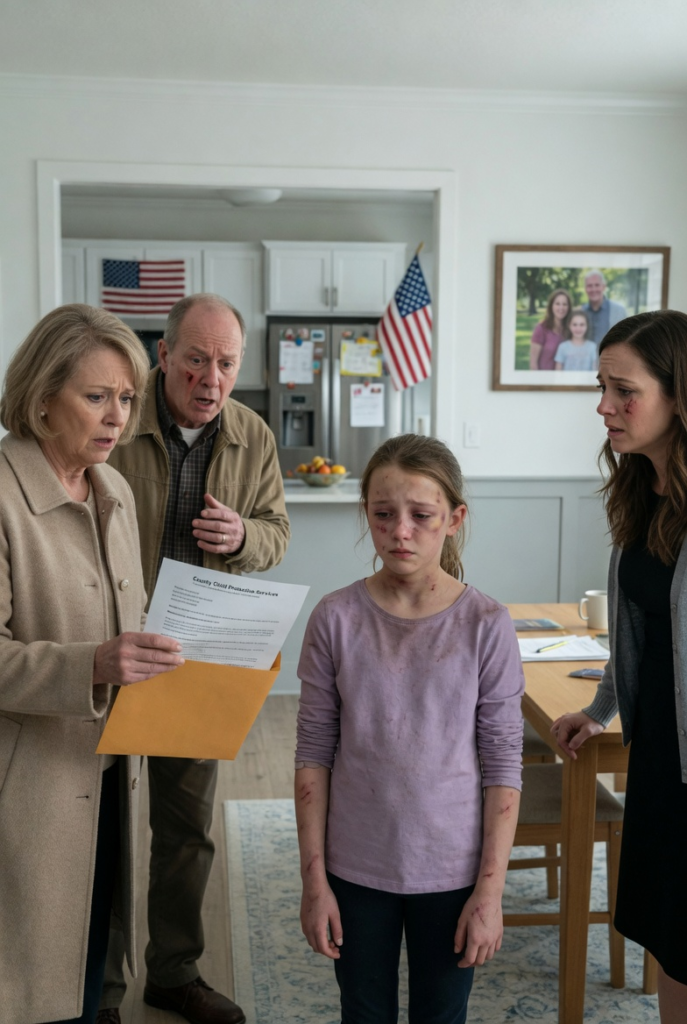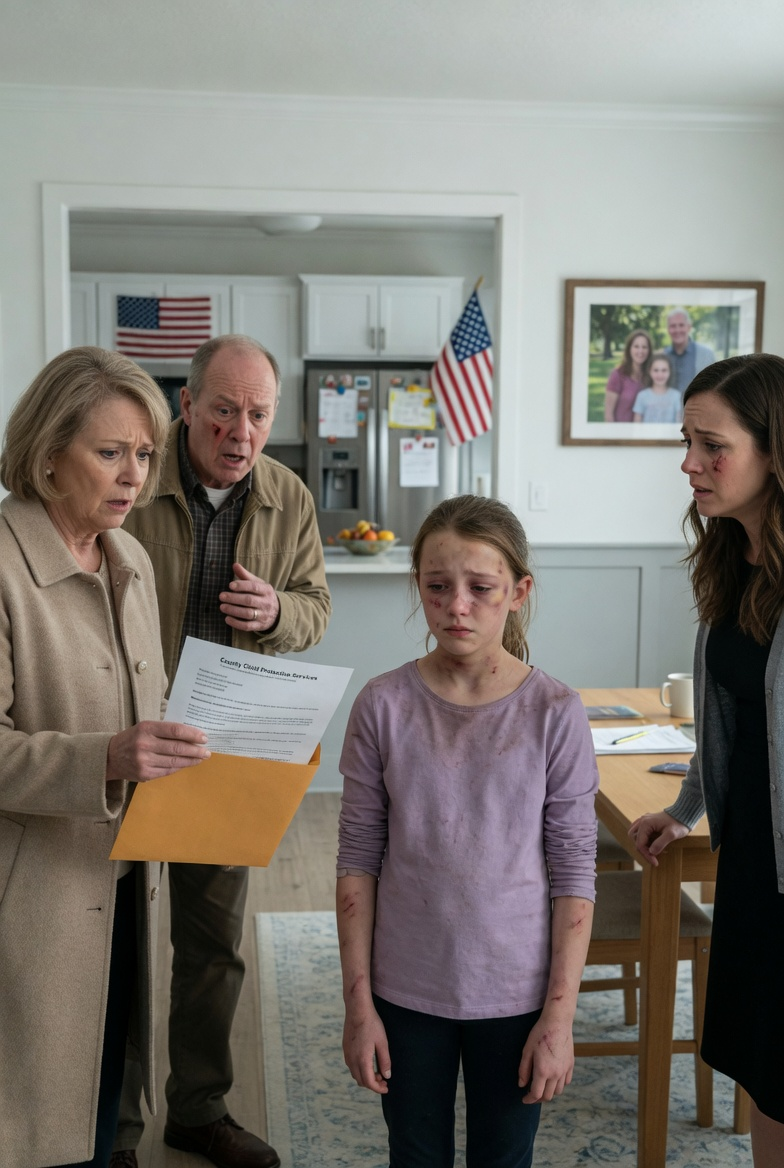
‘Daddy knew you would come.’
Nobody breathed.
The rain hammered harder against the windows, filling the silence my grandparents could not.
My mother blinked rapidly at the papers inside the envelope. My father’s jaw tightened so hard I heard his teeth click.
“What is this?” my mother whispered.
But she already knew.
The first page was Ethan’s amended will.
The second was a notarized legal statement from six months earlier.
And the third—
The third was a typed record of every time my parents had entered our home without permission while Ethan and I were away.
Dates.
Times.
Camera stills.
Even receipts.
Ethan had documented everything.
I remembered the night he installed the small black security cameras under the porch roof.
“Warehouse habits,” he had joked when I asked why we needed them. “People get strange around money.”
At the time, I laughed.
Now I realized he had not been laughing at all.
My father snatched the papers from my mother’s trembling hands.
“This is absurd.”
“No,” I finally said, my voice raw from days of crying. “What’s absurd is demanding money from the man you abandoned.”
My mother’s face hardened immediately, the grief-mask slipping away like wet makeup.
“We are still your parents.”
“And he was still my husband.”
The room sharpened around us.
Every detail hurt.
The ticking clock.
The scent of cold coffee.
Ethan’s reading glasses still sitting beside the couch cushion where he left them Tuesday morning.
Lily stood beside me clutching the brass house key so tightly it left red marks across her palm.
My father pointed toward the paperwork.
“This says our access to the property was revoked.”
“Yes,” I answered.
“He legally filed trespass notices?”
“Yes.”
My mother’s composure cracked.
“That man poisoned you against us!”
I laughed then.
Not because anything was funny.
Because grief sometimes cracks open into sounds that resemble madness.
“Poisoned me?” I whispered. “Mom… you hung up while he was dying.”
Her eyes flickered away.
Not guilt.
Avoidance.
Like always.
My father tried another approach, softening his voice into something almost reasonable.
“Savannah, listen carefully. We’re talking about substantial assets here. Ethan’s company alone—”
“You mean the company you mocked for years?”
Silence.
I stepped closer.
“You called his business ‘garage-boy work.’ Remember that?”
My mother folded her arms.
“Well, he wasn’t exactly a doctor.”
“No,” I said. “He was just the man who paid your mortgage three winters ago.”
That landed.
My father looked away first.
Lily suddenly spoke again, quiet but steady.
“There’s more in the envelope.”
My mother hesitated before reaching deeper inside.
Her face changed instantly.
This time, the blood did not merely drain.
It vanished.
“What… what is this?” she asked.
I knew before she turned the page.
Ethan’s handwriting.
Blocky. Firm. Familiar enough to split me open.
IF ANY MEMBER OF SAVANNAH’S FAMILY ATTEMPTS TO CLAIM, PRESSURE, OR COERCE HER REGARDING MY ESTATE AFTER MY DEATH, ALL PREVIOUS PRIVATE FINANCIAL ASSISTANCE GIVEN TO THEM WILL BE FORMALLY DISCLOSED AND LEGALLY PURSUED AS DEBT.
Attached beneath it were copies of checks.
Bank transfers.
Loan records.
Forty-eight thousand dollars for Heather’s failed boutique.
Twelve thousand for my father’s tax issue.
Eight thousand for my mother’s medical procedure.
Every cent marked clearly.
NOT A GIFT.
FAMILY LOAN.
My father looked physically ill.
“That can’t be enforceable,” he muttered.
A new voice answered from the doorway.
“It absolutely is.”
Everyone turned.
Daniel Reeves.
Ethan’s attorney.
Tall, silver-haired, soaked from the rain, carrying a leather briefcase under one arm.
My mother stumbled backward.
“You brought a lawyer?”
“No,” Daniel said calmly. “Ethan did.”
He stepped inside and shut the door carefully behind him.
The sound echoed.
Heavy.
Final.
Daniel removed his coat slowly.
“Ethan asked me to delay delivering these documents unless certain conditions were met.” He looked directly at my parents. “Specifically, if you attempted to seek financial access following his death while having no meaningful familial involvement.”
My father’s face reddened.
“This is manipulation.”
“This,” Daniel replied, “is documentation.”
He opened the briefcase and placed another folder onto the table.
“There’s also the matter of the recorded conversations.”
My stomach dropped.
Recorded conversations?
Daniel looked at me gently.
“He didn’t tell you because he hoped he’d never need them.”
My mother’s voice became sharp.
“What conversations?”
Daniel slid a USB drive across the wood.
“The ones where you discussed convincing Savannah to put the house into shared family ownership after Ethan died.”
The room exploded.
“That was private!” my mother snapped.
“Not in Oregon,” Daniel answered. “One-party consent.”
I stared at them.
“You planned this?”
Neither answered.
Which was answer enough.
Suddenly memories rearranged themselves inside my head like furniture in a burning house.
My mother insisting I “simplify inheritance stress.”
Heather asking whether Ethan’s business had investors.
My father casually asking if the house deed was survivorship-based.
Questions I ignored because love trains you to dismiss warnings.
Lily moved closer to me and wrapped both arms around my waist.
I felt how small she still was.
How much she had already lost.
And something inside me hardened forever.
My mother tried crying then.
Real tears this time.
Or convincing ones.
“Honey,” she whispered, “we were only worried about you.”
“No,” I said quietly.
“You were worried about money.”
Daniel cleared his throat.
“There’s one final matter.”
My father looked exhausted already.
“What now?”
Daniel handed me a sealed white envelope.
My name was written across the front in Ethan’s handwriting.
SAVANNAH.
My hands began shaking before I even opened it.
Inside was a letter.
I knew the smell immediately.
Cedar.
Motor oil.
Him.
I unfolded the paper carefully while the storm rattled the windows.
And I read:
If you’re reading this, then I was right about them.
First, I’m sorry.
Second, none of this is your fault.
You always loved people harder than they deserved.
That’s not weakness, Savannah. That’s why Lily grew up kind.
But kindness without boundaries becomes permission.
I need you to hear me now:
You do not owe access to people simply because they share your blood.
You do not owe grief to people who abandoned yours.
And you do not owe forgiveness to anyone demanding profit from my death.
Take care of Lily.
Keep the lake trip tradition alive.
Water the stupid tomatoes even though you hate gardening.
And one more thing—
In the safe beneath my workbench is a second envelope for Lily when she turns eighteen.
Tell her I knew she was brave long before she did.
I couldn’t keep reading.
My vision collapsed.
The paper slipped from my hands as grief hit me fresh and brutal, like the hospital all over again.
Lily picked up the letter carefully before it touched the floor.
My mother reached toward me instinctively.
I stepped back.
That hurt her.
Good.
Daniel turned toward my parents.
“Given the circumstances, I strongly advise you to leave.”
“This is unbelievable,” my father muttered.
“No,” I whispered through tears.
“What’s unbelievable is that the only person who prepared for my husband’s death… was my husband.”
For a second, nobody moved.
Then Lily looked directly at my mother and asked the question that finally destroyed whatever remained of them.
“If Daddy mattered so much now… why didn’t you come say goodbye?”
My mother opened her mouth.
Nothing came out.
Because there are questions too honest for lies to survive.
My father grabbed his coat first.
Neither of them looked at me when they walked toward the door.
But before leaving, my mother turned weakly toward Lily.
“We still love you.”
Lily’s answer came soft.
“But you didn’t love him.”
The door closed behind them.
And the house finally exhaled.
For the first time since Ethan died, silence no longer felt empty.
It felt clean.
Days later, Heather called screaming that my parents were panicking about legal exposure. Apparently Ethan had kept records of every financial transfer for nearly a decade.
I hung up before she finished.
Then I blocked her number.
The following week, Daniel helped me transfer ownership of Ethan’s company shares into a trust for Lily.
I cried signing the papers.
Not because of the money.
Because Ethan had thought of everything while I was still naïve enough to think love alone protected people.
That Sunday, Lily and I drove to the lake Ethan loved most.
The rain had finally stopped.
Fog rolled low across the water while pine trees swayed quietly along the shore.
Lily held the folded letter in both hands.
“Do you think Daddy knew he was going to die?” she asked.
I looked out across the gray water.
“I think,” I said slowly, “your daddy knew people.”
She nodded like that made perfect sense.
Then she slipped her small hand into mine.
And for the first time since the kitchen floor, I realized something important:
Ethan had not left us unprotected.
He had left us free.”The first letter arrived eleven days later.
No stamp.
No return address.
Just my name written in my mother’s looping handwriting.
SAVANNAH.
I stood at the kitchen counter staring at it while the coffee maker hissed behind me.
Lily sat at the table coloring silently, her tongue pressed against the corner of her mouth the way Ethan used to do while measuring wood cuts.
Everything reminded me of him now.
The empty hook where his keys should have been.
The dent in the couch cushion.
The flannel jacket I still could not move from the chair because some irrational part of me believed touching it would make his death permanent.
“Is it Grandma?” Lily asked quietly.
I nodded.
“Are you gonna open it?”
I almost threw it away.
Instead, I slid my finger under the envelope flap.
Inside was a single folded sheet.
No apology.
Of course not.
Just this:
We are willing to move past recent misunderstandings for Lily’s sake. Your father and I deserve a relationship with our granddaughter. Heather agrees this hostility has gone far enough.
Hostility.
That word sat in my chest like rusted metal.
Not grief.
Not betrayal.
Not abandoning us after Ethan died.
Hostility.
At the bottom, my mother had added:
We should also discuss the property issue before lawyers complicate things further.
I laughed so suddenly Lily looked up from her crayons.
It was not a happy sound.
It was the sound of finally understanding that some people will crawl across broken glass for money but never take one honest step toward love.
I folded the letter once.
Twice.
Then dropped it directly into the trash.
Lily watched carefully.
“Are they bad people?” she asked.
Children ask the questions adults spend years avoiding.
I sat beside her slowly.
“No,” I said after a long pause. “But they are selfish people. And selfish people can hurt others very badly.”
She thought about that.
Then nodded.
As if she already knew.
Because she did.
Children always know long before adults admit it.
Three days later, I learned my parents were telling relatives I had “become unstable” after Ethan’s death.
My cousin Natalie called me in tears.
“Savannah, they’re saying Ethan manipulated you and isolated you from the family.”
I nearly dropped the phone.
Manipulated.
The man who spent every Thanksgiving repairing someone else’s plumbing while my father drank beer and criticized football coaches.
The man who remembered every birthday.
The man who carried extra gloves in winter because “someone always forgets theirs.”
That man.
Something cold settled inside me then.
Not grief.
Clarity.
For years I had confused tolerance with peacekeeping.
I had swallowed insults to avoid conflict.
Excused neglect because “that’s just how they are.”
But Ethan had seen them clearly from the beginning.
Not cruel enough to be obvious.
Just selfish enough to destroy people quietly.
The next morning, Daniel called.
“They filed a petition.”
My stomach tightened instantly.
“What kind of petition?”
He hesitated.
“Grandparents’ visitation rights.”
I went completely still.
In the background, Lily was upstairs brushing her teeth before school, humming softly to herself.
“They skipped her father’s funeral,” I whispered.
“I know.”
“They ignored her after he died.”
“I know.”
“And now they want court-ordered access to my daughter?”
Daniel’s voice remained calm.
“This is about leverage, Savannah. They believe pressure will make you negotiate financially.”
I leaned against the counter because suddenly my knees felt weak.
“They’re using Lily.”
“Yes.”
The word shattered something final inside me.
Not because it surprised me.
Because it didn’t.
That was the worst part.
Part of me had expected this.
That evening, I found Lily sitting cross-legged on the garage floor beside Ethan’s old workbench.
Dust floated through the single overhead light.
She was holding one of Ethan’s tape measures, pulling it in and out slowly just to hear the metallic click.
“I miss him most at night,” she whispered without looking up.
My throat closed instantly.
“Me too.”
She pointed toward the workbench drawers.
“Can I look inside?”
I almost said no.
The garage still felt sacred somehow.
Like a room where grief slept lightly.
But Ethan had loved letting her help him here.
Teaching her screws from nails.
Sandpaper from steel wool.
So I nodded.
Lily opened the bottom drawer carefully.
Inside were neatly labeled folders, receipts, spare bolts… and one small black box.
She looked at me.
I recognized it immediately.
The safe key.
My pulse quickened.
The safe beneath the workbench.
The one Ethan mentioned in his letter.
Hands shaking, I crouched beside her and unlocked the metal compartment hidden behind the lower cabinet.
Inside sat another envelope.
And a recorder.
An actual digital voice recorder.
My breath caught.
Lily looked nervous suddenly.
“Should we open it?”
I swallowed hard.
“Yes.”
Inside the envelope was another note in Ethan’s handwriting.
If this was opened early, something worse happened than I hoped.
Savannah, the recorder contains copies of conversations automatically backed up from my office system.
Only listen if necessary.
I love you both.
My chest tightened painfully.
Necessary.
I already knew what that meant.
That night after Lily fell asleep, I sat alone at the kitchen table with the recorder beside my coffee mug.
Rain tapped softly against the windows again.
Same as the night Ethan died.
My finger hovered over PLAY for almost a full minute.
Then I pressed it.
Static crackled.
A chair scraped.
And then my mother’s voice filled the kitchen.
“…she’s too emotional to handle finances after something like this.”
Heather laughed softly.
“We just need her to lean on us for a while.”
My father answered next.
“The company alone is probably worth over a million.”
I stopped breathing.
The recording date flashed across the screen.
Eight months before Ethan died.
Eight.
Months.
My skin turned ice cold.
Heather spoke again.
“Do you think Ethan signed survivorship paperwork?”
“We’ll find out eventually,” my father said.
Then came Ethan’s voice.
Calm.
Controlled.
Dangerously calm.
“I think this meeting is over.”
Silence.
My mother scoffed.
“Oh, don’t act offended. Families help each other.”
“No,” Ethan replied quietly. “Healthy families do.”
The recording ended there.
I sat frozen in the dark kitchen long after the audio stopped.
Every instinct inside me screamed the same truth:
Ethan knew.
Not just suspicion.
Not paranoia.
Knowledge.
He had seen exactly what they were.
And he spent his final months quietly building walls around Lily and me while still trying to protect my heart from breaking under the truth.
I cried harder that night than I had at the funeral.
Because suddenly I understood the unbearable weight Ethan carried alone.
The next week, the visitation hearing was scheduled.
My parents arrived dressed like grieving saints.
My mother wore pearls.
Heather held tissues she never used.
They smiled sadly at people in the courthouse hallway like performers waiting for applause.
Then Lily walked in holding my hand.
And every fake expression collapsed when they saw who walked beside us.
Daniel had brought someone.
Judge Miriam Alvarez.
Retired family court mediator.
An old friend of Ethan’s late aunt.
She sat with us quietly beforehand reviewing timelines, messages, attendance records, photographs, school logs, everything.
Every missed birthday.
Every ignored call.
Every absence.
“You documented all this?” she asked gently.
I shook my head.
“Ethan did.”
Her eyes softened immediately.
“In thirty years,” she said quietly, “I’ve learned something important about men like your husband.”
“What?”
“The good ones prepare quietly.”
Inside the courtroom, my mother cried on command.
“We only want to maintain connection with our granddaughter after this terrible tragedy.”
The judge listened silently.
Then Daniel submitted the recordings.
The financial demands.
The missed funeral records.
The petition timeline filed less than two weeks after discovering estate details.
One by one, their masks cracked.
My father became angry first.
Heather became defensive.
My mother became vicious.
By the end, the courtroom no longer looked at them like grieving grandparents.
It looked at them like scavengers.
The judge denied the petition completely.
But that was not the moment I remember most.
It happened afterward.
Outside the courthouse.
Lily stood beside me under the gray Oregon sky while reporters from some local legal blog snapped photos near the steps.
My mother suddenly grabbed my arm.
Hard.
“You think you’ve won?” she hissed.
I pulled away instantly.
“No,” I said quietly.
“I think Ethan did.”
For the first time in my entire life, she looked afraid of me.
Not because I yelled.
Not because I threatened her.
Because I finally saw her clearly.
And people lose power the moment you stop needing them to become better humans.
That night, Lily crawled into bed beside me after a nightmare.
The house creaked softly around us.
She rested her head against my shoulder.
“Daddy saved us, didn’t he?”
Tears burned my eyes instantly.
“Yes,” I whispered into her hair.
“He really did.”