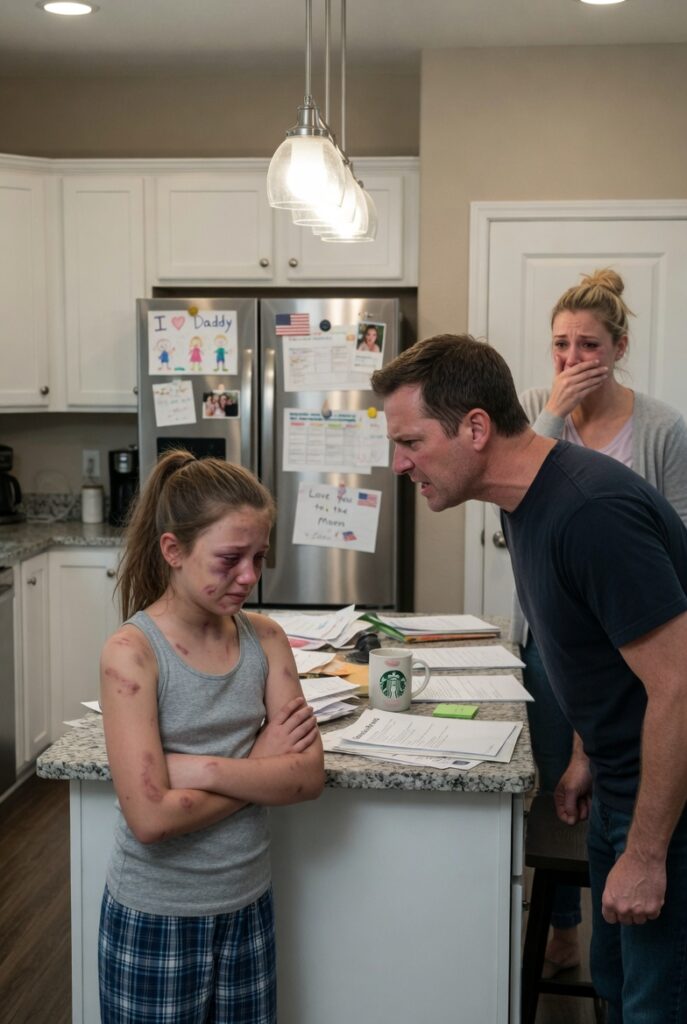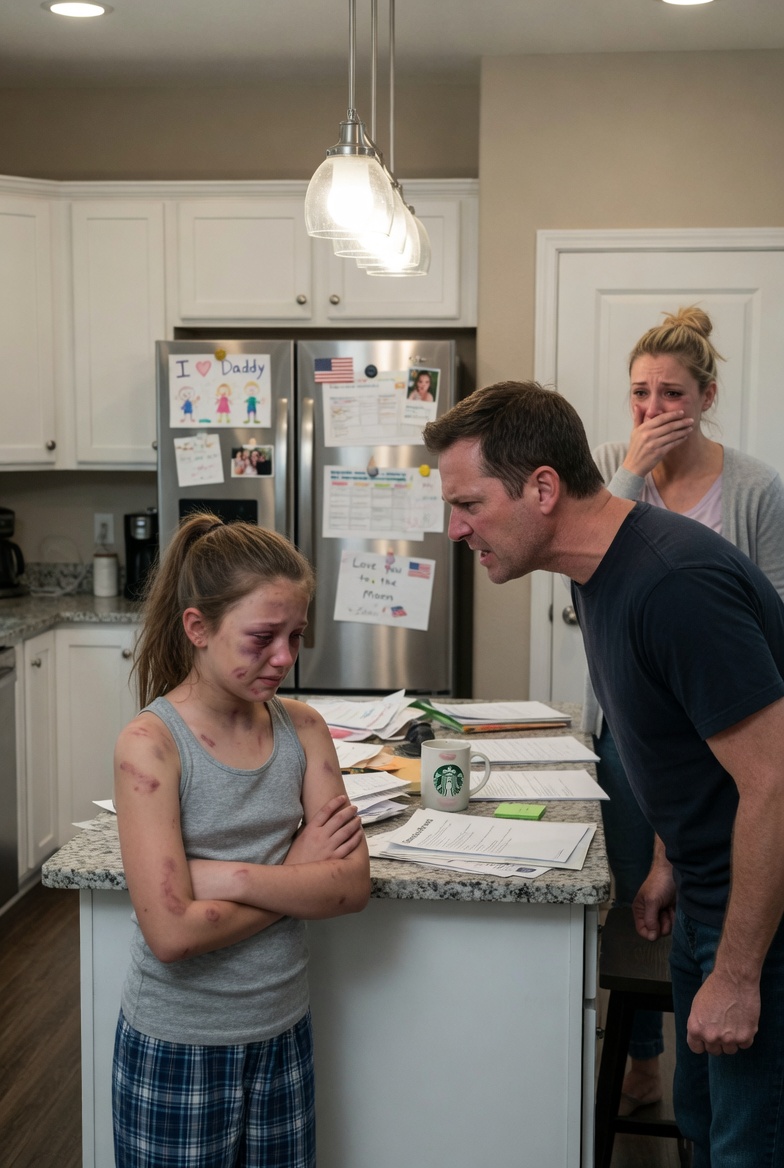
Karen spoke before anyone asked enough questions. “She slipped down the stairs.” Her voice was calm. Too calm. The nurse’s pen slowed against the hospital intake form.
The doctor who entered later did not behave like the adults Lily was used to. He did not pretend not to see. He asked Karen to step back and asked Lily where it hurt.
When he lifted Lily’s sleeve, his expression changed. Bruises covered different stages of healing. Purple at the edge of her shoulder. Yellow along her upper arm. Green fading near her wrist.
He checked the marks around her neck. He checked her eyes. He glanced once at Karen, then placed the chart down with a careful, controlled movement.
He did not accuse anyone in the room. That was what made Karen nervous. He simply stepped into the hall and told the nurse to call 911 immediately.
The officer arrived within minutes. Hospital staff moved differently after that, not frantic, but organized. A nurse placed Lily’s hoodie into a clear evidence bag. Another completed a body-map form.
Karen tried to regain control. She said Lily was confused. She said her daughter was in pain. She said accidents looked ugly sometimes, especially when children panicked.
But the doctor stood between Karen and Lily’s bed. He told Lily she did not have to answer questions in front of anyone who frightened her. That sentence changed the air.
Lily reached for her backpack with her good hand. Inside was the cracked phone, wrapped in a school worksheet. Her thumb shook as she unlocked the hidden folder.
The first file was labeled 11:38 P.M. RICHARD KITCHEN. The officer asked whether she wanted it played there or preferred to talk first. Lily chose to talk.
Once she began, she found she could not stop. Seven months of proof came out in pieces. Photos. Dates. Recordings. Karen’s repeated excuses. Richard’s threats. The pattern nobody had wanted to name.
Police went to the house that night. Richard tried the performance he always used in public. He acted offended, cooperative, confused, and finally angry when officers began asking about Lily’s injuries.
The recordings ended that performance. His voice filled the room from Lily’s phone, sneering and threatening while dishes clinked and Lily cried in the background. Charm could not argue with audio.
Richard was arrested before sunrise. Karen was questioned separately about why she had repeated a false explanation at the hospital and why prior injuries had never been reported.
The official process moved slower than Lily expected. There were reports, interviews, medical records, and follow-up photographs. A victim advocate explained each step in a voice that never rushed her.
Lily learned new words for old terror. Domestic violence. Coercion. Failure to protect. Pattern injuries. The language was clinical, but it gave shape to what she had survived.
In court, Richard’s lawyer tried to describe one bad night. The prosecutor answered with seven months of documentation. One bad night does not create bruises in five different stages of healing.
Karen cried when the recordings played. Lily did not look at her at first. Then she did, because some part of her needed to see whether her mother finally understood.
Karen looked smaller than Lily remembered. Not innocent. Not safe. Just small. For years, Karen had mistaken fear for an excuse and silence for survival.
Richard eventually faced consequences he could not smile through. The charges included assault, child abuse, and related offenses tied to the documented pattern. The hospital records made denial impossible.
Lily was placed somewhere safe while the case moved forward. The first night away from that house, she woke twice expecting boots in the hallway. There were none.
Healing did not arrive like a movie ending. It came in appointments, school forms, nightmares, and mornings when Lily realized she had slept six hours without listening for anger.
She kept the cracked phone for a long time. Not because she wanted to live inside what happened, but because it reminded her of the first brave thing she had done quietly.
She had documented everything when nobody else would. She had built a record out of bruises, whispers, timestamps, and fear. Evidence became the bridge between being trapped and being believed.
Years later, what stayed with Lily most was not Richard’s rage. It was the doctor’s calm voice, the nurse’s careful hands, and the officer asking her what she wanted before pressing play.
Sometimes monsters do not wait in alleys. Sometimes they sit across from you at dinner and smile in public. Lily learned that. But she also learned something else.
Sometimes rescue begins with one person who notices the bruise beneath the sleeve, hears the lie in a mother’s calm voice, and refuses to look away.