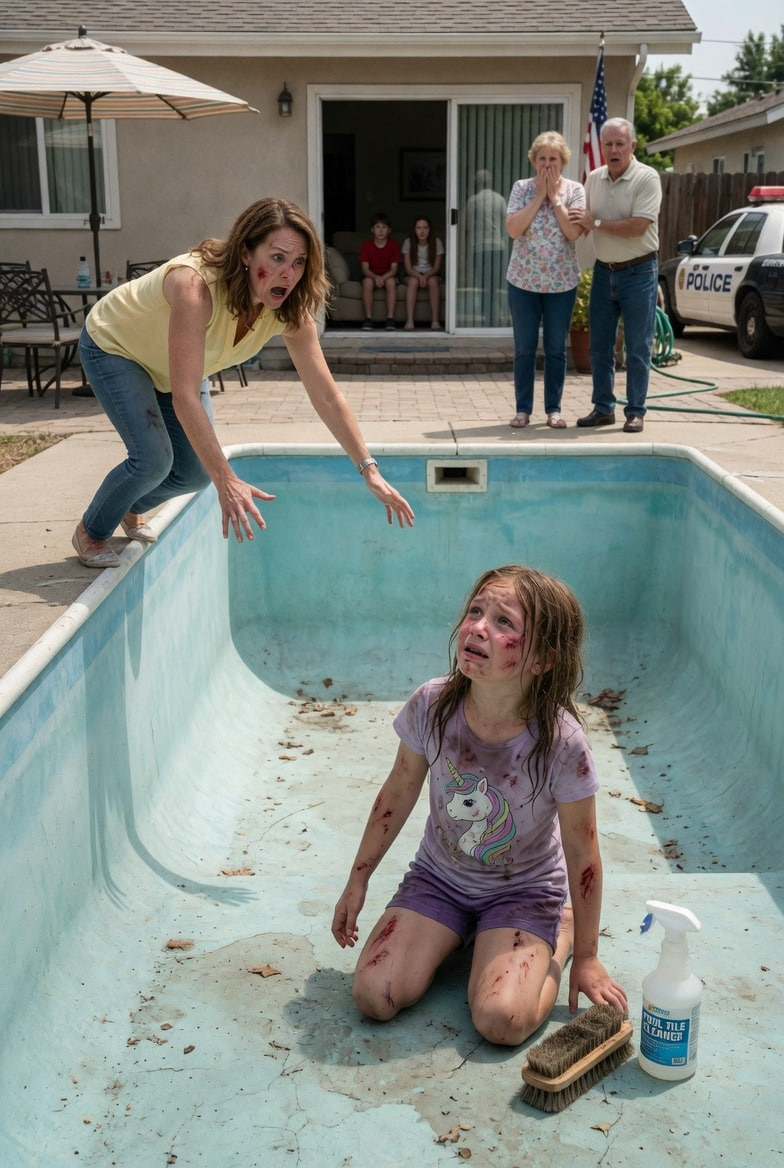
Her breath hitched against my shoulder.
Not crying.
Too exhausted to cry.
Ethan was beside me in seconds.
The second his hand touched her forehead, his face changed.
“Oh my God.”
I looked at my mother.
“What did you do?”
She rolled her eyes like I was being dramatic.
“For heaven’s sake, Liberty, she’s fine. She complained about being warm, so I told her to finish quickly.”
Finish.
Like my daughter was an employee.
Behind her, my brother Jason leaned back in a patio chair with a slice of pepperoni pizza in his hand.
“You always overreact,” he muttered.
I looked at the other kids sitting under the shade umbrella with paper plates balanced on their knees.
None of them were dirty.
None of them were sweating.
Only Amelia.
My father finally stood up.
“She offered to help.”
Amelia made a tiny sound against my shoulder.
“No,” she whispered weakly.
Silence dropped over the patio.
My mother’s mouth tightened instantly.
“Excuse me?”
Amelia’s voice cracked.
“You said… if I wanted lunch… I had to finish the pool first.”
Ethan inhaled sharply beside me.
I felt something inside me go perfectly still.
Not rage.
Rage burns hot.
This was colder than that.
This was the moment you realize someone crossed a line so far there’s no road back.
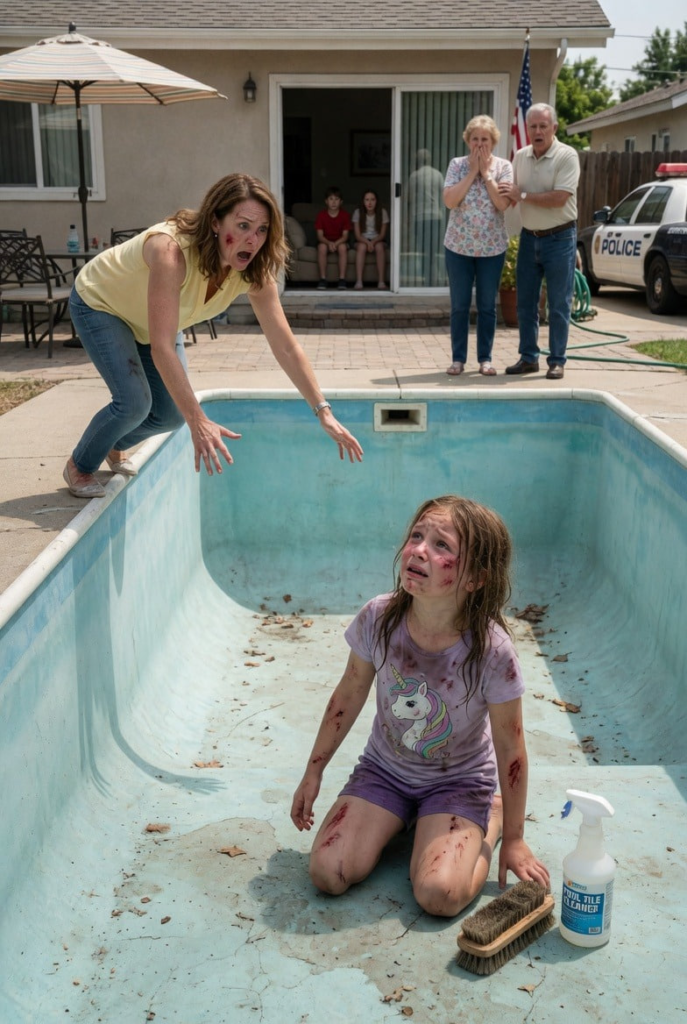
I looked down into the drained pool.
Concrete baking under direct California sun.
Chemical fumes climbing upward.
Scrub marks everywhere.
She’d been down there for hours.
An eight-year-old child.
My child.
And suddenly I remembered something Amelia had said two weeks earlier after visiting my parents.
Grandma says cousins who help deserve treats.
At the time I thought it was just one of my mother’s manipulative little comments.
Now I understood.
The humiliation wasn’t accidental.
It was tradition.
“Take her to the car,” I told Ethan quietly.
“Lib—”
“Now.”
Something in my voice made him obey immediately.
He carried Amelia toward the front driveway while I stayed standing there in the backyard where I’d grown up hunting Easter eggs and blowing out birthday candles and believing these people loved me correctly.
My mother crossed her arms harder.
“Oh, don’t start acting self-righteous.”
Then she said it.
The sentence that burned everything down.
“You and that child are always freeloading off somebody.”
Jason laughed under his breath.
Actually laughed.
I stared at them.
At the pizza boxes.
At the pool chemicals.
At my daughter’s little pink backpack tossed beside a lawn chair like she was temporary.
And then I reached into my purse.
My mother frowned.
“What are you doing?”
I pulled out my phone.
Not to call someone.
To open something.
Because six months earlier, after one too many “misunderstandings,” Ethan had convinced me to turn on automatic cloud backup and family-location recording on Amelia’s smartwatch.
Mostly for safety.
Mostly because kids wander.
But Amelia was obsessed with using the voice-note feature to leave us random messages.
Little recordings.
Tiny pieces of her day.
I opened the app calmly.
Scrolled.
Tapped.
And held the phone up.
My mother’s voice crackled through the speaker loud and sharp across the patio.
“If you stop scrubbing again, no pizza.”
Silence.
Then Amelia’s tiny exhausted voice:
“My arms hurt.”
My father answered this time.
“Then scrub slower and quit whining.”
Another scraping sound.
Concrete.
Brush.
Heavy breathing.
Then my mother again:
“Your cousins already finished eating because they actually help.”
Jason sat upright instantly.
My mother’s face drained white.
I kept playing it.
Minute after minute.
Their voices.
Their orders.
My daughter coughing.
At one point Amelia whispered:
“I feel dizzy.”
And my mother replied:
“You’re eight, not disabled.”
Nobody moved.
Nobody breathed.
The only sound was the recording and the distant buzz of traffic beyond the fence.
My father finally snapped:
“You recorded us?”
“No,” I said softly. “You recorded yourselves.”
My mother took a step forward.
“This is insane. We were teaching responsibility.”
I looked at her.
“She has a fever.”
“She looked fine this morning.”
“She can barely stand.”
“Oh please, Liberty, kids get overheated—”
“She’s burning at over one hundred seven degrees.”
That shut everyone up.
Even Jason.
Because there’s a difference between cruelty people can rationalize and numbers that sound lethal.
My father’s confidence flickered.
“Wait… what?”
I turned and walked toward the house.
My mother followed me immediately.
“Where are you going?”
Inside.
The air-conditioning hit my face cold and artificial after the brutal heat outside. The dining table was covered in paper plates and soda cans. One plate sat untouched.
A child-sized plate.
Two slices of pizza.
Probably Amelia’s “reward.”
I picked up the plate carefully.
My mother stared at me.
“What are you doing now?”
I crouched beside the kitchen trash can.
Inside sat a crumpled fast-food bag.
And beside it:
Amelia’s water bottle.
Full.
Untouched.
I felt Ethan appear behind me carrying our daughter back through the front door.
“She’s getting worse,” he said tightly. “We need the ER now.”
Amelia’s head rested limply against his shoulder.
My mother suddenly sounded nervous.
“You’re acting like we abused her.”
I stood slowly.
Then I looked directly at her and said the calmest words I have ever spoken in my life:
“You left a sick child in chemical fumes under direct heat without water while everyone else ate lunch.”
My father rubbed a hand over his face.
“Liberty, nobody meant—”
“I don’t care what you meant.”
And then I dialed 911.
Jason stood so fast his chair scraped backward.
“Whoa, whoa, are you serious right now?”
I held the phone to my ear without looking at him.
“Yes,” I said.
My mother’s face twisted in outrage.
“You ungrateful little—”
The emergency operator answered.
“911, what’s your emergency?”
I kept my eyes on my parents.
“My eight-year-old daughter has a temperature of one hundred seven point six after being forced to scrub an empty swimming pool for hours in extreme heat with chemical exposure.”
The room exploded.
“Liberty!”
“You can’t say that!”
“She was helping!”
“She volunteered!”
But the operator had already heard enough.
“Ma’am, is the child conscious?”
“Barely.”
“An ambulance is being dispatched now.”
My mother lunged toward me.
“Hang up the phone!”
Ethan stepped between us instantly.
And that’s when my father made the mistake that destroyed whatever remained of our family.
He pointed at Amelia.
At his unconscious granddaughter.
And said:
“If you people weren’t constantly needing help, none of this would’ve happened.”
You people.
Not family.
Not daughter.
Not granddaughter.
A burden.
Something inside me settled permanently into place.
The sirens arrived four minutes later.
Neighbors began stepping outside almost immediately.
Curtains moved.
Garage doors opened.
The quiet little cul-de-sac started watching the Armstrong family unravel in public.
Paramedics rushed in with a stretcher.
One took Amelia’s temperature twice because he thought the device malfunctioned the first time.
Then his face changed.
“We need to move now.”
The second paramedic smelled the chemicals on Amelia’s clothes and looked toward the backyard.
“Where was she?”
I answered.
“In the drained pool.”
He looked horrified.
My mother folded her arms defensively.
“She was doing chores.”
The paramedic stared at her for a long second.
Then said quietly:
“She’s a child.”
Police arrived before the ambulance even pulled away.
Two officers.
One older.
One young enough that anger still showed openly on his face.
They separated everyone immediately.
Statements.
Questions.
Timelines.
The older officer asked me if I had evidence.
I handed him my phone.
He listened to the recordings once.
Then again.
By the second playback, his jaw was tight.
My mother kept trying to interrupt.
“It sounds worse than it was—”
“She exaggerates—”
“Liberty has always been dramatic—”
The officer raised one hand.
“Ma’am,” he said flatly, “stop talking.”
And for the first time in my entire life… my mother actually did.
Hours later, at Valley Medical Center, Amelia lay in a hospital bed with IV fluids running into her tiny arm while doctors monitored for organ damage from hyperthermia and chemical inhalation.
Ethan sat beside her stroking her hair.
I stood near the window staring out at the parking lot lights when my phone started vibrating over and over again.
My brother.
My aunt.
My cousins.
Family friends.
Voicemails piling up.
Don’t destroy the family over this.
Your parents are devastated.
Think carefully before pressing charges.
Your mother’s crying hysterically.
They made a mistake.
A mistake.
I looked at my daughter asleep beneath white hospital blankets with adhesive marks still on her flushed skin.
Then I remembered the sound of that scrub brush scraping concrete while everyone else ate pizza in the shade.
My phone rang again.
Mom.
I answered this time.
She was already sobbing.
“Liberty, please… you can’t do this to us.”
I closed my eyes.
And finally understood something that took me forty years to learn:
People who hurt children often become most emotional when consequences arrive.
Not when the child suffers.
When they suffer.
“Mom,” I said quietly, “Amelia could have died.”
“She didn’t!”
The words came out sharp.
Defensive.
Instant.
And there it was.
Not remorse.
Relief at escaping the worst outcome.
I felt the last thread snap.
“You asked what I’m doing to this family,” I said.
“No, Liberty, please—”
“I’m ending it.”
Silence.
Then broken crying.
Begging.
Promises.
Excuses.
I listened for maybe ten seconds before pulling the phone away from my ear.
Ethan looked up at me.
“What did she say?”
I stared through the hospital glass at the dark California sky.
Then I whispered the only words I had left for any of them.
“Too late.”The pediatric ICU kept the lights dim after midnight.
Machines glowed softly in the darkness. IV pumps clicked. Nurses spoke in low voices that sounded almost reverent, like loud words might disturb healing itself.
Amelia slept beneath a thin hospital blanket with cooling packs tucked carefully near her arms and neck. Her fever had finally begun to come down, but not before the doctors used phrases I would hear in nightmares for years afterward.
Possible neurological damage.
Kidney stress.
Severe heat exposure.
Toxic inhalation.
Every sentence felt unreal because the people responsible weren’t strangers.
They were my parents.
At 1:13 a.m., a nurse stepped quietly into the room holding a clipboard.
“Mrs. Armstrong?”
I stood immediately.
“There are two detectives downstairs requesting a statement.”
Ethan looked at me carefully.
“You don’t have to do this tonight.”
“Yes,” I said. “I do.”
Because I already knew what would happen if I waited.
Morning would come.
Then excuses.
Then relatives.
Then pressure.
Then the slow rewriting of reality families specialize in.
She wasn’t that sick.
They meant well.
Liberty’s always been sensitive.
No.
Not this time.
The interview room downstairs smelled like stale coffee and copier paper. One detective introduced herself as Marisol Vega. The other, a broad-shouldered man named Chen, already had my phone connected to a department tablet.
They had listened to the recordings.
All of them.
Detective Vega folded her hands carefully.
“Mrs. Armstrong… how long has your family treated your daughter differently?”
The question hit harder than I expected.
Because deep down, I knew the answer.
Not one afternoon.
Not one pool.
Years.
Tiny comments.
Small exclusions.
“Your cousins earned dessert.”
“Maybe next time you’ll behave better.”
“Don’t be so dramatic.”
Death by paper cuts.
I sat back slowly.
“My brother’s children are favored,” I admitted.
“By both parents?”
“Yes.”
“Has Amelia ever been physically punished before?”
I hesitated.
Then remembered something I had buried because it seemed too small at the time.
Last Christmas.
Amelia accidentally spilled cranberry juice on my mother’s white dining chair.
My mother made her clean the entire dining room alone while the other children opened presents.
Eight years old.
Scrubbing floors while cousins laughed in the next room.
God.
Detective Chen watched my face carefully.
“You just remembered something.”
I nodded slowly.
And suddenly memories started surfacing faster than I could stop them.
Amelia always given chores the others avoided.
Amelia criticized for crying.
Amelia apologizing constantly.
Like she already believed love had to be earned through usefulness.
I covered my mouth with my hand.
“Oh my God.”
Detective Vega’s expression softened slightly.
“Mrs. Armstrong, abusive family systems often normalize gradually. Especially when the behavior escalates over years.”
I looked up sharply.
“You think this was abuse?”
Neither detective answered immediately.
They didn’t need to.
At 2:04 a.m., my father was brought into an interview room across the hall.
Not handcuffed.
Not yet.
But pale.
The confident patriarch act was gone now. He looked older than I had ever seen him.
My mother arrived twenty minutes later with Jason.
She was crying before she even entered the building loudly enough for half the station to hear.
“Where’s my granddaughter?”
Not How is she?
Where’s.
Possession before concern.
The detectives separated them immediately.
Jason objected first.
“This is insane. Nobody abused anybody.”
Detective Chen looked at him flatly.
“Your niece had a body temperature over one hundred seven degrees.”
Jason spread his hands.
“It was hot outside.”
“And the drained concrete pool?”
“She was helping clean.”
“The chemical exposure?”
“No one forced her—”
Chen pressed play on the recording.
My mother’s voice filled the interview room.
“If you stop scrubbing again, no pizza.”
Jason went silent.
The detective let the audio continue.
Amelia coughing.
Heavy scraping.
Tiny exhausted breathing.
Then:
“I feel dizzy.”
And my father answering:
“Quit whining.”
When the recording ended, Chen leaned forward slightly.
“Still want to tell me nobody forced her?”
Jason’s face changed.
Not guilt.
Fear.
Not fear for Amelia.
Fear for himself.
Families like mine build invisible contracts around silence. The first person to admit reality becomes the traitor.
He understood the structure was collapsing.
At 3:11 a.m., a doctor from PICU entered the waiting room carrying updated lab results.
I stood so quickly my chair nearly fell backward.
“How is she?”
“She’s stable.”
My knees almost buckled from relief.
But the doctor kept talking.
“We’re still monitoring neurological response carefully. Extreme fevers in children can become dangerous very quickly.”
Dangerous.
Such a controlled medical word for almost losing your child.
Ethan asked the question I couldn’t.
“Will she recover completely?”
The doctor paused just long enough to terrify me.
“We think so.”
Think.
I nodded because if I opened my mouth, I would start screaming.
Across the waiting room, my mother suddenly stood up.
“I want to see my granddaughter.”
The doctor looked confused.
“Immediate family only.”
“I am immediate family.”
“No,” I said quietly.
Everyone turned toward me.
My mother blinked.
“What?”
“You’re not seeing her.”
Her face crumpled instantly.
“Liberty, please.”
“No.”
“She needs her grandmother.”
I stared at her.
“She needed her grandmother yesterday.”
Silence slammed into the room.
My mother began crying harder.
The old performance.
The one that used to work.
Growing up, my mother weaponized tears like other people used credit cards. Efficiently. Frequently. Any conflict eventually became about comforting her.
But exhaustion changes people.
And somewhere between the drained pool and the ICU monitors, I had stopped responding to guilt.
“You don’t understand,” she whispered.
“No,” I said. “I finally do.”
My father spoke for the first time all night.
Quietly.
“Liberty… we didn’t think she was that sick.”
There it was again.
Not apology.
Explanation.
Because if they didn’t know, then maybe they weren’t monsters.
I looked directly at him.
“She told you she felt dizzy.”
He looked down.
“She said her arms hurt.”
Silence.
“She was burning with fever while you fed pizza to everyone else.”
My father’s eyes filled suddenly.
And for one dangerous second, part of me almost softened.
Then I remembered Amelia trying to smile at me from the bottom of that empty pool.
I remembered her whispering:
I almost finished.
Like love was waiting at the end of suffering.
And whatever softness remained inside me hardened again.
Detective Vega approached quietly.
“Mrs. Armstrong, Child Protective Services would like to interview Amelia once she’s medically cleared.”
“Of course.”
“There’s also discussion of criminal negligence charges.”
My mother gasped.
Jason stood up instantly.
“You can’t be serious.”
The detective’s expression never changed.
“An eight-year-old child was exposed to extreme heat and industrial cleaning chemicals while exhibiting obvious medical distress.”
“It was punishment!” Jason snapped.
The room went dead silent.
Because he’d said the quiet part out loud.
Punishment.
Not helping.
Not chores.
Punishment.
Detective Chen slowly closed his notebook.
“Thank you,” he said calmly. “That clarification helps.”
Jason’s face drained white.
At 4:22 a.m., Amelia woke up.
I was sitting beside her bed holding her hand when her eyes fluttered open slowly.
Confusion crossed her face first.
Then fear.
“Mom?”
“I’m here.”
Her fingers tightened around mine weakly.
“Am I in trouble?”
The question shattered me completely.
Not because she asked it.
Because she genuinely didn’t know.
I bent forward carefully and pressed my forehead against hers.
“No, baby,” I whispered. “Never again.”
She started crying softly.
“I tried to do a good job.”
I closed my eyes.
And finally cried too.
Not polite tears.
Not controlled ones.
The kind that hurt.
Because children should never believe survival depends on obedience.
And because I realized, with sickening clarity, that my parents had once trained me to believe the same thing.