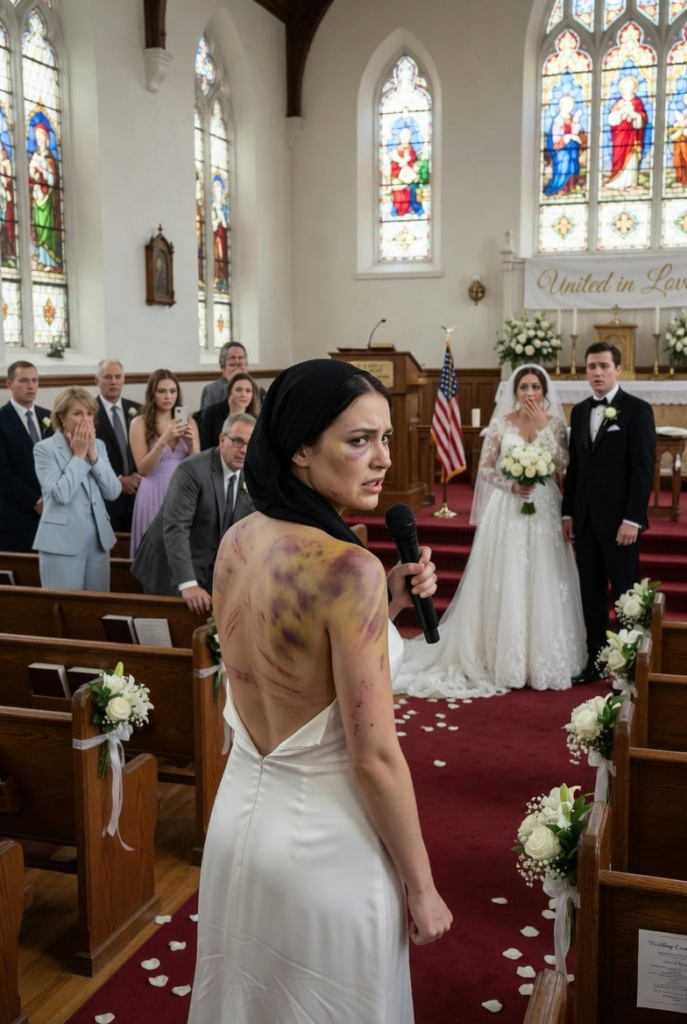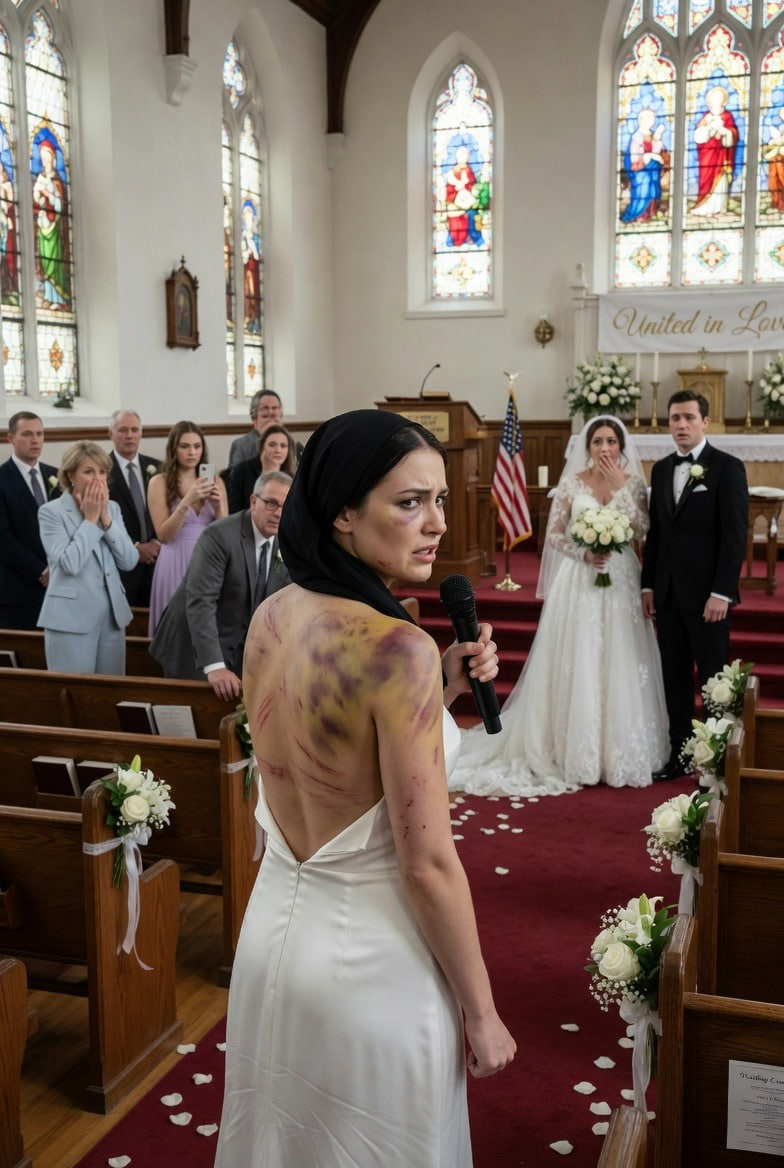
Crystal chandeliers glimmered above hundreds of guests dressed in silver, black, and champagne tones. Waiters carrying trays of white wine stopped mid-step when they saw me standing at the entrance in a plain navy dress with two worn suitcases behind me like ghosts nobody had invited.
At the altar, Valeria’s smile vanished.
Sebastián stared at me with newly healed eyes that still looked uncertain in bright light. For a moment, he almost seemed afraid.
Good.
My mother reacted first.
“Mariana,” she hissed, already moving toward me in sharp heels, “you are not welcome here.”
But I was already walking.
Every step echoed across the marble floor.
The orchestra faltered into silence.
My father’s face turned the color of wet cement when he realized I was heading toward the stage.
“Take her out,” he barked at security.
Nobody moved.
Because rich families love scandals almost as much as they love pretending morality matters.
And every guest in that ballroom knew something was wrong.
I reached the stage just as my mother lunged for the microphone.
For the first time in my life, I moved faster than her.
The microphone squealed sharply.
The entire ballroom froze.
I looked directly at Sebastián first.
Then Valeria.
Then my parents.
And finally the crowd.
“My name is Mariana Ortega Montes,” I said calmly. “Though apparently only until yesterday.”
A nervous laugh fluttered through the audience.
My mother tried to grab my arm. I stepped away.
“I apologize for interrupting this beautiful wedding. I know everyone came here expecting champagne, flowers, and lies. Fortunately, I brought documents.”
A ripple moved through the room.
Sebastián’s mother stood slowly from the front table.
“What exactly are you doing?” she demanded.
I lifted the thick folder in my hand.
“What your family paid mine to do three years ago.”
Silence.
Complete.
Dead.
I opened the first document carefully.
Paper sounds become thunder in quiet rooms.
“This,” I said, raising the stapled agreement, “is the financial contract signed on June 14 between the Ortega family and the Montes family after Sebastián Montes lost his eyesight.”
My father took a step forward so quickly his chair crashed behind him.
“Mariana—”
I read louder.
“Clause four: In exchange for continuation of the engagement arrangement, the Montes family agrees to refinance Ortega Group liabilities totaling—”
Gasps erupted.
Someone whispered, “Dios mío.”
I continued anyway.
“—provided one Ortega daughter fulfills the marital obligation abandoned by Valeria Ortega.”
Valeria’s face drained white.
“No,” she whispered. “No, no—”
“Oh yes,” I said softly. “You remember now.”
The guests were no longer pretending not to listen.
Phones appeared.
Tiny glowing screens lifted like candles around the ballroom.
My mother’s breathing turned ragged.
“This is private family business!”
I smiled at her.
“No, mamá. Private family business is forcing your healthy daughter to marry a blind man because your favorite child found him inconvenient.”
The words hit the ballroom like shattered glass.
Sebastián flinched.
For the first time since I had met him, I saw shame enter his face.
I turned toward him slowly.
“Would you like me to continue?”
He opened his mouth.
Nothing came out.
So I did.
“I was twenty-seven years old when my family sold me. I ended my relationship, left my apartment, and married a man who called me by another woman’s name in bed.”
A murmur spread across the guests.
Valeria looked ready to faint.
I almost pitied her.
Almost.
“His family called me ‘the replacement wife.’ His mother monitored my body like livestock. And when I failed to become pregnant…”
I paused.
Then slowly removed a folded medical report from the folder.
“…they never bothered asking why.”
Sebastián’s eyes fixed on the hospital logo.
Recognition flashed across his face.
I watched horror slowly bloom inside him.
Because he knew.
He remembered forcing me into that clinic.
He remembered the implant.
He remembered my fever.
I lifted another paper.
“This is my emergency hospitalization report from Hospital Ángeles Lomas.”
The room became so silent the chandeliers hummed.
“Systemic infection. Reproductive damage. Future fertility uncertain.”
A woman near the back covered her mouth.
Someone muttered, “Madre de Dios…”
I looked directly at Sebastián.
“You told me it was temporary.”
His lips trembled.
“I—”
“You told me if I got pregnant, your mother would never let Valeria come back.”
Valeria spun toward him violently.
“What?”
There it was.
The first crack.
Sebastián looked trapped now, eyes darting between both sisters like a drowning man searching for air.
My father finally snapped.
“She’s lying!” he shouted.
I pressed a button on my phone.
The recording filled the ballroom.
My mother’s voice echoed through the speakers first:
“Sebastián can see again. Divorce him so Valeria can take your place.”
Then my father:
“Don’t forget Sebastián belonged to your sister.”
The silence afterward was monstrous.
Not silence.
Execution.
Valeria staggered backward.
My mother grabbed her arm.
“Listen to me—”
“YOU SOLD HER?” Valeria screamed.
The ballroom erupted instantly.
Guests whispered openly now.
One older man near the front stood and walked away entirely.
Sebastián’s mother looked like she might collapse.
Then Sebastián spoke.
Quietly.
“To save the company?”
Nobody answered him.
Because the answer sat naked in the room already.
Yes.
Yes, they had.
My father’s forehead glistened with sweat.
“You don’t understand the pressure we were under—”
“No,” I interrupted. “You don’t understand pressure.”
I touched my chest lightly.
“I have stage-three lung cancer.”
The room stopped breathing.
Even the violinists stared.
My mother blinked at me once.
Twice.
As though her brain rejected the sentence.
I pulled the folded diagnosis from my purse and placed it on the table beside the wedding cake.
“I found out three weeks ago.”
Valeria’s face crumpled.
Sebastián looked like someone had struck him.
And suddenly everyone could see it—
the weight loss,
the pale skin,
the exhaustion hidden beneath makeup.
I laughed softly.
“You know what’s funny? I went home because I thought my family might finally love me if I was dying.”
My voice cracked then.
Just once.
“I actually believed that.”
My mother stepped toward me with tears forming instantly now that people were watching.
“Mariana…”
“No.”
The word sliced through her.
“You don’t get to cry now.”
I pointed toward the guests.
“You cried for Valeria when she lost a fiancé. You cried for father when he lost money. But when I lost my future, my body, my marriage, my health—”
I swallowed hard.
“—you called it sacrifice.”
Nobody moved.
Nobody defended them.
Because cruelty sounds different once spoken aloud.
I turned slowly toward Valeria.
The sister I had loved more than myself.
“She’s all yours now,” I said quietly.
Valeria stared at Sebastián like she had never truly seen him before.
Maybe she hadn’t.
Sebastián finally stepped down from the altar.
Toward me.
Not her.
Me.
“Mariana…” His voice broke. “I didn’t know about the cancer.”
I almost laughed.
“That’s the sentence you chose?”
He looked devastated.
Good.
“You knew enough.”
His eyes filled.
“I was angry. I was blind. I hated needing people.”
“And I was convenient.”
The truth landed between us heavily.
Sebastián lowered his head.
For the first time in our marriage, he looked small.
Not powerful.
Not cruel.
Just weak.
But weakness destroys people too.
I picked up my folder again.
Then I reached into the second suitcase.
The crowd leaned forward instinctively.
Inside were ledgers.
Copies.
Bank transfers.
Emails.
Everything.
Every payment between the Ortega and Montes families.
Every agreement.
Every threat.
Every signed arrangement built on my suffering.
My father’s expression turned to terror.
Because finally he understood.
I hadn’t come for revenge.
I had come prepared.
“I made copies,” I said softly. “Three sets.”
I looked toward the back of the ballroom.
Two people stood there quietly beside the doors.
A journalist.
And an attorney.
“I spent the last week learning exactly how expensive betrayal can become.”
My mother nearly collapsed into a chair.
“Mariana, please…”
“No,” I said again.
Then I smiled.
Small.
Cold.
Free.
“You taught me my value was transactional.”
I lifted the microphone one last time.
“So today, we begin the negotiations.”
The first person to move was Sebastián’s grandfather.
Don Ernesto Montes had remained silent the entire afternoon, seated near the front beneath the enormous white orchids arranged around the altar. At eighty-two, he looked carved from old stone—silver cane, dark suit, expression permanently sharpened by decades of power.
When he stood, the room obeyed instinctively.
Even Sebastián straightened.
Don Ernesto looked at the documents spread across the wedding table.
Then at me.
Then at my father.
“You used my family’s money,” he said slowly, “to purchase a daughter.”
Nobody answered.
My father tried anyway.
“It wasn’t like that—”
“Be quiet.”
The old man’s voice cracked across the ballroom harder than a slap.
My father fell silent immediately.
Don Ernesto turned toward Sebastián.
“Did you know?”
Sebastián looked destroyed now. Sweat clung to his temple. His tie hung loose beneath his collar.
“I knew they pressured her,” he admitted hoarsely. “I didn’t know about the contract.”
“And the implant?”
The question detonated through the ballroom.
Valeria stared at Sebastián in horror.
My mother whispered, “Please stop—”
Sebastián closed his eyes.
“Yes.”
A collective inhale swept the room.
I watched Valeria physically recoil from him.
“You forced her?” she whispered.
“It wasn’t—”
“You forced her?”
He looked toward me desperately, as if I might soften the truth for him.
I didn’t.
“She begged you to remove it after the fever started,” I said quietly. “You told me your mother wanted guarantees.”
Several guests stood abruptly from their tables.
One woman muttered, “This is criminal.”
Because it was.
And suddenly the beautiful wedding no longer looked elegant.
It looked rotten.
The flowers smelled too sweet.
The chandeliers too bright.
The gold decorations vulgar beneath the weight of what everybody now knew.
Don Ernesto removed his glasses slowly.
“When did you discover the cancer?”
“Three weeks ago.”
“And your family knew?”
I smiled without humor.
“They knew for eleven minutes before asking me to disappear.”
My mother burst into tears.
Real tears this time.
Not graceful ones.
Ugly, choking sounds.
But they arrived too late to matter.
“Mariana,” she sobbed, “we were scared—”
“You were embarrassed.”
Her mouth snapped shut.
Because she knew I was right.
Cancer did not fit neatly beside champagne towers and second weddings.
Dying daughters stain photographs.
Valeria suddenly ripped the veil from her head.
The room startled.
“I didn’t know,” she said frantically, looking at me. “Mariana, I swear to you, I didn’t know about the infection.”
“No,” I answered. “You only knew they gave me your life.”
Her face collapsed.
And for the first time since childhood, I saw something unfamiliar inside my sister:
Shame.
Not performance.
Not tears designed to rescue her.
Actual shame.
She looked around the ballroom as if waking from anesthesia.
“You all knew?” she whispered at our parents.
My father slammed both hands against the table.
“We did what we had to do!”
“There it is,” I said softly.
The truth.
Not love.
Not sacrifice.
Survival.
My father pointed at me with trembling fingers.
“You think you were the only one suffering? The company was dying! Everything we built was collapsing!”
“And you chose me to bury underneath it.”
His silence answered.
Because he had.
Every parent in that room understood it instantly.
When destruction came, they had chosen which daughter to save.
And it had never been me.
Don Ernesto turned toward the attorney waiting near the ballroom entrance.
The man stepped forward calmly and handed him a folder.
My father went pale instantly.
“What is that?”
Don Ernesto never looked at him.
“An internal audit.”
The room shifted again.
Predators recognizing blood.
“The Montes legal department began reviewing Ortega Group finances yesterday evening,” the old man said. “After Señora Mariana contacted us privately.”
My mother stared at me in shock.
I met her eyes calmly.
“Yes,” I said. “I stopped protecting you.”
My father lunged toward me then.
Not fully.
Just enough for hatred to finally become visible.
Security intercepted him instantly.
Guests gasped as two guards restrained him beside the cake table.
“You ungrateful little bitch!” he screamed.
The ballroom froze.
My mother covered her mouth.
Valeria burst into tears again.
And strangely—
I felt nothing.
No heartbreak.
No anger.
Only clarity.
Because abusive people eventually reveal themselves the moment obedience ends.
Don Ernesto’s face hardened into disgust.
“You speak to your daughter this way publicly,” he said coldly. “I can only imagine what happened privately.”
My father struggled against security.
“She owes us everything!”
“No,” I said quietly. “I paid already.”
The sentence landed harder than shouting.
Because everyone could see the truth written across my body now:
the exhaustion,
the hollow beneath my eyes,
the trembling hidden in my hands.
I had paid.
With years.
With health.
With fertility.
With dignity.
And now perhaps with my life.
Sebastián stepped closer to me again.
Tentatively.
Like approaching something wounded.
“Why didn’t you tell me about the cancer?”
I looked at him for a long moment.
“Because when people spend years teaching you that your pain is inconvenient,” I said softly, “eventually you stop bringing it to them.”
His face broke apart completely.
He sat down heavily in one of the gold chairs, covering his mouth with shaking fingers.
The mighty Sebastián Montes.
Reduced to a grieving man in front of four hundred witnesses.
Valeria looked at him.
Then at me.
Then finally asked the question she should have asked years ago.
“Were you ever happy?”
I almost answered automatically.
The old habit:
protect her feelings first.
But I was dying.
And dying people become honest.
“No.”
Her breath caught sharply.
“I tried,” I admitted. “God, I tried so hard. I kept thinking if I endured long enough, somebody would eventually love me back.”
Even the waitstaff had tears in their eyes now.
My mother stumbled toward me again.
“I loved you.”
I turned slowly.
“No,” I said gently. “You needed me.”
That hurt her more than screaming ever could.
Because it was precise.
True things cut cleanest.
The journalist near the back continued recording everything.
My father noticed too late.
“You can’t publish this!”
The journalist calmly raised an eyebrow.
“I think the public will be very interested in forced marital coercion, financial fraud, and reproductive abuse among two of Mexico City’s wealthiest families.”
The room exploded again.
Voices everywhere.
Lawyers whispering.
Guests calling assistants.
Phones vibrating nonstop.
A scandal this large would spread before dessert.
Don Ernesto closed the folder in his hands.
Then he looked directly at me.
“What do you want, Mariana?”
The question stunned everyone.
Because nobody had asked me that in years.
What do you want?
Not what will you endure.
Not what will you sacrifice.
What do you want?
My throat tightened unexpectedly.
I looked around the ballroom slowly.
At the flowers.
The diamonds.
The people who had watched me disappear in silence.
Then I answered honestly.
“I want my name back.”
Silence.
Absolute silence.
I reached slowly for the wedding program lying beside the champagne glasses.
The one where my name had been removed.
Where Valeria’s had replaced it.
I held it up for everyone to see.
Then tore it cleanly in half.
“My name is Mariana Ortega,” I said steadily. “And none of you will ever use me again.”
Don Ernesto nodded once.
As if acknowledging a contract.
Done.
Finished.
Then he shocked the room completely.
“The wedding is canceled.”
Gasps erupted instantly.
Valeria staggered backward.
Sebastián closed his eyes.
My mother nearly collapsed.
Don Ernesto continued calmly.
“The Montes family will fully cooperate with any legal investigations involving coercion, medical abuse, and fraudulent financial concealment.”
My father looked like a man watching his empire burn in real time.
“You can’t do this—”
“I can,” Don Ernesto interrupted coldly. “And I will.”
Then the old man turned toward me once more.
“And your treatment,” he said quietly, “will be paid for privately. Wherever in the world you choose.”
The ballroom went still again.
I stared at him.
“Why?”
His expression softened for the first time all afternoon.
“Because someone in this story should have acted like family.