Three hours.
I made a U-turn so hard the tires shrieked.
That morning, Amanda had stood in my driveway with my silver Honda keys swinging from her finger.
She had said her SUV was “acting weird,” and because she was my sister, I did not question it.
My mother had kissed Lucy’s forehead and told her to be good.
My father had buckled Lucy’s booster seat himself.
Amanda had smiled at me from behind the wheel of my own car and said, “Relax, Anna. We’ve got her.”
I believed her.
That is the part that still makes me sick.
Trust is strange that way. It can look like a spare key, a car seat, a quick goodbye in a driveway. Then one phone call shows you it was never safety. It was access.
I called Amanda while I drove.
She answered on the third ring.
There was laughter behind her, the bright clink of glasses, the low buzz of a restaurant patio.
“Hey, sis,” she said. “Why are you calling? We’re having the best time at this bistro.”
“Where is Lucy?” I screamed.
The laughter behind her softened.
“What?”
“Where is my daughter?”
Amanda exhaled sharply, irritated, like I had embarrassed her in front of friends.
“Oh my God, Anna. Stop being so dramatic.”
My hands were shaking so badly I almost dropped the phone.
“She was acting awful,” Amanda said. “She was throwing a tantrum and ruining the family mood, so Mom and Dad decided she needed a punishment. We left her in the car for a while. She’s fine.”
Fine.
There are words that should never be allowed near a hospital bed.
Fine is one of them.
“She’s in the emergency room,” I said. “The police found her.”
Amanda went silent.
Not horrified.
Not broken.
Calculating.
“Anna,” she whispered, “you can’t let them put my name in this.”
I nearly drove through a red light.
“She could have died.”
“I start my teaching job Monday,” Amanda said quickly. “Do you understand what a police report would do to me?”
That was when something in me went very still.
Not calm.
Worse than calm.
Still.
I hung up.
At the hospital, the automatic doors opened onto cold air and the smell of disinfectant.
A security guard looked up as I ran past.
The intake desk had a clipboard waiting.
Lucy’s name was printed at the top.
2:43 p.m. ER intake.
Pediatric heat illness.
Dehydration.
Altered responsiveness.
Suspected prolonged vehicle entrapment.
The language was clean and official, but every line meant my daughter had been trapped and calling for help while my family ate lunch.
A nurse led me down the corridor.
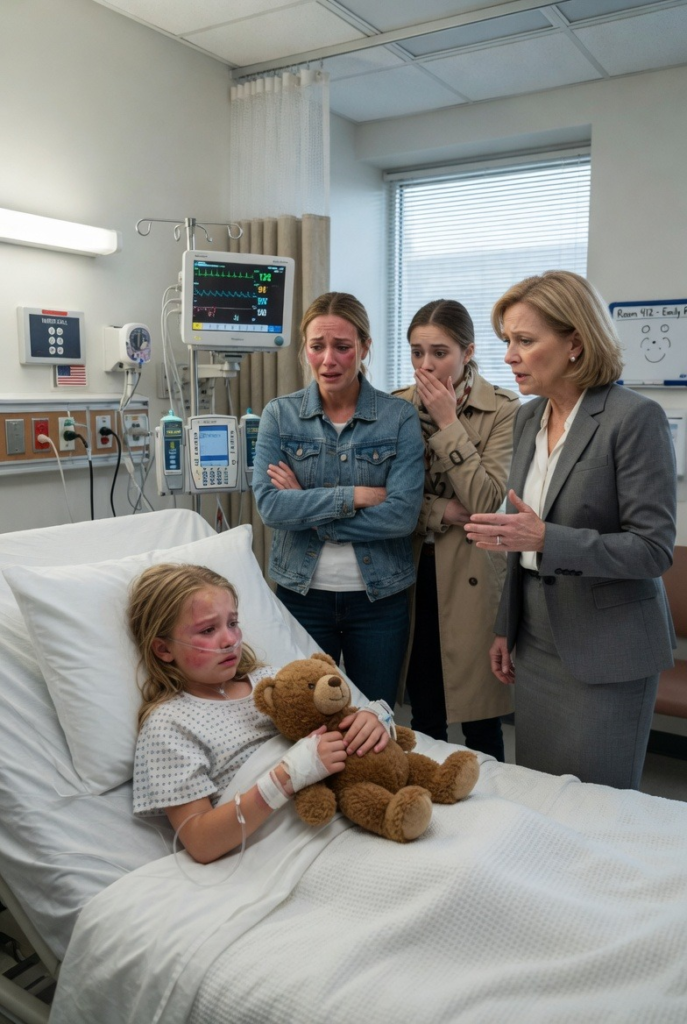
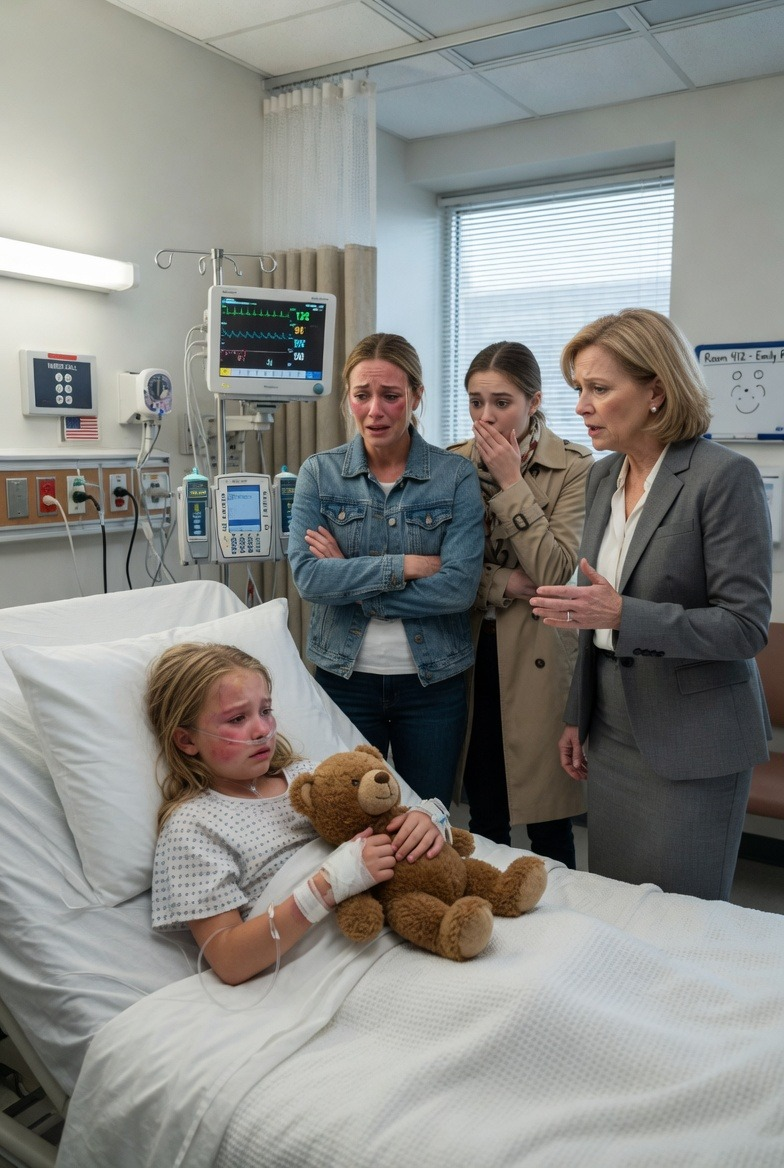
I saw Lucy through the glass before I reached the door.
She looked too small for the bed.
Her hair was damp at the temples.
An IV was taped to her hand.
Her lips were cracked.
Her cheeks were pale except for a frightening red flush that had not fully left her skin.
I pressed my palm to the glass.
My legs wanted to fold.
I did not let them.
That was the first choice I made that day.
I would not collapse where they needed me standing.
The doctor came out with a chart under his arm.
Officer Miller stood beside him with a notebook.
They asked me questions, and I answered them.
When had I last seen Lucy?
Around 10:45 a.m.
Who had custody of the vehicle?
Amanda.
Did Amanda have permission to drive it?
Yes.
Who was with her?
My parents.
Did anyone tell me Lucy had been left in the car?
No.
Had anyone asked permission to punish Lucy that way?
No.
I gave them Amanda’s number.
I gave them my parents’ numbers.
I told them exactly what I knew.
At 3:18 p.m., the elevator doors opened, and my family arrived.
Amanda came first, wearing oversized sunglasses and a loose sundress, mascara smudged just enough to look tragic.
My mother followed, clutching her purse to her chest like it might shield her.
My father came last, jaw tight, shoulders squared, already angry at me for making this inconvenient.
Amanda glanced toward Lucy’s room and said, “This has gotten completely out of hand.”
I looked at her.
There were so many things I could have said.
I said none of them.
My mother grabbed my wrist.
“Anna, listen to me,” she whispered.
Her fingers were cold.
“Your sister made a mistake, but you’re her mother. The car is yours. It will be simpler if you say you forgot Lucy was inside before Amanda took the car.”
For a moment, I thought I had misheard her.
Then my father pulled a folded sheet of paper from his pocket.
Not a tissue.
Not a prayer card.
Not a hospital form.
A handwritten statement.
He held it out to me like a receipt.
“Sign this before the officer comes back,” he said.
I did not take it.
He pushed it closer.
“Tell them it was your fault.”
The first line read, “I, Anna Vance, accept full responsibility for leaving my minor child unattended inside my vehicle.”
Amanda’s name did not appear once.
My mother’s name did not appear once.
My father’s name did not appear once.
Only mine.
The daughter who worked.
The mother who worried.
The one everyone expected to absorb the damage because I always had.
When we were kids, Amanda broke things and I explained them.
Amanda cried and I apologized.
Amanda needed money and I covered groceries.
Amanda forgot birthdays and I told people she was overwhelmed.
I had spent years translating her selfishness into something softer so the family could keep calling itself close.
But there are betrayals you can forgive only because nobody bled.
This one had an IV bag attached to it.
“No,” I said.
My father’s eyes hardened.
“Don’t be stupid.”
My mother looked toward the nurse’s station and lowered her voice.
“Anna, you don’t want your sister’s life ruined.”
I looked through the glass at Lucy’s hand under the tape.
“She’s six.”
Amanda stepped forward.
“You know I would never actually hurt her.”
That was when Officer Miller came back around the corner.
He saw the paper.
He saw my father’s hand.
He saw my mother gripping my wrist.
His expression changed very slightly.
Not dramatically.
Professionally.
“Is there a reason you’re trying to get Ms. Vance to sign something?” he asked.
My father folded the paper too fast.
“No,” he said.
I reached out and took it from him.
Then I handed it to Officer Miller.
“Yes,” I said. “There is.”
Amanda made a sound like a wounded animal.
The doctor stepped out of Lucy’s room before anyone else could speak.
He was holding a sealed plastic evidence bag.
Inside was Amanda’s phone.
A nurse had found it in Lucy’s small backpack, wedged between a towel and her water shoes, where Amanda must have shoved it when the police arrived.
The phone was still unlocked.
The screen glowed in the fluorescent light.
Instagram was open.
Officer Miller looked down at it, then up at Amanda.
There was a video story posted at 12:07 p.m.
My Honda sat in the supermarket parking lot under the hard white sun.
The windows were closed.
Amanda’s laugh was clear on the audio.
Across the video was a caption about “letting the little drama queen cool off.”
My mother saw it and covered her mouth.
My father stared at the floor.
Amanda lunged for the phone.
Officer Miller lifted it away.
“Do not touch that,” he said.
For the first time since she walked into the hospital, Amanda looked frightened for the right reason.
Not because Lucy was hurt.
Because the truth had a timestamp.
The doctor looked at me.
“There’s something else,” he said.
He turned to Officer Miller.
“Based on her condition and the witness statements, she was conscious for a significant portion of the time. She was seen waving and hitting the glass at approximately 1:31 p.m.”
My knees almost gave out.
1:31 p.m.
The Instagram video was posted at 12:07 p.m.
They had known she was there.
They had laughed about it.
Then they had left her there longer.
Officer Miller flipped a page in his notebook.
“A witness from the supermarket also reported an older woman telling the child to ‘stop making a scene’ through the glass at approximately 1:40 p.m.”
My mother’s face went slack.
I turned to her slowly.
“You came back to the car?”
She shook her head once.
Then again.
But it was not denial.
It was fear.
My father said, “Don’t answer that.”
Officer Miller looked at him.
“That is not your decision.”
The hallway froze.
A nurse at the station stopped typing.
A man with a paper coffee cup paused beside the vending machine.
The doctor held the evidence bag at his side.
My mother stared at the white tile as if the floor might open and take her somewhere easier.
Then Lucy made a small sound through the glass.
Not a cry.
A weak, confused whimper.
Every adult in that hallway heard it.
Amanda started crying louder.
I walked into the room.
The nurse gave me space.
I sat beside Lucy and slid my hand under her tiny fingers, careful not to disturb the IV.
Her skin was warm.
Too warm.
Her eyes opened a little.
“Mommy?” she rasped.
“I’m here,” I said.
Her lower lip trembled.
“I knocked.”
The sentence was so small I almost did not understand it.
Then she said it again.
“I knocked and knocked.”
I bowed my head over her hand.
I did not scream.
I did not run into the hallway and put my hands on my sister.
I stayed where Lucy could see me.
That was the second choice I made that day.
I would not give Amanda one more way to make herself the victim.
Outside the room, Officer Miller began separating their statements.
Amanda tried to talk over everyone.
My father demanded a lawyer though no one had asked him a question yet.
My mother sat in a chair with both hands locked around her purse strap, whispering that she had only agreed because Amanda said it would be five minutes.
Five minutes became lunch.
Lunch became three hours.
Three hours became my daughter in a hospital bed.
The police report listed their statements separately.
Amanda claimed Lucy “refused to behave.”
My mother claimed she thought my father had gone back to check.
My father claimed he thought Amanda had the keys.
The witness statement said otherwise.
The Instagram video said otherwise.
The hospital intake record said otherwise.
And the folded confession paper my father had tried to make me sign said they already knew they needed someone else to carry the blame.
By 5:26 p.m., Officer Miller asked if I wanted to make a formal statement.
I said yes.
My voice did not shake.
I told him about the call.
I told him about Amanda’s words.
I told him about the restaurant noise behind her.
I told him about my mother’s hand around my wrist and my father’s paper.
When I finished, Officer Miller closed his notebook.
“I’m sorry,” he said.
People say that when there is nothing else useful to give.
This time, I believed he meant it.
Amanda was not arrested in the dramatic way people imagine.
There was no shouting match, no movie scene, no satisfying slam of metal doors right there in the hallway.
There was paperwork.
Interviews.
Evidence collection.
A hospital social worker.
A police report.
A child protective services notification.
Consequences often arrive quietly first.
That does not make them weak.
It makes them harder to stop.
My parents tried to speak to me before they left.
My mother cried and said, “You’re tearing this family apart.”
I looked at her and said, “No. You left my daughter in a car. I’m just refusing to hide it.”
My father told me I would regret choosing strangers over blood.
I looked through the glass at Lucy sleeping under a thin hospital blanket.
“Blood was in the car with her,” I said.
He had no answer for that.
Lucy stayed overnight.
The nurses monitored her temperature, her fluids, her confusion, her little body working its way back from something no child should ever have to survive.
I sat in the chair beside her bed until my back ached.
Every time she stirred, I touched her hand.
Every time she asked where we were, I told her the truth in the softest way I could.
“You got too hot, baby. The doctors are helping you. I’m right here.”
At 1:12 a.m., my phone buzzed.
Amanda.
Then my mother.
Then my father.
I did not answer.
At 1:43 a.m., Amanda texted me.
You’re really going to ruin my life over one mistake?
I stared at that sentence for a long time.
One mistake.
A mistake is forgetting sunscreen.
A mistake is leaving a towel at home.
A mistake is ordering the wrong lunch.
Locking a six-year-old in a car under the sun and laughing about it online is not a mistake.
It is a choice.
Trying to make her mother confess to it is another one.
I took a screenshot.
Then I sent it to Officer Miller.
For the next few weeks, my family changed its strategy.
First they begged.
Then they blamed.
Then they tried shame.
My aunt called and said I should think about Amanda’s future.
A cousin messaged that family business should stay private.
My father sent one long text about loyalty, sacrifice, and how mothers sometimes have to “take the hit.”
I saved every message.
I created a folder.
Screenshots.
Voicemails.
Hospital records.
Police report number.
Instagram video copy.
The handwritten confession.
For years, they had counted on me being too tired to document the harm.
This time, I documented everything.
Amanda did lose the teaching job.
Not because I called the school.
Not because I posted about it.
Because a pending police investigation involving child endangerment does not stay invisible when your own social media video is part of the evidence.
My parents told everyone I had destroyed her career.
I let them talk.
The people who mattered saw the records.
The people who wanted gossip were never owed my daughter’s pain.
Lucy came home two days later.
She was quieter for a while.
She did not want to sit in the back seat unless I kept the front window cracked at first.
She asked if bad people could lock doors from far away.
She asked if I would forget her.
That one nearly broke me.
I told her no.
Then I showed her how the car locks worked.
I showed her the horn.
I showed her how to press it with both hands and keep pressing.
We practiced in the driveway until the neighbor looked over his fence and I waved an apology.
Lucy laughed for the first time in days.
It was not a big laugh.
But it was hers.
That mattered more than any apology my family could have offered.
There was an investigation.
There were interviews.
There were consequences that belonged to adults who had made adult choices.
I will not dress that part up as revenge.
Revenge would have been easy to misunderstand.
What happened was accountability.
Amanda’s online video became evidence.
My father’s handwritten confession attempt became evidence.
My mother’s statement at the hospital contradicted Amanda’s timeline.
The witness from the supermarket gave a clear account.
The doctor’s notes supported the timeline.
Piece by piece, the story my family wanted to tell fell apart.
A few months later, my mother left a voicemail.
She sounded smaller.
Not sorry exactly.
Lonely.
She said, “I just want to see Lucy.”
I listened once.
Then I saved it.
I did not call back.
Some people hear boundaries only when they come with paperwork.
Mine did.
The last time I saw Amanda in person, she was standing outside a hearing room with her arms folded, looking at me like I had stolen something from her.
Maybe I had.
I had stolen her certainty that I would always fix what she broke.
She said, “Are you happy now?”
I looked at her for a long moment.
I thought about Lucy’s damp hair on the hospital pillow.
I thought about the little half-moon marks my mother’s nails left on my wrist.
I thought about my father holding out that paper like my life was a trash can for their guilt.
Then I said, “No. But I’m done protecting you.”
Her face changed.
That was the satisfying part people never understand.
It was not watching anyone suffer.
It was watching the old rules stop working.
It was watching my father realize his voice did not control the room.
It was watching my mother realize tears did not erase a timestamp.
It was watching Amanda realize that my love for my daughter was bigger than my training to keep the peace.
For years, I had been the one everyone expected to absorb the damage because I always had.
Not anymore.
Family was supposed to be my safety net.
That day, I learned a harder truth.
Sometimes the net is the thing you have to cut loose before it drags your child down with it.
Lucy is safe now.
She is seven.
She still hates hot car seats.
She still asks me to leave the front window cracked until the air cools down.
And every time I buckle her in, I look her in the eye and say, “I see you.”
She says, “I know, Mommy.”
That is the only ending I needed.
Not forgiveness.
Not family peace.
Not everyone understanding my side.
Just my daughter alive, my hands clean, and the truth written down where nobody could fold it into a pocket and make me sign it away.