I do not remember taking my gloves off.
I do not remember handing the needle to my assistant.
I remember saying, “Cancel the rest of the day,” and moving before anyone could ask me what had happened.
At 2:41 p.m., I signed the hospital intake clipboard with a hand that looked detached from my body.
The receptionist’s face changed when I gave my name.
That was the second warning.
The first had been the call.
The third was the nurse who came out with Meadow’s chart held against her chest.
“Mrs. Hawthorne,” she said, “your daughter is in critical condition. The doctor will explain, but you should prepare yourself.”
Prepare yourself.
I had spent twenty years in the military.
I had completed three tours.
I had a Bronze Star in a box in my closet and memories that still found me at 3:00 a.m. if a truck backfired outside my window.
I had learned how to breathe through fear, how to read a room, how to keep my hands steady when everything in me wanted to run.
But no war teaches you how to prepare for your child in a hospital bed.
People in our small Nebraska town knew me as Doc Tori.
They brought me their dogs, calves, horses, barn cats, and half-wild animals that bit first and considered gratitude optional.
They knew I did not scare easily.
They knew I could handle blood.
They did not know what it cost to become calm.
They did not know I chose corner tables at diners.
They did not know I memorized exits in grocery stores.
They did not know I still woke in the dark reaching for danger that was not there.
Meadow was the reason I kept choosing life after I came home.
She made me relearn gentleness.
She made me care about school picture forms, pancake batter, mismatched socks, and whether the night-light was shaped enough like a moon to count as a moon.
She made the world feel worth staying in.
Dennis knew that.
Dennis Hawthorne, my husband of nine years, was the kind of man people trusted before he finished speaking.
He managed the bank.
He coached Little League.
He served pancakes at church breakfasts and remembered which older customers liked extra syrup.
He lowered his voice when he wanted people to lean closer.
That was one of his talents.
He understood that a soft voice can feel like honesty if a person uses it well.
Everyone called him a good father.
Lately, he had been distant in ways I kept explaining away.
Late nights.
A guarded phone.
Smiles that stopped before they reached his eyes.
Short answers that made me feel needy for asking ordinary questions.
Trauma teaches you to doubt your own edges before you doubt someone else’s betrayal.
So I wondered if I was too watchful.
Too guarded.
Too hard to love.
Maybe Dennis wanted a softer wife, and I had become a woman made of alarms.
Serena made that lie easier to believe.
My younger sister was everything people thought women should be when they wanted comfort without complication.
Warm.
Social.
Bright.
Easy with strangers.
She sold houses and could make a nervous couple feel at home before they had even crossed the porch.
She brought wine on difficult nights.
She picked Meadow up from school when an animal emergency ran long.
She had my alarm code, a spare key, and the kind of access you only give someone when you believe family means safety.
Meadow adored her.
Aunt Serena braided her hair.
Aunt Serena bought glitter notebooks.
Aunt Serena let her put stickers on furniture and then laughed while I scraped them off later.
She was not just my sister to Meadow.
She was part of the map of home.
That was why the betrayal did not feel like a knife.
It felt like poison in the water.
The doctor led me down the hall.
His shoes squeaked softly on the polished floor.
He spoke in fragments because doctors do that when they are trying to be both honest and merciful.
Fall.
Imaging.
Shoulder.
Observation.
Bruising.
Possible internal trauma.
All I heard was get to her.
Then I saw my child.
Meadow looked too small for the bed.
Her arm was wrapped.
Her shoulder was braced.
There were dark bruises against her skin that made something ancient and violent rise in me before training shoved it back down.
Machines beeped beside her.
A clear tube ran near her arm.
A hospital wristband circled her small wrist like proof she had entered a world no seven-year-old should have to enter.
“Meadow?” I whispered.
Her eyelids moved.
For one second, I thought she might not come back to me.
Then she opened her eyes.
“Mom,” she whispered. “I’m sorry.”
Those were the first words my injured child gave me.
Not help me.
Not it hurts.
Sorry.
I bent over her with my hand hovering because I was terrified to touch the wrong place.
“No, sweetheart,” I said. “You do not apologize. Not to me. Not ever.”
Her eyes moved toward the door.
That was when I understood she was not only hurt.
She was afraid of being heard.
“I saw Dad,” she whispered.
My body went still.
“With Aunt Serena.”
I felt the words arrive before I understood them.
“In your bed,” she said.
Dennis.
Serena.
My bedroom.
My daughter in the doorway.
My child seeing something that belonged to adult wreckage and adult shame.
I wanted the room to spin because spinning would have felt human.
Instead, everything sharpened.
Meadow’s breath caught.
“He got mad,” she said. “He said I ruined everything.”
I did not speak.
I was afraid of what my voice might do.
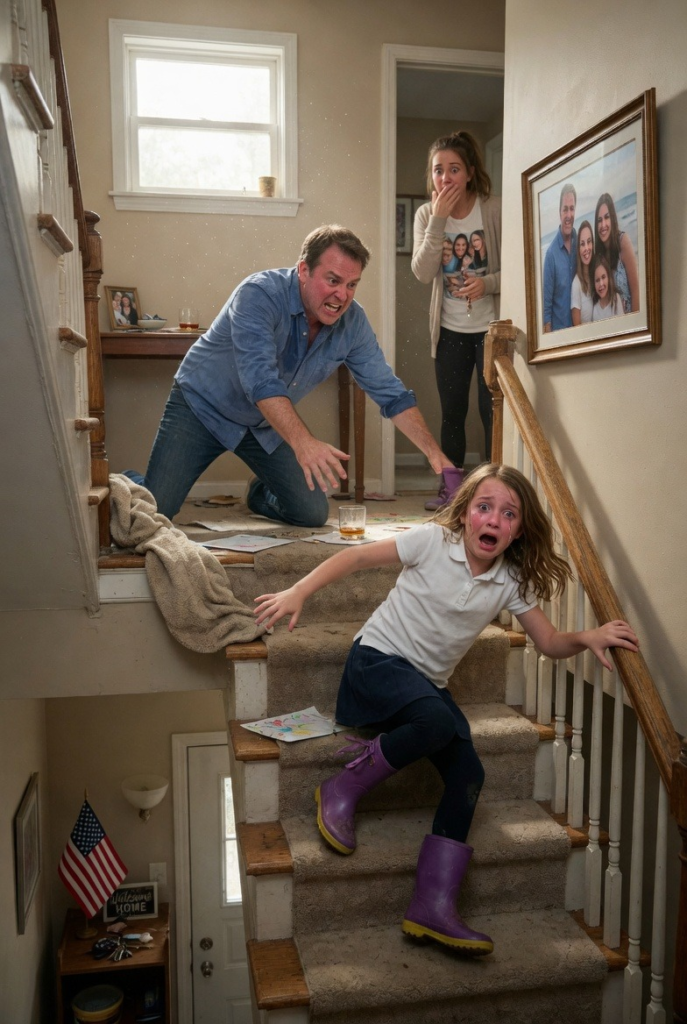
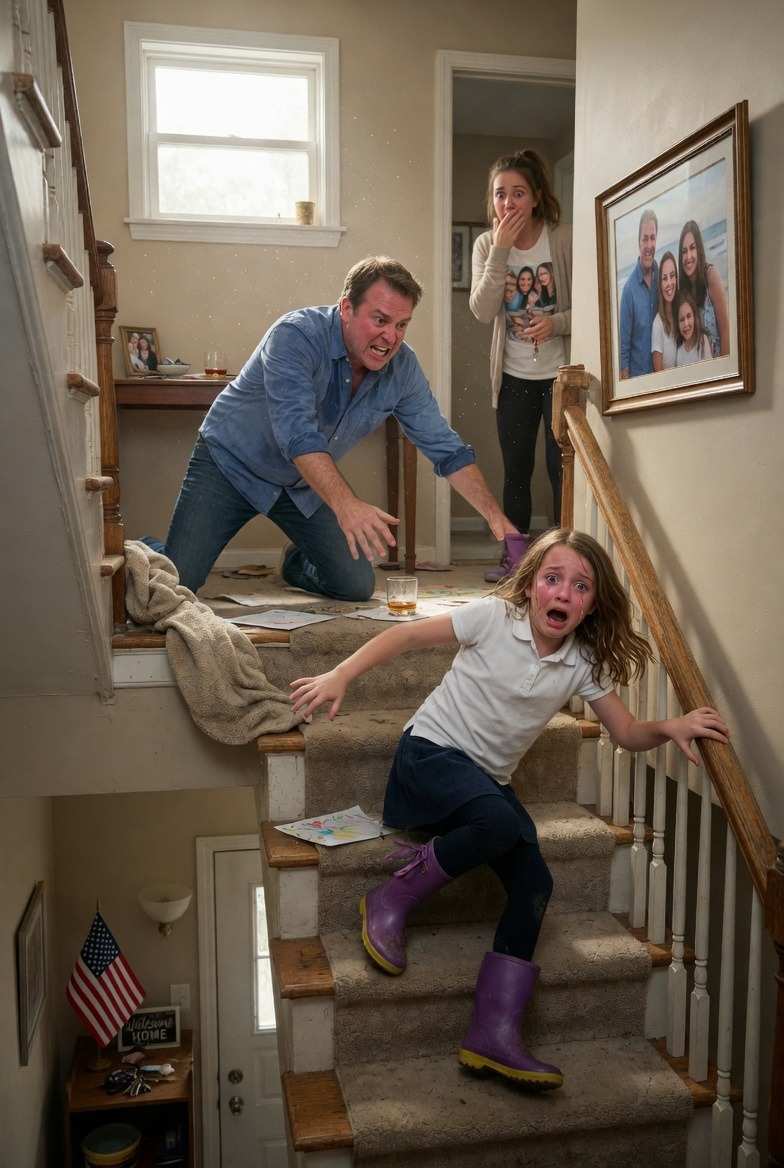
“Then he threw me down the stairs.”
There are kinds of anger that burn everything they touch.
This one froze.
For one ugly heartbeat, I saw Dennis’s face under my hands.
I saw Serena’s whiskey glass breaking across tile.
I saw the kind of revenge that would have satisfied the worst part of me for exactly three seconds and ruined everything after.
Then Meadow whimpered.
The rage folded itself into a place where it could work.
“They told me to say I fell,” she whispered. “Playing dress-up. Dad said nobody would believe me.”
“I believe you,” I said immediately.
She searched my face.
“I believe every word.”
“They’re still there,” she said.
Her voice thinned until it was almost air.
“In the kitchen. Drinking whiskey.”
My husband and my sister were still in my house.
Drinking.
After my daughter had been carried away injured.
The nurse entered quietly with a folder.
A police report form was clipped to the front.
“Mrs. Hawthorne,” she said, “two officers are waiting to speak with you.”
I kissed Meadow’s forehead.
“Mommy is going to handle this.”
“Don’t let them be mad at me,” she whispered.
That sentence broke something in me that combat had never reached.
“They do not get to be mad at you,” I told her. “They get to answer.”
In the hallway, two officers turned when I walked out.
One had a notebook open.
The other watched me with the careful attention of someone who had seen grief become dangerous when mishandled.
“What can you tell us?” he asked.
“My husband hurt my daughter after she found him with my sister,” I said. “He told her to lie. They are both still in my home, and they have been drinking.”
The officer’s pen stopped.
I gave them the house layout.
Bedroom at the top of the stairs.
Kitchen off the back hall.
Whiskey in the cabinet beside the sink.
Back door that stuck when opened.
Spare key under the broken planter because Dennis never listened when I told him that was foolish.
I did not cry.
Crying would come later, when it could not cost my daughter evidence.
At 3:09 p.m., the older officer told the nurse to preserve Meadow’s statement and the hospital intake notes.
At 3:12 p.m., his partner asked whether my home had cameras.
I had installed one in the hallway months earlier after a break-in three streets over.
It did not face the bedroom.
It did not face the kitchen.
It did face the stairwell.
My phone buzzed while we were still talking.
Motion detected.
The notification was from 1:52 p.m.
The officer held out an evidence bag.
“Do not delete anything,” he said.
“I was not planning to.”
The drive back to my house felt both too fast and impossibly slow.
A cruiser pulled ahead of me.
Another followed.
The afternoon sun was bright enough to make the streets look normal, which felt offensive.
People were mowing lawns.
A yellow school bus rolled past the corner.
A small American flag moved gently on someone’s porch.
The world had not stopped because my child had been broken.
That is one of the cruelties nobody warns you about.
Your life can split in half while everyone else remembers to take the trash cans in.
When we pulled into my driveway, Dennis opened the front door before the second cruiser even stopped.
He had changed shirts.
That was the first thing I noticed.
Not the apology he was preparing.
Not the worry he had arranged on his face.
The shirt.
The man had found time to change.
“Tori,” he said. “There’s been an accident.”
The older officer stepped between us before I could answer.
Serena stood behind Dennis near the kitchen island.
She had one hand wrapped around a whiskey glass.
Her hair was too neat for someone supposedly devastated.
Her face was pale, but not with grief.
With calculation.
“Tori,” she whispered, and hearing my name in her mouth made my stomach turn.
I did not look at her.
If I looked too long, I might have forgotten the difference between justice and punishment.
The officers separated them immediately.
Dennis tried to keep talking.
He said Meadow was confused.
He said she had been playing.
He said children misunderstand things.
He said I was emotional.
That was the word that nearly made me smile.
Men like Dennis love the word emotional because it turns truth into weather.
They hope everyone will wait for it to pass.
The younger officer asked where the stairs were.
Serena’s hand tightened around the glass.
The whiskey inside trembled.
We walked to the hallway.
The house looked too familiar.
Meadow’s raincoat hung on the hook by the door.
Her school drawing was still magneted to the refrigerator.
A cereal bowl sat in the sink.
Ordinary things can become witnesses when people behave badly around them.
At the bottom of the stairs, one purple rain boot lay on its side.
The second was halfway under the hall table.
I had bought those boots because Meadow said they made her “faster in puddles.”
The officer photographed them.
He photographed the stair tread.
He photographed the railing where one small smear marked the varnish.
He photographed the glass on the kitchen island and the whiskey bottle beside it.
Then I opened the camera app.
The clip loaded slowly.
For a second, all of us watched a frozen thumbnail of the hallway where my daughter had grown up running from bath time.
Then it played.
Meadow appeared at the top of the stairs in her purple boots.
She was backing away from the bedroom door.
Dennis stepped into the frame.
There was no sound, which somehow made it worse.
His mouth moved.
His hand shot out.
Her small body twisted.
One boot came loose.
The officer paused the clip before the fall finished.
No one needed the rest to understand.
Serena made a sound behind us.
Not a sob.
A collapse of breath.
She slid down the side of the kitchen island until she was sitting on the floor, whiskey soaking into the knee of her jeans.
“I didn’t think he meant to,” she whispered.
It was the first honest thing she had said, and it was still not enough.
Dennis’s face changed.
All day, he had lived inside the belief that reputation was stronger than a child’s voice.
But reputation is not stronger than a timestamp.
It is not stronger than a hospital intake form.
It is not stronger than a police report, a hallway camera, two purple boots, and a seven-year-old whispering the truth from an emergency room bed.
The older officer told Dennis to turn around.
Dennis looked at me then.
Not at the officers.
Not at Serena.
At me.
“Tori,” he said softly.
He used the voice that made people lean in.
I did not.
“Do not use that voice on me,” I said.
His mouth opened and closed.
For the first time since I had known him, Dennis Hawthorne had nothing polished ready.
Serena began crying harder when the officer asked whether she wanted to make a statement separately.
“I love Meadow,” she said.
I looked at my sister then.
Just once.
“No,” I said. “You loved being trusted.”
That was the last sentence I gave her in my house.
By sunset, both of them were gone from my driveway in separate cruisers.
I did not feel triumphant.
People who have never had to protect a child imagine justice feels like fire.
It does not.
It feels like standing in your own kitchen after strangers have photographed the worst day of your life and realizing you still have to go back to the hospital.
I returned to County General with my hair still smelling faintly of the house.
The nurse told me Meadow had been asking for me.
When I stepped into the room, she turned her head very carefully.
“Are they mad?” she whispered.
“No,” I said.
It was not the full answer, but it was the only one she needed.
I sat beside her bed and placed my hand near hers.
She curled two fingers around my thumb.
It was the smallest grip.
It held me together anyway.
The weeks after that were not clean.
There were medical follow-ups.
There were interviews.
There were forms with boxes too small for the damage they were trying to contain.
There was a hospital record, a police report, and a victim advocate who spoke gently without treating Meadow like glass.
There was a family court hallway where Dennis’s perfect-father smile did not work the way it had in church basements and bank lobbies.
There were people in town who avoided my eyes at the grocery store because they had once praised him to my face.
There were others who left casseroles on my porch without knocking.
One older farmer whose calf I had saved years before came by the clinic, stood in the doorway with his cap in his hands, and said only, “Doc, if you need anything fixed at the house, you call me.”
That was the kindest thing anyone said that month.
Not dramatic.
Not polished.
Just useful.
Meadow healed in the uneven way children do when their bodies mend faster than their trust.
Her shoulder improved.
The bruises changed color.
The nightmares did not listen to the discharge instructions.
Some nights she asked if Aunt Serena could still see the moon from wherever she was.
Some nights she asked whether Dad had stopped being Dad when he got mad or whether he had been pretending before.
Those are questions no mother should have to answer.
I answered what I could.
I told her grown-ups are responsible for their own choices.
I told her love is not real when it asks a child to lie.
I told her the truth did not hurt our family.
The people hiding from it did.
My divorce paperwork was filed before the month was over.
I signed my name at the county clerk’s counter while Meadow sat beside me with a coloring book and a purple crayon.
When we walked out, the air smelled like rain on hot pavement.
She looked up at me and asked whether we could get pancakes for dinner.
So we did.
She wore the replacement purple boots I had ordered online at 1:00 a.m. after the first pair became evidence.
She jumped over a puddle outside the diner and landed badly enough to splash my jeans.
Then she laughed.
The sound nearly took my knees out.
Meadow was the reason I kept choosing life after I came home.
After Dennis and Serena, she became the reason I stopped apologizing for surviving it.
People still call me Doc Tori.
They still bring me dogs with torn paws, calves that will not stand, barn cats with more attitude than sense.
My hands are still steady.
But now, when people lower their voices and say Dennis fooled everyone, I correct them.
He did not fool everyone.
He counted on everyone trusting his smile more than my daughter’s fear.
That was his mistake.
Because the town’s perfect father and her favorite aunt thought I would shatter before I fought back.
They were wrong.
I did shatter.
Then I used every broken piece to point straight at the truth.