Another asked what I would do if a child lied.
I told her fear teaches children to lie before they ever learn multiplication.
Sarah, the caseworker assigned to my file, was the first person in that office who did not make me feel like a problem to be managed.
She never promised anything.
She did not soften the truth.
But she listened.
On Tuesday at 8:12 a.m., while I was mopping a hallway that smelled like bleach and old coffee, Sarah called.
“Emily,” she said, “your file has been approved.”
I stopped with the mop in both hands.
“There is a girl named Clara,” she continued.
“Seven years old. She needs emergency placement.”
The word emergency sat between us.
I asked what had happened.
Sarah was quiet just long enough for me to understand there were things she could not say on the phone.
“She is sweet,” she said finally.
“She has been through a lot.”
By Saturday, I had turned my little spare room into the closest thing to a daughter’s room I could make on clearance money and hope.
Purple sheets.
Butterfly curtains.
A moon night-light.
Two empty hangers in the closet.
I bought colored pencils, a purple hoodie, and a teddy bear from the discount aisle because every child deserves to arrive somewhere and find proof that someone expected her.
The child services lobby smelled like paper, sanitizer, and old air.
Clara sat in the corner with her hands tucked deep inside her sleeves.
She looked smaller than seven.
Not younger.
Smaller.
As if she had been folding herself away for years.
“Hi, Clara,” I said softly.
“I’m Emily.”
She did not answer.
I put the colored pencils on the table between us.
“They told me you like purple.”
Her fingers came out just enough to choose one.
She drew a house.
Then she drew a door.
Then she dragged black lines over the door until the purple point nearly tore through the paper.
“Is that rain?” I asked.
She shook her head.
“Bars.”
Sarah looked down at her file.
I saw her jaw tighten.
That was the first moment I understood that whatever Clara had survived had left fingerprints on every ordinary thing.
Doors.
Food.
Water.
Silence.
On the way home, Clara held the teddy bear against her chest and watched the road through the window.
I stopped at the grocery store because I wanted the apartment to smell like something normal.
Milk.
Bread.
A little vanilla cupcake in a plastic shell.
When I handed it to her, she did not eat it.
She put it in her backpack.
“You can have it now, honey,” I told her.
She looked at the zipper.
“Later.”
“Why later?”
“In case there isn’t any tomorrow.”
I wanted to pull the car over and cry until my ribs hurt.
Instead, I drove home.
Some children do not need big speeches.
They need someone to keep both hands steady on the wheel.
At the apartment, I showed Clara the bedroom.
She stood at the threshold and looked at the bed as if it might change shape.
“Do I sleep here?”
“Yes.”
“Alone?”
“If you want, I’ll leave the door open.”
She pressed the teddy bear to her chest.
“Does it lock from the outside?”
The question went through me like cold water.
“No,” I said.
“Nothing here locks from the outside.”
She did not smile.
But her shoulders lowered by less than an inch.
I counted it as the first gift she gave me.
Dinner was half a grilled cheese sandwich and three sips of milk.
She asked before touching the napkin.
She asked before setting the teddy bear on the chair.
She asked if she was allowed to use the bathroom.
Every question was a little window into a place I did not want to imagine.
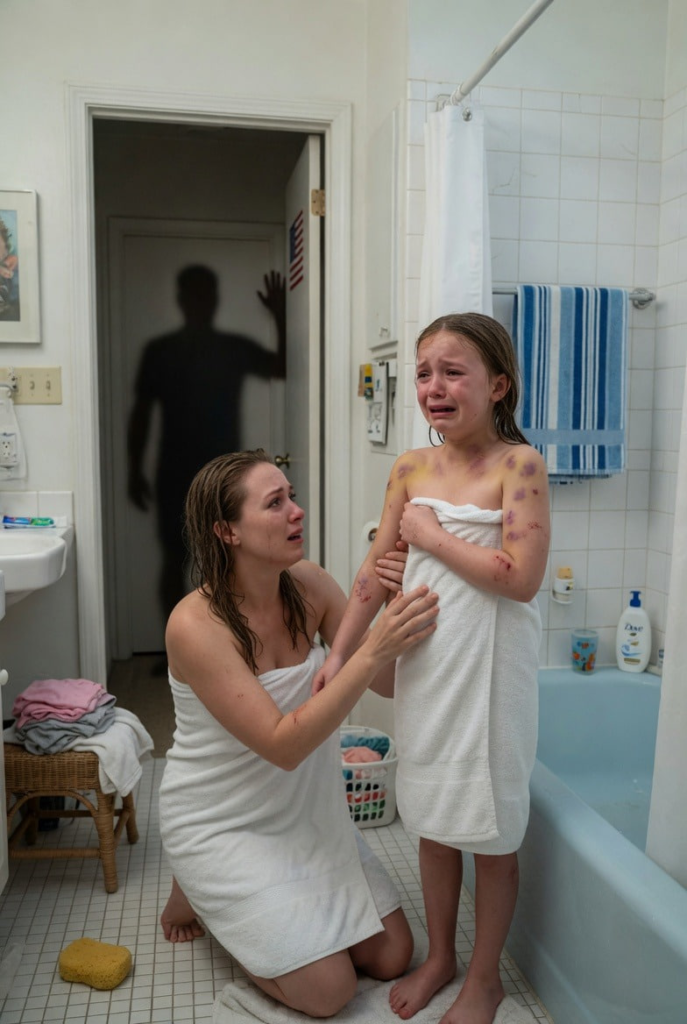
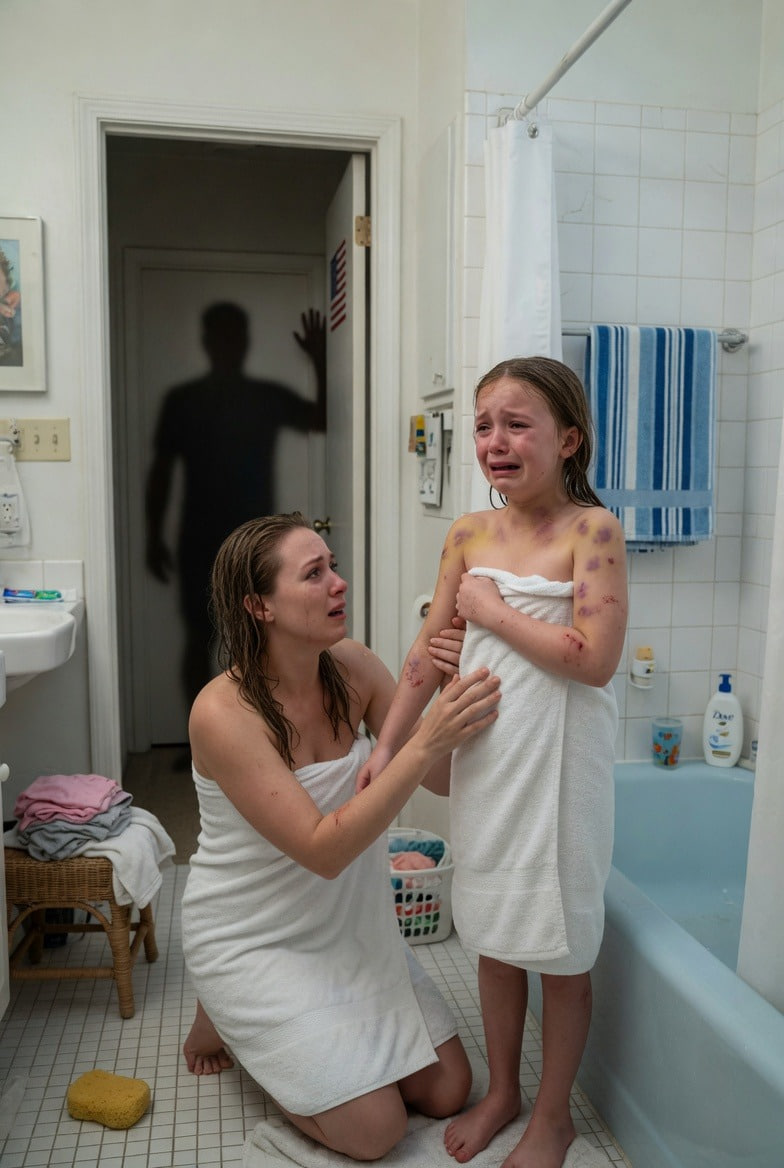
At 7:48 p.m., I told her it was bath time.
The color left her face.
“No.”
“It’s warm water,” I said.
“I can help you, or I can sit right outside.”
“No.”
The word came out hard.
Then she flinched from herself.
“Sorry. Don’t hit me.”
I knelt in front of her.
The hallway carpet scratched my knees through my jeans.
“Clara, look at me.”
She looked at my shoulder instead of my eyes.
“In this apartment, nobody hits.”
It took ten minutes for her to agree.
She only agreed when I promised not to close the bathroom door.
I filled the tub with warm water and chamomile soap.
Steam climbed the mirror.
The bathroom smelled clean and soft, and that made the fear on Clara’s face feel even more wrong.
She undressed with her back turned.
I looked away because dignity matters, even when a child is too frightened to ask for it.
First I saw the old bruises.
Yellow on her arms.
Small marks on her legs.
A shadow shaped like fingers around one wrist.
I kept my face still.
“Did you fall?”
She looked at the water.
“That’s what the lady said.”
“What lady?”
She did not answer.
I did not push.
I helped her into the tub.
She went rigid.
No splashing.
No questions.
No toys.
Just a child sitting in warm water as if she had been trained to endure kindness quietly in case it was a trick.
I washed her hair slowly.
There was a scab behind her ear.
Another at the back of her neck.
I asked her to lean forward so I could rinse her back.
That was when I saw it.
Low on her back, partly hidden by water, was a mark made by heat.
Three letters.
One number.
A crooked little cross beneath them.
The sponge fell out of my hand and hit the bathwater.
Clara twisted away so fast water spilled onto the floor.
She slapped both hands over her back.
“Don’t look at it.”
My mouth went dry.
“Clara, who did that to you?”
“If I tell you, they’ll come for me.”
The apartment seemed to shrink around us.
I wrapped her in the towel without touching the mark.
I wanted to scream.
I wanted to run into the hallway and pull every door open until I found the people who had done it.
Instead, I held the towel closed under Clara’s chin and kept my voice low.
Rage is easy.
Safety is harder.
At that exact moment, someone knocked on my apartment door.
Three knocks.
Slow.
Firm.
Clara stopped breathing.
She grabbed my wet wrist with both hands.
“It’s them,” she whispered.
I moved without thinking.
I put my body between Clara and the hallway.
The person knocked again.
I could see the kitchen counter from where I stood.
Sarah’s emergency number was clipped to the front of Clara’s intake packet.
My phone was beside it.
I backed up with Clara behind me and reached for it.
My first call was 911.
My second was Sarah.
The dispatcher asked for my apartment number.
I gave it in a voice I barely recognized.
“Do not open the door,” she said.
“I’m not.”
“Is the child with you?”
“Yes.”
“Is she injured?”
I looked at Clara’s wet hair, the towel clutched in her fists, the way her eyes had gone empty.
“Yes,” I said.
Sarah answered on the second ring.
“Emily?”
“Someone is at my door,” I whispered.
“Clara says it’s them.”
Sarah’s voice changed.
Not louder.
Sharper.
“Put me on speaker but keep the line open.”
As I moved the phone, I saw the folded edge of Clara’s emergency placement sheet sticking out from the packet.
There was a handwritten notation on the back corner.
Three letters.
One number.
The same ones I had seen on her skin.
For a second, the hallway tilted.
“Sarah,” I said.
“What is this code?”
Silence.
Then Sarah said, “Emily, listen to me very carefully. The officers are on their way.”
The person outside leaned close to the door.
“Emily,” a voice said.
Calm.
Polite.
Almost friendly.
“We know she’s in there.”
Clara made a sound I had never heard from a child.
It was not crying.
It was the sound of someone trying to disappear inside her own bones.
I put my arm around her.
“You are not going anywhere,” I said.
The person outside knocked once more.
This time the doorframe seemed to answer.
The dispatcher told me officers were approaching.
Sarah stayed on the line.
I could hear papers moving on her end.
She was pulling Clara’s file.
The apartment hallway outside my door went quiet.
Then there was another voice.
“Police. Step away from the door.”
Clara collapsed against my side.
I held her up.
The next minute was a blur of commands, footsteps, and the metallic click of a radio.
I did not open the door until the dispatcher told me to.
When I did, two officers were in the hall.
A woman stood between them and the stairwell.
I will not describe her face in detail because it does not deserve that much space in my memory.
What I remember is that she looked annoyed.
Not frightened.
Not ashamed.
Annoyed.
Like Clara was property someone had delayed returning.
One officer asked if she knew the child.
The woman smiled.
“She has behavioral issues,” she said.
“She makes things up.”
Clara shook so hard I thought she might fall.
I felt something in me go still.
Not anger.
Worse than anger.
Proof.
I turned to the officer nearest me and said, “She has a mark burned into her back. I found it ten minutes ago. I need a police report, an ambulance, and I need county child services on record that this child is not leaving with anyone but me or an officer.”
The officer’s face changed.
The woman’s smile did not last.
At the hospital intake desk, I gave Clara’s name, age, and placement paperwork.
A nurse with kind eyes brought a blanket warmed in a machine.
Clara asked if she was allowed to keep it.
The nurse looked at me, then at Clara.
“Yes, sweetheart,” she said.
“That blanket is yours while you need it.”
A doctor documented every bruise.
A nurse photographed the mark for the medical file.
An officer took my statement for the police report.
Sarah arrived wearing the same cardigan she had worn at the child services office, only now one sleeve was shoved up like she had left in the middle of something.
When she saw Clara in the hospital bed, she pressed her lips together and looked at the floor for one second.
Then she came to us.
“I’m sorry,” she said.
Not the useless kind of sorry.
The kind that meant she was about to work.
She explained what she could.
Clara had been moved fast.
Too fast.
There were gaps in the prior placement records.
There were complaints that had been filed and closed too neatly.
The notation on the emergency sheet should never have been there.
Sarah did not make excuses.
She started making calls.
By 1:16 a.m., Clara was asleep with the teddy bear under her chin and the warmed blanket tucked around her.
I sat beside her hospital bed with dried bathwater on my jeans and my work shoes still unlaced.
The officer came back with a report number written on a card.
Sarah placed a temporary safety plan on the tray table.
My name was on it.
Clara’s name was on it.
For the first time all night, those two names on one page did not feel like paperwork.
They felt like a door opening from the inside.
The next weeks were not easy.
Children do not heal because an adult wants a clean ending.
Clara hid food for months.
She slept with the light on.
She cried once because I washed her purple hoodie without asking, and I learned to ask before touching anything that felt like hers.
We went to appointments.
We sat in waiting rooms.
We spoke with counselors, detectives, doctors, and child services workers.
There was a family court hallway with hard benches and a flag by the door.
There were stamped forms, signed statements, recorded interviews, and more silence than justice should ever require.
But Clara stayed.
That mattered.
The first time she ate a cupcake the same day I bought it, I had to turn toward the sink and pretend to rinse a plate.
The first time she shut her bedroom door halfway, not because she was afraid but because she wanted privacy, I cried into a dish towel after she fell asleep.
The first time she called the apartment “home,” she said it while looking for her sneakers.
Like it was ordinary.
Like it had always been true.
I learned that love for a wounded child is not one grand rescue.
It is a hundred small permissions repeated until the body believes them.
You can eat now.
You can sleep here.
You can say no.
You can tell the truth.
You are not going back.
Months later, Clara drew another house.
This one had a porch, a mailbox, two windows, and a crooked little moon in the sky.
There were no bars over the door.
She taped it to the refrigerator with the small American flag magnet from the hallway table.
I stood there looking at it for a long time.
I thought about that first night, the fogged mirror, the dropped sponge, the knock at the door, and a child asking if she would be sent back.
A safe room can still look like a trap to a child who has survived by asking permission to breathe.
But one day, if you keep the door open long enough, she may walk through it on her own.
That is what Clara did.
And when she did, I was there.