Ivy wore a pale blue dress with tiny covered buttons down the back.
Marcus clipped her hair because my hands were shaking too much to get the bow straight.
He knelt in the hallway by our front door, old sneakers beside her patent-leather shoes, and told her she looked like herself.
That was his highest compliment.
He never wanted our daughter to feel decorated into somebody else.
At the country club, the valet line was full of black SUVs and polished sedans.
Inside, a seating chart stood beside a small American flag on the check-in table.
That flag is the detail I remember most clearly now, because everything around it was trying so hard to look proper.
My sister Paige’s name was at Table 2.
Ours was at Table 7, near the kitchen doors.
My mother greeted me with a glance that started at my shoes and ended at Marcus’s jacket.
“Joanna, you came,” she said.
Not good to see you.
Not thank you for bringing our granddaughter.
Just an audit.
My father air-kissed beside my cheek and moved past me toward a man he knew from the bank board.
Paige waved from across the room with two fingers.
She looked radiant.
She always did when she had an audience.
My older sister had learned early that my parents rewarded confidence even when it was just cruelty wearing perfume.
She married well.
She dressed better.
She raised her son Tanner as if he had been born already seated at the head of a table.
Tanner was twelve, tall for his age, with a smile that copied Paige’s too perfectly.
He had never been mean to Ivy in private.
That was what bothered me later.
He saved it for rooms where adults would approve.
Dinner began at 7:10 p.m.
That timestamp is burned into me because I checked my phone under the table when the speeches started, wondering how early we could leave without creating the exact scene my mother accused me of creating.
First came Dad’s golf partner.
Then Aunt Felicity, who spoke about devotion and sacrifice while my mother blinked like a woman listening to a hymn written about herself.
Then Paige stood.
Her glass caught the chandelier light.
“Mom and Dad taught us family hierarchy,” she said.
A few people chuckled before she even reached the cruel part, as if her tone had already given them permission.
“Some are born to lead,” she continued. “Others are born to serve.”
The laughter was light.
Polite.
Almost embarrassed.
But it was laughter.
Ivy looked at me.
“What does that mean?” she whispered.
Marcus leaned close before I could answer.
“It means your aunt likes hearing herself talk.”
I almost laughed.
I did not, because Paige’s eyes had moved to our table.
Families like mine have a language under the language.
One lifted eyebrow can be a warning.
One smile can be a threat.
One toast can tell you exactly where they plan to put your child.
Dessert came after the speeches.
Small plates.
Chocolate mousse.
Tiny forks too delicate for what happened next.
Tanner appeared beside Ivy’s chair.
“Come help me,” he said.
Ivy looked at me, confused.
Before I could speak, he grabbed her by the arm and tugged.
Her shoe scraped against the ballroom floor.
Marcus stood so quickly his chair hit the wall behind him.
“Take your hand off my daughter.”
The nearest table went quiet.
Paige came toward us smiling.
She did not look alarmed.
She looked pleased that her son had started the lesson without her.
“Tanner is the eldest grandson,” she said. “The heir. She can help serve him.”
“She is a child,” Marcus said.
“So is he,” Paige replied.
“No,” I said. “He is acting like a little tyrant because you keep clapping for it.”
That was the first honest sentence I had said in that room all night.
My mother’s head turned.
My father heard it from three tables away.
It is amazing how fast powerful people can move when respectability is in danger.
Mother reached us first.
“Don’t make a scene, Joanna.”
I looked down at Ivy’s arm, still in Tanner’s grip.
“He is hurting her.”
“Tanner is the king of this family,” my mother said, as if she were explaining where to place a napkin.
My father’s voice came from behind Marcus.
“The girl can learn her place.”
Some families teach love through Sunday dinners and rides home from school.
Mine taught place cards, inheritance, and fear.
They taught my child she had a place beneath the table.
I said, “We’re leaving.”
Marcus put his hand out for Ivy.
Tanner let go because Marcus scared him.
Paige did not.
She stepped forward and caught Ivy’s wrist.
What happened next took maybe five seconds.
I have replayed it for years, and it still will not slow down.
Paige yanked my daughter away from me.
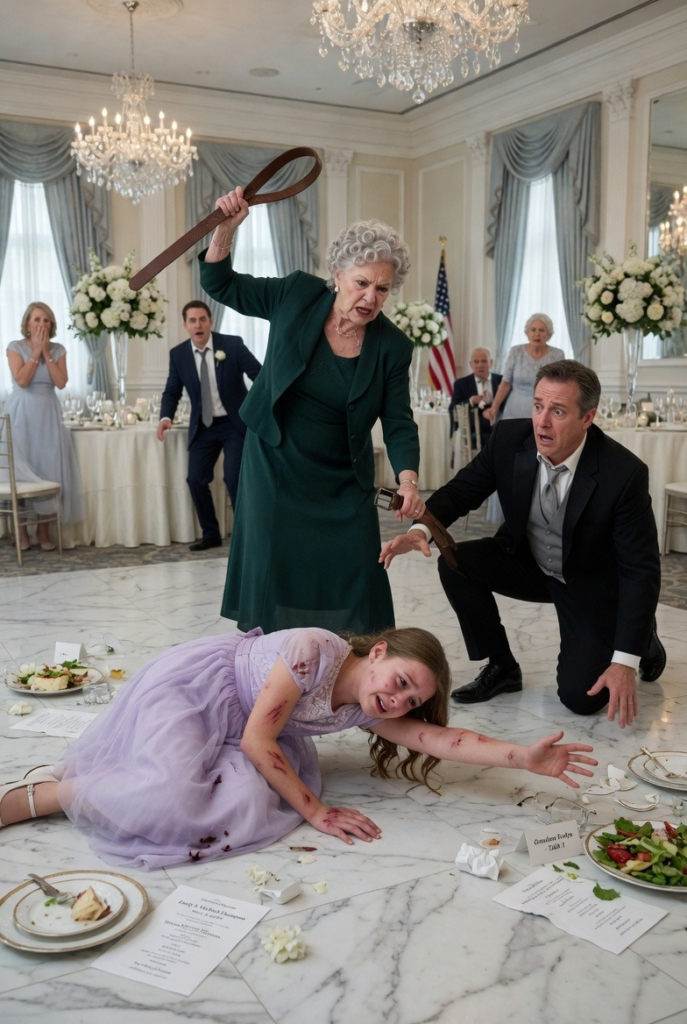
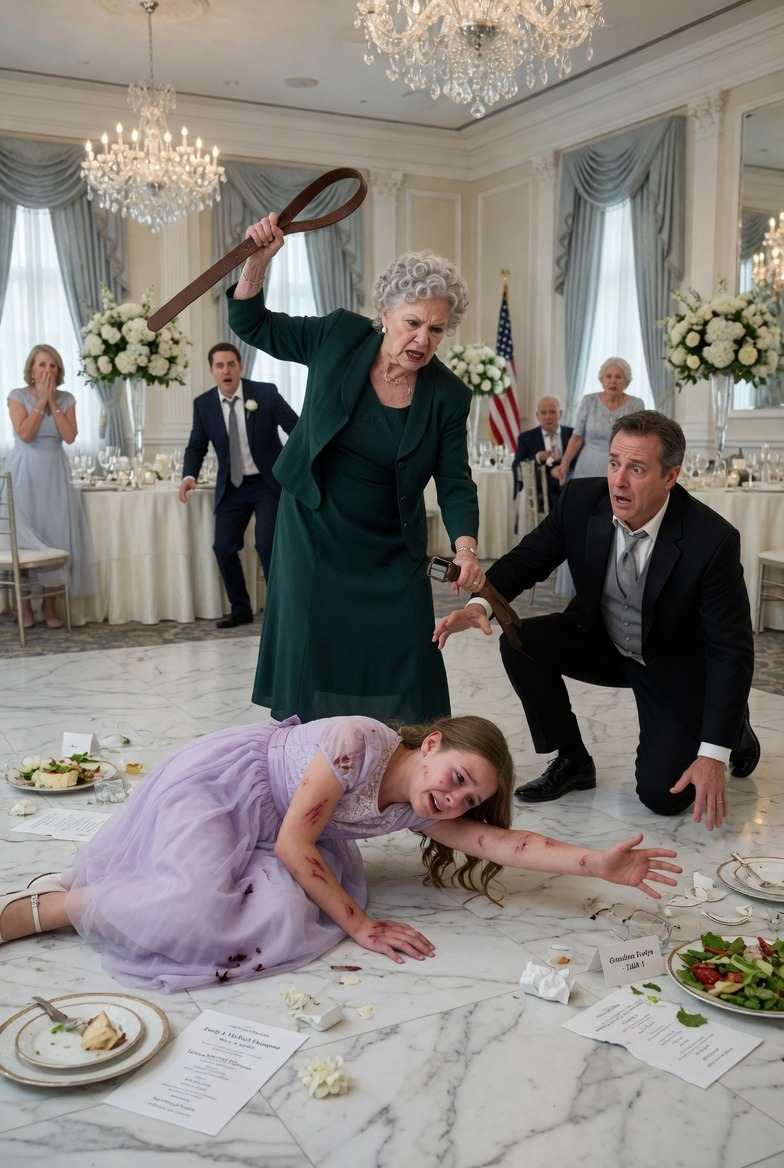
Her other hand went to her waist.
The buckle gave a small metallic click.
Then the belt slid free with a hiss.
I remember thinking, absurdly, no.
Not here.
Not in front of everyone.
The first strike cracked through the ballroom.
Ivy screamed.
It was not a movie scream.
It was not dramatic.
It was the sound of a child discovering that adults can become monsters while everyone watches.
Marcus lunged.
My father stepped into him.
My mother grabbed my wrist with both hands.
Her nails dug into my skin hard enough to leave half-moon marks.
“Do not ruin this night,” she whispered.
I looked at her.
For one clean second, I did not recognize the woman holding me.
Or maybe I finally did.
The room froze.
Forks hung in the air.
A server stood by the wall with a tray tilted in both hands.
A champagne flute tipped against someone’s lip and never moved.
The quartet stopped after one strangled note from the violin.
Fifty people saw my child on the carpet.
Fifty people learned something about themselves in the time it took them not to move.
Paige raised the belt again.
“Feed your brother or get out,” she snapped. “You’re useless.”
“He is not her brother,” I said.
My voice was too thin.
My father dropped to one knee and pinned Ivy by the shoulder.
That is the image that still wakes Marcus at night.
Not Paige.
Not the belt.
My father’s hand on our daughter.
A man in a tuxedo holding down an eight-year-old girl so his favorite child could punish her properly.
Aunt Felicity lifted the ice pitcher.
I saw the cubes knocking against the glass.
I saw Ivy’s eyes widen.
Felicity poured it over her.
“Stop crying,” my mother said.
The words landed harder than the water.
That was when the man at Table 3 stood up.
I did not know him then.
Later, I learned he had been one of my father’s old business acquaintances, invited for the same reason most people were invited: to admire the Crawfords and be admired by them.
He had his phone out.
The recording timer was red.
Two minutes and forty-three seconds.
Paige saw it.
Her arm stopped in the air.
Marcus shoved past my father hard enough that Dad stumbled backward into a chair.
I broke my mother’s grip by twisting down, not away, a move I had learned years before when she would hold my wrist in grocery stores and tell me to stop embarrassing her.
I reached Ivy on my knees.
She was wet, shaking, and trying not to cry because three adults had just told her pain was disobedience.
“Look at me,” I said.
Her eyes found mine.
“Daddy,” she sobbed.
“I’m here,” Marcus said, dropping beside us. “Baby, I’m here.”
Paige still held the belt.
But the room had changed.
It had gone from silent approval to recorded evidence.
That is a different kind of silence.
My father knew it first.
He looked at the phone, then at the guests, then at the doors as if respectability might run in and save him.
The ballroom manager appeared with two staff members.
He had been called by one of the servers.
I know that because the server told me later, crying in the hallway, that she had pressed the radio button before anyone at the tables found their courage.
“Ma’am,” the manager said to Paige, “put the belt down.”
Paige laughed once.
It sounded wrong.
“This is a family matter.”
“No,” Marcus said.
He had Ivy wrapped in his jacket.
His voice was low enough to frighten me, not because it was wild, but because it was controlled.
“This is my daughter.”
The man at Table 3 said, “I have the whole thing.”
My mother sat down.
Not collapsed.
Sat.
As if manners still applied.
Tanner began to cry then, quietly, because the kingdom his mother built for him had turned into a room full of witnesses.
The manager asked if we wanted police and medical help.
Marcus said yes before I could breathe.
At 7:41 p.m., a county deputy walked into the ballroom.
At 7:48 p.m., the country club incident report was opened at the front desk.
At 8:16 p.m., a hospital intake nurse wrote down Ivy’s name while she held Marcus’s thumb with both hands.
Those times matter to me.
They are how I remind myself that the world did eventually move.
Too late for the first strike.
Too late for the ice water.
But not too late for the truth.
At the hospital, Ivy kept asking if she had done something bad.
That question nearly broke Marcus.
He walked into the hallway, pressed both hands to the wall, and bent forward like he had been punched.
I stayed beside her bed.
“No,” I told her.
“No, baby. Adults did something bad. You did not.”
She stared at the ceiling.
“Grandpa held me down.”
I had no answer that could make that gentler.
So I did not lie.
“Yes,” I said.
She turned her face toward me.
“Why?”
Because he had always believed love was control.
Because he had always punished weakness harder than cruelty.
Because he had mistaken money for character for so long that he could no longer tell the difference.
I said, “Because Grandpa was wrong.”
A doctor documented redness and bruising.
A nurse took photographs with my consent.
Marcus filed the police report before midnight.
The deputy asked questions in a voice so gentle it made me cry harder than shouting would have.
The next morning, Paige called me fourteen times.
My mother called nine.
My father did not call at all.
He sent one text.
You have humiliated this family.
I showed it to Marcus.
He took my phone, photographed the screen, and emailed it to the deputy along with the recording from Table 3.
That was Marcus in a crisis.
No speeches.
No threats.
Just careful steps.
Screenshots.
Names.
Times.
Files.
The country club sent its incident report two days later.
It listed the staff who witnessed the assault, the manager’s intervention, the time the deputy arrived, and the fact that Paige surrendered the belt only after being told the police were on the way.
My parents hired an attorney.
Paige posted online that a private family disagreement had been exaggerated by unstable people.
That lasted eleven minutes.
The man from Table 3 uploaded nothing publicly.
He did something better.
He gave the recording to the deputy, and then, when Paige tried to smear us in front of mutual friends, he told them plainly: “I watched a grown woman raise a belt over a child while her grandfather held her down.”
People do not always need the whole video.
Sometimes one honest witness is enough to make a room stop pretending.
Family court came later.
So did supervised visitation orders for anyone who thought they had a right to reach my daughter.
The criminal process moved slowly, the way it often does when people with money expect time to soften consequences.
But the story did not soften in our house.
Ivy slept with the hallway light on for six months.
She stopped wearing pale blue.
She flinched when ice clinked in a glass.
Marcus bought plastic cups without making a big announcement, and one afternoon I found every glass pitcher in our kitchen packed into a box in the garage.
He did not ask me to thank him.
He just made the house easier for her to live in.
That is love.
Not speeches in ballrooms.
Not anniversary toasts.
A man noticing that ice has become a sound your child cannot bear and quietly removing it from the cabinets.
My parents eventually asked to see Ivy.
They did not apologize.
They said they wanted to move forward.
I told them forward was a direction for people who had stopped doing harm.
My mother cried then.
Maybe she meant it.
Maybe she cried because crying had worked for her all her life.
I did not hand her my daughter to find out.
Paige sent a letter through her lawyer saying she had been overwhelmed, embarrassed, provoked.
There was no sentence in that letter that said Ivy’s name without explaining Paige’s feelings immediately afterward.
I kept it in a folder with the hospital paperwork, the police report number, the country club incident report, and a printed screenshot of my father’s text.
Not because I wanted to live inside the worst night of our lives.
Because people who rewrite cruelty depend on everyone else throwing away the proof.
The first time Ivy asked to wear blue again, it was spring.
She chose a denim jacket, not a dress.
Marcus cried in the laundry room where she could not see him.
I pretended not to notice until he reached for me.
Then I stood there with him between the dryer and the shelf of detergent, both of us listening to our daughter in the kitchen asking for pancakes like the world had not ended and restarted.
Years later, when people ask why I cut off my parents after one party, I know they are not asking about the belt.
They are asking whether I am willing to protect the image of a family over the body of a child.
I am not.
I was raised to believe that keeping peace meant swallowing pain before anyone important had to taste it.
I am raising Ivy differently.
In our house, peace does not mean silence.
Family does not mean hierarchy.
And no child of mine will ever again be taught she has a place beneath the table.
The last time I saw my father was in a county hallway outside a hearing room.
He looked older.
Smaller.
For a second, I saw the man who taught me to ride a bike in our driveway when I was six, one hand on the seat, promising not to let go.
Then I remembered Ivy on the ballroom carpet.
I remembered his hand on her shoulder.
He said, “Joanna, this has gone far enough.”
I looked at him for a long moment.
Then I said the words I should have learned decades earlier.
“No. It finally went far enough the night you touched my child.”
He had no answer.
People like my father always think the final word belongs to whoever speaks loudest.
They forget that sometimes the final word is a door closing.
I walked out to the parking lot where Marcus was waiting in our SUV.
Ivy was in the back seat, drawing stars on a fogged-up window with her fingertip.
When she saw me, she smiled.
Not carefully.
Not politely.
Just smiled.
And I understood then that the anniversary party had not destroyed our family.
It had identified it.
My family was not the people under the chandeliers.
My family was the man waiting with the engine running, the child safe in the back seat, and the quiet drive home where nobody asked her to serve anyone before she was allowed to be loved.