He grabbed his keys from the folding table by the training leads, whistled once, and Max was already moving.
The dog jumped into the back of the pickup so fast his nails scraped the liner.
Michael called Sarah before he left the parking lot.
Voicemail.
He called again at the first red light, one hand clenched on the steering wheel.
Voicemail.
The third time, the call did not even connect.
That was when the fear became something heavier.
Michael and Sarah had been married for almost three years.
She was his second wife, the woman who had brought soft blankets into his plain house, who had told people at cookouts that Emily was “her girl too,” who had held newborn Noah in the hospital with tears in her eyes.
Michael had wanted to believe that.
He had wanted to give his daughter a home that felt whole again.
Emily’s mother had left when Emily was small, not with a dramatic goodbye, but with a slow fading that made a child ask questions nobody could answer kindly.
So when Sarah came along with casseroles, baby books, and a voice that sounded patient in public, Michael let himself trust her.
He gave her the house key.
He put her name on the school pickup card.
He let her decide where Emily’s backpack hooks went in the mudroom.
Those are not grand gestures, but in a family, access is often the deepest form of trust.
Michael had handed Sarah the ordinary doors to his daughter’s life.
Now he was racing home because one of those doors had been left cracked open.
Their neighborhood sat just outside town, the kind of place with trimmed lawns, basketball hoops in driveways, and small American flags in porch planters after every holiday.
From the curb, his house looked untouched.
The mailbox was straight.
The flowerpots were lined up by the porch steps.
The curtains were open.
The family SUV was gone.
Only the front door was wrong.
It stood open by two inches.
Max jumped down first.
His ears went stiff.
A low growl came from him, not loud, not wild, just certain.
Michael pushed the door with two fingers.
The smell hit him before the room did.
Sour milk.
Floor cleaner.
Sweat.
Under it all, something metallic and wrong.
The kitchen was a mess in a way that did not look like a child had spilled something.
It looked like a child had been trying to fix something an adult had made impossible.
Broken dishes lay across the tile.
Water had spread under the table and toward the hallway.
A broom had been thrown near the sink.
A baby bottle rolled slowly beneath a chair, leaving a cloudy line behind it.
“Emily!” Michael shouted.
The baby cried harder.
He stepped into the kitchen and felt glass crack beneath his boot.
Then he saw her.
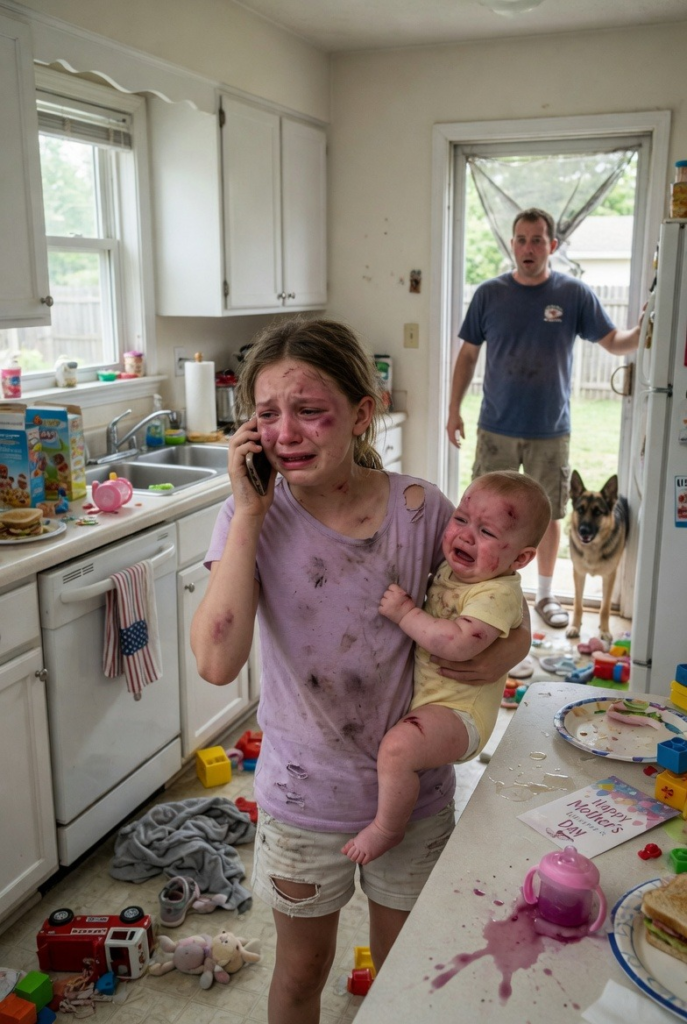
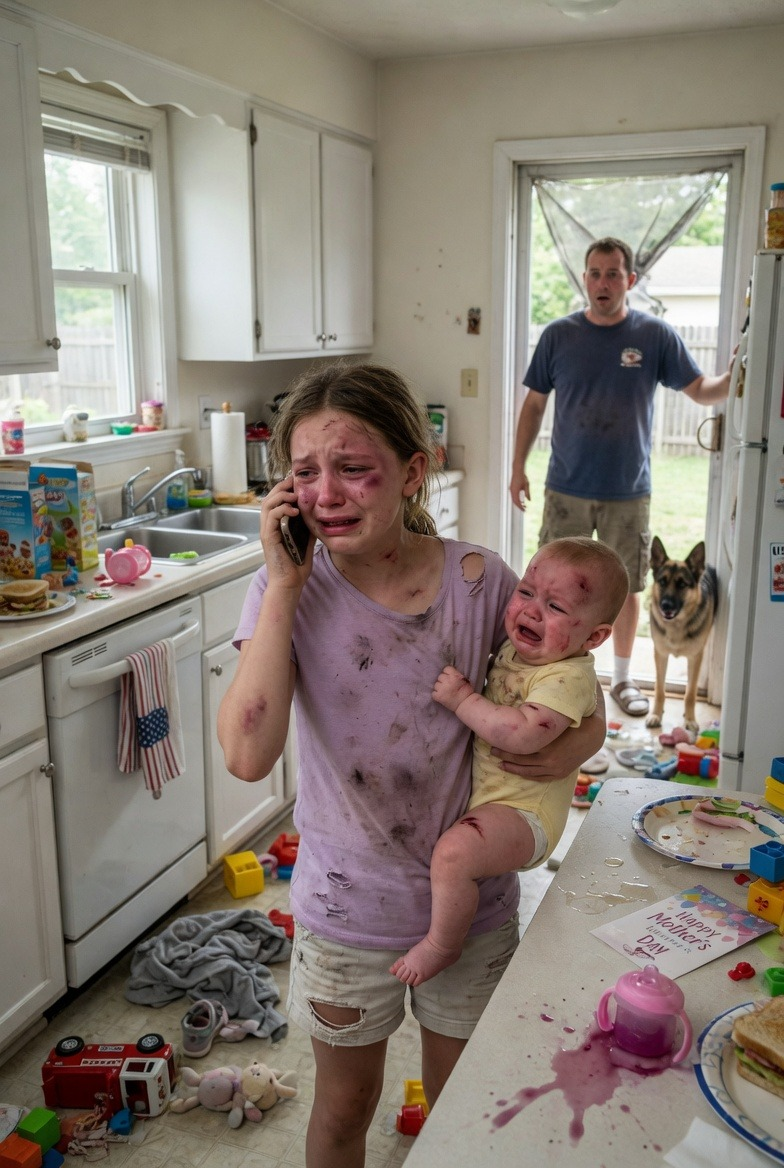
Emily was on her knees near the cabinets, scrubbing the floor with an old towel.
Her hair was damp and stuck to her forehead.
Her cheeks were streaked with tears she seemed too tired to wipe away.
Her T-shirt had ridden up at the back, and dark marks showed beneath the fabric.
Seven-month-old Noah was pressed against her shoulder, his little face red from crying, his fists grabbing at her shirt.
Emily’s body leaned sideways from his weight.
She was eight years old.
She looked smaller than that.
For one ugly second, Michael saw everything in pieces.
The towel.
The glass.
The broom.
His daughter’s bent back.
His son crying against a child who could barely hold herself upright.
He wanted to tear the room apart.
He wanted to call Sarah until she answered and make her hear what he was seeing.
But Emily flinched when he moved too fast.
That stopped him colder than any order ever had.
Rage is easy when the danger is over.
When your child is still inside it, love has to become steady hands.
Michael crouched slowly.
“Em,” he said, keeping his voice low. “It’s Dad.”
She looked up at him.
She did not run into his arms.
She did not fall apart.
She looked down at the towel, like she was ashamed the floor was still dirty.
“Sorry, Dad,” she whispered. “I’m almost done.”
Michael felt something inside him split.
Almost done.
Not “help me.”
Not “I hurt.”
Almost done.
As if his daughter had been turned into help.
As if the house was more important than her body.
As if being hungry later was the punishment she was trying to avoid.
He reached for Noah first and settled the baby against his chest.
Noah hiccuped, still crying, his hot little face pressed beneath Michael’s chin.
Then Michael slid his other arm under Emily’s shoulders.
The moment he touched her, she sucked in a breath so sharp it scared him.
“Where’s Sarah?” he asked.
Emily’s eyes moved toward the driveway, then back to the floor.
“She left this morning,” she said. “She said I had to watch Noah and clean everything.”
Michael swallowed.
“And if you didn’t?”
Emily’s fingers tightened around the towel.
“She’d be mad again.”
Again.
The word did not land loudly.
It landed deeply.
Michael looked around the kitchen with new eyes.
The sink was stacked with dishes too high for an eight-year-old to reach safely.
Baby clothes spilled from a laundry basket by the washer.
A small step stool stood near the stove.
On the fridge, a white board had been wiped badly, but he could still see the ghost of Emily’s name under chores written in Sarah’s handwriting.
Floors.
Bottles.
Noah nap.
Not one bad afternoon.
A system.
Not carelessness.
Not stress.
A routine built in the hours when Michael was gone.
He laid the towel aside and carried Emily to the living room, stepping carefully around the glass.
Max stayed close, his body between Emily and the hallway.
Michael called 911.
His voice sounded calm on the recording later.
That bothered him more than if it had cracked.
He gave the address.
He said his daughter had back injuries.
He said there was an infant in the house.
He said his wife was not home.
He did not say what he wanted to do to the person who had left them like this.
He held Emily’s hand instead.
At 3:39 p.m., the first ambulance pulled up outside.
The lights washed red and white across the front windows.
A neighbor came halfway down her driveway, then stopped when she saw Michael’s face.
The older paramedic came in with a bag over one shoulder and a practiced calm that lasted until he saw Emily.
He knelt in front of her.
“Hey, sweetheart,” he said. “Can you tell me where it hurts?”
Emily looked at Michael first.
That told him more than her answer did.
“My back,” she whispered.
The paramedic asked if she had fallen.
Emily hesitated.
Michael did not push her.
The younger paramedic had gone into the kitchen.
He came back holding his expression too still.
He had seen the broken dishes.
He had seen the white board.
He had seen the stool by the stove.
When they lifted Emily onto the stretcher, she grabbed Michael’s sleeve with surprising strength.
“Dad,” she whispered. “Please don’t tell her I called you.”
Michael leaned down until she could see his eyes.
“You are not in trouble,” he said.
Her mouth trembled.
That was when he understood the worst part.
Emily was not only afraid of being hurt.
She was afraid of being returned.
At the hospital intake desk, a nurse put a wristband around Emily’s small wrist and asked Michael for the timeline.
He gave it piece by piece.
Call received at 3:17 p.m.
First call to Sarah at 3:19 p.m.
Arrived home at approximately 3:31 p.m.
Ambulance dispatched at 3:39 p.m.
He watched the nurse type each time into the hospital intake form.
There was a strange mercy in documentation.
The truth looked less fragile when it had timestamps.
A doctor examined Emily while Michael stood beside the bed holding Noah.
Noah had finally fallen asleep, exhausted, one tiny hand tangled in Michael’s shirt.
Emily answered questions in a voice that kept getting smaller.
The doctor’s face changed slowly as he listened.
Not shock all at once.
Something worse.
Recognition.
“These marks are not all from today,” he said softly, outside the curtain a few minutes later.
Michael did not answer.
If he opened his mouth, he was not sure what would come out.
The doctor continued, carefully.
“She has been carrying too much. Repeated strain. Some bruising in different stages. We are going to document everything.”
Document.
Michael held onto that word.
Not because it made him feel better.
Because feeling better was not the point anymore.
The point was that nobody would be able to pretend later that this had been a misunderstanding.
A hospital social worker came next.
She wore a cardigan over scrubs and carried a clipboard against her chest.
She did not speak to Emily like a baby.
She did not speak to Michael like a suspect.
She sat down and asked simple questions.
Who watched Noah when Michael volunteered?
Who made meals?
Who helped Emily with schoolwork?
What happened if chores were not done?
Emily looked at the blanket in her lap for a long time.
Then she said, “She says babies are easy if you stop whining.”
Michael closed his eyes.
He thought of all the evenings Sarah had smiled at him across the kitchen and said Emily was tired from school.
He thought of all the times Emily had fallen asleep early and he had believed it was growth, not exhaustion.
He thought of the way Sarah had praised Emily in front of neighbors for being “such a little helper.”
A child should be allowed to help.
A child should not be turned into the adult nobody wants to be.
That night, Michael did not take Emily home.
He signed every form the hospital placed in front of him.
He gave a statement for the police report.
He allowed the social worker to photograph the injuries and the marks.
He forwarded the call log from his phone.
He described the kitchen.
He described the white board.
He described the small stool by the stove, and his voice broke on that detail because it was so ordinary.
A stool.
A child-sized thing turned into evidence.
Sarah arrived just after 8 p.m.
She came fast through the sliding doors, still in her neat jacket, her hair pulled back, her face arranged into panic for the room.
“Where is my baby?” she demanded.
Michael stood in the hospital hallway with Noah asleep in his arms.
Max was not allowed past the entrance, so the dog waited in the truck with the windows cracked and water in a bowl, watching every person who passed.
Sarah reached for Noah.
Michael stepped back.
For the first time since he had known her, Sarah looked startled by him.
“Michael,” she said. “Don’t do this here.”
“Do what?”
“Make a scene.”
He almost laughed.
Not because anything was funny.
Because even there, with Emily behind a curtain and a hospital intake form already printed, Sarah was still worried about appearances.
The social worker stepped into the hallway.
Sarah saw the clipboard.
Her expression changed.
Just a flicker.
But Michael saw it.
People who have nothing to hide usually look confused by paperwork.
Sarah looked angry at it.
“She exaggerates,” Sarah said quickly. “Emily has always been dramatic. She wants attention from him.”
The social worker did not react.
Michael did.
He took out his phone and played the voicemail that had come through late.
Sarah’s voice filled the hallway.
“Don’t rush home. Emily’s being dramatic again.”
The word again hung there.
A nurse at the desk looked up.
Sarah’s mouth opened, then closed.
For a moment, all her careful softness was gone.
There was only calculation.
Then Emily’s voice came from behind the curtain.
“Dad?”
Michael turned immediately.
Sarah tried to move past him.
The social worker stepped in front of her.
“Not right now,” she said.
It was quiet.
It was professional.
It landed like a locked door.
Emily was sitting up in the bed when Michael came back in.
Her face was pale, but her eyes were clearer.
She looked at Noah sleeping against his shoulder.
“Is he okay?” she asked.
Michael sat beside her.
“He is okay.”
“Are you mad?”
“No.”
“At me?”
The question nearly took him down.
He put Noah carefully into the small hospital bassinet the nurse had brought and took Emily’s hand in both of his.
“Never at you,” he said.
She watched his face the way frightened children do, searching for the punishment hidden behind the comfort.
There was none.
He made sure she saw that.
By midnight, Emily was asleep.
Michael stayed in the chair beside her bed, one hand on the rail, listening to the monitor beep and Noah breathe.
The hospital hallway smelled like coffee, disinfectant, and old worry.
Every so often, someone rolled a cart past the door.
Every so often, Emily moved in her sleep and Michael leaned forward before she even opened her eyes.
The next morning, he returned to the house with an officer, the hospital social worker, and a camera on his phone ready.
He did not go alone because he had learned long ago that grief makes bad witnesses if nobody else sees what you see.
The kitchen had been partly cleaned.
That was the first thing that made him cold.
The broken dishes were gone.
The towel was gone.
The white board had been wiped clean.
But Sarah had missed the trash can in the garage.
Inside were the paper towels she had used to clean the floor, the broken pieces of the dish, and a torn corner of the chore list with Emily’s name still visible.
The officer photographed it.
The social worker said nothing, but her mouth tightened.
Then Michael opened the laundry room cabinet.
On the top shelf was a plastic storage bin with Emily’s school papers stacked under baby receipts, grocery lists, and handwritten notes in Sarah’s neat script.
Noah bottles 10 and 2.
Laundry before TV.
No snacks if back talk.
Michael stared at the last one until the words blurred.
Back talk.
That was what Sarah had called a child asking not to hurt.
In the weeks that followed, everything moved through forms, offices, and waiting rooms.
Police report.
Hospital record.
Social worker notes.
Temporary safety plan.
Family court hallway.
Michael learned that protecting a child is not one dramatic speech.
It is signatures.
It is copies.
It is answering the same question ten times without letting shame make you quiet.
It is bringing the blue sports drink because your daughter asked for it, then watching her hold it with both hands like proof that small wishes still mattered.
Sarah tried to explain.
She said she was overwhelmed.
She said Noah cried all day.
She said Emily wanted to help.
She said Michael had no idea how hard it was.
Maybe he did not know every hard thing.
But he knew the difference between asking a child to bring a diaper and making her afraid to call her father.
He knew the difference between a messy house and a hidden routine.
He knew the difference between help and harm.
Emily healed slowly.
Not just her back.
The other part took longer.
For weeks, she asked before eating anything.
For weeks, she apologized when Noah cried, even if she was in another room.
For weeks, she froze when a phone rang.
Michael did not tell her to stop being scared.
He made breakfast.
He packed her lunch.
He sat beside her during school meetings.
He let Max sleep outside her bedroom door, where the old dog sighed heavily every time she turned over in bed.
Care did not look heroic.
Most nights it looked like laundry folded at 11 p.m. and a night-light left on in the hall.
One Saturday morning, months later, Emily stood in the kitchen while Michael made pancakes.
Noah was in his high chair, banging a spoon on the tray.
The floor was sticky with syrup.
A bowl sat in the sink.
A towel had fallen near the dishwasher.
Emily looked at the mess and went still.
Michael saw it happen.
He turned off the burner.
“Leave it,” he said.
She blinked.
“But it’s dirty.”
“I know.”
“Aren’t you mad?”
Michael picked up Noah’s spoon and handed it back to him.
“No, Em.”
She looked around the kitchen as if the walls themselves might disagree.
Then Max walked in, sniffed the syrup on the floor, and sneezed.
Emily laughed.
It was small.
It was rusty.
But it was real.
Michael had heard fear in her voice that day at 3:17 p.m., and he would never forget it.
He would also never forget the first time laughter came back into the same kitchen where she had once whispered that she was almost done.
Because she had never been the one who needed to be almost done.
The house was.
The silence was.
The pretending was.
And from that day forward, Michael made sure his daughter understood the one thing Sarah had tried to steal from her.
Emily was not the help.
She was the child.
And children are not supposed to earn dinner by surviving the people who promised to love them.