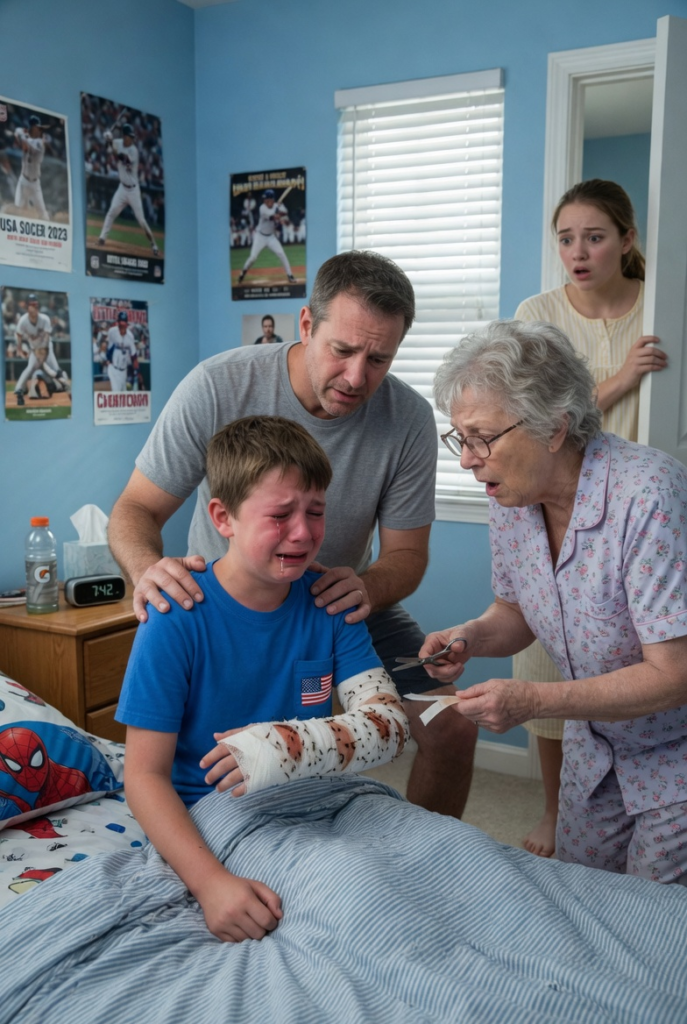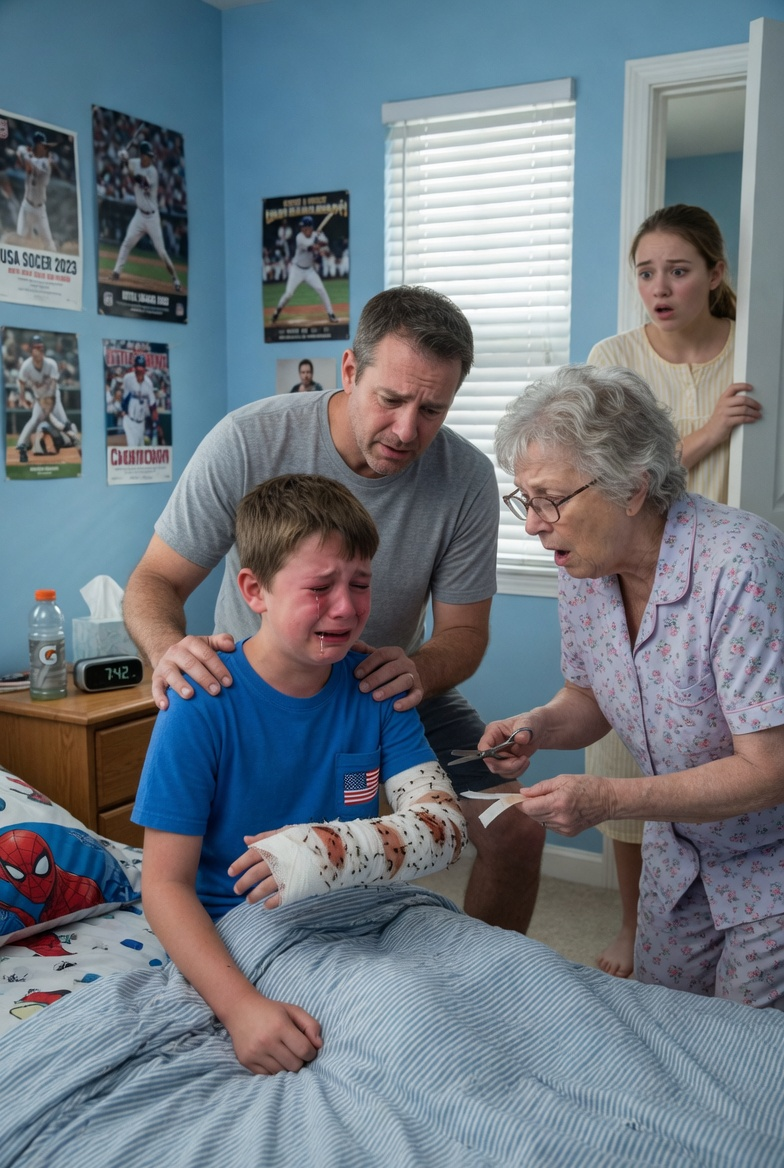
She also learned quickly that Ethan was the one part of the Miller home that could not be redecorated.
At first, she called him sensitive.
Then she called him defiant.
By the time she had been married to Richard less than a year, she was calling him unstable with a soft voice and a worried face.
Richard mistook that voice for concern.
He gave Vanessa keys to the house.
He gave her the security code.
He gave her permission to sign school forms and answer medical calls when he was stuck in meetings.
That was the trust she used like a weapon.
Four days before the worst night, Ethan broke his arm at school.
The nurse’s call came in the middle of Richard’s conference call, and Vanessa was the one who got to Dallas Children’s Orthopedic Clinic first.
The discharge sheet said closed fracture, immobilize, follow up in seven days.
A nurse wrote 4:18 PM beside the release time.
The follow-up appointment card went behind the discharge sheet.
Vanessa folded both papers herself and placed them in the kitchen drawer.
Later, Richard would remember the neatness of that fold.
It would become one of the first small things that made him sick.
The first night after the cast went on, Ethan cried from pain.
The second night, he scratched at the plaster.
The third night, his nails split at the edges and left tiny red marks on the white cast.
By the fourth night, he was begging anyone who came near him to believe that something inside the plaster was moving.
“It’s not the bone,” he kept saying. “Something is biting me.”
Vanessa had an explanation ready before Richard had even asked the question.
She said Ethan hated her because she had taken Laura’s place.
She said he had always been jealous when Richard gave attention to anyone else.
She said grief could turn into aggression if adults refused to set limits.
She sent Richard three screenshots from a child psychiatrist she “trusted,” each one underlined in blue.
Possible anxiety episode.
Risk of self-harm.
Temporary inpatient care if behavior escalates.
The words looked clinical enough to hide the cruelty inside them.
That is how bad decisions disguise themselves.
They do not arrive screaming.
They arrive sounding reasonable.
When Ethan began hitting the cast against the bed rail, Vanessa stepped behind Richard and lowered her voice.
“The doctor said he can’t move that arm,” she whispered. “If he keeps hitting it, he’ll make the fracture worse.”
Richard looked at his son, then at the cast, then at the healthy wrist Ethan kept using to claw at the plaster.
He had not slept in four nights.
His eyes burned.
His hands shook.
He took a leather strap from the bedframe storage drawer and tied Ethan’s healthy wrist to the headboard.
Ethan stared at him in disbelief before the crying even started again.
“You don’t believe me,” he said.
Richard said nothing.
In the doorway, Mrs. Rosa stood very still.
“Sir,” she said quietly, “that child is not pretending.”
Vanessa turned on her like a blade.
“You’re not a doctor, Rosa.”
“I don’t need a medical degree to recognize real pain.”
The room held itself in one frozen breath.
Rain tapped the glass.
The bedside lamp hummed.
Ethan whimpered into his pillow while Richard looked at the wrist he had tied and could not bring himself to undo it.
Nobody moved.
“Enough,” Richard said at last, because exhaustion can make cowardice sound like patience.
Mrs. Rosa looked at him with a sadness that stayed with him for the rest of his life.
“One day, Mr. Miller, you will remember this night,” she said. “And you will beg God to take it out of your head.”
Ethan cried until his body gave up.
The mansion went quiet after that, but quiet was not peace.
It was the silence that comes after a scream has been buried alive.
At 6:07 AM, Richard sat in his home office staring at coffee he had not touched.
On the wall hung the photo Vanessa hated but never dared criticize directly.
Laura held newborn Ethan in that picture, smiling with the exhausted brightness of a woman who thought she had decades ahead of her.
Vanessa called the photo unhealthy.
She said a home could not move forward while living with ghosts.
Richard’s phone buzzed with another message from her, another warning about Ethan’s “escalating behavior.”
He wanted to throw the phone across the room.
He did not.
He pressed his palms to his eyes until sparks moved behind his lids.
Then the office door opened without a knock.
Mrs. Rosa walked in and held out her hand.
In her palm lay a dead red ant.
Richard stared at it.
“What is that?”
“There were more in his sheets,” she said.
“They could’ve come from outside.”
Mrs. Rosa stepped closer.
“They came from the cast.”
Richard’s body seemed to turn cold from the inside out.
By 6:12 AM, he was running upstairs.
Ethan lay pale and half-awake, his lips dry, his lashes stuck together from tears.
The red mark on his healthy wrist looked almost obscene against his skin.
Then Richard smelled it.
Sweet.
Rotten.
Wrong.
It was coming from the cast.
Mrs. Rosa had already prepared the bedside table with scissors, towels, gauze, and a small cast cutter from the medical supply cabinet Richard had kept after Laura’s home care months.
Beside the tools, she had laid out the urgent care discharge sheet, the follow-up appointment card, and Vanessa’s handwritten note about Ethan “acting unstable.”
Three pieces of proof.
None of them explained the smell.
“We have to open it,” Mrs. Rosa said.
“We can’t,” Richard whispered. “If the bone shifted—”
“If we wait any longer,” she cut in, “there may not be an arm left to save.”
Then Vanessa appeared in the doorway.
Her silk robe was knotted tight.
Her face had already changed.
“What are you doing?” she asked.
Mrs. Rosa did not look away from Ethan.
“Opening the cast.”
“Absolutely not,” Vanessa snapped. “The orthopedic doctor said no one should touch it.”
Richard turned toward his wife slowly.
For the first time since she had entered his life, her calm did not soothe him.
It revealed her.
“Why are you scared?” he asked.
Vanessa’s eyes widened.
“Are you accusing me after everything I’ve put up with from that boy?”
Ethan stirred at the sound of her voice.
“Dad,” he whispered. “They’re back.”
Mrs. Rosa switched on the cutter.
The buzzing filled the room, low and sharp, and Ethan screamed as if the sound had awakened something beneath the plaster.
Richard leaned over him and held his shoulders.
“I’m here, buddy,” he said, his voice breaking. “I’m here. I’m so sorry.”
Ethan looked up through tears.
“You tied me down.”
Those four words did what the screaming had not done.
They reached the part of Richard that had been hiding.
The cast cracked.
Mrs. Rosa worked slowly, carefully, never cutting toward the skin.
First came the smell.
Then came the brown stain soaked deep into the padding.
Then the damp gauze shifted.
Between the lining and Ethan’s raw, inflamed skin, dozens of red ants began crawling out.
Richard stopped breathing.
His son had been telling the truth.
Someone had turned that cast into a living trap.
Vanessa took one step backward.
Not in shock.
In anger.
That was when Richard’s phone rang.
Dallas Children’s Orthopedic Clinic flashed across the screen.
He answered on speaker because his hands were too unsteady to do anything else.
The nurse identified herself and said she was confirming a chart irregularity from Ethan’s file.
“Mr. Miller,” she asked, “did you authorize a second visit under his name at 8:31 PM the night after discharge?”
Mrs. Rosa’s hand closed over Ethan’s blanket.
Richard looked at Vanessa.
For the first time, she had no prepared sentence.
“What did you take my son back there for?” he asked.
Vanessa opened her mouth.
No sound came out.
The nurse, hearing the silence, continued more cautiously.
The clinic record showed that a woman identifying herself as Ethan’s mother had returned after hours, claiming the cast felt too loose and asking whether padding could be adjusted.
The note said no full re-casting was performed.
It also said the child was not examined by the same provider who treated the fracture.
It was only a chart note, a small administrative line in a system full of small administrative lines.
But small lines can become knives when the truth finally has a place to enter.
Richard called 911 with one hand and kept the other on Ethan’s shoulder.
Vanessa tried to leave the doorway.
Mrs. Rosa stepped into her path.
She was sixty-two years old.
Vanessa was younger, taller, and stronger.
But there are moments when age becomes something harder than muscle.
“You stay,” Rosa said.
The paramedics arrived to a room that smelled of plaster dust, antiseptic, and rot.
They cut away the rest of the cast under medical supervision, flushed Ethan’s skin, stabilized the fracture, and moved him downstairs on a stretcher while Richard walked beside him saying his name over and over.
At the hospital, the emergency physician documented multiple insect bites, inflamed skin, early infection, and pressure swelling in the fingers.
The nurses photographed the arm.
They photographed the cast lining.
They bagged the padding, gauze, and plaster fragments as evidence after Richard told them what had happened.
A hospital social worker came in with a calm voice and a clipboard.
Then a police officer came.
Then another.
Richard sat in the hallway with both hands locked together and watched the life he had chosen begin to collapse in public.
Vanessa told the officers Ethan had been disturbed.
She said he must have pushed ants into the cast himself.
She said Rosa hated her and had planted the insects because she never accepted Richard’s remarriage.
She said grief had infected the entire household.
Her words sounded polished.
But polished lies have a weakness.
They do not survive evidence.
The discharge sheet showed the original cast time.
The 8:31 PM clinic note showed Vanessa’s after-hours return.
Security footage from the clinic corridor showed her walking in with Ethan’s arm held tightly against her side while the boy looked half-asleep.
A pharmacy receipt found in her purse showed the purchase of adhesive gauze, antiseptic spray, and a small bottle of sugary wound gel the night before Ethan’s symptoms worsened.
The hospital evidence bag held the stained cast padding.
Mrs. Rosa gave a statement about the dead ants in the sheets.
Richard gave a statement about the leather strap.
That was the hardest one.
He did not try to make himself look better.
He told them exactly what he had done.
He told them he had believed his wife over his child.
He told them Ethan had begged him, and he had tied him down.
The detective did not comfort him.
Richard did not deserve comfort yet.
Ethan spent two nights in the hospital.
Doctors treated the infection, cleaned the skin, and replaced the cast with a removable brace once the swelling came down.
The fracture would heal.
The bites would fade.
But the doctor warned Richard that physical recovery was the easier part.
On the second night, Ethan woke from a nightmare and asked whether Vanessa was outside the door.
Richard stood from the vinyl chair so fast the blanket fell from his lap.
“No,” he said. “She will never come near you again.”
Ethan stared at him for a long time.
“Do you believe me now?”
Richard sat on the edge of the bed.
The answer should have been simple.
It was not, because the truth was no longer only about Vanessa.
It was about every minute he had spent explaining away his son’s terror.
“I believe you,” Richard said. “And I should have believed you sooner.”
Ethan turned his face toward the window.
“I asked you to cut off my arm.”
“I know.”
“You tied me down.”
“I know.”
Richard’s voice broke there, but he did not ask his child to make him feel better.
That was the first useful thing he did after the truth.
He let the pain belong to Ethan.
Vanessa was arrested after investigators reviewed the clinic footage and household evidence.
The case did not become a clean story overnight.
Cruelty rarely does.
Her attorney argued that the evidence was circumstantial.
Her friends said she had always seemed elegant and composed.
A few people asked why a woman would risk everything over a stepson.
Mrs. Rosa answered that question once, outside a courtroom, with her hands folded over her purse.
“Because he was loved before she arrived,” she said. “Some people cannot stand a room where the dead are still honored.”
The prosecutor built the case carefully.
There were photographs of Ethan’s arm.
There were medical notes.
There was the 4:18 PM discharge record.
There was the 8:31 PM clinic entry.
There was the handwritten note describing Ethan as unstable.
There was the purchase receipt.
There was also Vanessa’s own phone, which held searches about cast irritation, insect bites, and whether children could be hospitalized for psychological evaluation after self-injury.
She never admitted everything in one clean confession.
People like Vanessa often do not.
They surrender in fragments.
She claimed she only wanted Richard to see how “unmanageable” Ethan had become.
She claimed she never meant for the bites to get serious.
She claimed the ants must have gotten inside after she loosened the padding.
Every explanation made the same mistake.
It admitted she had touched the cast.
Richard filed for divorce before the first hearing ended.
He removed Vanessa’s name from every school contact form.
He changed the locks.
He boxed her belongings without entering Ethan’s room once.
He also asked the court to let Mrs. Rosa remain in the house as Ethan’s caregiver.
The judge did not need convincing.
Healing did not look like a dramatic speech.
It looked like Richard learning to sit quietly when Ethan was angry.
It looked like therapy appointments on Tuesday afternoons.
It looked like Mrs. Rosa making soup and pretending not to cry when Ethan finally left his bedroom door open again.
It looked like the framed photo of Laura staying exactly where it had always been.
One morning, weeks later, Ethan asked Richard to take him to the small garden Laura had planted behind the house.
The rain had washed the air clean.
The soil smelled dark and new.
Ethan stood beside the rosemary bush his mother had loved and tucked his healing arm carefully against his chest.
“Mom would have believed me,” he said.
Richard closed his eyes.
“Yes,” he said. “She would have.”
Ethan looked at him.
“You have to learn how to do that.”
“I will,” Richard said.
It was not forgiveness.
It was instruction.
And Richard treated it like the most merciful sentence he would ever receive.
Months later, when Vanessa accepted a plea deal and was barred from any contact with Ethan, Richard did not feel triumph.
He felt the heavy, permanent knowledge that justice could punish Vanessa but could not erase the night he fastened leather around his son’s wrist.
Mrs. Rosa stayed.
The house changed slowly.
The silk robes disappeared.
The clinic paperwork went into a folder marked with the detective’s case number.
The cast fragments remained in evidence.
The photo of Laura remained on the office wall.
Ethan returned to school with a brace, then without one.
Some days he laughed.
Some nights he still woke up shaking.
Richard learned that repair is not one apology.
It is a thousand ordinary choices made after the apology stops being dramatic.
It is believing the child before the adult has finished sounding reasonable.
It is picking up the phone.
It is opening the door.
It is cutting through the cast when your child says something inside is moving.
Near the end of the year, Ethan found the old scarf under his pillow and brought it to Richard.
“I don’t need to hide it anymore,” he said.
Richard held it carefully because it smelled faintly of cedar, laundry soap, and a life he had failed to protect but could still honor.
The first line of the story would always sound impossible to anyone who had not lived it.
“Cut Off My Arm!” The Little Boy Screamed… Until His Nanny Broke the Cast and Found What His Stepmother Had Hidden Inside.
But inside that terrible sentence was the lesson Richard carried for the rest of his life.
That is how bad decisions disguise themselves.
They do not arrive screaming.
They arrive sounding reasonable.
And the only way to stop them is to believe the small voice in the room before silence teaches it to disappear.