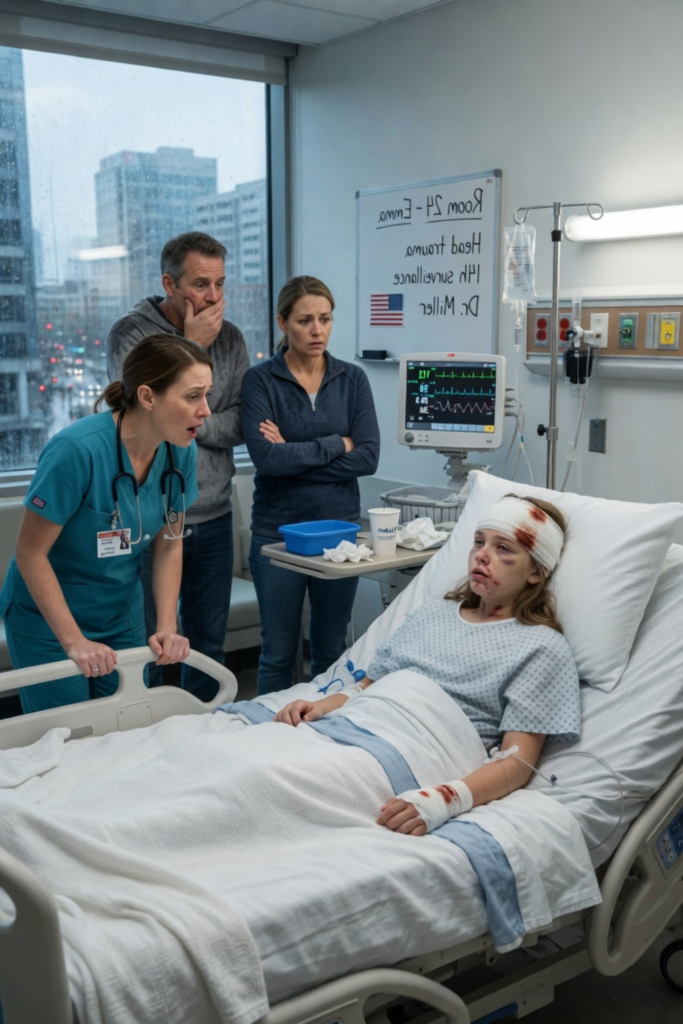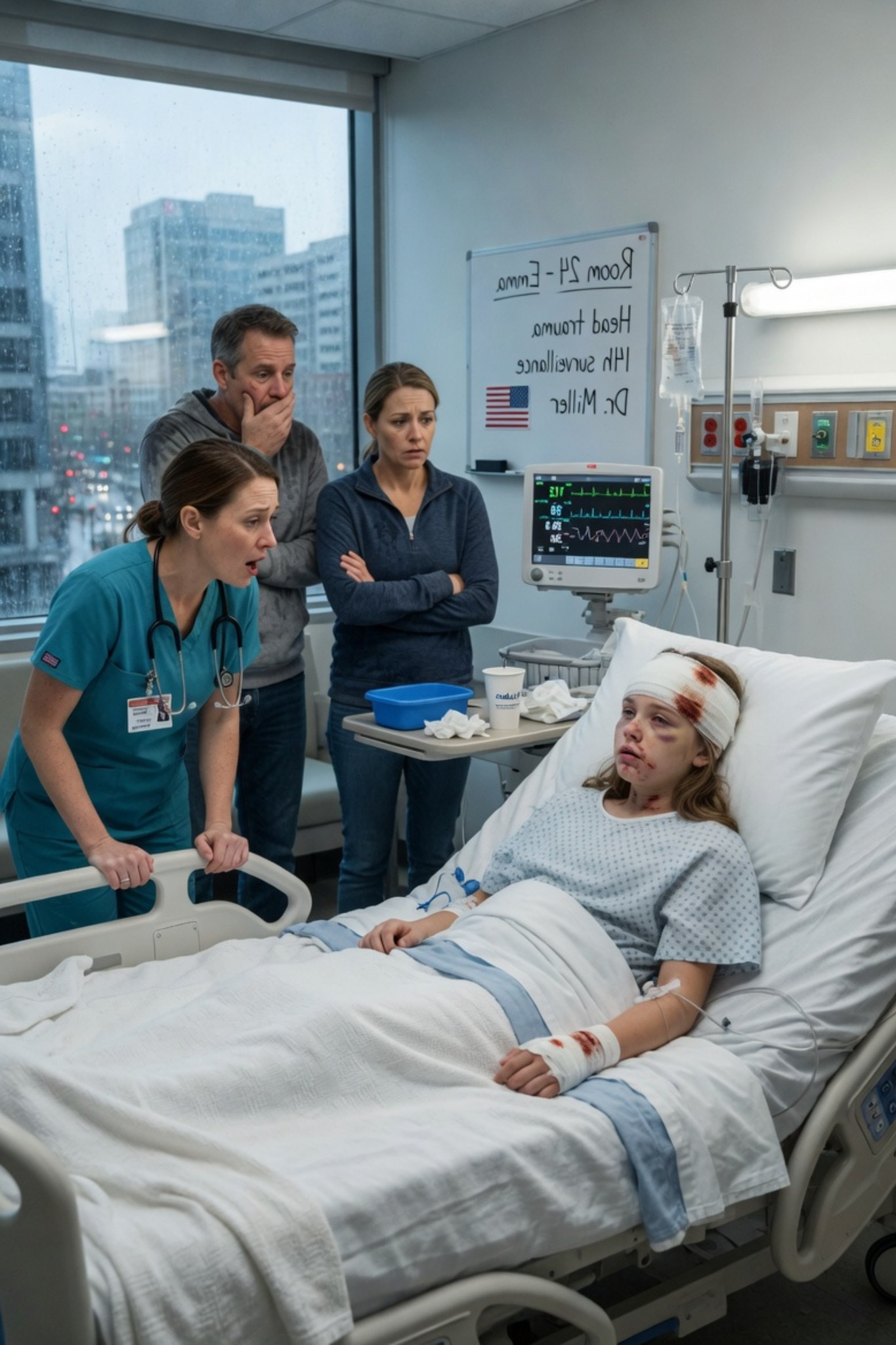
The nurse said “critical condition” in a voice that was almost soft enough to hide inside.
She said “serious injuries.”
She said “possible fall.”
Possible.
That word sat in the room like a lie waiting for paperwork.
Meadow’s eyelids fluttered before I could ask another question.
I stepped closer until my knees touched the side rail.
“Baby,” I whispered.
Her lashes trembled.
Then she opened her eyes just enough to see me.
“Mommy…” she breathed.
I leaned in so close I could feel the fever-warm air of her breath on my cheek.
“I’m here.”
“I’m sorry.”
Those two words broke something in me before I understood why she had said them.
She was 7 years old.
She apologized when she spilled juice, when she forgot to feed the goldfish, when she tracked mud inside because she had been hunting imaginary fossils in the yard.
She should not have been apologizing from a hospital bed.
“For what, Meadow?”
Her lips moved once before sound came out.
“Daddy was with Aunt Serena in your bed.”
The nurse’s hand tightened on the curtain.
My own hand closed around the metal rail.
“When they saw me,” Meadow whispered, “he threw me down the stairs.”
There is a moment after the worst sentence of your life when the world does not react correctly.
The floor does not tilt.
The ceiling does not crack.
The machines continue their patient beeping as if they have not just become witnesses.
I waited for someone to tell me I had misheard.
No one did.
The nurse froze at the curtain.
An officer I had not noticed yet stood just outside the doorway with his pen hanging over a preliminary incident report.
A young orderly stopped beside a cart and stared at the wheel nearest his shoe.
Somewhere down the hall, a phone rang twice and went silent.
The strip of paper from the monitor curled slowly against the side of the machine, still printing proof that my daughter was alive while the adults around her learned how ugly the truth was.
Nobody moved.
Meadow swallowed, and the effort looked too large for her body.
“They’re still there,” she breathed. “Drinking whiskey in the kitchen.”
I could feel my pulse in my jaw.
“Daddy told me to say I fell while playing dress-up.”
The sentence came out practiced.
That hurt in a different place.
It meant he had given it to her.
It meant he had leaned over our injured daughter and handed her a story small enough for adults to accept.
Dress-up.
A child’s game turned into an alibi.
Some lies are not made to survive investigation.
They are made to buy silence from people who prefer neat explanations to ugly truths.
I looked at the intake form again.
Admission time: 5:18 p.m.
Critical condition.
Possible fall.
Parent not present at arrival.
The facts were sitting there in black ink, polite and clean, while my daughter’s words dragged blood and whiskey and betrayal into the room.
I had spent years training myself not to react first.
In the army, reaction could get someone killed.
In veterinary medicine, panic could make a frightened animal worse.
As Doc Tori, I had learned how to hold a snapping dog still without anger and how to speak softly to a rancher while his horse bled onto the floor.
But no training teaches you how to hear that the man you married hurt your child and then tried to make her carry the lie.
My husband’s name was Dennis Hawthorne.
For 9 years, I had said that name with the tired affection of a woman who believed marriage was hard but honest.
Dennis managed the local bank.
He coached the kids’ baseball team.
He remembered other people’s birthdays, held doors open at restaurants, and knew exactly how long to squeeze a shoulder at church so the gesture looked tender but not dramatic.
People trusted him because he looked like the kind of man who deserved trust.
That is how men like Dennis survive.
They borrow respectability from everyone around them until it looks like character.
My younger sister Serena was different on the surface.
She was quick, pretty, charming, and impossible to stay angry with for more than five minutes if you only knew the public version.
She sold houses and called every kitchen “the heart of the home.”
She could walk through a stranger’s living room and point out sunlight, storage, and the best place to put a Christmas tree.
She had braided Meadow’s hair when my emergency calls ran late.
She taught Meadow how to whistle with two fingers.
She bought dinosaur stickers because Meadow hated dolls unless they came with lab coats or helmets.
She had stood at my stove on Sundays, laughing while smoke from Dennis’s barbecue drifted through the screen door.
We had been a family.
At least, I had been foolish enough to believe the word still meant what I thought it meant.
In recent months, Dennis had come home late.
He said audits.
He said client meetings.
He said bank problems that would bore me if he tried to explain them.
Serena had been around more often too, always helpful, always bright, always stepping into the gaps I blamed myself for leaving.
PTSD makes you suspicious of your own reactions.
That is one of its quiet cruelties.
When Dennis became distant, I wondered if I was too guarded.
When Serena stayed too long after dinner, I told myself she was lonely.
When they stopped talking the second I entered a room, I accused my own mind of turning shadows into enemies.
I had trusted them with my house keys.
I had trusted them with the alarm code.
I had trusted them with Meadow.
That was not just betrayal.
That was access weaponized.
My right hand was still on the bed rail.
My knuckles were pale.
For one violent second, I imagined Dennis standing in front of me.
I imagined my hands doing what they knew how to do.
Then Meadow made a tiny sound, and the image vanished.
Rage without control is just another kind of danger.
I would not bring more danger into her room.
So I breathed in through my nose, out through my mouth, and let the rage go cold.
Cold rage does not shake.
Cold rage remembers.
The nurse stepped forward as if she had decided I might collapse.
I did not.
“Mrs. Hawthorne,” she said, “the police are here about the incident.”
Incident.
The word was so clean it almost made me smile.
People use small words when they are afraid of large truths.
I looked at her.
“It was not an incident.”
Her face changed, only a fraction.
“No,” she said quietly.
That one syllable was the first honest thing an adult had said to me since the call.
“Tell the officers I’ll speak to them,” I said. “But first, give me a moment alone with my daughter.”
The nurse hesitated.
Then she nodded and drew the curtain enough to give us privacy without leaving Meadow unwatched.
I bent over the bed.
Meadow smelled like hospital soap and the lavender shampoo she insisted made her hair “dinosaur princess hair.”
I pressed my lips to her forehead.
Her skin was too warm.
Her fingers found mine under the sheet and held weakly.
“Mommy,” she whispered.
“I know.”
“I didn’t mean to see.”
My chest tightened so sharply I nearly lost the calm I had built around myself.
That was the sentence that told me everything.
She was not afraid because she had been hurt.
She was afraid because someone had made her believe the hurt was her fault.
I brushed my thumb over the back of her hand.
“You did nothing wrong.”
Her eyes filled slowly.
“Daddy said you’d be mad.”
“At him,” I said.
Her fingers tightened.
“At Serena too?”
My answer came out lower than a whisper.
“Yes.”
A tear slid from the corner of her eye into her hair.
I wanted to wipe it away, but the nurse had warned me where not to touch.
So I stayed still.
I let my daughter feel one thing in that room that did not flinch.
“Mommy is going to fix this,” I told her.
Her eyes searched mine, hazy but desperate.
“I always keep my promises.”
That had been our phrase since she was 4.
I said it when I promised to come back from late-night farm calls.
I said it when the thunder scared her and she asked whether the house could break open.
I said it when she worried that my nightmares meant I would disappear somewhere she could not follow.
I always keep my promises.
This time, the promise felt heavier than anything I had carried in uniform.
When I stepped out of the room, the two officers were waiting near the nurses’ station.
One was older, with silver at his temples and the tired eyes of someone who had seen families lie badly under fluorescent lights.
The other was younger, holding his notebook too tightly.
The older officer introduced himself, but I barely held the name.
My eyes went to the paperwork.
Police report.
Hospital intake form.
Preliminary injury notes.
Admission time, statements, chain of events.
The world had shifted from mother to witness, from wife to complainant, from family emergency to something with signatures at the bottom.
I gave them what Meadow had told me.
I said Dennis.
I said Serena.
I said whiskey.
I said stairs.
I said my bed.
The younger officer’s pen slowed when I said my sister’s name.
The older officer did not react, which told me he believed me more than I wanted him to.
“Do you believe they’re still at the residence?” he asked.
“Yes.”
“Do they know you’re aware?”
“No.”
He looked toward Meadow’s room and back at me.
“Mrs. Hawthorne, we can send a unit.”
“You should.”
There was a pause.
He heard the soldier in my voice then, not the veterinarian, not the wife, not the mother holding herself together with wire.
“Are you planning to go there?”
I looked at the hallway floor.
There was a coffee stain near the vending machine, dark at the edges and pale in the middle.
I remember that because shock makes the mind collect useless details to avoid drowning in useful ones.
“My daughter is in that room,” I said. “And the people who put her there are in my house.”
The officer did not tell me not to go.
He only said, “Stay outside until we arrive.”
I nodded.
I meant to obey.
Maybe part of me did.
My body moved through the hospital with the precision of a checklist.
I signed the release for the officers to receive updates.
I gave the nurse my cell number.
I asked what Meadow needed in the next hour and listened when she answered.
I did not cry.
I did not call Dennis.
I did not call Serena.
I did not give either of them the kindness of warning.
Outside, the air had changed.
The sun was lowering, and the parking lot held that flat Nebraska brightness that makes every windshield flash like a signal mirror.
My truck door opened with a familiar groan.
I sat behind the wheel and stared at my left hand.
My wedding ring was still there.
For 9 years, it had meant vows, bills, shared calendars, church potlucks, Sunday barbecues, and pretending not to notice the empty places in a marriage because naming them felt like failure.
Now it felt like evidence.
I left it on.
Not because I loved him.
Because I wanted Dennis to see exactly what he had broken.
The drive home took twelve minutes.
I know because I watched every minute pass on the dashboard clock like it was being entered into a report.
At the first stoplight, my hands started to tremble.
I put them flat against the wheel and waited until they stopped.
At the second, I remembered Meadow at 3 years old wearing rain boots and a dinosaur costume, roaring at Dennis while he pretended to be afraid.
At the third, I remembered Serena holding Meadow on her hip at the county fair, both of them sticky with cotton candy, both of them laughing so hard they could not stand straight.
Memory is cruel because it refuses to arrive in order.
It gives you the sweetest picture right before it shows you the knife hidden behind it.
By the time I turned onto our street, my breathing had gone calm again.
The porch light was on.
Dennis always forgot that light unless he expected someone to come home after dark.
His truck sat in the driveway at an angle.
Serena’s white SUV was parked behind it, too close to the mailbox, exactly the careless way she parked when she believed she belonged somewhere.
For a moment, I sat there with the engine running.
Our house looked ordinary.
That was the obscene part.
White trim.
Blue shutters.
A hanging fern Serena had given me in May.
A chalk drawing Meadow had made on the walkway two days earlier, now smudged by tire dust and somebody’s shoe.
The home did not know it had become a crime scene.
Homes rarely do.
They hold the smell of laundry detergent and coffee and last night’s dinner while people inside them learn how easily love can be used as cover.
I shut off the engine.
The silence after it died was huge.
Through the kitchen window, I saw Dennis.
He stood at the counter in his dress shirt, the sleeves rolled up, his tie gone, a glass of amber liquid in his hand.
Whiskey.
Meadow had been right.
Serena stood near him in my robe.
My robe.
Pale blue cotton, the one Meadow liked because she said it made me look like a cloud.
The sight of Serena wearing it did not make me angry in a loud way.
It made every part of me go still.
That stillness saved me.
I stepped out of the truck and closed the door without slamming it.
The porch boards creaked under my boots.
At the second stair inside the front window, something purple caught the light.
At first my brain refused to identify it.
Then it did.
Meadow’s boot lay sideways on the second stair.
One muddy heel pointed toward the kitchen.
A small rhinestone near the ankle had been torn loose, leaving a dull spot where glitter should have been.
Beside it, near the baseboard, was a pink plastic tiara cracked clean through the middle.
Dress-up.
There was the story Dennis wanted.
There was the prop.
There was the lie dressed in plastic and mud.
The doorknob was cold when I touched it.
Inside, Dennis laughed once, short and nervous.
Serena turned toward the sound of the porch board.
She saw me through the glass.
Her hand went to her mouth.
The whiskey glass in her other hand hit the counter with a hard little crack, and one sharp piece of the rim snapped free.
Dennis turned.
For a second, he still looked like my husband.
Then his face understood mine.
The bank-manager smile vanished.
The baseball-coach warmth drained out.
The man standing in my kitchen was not charming, not tired, not misunderstood.
He was cornered.
Behind me, tires whispered against the curb.
Blue and red light did not flash yet, but the shape of a patrol car slid across the garage door in the reflection from the window.
Dennis’s eyes moved past my shoulder.
He saw the officers.
He saw my hand on the door.
He saw Meadow’s boot on the stairs between us, small and purple and impossible to explain away.
No one touches my child and gets away with it.
He opened his mouth, but no lie came fast enough.
Serena whispered, “Tori.”
I looked from my sister to my husband, then down at the cracked tiara waiting at the foot of the stairs.
The house was bright, silent, and full of evidence.
I turned the knob.
And when the door opened, Dennis finally said, “Victoria… what did you do?”