My wife would have known what to do. That was my first selfish thought. She had been the one who could turn panic into a list.
So I made a list.
At 10:17 a.m., I wrote Lily’s words into my phone exactly as she had said them: weird juice, sleep really long, don’t remember the morning, legs feel floaty.
At 10:22 a.m., I called Mark. He did not answer. At 10:31 a.m., I called Riverside Children’s Clinic and asked for Dr. Elaine Porter.
The receptionist told me there were no openings. I told her my eight-year-old granddaughter might be receiving unknown substances at night. The line went quiet.
Dr. Porter came on herself. She had treated Lily twice before for ordinary childhood things: a spring rash, one stubborn ear infection. She knew I was not a dramatic man.
“Bring her in,” she said. “Do not confront anyone first. Bring her in.”
That sentence changed everything. Not because it gave me permission, but because it confirmed I was not imagining the shape of the danger.
By 11:08 a.m., I was back at Mark’s house. I told Natalie I had forgotten my reading glasses, then acted as if the thought had just occurred to me.
“Maybe I can take Lily for lunch,” I said. “A little early birthday treat.”
Natalie stood by the island, one hand resting near a half-empty cup. The kitchen smelled faintly of orange juice, dish soap, and something floral from a plug-in air freshener.
“She already ate,” Natalie said.
Lily looked at the floor.
The room froze around that tiny glance. Natalie stared at me. Lily’s fingers tightened against the hem of her sweater. The refrigerator hummed on as if it had not just become the loudest thing in the room.
Nobody moved.
I smiled as if I had not noticed. “Then ice cream. Mark won’t mind.”
Natalie’s mouth tightened. She had to choose between refusing me in a way that might sound strange later or letting me take Lily out of the house. She chose the safer performance.
“Fine,” she said. “But don’t keep her long. She gets tired.”
I buckled Lily into the back seat myself. Her hand was cool when it slipped into mine. Halfway to the clinic, she asked whether she was in trouble.
“No,” I said. “Not with me. Never with me.”
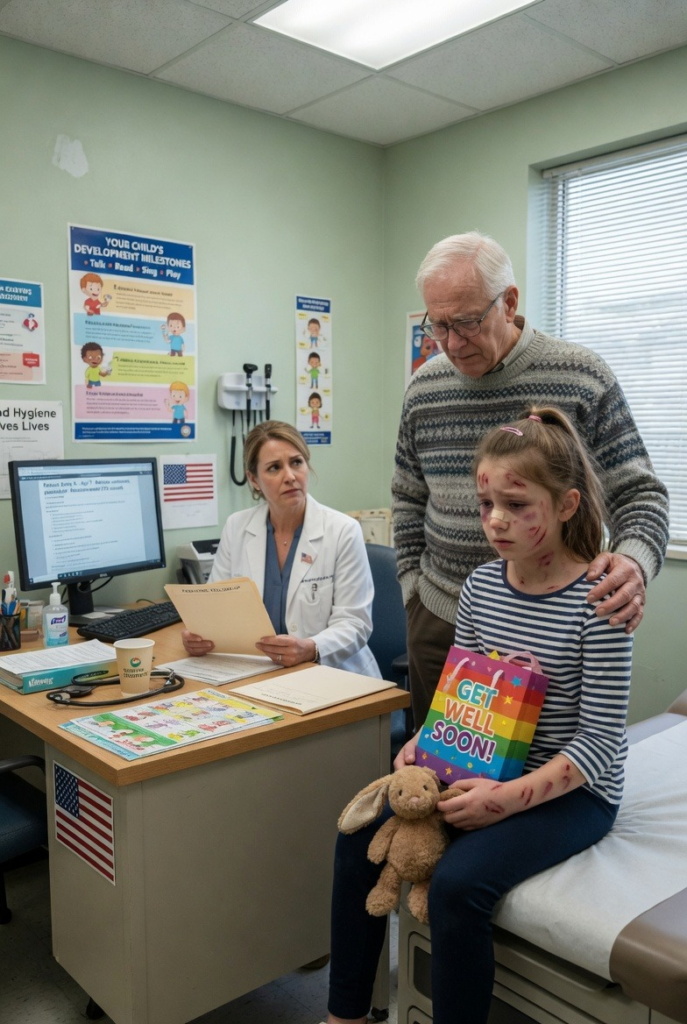
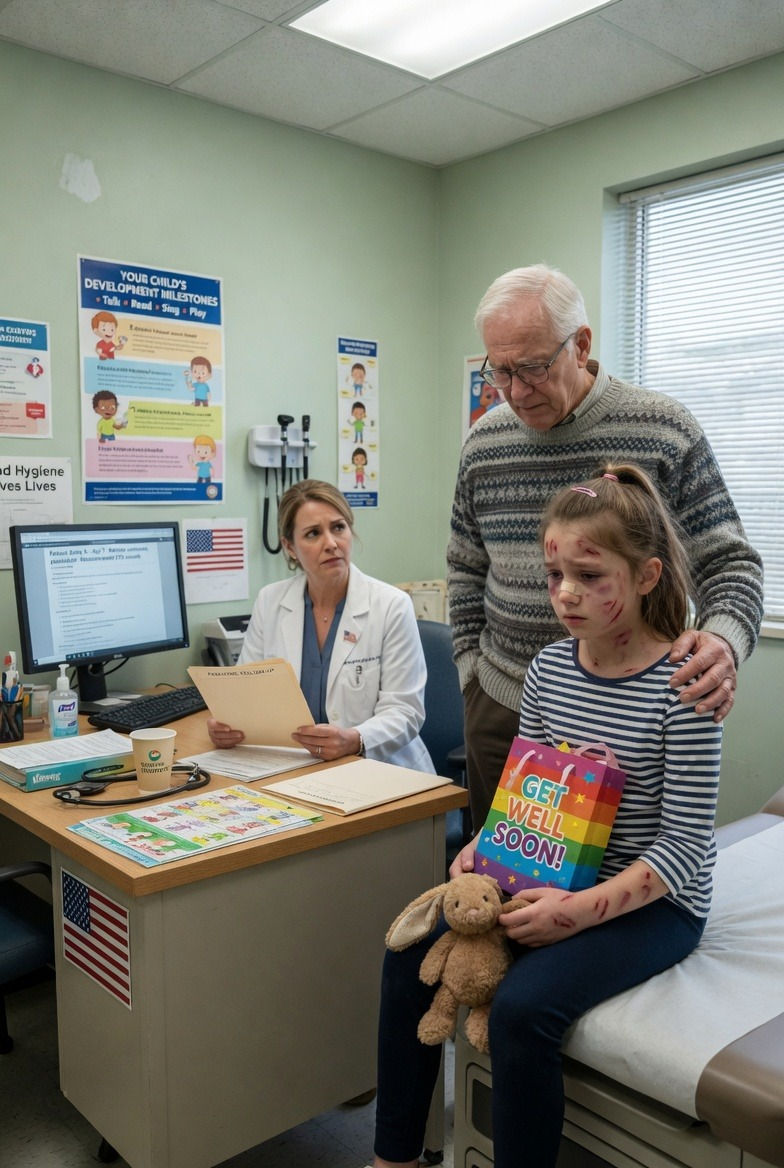
At Riverside Children’s Clinic, Dr. Porter met us before the nurse had finished entering Lily’s name. That was when my stomach truly dropped.
The nurse took Lily’s temperature, blood pressure, and weight. Dr. Porter asked careful questions in a voice soft enough not to scare her and precise enough to make me understand every answer mattered.
Had the drink been given nightly? Did it taste bitter, metallic, or sweet? Did Lily ever vomit after it? Did she wake up confused? Did she wet the bed after being fully trained?
Lily answered some questions. I answered others. The whole time, Dr. Porter’s pen moved across the intake form with a quiet, steady speed.
Then came the blood draw. Lily tried to be brave and failed only at the very end, when the needle slid in and her eyes filled.
I told her she was doing great. She asked again if her mother would be mad. I told her the grown-ups would handle Mom.
That was the line I needed to believe.
Dr. Porter ordered bloodwork, a urine toxicology screen, and a medication panel. The nurse printed labels with Lily’s name and date of birth and placed barcodes on two vials and one collection cup.
The first sample was logged at 12:46 p.m. I remember because I stared at the wall clock while Lily drank water through a straw, blinking too slowly.
Forensic detail has a way of calming panic. Names. Times. Labels. Forms. They turn terror into something other people are required to answer.
At 1:34 p.m., Mark called back. I stepped into the hallway and answered while Lily colored in the waiting area behind the glass.
“Dad?” he said. “Natalie said you took Lily without asking. What’s going on?”
I looked at my granddaughter through the glass. She was holding one purple crayon, but she was not coloring anymore. Her head had dipped toward her shoulder.
“Mark,” I said, “you need to come to Riverside Children’s Clinic right now.”
He asked why. I did not answer fast enough, and that silence told him more than words could have.
“Dad,” he said again, quieter. “What happened?”
Before I could respond, the lab door opened. Dr. Porter stepped out holding Lily’s file. Her professional expression was gone.
Doctors are trained not to show fear. That is how I knew.
She led me into a consultation room and closed the door almost all the way. Not fully. Enough that she could still see Lily through the glass.
The first page in her hand was not a diagnosis. It was a toxicology summary. She tapped one line with her pen, then another. Her face stayed still in a way that made my ears ring.
“Could this be from vitamins?” I asked.
She looked at me. That was answer enough.
Then she showed me the mandated reporter intake sheet, already stamped 1:58 p.m. Riverside Children’s Clinic. Child protective referral pending physician signature.
My knees felt weak. I sat because I did not trust myself to remain upright, and for one breath I saw Natalie in that bright kitchen again, saying Lily got tired.
Not tired. Managed.
That is the cruel genius of poisoning a routine. Bedtime becomes evidence. Juice becomes cover. A child’s trust becomes the delivery system.
A nurse appeared in the doorway. “Her father is here.”
Mark came down the hallway still wearing his work shirt, phone in hand. He looked first at Lily, then at me, then at the folder on the table.
He had been my boy before he was anyone’s husband. I saw both versions of him collide in that doorway: the man trying to understand and the child realizing his house was not safe.
“Dad,” he said, and his voice cracked. “What did Natalie give her?”
Dr. Porter closed the folder halfway. “Mr. Hale, I cannot discuss every detail in the hallway. But Lily needs further evaluation, and I have already initiated a child protective referral.”
Mark turned white. “A referral? For what?”
No one answered quickly. That was its own answer.
The next hour unfolded in pieces. Mark called Natalie from the parking lot while I stayed with Lily. He put the call on speaker only after warning Dr. Porter, who stood nearby documenting everything.
Natalie answered irritated. Then annoyed. Then silent.
When Mark asked what she had been putting in Lily’s juice, she laughed once and said, “Your father is being ridiculous.”
Dr. Porter wrote that sentence down.
Mark asked again. Natalie said they were children’s vitamins. Mark asked the brand. Natalie said she did not remember. Mark asked where they were. Natalie hung up.
By 3:12 p.m., a social worker named Karen Meade arrived from Franklin County Children’s Services. She spoke to Lily gently, without leading her, and documented the same phrases Lily had used with me.
Weird juice. Sleep really long. Legs feel floaty. Sometimes I don’t remember the morning.
Mark looked like each sentence struck him physically. He kept rubbing both hands over his face, then stopping himself because Lily was watching.
That evening, under guidance from the social worker, Mark agreed not to take Lily home until the house had been assessed. Natalie texted him thirteen times in twenty minutes.
The messages started angry. Then they turned sweet. Then they became threatening.
I took photographs of every message with my own phone. Mark forwarded them to Karen Meade. Dr. Porter added the medical records to Lily’s chart and recommended hospital observation for additional testing.
The following morning, Mark returned to the house with a police officer and the social worker present. I was not allowed inside, which was probably for the best.
In the kitchen, they found two bottles in a cabinet above the refrigerator, behind holiday mugs Natalie never used. One bottle had the label peeled halfway off.
They also found a small plastic dosing cup in the dishwasher and a child’s cup with orange residue near the sink. Those items were bagged, logged, and sent for testing.
I learned later that Natalie had been telling people Lily was difficult, restless, and impossible at bedtime. She had called it exhaustion. She had called it parenting.
What she had not expected was Lily telling the truth to someone who still knew how to listen.
The official process took longer than any social media ending would make it seem. There were interviews, temporary custody orders, medical follow-ups, and hearings where every word mattered.
Mark was not perfect in those rooms. He cried. He blamed himself. He asked how he had missed it when it was happening under his own roof.
I told him the truth. Trust can blind good people. That does not excuse blindness, but it explains why guilt arrives before sleep and stays until morning.
Natalie denied everything at first. Then she minimized it. Then, when the testing on the cup and bottles came back, her story changed again.
I will not write the names of the substances here. Lily deserves privacy more than the internet deserves specifics. What matters is that they were not vitamins.
The court granted Mark temporary sole custody while the investigation continued. Natalie was ordered to have no unsupervised contact with Lily. Later, that order became longer and stricter.
Lily spent weeks sleeping in the guest room at my house because she said my hallway light sounded safe. Children say things like that and do not understand they are handing you your own heart.
Some nights she woke up crying. Some mornings she asked whether breakfast was normal food. Mark sat with her through all of it, learning how to be present in a way apology alone could never replace.
On her eighth birthday, the party was small. No big crowd. No perfect decorations. Just cake, three balloons, Mark, me, and Lily wearing a paper crown tilted over her apple-scented hair.
She opened the crookedly wrapped gift at my kitchen table. This time, she tore into the paper with both hands.
I still think about that Tuesday. I think about the refrigerator hum, the half-empty cup, Natalie’s controlled smile, and Lily’s voice asking if vitamins were supposed to make her legs feel floaty.
The sentence that saved her was not loud. It was not dramatic. It was whispered by a child who trusted one adult enough to ask for help.
An entire house had taught Lily to doubt what her own body knew. So the rest of us had to teach her something stronger: when something feels wrong, you are allowed to say it.
And someone who loves you should listen the first time.