By 11:20, it had thirty-seven shares.
By midnight, strangers were asking for my PayPal link.
And by 2:00 a.m., my brother’s livestream chat was flooding so fast he had to switch to subscriber-only mode.
I found that out because someone screen-recorded it and sent it to me.
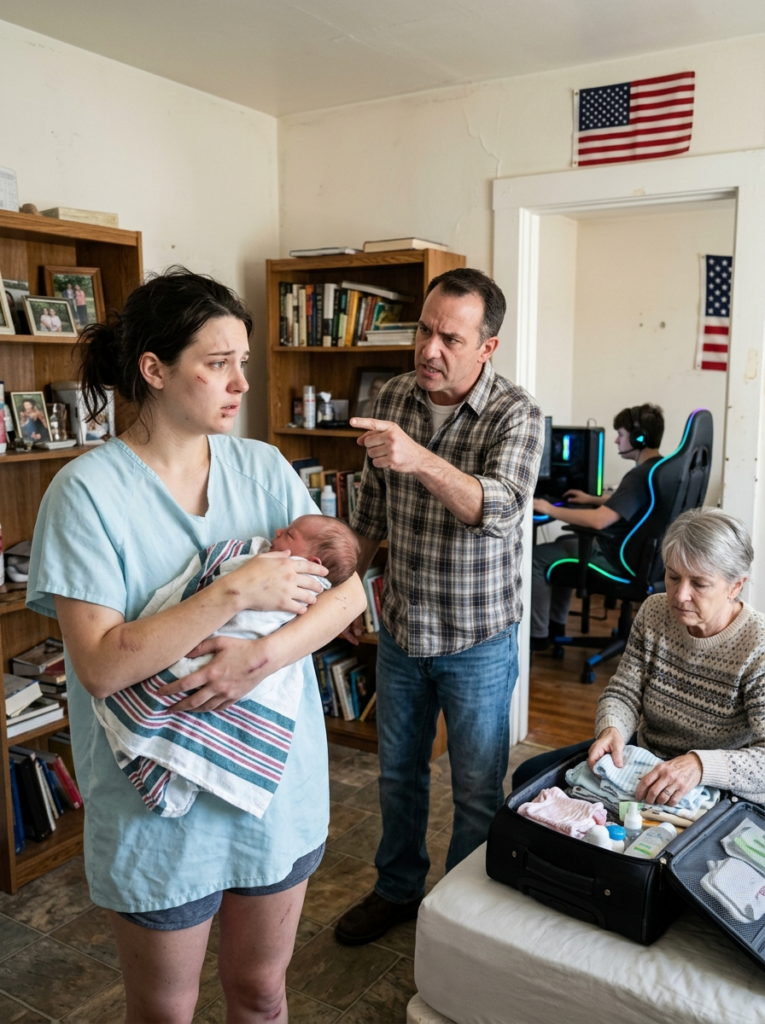
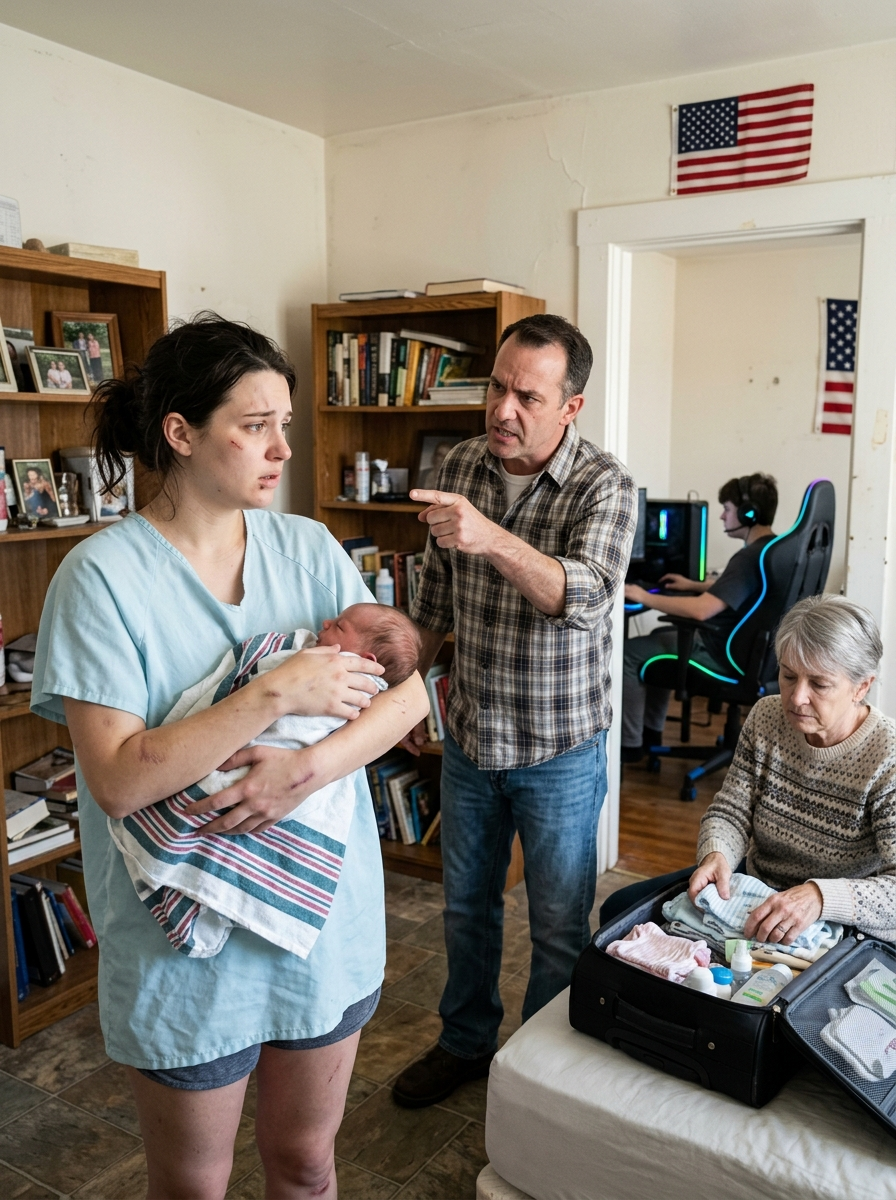
Sergio sat in his expensive gaming chair—the one my parents bought him “for content creation”—wearing giant headphones and pretending to laugh while donations popped across the screen.
Then someone in chat wrote:
IS IT TRUE YOU KICKED YOUR POSTPARTUM SISTER OUT FOR TWITCH?
Another:
BRO YOUR NEPHEW IS SLEEPING ON A FLOOR???
Then another.
And another.
The clip ended with Sergio muttering, “Mods, ban anybody talking about family drama.”
Family drama.
As if I had complained about borrowed clothes instead of being discarded with surgical staples still in my abdomen.
Bruno woke crying around 3:00 a.m.
The apartment was freezing.
I tried to stand too quickly and pain tore through my stomach so sharply I nearly dropped him. I sank back onto the mattress biting my lip hard enough to taste blood while he screamed from hunger against my chest.
That was the moment I finally cried.
Not graceful tears.
Not cinematic ones.
Exhausted, ugly sobs in a mildew-smelling room while my newborn rooted helplessly against my hospital gown.
I kept thinking the same thing over and over:
They really left us here.
Not temporarily.
Not emotionally.
Completely.
At 8:13 the next morning, someone knocked on the apartment door.
I froze instantly.
My father had a habit of pounding on doors when angry, and for one awful second I thought they had come back to yell at me for posting online.
Instead, a woman around sixty stood outside holding two grocery bags.
“I saw your post,” she said awkwardly. “I live downstairs.”
I stared at her.
She lifted one bag slightly. “Soup. Diapers. Formula if you need it.”
That was the first kindness.
Then came more.
A nurse from another city messaged offering postpartum care advice.
A woman sent me a portable bassinet saying her son had outgrown it.
Someone else paid three months of a phone bill anonymously.
By the second day, my post had spread far beyond my tiny Instagram account.
People were furious.
Not just because of the room.
Because of the way my parents spoke to me.
The coldness.
The casualness.
As though motherhood had immediately stripped me of personhood.
Comments poured in under Sergio’s channel videos.
YOUR SISTER JUST HAD MAJOR SURGERY.
Imagine choosing Twitch over your own grandchild.
“Stop playing the victim”?? She had a C-section TWO DAYS AGO.
His subscriber count started dropping.
Sponsors noticed.
Internet outrage moves fast when cruelty becomes visible.
And my family still believed they controlled the story.
Three days after the post, my mother finally called.
Not to ask about Bruno.
Not to ask whether I was healing.
The second I answered, she hissed:
“Have you completely lost your mind?”
I stayed quiet.
“You humiliated this family online.”
I looked around the apartment.
The stained ceiling.
The grocery bags from strangers.
The mattress where I was bleeding through postpartum pads alone.
Then I asked quietly:
“What family?”
Silence.
She recovered quickly.
“You twisted everything.”
“Did I?”
“You made it sound like we abandoned you.”
I laughed once.
Actually laughed.
“You dropped me in a one-room apartment after abdominal surgery.”
“That is not what happened.”
“It literally is.”
My mother’s breathing sharpened through the phone.
“You always do this. Ever since childhood, everything had to be about you.”
There it was.
The old script.
I remembered being sixteen and winning a regional writing competition while my father missed the ceremony because Sergio had a soccer game.
I remembered birthdays rescheduled around Sergio’s tournaments.
I remembered my mother once telling relatives, right in front of me:
“Luciana is sensitive. Sergio is the one with real potential.”
Back then, I thought families simply had favorites sometimes.
I didn’t realize favoritism could become a form of starvation.
Not physical.
Emotional.
The slow teaching of one child to shrink so another can shine.
“You chose him,” I said quietly.
“We supported opportunity.”
“You chose him over your daughter and grandson.”
My mother snapped then.
“You got pregnant with no husband and expected applause?”
The words hit harder than they should have.
Because pain always lands deepest where shame already lives.
Bruno stirred softly against me.
I looked down at his tiny face and suddenly understood something terrifying:
If I stayed connected to these people, someday they would teach my son to feel small too.
“No,” I whispered. “I expected humanity.”
Then I hung up.
The internet kept digging.
That was the problem with public cruelty—once exposed, people start looking closer.
Old clips surfaced from Sergio’s streams.
Jokes about me crying too much.
Comments about “single moms wanting sympathy.”
One clip showed my mother off-camera laughing while Sergio mocked postpartum depression as “women being dramatic for attention.”
That clip spread everywhere.
A commentary creator with three million followers reposted my story under the title:
THEY THREW HER OUT AFTER A C-SECTION FOR THIS?
Sergio tried going live again that Friday.
It lasted twelve minutes.
Someone donated fifty dollars just to ask:
DOES YOUR NEPHEW STILL SLEEP ON THE FLOOR?
Another:
SHOW US THE ROOM YOU TOOK FROM YOUR SISTER.
Then came the worst one.
A verified sponsor account publicly commented:
We are reviewing our partnership with this creator.
The stream ended almost immediately afterward.
My father arrived at the apartment two days later.
Alone.
He stood in the doorway looking older somehow.
Less certain.
“I came to talk.”
I almost didn’t let him in.
But Bruno had finally fallen asleep and I was too exhausted to argue in the hallway.
My father looked around the apartment uncomfortably.
The plastic chair.
The drying baby clothes hanging over the sink.
The heating unit that clicked loudly every few minutes.
His jaw tightened slightly.
“You could’ve come home instead of making a spectacle.”
I stared at him in disbelief.
“You threw me out.”
“We asked for temporary compromise.”
I pointed toward my healing stomach.
“I could barely walk upstairs.”
“You’re stronger than you think.”
That sentence.
Parents say it when they want endurance from children instead of accountability from themselves.
He sat heavily in the chair.
“Sergio lost two sponsors.”
I said nothing.
“He’s devastated.”
I almost thought I misheard him.
Not:
I’m sorry.
Not:
We failed you.
Not:
How’s the baby?
Sergio.
Always Sergio.
My father rubbed his forehead.
“You don’t understand how important this was for him.”
And suddenly something inside me settled completely still.
Not anger.
Clarity.
“I understand perfectly,” I said softly. “That’s the problem.”
Bruno made a tiny sleepy sound from the mattress.
My father finally looked at him properly for the first time.
Really looked.
At his grandson.
At the tiny fists.
The dark hair.
The newborn face scrunched in sleep.
Something flickered across his expression then.
Maybe guilt.
Maybe realization.
But it came too late.
“He looks like you did,” my father murmured.
I swallowed hard.
Because all at once I remembered being small enough to sleep on his chest during thunderstorms.
Before ambition poisoned our house.
Before love became conditional.
Before my worth started depending on how convenient I was.
“He deserves better,” I whispered.
My father looked up slowly.
And for the first time in my life, I think he understood I was no longer asking for permission to matter.My father stayed quiet for a long time after that.
The apartment heater clicked again. Somewhere outside, a motorcycle roared down the street, and upstairs pipes groaned behind the walls. Bruno slept through all of it with one tiny hand curled near his cheek.
My father kept staring at him.
Not casually.
Like a man suddenly realizing an entire bloodline could continue without him.
“You’re being stubborn,” he said finally, though the force had gone out of his voice.
I almost smiled.
Parents call it stubbornness when obedience expires.
“You abandoned me after surgery.”
“We provided somewhere for you to stay.”
“In a moldy apartment with no crib.”
His jaw tightened again. “You had options.”
“No,” I said quietly. “I had survival.”
That shut him up.
For the first time in my life, he looked uncomfortable sitting inside the consequences of his own decisions.
Usually my mother handled emotions for him—translated them, softened them, dismissed them before they became inconvenient. My father preferred logistics. Solutions. Practicality.
And practical men can justify astonishing cruelty if they rename it necessity.
He stood abruptly after a while.
“Your mother’s very upset.”
I laughed softly under my breath.
Not because it was funny.
Because even now, somehow, my mother remained the injured party in his mind.
“She should be.”
“She says strangers are threatening Sergio online.”
I looked at him carefully.
“I never told anyone to threaten him.”
“That post ruined things.”
“No,” I said. “What you did ruined things. The post just let people see it.”
Silence again.
Then my father made a mistake.
A fatal one.
“You know how your brother is,” he muttered. “He’s sensitive.”
I stared at him.
Sensitive.
Sergio screams at video games for money.
I bled through surgical dressings alone on a mattress.
And somehow he was still the fragile one.
That was the moment something final broke loose inside me.
Not explosive.
Permanent.
“You don’t even hear yourselves anymore,” I whispered.
My father frowned slightly.
“You spent my entire life teaching me to take up less space so he could take up more.”
“That’s ridiculous.”
“Is it?”
Memories came flooding up so fast they almost made me dizzy.
Sergio getting a new laptop while I reused school supplies.
My college acceptance letter folded quietly into a kitchen drawer because my parents were busy celebrating Sergio hitting ten thousand followers online.
The way my mother called his hobbies “dreams” and mine “phases.”
Even during pregnancy, she treated Bruno like an inconvenience interrupting Sergio’s momentum.
“You know what the worst part is?” I asked.
My father said nothing.
“I kept trying to earn love that should’ve already been mine.”
He looked away then.
And that told me everything.
Because people only avoid eye contact when truth corners them.
When he left, he paused awkwardly at the doorway.
“If you come home,” he said carefully, “we can probably work something out.”
Probably.
Work something out.
As if I were negotiating office space instead of returning to the family that discarded me.
I looked down at Bruno.
At his tiny chest rising and falling steadily against the blanket strangers had mailed us.
“No,” I said.
My father blinked.
“I’m not raising my son in a house where love depends on usefulness.”
Then I closed the door.
My hands shook afterward.
Not from regret.
From grief.
Because cutting off your parents feels less like anger and more like attending your own orphaning.
The next week changed everything.
A woman named Teresa—the same neighbor who brought soup—helped me apply for emergency housing assistance. Another follower connected me with a postpartum support organization. Someone else sent me freelance editing work I could do remotely while Bruno slept.
For the first time in years, every bit of help I received came without humiliation attached to it.
No sighs.
No guilt.
No reminder that I was burdensome.
Just kindness.
And kindness feels suspicious at first when you were raised on conditional affection.
One afternoon, while Bruno napped against my chest, I received a message request from someone I didn’t recognize.
It was Sergio.
Not a text.
Not a call.
A message.
Coward’s distance.
You seriously destroyed my career over a room?
I stared at the screen for a long time.
Then another message appeared.
Sponsors dropped me.
Mom cries every day.
Was it worth it?
I looked around the apartment again.
The secondhand bassinet someone donated.
The diapers stacked near the mattress.
The baby monitor purchased by strangers who cared more about my child than his own grandparents had.
Then I typed back:
You mean was my dignity worth more than your streaming setup?
Yes.
Three dots appeared instantly.
Then disappeared.
Then came the message that finally explained my entire childhood.
You always hated when attention wasn’t on you.
I actually stopped breathing for a second.
Because there it was.
The family myth.
The role assigned to me so early everyone believed it by reflex:
Sergio = talented.
Luciana = difficult.
Not neglected.
Not dismissed.
Difficult.
Children in unhealthy families often get assigned identities that protect everyone else from guilt.
The golden child.
The dramatic one.
The disappointment.
The caretaker.
Once assigned, every action gets filtered through the role.
I wasn’t hurt.
I was “overreacting.”
I wasn’t abandoned.
I was “attention-seeking.”
Even bleeding after surgery became selfish somehow because it interfered with Sergio’s success story.
I never replied.
Three days later, another creator uploaded leaked screenshots from Sergio’s private Discord server.
Jokes about me being “homeless with a baby.”
Memes about postpartum bodies.
One message from Sergio read:
She’ll come crawling back once she realizes being a single mom isn’t content people care about.
That one went viral.
The backlash became catastrophic.
Not because the internet suddenly developed morality.
Because cruelty toward mothers triggers something visceral in people.
Especially when the mother clearly has nothing left to gain by lying.
Sergio lost every remaining sponsorship within forty-eight hours.
His subscriber numbers collapsed.
Reaction channels tore him apart for days.
And suddenly my family wanted peace.
Funny how reconciliation always arrives once consequences do.
My mother showed up at the apartment unannounced the following Tuesday carrying shopping bags full of baby clothes.
Peace offerings.
Purchased guilt.
I didn’t let her inside.
She stood in the hallway looking exhausted, makeup smeared slightly beneath her eyes.
“You made your point,” she said quietly.
My stomach twisted.
Not:
I’m sorry.
A point.
Like this had been an argument instead of survival.
“You abandoned me after surgery.”
“We panicked.”
“No. You prioritized him.”
My mother’s eyes flashed.
“He had momentum.”
“And I had staples in my abdomen.”
She flinched.
Good.
For once, I wanted the words to land.
A baby cried somewhere else in the building.
My mother glanced past me instinctively, trying to see Bruno.
“Can I hold him?”
The question nearly broke me.
Because part of me still wanted to say yes.
Children do not stop loving their parents simply because their parents fail them.
That’s the tragedy.
“I don’t know yet,” I admitted.
Her face crumpled slightly.
Then, for the first time in my entire life, my mother said something honest.
“We didn’t think you’d leave.”
There it was.
The real foundation beneath everything.
Not hatred.
Entitlement.
They believed I would absorb any amount of pain as long as the family structure stayed intact.
Because I always had before.
I looked at her carefully.
“At some point,” I said softly, “you stopped seeing me as your daughter and started seeing me as the person who adjusts.”
Tears filled her eyes.
But I didn’t move to comfort her.
That was new too.
Behind me, Bruno stirred awake and made a soft newborn sound.
My mother heard it.
And suddenly she started crying for real.
Not dramatically.
Not manipulatively.
Just quietly.
Like a woman realizing she might become a stranger to her grandson because she spent too many years loving one child loudly and the other conditionally.
“I don’t know how to fix this,” she whispered.
Neither did I.
But for the first time, fixing it was no longer my responsibility alone.