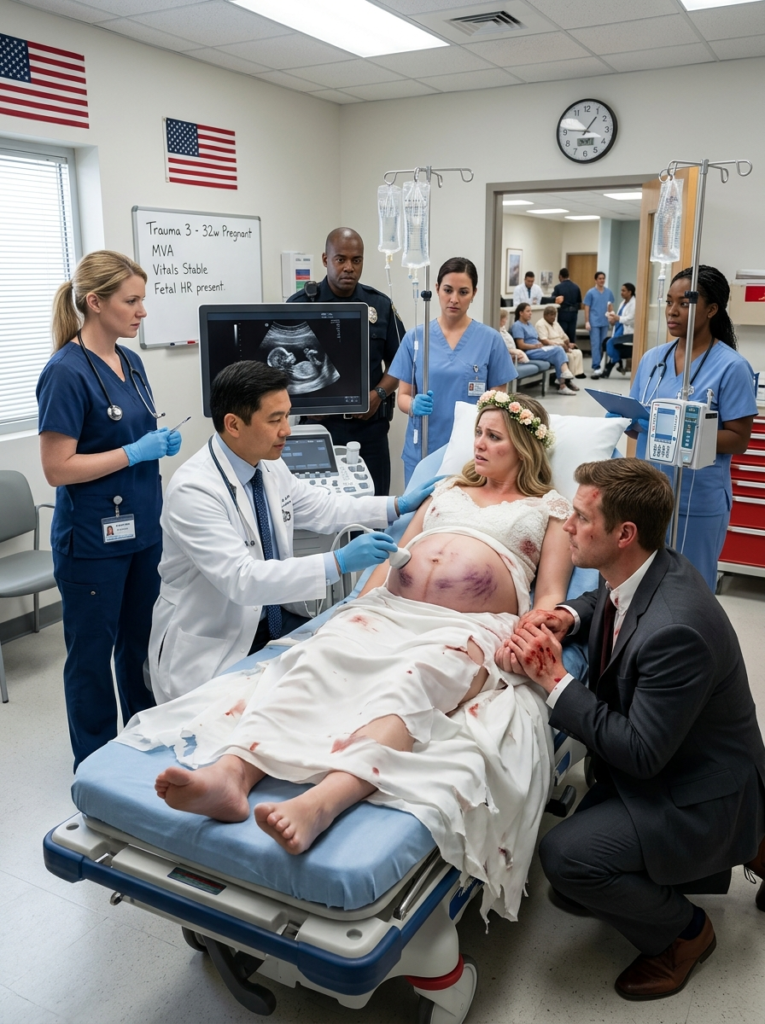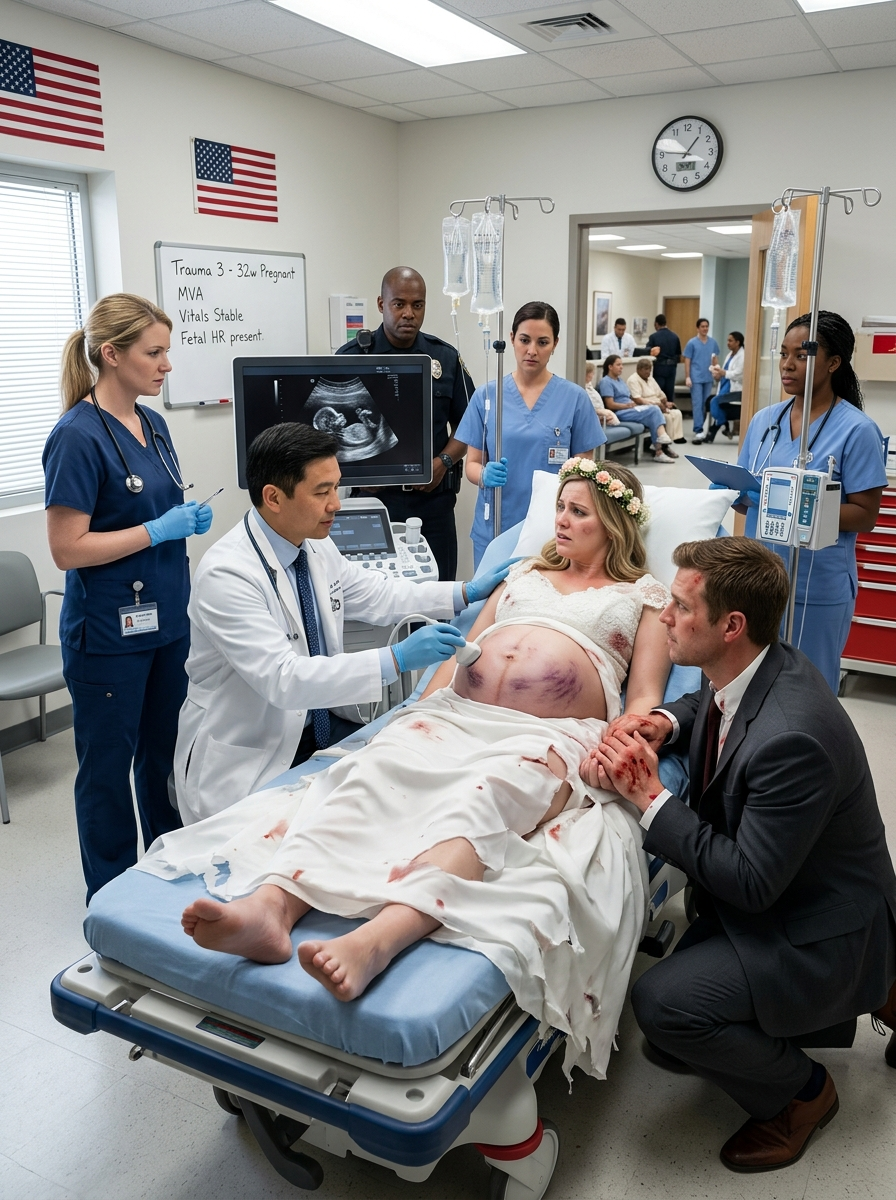
Then he pointed to the screen.
“Your placenta has ruptured,” he said quietly. “And your uterus is filling with blood.”
The room tilted.
I heard words after that, but they came like broken pieces floating through water.
Massive internal bleeding.
Fetal distress.
Emergency cesarean.
Possible hysterectomy.
Possible maternal cardiac arrest.
Someone pushed papers toward Mark. Someone shouted for surgical prep. A nurse cut away the rest of my dress while another jammed an IV needle into my arm.
And underneath all of it was one horrifying truth:
My father hadn’t just pushed me.
He had nearly killed both me and my child.
Mark bent over me, pale as death itself. His eyes were wet, but his voice stayed steady because he knew if he broke apart, I would too.
“Hey,” he whispered, brushing hair away from my forehead. “Stay with me. You hear me? Stay with me.”
I grabbed his wrist with shaking fingers.
“If something happens—”
“Don’t.”
“If something happens,” I cried harder, “save the baby.”
His face crumpled.
“No,” he said immediately. “No. I’m not choosing.”
But the doctor stepped closer, his expression grim in the way only trauma doctors learn to look.
“You may have to.”
The silence afterward was unbearable.
Mark looked like someone had ripped the air from his lungs.
Five years.
Five years of injections and debt and hope and disappointment and prayers whispered over pregnancy tests at 4 a.m.
Five years for this baby.
And now he was being asked which heartbeat mattered more.
The operating room doors burst open.
Everything moved fast after that.
Bright lights streaked overhead as they rushed my bed down the corridor. Nurses barked numbers. Machines beeped in shrill panicked rhythms. I could feel warm blood pooling beneath my lower back no matter how many towels they shoved under me.
Then another contraction of pain tore through my abdomen so violently I screamed.
A nurse looked at the monitor and swore under her breath.
The baby’s heart rate was crashing.
“Sarah,” the doctor said sharply, leaning over me while we rolled, “I need you conscious for thirty more seconds. Can you do that?”
I nodded even though I wasn’t sure.
“Good. Listen carefully. Your placenta detached during the fall. Your baby is losing oxygen. If we don’t operate immediately, you will both die.”
Both.
Die.
The words did not sound real.
I thought of the tiny yellow nursery Mark had painted himself because we couldn’t afford professional decorators after IVF.
I thought about the little socks folded in the dresser.
I thought about the ultrasound heartbeat we had played over and over on our drive home from the clinic because we had waited so long to hear something live inside me.
Then darkness crowded the edges of my vision.
The last thing I heard before anesthesia swallowed me was Mark shouting:
“I love you! Sarah, I love you so much!”
When I woke up, the world was white.
White ceiling.
White lights.
White sheets tucked tightly around my body.
For several seconds I couldn’t understand why my stomach hurt so badly.
Then memory slammed into me.
The stairs.
The blood.
The monitor.
I jerked upright with a gasp.
“My baby—”
Pain exploded through my abdomen so violently I nearly blacked out again.
A hand caught my shoulder gently.
“Easy,” a nurse said softly. “Easy, sweetheart.”
I looked down.
My stomach was smaller.
Empty.
Panic hit instantly. Animal. Uncontrollable.
“Where is my baby?!”
The nurse’s face changed in the tiniest way, and terror flooded my veins so fast I thought my heart would stop.
“No,” I whispered. “No no no no—”
“Your son is alive.”
Everything inside me shattered into sobs.
Alive.
Alive.
I covered my face and cried so hard my incision burned.
The nurse squeezed my hand.
“He came out not breathing,” she said carefully. “They worked on him for almost seven minutes.”
Seven minutes.
Seven minutes without air because my father threw me down a staircase.
“He’s in the NICU now. He’s critical, but he’s fighting.”
A sound escaped me then that did not even feel human.
Relief and horror mixed together until they became unbearable.
“What about Mark?” I whispered.
The nurse hesitated.
That hesitation terrified me more than anything else had.
“Your husband was arrested.”
My entire body froze.
“What?”
“He assaulted your father in the surgical waiting area.”
I stared at her.
The nurse lowered her voice.
“According to witnesses, your father started complaining about the blood on his suit jacket and said this whole thing was ‘dramatic nonsense.'”
I felt cold all over.
“Your husband broke his jaw.”
I closed my eyes.
And somewhere deep inside me—beneath the pain, beneath the fear, beneath the trauma—
a tiny terrible part of me understood.
Two days later, detectives came to my hospital room.
By then I had finally seen my son.
He weighed four pounds, eleven ounces.
He was covered in wires.
His tiny chest fluttered under tubes and monitors while machines breathed beside him in mechanical sighs. His skin looked almost translucent. One of his hands was no bigger than Mark’s thumb.
But he was alive.
And when I touched his fingers, they curled weakly around mine.
That single movement saved me from drowning completely.
Then the detectives arrived.
My mother had apparently spent the last forty-eight hours telling relatives I had “fallen because of pregnancy hormones.”
But there had been over sixty guests at the party.
And someone had recorded everything.
A seventeen-second video.
The detective placed his tablet carefully on my hospital tray.
“Mrs. Whitmore,” he said gently, “I need to ask whether you’d like to press charges.”
My hands shook as the video played.
I watched myself sitting quietly on the sofa.
I watched my mother pointing.
I watched my father grab me.
And then—
The shove.
Not an accident.
Not a stumble.
A deliberate violent throw.
The sound Mark made in the background when my body hit the stairs would haunt me for the rest of my life.
I couldn’t breathe by the time the video ended.
The detective turned the screen off.
“Your father has already been detained pending aggravated assault charges,” he said. “But given the injuries to you and your child, the district attorney is considering attempted homicide.”
Attempted homicide.
The words echoed through my skull.
My mother still hadn’t called to ask if her grandson survived.
Not once.
Instead, she had called the hospital administrator demanding they stop “exaggerating family drama.”
That was when something inside me finally died.
Not hope.
Not grief.
Obligation.
The lifelong desperate ache to be loved by people incapable of love.
Gone.
Completely gone.
I looked at the detective.
Then I looked through the NICU window where my son fought for every breath.
And for the first time in my life, I stopped protecting my family from the consequences of what they had done.
“Yes,” I said.
My voice did not shake this time.
“I want charges filed against both of them.”
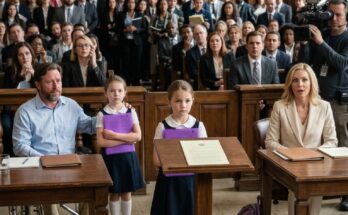
Three months later, my father stood before a judge in an orange jail uniform while reporters packed the courtroom benches.
The video had spread everywhere.
People were horrified not only by the violence—
but by my mother’s screaming afterward while I bled on the floor.
My father received eleven years.
My mother received three for obstruction, witness tampering, and falsifying statements after she tried to convince guests to delete recordings.
Chloe never visited either of them.
Turns out loyalty disappears quickly when inheritance money gets frozen.
And Mark—
My beautiful, exhausted Mark—
had his assault charges dismissed after the judge reviewed the circumstances and the surveillance footage from the hospital waiting room showing my father mocking my condition minutes after emergency surgery began.
But the real ending happened quietly.
Not in court.
Not in front of cameras.
It happened at 2:14 in the morning six months later.
I was sitting in the rocking chair beside my son’s crib, half asleep, when he opened his eyes and reached for me.
No wires.
No tubes.
Just warm little fingers and sleepy breaths.
Mark wrapped a blanket around my shoulders and kissed the top of my head.
And as our son fell asleep against my chest, I realized something that years of pain had never taught me before:
Some people give you life.
Other people teach you why you must protect it.
My parents gave me my childhood.
But my son—
my son gave me the courage to finally leave it behind forever.The first birthday invitation arrived exactly one year after the trial.
No return address.
Just thick cream paper slid beneath our front door while rain hammered softly against the porch windows.
Mark picked it up before I could.
The moment he saw the handwriting, every muscle in his body locked.
My mother’s handwriting.
Elegant.
Sharp.
Cruel even in cursive.
He looked at me carefully before opening it, as though the envelope itself might explode.
Inside was a single card.
Your grandfather is dying.
If you want closure, come now.
—Mother
No apology.
Not one word about the stairs.
Not one word about the baby.
Not one word about the fact that my son, Noah, still startled awake screaming whenever loud male voices echoed too suddenly near him.
I stared at the card so long the letters blurred.
Mark reached for it quietly. “You don’t owe them anything.”
I knew that.
Logically, I knew that.
But trauma does not die when justice is served. Sometimes it just changes clothes and waits in quieter rooms.
For a year, I had dreamed about my grandfather almost every night.
Not because we were especially close.
Because he had watched.
He had sat at the head of the birthday table while my father dragged his pregnant granddaughter across polished marble.
He had seen the blood.
And he had done nothing.
Silence can be violence when it protects the guilty.
Still… he was dying.
And somewhere inside me was the little girl who remembered him sneaking me peppermints during church services and teaching me how to play chess beside the fireplace while my parents fought upstairs.
“I need to go,” I whispered.
Mark hated it instantly.
I saw it in the tension around his mouth.
But he nodded.
“Then I go with you.”
The estate looked smaller when we returned.
Funny how power shrinks once you stop fearing it.
The iron gates opened slowly under gray November skies. Dead leaves scraped across the stone driveway like brittle whispers. The mansion that had once felt untouchable now looked old.
Cold.
Tired.
The same chandelier still hung above the foyer.
I couldn’t look at the stairs.
My body remembered before my mind did.
Pain flashed through my spine so vividly my knees weakened.
Mark’s hand immediately slid against my lower back.
Grounding me.
Anchoring me.
Noah slept against his chest in a tiny blue carrier, one soft cheek pressed against Mark’s sweater.
Alive.
Breathing.
Mine.
That was the only reason I could walk inside without collapsing.
A housekeeper led us upstairs in silence.
And there, inside the dim master bedroom, lay my grandfather.
Arthur Bennett had once terrified boardrooms.
Now he looked paper-thin beneath blankets, oxygen tubing looped beneath his nose. The machines around him beeped softly in the dark.
His eyes opened when he saw me.
Then shifted to Noah.
And immediately filled with tears.
“Leave us,” he rasped.
The housekeeper disappeared.
For several seconds nobody spoke.
Then my grandfather looked at me with a face so full of regret it almost made him unrecognizable.
“I failed you.”
Simple words.
Late words.
But real.
I stood frozen beside the bed.
He swallowed painfully. “I replay that night every hour.”
Mark stayed silent near the doorway.
Watching.
Protective.
My grandfather’s gaze drifted toward the staircase visible through the bedroom hall.
“I should have stopped him before he touched you,” he whispered. “I knew what he was capable of.”
A chill crawled across my skin.
“What do you mean?”
He closed his eyes.
And for the first time in my life, someone finally told the truth about my father.
“When you were twelve,” my grandfather said weakly, “your father broke your wrist.”
The memory hit instantly.
The kitchen.
The shattered plate.
My father’s grip.
The pain.
But then—
My mother’s voice telling the ER doctor I had fallen off my bicycle.
I had believed her.
Children believe the stories adults hand them because the alternative is too frightening.
“You told everyone it was an accident,” I whispered.
“I let her.” Shame twisted his face. “I always let her clean up his violence.”
The room felt suddenly airless.
My grandfather started crying quietly.
“I told myself he had a temper. That he didn’t mean it. That family matters stayed inside family walls.”
His voice cracked completely.
“Then I watched him try to kill you and your child in my own home.”
I couldn’t speak.
Years.
Years of memories rearranged themselves inside my head like shattered glass finally forming the right picture.
The punishments.
The fear.
The way my mother always blamed me afterward.
The way Chloe learned early that cruelty earned rewards.
My grandfather looked toward Noah again.
“May I see him?”
Mark hesitated.
Not because he was cruel.
Because he remembered me bleeding on marble floors while these people screamed at me for ruining a party.
I nodded once.
Carefully, Mark brought Noah closer.
My grandfather touched one trembling finger against Noah’s tiny hand.
And Noah—sleepy and warm and innocent—wrapped his fingers around the old man’s knuckle.
Arthur Bennett broke apart.
A lifetime of pride collapsed right there beside the oxygen machine.
“I don’t deserve this,” he sobbed.
No.
He didn’t.
But Noah wasn’t touching him because he deserved forgiveness.
Babies do not understand legacy.
Only warmth.
We learned the truth after the funeral.
My grandfather had changed his will six weeks before he died.
Everything skipped my father.
Everything skipped my mother.
The estate, the investments, the properties—
all of it went into a protected trust for Noah.
And attached to the legal documents was a sealed handwritten letter addressed to me.
I opened it alone.
Inside, my grandfather had written:
I spent my life confusing peace with silence.
I thought keeping the family together mattered more than confronting evil inside it.
By the time I understood my mistake, your blood was already on my floor.
There is no inheritance large enough to repay what cowardice cost you.
Protect your son from this family.
Do not repeat my failure.
I cried harder reading that letter than I had during the trial.
Because accountability sounds different from excuses.
And I had spent my entire life hearing excuses.
Three weeks later, my mother showed up at our house.
Not prison.
Not court.
Not lawyers.
Straight to our front porch.
I saw her through the window while Noah played on the carpet.
For one terrifying second, I was twelve years old again.
Then Mark stepped beside me.
And I remembered who I was now.
My mother looked older.
Smaller.
But her eyes were exactly the same.
Sharp enough to cut.
“I just want to talk,” she said when I opened the door halfway.
“No.”
Her jaw tightened immediately. “You can’t punish me forever.”
The audacity almost made me laugh.
Punish her?
As if boundaries were violence.
As if surviving her was cruelty.
“You told people I faked a hemorrhage,” I said quietly.
“You turned my relatives against me.”
“You watched me miscarry on a staircase—”
“You didn’t miscarry,” she snapped instantly. “The baby lived.”
The world stopped.
There it was.
The truth underneath everything.
In her mind, if Noah survived, then what happened wasn’t really abuse.
My hands started shaking.
Behind me, Noah laughed softly at one of his toys.
The sound grounded me instantly.
My mother heard it too.
Her eyes shifted past me into the house.
Then softened into something possessive.
“I deserve to know my grandson.”
No.
No, she deserved consequences.
“You will never touch my child.”
Her face hardened. “After everything I sacrificed for you—”
I opened the door wider then.
Not inviting her in.
Showing her the security camera above the porch.
Showing her I wasn’t trapped anymore.
“Leave,” I said.
And for the first time in my entire life—
my mother realized she could no longer control what happened next.
The mask slipped.
Pure hatred flashed across her face.
“You were always weak,” she hissed.
I smiled then.
Not because it didn’t hurt.
Because finally, finally, I understood something important:
Weak people do not survive what I survived.
Weak people do not rebuild themselves from blood and grief and operating rooms.
Weak people do not learn how to mother gently after growing up unloved.
She mistook kindness for weakness because cruelty was the only language she spoke fluently.
I closed the door in her face.
Then I locked it.
And behind me, my son reached his tiny arms upward for me to hold him.
So I did.