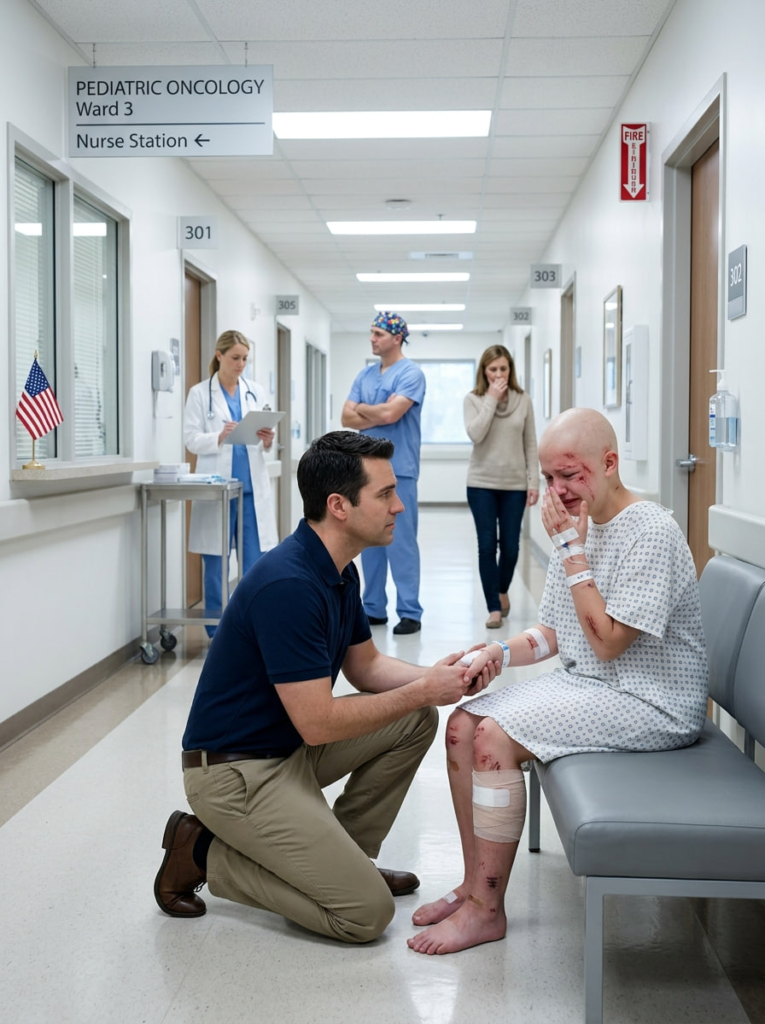
Maya slowly withdrew her hand from mine.
For a second, panic flashed across her face—not fear of the hospital, not fear of pain.
Fear of me knowing.
That hurt worse than anything.
Because even after everything, even after I had abandoned her emotionally long before the divorce papers made it official, she was still trying to protect me from carrying the weight of her suffering.
“I should go,” she whispered.
I stood immediately. “I’m coming with you.”
“No.” The word came too quickly.
Then her expression softened with apology.
“Arjun… please.”
But I had already seen too much.
The oversized hospital gown.
The missing hair.
The IV line taped to her arm.
The exhaustion buried deep inside her bones.
And suddenly all the little details from the last year rearranged themselves into something monstrous.
The fatigue.
The weight loss she blamed on stress.
The nights she fell asleep at the dinner table.
The bruises she once laughed off as clumsiness.
Dear God.
“How long have you been sick?” I asked quietly.
Her eyes dropped to the floor.
The silence answered before her mouth did.
Too long.
The consultation room smelled faintly of sanitizer and printer ink.
I sat beside Maya while the doctor reviewed her chart, though every instinct told me I had lost the right to sit beside her anywhere.
The doctor—a tired-looking woman in her fifties named Dr. Farkas—adjusted her glasses and looked between us carefully.
“You’re family?” she asked.
Maya opened her mouth.
I spoke first.
“I’m her ex-husband.”
The word felt disgusting in my throat.
Ex-husband.
As if five years of loving her could suddenly become past tense while she sat connected to an IV.
Dr. Farkas nodded slowly.
Then she looked at Maya.
“Do you want him here?”
Maya hesitated.
And that hesitation nearly broke me.
Because once, there would have been no question.
Once, I was the person she reached for first.
Finally, she gave one small nod.
The doctor opened the file.
And my entire life changed.
“Maya was diagnosed with acute myeloid leukemia four months ago.”
I stopped breathing.
The room blurred around the edges.
Leukemia.
No.
No, that was impossible.
Maya was thirty.
Maya made soup when I was sick.
Maya laughed at terrible television commercials.
Maya watered plants and folded towels and cried during animal rescue videos online.
People like Maya were not supposed to get leukemia.
But disease does not care who feels gentle.
I stared at the doctor while my heartbeat pounded violently in my ears.
“Four…” My voice cracked. “Four months?”
Maya kept her eyes lowered.
Four months ago.
We were still married four months ago.
Suddenly I remembered every argument.
Every cold silence.
Every night I stayed late at work because being home felt too heavy.
And all that time—
She had been carrying this alone.
“Why didn’t you tell me?” I whispered.
Maya finally looked at me then.
And I saw it.
Not anger.
Not blame.
Just exhaustion.
“You already looked unhappy,” she said softly. “I couldn’t survive watching you stay out of obligation.”
The sentence went through me like glass.
Because she thought I left because she became too difficult to love.
And maybe part of me had.
God help me, maybe part of me had.
Grief changes people slowly enough that you do not notice yourself becoming selfish.
Dr. Farkas explained the treatment plan while I sat frozen.
Chemotherapy.
Transfusions.
Possible bone marrow transplant.
The words stacked together until they stopped sounding real.
“Maya delayed treatment initially,” the doctor added carefully.
I looked at her sharply.
“Why?”
Maya rubbed weakly at her wristband.
“I thought it was stress at first.”
The doctor gave her a look that suggested otherwise.
Then quietly said, “She also missed several appointments.”
My stomach dropped.
“Maya?”
She stayed silent.
But I knew.
Hospital visits cost money.
Treatment cost money.
And during those final months of our marriage, we had argued constantly about finances because I thought she was becoming irresponsible.
I remembered snapping at her one night after seeing charges on our account.
“What are you spending all this money on?”
She had looked so pale sitting at the kitchen table.
“Medical things,” she whispered.
And I—
God.
I had sighed in frustration and gone to bed angry.
Because I assumed it was therapy.
Or vitamins.
Or another attempt to “fix” herself after the miscarriages.
I never asked deeper.
I never looked closely enough.
Love dies in small neglects long before abandonment becomes official.
After the consultation, Maya insisted she could manage alone.
“I take the tram home,” she said quietly while gathering paperwork into trembling hands.
Home.
The word hit strangely.
Because where was home now?
The apartment we once shared belonged to another version of us.
“You’re not taking the tram,” I said immediately.
“Arjun—”
“You can barely stand.”
“I’ve been doing this alone for months.”
That sentence carried no cruelty.
Only truth.
And somehow that made it worse.
I followed her silently through the corridor anyway.
Outside, rain drizzled over Budapest in silver streaks. Cars hissed across wet pavement. The cold air smelled like river water and winter.
Maya swayed slightly near the hospital entrance.
Without thinking, I reached for her elbow.
She flinched.
Not dramatically.
Just enough to tell me she had learned not to expect support anymore.
The realization hollowed me out.
Her apartment was tiny.
One room. A narrow kitchen. A radiator that clicked loudly every few minutes.
There were medicine bottles beside the sink.
Hospital paperwork stacked near the couch.
And knitted beside the window sat the yellow blanket we bought years ago during our first winter together because she claimed every apartment needed one cheerful thing.
She had kept it.
I almost couldn’t bear that.
Maya moved slowly, exhausted from the hospital visit.
“I’m okay,” she murmured automatically when she noticed me looking around.
That phrase.
Women like Maya say I’m okay while quietly drowning because they learn early that needing too much makes people leave.
I helped her sit down.
Then I saw the calendar on the wall.
Chemotherapy dates circled in blue pen.
Appointment reminders.
Blood test schedules.
And beside one date was a tiny handwritten note:
Tell Arjun?
My knees nearly gave out.
She had wanted to tell me.
At some point, she had sat alone in this apartment wondering whether her husband still loved her enough to stay.
And I had already emotionally packed my bags.
I turned away quickly because suddenly I could not breathe correctly.
Maya noticed.
“Please don’t pity me,” she whispered.
Pity?
The word shattered something inside me.
I crouched in front of her.
“Maya,” I said hoarsely, “I don’t pity you.”
My eyes burned violently.
“I hate myself.”
She stared at me silently.
And then, very softly, she asked the question I deserved most:
“Then why did you leave me alone?”
There are questions that expose your soul so completely that answering them honestly feels like peeling skin off bone.
I could have lied.
Could have blamed stress.
The miscarriages.
The fighting.
Depression.
But all of those were only pieces.
The ugliest truth was simpler.
“Because I was weak,” I whispered.
The radiator clicked softly behind us.
Rain tapped against the windows.
And for the first time in my adult life, I admitted something I had spent years hiding from myself:
I had loved Maya deeply.
But when grief made loving her harder instead of easier, I chose escape over tenderness.
That night, Maya fell asleep halfway through trying to drink tea.
The mug slipped slightly in her hands before I caught it.
She looked so tired.
Not ordinary tired.
Bone-deep exhausted.
Like her body had been fighting a war quietly for too long.
I covered her with the yellow blanket.
Then sat beside the couch watching the city lights flicker faintly beyond the rain-streaked window.
At 2:13 a.m., Maya stirred weakly in her sleep.
And whispered my name.
Not angrily.
Not accusingly.
Just softly.
Like home.
I pressed my hands hard against my eyes because suddenly the full horror of what I had done finally arrived all at once.
Not the divorce papers.
Not the arguments.
Not the loneliness afterward.
No.
The real horror was this:
The woman I loved had been dying beside me—
and I had mistaken her suffering for distance.