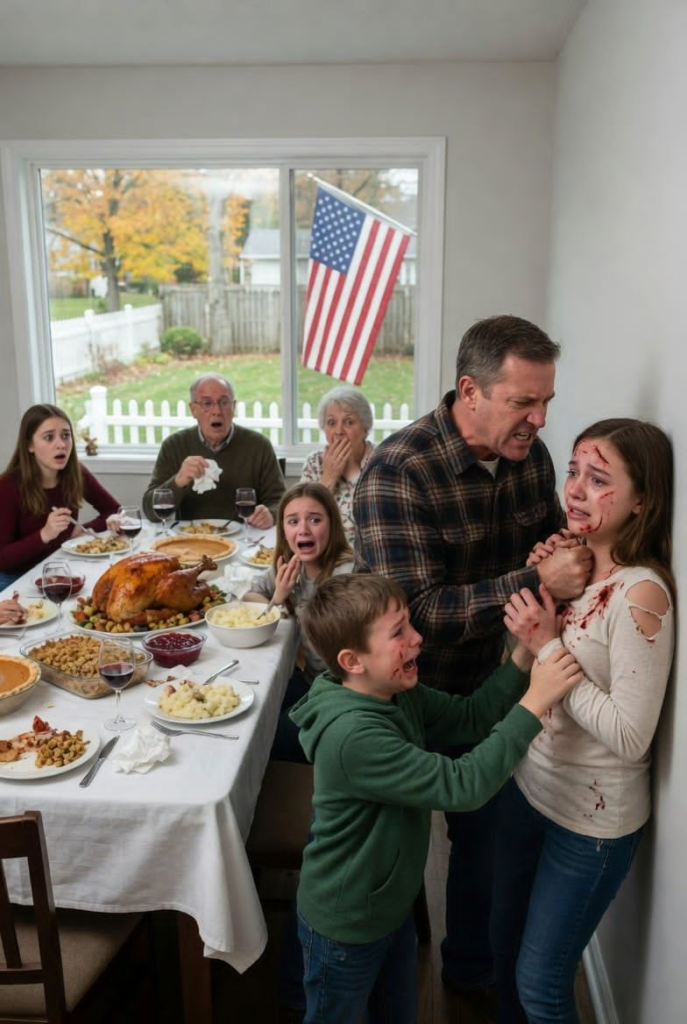
Not hard enough to send him flying across the room like in movies.
Real violence is uglier than that.
My father’s boot caught Tyler in the stomach with a blunt, sickening force that folded his tiny body instantly. My son made this short choking sound—more surprise than pain at first—and crashed sideways into the dining chair.
The chair tipped backward.
Wood slammed against hardwood.
Then Tyler hit the floor.
Everything inside me stopped.
Megan screamed his name.
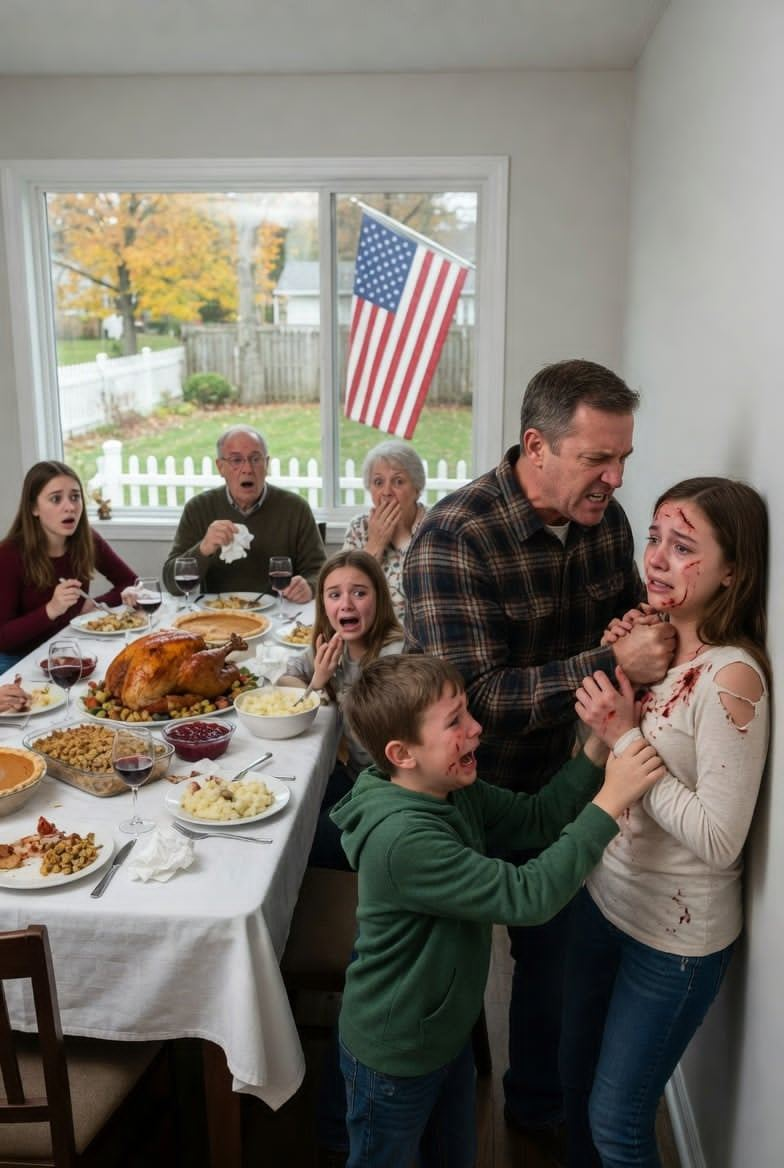
I crawled toward him on shaking hands, my throat burning from where my father’s fingers had crushed against it. Tyler curled inward, clutching his stomach, his navy sweater twisted crooked beneath his coat jacket.
And the worst part?
The room still hesitated.
Not one person rushed forward immediately.
Not one.
Twenty years from now, I will still remember that pause.
The silence after a child gets kicked by his grandfather while relatives decide whether getting involved would make dinner uncomfortable.
My mother stood near the turkey platter, lips tight with irritation instead of horror.
‘Richard,’ she snapped, not because he hurt Tyler, but because he had made a scene. ‘For God’s sake.’
Natalie crossed her arms. ‘He shouldn’t have charged at Dad.’
Charged at him.
My eight-year-old son had tried to protect me.
And they talked about him like he was the aggressor.
Something inside my daughter broke then.
Megan lunged forward and shoved Natalie hard enough to make her stumble backward into the china cabinet.
‘Don’t touch my brother!’ she screamed.
Before I could even react, my mother slapped Megan across the face.
The sound cracked through the room.
Sharp.
Clean.
Unforgettable.
My daughter froze.
One red handprint bloomed slowly across her cheek while her eyes widened in shock—not just from the pain, but from the betrayal of realizing her grandmother could hit her and still stand there feeling righteous afterward.
That was the moment the room changed for me forever.
Not when my father grabbed my throat.
Not even when Tyler hit the floor.
It changed when I looked around and saw everyone else trying not to look involved.
Uncle Warren stared into his whiskey.
Aunt Linda whispered, ‘This has gotten out of hand,’ without actually moving from her chair.
Michael pretended to scroll his phone.
And Susan—
sweet smiling Aunt Susan—
actually laughed nervously and said, ‘Well… every family has drama on holidays.’
Drama.
Like my children were witnessing bad theater instead of violence.
I pulled Tyler into my arms.
He was crying now, trying not to cry hard because boys his age already think bravery means silence.
‘Mom,’ he whispered painfully, ‘I was helping.’
I kissed the top of his head so quickly I nearly sobbed.
‘I know, baby. I know.’
Megan climbed beside us, one hand still against her burning cheek.
My children pressed themselves against me like frightened animals.
And suddenly I understood something with terrifying clarity:
If I stayed one minute longer, these people would teach my children that abuse is normal when family does it.
I stood slowly.
My father pointed at me from across the dining room. ‘Don’t you dare walk away while we’re talking.’
Talking.
That word almost made me laugh.
I grabbed our coats from the hallway bench.
My mother followed behind me in sharp furious clicks of heels.
‘You are overreacting,’ she hissed. ‘Children get emotional. Families fight.’
I turned around so fast she actually stepped back.
‘You slapped my daughter.’
Elaine folded her arms instantly. ‘She shoved Natalie.’
‘After Natalie watched Tyler get kicked.’
‘Tyler should not have interfered.’
The words landed like acid.
Not once—not once—had she asked if he was hurt.
My father appeared behind her, still breathing hard from rage.
‘If you leave now,’ he warned, ‘don’t bother coming back.’
I looked at him for a long moment.
Then at the family photos lining the hallway walls.
Christmas mornings.
Graduations.
Birthdays.
Smiling lies framed in polished wood.
All those years I kept bringing my children here because I wanted them to have grandparents.
And all this time, I had mistaken access for love.
‘Good,’ I said quietly.
My father blinked.
I opened the front door.
Cold November air rushed inside, carrying the smell of wet leaves and chimney smoke.
Behind me, Natalie called out loudly enough for everyone to hear:
‘She always does this! She turns herself into the victim!’
I stopped in the doorway.
Then I looked back at the dining room one final time.
Turkey cooling on china plates.
Candles still flickering softly.
Wineglasses glowing amber under chandelier light.
An entire room full of adults who watched children get hurt and worried more about tension than truth.
And suddenly I was no longer ashamed.
They should have been.
Tyler threw up halfway home.
I pulled the car onto the shoulder while Megan held his forehead with trembling little hands.
Cars rushed past us through the darkness.
My son cried quietly from pain and embarrassment.
‘I didn’t mean to make trouble,’ he whispered.
That sentence destroyed me.
Because children from cruel families learn early that being harmed is somehow the same thing as causing harm.
I drove straight to the emergency room.
The nurse took one look at Tyler’s stomach bruising and asked what happened.
And for the first time in my entire life—
I told the truth.
Not the softened version.
Not the family-safe version.
Not the version designed to protect adults from consequences.
The truth.
‘My father assaulted me and kicked my son.’
The words felt unreal coming out of my mouth.
The nurse’s expression changed immediately.
Within minutes, a social worker entered the room.
Then security.
Then a police officer.
Tyler had bruised ribs.
Megan had swelling on her face.
And I had fingerprints darkening around my throat.
Physical evidence.
Visible proof of what my family had spent decades convincing me wasn’t serious enough to matter.
The officer asked carefully, ‘Do you want to file charges?’
My first instinct was still fear.
Fear of retaliation.
Fear of family outrage.
Fear of becoming the villain in everyone else’s version of events.
Then Tyler reached for my hand from the hospital bed.
And Megan leaned silently against my shoulder.
My children were watching what I would do next.
Not just as their mother.
As the person teaching them what protection looks like.
‘Yes,’ I said.
My voice shook once.
Then steadied.
‘Yes. I do.’
The fallout exploded by morning.
Voicemails.
Texts.
Missed calls.
My mother left six messages before 8 a.m.
‘How dare you involve police.’
‘You’re destroying this family.’
‘Your father barely touched anyone.’
Natalie posted vague social media quotes about toxic people who weaponize victimhood.
Uncle Warren texted:
Families should handle things privately.
Privately.
That word again.
As if privacy was more sacred than children feeling safe.
Then came the message that finally snapped the last thread holding me to them.
It was from my father.
One sentence.
You always were an ungrateful little bitch.
I stared at the screen while Megan ate cereal quietly at the kitchen counter and Tyler lay curled on the couch with a heating pad against his ribs.
No apology.
No shame.
Only rage that I refused to protect him from consequences anymore.
That was when I blocked every number.
Every single one.
Three weeks later, I sat in family court holding Tyler’s hand while my father avoided looking at us.
The prosecutor showed photographs.
My throat.
Megan’s cheek.
Tyler’s bruises.
The courtroom went silent.
Even Richard looked uncomfortable seeing what his anger had actually done to a child.
But the moment that truly mattered happened outside afterward.
We were walking down the courthouse steps when Tyler suddenly stopped beside me.
‘Mom?’
‘Yeah, baby?’
He looked up at me carefully.
‘Are we still a family even if they aren’t with us anymore?’
I knelt immediately despite the cold wind cutting across the concrete.
Then I held both my children close.
‘Listen to me,’ I whispered fiercely. ‘Family is not people who hurt you and call it love.’
Megan started crying softly beside us.
I kissed her forehead.
‘Family is who protects you.’
And standing there outside that courthouse—with my son bruised, my daughter wounded, and my entire childhood finally burned down behind me—I realized something painful but freeing:
Blood can make you related.
But love, safety, and truth?
Those are choices.
Christmas came quietly that year.
No giant dining table.
No expensive centerpiece.
No performance.
Just the three of us in our little house with mismatched ornaments, sugar cookies slightly burned at the edges, and a tree Tyler insisted needed “at least fifty more lights.”
For the first time in my life, the holidays felt peaceful instead of dangerous.
And that peace terrified me at first.
Children from volatile families learn to mistake calm for the moment before something bad happens.
Every loud sound made Megan flinch for weeks.
Tyler stopped talking in his sleep only after December.
And me?
I kept checking the locks at night like cruelty might somehow still have a key.
The criminal case moved faster than I expected.
Probably because there were witnesses.
Not helpful witnesses.
But enough people at Thanksgiving had admitted under oath that Richard grabbed my throat and kicked Tyler that the story became impossible to smooth over into “family drama.”
My mother tried anyway.
Of course she did.
She arrived at the preliminary hearing dressed elegantly in cream wool and pearls, carrying herself like a woman attending charity brunch instead of assault proceedings involving her grandchildren.
She never once looked at Tyler.
Not really.
Only at me.
Like I had betrayed her by refusing to bleed quietly.
Her attorney argued that emotions escalated during a “heated family disagreement.”
The prosecutor responded by holding up photographs of bruises on an eight-year-old child.
The courtroom went silent after that.
Richard accepted a plea deal eventually.
Probation.
Mandatory anger counseling.
No contact with my children.
The no-contact order enraged him more than the charges themselves.
Because men like my father can tolerate consequences more easily than loss of control.
But the real damage happened outside courtrooms.
Families do not collapse all at once.
They split slowly along fault lines that were always there.
Aunt Susan sent me a Christmas card with no return address.
Inside, she wrote:
I should have stopped it sooner.
I am sorry.
That was all.
No excuses.
Just truth.
I cried harder over that little card than I had during the hearing.
Because accountability sounds so different from manipulation.
Uncle Warren never spoke to me again.
Natalie posted online constantly about “cutting out toxic narcissists.”
And my mother—
my mother launched a full campaign.
According to relatives, I had brainwashed my children.
Exaggerated the violence.
Destroyed the family over money.
One cousin actually called to tell me:
“Your father’s old-fashioned. That generation was stricter.”
Stricter.
As if assaulting children was a parenting style.
I hung up before she finished.
Then came January.
And with it, the first truly awful realization:
Tyler blamed himself.
I found out accidentally.
He was in his room building Legos while I folded laundry nearby.
I heard him whispering quietly to himself the way children do when trying to make sense of pain.
“If I didn’t run at Grandpa…”
My entire body went cold.
I sat beside him immediately.
“Tyler.”
He froze.
His little face crumpled instantly because he already knew I heard him.
“I made it worse,” he whispered.
No.
God, no.
I pulled him into my lap so fast pieces scattered across the carpet.
“Listen to me very carefully,” I said, holding his face in both hands. “Nothing that happened was your fault.”
“But Grandpa got mad because—”
“Grandpa got violent because Grandpa chose violence.”
Tears slid down his cheeks.
“He kicked me because I was bad.”
I actually felt my heart break physically inside my chest.
Children would rather believe they are bad than believe adults are unsafe.
Because if adults are unsafe, the whole world becomes terrifying.
So they blame themselves instead.
I hugged him until he stopped shaking.
Then I made therapy appointments for all three of us the next morning.
Megan changed differently.
Tyler became quieter.
Megan became furious.
At school, she snapped at teachers.
Argued with classmates.
One afternoon the principal called because she punched a boy who joked about “crazy family holidays.”
When I asked her why, she burst into tears so violently she could barely breathe.
“Because everybody watched!” she screamed. “Everybody watched and nobody helped us!”
There it was.
The wound beneath the anger.
Not just the violence.
The audience.
The betrayal of realizing adults will sometimes witness harm and choose comfort over courage.
I held her while she sobbed into my sweater.
And silently, I hated every relative at that table all over again.
By February, things finally became quieter.
Not healed.
Healing is slower than movies pretend.
But quieter.
Then one snowy Thursday evening, my doorbell rang.
I looked through the window and nearly stopped breathing.
My mother stood on the porch.
Alone.
Snow gathered across her dark coat. Her hands were bare despite the cold.
For one weak, dangerous second, hope flickered inside me.
Maybe she came to apologize.
Maybe becoming publicly accountable had finally cracked something open inside her.
Maybe mothers eventually choose their grandchildren over pride.
I was still grieving the idea of having one.
I opened the door halfway.
Elaine looked older.
Not softer.
Just older.
“I need to speak to the children.”
“No.”
Her jaw tightened instantly.
“You cannot keep them from me forever.”
“You slapped Megan.”
“She attacked Natalie.”
“She was protecting Tyler.”
“Tyler caused the escalation.”
The words hit exactly the same as before.
Not one ounce of remorse.
Just blame redistributed downward onto children.
I should have closed the door immediately.
Instead I asked quietly:
“Do you even hear yourself?”
My mother exhaled sharply through her nose.
“You always were dramatic.”
There it was.
The sentence beneath my entire childhood.
Not hungry.
Not hurt.
Not frightened.
Dramatic.
Every feeling minimized until I doubted my own reality.
And suddenly I saw it clearly:
They trained me my whole life to tolerate cruelty by convincing me my pain was the problem.
Behind me, footsteps creaked softly.
Megan stood in the hallway watching.
My mother spotted her instantly.
And smiled.
Actually smiled.
“Megan, sweetheart—”
My daughter stepped backward immediately.
Fear crossed her face so fast and raw it stunned even me.
Elaine saw it too.
For one tiny moment, something flickered in her expression.
Not guilt.
Shock.
Because narcissistic people genuinely believe children naturally belong to them no matter what they do.
Seeing fear instead of devotion unsettled her.
Good.
“Megan,” I said softly, never taking my eyes off my mother, “go upstairs please.”
She disappeared instantly.
My mother looked wounded.
“How dare you make her afraid of me.”
I laughed then.
One sharp ugly laugh before I could stop it.
“You did that yourself.”
Snow swirled harder around the porch light.
And suddenly I realized something important:
I was no longer afraid of losing them.
I had already survived it.
“You need to leave,” I said quietly.
Elaine’s face hardened into something cold enough to freeze the air between us.
“You think you’ve won?”
No.
That was the difference between us.
She thought relationships were wars.
I thought they were responsibilities.
“I think my children are finally safe.”
Her eyes narrowed.
Then she delivered the final gift cruel parents always give once they lose control:
The truth.
“You were always difficult to love.”
The sentence landed hard.
Not because I believed it anymore.
Because once, I had.
Once, that sentence would have destroyed me for months.
But therapy teaches you something life-changing:
Abusive people describe your reactions to abuse as personality flaws.
I looked directly at my mother.
And for the first time in my life, I saw her clearly.
Not powerful.
Not superior.
Just emotionally small.
A woman who confused obedience with love because control was the only intimacy she understood.
“You should go,” I repeated calmly.
She stared at me another moment.
Then turned and walked into the snow without saying goodbye.
I watched until her car disappeared.
Then I locked the door.
Behind me, Tyler sat cross-legged on the living room floor untangling Christmas lights we still hadn’t packed away.
Megan curled beneath a blanket reading beside the fireplace.
Safe.
That word mattered more than family names ever would again.
Tyler looked up when I entered the room.
“Who was it?”
I sat beside him and gently took the tangled lights from his hands.
“Nobody important anymore,” I said.