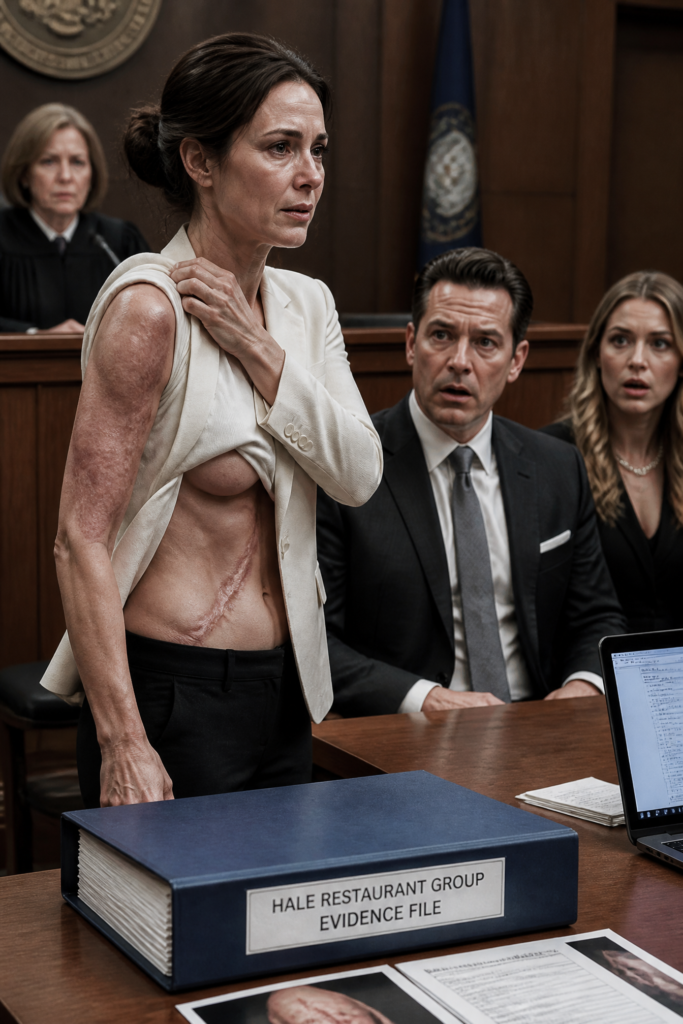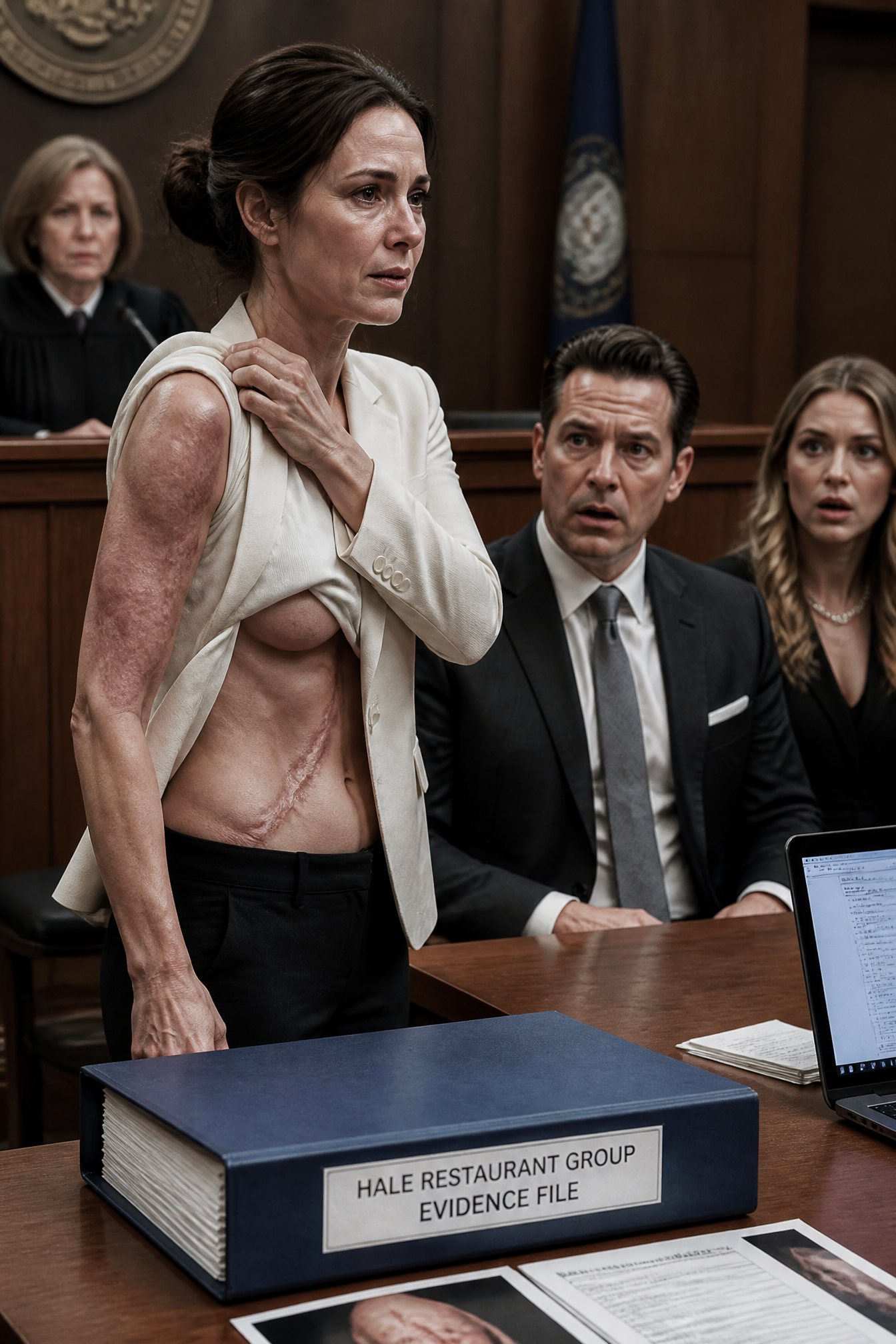
. He Thought Humiliating Me in Public Would End the Case. Instead, I Exposed the Scars He Had Spent Twenty Years Covering Up—and Watched His Entire World Begin to Collapse. The courtroom fell silent the moment Victor Hale started laughing. Not the uncomfortable laugh of a nervous man. Not the forced laugh of someone trying to save face. This was the laugh of a man convinced he had already won. For two decades, Victor had carefully built an image. Successful businessman. Beloved restaurant owner. Respected member of the community. A self-made success story. At least, that’s what everyone believed. Now, seated confidently in an expensive custom suit, he was preparing to erase me from that story completely. “Your Honor,” Victor said with a smirk, “let’s stop pretending. My wife didn’t build anything. She carried boxes, cleaned floors, and followed instructions. She was basically a pack mule.” A few people shifted uncomfortably. His attorney couldn’t hide a small smile. Behind them, his younger girlfriend, Melissa, looked amused. The insult hung in the air. But I didn’t react. I didn’t cry. I didn’t argue. I simply sat there as twenty years of memories flashed through my mind. Opening the restaurant before dawn. Working sixteen-hour days. Lifting heavy deliveries until my back screamed with pain. Standing over scorching ovens. Missing birthdays. Missing holidays. Giving up pieces of my life so Victor could stand in front of customers and proudly call himself self-made. The judge turned toward me. “Mrs. Hale, would you like to respond?” Victor leaned back, completely relaxed. “Go ahead, Evelyn,” he said mockingly. “Tell everyone how scrubbing floors turned you into a business owner.” He wanted a reaction. He wanted tears. He wanted me to look bitter and desperate. Instead, I stood. Slowly. Calmly. My attorney, Grace, remained seated, but I could see her watching closely. Without speaking, I unbuttoned my jacket. Victor’s smile weakened. I rolled back my sleeve and revealed the large burn scar stretching from my shoulder down my arm. The room instantly quieted. Several people gasped. Then I lifted my blouse slightly to reveal another scar. Long. Jagged. Permanent. The scar left behind after an industrial mixer crushed part of my body years earlier. An accident Victor had spent years trying to hide. Melissa’s expression vanished. Victor’s lawyer suddenly sat upright. The judge narrowed her eyes. “You told everyone I got hurt at home,” I said calmly. “You told the insurance company I wasn’t an employee.” “You told the hospital I was simply helping my husband.” Victor’s jaw tightened. “That has nothing to do with this divorce.” For the first time that day, I smiled. A real smile. “Oh, it has everything to do with it.” Grace rose from her chair. Then she placed a thick blue folder onto the table. The sound echoed through the silent courtroom. Inside were twenty years of secrets. Medical records. Payroll files. Insurance reports. Tax documents. Witness statements. Evidence Victor never believed anyone would find. His confidence disappeared. He stared at the folder as if it were a ticking bomb. And for the first time in twenty years, I saw something in his eyes I had never seen before. Fear. Real fear. Because he suddenly understood this wasn’t just a divorce anymore. This was an investigation. And the truth he had buried for decades was about to come to light. The restaurant wasn’t the only thing he stood to losePART 2
The judge didn’t touch the folder immediately.
She just looked at it.
That was worse than opening it.
Victor noticed too.
His earlier confidence shifted—subtly at first, then visibly. His hand tightened around the edge of the table like it might steady him.
“Your Honor,” his attorney said quickly, “this is highly irregular. We are here for divorce proceedings, not a—”
“A what?” the judge interrupted calmly.
No one spoke.
She finally opened the folder.
Page one.
Then page two.
Then she stopped.
Looked up.
“Mrs. Hale,” she said carefully, “did you submit this evidence today?”
I nodded. “No, Your Honor. This was submitted under seal three weeks ago through my attorney.”
Grace stood.
“We were waiting for the appropriate moment in proceedings to introduce it,” she said. “Given the defendant’s statements regarding my client’s lack of contribution, we now believe context is necessary.”
Victor laughed again—but it came out thinner this time.
“This is ridiculous,” he snapped. “She’s angry. She’s trying to rewrite history because she didn’t get a fairytale divorce settlement.”
The judge didn’t respond to him.
She kept reading.
Then she reached the medical section.
Her expression changed.
Subtle—but unmistakable.
“Mr. Hale,” she said slowly, “did your wife suffer a workplace injury in your restaurant kitchen?”
Victor exhaled sharply.
“It was an accident. She was just helping out. She wasn’t officially employed.”
Grace stood again.
“Then why,” she asked, sliding another document forward, “does your insurance policy list her as an unpaid labor classification worker under your business liability coverage for twelve years?”
Silence.
Victor blinked.
Once.
Twice.
“That’s… standard language,” he said quickly. “Every small business does that—”
“No,” Grace interrupted. “They don’t.”
A murmur spread through the courtroom.
Victor’s girlfriend shifted uncomfortably behind him.
The judge flipped another page.
Then another.
Then she leaned back slightly.
“This shows multiple injury reports,” she said. “Burns. Repetitive strain damage. A major industrial accident that required emergency surgery.”
Her eyes lifted to Victor.
“And yet none of these were reported as workplace incidents?”
Victor’s mouth opened.
Closed again.
For the first time, his voice wasn’t confident.
“It would have destroyed the business,” he said.
That sentence landed like a confession.
Because it was.
I finally spoke again.
Quietly.
“You told me I wasn’t your employee because you said I was your wife.”
A pause.
“That was convenient for you.”
Victor shook his head fast now. “Evelyn, don’t do this—”
But I continued.
“You told the hospital I was ‘just helping out’ when I was crushed by a machine that should have never been operated without safety clearance.”
A silence so deep filled the room that even breathing sounded loud.
“I signed nothing,” I added. “I waived nothing. I just trusted you.”
That last word hung in the air longer than anything else.
Grace placed the final document on top.
“This,” she said, “is the financial reconstruction of Hale’s Restaurant over twenty years.”
Victor leaned forward.
And then froze.
Because the numbers didn’t make sense.
At first.
Then they did.
Slowly.
Terrifyingly.
His attorney frowned. “What am I looking at?”
Grace answered.
“Labor suppression fraud. Insurance misrepresentation. Unreported workplace injury settlements. Tax evasion through misclassification of employees.”
A pause.
“And systematic denial of compensation to the actual labor contributor of the business.”
Victor whispered, “Stop.”
But no one did.
The judge closed the folder.
Very gently.
Then she looked at Victor.
“Mr. Hale,” she said, “do you understand what this means?”
For the first time, he didn’t respond immediately.
Because he finally did.
This wasn’t about divorce assets anymore.
This was about liability.
Criminal exposure.
Years of hidden documentation now sitting in an official court record.
And one undeniable truth:
Everything he built publicly had been protected by everything I suffered privately.
Melissa leaned toward him.
“Victor… what is she talking about?”
He didn’t answer.
He couldn’t.
Because he was finally realizing something even worse than exposure.
He had never actually built his empire alone.
And now the person he dismissed as “nothing” was the only reason it still legally existed at all.
The judge spoke again.
“This court will be adjourned pending full financial and legal audit.”
Then she added, looking directly at Victor:
“And Mr. Hale… you may want to prepare for a separate proceeding.”
Her tone shifted slightly.
“Possibly criminal.”
The gavel came down.
Sharp.
Final.
But Victor didn’t move.
He just stared at me.
Like he was seeing me for the first time in twenty years.
Not as a wife.
Not as a helper.
But as the foundation he never acknowledged was holding him up.
And now—
was no longer there to hold him at all.
Outside the courtroom, reporters had already begun gathering.
Grace walked beside me.
“You ready for what comes next?” she asked quietly.
I looked ahead.
At the doors.
At the cameras waiting outside.
At the life I had finally stepped out of silence to reclaim.
“Yes,” I said.
And for the first time in decades…
I meant it without fear.The day Hale’s Restaurant officially closed, there wasn’t a dramatic announcement.
No speech.
No farewell dinner.
Just a notice taped quietly to the front door.
“Temporarily Closed Pending Legal Review.”
But everyone in the neighborhood understood what it really meant.
Temporarily was just the polite word people used before something disappeared for good.
I didn’t go there that day.
I didn’t need to.
I could already picture it.
The empty tables.
The silence where Victor used to bark orders.
The kitchen that once ran on my exhaustion now sitting frozen under fluorescent lights.
Grace called me mid-morning.
“They’ve started interviews,” she said.
“Who?”
“Former staff. Three already gave sworn statements. Two more are on the way.”
I closed my eyes for a moment.
Not sadness.
Just confirmation.
“Victor?” I asked.
A pause.
“He’s refusing to speak to investigators without counsel present,” she said. “But Evelyn… he doesn’t look good.”
I didn’t answer right away.
Because I wasn’t sure what I expected him to look like anymore.
That afternoon, I received another call.
This time, I recognized the number.
Melissa.
I almost didn’t answer.
But curiosity won.
“Hello?” I said.
There was silence.
Then her voice, sharp but strained.
“I didn’t know,” she said immediately.
I stayed quiet.
“I didn’t know about any of it,” she continued. “The workers, the injuries… I thought you were exaggerating. I thought he was… I don’t know, just successful.”
I exhaled slowly.
“You believed what he showed you,” I said.
Another pause.
“Yes,” she admitted.
I leaned back in my chair.
“That’s what he always counted on,” I said quietly. “People only looking at the surface.”
She hesitated.
Then said something unexpected.
“He’s not answering anyone anymore.”
That made me pause.
“Is he okay?” she asked.
The question wasn’t emotional.
It was uncertain.
Detached from loyalty now.
I answered honestly.
“I don’t know,” I said. “But he’s finally alone with everything he ignored.”
Silence.
Then she whispered:
“I think he thought you would protect him again.”
I didn’t respond.
Because that part was no longer my responsibility.
Two days later, Victor showed up at my apartment.
I knew it was him before I opened the door.
Not because I expected him.
But because the knock wasn’t confident anymore.
It was uneven.
Hesitant.
Like someone who had forgotten how to enter a room where they no longer had authority.
I opened the door but didn’t step aside.
He stood there in a plain jacket, no tie, no polish.
For the first time, he looked like what he had always avoided becoming:
just a man.
“Evelyn,” he said softly.
I waited.
He swallowed.
“I lost everything,” he said.
I nodded slightly.
“Yes.”
That answer made him flinch.
Not anger.
Just realization that I wasn’t going to soften it for him anymore.
He tried again.
“I didn’t think it would go this far.”
I studied him.
“You never thought anything would reach you,” I said quietly. “That was the problem.”
He looked down for a moment.
Then back up.
His voice cracked slightly.
“I need help,” he admitted.
There it was.
The first honest sentence.
But it came too late.
I didn’t respond immediately.
Because part of me remembered the version of him that once existed.
Or at least the version I had built my life around believing existed.
Then I said:
“You didn’t need help when I was injured.”
Silence.
“You didn’t need help when I worked until my body gave out.”
Another pause.
“And you didn’t need help when you decided my life was less important than your image.”
His jaw tightened.
“I didn’t mean for it to become like this.”
I nodded slowly.
“That’s the difference between us,” I said. “I lived through what you ‘didn’t mean.’”
He stepped forward slightly.
Not aggressively.
Just desperate.
“I can fix it,” he said again. “I can rebuild—apologize—make things right—”
I shook my head once.
“No,” I said calmly. “You can’t rebuild what you never respected.”
That stopped him.
Completely.
For the first time, he had no response ready.
Behind him, footsteps approached the hallway.
Grace.
She stood a few feet away, holding a folder.
“Sorry to interrupt,” she said evenly, “but I need Mrs. Hale for a signed clarification.”
Victor flinched at the name.
Mrs. Hale.
Still legal.
Still real.
Even now.
Grace looked at him briefly.
Then back to me.
“They’re moving forward with the final audit results,” she said. “He’ll be formally named in the restitution filing within the week.”
Victor’s face went pale.
“Restitution?” he repeated.
Grace nodded.
“Labor compensation adjustments. Injury liability. Tax corrections. It’s extensive.”
He turned back to me quickly.
“Evelyn… please.”
That word again.
Please.
But now it had no leverage.
Only memory.
I looked at him one last time.
Not with anger.
Not with satisfaction.
Just truth.
“I didn’t do this to you,” I said softly. “I just stopped protecting what you built on top of me.”
A long silence followed.
Then I stepped back slightly and closed the door.
Not violently.
Not dramatically.
Just final.
Later that night, Grace and I sat in her office reviewing the last set of documents.
She glanced at me.
“You know this is essentially over,” she said.
I nodded.
“Yes.”
She hesitated.
“And how do you feel?”
I thought about that.
Really thought about it.
Not about him.
Not about the restaurant.
Not about the court.
Just me.
“I feel like I can finally put something down,” I said.
Grace studied me for a moment.
Then nodded.
“That’s usually what winning actually looks like,” she said quietly.
Not celebration.
Release.
And somewhere across town, the lights in Hale’s Restaurant stayed off for the first time in twenty years.
Not because someone turned them off.
But because the story that kept them on…
had finally ended.