My Son Told Me I Wasn’t Welcome at His Dinner Table. He Never Imagined I Would Discover What He Was Planning to Steal.
At seventy-seven years old, I learned that the most dangerous person in your life isn’t always a stranger.
Sometimes, he’s the little boy you once carried in your arms.
Sometimes, he’s the man who still calls you “Mom” while secretly preparing documents that could take away everything you own.
And sometimes, all it takes to discover the truth is a single text message.
Mine arrived at 6:18 on a rainy October evening.
“Mom, the plans have changed.”
I was standing in my kitchen, wearing the navy-blue dress I’d carefully ironed for dinner at my son’s townhouse.
Before I could reply, another message appeared.
**”You weren’t invited. My wife doesn’t want you there.”**
I stared at those words.
My son, Benjamin Kelley, had invited me two weeks earlier.
Seven o’clock.
Family dinner.
His wife, Genevieve, was supposedly preparing something special.
I’d even purchased a wooden puzzle for my five-year-old granddaughter, Lily, and wrapped it in yellow paper.
Now, apparently, I wasn’t welcome.
I looked at the clock.
6:20 p.m.
Outside, the rain slid down the windows in crooked silver lines.
The kettle had gone cold. My cup of tea sat untouched beside the telephone.
I read the message again.
And again.
Perhaps Benjamin had sent it by mistake.
Perhaps Genevieve was sick.
Perhaps there had been an argument.
But I knew better.
**”You weren’t invited.”**
Those four words weren’t an explanation.
They were a verdict.
My name is Eleanor Margaret Kelley.
I was married to Thomas Kelley for fifty-three years before cancer took him away.
We raised three children: Wesley, Serena, and Benjamin.
Thomas worked for thirty-eight years as an engineer. I taught elementary school until retirement.
We never considered ourselves wealthy.
We were careful.
We saved.
We paid our bills.
And when we could afford something beautiful, we usually talked ourselves out of buying it.
Thomas used to say, “Ellie, money is supposed to give you choices, not take them away.”
I hadn’t thought about those words in years.
That evening, however, they returned with a force that nearly knocked the breath from me.
On the mantel stood Thomas’s silver-framed photograph.
Beside it lay the pearl earrings he’d given me for our fiftieth anniversary.
I was wearing those earrings for Benjamin’s dinner.
Also on the mantel was a glossy brochure.
A townhouse with white trim, high ceilings, and a beautiful kitchen.
Benjamin had mailed it to me in March.
Across the top, in his familiar handwriting, were three words.
**”For you too.”**
I had believed him.
I believed the townhouse was a place where our family would gather, where Lily would grow up surrounded by people who loved her.
And I believed I would always be welcome.
After all, I had helped pay for it.
Not a little.
A great deal.
In the previous twelve months alone, I’d covered **$93,600 of Benjamin’s family expenses**.
Mortgage assistance.
Insurance premiums.
Utility bills.
Country club dues.
Lily’s preschool tuition.
Repairs that supposedly couldn’t wait.
Business emergencies that always seemed to arrive just before another payment was due.
Some mothers send their children homemade cookies.
Apparently, I had been sending mine a comfortable lifestyle.
And still, I wasn’t worth a chair at the dinner table.
I sat down at the kitchen table and remembered how it had begun.
Fifteen years earlier, Benjamin had called after losing his first job.
“Mom, I’m embarrassed to ask.”
He needed $1,800.
Thomas and I sent it.
Then came another emergency.
And another.
After Thomas died, Benjamin visited more often.
At first, I thought he was worried about me.
He brought groceries, changed lightbulbs, and called every Sunday.
Eventually, the conversations changed.
“Mom, things are tight this month.”
“Mom, the insurance went up.”
“Mom, we just need a little breathing room.”
His voice always softened when he needed something.
And mine always softened when I answered.
Genevieve was different.
A fashionable woman in her forties, with smooth dark-blond hair and a collection of cream-colored coats, she had mastered the art of making insults sound like concerns.
Once, at lunch, she told a friend, “Eleanor is sweet, but she doesn’t always understand boundaries.”
I was sitting right there.
I had paid for their lunch.
I smiled anyway.
Another time, she suggested that older people could become “emotionally demanding” without realizing it.
Benjamin said nothing.
I pretended not to hear.
I had spent so much of my life keeping the peace that I hadn’t noticed how often peace required me to swallow humiliation.
At 6:47 p.m., my phone buzzed.
It was Lily.
“Grandma, are you coming?”
I covered my mouth.
That little girl loved sitting beside me while we worked on puzzles. She liked how I made pancakes shaped like hearts, although mine usually looked more like potatoes.
She had no idea why adults made complicated things out of simple love.
I typed:
“Not tonight, sweetheart. I love you.”
Then I put the phone down.
I could have called Wesley.
My eldest son had warned me for years that Benjamin depended too much on my money.
I could have called Serena, my daughter, who worked as a real estate paralegal and had once offered to review my financial paperwork.
But I didn’t call either of them.
I was tired of defending Benjamin.
And I was tired of pretending I didn’t know what was happening.
I crossed the kitchen and opened the bottom drawer of Thomas’s old oak desk.
Inside was a thick folder labeled BENJAMIN.
I carried it back to the table.
The folder contained fifteen years of records.
Every transfer.
Every emergency.
Every promise.
There was the $6,400 home repair Genevieve had called temporary.
The monthly $2,800 preschool tuition.
Mortgage assistance that had continued long after Benjamin told me his business was profitable.
Several subscription charges.
And one unfamiliar business-related debit.
I examined the name.
**Hearthstone Family Services LLC.**
It meant nothing to me.
I wondered if it was connected to Benjamin’s consulting business.
But that wasn’t the strangest part.
The payments to Hearthstone had begun shortly after Benjamin mailed me the townhouse brochure.
I made a note to ask the bank.
Then I picked up the telephone.
The woman on the emergency banking line was courteous and patient.
She verified my identity and pulled up my account information.
“How can I assist you tonight, Mrs. Kelley?”
“I want to cancel the recurring payment authorizations connected to my son.”
“One specific payment?”
“No.”
I swallowed.
**”Every one of them.”**
There was a pause.
“Mrs. Kelley, that involves quite a few instructions.”
“I understand.”
She began reading the payment descriptions.
Mortgage.
Insurance.
Utilities.
Tuition.
Business expenses.
Membership fees.
I listened without interrupting.
Some arrangements I remembered approving.
Others had been established through paperwork I’d never carefully examined.
The representative explained which authorizations could be blocked immediately and which would require follow-up.
I requested every available stop-payment measure and asked for a full review.
At 7:03 p.m., I sent Benjamin one final text.
**”Then you and your wife can start paying your own way.”**
I turned off my phone.
Removed Thomas’s pearl earrings.
And placed them beside his photograph.
For the first time in years, I fell asleep without calculating how much money Benjamin might need next month.
The following morning, I arrived at First National Bank at 8:11.
Clara Bennett, the senior banking officer, had known our family for twenty-two years.
She had helped Thomas establish his retirement accounts.
After his funeral, she’d sent white lilies and a handwritten card.
When I sat across from her, she didn’t ask whether Benjamin had upset me.
She simply said, “Tell me what you need, Eleanor.”
I placed the folder between us.
“I need to know exactly what I’ve been paying for.”
Clara examined the records.
Then she began printing.
Eight pages emerged from the machine.
**One hundred seventy-four recurring payment instructions and authorizations were associated with Benjamin’s expenses.**
Some were monthly.
Others were scheduled quarterly or annually.
Several were small enough that I’d overlooked them for years.
But together, they represented an astonishing web of dependence.
Clara turned her monitor toward me.
“This business-related payment concerns me.”
She pointed to Hearthstone Family Services LLC.
“Do you know this company?”
“No.”
“Have you signed an agreement with them?”
“Not that I remember.”
“Does Benjamin have access to your online banking?”
“No. I’ve never authorized that.”
Clara leaned back.
“I’d like our fraud department to examine how these debits were established.”
Something tightened inside my stomach.
“Do you think someone has been stealing from me?”
“I don’t want to make that accusation without evidence.”
Then she said something I would remember for the rest of my life.
**”But an account holder’s trust in a family member is not the same thing as authorization.”**
I stared at the screen.
For years, I’d confused the two.
Clara helped complete the cancellation paperwork and initiated the appropriate review.
She cautioned me that valid gifts couldn’t simply be reversed and that questionable charges would have to be investigated individually.
I understood.
I wasn’t expecting the bank to restore fifteen years of generosity.
I simply wanted the generosity to stop.
Before leaving, I signed the final form.
My signature looked small against the white paper.
But it was mine.
And for once, I was using it for myself.
On my way home, I bought white chrysanthemums.
Thomas’s favorite flowers.
I placed them in a vase beside his photograph, made tea in my finest china cup, and opened the curtains.
The rain had stopped.
The wet garden glistened beneath a pale October sky.
At precisely 11:26 a.m., a payment was declined.
Then another.
My phone began ringing.
Benjamin.
Genevieve.
Benjamin again.
Then came the messages.
“Mom, you’ve made a terrible mistake.”
“We need to talk NOW.”
And finally:
**”You have no idea what you’ve done.”**
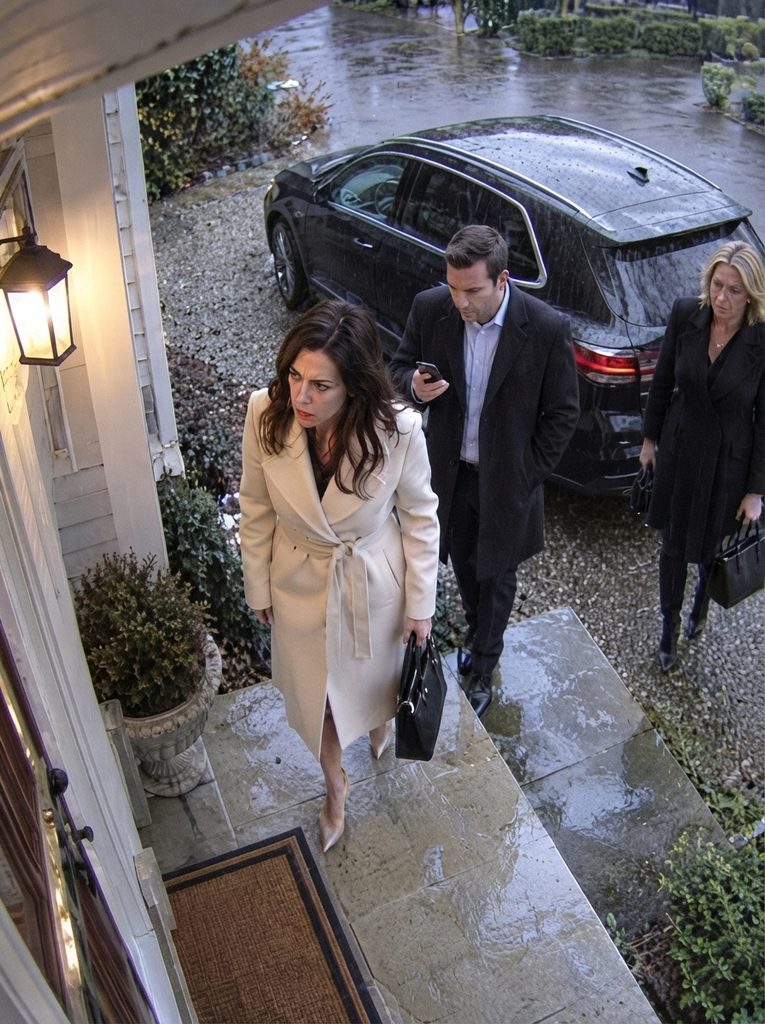
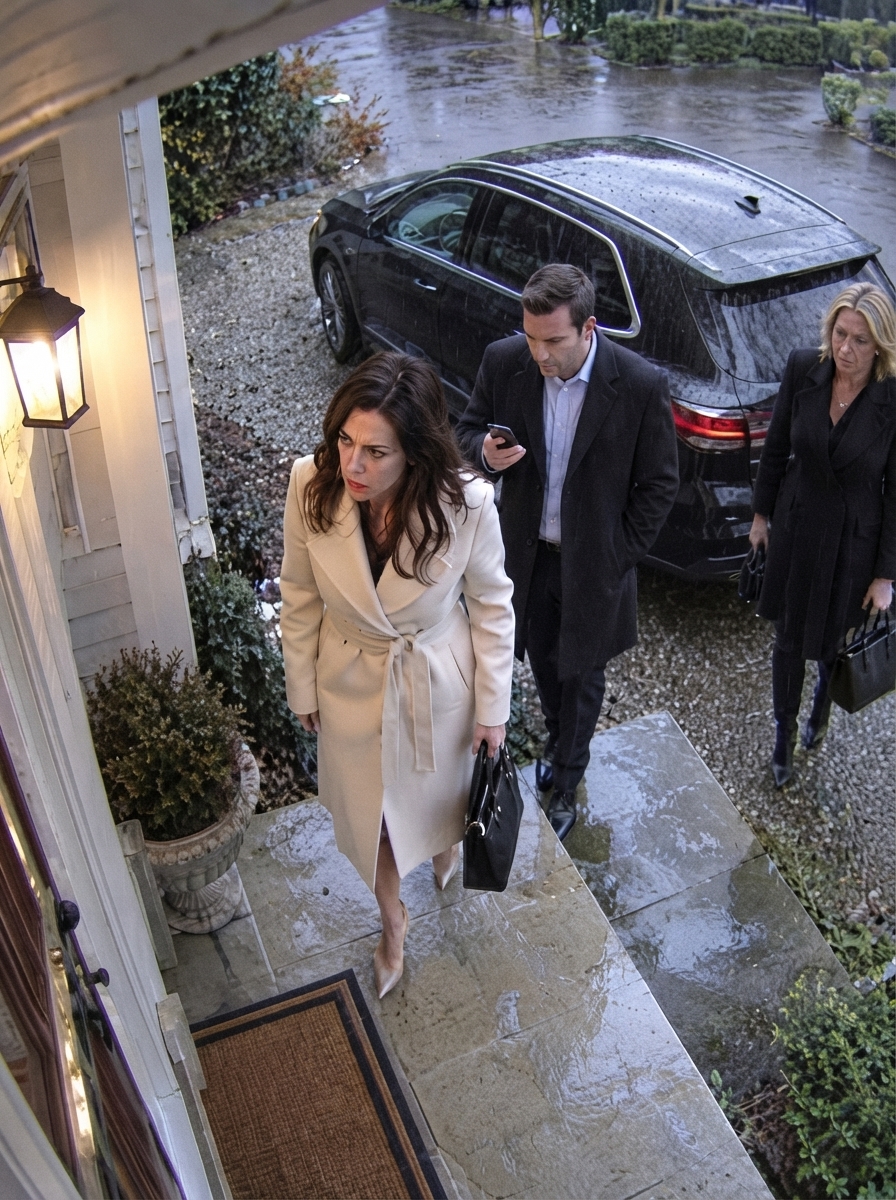
I was reading that last message when a dark SUV pulled into my driveway.
Genevieve climbed out first.
Her cream-colored coat looked immaculate despite the wet gravel.
Benjamin followed, his brown hair disheveled, his phone clenched in one hand.
His face was white.
Then the rear passenger door opened.
A woman stepped out, holding a thick envelope.
It was Serena.
My daughter.
I hadn’t told her anything.
So why was she here?
I opened the front door.
“Serena?”
She looked at me with an expression I hadn’t seen since Thomas was dying.
Fear.
“Mom,” she said, “we need to talk.”
Benjamin stepped forward.
“First, we need to fix what you’ve done to our accounts.”
“Our accounts?”
Genevieve folded her arms.
“Eleanor, your decisions affect other people.”
I looked at her.
“And apparently, so does my presence at dinner.”
Her face tightened.
Benjamin opened his mouth.
But Serena interrupted.
“Mom, don’t sign anything.”
Benjamin turned sharply.
“Serena, we discussed this.”
“No,” she said. “You explained what you wanted me to say. That’s different.”
She handed me the envelope.
It bore the seal of the county court.
I opened it.
The document inside was titled:
**PETITION FOR APPOINTMENT OF CONSERVATOR.**
Beneath those words was my name.
Eleanor Margaret Kelley.
My mouth went dry.
“What is this?”
Serena took my hand.
“Benjamin filed a petition yesterday morning. He’s asking the court to put him in charge of your finances.”
For a moment, I couldn’t understand the words.
“Why?”
Benjamin took a step toward me.
“Mom, you’re not thinking clearly. You’ve been giving away enormous amounts of money. We’re concerned.”
I stared at him.
“Giving it away?”
“Yes.”
“To whom, Benjamin?”
He didn’t answer.
“Tell me who I’ve been giving it to.”
His eyes moved toward Genevieve.
And then I understood.
**My son was using the money I had given him as evidence that I couldn’t manage my own affairs.**
The cruelty of it was almost impossible to comprehend.
For fifteen years, I’d kept his household afloat.
Now he wanted a judge to believe those same payments proved I was incapable of making financial decisions.
“Mom,” Benjamin began, “it’s more complicated than that.”
“No,” Serena said. “It isn’t.”
She removed another document from the envelope.
“This is connected to Hearthstone Family Services.”
My stomach dropped.
The company Clara had questioned.
The paperwork described an arrangement involving Benjamin’s townhouse and my future housing.
It named Benjamin as my designated representative for residential decisions.
At the bottom was a signature.
Eleanor M. Kelley.
It looked almost exactly like mine.
Except for one thing.
**I had never signed that document.**
“I didn’t agree to this.”
Benjamin swallowed.
“Mom, we discussed your future.”
“We discussed having Thanksgiving together.”
“That’s not what I mean.”
“Then what do you mean?”
Serena pointed to a paragraph near the bottom.
“The company has been recording payments for a reserved residential suite.”
“A what?”
“A room in Benjamin’s townhouse. Supposedly reserved for you.”
I looked at my son.
Then at Genevieve.
For months, they’d been taking money connected to a place I had never lived.
A place where I apparently wasn’t even welcome for dinner.
“How much?” I whispered.
Serena glanced at the page.
“Three thousand one hundred fifty dollars a month.”
I gripped the doorway.
The payments had begun in April.
One month after the brochure arrived.
**”For you too.”**
Suddenly, those words sounded very different.
Benjamin tried to take the document.
“Serena, let me explain.”
She moved it out of his reach.
“Explain why her signature is on an agreement she never signed.”
He looked directly at me.
“Mom, we were trying to plan ahead.”
“Plan ahead for what?”
He hesitated.
Genevieve spoke instead.
“For a time when you can’t live independently anymore.”
I looked past her toward the little house Thomas and I had bought forty-one years earlier.
The garden he’d planted.
The kitchen we’d renovated together.
The oak desk.
The mantel.
Every corner held a memory.
I had never expressed a wish to leave.
“Who decided that time was coming?” I asked.
Nobody answered.
Serena touched my shoulder.
“Mom, there’s another page. It describes a proposed sale of your property.”
The words struck harder than the dinner message.
“My house?”
Benjamin looked away.
I felt something inside me settle into a frightening calm.
**”Get off my porch.”**
“Mom—”
“All three of you, please.”
Serena stepped back, startled.
I looked at her.
“Not because I don’t believe you, sweetheart. Because I need to understand this before anyone says another word.”
She nodded.
Benjamin moved closer.
“You’re making a mistake. We could lose everything.”
I held his gaze.
“Then you’ll know how I feel.”
I closed the door.
And locked it.
For several minutes, I stood with my hand against the wood.
Then I called Serena.
“Come back alone.”
She returned twenty minutes later.
We sat at the kitchen table with Thomas’s photograph watching over us.
Serena explained how she’d discovered the petition.
As an interested family member, she’d been notified of the filing.
When Benjamin called that morning asking her to help persuade me to restore the payments, she’d insisted on seeing him.
He had handed her the paperwork in the SUV.
She’d recognized immediately that something was wrong.
“Mom, there are statements in here about you forgetting bills and making irrational purchases.”
I almost laughed.
“Forgetting bills?”
“You’ve been paying everyone else’s.”
She opened another page.
Benjamin’s petition described me as susceptible to financial exploitation.
I looked at the supporting evidence.
There were copies of transfers I’d made to him.
But the explanations beside them had been changed.
Mortgage assistance was described as an unexplained gift.
Preschool tuition became an impulsive disbursement.
Emergency business transfers were presented as evidence of poor financial judgment.
He hadn’t invented the transactions.
**He had stripped away the reasons for them.**
“Could a judge really believe this?” I asked.
“A judge will consider the evidence,” Serena answered. “But Benjamin hasn’t been appointed to anything. You have the right to contest it.”
She reached across the table.
“And you won’t be doing that alone.”
That afternoon, Serena helped me contact Martha Bell, an attorney experienced in elder-law matters.
Martha listened carefully.
Then she said, “Mrs. Kelley, refusing to fund your adult son’s household does not establish that you lack financial capacity.”
Those words brought tears to my eyes.
I hadn’t realized how badly I needed someone to say them.
We arranged an appointment.
Martha asked us to preserve the texts, bank statements, letters, payment instructions, and every document connected to Hearthstone.
She also advised me to secure my accounts, review my credit, and change the locks if Benjamin still had a key.
I did all three.
Wesley drove over that evening.
My eldest son was sixty, with Thomas’s quiet manner and his habit of listening before speaking.
When Serena showed him the petition, he removed his glasses.
“I warned you Benjamin was taking advantage of Mom.”
“I know,” Serena said.
Wesley looked at me.
“I should’ve pushed harder.”
“No,” I told him. “I wouldn’t have listened.”
It hurt to admit that.
For years, Wesley had asked why Benjamin needed so much money.
I’d accused him of jealousy.
Serena had offered to review my finances.
I’d told her not to interfere.
I’d protected Benjamin from criticism because acknowledging his behavior felt like admitting I’d failed as a mother.
But Wesley shook his head.
“Mom, you raised three children. Two of us learned to pay our bills. Benjamin made different choices.”
I began crying.
Not because I disagreed.
Because I finally believed him.
Over the next several days, we learned how much worse the situation had become.
Martha’s office requested records, examined the court filing, and helped me prepare a formal response.
Clara’s fraud department reviewed the questionable banking authorizations.
Serena examined public business filings and property records.
Hearthstone Family Services LLC had been formed shortly before Benjamin purchased the townhouse.
Its organizers were Benjamin and Genevieve.
Their business materials described a small, private senior-living concept offering personalized family care.
At first, I struggled to understand.
They lived in an ordinary townhouse.
They weren’t nurses.
They hadn’t built a senior-care residence.
Yet their promotional materials referred to future residents, residential suites, and plans for expansion.
Then Serena found a presentation prepared for prospective investors.
It contained photographs of the townhouse.
The same white trim.
The same beautifully staged kitchen.
And a picture of an elderly woman sitting in a garden.
Me.
**They had used my photograph without asking permission.**
Beneath it appeared the words:
“Founding resident and family inspiration.”
I stared at the picture.
It had been taken during Lily’s birthday party.
I remembered the moment clearly.
Thomas had loved that garden.
I was smiling because Lily had just put a paper crown on my head.
Now strangers were being shown that photograph as part of a business proposal.
A proposal claiming I was already participating in a care arrangement.
“Is this legal?” I asked Martha.
“That depends on several things,” she replied. “But your lack of consent is extremely important.”
We discovered that the townhouse wasn’t merely Benjamin’s home.
It was also the proposed headquarters of Hearthstone’s business.
And the payments I’d been making weren’t all being used for the ordinary household expenses I’d been told about.
Some had been directed to the company.
The $3,150 monthly charges were described internally as residential reservation fees.
The $6,400 repair Benjamin had requested was associated with improvements to a room intended for the business.
The records raised serious questions about which charges I’d actually authorized.
Martha helped me dispute the suspicious payments.
She was careful not to promise that every dollar would come back.
Some money had been given willingly, even if my reasons for giving it had been manipulated.
Other charges involved potentially forged authorizations and required further investigation.
But the most disturbing discovery was still ahead.
One afternoon, I received a letter from Genevieve.
She wanted to meet.
Without Benjamin.
I nearly threw it away.
Serena encouraged me to let Martha arrange a conversation.
So we met in Martha’s office.
Genevieve arrived wearing a beige blouse and carrying an expensive leather handbag.
For the first time since I’d known her, she looked genuinely tired.
“I never wanted this to get so ugly,” she said.
I looked at her.
“You told my son I wasn’t welcome in his home.”
She lowered her eyes.
“That evening wasn’t supposed to be a family dinner.”
I felt my pulse quicken.
“What was it?”
“A meeting.”
“With whom?”
“Two potential investors.”
I waited.
Genevieve twisted her wedding ring.
“They were considering supporting the expansion.”
“Of Hearthstone?”
She nodded.
“Benjamin had already told them about you.”
“What did he tell them?”
Her silence answered before her words did.
“That you had begun needing assistance. That you would soon be moving into our care.”
I sat perfectly still.
“I live independently.”
“I know.”
“I cook. I drive. I pay my bills.”
“I know, Eleanor.”
“Then why would he tell strangers otherwise?”
Genevieve’s eyes filled.
“Because the business needed a resident to demonstrate the model. Investors wanted evidence that the concept worked.”
I stared at her.
**They had turned my imagined future decline into a sales pitch.**
I thought about the dinner invitation.
The sudden cancellation.
The excuse that Genevieve didn’t want me there.
“Why wasn’t I allowed at dinner?” I asked.
She rubbed her forehead.
“Benjamin was afraid you’d contradict the presentation.”
I leaned back.
“So he lied to me.”
Genevieve looked at the floor.
“And to them.”
I waited for her to apologize.
Instead, she whispered, “We could lose the townhouse.”
I felt my sympathy vanish.
“Genevieve, do you understand what you nearly took from me?”
She began crying.
“We never meant to hurt you.”
I looked her directly in the eyes.
**”You were willing to take away my independence. Whether you intended to hurt me is no longer the important question.”**
Martha ended the meeting shortly afterward.
Outside, Serena waited beside her car.
When she saw my expression, she didn’t ask what had happened.
She simply opened the passenger door.
For once, I was grateful not to have to explain myself.
The weeks that followed were exhausting.
Martha filed our opposition to Benjamin’s petition.
We provided banking records, evidence of my independent finances, and medical information relevant to my ability to manage my affairs.
The questionable signature on the housing agreement was referred for further examination.
Benjamin’s attorney contacted Martha several times.
First came an offer to withdraw the petition if I resumed certain payments temporarily.
I refused.
Then came a proposal for a private family agreement.
I refused that too.
Finally, Benjamin called me himself.
I answered because I wanted to hear his voice without a lawyer between us.
“Mom.”
He sounded like the little boy who used to crawl into my lap after scraping his knees.
“Benjamin.”
“I’m sorry things got out of hand.”
“Things didn’t get out of hand. You filed court papers.”
“I was scared.”
“Of what?”
“Of losing everything.”
I took a breath.
“Why didn’t you simply tell me you couldn’t afford the townhouse?”
He said nothing.
“You could have sold it. You could have changed your lifestyle. You could have come to me and said you needed to start over.”
“It’s not that simple.”
“No,” I replied. “It became complicated when you started lying.”
His voice hardened.
“Do you have any idea what Genevieve and I are facing?”
“Yes. Bills.”
“Mom, please.”
“And I know something about bills, Benjamin. I’ve been paying yours for fifteen years.”
He went quiet.
Then he said the words I had been expecting.
“After everything I’ve done for you—”
I interrupted.
“What exactly have you done for me that entitled you to my home?”
He didn’t answer.
I continued.
“I loved you before you could walk. I loved you when you lost your job. I loved you when you made mistakes.”
My voice began shaking.
“But I will not prove that love by surrendering my right to live as I choose.”
He whispered, “You’re choosing money over your family.”
“No, Benjamin.”
I wiped my eyes.
**”I’m choosing to remain a person inside my family.”**
I ended the call.
For the first time, I didn’t feel guilty afterward.
The court hearing took place several weeks later.
I wore my navy-blue dress.
The same one I’d chosen for dinner.
I also wore Thomas’s pearl earrings.
Serena sat beside me.
Wesley sat behind us.
Benjamin was across the room with his attorney.
Genevieve sat several chairs away from him.
When I was asked about the financial support I’d provided, I answered plainly.
Yes, I’d given Benjamin money.
Yes, the amounts had become excessive.
Yes, I had sometimes made decisions out of guilt or fear of disappointing him.
But I understood what those decisions meant.
I could explain the accounts.
I could identify the expenses.
I could describe the support I’d provided and why.
And I’d independently decided to stop.
Martha introduced the disputed business records and the evidence concerning the forged housing agreement.
She also presented the original text messages.
The judge examined the documents carefully.
Benjamin’s attorney attempted to portray my sudden cancellation of payments as impulsive.
But Martha pointed out that I had consulted the bank, preserved records, and sought professional advice.
**My decision had been deliberate, documented, and financially rational.**
By then, Benjamin’s attorney had indicated that his client would not continue pursuing the conservatorship petition.
After reviewing the submissions and hearing the parties, the court dismissed the matter.
The judge made clear that adult children do not gain control of a parent’s finances simply because they disagree with the parent’s decisions.
The dismissal did not resolve the separate questions about financial misconduct.
Those remained under investigation.
But my independence was no longer being challenged in that proceeding.
Outside the courthouse, I stood on the steps beneath a bright autumn sky.
Serena hugged me.
Wesley kissed my forehead.
I should have felt victorious.
Instead, I felt tired.
Because Benjamin was still my son.
And love doesn’t disappear just because trust has been destroyed.
A few days later, Martha called with an update.
The financial investigation had identified additional suspicious company transactions.
Records suggested that some authorization documents had been created using copies of signatures from older family paperwork.
The bank was reviewing which disputed debits qualified for reimbursement.
Other questions had been referred to the appropriate investigators.
I didn’t know whether Benjamin or Genevieve would face criminal charges.
I didn’t know how much money, if any, I might recover.
And I didn’t pretend that a court dismissal could repair our family.
But I knew this.
**There would be no more open access to my accounts.**
I updated my estate documents.
I appointed Serena and Wesley to serve in appropriate financial roles if I ever genuinely needed help, with professional oversight and safeguards.
I arranged my affairs so Lily could benefit from a separate educational gift without giving Benjamin control over it.
And I made one decision that surprised everyone.
I signed up for a spring trip to Charleston.
Thomas and I had always wanted to visit the gardens there.
For years, I’d said I couldn’t afford it.
Apparently, I could.
What I couldn’t afford was continuing to finance everyone else’s dreams while abandoning my own.
Then, just when I thought the worst discoveries were behind me, Serena arrived with another envelope.
“Mom, Martha wanted you to see this.”
Inside was a copy of an investor presentation that had been recovered during the financial review.
I’d seen the photographs before.
The townhouse.
The beautiful kitchen.
My picture from Lily’s birthday.
But this version contained pages that had not appeared in the earlier materials.
They described a second property.
A future expansion site.
I recognized the address immediately.
My house.
The home Thomas and I had bought forty-one years earlier.
The property where our children had learned to ride bicycles.
Where we had celebrated birthdays and Christmas mornings.
Where I’d held Thomas’s hand through his final weeks.
Benjamin had included it in a proposed business expansion plan.
Not as a possibility to discuss with me.
Not as a dream that required my consent.
But as a target property to acquire after he obtained control of my financial affairs.
The projected purchase financing depended on the conservatorship proceeding succeeding and on obtaining the necessary authority for the transaction.
Beside my address was a proposed relocation schedule.
Serena was crying.
“Mom, there’s more.”
She turned to the final page.
There, in a table of business risks, were the words:
**”Existing occupant may resist relocation.”**
I read them twice.
Existing occupant.
They meant me.
Not mother.
Not Eleanor.
Not the woman whose savings had supported their lives.
**An obstacle to be removed from a property they wanted.**
For a moment, I couldn’t speak.
Then I remembered the townhouse brochure.
“For you too.”
I’d imagined it meant there would always be a place for me in Benjamin’s life.
Now I understood the crueler possibility.
It had helped make the plan sound like a family arrangement.
Move Mother into the townhouse.
Present her as a care resident.
Use the business to collect fees.
And, if they succeeded in obtaining the legal authority they wanted, pursue the sale of her home to finance their expansion.
They weren’t simply asking me to help pay for their future.
**They had put my own home into their future business plan without asking me.**
That was the final betrayal.
Not the dinner.
Not the money.
Not even the forged agreement.
It was discovering that my son had stopped seeing me as the owner of my life.
To him, I had become a financial problem with a house attached.
I carried the documents to the mantel.
Thomas’s photograph stood beside the chrysanthemums.
I picked it up.
“I should have listened to you,” I whispered.
I remembered a conversation we’d had shortly before his illness worsened.
Benjamin had asked for another substantial transfer.
Thomas had said, “Ellie, we have to help him learn to stand.”
I’d argued that our son was struggling.
Thomas had taken my hand.
**”Helping him stand doesn’t mean letting him climb onto your shoulders forever.”**
At the time, I’d thought he was being too harsh.
Now I wished I’d understood.
I placed his picture back on the mantel.
Then I called Martha and asked her to preserve the newly discovered material for the ongoing investigations.
I wasn’t going to hide Benjamin’s actions to spare him embarrassment.
Not anymore.
Winter arrived slowly that year.
The chrysanthemums faded.
The trees grew bare.
And the house became quieter.
Benjamin stopped calling after Martha instructed him to direct communications about the dispute through his attorney.
Genevieve sent one more letter.
I didn’t answer.
Their townhouse business plans collapsed when the financial questions and legal dispute disrupted their proposed funding.
The details of their debts remained their responsibility.
For the first time in fifteen years, they were facing consequences I wasn’t paying to erase.
But Lily was innocent.
That mattered to me.
Through a carefully arranged family visit, I saw her again before Christmas.
Serena was there, and the visit had been agreed upon in advance.
Lily ran across the room the moment she saw me.
“Grandma!”
She wrapped her arms around my waist.
I held her tightly.
Then she stepped back and looked at me with serious little eyes.
“Why didn’t you come to dinner?”
The question broke my heart.
I knelt carefully.
“Sometimes grown-ups make mistakes, sweetheart.”
“Did I do something wrong?”
“Oh, Lily. Never.”
I hugged her again.
“Nothing that happened was because of you.”
She reached into her backpack.
“I saved this.”
It was a small folded piece of paper.
Inside, she’d drawn a long dining table with five stick figures.
Grandma.
Daddy.
Mommy.
Lily.
And an empty chair beside Grandma.
At the top, in uneven letters, she’d written:
**”GRANDMA’S PLACE.”**
I stared at the drawing.
She’d made a place for me.
A child who knew nothing about bank accounts, court petitions, or expensive townhouses had understood something the adults had forgotten.
Love isn’t a financial arrangement.
It’s making room.
I kissed the top of her head.
“Thank you, sweetheart.”
That evening, after Lily left, I put her drawing beside Thomas’s photograph.
I removed the townhouse brochure from the mantel.
I no longer needed it.
The following spring, I traveled to Charleston.
I walked through gardens filled with camellias and azaleas.
I visited old houses and ate seafood beside the water.
One afternoon, I sat alone on a bench beneath a flowering tree.
I thought about Thomas.
About Benjamin.
About all the years I’d spent confusing sacrifice with love.
I still loved my son.
Perhaps I always would.
But I no longer believed that love required me to surrender my dignity.
I had lost money.
I had lost trust.
And I had lost the comforting illusion that my youngest son would never deliberately hurt me.
But I hadn’t lost my home.
I hadn’t lost my independence.
And I hadn’t lost the chance to spend the rest of my life as something more than a source of money for other people.
When I returned, I framed Lily’s drawing.
It hangs beside Thomas’s photograph.
Sometimes visitors ask why I keep a child’s crooked picture in such an important place.
I tell them it’s the most valuable gift I’ve received in years.
Because the townhouse brochure had promised me a place that wasn’t really mine.
Lily’s drawing gave me something far more meaningful.
A place in someone’s heart.
And it cost nothing.
At seventy-seven, I finally understood what Thomas had meant when he said money should give you choices.
**I could love Benjamin without financing him.**
**I could forgive without surrendering my boundaries.**
**And I could grow old without allowing anyone to turn my age into an excuse to take away my voice.**
The night Benjamin told me I wasn’t invited, I thought I’d lost my place in the family.
But I hadn’t.
I had simply stopped paying for a seat at the wrong table.
And the home he had already planned to take from me?
I’m writing this story from its kitchen.
The same kitchen where I received those two terrible messages.
The same kitchen where I made the phone call that changed everything.
Outside, the chrysanthemums are blooming again.
Thomas’s photograph rests on the mantel.
And beside it is a small framed drawing of a dining table, made by a little girl who never needed a bank statement to know that her grandmother belonged.
**My son had tried to take control of my future.**
**Instead, he taught me that I still had one worth protecting.**