Alexander hired people with credentials thick enough to fill folders.
Dallas child trauma specialists.
New York therapists.
Private nannies who had worked for families whose Christmas cards arrived on embossed paper.
They all arrived with clean uniforms, soft voices, and practiced confidence.
They all left.
Some left humiliated.
Some left bruised.
The last one left bleeding.
By 3:18 that same afternoon, Emily Carter stepped through the service entrance carrying two canvas bags and a hospital bill folded small inside her purse.
She was twenty-two years old.
She was not trained to handle traumatized children.
She had never worked inside a house with armed security before.
She had taken the job because her little brother needed heart surgery, and the debt had already climbed past $12,000.
Every call from the billing office made her stomach knot before she even answered.
She came from the edge of Fort Worth, from a neighborhood where nobody replaced a washing machine until it quit completely and nobody threw out leftovers unless they had gone bad twice.
Her mother had once worked nights cleaning offices and still managed to hum old songs while folding towels at midnight.
Emily had learned early that care did not always look soft.
Sometimes it looked like packing lunches when the electricity was almost due.
Sometimes it looked like saying, “I’m fine,” because the younger child in the house needed to believe somebody was.
Mrs. Evelyn, the head housekeeper, met Emily near the laundry room with a clipboard against her chest.
She had silver hair pulled into a severe bun and the stiff calm of a woman who had spent years making other people afraid to question her.
“You clean quietly here,” Evelyn said.
Emily nodded.
“You don’t ask questions.”
Emily nodded again.
“You don’t look Mr. Blackwood in the eye.”
Emily’s fingers tightened around the mop handle.
“And you never enter the north wing.”
That final rule did not sound like a workplace policy.
It sounded like a warning.
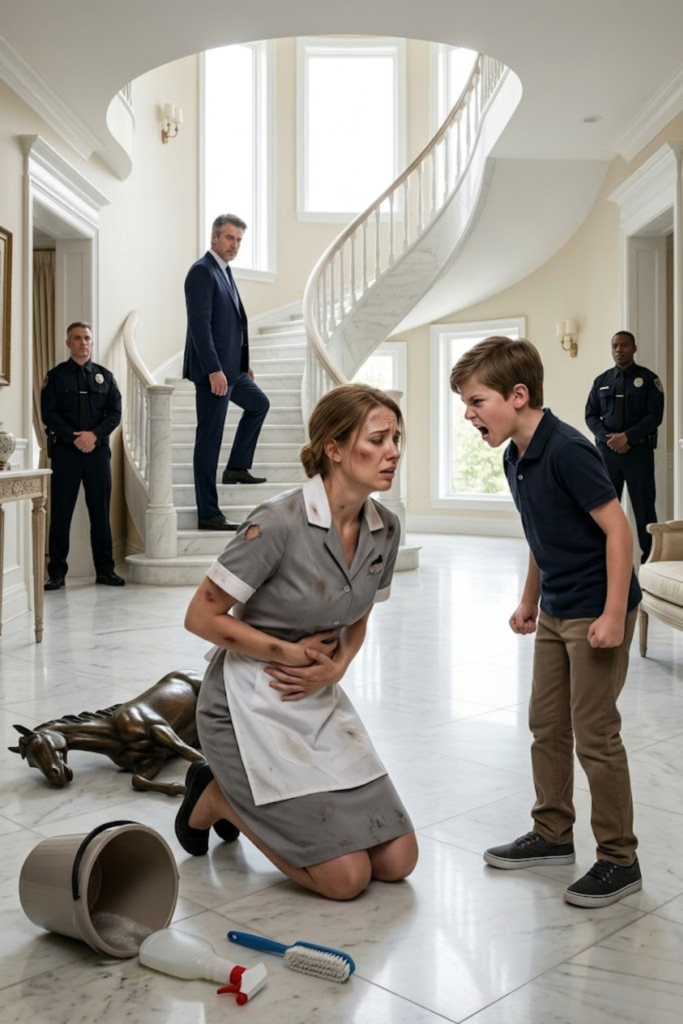
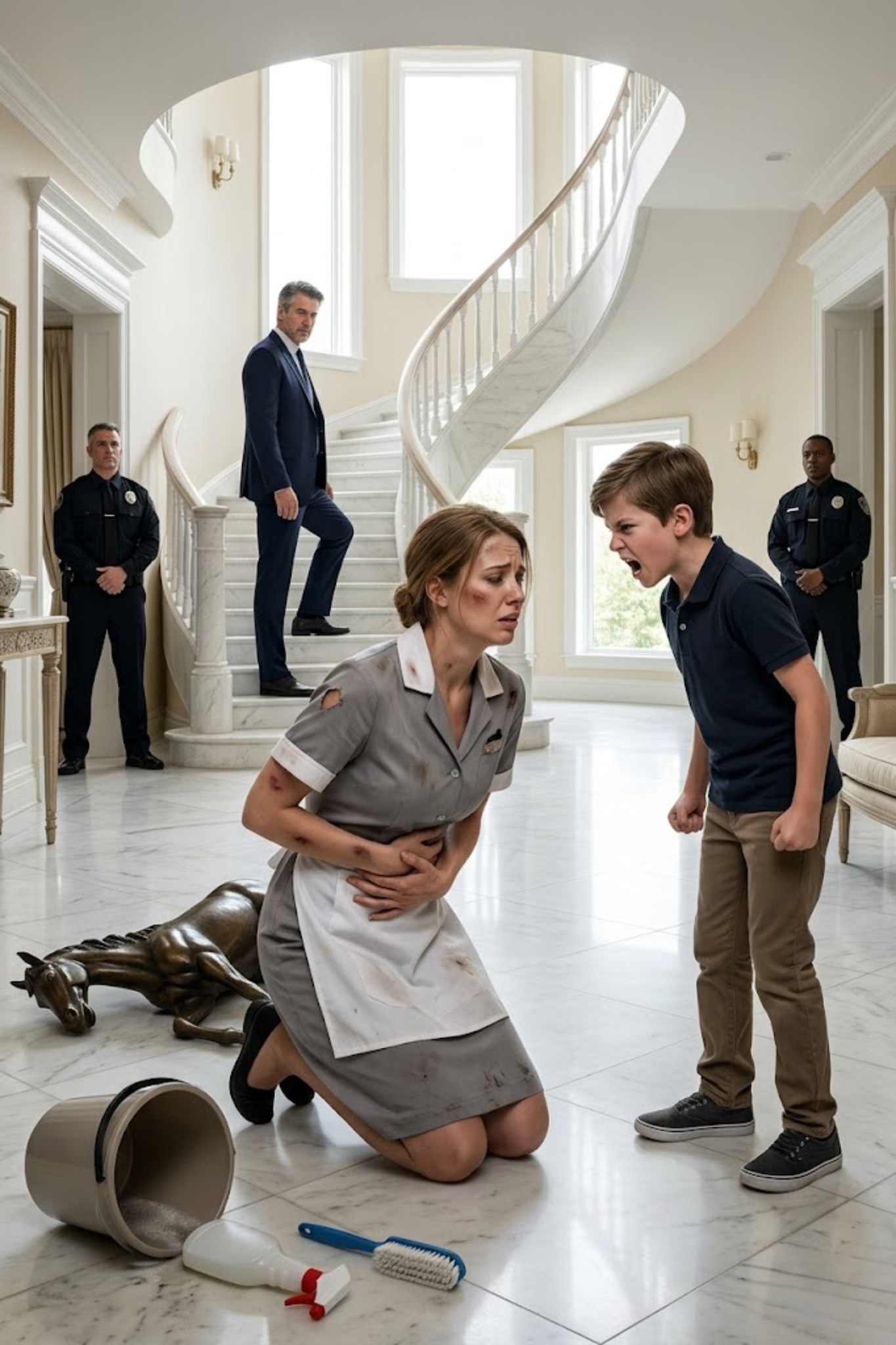
At 3:42, Emily was wiping a mahogany table in the main foyer.
The air smelled like lemon polish, cold water, and expensive emptiness.
Her shoes squeaked softly against the marble, and somewhere above her, the chandelier made the floor glitter like broken ice.
Then a scream came from the hallway.
It was not a child asking for attention.
It was wild.
Raw.
The kind of sound that makes adults stop pretending they are in control.
Mason Blackwood ran into the foyer clutching a bronze horse statue in both hands.
It was heavy, decorative, and far too reachable.
One guard turned.
Another said, “Mason, no.”
They were too late.
The statue struck Emily in the ribs with a dull, sickening thud.
For one second, she could not inhale.
Then her knees hit the floor.
The mop bucket tipped over beside her, and water spread across the marble in a bright, widening sheet.
“Mason!” Alexander roared from the staircase. “Stop!”
The boy did not stop.
He rushed at Emily and kicked her legs again and again with a fury that looked impossible inside such a small body.
The guards froze because nobody wanted to be the man who put hands on Alexander Blackwood’s son.
Mrs. Evelyn stood at the hall entrance with her clipboard held too tightly.
Alexander came down two steps, then stopped.
Everyone waited for Emily to do what everyone else had done.
Scream.
Shove him.
Quit.
Call him dangerous.
Call him ruined.
Instead, Emily pressed one hand to her ribs and slowly lowered herself until her eyes were level with Mason’s.
“That hurt a lot,” she said.
Her voice was thin from pain, but it did not shake.
“The hit hurt. The kicks hurt too.”
Mason stood over her with his fists curled.
His face was red.
His chest pumped like he had run for miles.
Emily touched her own heart.
“For someone carrying that much fire in here,” she whispered, “you must be holding something very heavy.”
The foyer went still.
One guard’s hand stayed halfway to his radio.
The mop water kept spreading under the table.
A drop fell from the edge of the bucket and clicked against the marble.
Nobody moved.
Alexander stared at Emily as if she had spoken a language he had forgotten existed.
Mason lifted his fist again.
Emily did not lean back.
“You can hit me a hundred more times if you think it will put out what’s burning inside you,” she said softly. “But I’m not going to run from you.”
Mason’s fist hovered in the air.
His lower lip trembled.
The anger on his face changed shape.
It became terror.
Then the boy stumbled forward, crashed against Emily’s chest, and wrapped both arms around her neck.
Emily made one small sound from the pain in her ribs, but she did not push him away.
She held him carefully.
Not too tight.
Not too loose.
The way someone holds a frightened animal that has only learned teeth because nobody taught it hands could be safe.
Alexander’s whiskey glass slipped from his fingers.
It hit the floor and shattered.
The sound cracked through the foyer, but Mason did not pull away from Emily.
Then Mrs. Evelyn stepped forward.
“Separate them,” she ordered.
The change in Mason was instant.
His entire body locked.
His fingers dug into Emily’s uniform.
His face disappeared against her shoulder.
Emily felt it before she understood it.
That was not rage.
That was fear.
Alexander saw it too.
“Nobody touches them,” he said.
Mrs. Evelyn’s mouth tightened.
For a moment, she looked less like a housekeeper and more like someone who had almost lost control of a secret.
Mason cried until he fell asleep against Emily’s shoulder.
Not screaming.
Not thrashing.
Just crying with the exhausted, broken sound of a child who had been trapped inside his own body for too long.
That night, Alexander made a decision.
Emily would no longer clean floors.
She would stay close to Mason.
Mrs. Evelyn objected immediately.
“She has no training,” she said. “She has no credentials. That boy is dangerous.”
Alexander looked at her.
“Eighteen trained women ran from him,” he said. “She was the first one who didn’t call him a monster.”
Emily accepted because she needed the money.
But money was not the only reason she stayed.
When she carried Mason upstairs, she noticed things nobody had mentioned.
Family portraits turned toward the wall.
A hallway camera with a red light blinking near the north wing.
A locked door that looked too ordinary for the way everyone avoided it.
A child learns fear before he learns words.
Sometimes silence is not emptiness.
Sometimes it is the only locked room left.
They gave Emily a small room near Mason’s suite.
At 9:06 p.m., she tucked him into bed.
His sheets were white, his pajamas soft, his room full of toys that looked untouched.
The shelves held wooden trains, stuffed animals, picture books, and a model fire truck with one wheel missing.
Mason reached for Emily’s sleeve before she could step back.
He gripped it in both hands and refused to let go.
So Emily sat down beside his bed.
Her ribs throbbed each time she breathed.
She sang the only song that came to her, an old tune her mother used to hum when rain hit the roof of their tiny house and bills sat unopened on the kitchen counter.
Her voice was not perfect.
It was low and tired and real.
Mason’s eyelids lowered.
Then Alexander spoke from the doorway.
“Camila used to sing something like that.”
Mason’s eyes flew open.
He turned his face to the wall.
The name had landed in the room like a stone dropped into still water.
Emily looked at Alexander.
His face had gone hard in the way people’s faces go hard when softness would destroy them.
“Maybe the problem isn’t that he remembers her,” Emily said. “Maybe the problem is that everyone here pretends she never existed.”
Alexander’s jaw tightened.
“In this house,” he said, “we don’t talk about that day.”
Mason began trembling under the blanket.
Emily felt the bed shift with it.
She put one hand near him, not on him.
“I’m here,” she whispered.
Then Mason spoke.
One word.
So small it almost disappeared into the hum of the air vent.
“Door.”
Emily stopped breathing.
Alexander went still.
For two years, his son had not spoken.
Not to doctors.
Not to his father.
Not in nightmares.
And the first word he gave them was not Mommy.
Not Daddy.
Not help.
Door.
Emily turned slowly toward the north wing.
At the end of the hall, beyond the bedroom doorway, that locked corridor waited under a line of soft wall lights.
Mrs. Evelyn appeared so quietly that Emily wondered how long she had been there.
“No,” Evelyn said.
The word was too fast.
Too sharp.
Alexander’s eyes shifted to her.
“Why not?” he asked.
Evelyn swallowed.
The clipboard she always carried was gone.
Without it, her hands looked older.
Mason reached beneath his pillow with trembling fingers.
Emily thought he was reaching for a toy.
Instead, he pulled out a small torn piece of a photograph.
It had been folded and unfolded so many times the edges were soft.
Only part of the picture remained.
A woman’s hand.
A white sleeve.
A sliver of dark wood behind her.
Emily looked at the hallway again.
The wood in the photograph matched the locked north-wing door.
Alexander took one step forward.
“Where did he get that?” he asked.
Evelyn said nothing.
Mason pressed his face into Emily’s shoulder.
His little body shook so hard the torn photograph fluttered in Emily’s fingers.
Alexander walked to the door.
For all his reputation, for all the fear his name carried outside that house, his hand hesitated on the brass knob.
Emily saw then that he was not only angry.
He was afraid.
The door was locked.
“Key,” Alexander said.
Evelyn’s lips parted.
“No one has gone in there since the night Mrs. Blackwood died.”
“That is not what I asked.”
The hallway felt too bright.
Too quiet.
One guard looked at the floor.
Another kept his eyes on the security camera, as if the little red light might explain what none of the adults wanted to say.
Evelyn reached into the pocket of her black skirt.
Her fingers shook when she pulled out a key.
That was when Alexander’s expression changed.
Not with surprise.
With recognition.
He had not known she still had it.
Emily held Mason tighter.
Evelyn handed over the key.
Alexander unlocked the north-wing door.
The room beyond smelled stale, like closed curtains and old perfume.
For a moment nobody moved.
Then the door opened fully.
It was Camila’s sitting room.
Everything had been preserved and disturbed at the same time.
A cream chair sat near the window.
A scarf lay folded over the arm as if someone had placed it there carefully.
On the desk were old sympathy cards, a dried rose in a glass vase, and a framed family photo turned face down.
But the rug was wrong.
It had been shifted.
Emily noticed because her mother had cleaned houses, and Emily knew the shape dust made around furniture that had not moved in years.
Alexander noticed the safe behind the desk.
He looked at Evelyn.
She whispered, “Please.”
That one word told him enough.
He opened the safe himself.
Inside were documents, a small recorder, and an envelope marked in Camila’s handwriting.
The name on the front was Mason.
Alexander’s hand faltered.
Emily looked down at the boy.
His eyes were open.
He was staring at the envelope like he had seen it before.
Alexander opened it.
Inside was a letter, a flash drive, and a second photograph.
This one had not been torn.
Camila stood near the north-wing door in the same white sleeve from Mason’s scrap.
Behind her, reflected in the dark glass of the window, was Evelyn.
And Evelyn was not helping her.
She was holding the door shut.
Alexander read the letter once without speaking.
Then again.
The silence in the room changed with each line.
Emily could not see the words, but she saw the way Alexander’s face lost its color.
Camila had been afraid before the ambush.
She had written that someone inside the house was feeding information to men outside it.
She had written that Mason had seen too much.
She had written that if anything happened, Alexander should not let them make grief look like madness.
Grief had covered the house for two years.
But grief had also been useful.
It had kept Alexander from asking questions.
It had kept Mason silent.
It had kept Evelyn in charge.
Alexander turned to her.
“You told me he was making things up,” he said.
Evelyn’s eyes filled, but not with innocence.
“With everything happening, he was confused,” she whispered.
Mason made a small sound against Emily’s shoulder.
Not a scream.
Not a cry.
A refusal.
Emily looked down at him.
His lips moved again.
“Bad door,” he whispered.
Alexander closed his eyes.
For a man who had spent his life making others afraid, there is no punishment crueler than realizing fear had been living in your child’s room while you stood guard at the wrong gates.
He did not shout.
That was what made the room colder.
He told one guard to call the police.
He told another to bring every security archive from the night Camila died.
He told the house manager to pull every staff log, every visitor list, every hallway camera record, every maintenance order attached to the north wing.
Process began where silence had been.
Files were gathered.
Footage was copied.
Locks were changed before midnight.
Evelyn sat in a chair near the wall with her hands folded and her face emptied of all authority.
Emily stayed on the floor with Mason because he would not let go.
At 11:37 p.m., an officer took Alexander’s statement in the downstairs study.
At 12:14 a.m., a second officer asked Emily what she had witnessed in the hallway.
At 12:29, Mason fell asleep with the torn photograph still near his hand.
The house did not heal that night.
Real houses do not heal because one secret is named.
They creak afterward.
They show you which boards were rotten.
They make you walk carefully until morning.
But something changed.
The next day, Alexander did not say Camila’s name like it was forbidden.
He said it at breakfast.
He said it when Mason looked toward the empty chair.
He said it when Emily placed a small bowl of cereal on the table and waited to see if Mason would push it away.
“Your mother loved that song,” Alexander told him.
Mason stared at the spoon.
Then, very slowly, he picked it up.
Emily did not clap.
She did not make a big scene.
She only slid a napkin closer, as if ordinary things deserved to be ordinary again.
Over the next week, the mansion became less quiet and more honest.
Not peaceful.
Honest.
The police returned twice.
A child trauma specialist came back, but this time Emily sat in the room because Mason kept one hand on her sleeve.
Alexander gave investigators the archived security files and signed statements that should have been requested two years earlier.
He also found the hospital intake note from the night of Camila’s death, the one that mentioned Mason repeating a sound nobody had understood because he had stopped speaking by morning.
It had sounded like “door.”
Nobody had listened then.
Emily listened now.
That was the difference.
Mason did not become an easy child overnight.
He still woke screaming.
He still flinched when shoes clicked too sharply on marble.
He still hid under the desk when strangers raised their voices.
But after the north-wing door opened, his fear had somewhere to point.
That mattered.
A month later, Emily’s brother had surgery.
Alexander paid the remaining hospital balance without making a speech about it.
Emily tried to refuse.
He slid the receipt across the kitchen table and said, “You kept my son alive before any of us understood he was asking to be saved.”
Emily looked at the paper.
For years, she had known what it felt like to owe money.
That day, she learned what it felt like to have someone pay a debt without making it a leash.
She stayed at the mansion after that, not as a maid and not as a replacement mother.
She stayed as the first safe person Mason had chosen for himself.
In time, Mason spoke more.
Small words first.
Water.
Light.
Song.
Then Mommy.
The first time he said it, Alexander turned away from the breakfast table and gripped the counter until his knuckles went white.
Emily pretended not to see.
Care sometimes means giving someone the dignity of not being watched while they break.
The north wing was not sealed again.
Camila’s sitting room became a room with open curtains, fresh air, and a small table where Mason could draw.
The torn photograph was placed in a frame beside the whole one.
Alexander kept the letter locked away, but not hidden.
There is a difference.
Mrs. Evelyn never returned to the house.
What happened to her after the investigation moved beyond staff logs and into old phone records was handled by people with badges and folders, not by whispers in marble halls.
Emily did not ask for every detail.
She had learned enough.
The housekeeper who had entered through the service door with a mop and a hospital bill had not fixed a broken child.
That was never what Mason was.
She had knelt in front of his fire and refused to mistake it for evil.
She had listened when everyone else had labeled.
She had heard one word and understood it was not nonsense.
It was a map.
Door.
The first word Mason Blackwood spoke in two years did not solve everything.
But it opened the room where the truth had been waiting.
And after that, nobody in the Blackwood mansion was allowed to pretend silence meant nothing was wrong.